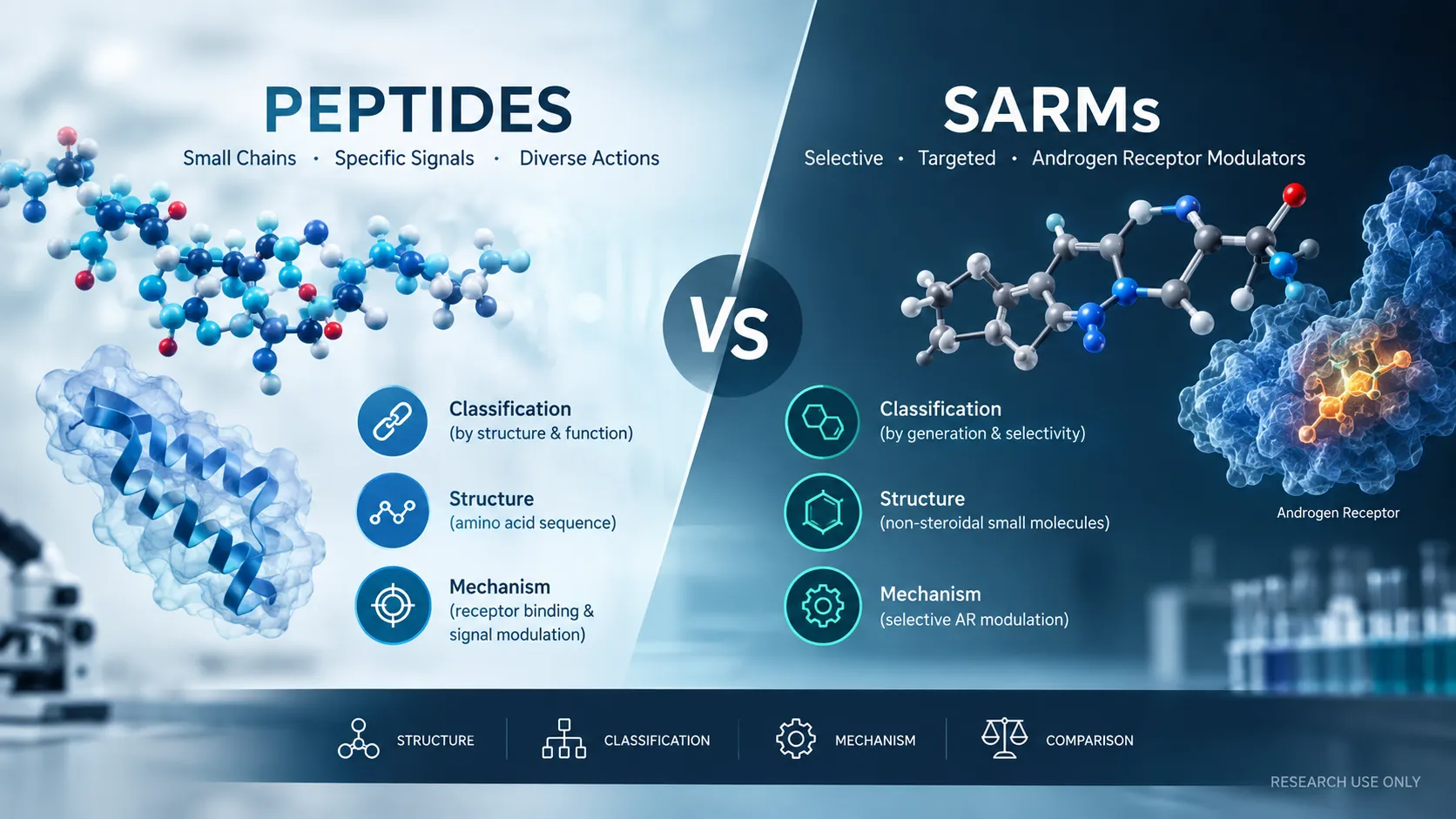
SARMs are not peptides: they contain no amino acids and no peptide bonds.
A peptide is a chain of amino acids, typically two to fifty, joined by peptide bonds; chains of fifty-one or more are polypeptides.
"Peptide" is a structural term describing composition, while "SARM" is a pharmacological term describing intended receptor activity, so the two labels answer different questions.
There is no single peptide mechanism of action, because peptide targets span unrelated receptor families including class A and class B GPCRs and receptor tyrosine kinases.
The androgen receptor is an intracellular nuclear receptor, so SARM ligands act in a different cellular compartment from most peptide signalling, which occurs at the cell surface.
"Selective" in SARM refers to a proposed tissue-differentiated pharmacological profile, not to chemical structure, and a 2025 critical appraisal reports that clinically meaningful selectivity remains unclear.
Peptides and SARMs are grouped together commercially rather than chemically, and regulatory status is independent of chemical class: peptide drugs are approved by the FDA every year, while no SARM holds FDA approval for any indication.
A 2017 JAMA analysis of 44 products sold online as SARMs found that only 23 of them, 52 percent, contained a SARM, and compounds such as ibutamoren are commonly sold as SARMs despite acting at entirely different targets.
Search for either term and the other turns up beside it. Online catalogues file peptides and SARMs under one "research chemicals" heading, the same forums discuss them in the same threads, and most comparison pages treat them as two options inside a single decision. None of that reflects a chemical relationship. What follows is the classification, the structural difference, the mechanistic difference and the regulatory position — and, at the end, what none of it establishes.
The short answer
No, SARMs are not peptides. A peptide is a chain of amino acids joined by peptide bonds. A SARM — selective androgen receptor modulator — is a synthetic small molecule that contains no amino acids and no peptide bonds, developed to act at the androgen receptor. They are separate chemical classes with separate design histories. They appear together because they are sold and discussed together, not because chemistry places them near each other.
There is a deeper reason the comparison sits badly, and it is worth stating before anything else. The two words do not describe the same kind of property. Peptide is a structural term: it says what a molecule is built from and nothing about what it does. SARM is a pharmacological term: it says what a molecule is meant to do at one receptor and comparatively little about how it is built. So the two labels are not rival answers to one question. They are answers to different questions that happen to get asked in the same sentence.
Synthetic non-steroidal small molecules (as originally defined)
Basic structure
Repeating amino-acid backbone with a defined sequence and two termini
A single covalent scaffold with no repeating unit and no sequence
Peptide bonds
Present by definition
Absent
Typical target
Varies by molecule; most act at cell-surface receptors
The androgen receptor, an intracellular nuclear receptor
Mechanistic diversity
Very high — no shared mechanism across the class
Low at the target level; all bind one receptor
FDA-approved members
Yes, many, across several decades
None, for any indication
Peptides are defined by the bond, not by origin
The National Human Genome Research Institute defines a peptide as a short chain of amino acids, typically two to fifty, joined by chemical bonds called peptide bonds, with chains of fifty-one or more described as polypeptides. A peptide bond is the amide linkage formed between the carboxyl group of one amino acid and the amino group of the next, with the loss of a water molecule.
Two consequences follow, and both are routinely missed in vendor-side writing.
The definition is structural, so origin is irrelevant. A peptide assembled entirely by solid-phase synthesis is as much a peptide as one purified from tissue. "Synthetic" and "peptide" are not opposites, which is why calling SARMs synthetic does nothing to distinguish them — most research peptides are synthetic too. The distinction is the backbone, not the factory.
The definition also excludes a great many compounds that are sold beside peptides. A quinolinium small molecule is not a peptide, which is the argument made in detail in the article on why 5-Amino-1MQ is not a peptide. A C19 steroid is not a peptide either, as set out in the article on DHEA and adrenal steroidogenesis. SARMs join that list for the same reason those two do: no amino acids, no peptide bonds, no chain.
SARMs are defined by the target, not by a shared scaffold
The SARM concept came out of an effort to get anabolic activity from something other than a modified steroid nucleus. The pharmacology literature describes the class as having deliberately moved to non-steroidal chemistry — quinolinones, arylpropionamides, indole derivatives and related scaffolds — precisely to escape the constraints of the steroid ring system.
That history explains the structural situation now. SARMs do not share a backbone with each other the way peptides do. Ostarine, LGD-4033 and RAD-140 are not variations on one chemical chassis; they are separate small molecules that happen to have been selected for activity at the same receptor. Each is a single covalently assembled structure: no repeating unit, no residue sequence, no N-terminus or C-terminus. Nothing on a SARM specification sheet corresponds to the sequence row on a peptide certificate, because there is no sequence to report.
One precision point is worth making here, since it is where careless writing goes wrong. Several SARM scaffolds do contain amide bonds — the arylpropionamides are named for one. An amide bond only counts as a peptide bond when it joins two amino acid residues within a chain. The presence of an amide group in a molecule says nothing about whether that molecule is a peptide.
A practical version of the same test: peptides have a sequence, small molecules have a structure. If a compound can be written as a string of three-letter residue codes, it is a peptide. If its identity can only be given as a structural formula or an IUPAC name, it is not.
Mechanism: many peptide pathways, one SARM target
There is no single peptide mechanism
The most common error in comparison content is treating "how peptides work" as a question with one answer. It does not have one. Peptides act through whichever receptor or target the individual molecule engages, and those targets sit in entirely different protein families.
Peptide example
Target
Receptor family
GHRH analogues
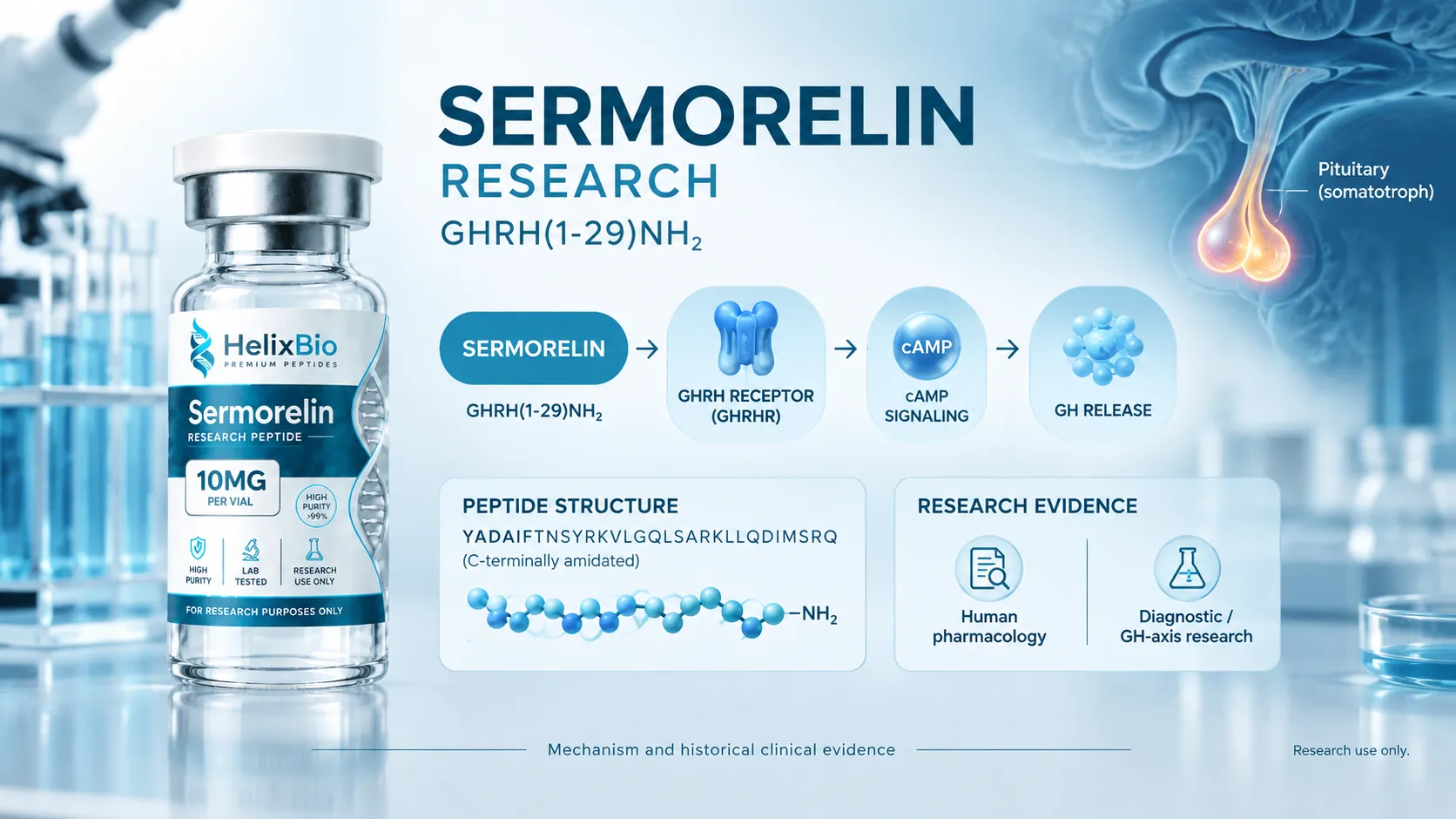
GHRH receptor
Class B G-protein-coupled receptor
Growth hormone releasing peptides
GHS-R1a
Class A G-protein-coupled receptor
GLP-1 analogues
GLP-1 receptor
Class B G-protein-coupled receptor
Insulin
Insulin receptor
Receptor tyrosine kinase
LL-37
Microbial membranes and nucleic-acid complexes
No single classical receptor
Those five entries do not even share a receptor superfamily. Two closely related peptide classes can still diverge sharply at the receptor, which is the subject of the comparison of GHRH analogues and GHRPs; and a peptide like the human cathelicidin covered in the LL-37 mechanism article works substantially through direct membrane interaction rather than a receptor at all. The useful question is never what peptides do. It is what this peptide does.
SARMs converge on one nuclear receptor
SARM mechanism is described more narrowly, because the class was defined by its target. The androgen receptor is a ligand-activated transcription factor held in an inactive complex with heat-shock proteins and corepressors. Ligand binding changes receptor conformation, the receptor dimerises and moves into the nucleus, binds androgen response elements on target gene promoters, recruits coactivators, and transcription follows.
That is a categorically different kind of mechanism from most peptide signalling, and the difference is physical rather than semantic. A nuclear receptor sits inside the cell, so its ligands have to cross the plasma membrane to reach it. Peptides generally do not cross membranes unaided, which is a large part of why peptide targets tend to be on the cell surface. The two classes are not working at different points along one pathway; they are working in different compartments of the cell.
What "selective" actually refers to
The S in SARM is the most misread letter in the acronym. It does not mean chemically selective, structurally distinctive, or in any way peptide-like. It refers to a proposed tissue-differentiated pharmacological profile: greater activation of androgen-receptor-driven programmes in muscle and bone than in tissues such as prostate and skin.
The proposed mechanism is that a non-steroidal ligand induces a slightly different receptor conformation than testosterone or dihydrotestosterone, and that this altered conformation interacts differently with the coactivator and corepressor proteins available in each tissue, so a different set of genes is switched on in different places.
The qualification matters as much as the claim, and it is where most pages stop early. A 2025 critical appraisal in Frontiers in Endocrinology reports that much of the apparent selectivity seen in preclinical anabolic-to-androgenic ratios may come from something simpler than coregulator biology: SARMs are not substrates for the steroidal metabolism — 5α-reduction and 3α/3β-reduction — that steroidal androgens undergo, so the comparison is not like-for-like. The same appraisal states that while differential coregulator recruitment and non-genomic signalling may contribute to tissue-selective effects, whether this amounts to clinically meaningful selectivity remains unclear, and notes the term has been criticised as a marketing description rather than an accurate pharmacological one.
So "selective" is a hypothesis about tissue behaviour that is still contested in the literature. It is not a structural claim, and it certainly is not a claim of safety.
Why the two categories get discussed together
The association is real. It is just not chemical. The documented drivers are commercial and social.
Shared storefronts. The same online sellers list both categories, under the same research-use framing.
Shared labelling conventions. The FDA's consumer page on SARM-containing bodybuilding products notes that such products are sometimes labelled "for research purposes" or "not for human consumption" while being sold directly to consumers with dosing instructions. Peptides sold on a research-use basis carry similar labelling, so the two look alike on the shelf.
Shared communities. Fitness and biohacking discussion covers both, which puts the terms in the same sentences regardless of chemistry.
Comparison content feeds itself. Every "peptides vs SARMs" page, including this one, strengthens the statistical association between the two terms. The pairing exists partly because the pairing is written about.
A genuinely shared problem. Both categories sit outside the approved-drug supply chain, so the same sourcing, identity and documentation questions apply to both. That overlap is real — it is just a question about supply, not about molecules.
Regulatory status answers a different question than chemistry
Regulatory position and chemical class are independent variables, and conflating them produces most of the bad claims in this topic.
On SARMs, the FDA's position is stated plainly: products containing SARMs have not been approved by the agency, are not dietary supplements despite being marketed as such, and are unapproved drugs that have not been reviewed for safety and effectiveness. The same page lists reported harms, including liver injuries requiring hospitalisation, and potential for increased heart attack or stroke risk, psychosis and hallucinations, sexual dysfunction, infertility and testicular shrinkage. No SARM holds FDA approval for any indication.
On peptides, there is no single regulatory status, and any page that implies one is wrong. Peptide drugs are approved regularly: peer-reviewed annual reviews of FDA approvals record four peptides approved in 2022, five in 2023, two in 2024 and one in 2025. Other peptides have no approval at all and are supplied on a research-use-only basis, a distinction covered in the article on research peptide legality and RUO compliance. Being a peptide predicts nothing about approval status.
Legality is a third question again, separate from both. As a class, SARMs are not federally scheduled controlled substances in the United States; bills proposing to add them to Schedule III have been introduced in Congress since at least 2018, and those bills define SARMs as substances chemically unrelated to testosterone. Statements that SARMs are simply "illegal" flatten several distinct things — unapproved drug status, unlawful marketing as a dietary supplement, and controlled-substance scheduling — that behave differently.
Legal exposure attaches to what is in a container, not to the category printed on it. FDA laboratory testing of one product marketed in this space found undeclared trendione, an anabolic steroid classified as a Schedule III controlled substance, alongside the SARM named on the label. A product's category label is not a statement about its contents.
The label on the bottle is weaker evidence than it looks
The strongest practical reason not to reason from category labels is that the labels are unreliable in both directions.
An analysis published in JAMA in 2017 purchased 44 products marketed and sold online as SARMs and analysed them. Only 23, or 52 percent, contained one or more SARMs — ostarine, LGD-4033 or andarine — and a further 17, or 39 percent, contained another unapproved drug. The authors bound their own finding carefully: the products were identified in February and March 2016 and purchased and analysed between April and August 2016, and the results apply to those products rather than to online sellers generally.
The category is also applied to compounds that do not belong to it. The NIH LiverTox database lists several compounds commonly marketed for muscle growth that are, in its words, sometimes mistakenly claimed to be SARMs.
Compound
Commonly sold as
Actual pharmacology
Ibutamoren (MK-677)
A SARM
Non-peptide ghrelin receptor agonist and growth hormone secretagogue
Cardarine (GW-501516)
A SARM
PPARδ agonist
Stenabolic (SR9009)
A SARM
Rev-Erbα and Rev-Erbβ agonist
MK-677 is the most instructive of the three, because it fails both labels at once. It is not a SARM, since it does not act at the androgen receptor, and it is not a peptide, since it is a small molecule. It is routinely sold in both categories.
Even the non-steroidal half of the SARM definition is not applied consistently in the market. YK-11, widely listed as a SARM, is described in the chemistry literature as having a tetracyclic steroidal nucleus. Whatever else it is, it is not non-steroidal.
At the bench, the resolvable question is not which category a supplier assigned to a product but what analytical documentation accompanies the specific lot, and whether that documentation establishes identity as well as purity. The field-by-field walkthrough in the [certificate of analysis guide](/how-to-read-peptide-certificate-of-analysis) covers what each test does and does not establish.
What this comparison does not establish
Classification is a narrow instrument. It answers what a molecule is made of, and then it stops. Several conclusions that get drawn from it do not follow.
Claim
What it rests on
What it does not establish
"Peptides are safer than SARMs"
A class distinction
Nothing about safety. Safety is a property of a specific compound at a specific exposure, established by study, not by chemical family. Peptide status is not a safety finding.
"SARMs all behave alike"
One shared receptor target
Individual SARMs differ in receptor affinity, potency and reported tissue profile. A shared target is not identical pharmacology.
"It is unapproved, so it is dangerous"
Regulatory status
Absence of approval most often reflects that a compound has not completed the evidence pathway. It is a statement about the record, not a measurement of risk.
"It is research use only, so it is permitted"
Product labelling
Research-use labelling is not a regulatory clearance. The FDA has explicitly noted such labelling on products sold directly to consumers for human use.
"Structure predicts effect"
What the comparison does establish is narrower and more useful than any of the above. Peptides and SARMs are distinct chemical classes with distinct targets and distinct regulatory records. Anything beyond that — safety, quality, legality, effect — has to be established compound by compound, lot by lot, and document by document.
Got Questions?
Frequently Asked Questions
No. SARMs contain no amino acids and no peptide bonds, which are the defining features of a peptide. They are synthetic small molecules assembled as single covalent scaffolds rather than as chains of amino-acid residues.
Peptides are amino-acid chains joined by peptide bonds, and their mechanisms vary widely by molecule. SARMs are non-steroidal small molecules grouped by a shared target, the androgen receptor. The two are separate chemical classes, and the terms describe different kinds of property — one structural, one pharmacological.
No. Proteins are built from one or more polypeptide chains, meaning chains of fifty-one or more amino acids. SARMs contain no amino-acid chain of any length, so they are neither peptides nor proteins.
SARMs are not hormones. A hormone is an endogenous signalling molecule produced by the body. SARMs are synthetic compounds developed to act at a receptor that endogenous androgens also use, which is a different relationship from being a hormone.
The association is commercial rather than chemical. The same online sellers list both categories, both carry similar research-use labelling, the same fitness and biohacking communities discuss both, and the volume of comparison content reinforces the pairing in search results.
A peptide has a repeating amino-acid backbone with a defined sequence and two termini, so its identity can be written as a residue sequence. A SARM has no repeating unit and no sequence, so its identity can only be given as a chemical structure or systematic name.
SARMs bind the androgen receptor, an intracellular ligand-activated transcription factor. Ligand binding changes receptor conformation, the receptor dimerises and enters the nucleus, binds androgen response elements on target genes, recruits coactivator proteins, and transcription follows.
It refers to a proposed tissue-differentiated pharmacological profile, thought to arise from ligand-specific receptor conformations recruiting different coregulator proteins in different tissues. It is not a structural term, and a 2025 critical appraisal in Frontiers in Endocrinology reports that whether it translates into clinically meaningful selectivity remains unclear.
Generally no. Most peptides are larger than the conventional small-molecule range and are handled analytically as chain molecules with a sequence. Very short peptides can approach small-molecule mass, but they are still classified by their peptide-bonded backbone rather than by size.
Neither. MK-677, also called ibutamoren, is a non-peptide ghrelin receptor agonist and growth hormone secretagogue. The NIH LiverTox database lists it among compounds sometimes mistakenly claimed to be SARMs; it does not act at the androgen receptor.
The phrase describes how the products are labelled and sold, not what the compounds are. The FDA has noted that SARM-containing products are sometimes labelled "for research purposes" or "not for human consumption" while being sold directly to consumers with dosing instructions.
No. The two are independent. Peptide drugs are approved by the FDA regularly while other peptides remain unapproved, and no SARM holds approval for any indication. Approval status is a record of what evidence has been submitted and reviewed, not a chemical property.