DHEA Research: Steroidogenesis, DHEAS and Regulatory Status
Metabolic researchSeptember 13, 202618 min read
DHEA is a C19 steroid, not a peptide. How adrenal steroidogenesis builds it, why DHEAS is a separate molecule, and what the receptor and human evidence show.
DHEA (dehydroepiandrosterone) is a C19 steroid, not a peptide, with molecular formula C19H28O2, molecular weight 288.42 g/mol and CAS number 53-43-0.
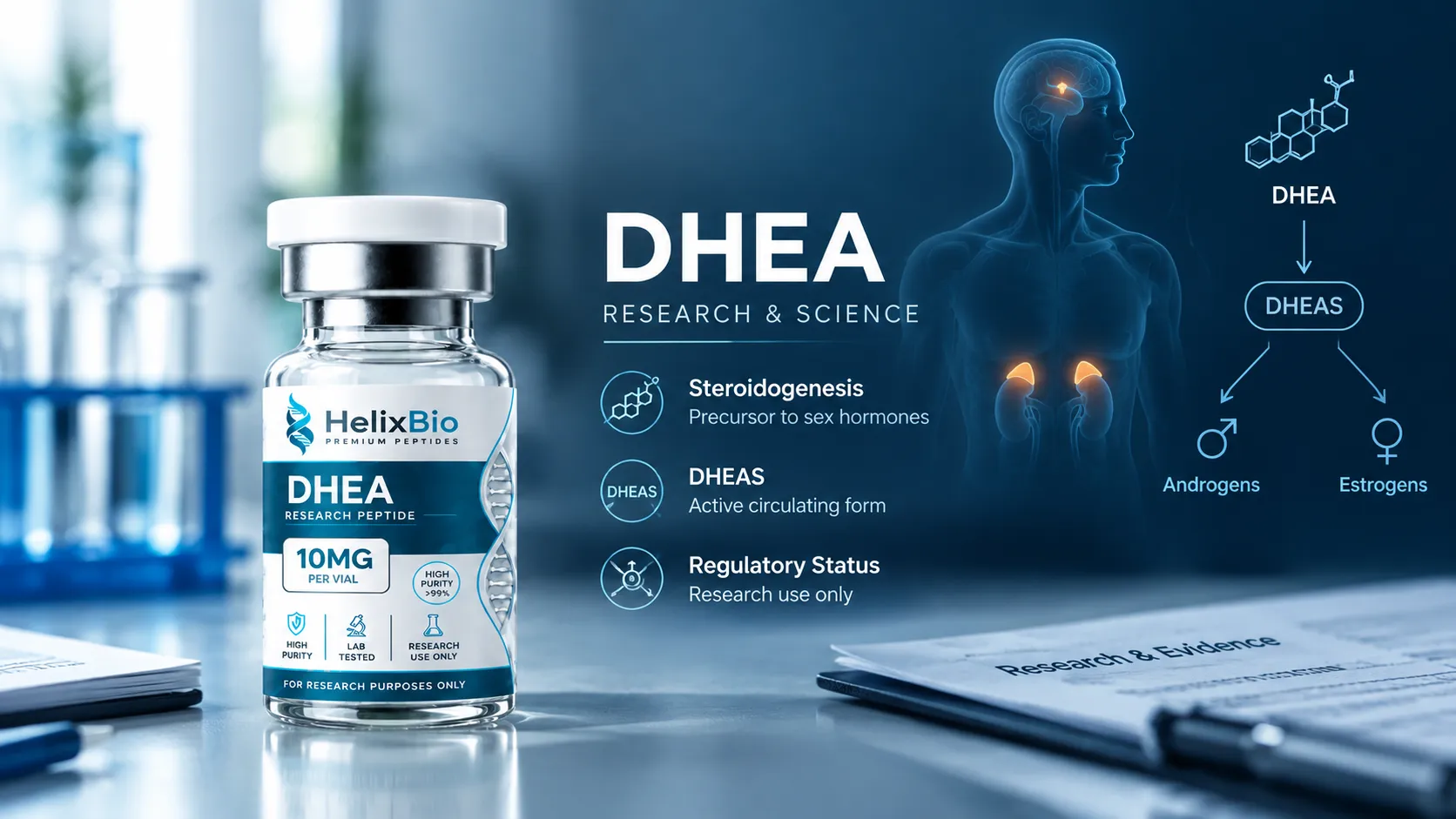
DHEA is synthesised from cholesterol via CYP11A1 to pregnenolone, then by two sequential CYP17A1 activities through 17-hydroxypregnenolone to DHEA.
SULT2A1 sulfates DHEA to DHEAS using PAPS supplied by PAPSS2, and steroid sulfatase (STS) reverses the reaction in peripheral tissues, making sulfation a two-way regulated switch rather than one-way storage.
DHEAS circulates at micromolar concentrations against DHEA's nanomolar range, is cleared more slowly and varies little across the day, which is why DHEAS is the standard marker of adrenal androgen production.
DHEA lacks the conjugated chromophore of Δ4-3-ketosteroids such as testosterone, so UV-based HPLC purity figures for DHEA are less informative than for compounds with strong absorbance.
Structural work published from 2022 identified DHEA and DHEAS as agonists of the adhesion receptor ADGRG2, alongside androstenedione and 20α-hydroxycholesterol, with deoxycorticosterone acting as an endogenous antagonist.
The ADGRG2 evidence is in vitro and murine, and DHEA is not a selective ligand for that receptor, so it does not establish a human physiological mechanism.
A two-year randomised placebo-controlled trial found that systemic DHEA raised circulating DHEAS but produced no effect on body composition, physical performance, insulin action or quality of life in elderly adults.
Prasterone is FDA-approved only as a vaginal insert for moderate to severe dyspareunia due to menopausal vulvar and vaginal atrophy, an approval limited to that formulation and indication.
DHEA is named as prasterone on the WADA Prohibited List under S1.1 and is prohibited at all times regardless of the source of the material.
DHEA turns up in research catalogues next to peptides, and it is not one. Dehydroepiandrosterone is a C19 steroid built on a fused four-ring carbon skeleton, with no amide bonds and no sequence to report. The distinction is not pedantry. It changes which enzymes act on the molecule, how identity and purity are demonstrated on a certificate, and which regulatory frameworks apply. What follows covers what DHEA research actually supports: how the molecule is assembled in the adrenal cortex, why its sulfated form behaves as a separate entity rather than a storage tank, what the receptor work published since 2022 shows, and why one molecule currently holds three different regulatory statuses at the same time.
Featured In This Article
DHEA
RESEARCH PEPTIDE
Highly purified synthetic peptide prepared for rigorous laboratory research.
$77.00
What the Evidence Establishes
DHEA is the steroid the human adrenal cortex produces in the greatest quantity, and its sulfate ester DHEAS is the most abundant steroid in human circulation. Both originate principally in the zona reticularis. The biosynthetic route from cholesterol through pregnenolone and 17-hydroxypregnenolone to DHEA is settled biochemistry, as is the enzymology: CYP11A1 performs the first and rate-limiting step, CYP17A1 performs the next two, and SULT2A1 attaches the sulfate.
What DHEA does is a different question, and it separates into three layers that are routinely collapsed into one. Most of the androgenic and estrogenic activity attributed to DHEA is not DHEA's own — it belongs to the downstream steroids that individual tissues make from it. A direct, non-classical mechanism has emerged since 2022, with DHEA and DHEAS characterised as agonists of the adhesion receptor ADGRG2. And the human outcome literature for systemic DHEA administration in healthy older adults is, for the endpoints most often claimed, negative. Pathway, mechanism, and outcome are three separate evidence bases. Keeping them apart is most of what this article is for.
Molecular Identity
Property
Value
Systematic name
3β-hydroxyandrost-5-en-17-one
Molecular formula
C19H28O2
Molecular weight
288.42 g/mol
CAS number
53-43-0
PubChem CID
5881
FDA UNII
459AG36T1B
ChEBI
CHEBI:28689
InChIKey
FMGSKLZLMKYGDP-USOAJAOKSA-N
International non-proprietary name
Prasterone
The name prasterone carries more weight than it appears to. It is the non-proprietary name for exactly this molecule, and it is the string used both on the FDA-approved product label and on the World Anti-Doping Agency Prohibited List. Searching regulatory databases for "DHEA" and finding nothing means searching the wrong term.
Structurally, DHEA carries a hydroxyl group at C3 in the beta configuration, a double bond between C5 and C6, and a ketone at C17. The double bond and the ketone are not conjugated to one another, and that has a direct analytical consequence. Δ4-3-ketosteroids such as testosterone absorb ultraviolet light strongly near 240 nm because their alkene and ketone sit adjacent. DHEA has no equivalent chromophore. Ultraviolet detection has to run at low wavelength, where selectivity degrades and many co-eluting species are effectively invisible, which is why published steroid assays generally rely on mass spectrometry or derivatise the molecule before analysis.
A purity figure quoted as "≥99% by HPLC" does not mean the same thing for DHEA as it does for an aromatic-containing peptide. Without a strong chromophore, a UV-based area-percent result can under-report impurities that absorb weakly or not at all. The useful questions for a steroid certificate are which detector was used, at what wavelength, and whether identity was confirmed independently by mass spectrometry.
How DHEA Is Made
Steroidogenesis is a linear pathway with two branch points, and DHEA sits at the second one.
Step
Substrate
Product
Enzyme
Significance
1
Cholesterol
Pregnenolone
CYP11A1 (side-chain cleavage)
Rate-limiting step for every steroid hormone; occurs on the inner mitochondrial membrane with adrenodoxin and adrenodoxin reductase
2
Pregnenolone
17-hydroxypregnenolone
CYP17A1 (17α-hydroxylase activity)
Commits the substrate toward C19 steroids
3
17-hydroxypregnenolone
DHEA
CYP17A1 (17,20-lyase activity)
Same enzyme, second catalytic activity; efficiency depends on cytochrome b5 and P450 oxidoreductase
Two features of this sequence are worth pulling out. First, CYP17A1 is one protein performing two chemically distinct reactions, and the ratio between them is not fixed — it is modulated by cytochrome b5, which favours the lyase activity that produces DHEA. The adrenal's output of DHEA versus cortisol precursors is partly a question of how that single enzyme is configured in a given zone. Second, steps 4 and 5 form a cycle, not a one-way arrow, and that cycle is the subject of the next section.
DHEA and DHEAS Are Different Molecules
DHEAS is DHEA bearing a sulfate ester at the 3β position. In mass terms the addition is SO3, roughly 80 Da: the free acid sits near 368.5 g/mol against DHEA's 288.42, and research material is frequently supplied as the sodium salt, which moves the mass basis again. One mass spectrometry run separates the two without ambiguity — which also means a certificate describing "DHEA" should confirm which of the two it characterised.
Feature
DHEA
DHEAS
Chemical form
Free 3β-hydroxy steroid
3β-sulfate ester, anionic
Formed by
CYP17A1 (17,20-lyase)
SULT2A1, PAPS-dependent
Reverted by
Not applicable
STS (steroid sulfatase)
Physical character
Lipophilic
Hydrophilic
Cell entry
Passive diffusion
Transporter-dependent
Circulating concentration
Nanomolar range
Micromolar range
Published half-life values for both differ by method and population, so no single figure is quoted here. The reproducible point is directional: DHEAS is cleared more slowly and varies less through the day, which is precisely why DHEAS rather than DHEA is the analyte used to index adrenal androgen production.
The sulfation switch
Describing DHEAS as "stored DHEA" names the arrow but misses the control. Sulfation by SULT2A1 requires the universal sulfonate donor PAPS, which is supplied by PAPSS2, and human genetics has already shown what happens when that machinery fails in either direction. Inactivating PAPSS2 variants reduce DHEA sulfation, leave more DHEA available for activation into androgens, and present as androgen excess. Running the other way, X-linked steroid sulfatase deficiency removes the reactivating enzyme; a prepubertal rise in the serum DHEA-to-DHEAS ratio observed in healthy controls is absent in affected individuals, which reads as STS activity being physiologically upregulated before puberty. Sulfation is a regulated switch on androgen availability, and the switch has measurable consequences in people rather than only in cell culture.
Where "inert reservoir" breaks down
DHEAS also appears to do things that are not simply a consequence of being converted back to DHEA. In a reconstituted in vitro system built from purified CYP11A1, adrenodoxin and adrenodoxin reductase, DHEAS increased the conversion of cholesterol by about 26 percent, with difference spectroscopy showing tighter cholesterol binding to CYP11A1 in its presence. That is a sulfated end-product acting on the first and rate-limiting step of the pathway that produced it. Separately, DHEAS was characterised alongside DHEA as an agonist at ADGRG2, and cell-differentiation work has asked whether DHEAS acts directly or only after desulfation.
None of that makes DHEAS a well-characterised signalling molecule; these are in vitro observations in defined systems. It does mean the shorthand is wrong in a way that matters for experimental design. A finding demonstrated for DHEAS is not automatically a DHEA finding, and the reverse holds equally.
Circulating DHEA Is Not Tissue Steroid Exposure
The intracrine model is the reason a serum DHEA value answers fewer questions than it appears to. DHEA delivered to a tissue is acted on by whichever enzymes that tissue expresses. Where HSD3B2 and HSD17B are abundant, the route runs toward testosterone and, with SRD5A, toward dihydrotestosterone. Where CYP19A1 is abundant, the same substrate runs toward estrone and estradiol. Where SULT2A1 dominates, it runs back to DHEAS and out of circulation as an active precursor.
The practical consequence is that two tissues sampled from the same individual, drawing on the same circulating pool, can generate entirely different local steroid environments. Saying that DHEA "converts to testosterone" is true only as a statement about one possible route in one enzymatic context. It is not a description of what a given cell type does.
Receptor Research: ADGRG2 and Steroid-Sensing Adhesion Receptors
The most substantive recent development in DHEA mechanism research is not about steroid receptors at all. Work published in Nature Chemical Biology in 2022 screened 37 steroid hormones against a binding pocket in ADGRG2 (also known as GPR64), an adhesion G protein-coupled receptor previously treated as an orphan. Four activators emerged — androstenedione, DHEA, DHEAS, and 20α-hydroxycholesterol — and DHEA and DHEAS were characterised in detail as the more efficacious pair. Deoxycorticosterone was identified as an endogenous antagonist. Cryo-EM structures of DHEA bound to both the full-length receptor and a truncated construct resolved two distinct binding modes, one higher in the pocket involving a structured water molecule and one deeper in the transmembrane region.
A 2026 review in Pharmacology Research and Perspectives places this in a wider pattern: the DHEA pocket in ADGRG2 partially resembles the cortisol-binding site in the related receptor ADGRG3, sharing three conserved hydrophobic residues, while diverging enough in the extracellular loops to tilt the steroid core. A 2025 paper, again in Nature Chemical Biology, reported a nanobody acting as a positive allosteric modulator that enhanced DHEA-induced ADGRG2 activation and rescued signalling in disease-associated receptor mutants, tested in a mouse model of testicular inflammation.
Three qualifications keep this in proportion. ADGRG2 is characterised principally in the male reproductive tract, where it works with CFTR in fluid reabsorption — the biological context is narrow, not systemic. The evidence is structural, cell-based and murine, not human physiology. And DHEA is not a selective ADGRG2 ligand: androstenedione activates the same receptor, which undercuts any framing of DHEA as uniquely privileged there.
Mechanism
Evidence type
Model
Reasonable reading
Conversion to androgens and estrogens
Enzymology, human genetics, tracer studies
Human
Established; accounts for most classical steroid-receptor activity attributed to DHEA
Direct androgen or estrogen receptor binding
Binding studies
In vitro
Weak relative to the downstream steroids; not the main route to those receptors
ADGRG2 agonism
Cryo-EM structures, cAMP and binding assays, mutant rescue
In vitro, mouse
Emerging; direct ligand evidence is solid, physiological significance in humans is not established
The most informative human dataset for systemic DHEA is a two-year randomised, double-blind, placebo-controlled trial published in the New England Journal of Medicine in 2006, involving 87 elderly men and 57 elderly women selected for low DHEAS. The intervention worked pharmacologically — circulating DHEAS rose substantially against placebo. It did not translate. The investigators found no effect on body composition, physical performance, insulin action or quality of life, and a minimal and inconsistent effect on bone mineral density far smaller than that of established osteoporosis therapies. Their stated conclusion argued against use as an antiaging supplement.
Set against that is the one context where human evidence is positive, and it is instructive precisely because it is local rather than systemic. Prasterone vaginal inserts were approved by the FDA in November 2016 for moderate to severe dyspareunia as a symptom of vulvar and vaginal atrophy due to menopause, supported by two 12-week placebo-controlled trials enrolling 255 and 558 postmenopausal women. That is the intracrine model working as described: the substrate is delivered to a tissue that possesses the enzymes to convert it locally. It says nothing about systemic administration in healthy adults, and it is not a general endorsement of the molecule.
What the Evidence Does Not Establish
Systemic DHEA administration has not been shown in randomised human trials to improve body composition, physical performance, insulin action or quality of life in healthy older adults.
An approved local formulation for one menopausal symptom does not establish efficacy for any systemic indication, at any exposure.
The ADGRG2 structural work establishes that DHEA and DHEAS bind and activate a specific receptor. It does not establish that this pathway contributes meaningfully to human physiology, and it does not establish any clinical effect.
A decline in DHEAS with age is a well-documented association. No trial has shown that restoring the measurement restores anything the measurement was standing in for.
Mechanisms demonstrated for DHEAS cannot be attributed to DHEA, and DHEA findings cannot be transferred to DHEAS, because the two differ in transport, clearance and enzyme substrate status.
A circulating DHEA or DHEAS concentration does not predict local androgen or estrogen exposure in any particular tissue.
In vitro and mouse findings, including the receptor work discussed above, do not establish human efficacy for anything.
Regulatory Status: One Molecule, Three Answers
DHEA occupies an unusual regulatory position, and the apparent contradictions dissolve once it is clear that status attaches to a product in a context rather than to a molecule in the abstract.
Entity or product
Status
Jurisdiction
What that status actually means
Prasterone vaginal insert (INTRAROSA)
FDA-approved drug product, initial US approval 2016
United States
Approval covers one formulation, one strength and one indication, reviewed as a new chemical entity. It is not an approval of DHEA generally, by any other route, for any other purpose
DHEA as a dietary supplement ingredient
Lawful to market under the US dietary supplement framework established in 1994
United States
Lawful marketing is not a finding of efficacy or safety. The FDA has not established either for supplement products
Prasterone (dehydroepiandrosterone, DHEA)
Prohibited at all times, in and out of competition, under S1.1 anabolic androgenic steroids
WADA Prohibited List, all signatory sport
Named explicitly on the list. The source of the substance, including a lawfully purchased supplement, is irrelevant to an anti-doping finding
Two implications follow that are easy to miss. Athletes subject to anti-doping rules face prohibition regardless of how the material was obtained, because the list names the substance rather than the product category. And research-use-only labelling is a statement about what the material is sold for; it is not a lighter version of an approval. Helix Bio's research-grade DHEA is supplied for laboratory, analytical and scientific research, and the same research-use-only framework applies to it as to the peptide catalogue, despite DHEA not being a peptide. The medical disclaimer sets out the same position in the site's own terms.
Sourcing and Documentation
For a steroid rather than a peptide, the documentation questions shift. Sequence and net peptide content are not applicable. Identity rests on chromatographic retention matched against a reference standard plus mass spectrometric confirmation, and the chromophore problem described earlier means the detection method deserves scrutiny rather than acceptance. The general certificate of analysis principles still apply — lot-specific documentation, a named method, a stated test date — but the specific checks are different, and a template written for peptides will not ask the right questions of a C19 steroid. DHEA is not the only non-peptide compound that ends up in peptide catalogues; the same category mismatch applies to 5-Amino-1MQ, a quinolinium small molecule.
When evaluating documentation for a steroid research material, check three things the peptide template does not cover: whether the analysis distinguished DHEA from DHEAS, whether identity was confirmed against a reference standard rather than inferred from retention time alone, and whether the purity method used a detector capable of seeing weakly absorbing impurities.
DHEA is one of the better-characterised molecules in endocrinology at the level of structure and pathway, and one of the less settled at the level of what its administration accomplishes. Those two facts sit together comfortably. The enzymology is not in dispute; the outcomes are. Research that keeps the distinction visible is more useful than research that lets a clean biosynthetic diagram stand in for evidence that has not been generated.
Got Questions?
Frequently Asked Questions
DHEA (dehydroepiandrosterone) is a C19 steroid produced mainly by the zona reticularis of the adrenal cortex, with smaller contributions from the gonads and brain. It functions as a precursor from which tissues synthesise androgens and estrogens, and it is the steroid the human adrenal produces in the greatest quantity.
No. DHEA is a steroid built on a fused four-ring carbon skeleton with no amide bonds and no amino acid sequence. It appears in research peptide catalogues as a hormone research compound, but analytically and biochemically it belongs to a different class entirely.
DHEAS (dehydroepiandrosterone sulfate) is DHEA carrying a sulfate ester at the 3β position, formed by the enzyme SULT2A1. It is the most abundant steroid in human circulation, is hydrophilic rather than lipophilic, and requires transporter proteins to enter cells.
They differ by a sulfate group, roughly 80 Da, and that single modification changes almost everything downstream: solubility, cell entry, clearance rate, diurnal stability and enzyme substrate status. DHEA circulates in the nanomolar range and DHEAS in the micromolar range. Because DHEAS is cleared more slowly and varies little across the day, it is the analyte used to index adrenal androgen production.
SULT2A1, the cytosolic DHEA sulfotransferase, using the sulfonate donor PAPS supplied by PAPSS2. The reverse reaction is catalysed by steroid sulfatase (STS) in peripheral tissues, so the two forms interconvert rather than flowing one way.
Cholesterol is converted to pregnenolone by CYP11A1, the rate-limiting step for all steroid hormones. CYP17A1 then performs two sequential reactions — 17α-hydroxylation to 17-hydroxypregnenolone, then 17,20-lyase cleavage to DHEA. The efficiency of that second activity depends on cytochrome b5 and P450 oxidoreductase.
Depending on which enzymes a tissue expresses, DHEA can proceed via androstenedione toward testosterone and dihydrotestosterone, or toward estrone and estradiol through aromatase. It can also be sulfated back to DHEAS. Which route dominates is a property of the tissue, not of the circulating DHEA concentration.
Structural work published from 2022 onward identified DHEA and DHEAS as agonists of the adhesion receptor ADGRG2, with cryo-EM structures resolving the binding pocket. DHEA binds classical androgen and estrogen receptors only weakly; most classical steroid-receptor activity attributed to it is produced by the downstream steroids tissues make from it.
No. The direct ligand evidence is strong — cryo-EM structures, binding assays and functional readouts — but the work is in vitro and in mouse models, and ADGRG2 is characterised principally in the male reproductive tract. DHEA is also not selective for it, since androstenedione activates the same receptor.
Extensively, with largely negative results for systemic administration. A two-year randomised placebo-controlled trial in 87 elderly men and 57 elderly women found no effect on body composition, physical performance, insulin action or quality of life, despite raising circulating DHEAS. The positive human dataset is for a locally applied vaginal formulation in one menopausal symptom, which does not generalise to systemic use.
A specific product is. Prasterone vaginal inserts were approved in 2016 for moderate to severe dyspareunia due to menopausal vulvar and vaginal atrophy. That approval covers one formulation, strength and indication. DHEA is separately lawful as a dietary supplement ingredient in the United States, which is a marketing status rather than a finding of efficacy.
Yes. It is named on the WADA Prohibited List under S1.1 anabolic androgenic steroids, as prasterone (dehydroepiandrosterone, DHEA, 3β-hydroxyandrost-5-en-17-one), and is prohibited at all times, in and out of competition. Because the list names the substance, a lawfully purchased supplement is not a defence to an adverse finding.