- Kisspeptin is the peptide product of the KISS1 gene, which was originally identified as a metastasis-suppressor gene and whose product was first called metastin.
- Kisspeptin-54 and kisspeptin-10 share the same C-terminal decapeptide, which is the region required for binding and activating the KISS1R receptor.
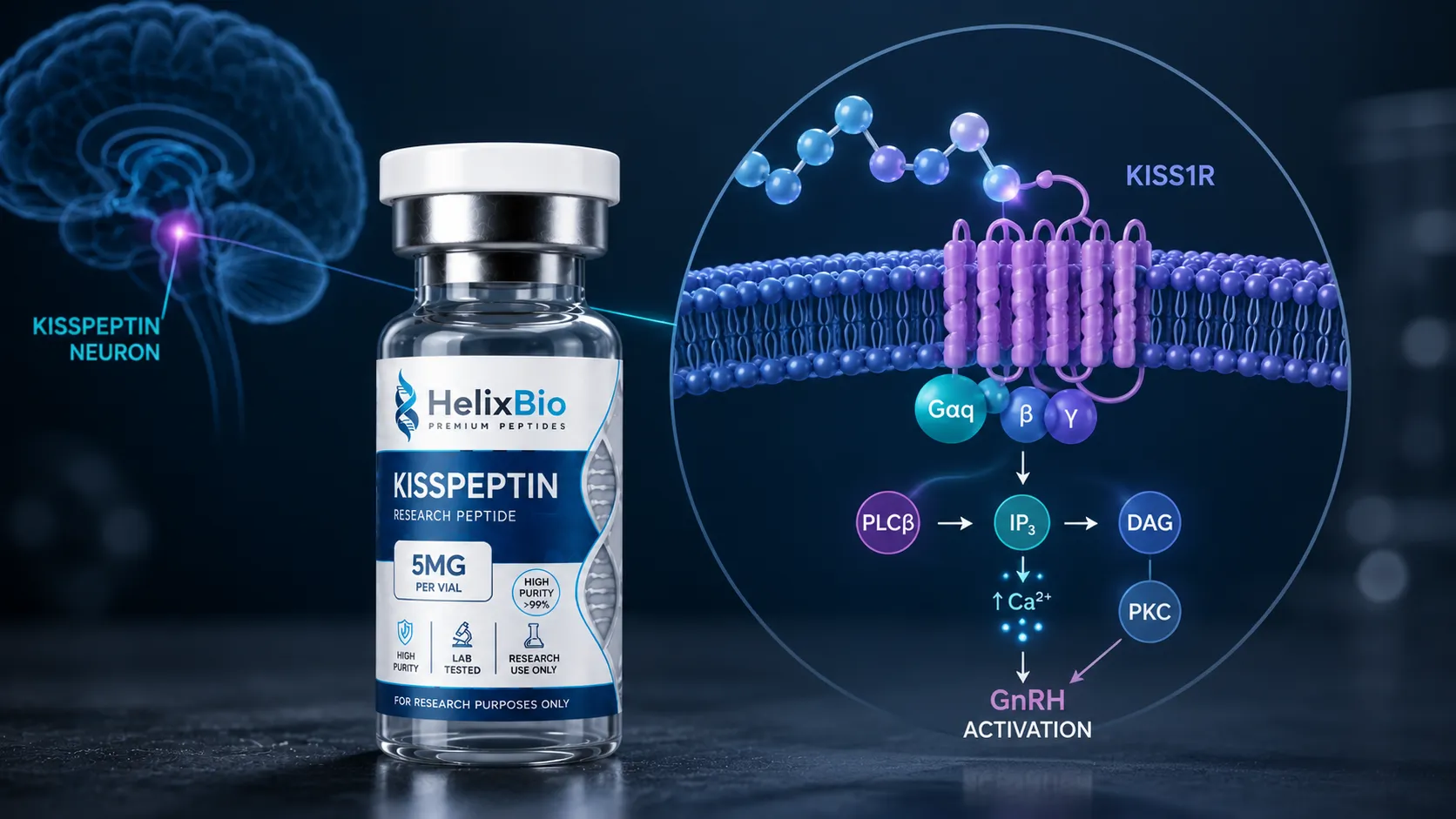
- KISS1R, also known as GPR54, is a Gq/11-coupled G-protein-coupled receptor expressed on GnRH neurons, placing kisspeptin signaling upstream of the hypothalamic-pituitary-gonadal axis.
- Loss-of-function mutations in GPR54 cause idiopathic hypogonadotropic hypogonadism, reported independently by de Roux and colleagues in PNAS and Seminara and colleagues in the New England Journal of Medicine in 2003.
- An activating GPR54 mutation, Arg386Pro, was identified in a patient with central precocious puberty and produced prolonged rather than larger intracellular signaling in response to kisspeptin.
- In a phase 2 open-label randomized trial of 60 women at high risk of ovarian hyperstimulation syndrome, kisspeptin-54 produced oocyte maturation in 95% of women with no moderate, severe or critical OHSS observed.
- Deletion sequences are the dominant impurity risk for kisspeptin-54, because a 54-residue synthesis accumulates coupling inefficiency across every cycle.
- Net peptide content is a distinct measurement from HPLC purity, and for long peptides with multiple basic residues the counterion and moisture load can materially exceed 10% of vial mass.
Kisspeptin is the peptide product of the KISS1 gene, and it sits one step upstream of gonadotropin-releasing hormone in the reproductive axis. The most common source of confusion in kisspeptin research peptide sourcing is that "kisspeptin" names a family rather than a single molecule: KISS1 is processed into several bioactive fragments, of which kisspeptin-54 and kisspeptin-10 are the two most studied, and they are not interchangeable. A second point of confusion is category. A large share of searches around this compound are for antibodies and ELISA kits, which are immunoassay reagents used to detect kisspeptin or its receptor, not the synthetic peptide itself. This piece covers the receptor biology in enough depth to be useful to either audience, the human genetic evidence that anchors the mechanism, the clinical trial record, and what a defensible certificate of analysis for a 54-residue peptide should contain.
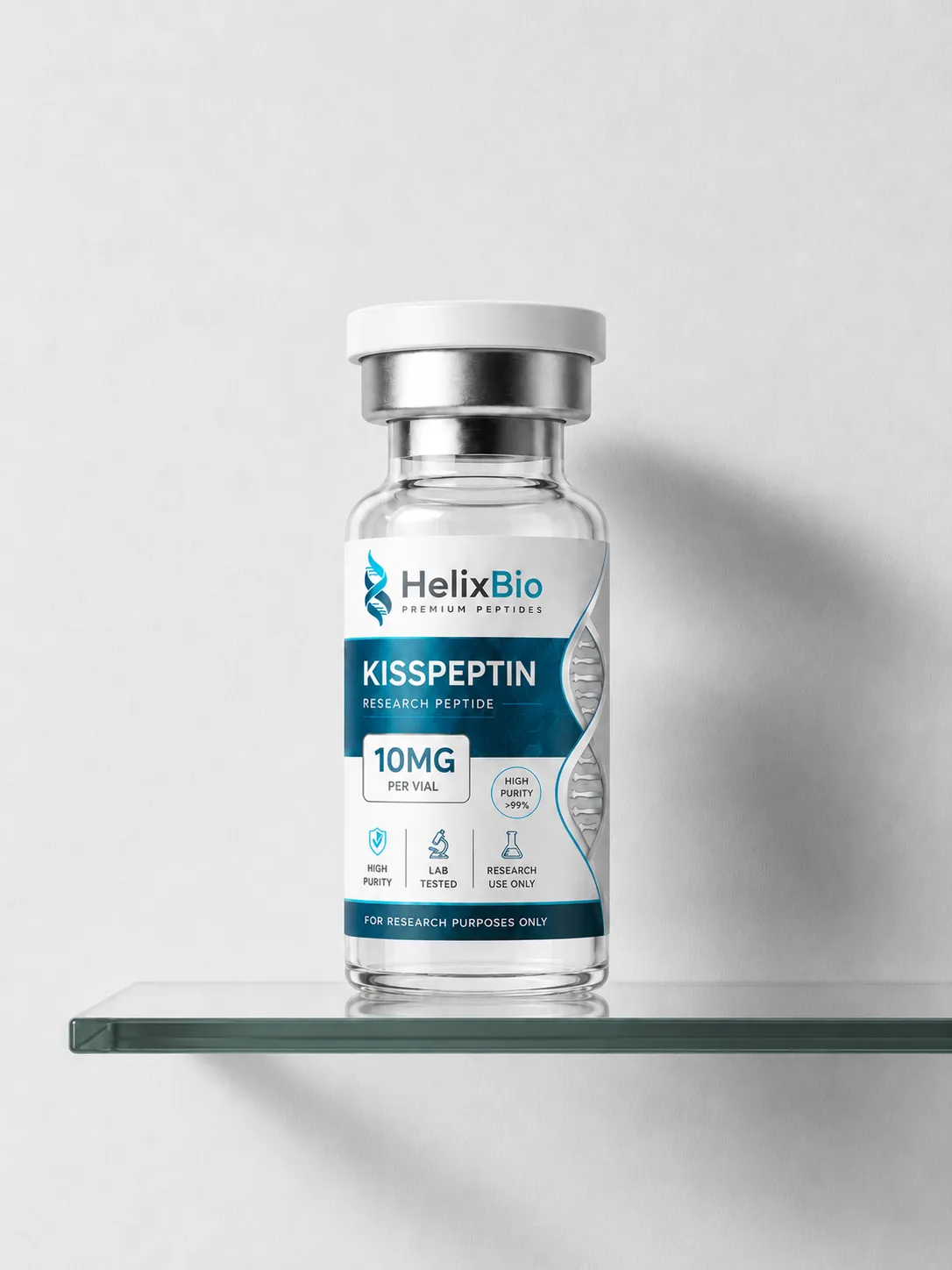
Kisspeptin
RESEARCH PEPTIDE
Kisspeptin is a naturally occurring peptide that plays an important role in scientific research related to reproductive endocrinology, neuroendocrine signaling, and hormonal regulation. Researchers have studied kisspeptin for its interaction with the GPR54 (KISS1R) receptor and its involvement in signaling pathways that regulate gonadotropin-releasing hormone (GnRH). Helix Bio supplies Kisspeptin exclusively for laboratory and research purposes. It is not intended for human or veterinary use, diagnostic procedures, or therapeutic applications.
What Is Kisspeptin? From Metastasis Suppressor to Reproductive Regulator
KISS1 was not discovered in reproductive biology. It was identified as a metastasis-suppressor gene, and its peptide product was initially called metastin for that reason. The reproductive function came later and largely by accident, through human genetics rather than through a hypothesis about fertility.
The KISS1 gene encodes a 145-amino-acid precursor protein that is proteolytically cleaved into shorter fragments. Kisspeptin-54 is the longest bioactive product and corresponds to residues 68-121 of the precursor. Shorter fragments including kisspeptin-14, kisspeptin-13, and kisspeptin-10 share the same C-terminal decapeptide, which is the region required for receptor binding and activation. That shared C-terminus is why the shorter fragments retain potency at the receptor despite losing most of the molecule.
The receptor is KISS1R, still widely referred to by its original orphan designation GPR54. It is a class A G-protein-coupled receptor, and its distribution is what makes the system interesting: KISS1R is expressed on GnRH neurons in the hypothalamus, placing kisspeptin signaling directly upstream of the hormone that initiates the entire hypothalamic-pituitary-gonadal cascade.
KISS1R and GPR54 Receptor Biology
This section is written for the receptor-focused end of the audience, including researchers whose work centers on detection reagents rather than synthetic peptide. Helix Bio supplies research peptides and does not sell antibodies or assay kits, but the receptor biology below is the shared foundation either way.
Signal transduction
KISS1R couples primarily through Gq/11. Ligand binding activates phospholipase C-beta, which hydrolyzes phosphatidylinositol 4,5-bisphosphate into inositol trisphosphate and diacylglycerol. IP3 mobilizes calcium from intracellular stores while DAG activates protein kinase C, and downstream ERK1/2 phosphorylation follows. The inositol phosphate accumulation assay used to characterize KISS1R function in transfected cell lines reads out this pathway directly, which is why it appears in the genetics literature described below.
KISS1R shows relatively slow desensitization compared with many class A GPCRs, and the duration of intracellular signaling after ligand binding turns out to be functionally consequential rather than a technical detail.
Neuronal populations
Two anatomically distinct kisspeptin neuron populations have been characterized in the mammalian hypothalamus. Neurons in the arcuate nucleus co-express kisspeptin, neurokinin B, and dynorphin, and are commonly abbreviated as KNDy neurons. These are implicated in generating the pulsatile pattern of GnRH release. A separate population in the anteroventral periventricular and preoptic region is associated with the preovulatory surge in females. The two populations respond differently to sex steroid feedback, which is part of how a single ligand-receptor pair supports both tonic pulsatility and a discrete surge.
The Human Genetic Evidence
The strongest mechanistic case for kisspeptin-KISS1R signaling comes from loss-of-function and gain-of-function mutations in humans, and the two point in opposite directions exactly as the model predicts.
In 2003, two independent groups reported that loss-of-function mutations in GPR54 cause idiopathic hypogonadotropic hypogonadism. Nicolas de Roux and colleagues published their findings in the Proceedings of the National Academy of Sciences, and Stephanie Seminara and colleagues published a parallel report in the New England Journal of Medicine. Affected individuals fail to undergo normal puberty despite structurally intact hypothalamic and pituitary anatomy. Targeted disruption of GPR54 in mice reproduces the phenotype.
In 2008, Milena Teles and colleagues reported the mirror-image finding in the New England Journal of Medicine: an autosomal dominant activating mutation in GPR54, the substitution of proline for arginine at codon 386 in the receptor's carboxy-terminal tail, in an adopted girl with idiopathic central precocious puberty. In vitro work in COS-7 cells showed the Arg386Pro receptor produced prolonged intracellular signaling in response to kisspeptin rather than a larger peak response. The defect was in signal duration, not signal amplitude.
Taken together, these results establish kisspeptin-KISS1R signaling as necessary for normal pubertal onset in humans and show that the timing of that onset is sensitive to how long the receptor signals after it is engaged. That is a considerably stronger mechanistic anchor than most research peptides can claim.
Kisspeptin-54 Versus Kisspeptin-10
Property | Kisspeptin-54 | Kisspeptin-10 |
|---|---|---|
Length | 54 amino acids | 10 amino acids |
Relationship to precursor | Longest bioactive KISS1 cleavage product, residues 68-121 | C-terminal decapeptide shared by all bioactive fragments |
Receptor activation | Full agonist at KISS1R | Full agonist at KISS1R |
Circulating duration | Longer; used where sustained gonadotropin exposure is the object of study | Markedly shorter; used where a brief, well-defined stimulus is wanted |
Human clinical use | The form used in the Hammersmith IVF trigger trials | Used in acute gonadotropin-response and receptor-pharmacology studies |
Synthesis complexity | High; long-chain synthesis with substantial deletion-sequence risk | Low; routine short-peptide synthesis |
The synthesis column is the one that matters most for sourcing. A 54-residue peptide is a fundamentally harder manufacturing problem than a 10-residue one, and the purity and identity questions scale accordingly.
Clinical Research: The Hammersmith IVF Trials
The most substantive human data on kisspeptin-54 comes from a program at the Hammersmith Hospital IVF unit in London, run out of Imperial College London under Waljit Dhillo.
The rationale was specific. Standard IVF protocols trigger final oocyte maturation with human chorionic gonadotropin, which produces a long-lasting luteinizing hormone-like stimulus and carries a risk of ovarian hyperstimulation syndrome, a potentially serious complication. Kisspeptin-54 acts upstream, prompting the patient's own GnRH neurons to drive an endogenous LH surge, which is shorter in duration than the hCG stimulus. The hypothesis was that a shorter surge would still mature oocytes while reducing OHSS risk.
Ali Abbara and colleagues published the primary result in the Journal of Clinical Endocrinology & Metabolism in 2015. The trial design deserves precise description, because it is often overstated: it was a phase 2, multi-dose, open-label, randomized study of 60 women at high risk of OHSS, conducted during 2013 and 2014. It was not placebo-controlled and not blinded. Patients received a single injection of kisspeptin-54 using an adaptive dose-allocation design across four dose levels, with oocytes retrieved 36 hours later.
Reported outcome | Result |
|---|---|
Oocyte maturation | Occurred in 95% of women |
Highest oocyte yield | 121%, at the 12.8 nmol/kg dose |
Biochemical pregnancy per transfer, all doses (n = 51) | 63% |
Clinical pregnancy per transfer, all doses | 53% |
Live birth per transfer, all doses | 45% |
Best-performing dose for pregnancy outcomes | 9.6 nmol/kg, at 85%, 77% and 62% respectively |
Moderate, severe or critical OHSS | None observed |
A follow-up trial published in Human Reproduction in 2017 tested whether extending LH exposure improved results. Sixty-two women aged 18 to 34 at high risk of OHSS all received an initial 9.6 nmol/kg dose, then were randomized 1:1 to a second dose of kisspeptin-54 or saline ten hours later, with patients, embryologists and clinicians blinded to allocation. The second dose induced further LH secretion and improved the proportion of patients reaching the prespecified oocyte yield threshold.
The limits are worth stating once and clearly. These were single-centre phase 2 trials in a specific high-risk population, the first was unblinded, and the sample sizes were in the dozens. Kisspeptin-54 is not an approved ovulation trigger in any jurisdiction. What the trials establish is proof of mechanism in humans, which is a meaningful result and not the same as efficacy established for clinical use.
Research Applications and Assay Considerations
Kisspeptin appears in laboratory work in two distinct roles, and conflating them causes real interpretive problems.
As a stimulus, synthetic kisspeptin-54 or kisspeptin-10 is applied to characterize gonadotropin responses, receptor pharmacology in transfected cell lines, or downstream signaling. The inositol phosphate accumulation assay described earlier is a standard readout in that setting, and it is how the functional consequence of the Arg386Pro mutation was demonstrated.
As an analyte, endogenous kisspeptin is measured in plasma or tissue, usually by immunoassay. This is where the shared C-terminal decapeptide becomes a methodological trap. Because kisspeptin-54, kisspeptin-14, kisspeptin-13 and kisspeptin-10 all terminate in the same ten residues, an antibody raised against that region will recognize all of them. Assays reporting "kisspeptin immunoreactivity" are therefore often reporting a summed signal across fragments rather than a concentration of any single species. Distinguishing fragments requires either an antibody directed at a fragment-specific region or a separation step such as chromatography ahead of detection.
That distinction has consequences beyond assay design. Reports of kisspeptin concentrations across physiological states are not directly comparable unless the antibody specificity and any separation step are matched, and a substantial share of the older literature does not specify either clearly. Researchers reading concentration data should check what was actually being detected before treating two studies as measuring the same quantity.
Helix Bio supplies synthetic research peptide for the first role. Detection reagents for the second are a separate product category and are sourced elsewhere.
Certificate of Analysis and Purity Verification for Kisspeptin
Kisspeptin-54 presents an analytical problem that short research peptides do not, and a COA that would be adequate for a nonapeptide is not adequate here.
Deletion sequences are the dominant impurity risk. Solid-phase synthesis proceeds one residue at a time, and each coupling step is slightly less than perfect. Over 54 cycles, even a 99.5% average coupling efficiency leaves roughly a quarter of chains carrying at least one deletion. Those single-deletion species differ from the target by one residue's mass and often co-elute closely on RP-HPLC, which means the purity figure and the mass spectrum have to be read together rather than separately.
Purity threshold and method. Research-grade kisspeptin is typically reported at 98% or higher by RP-HPLC with UV detection at 214 nm. For a peptide this long, ask whether the gradient was shallow enough to resolve near-neighbours. A steep gradient produces a tidy-looking chromatogram by compressing everything into one peak.
Identity confirmation. Mass spectrometry, usually ESI-MS or MALDI-TOF, should report an observed mass matching the theoretical mass for the stated sequence. For a 54-residue peptide the multiply-charged envelope in ESI is itself informative. The COA should state both the theoretical and observed values so they can be compared, rather than asserting that identity was confirmed.
Net peptide content. This is not optional for long peptides. Kisspeptin-54 carries multiple basic residues, which means a substantial counterion load. Between trifluoroacetate or acetate salt and residual moisture, gross vial weight can exceed actual peptide mass by a wide margin. Net peptide content is typically determined by amino acid analysis or quantitative nitrogen determination, and without it, any calculation based on stated vial weight is wrong by an unknown amount.
Batch-specific documentation. Cross-check three things against the vial in hand: the lot number on the COA matches the lot printed on the label, the analysis date is after the synthesis date, and the stated fill quantity matches. A generic COA reproduced for every batch of a product is a marketing document.
For long peptides, the most informative single line on a COA is net peptide content, not HPLC purity. A vial can be 99% pure peptide and still contain 20% less peptide by mass than the label implies, because purity describes the proportion of peptide that is the right peptide, while net content describes how much peptide is there at all. Both numbers are needed and they answer different questions.
The broader methodology for evaluating these documents is covered in the certificate of analysis reading guide, and supplier-level vetting is covered in the U.S. research peptide sourcing checklist.
Regulatory Status
Kisspeptin is not approved by the FDA for any indication, in any form or fragment length. It has orphan and investigational status nowhere that converts to marketing authorization, and the Hammersmith trials were conducted under UK Medicines and Healthcare products Regulatory Agency clinical trial authorization rather than as part of a registration program.
Kisspeptin was not among the seven peptide bulk drug substances the FDA's Pharmacy Compounding Advisory Committee reviewed on July 23 and 24, 2026, so nothing in that proceeding altered its status. Material sold in the United States is research-use-only, and the applicable framework is described in the RUO legality and compliance overview.
Storage handling for kisspeptin follows standard practice for lyophilized long-chain peptides: -20°C or lower for the lyophilized powder, protection from moisture, and short refrigerated windows after reconstitution. The mechanics are covered in the reconstitution and stability guide.
The Open Question in Kisspeptin Research
The Hammersmith results contain a finding that has not been fully exploited. Kisspeptin-54 produced an LH surge of roughly 12 to 14 hours, which is shorter than the physiological surge and far shorter than the hCG stimulus it replaced, and yet oocyte maturation occurred in 95% of women with no moderate or severe OHSS observed. The 2017 follow-up then showed that adding a second dose to extend LH exposure further improved oocyte yield.
Those two results pull in slightly different directions, and reconciling them is the interesting problem. If a short surge is sufficient for maturation and protective against hyperstimulation, but a longer surge yields more mature oocytes, then surge duration is a tunable parameter with a real trade-off attached rather than something to be maximized. The Teles finding that a receptor mutation affecting signal duration alone is enough to shift the timing of human puberty suggests the same variable matters at the other end of the axis. How long KISS1R signals, rather than how hard, may be the governing quantity throughout this system.
Frequently Asked Questions
Kisspeptin is the peptide product of the KISS1 gene, cleaved from a 145-amino-acid precursor into shorter bioactive fragments. It signals through the KISS1R receptor on GnRH neurons and functions as an upstream regulator of the hypothalamic-pituitary-gonadal axis.
Kisspeptin-54 is the longest bioactive KISS1 cleavage product, corresponding to residues 68 to 121 of the precursor, while kisspeptin-10 is the shared C-terminal decapeptide. Both are full agonists at KISS1R, but kisspeptin-54 has a longer circulating duration and is substantially harder to synthesize.
They are the same receptor. GPR54 was the original orphan receptor designation and KISS1R is the name adopted after its ligand was identified, and both appear throughout the literature.
KISS1R couples primarily through Gq/11, activating phospholipase C-beta to generate inositol trisphosphate and diacylglycerol. IP3 mobilizes intracellular calcium while DAG activates protein kinase C, with downstream ERK1/2 phosphorylation following.
Loss-of-function mutations in KISS1R cause idiopathic hypogonadotropic hypogonadism, in which affected individuals fail to undergo normal puberty despite intact hypothalamic and pituitary anatomy. Targeted disruption of the gene in mice reproduces the phenotype.
A defensible COA reports RP-HPLC purity with the chromatogram attached, mass spectrometry identity with theoretical and observed masses printed side by side, and net peptide content as a separate figure from gross vial weight. The lot number must match the vial label and the analysis date must follow the synthesis date.
Research-grade material is typically reported at 98% or higher by RP-HPLC with UV detection at 214 nm. For a peptide of this length it is also worth confirming that the gradient was shallow enough to resolve closely eluting deletion sequences rather than compressing them into the main peak.
Solid-phase synthesis adds one residue per cycle and each coupling is slightly less than complete. Across 54 cycles even a 99.5% average coupling efficiency leaves a substantial fraction of chains carrying at least one deletion, and those species differ by a single residue's mass and can co-elute closely on RP-HPLC.
Net peptide content is the proportion of vial mass that is actually peptide, as opposed to counterion salt and residual moisture, and it is determined by amino acid analysis or quantitative nitrogen determination. It is a different question from HPLC purity, which describes what fraction of the peptide present is the correct peptide.
No. Antibodies and ELISA kits are immunoassay reagents used to detect kisspeptin or KISS1R in biological samples, which is a different product category from synthetic research peptide. Helix Bio supplies research peptides only.
In a phase 2, multi-dose, open-label randomized trial of 60 women at high risk of ovarian hyperstimulation syndrome conducted at Hammersmith Hospital during 2013 and 2014, oocyte maturation occurred in 95% of women and no moderate, severe or critical OHSS was observed. Biochemical pregnancy, clinical pregnancy and live birth rates per transfer across all doses were 63%, 53% and 45% respectively.
The 2015 trial published in the Journal of Clinical Endocrinology and Metabolism was open-label and not placebo-controlled, using an adaptive design for dose allocation. The 2017 follow-up in Human Reproduction was blinded for the second-dose comparison, randomizing 62 women to either a second dose of kisspeptin-54 or saline.
No. Kisspeptin is not approved by the FDA for any indication in any fragment length, and the Hammersmith trials were conducted under UK clinical trial authorization rather than as part of a United States registration program.
No. The seven bulk drug substances reviewed by the Pharmacy Compounding Advisory Committee on July 23 and 24, 2026 were BPC-157, KPV, TB-500, MOTS-c, Emideltide, Semax and Epitalon. Kisspeptin was not among them, so nothing in that proceeding changed its status.
Lyophilized long-chain peptides such as kisspeptin-54 are generally held at -20 degrees Celsius or lower with protection from moisture. After reconstitution the usable window shortens considerably, and refrigeration is standard practice rather than repeated freeze-thaw cycling.
- 01de Roux N, Genin E, Carel JC, Matsuda F, Chaussain JL, Milgrom E. Hypogonadotropic hypogonadism due to loss of function of the KiSS1-derived peptide receptor GPR54. Proc Natl Acad Sci U S A. 2003;100(19):10972-10976. doi:10.1073/pnas.1834399100
- 02Seminara SB, Messager S, Chatzidaki EE, et al. The GPR54 gene as a regulator of puberty. N Engl J Med. 2003;349(17):1614-1627. doi:10.1056/NEJMoa035322
- 03Teles MG, Bianco SDC, Brito VN, et al. A GPR54-activating mutation in a patient with central precocious puberty. N Engl J Med. 2008;358(7):709-715. doi:10.1056/NEJMoa073443
- 04Abbara A, Jayasena CN, Christopoulos G, et al. Efficacy of kisspeptin-54 to trigger oocyte maturation in women at high risk of ovarian hyperstimulation syndrome (OHSS) during in vitro fertilization (IVF) therapy. J Clin Endocrinol Metab. 2015;100(9):3322-3331. doi:10.1210/jc.2015-2332
- 05Abbara A, Clarke S, Islam R, et al. A second dose of kisspeptin-54 improves oocyte maturation in women at high risk of ovarian hyperstimulation syndrome: a Phase 2 randomized controlled trial. Hum Reprod. 2017;32(9):1915-1924. doi:10.1093/humrep/dex253
Helix Bio Chem Team
Research & Product Team
Our in-house team tracks published peptide research and translates it into clear, source-cited summaries for the research community.
Reviewed by in-house research chemists
support@helixbiochem.com