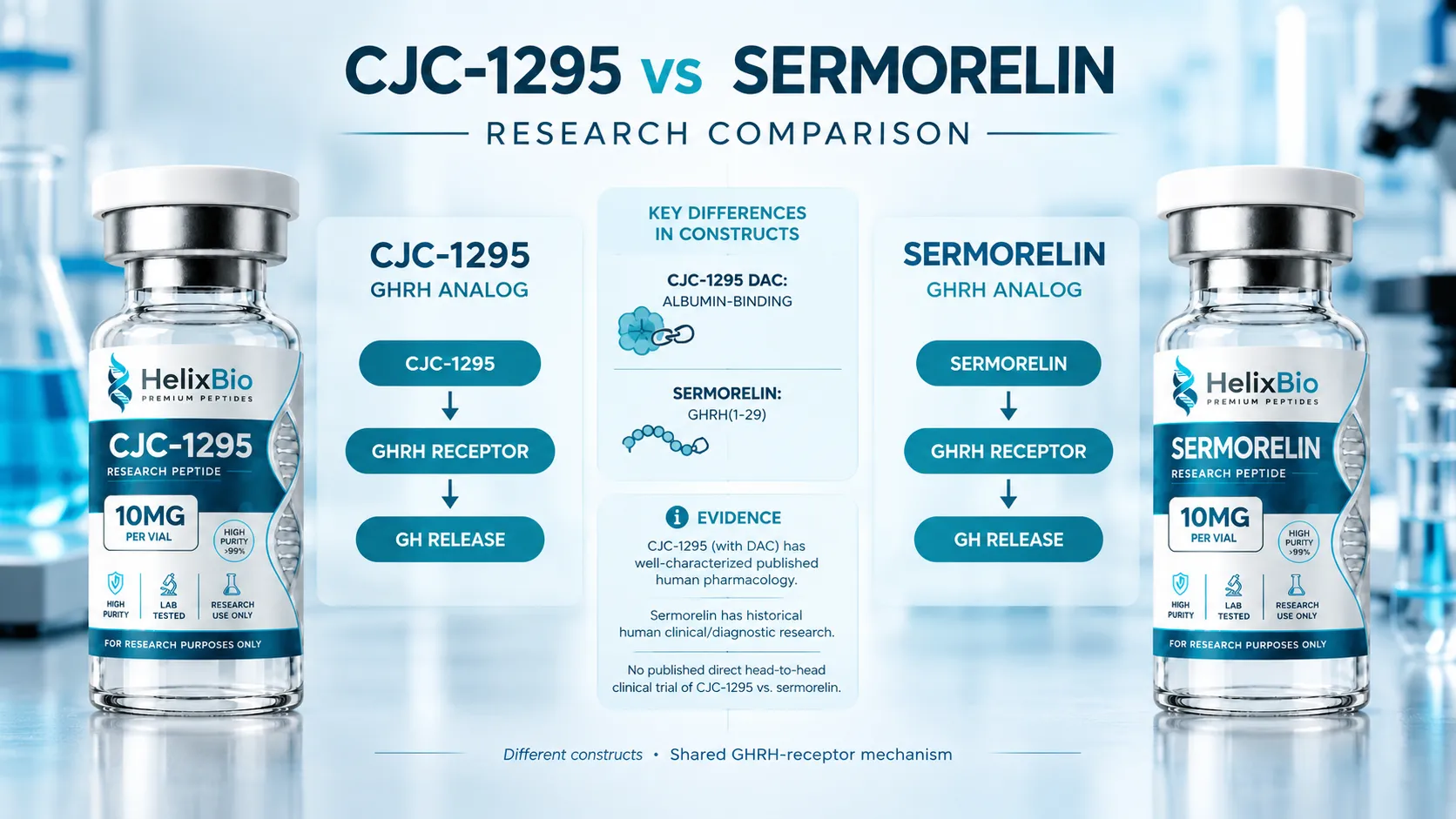
- CJC-1295 and sermorelin both bind the GHRH receptor, so the comparison is about signal duration and not about different pathways.
- The name CJC-1295 covers two different molecules, and the with-DAC form and the no-DAC form behave nothing alike.
- CJC-1295 with DAC has a reported half-life of 5.8 to 8.1 days in healthy adults, measured in a single published trial.
- Sermorelin is the native GHRH(1-29) fragment and is cleaved rapidly in plasma by dipeptidyl peptidase IV.
- Sermorelin's registration-era trials came from pediatric growth hormone deficiency, and it underperformed growth hormone itself on height velocity.
- No trial has ever compared CJC-1295 and sermorelin head to head, so every published ranking between them is inference.
- FDA found no approved product containing any form of CJC-1295 across twelve surveyed countries plus the European Union.
- WADA's 2026 Prohibited List names both compounds at S2.2.4, prohibited at all times.
CJC-1295 and sermorelin are both GHRH-receptor agonists studied for growth hormone release. They differ in how long the signal lasts and in the quality of the human evidence behind each. This comparison sets out what the primary literature reports for each compound, where the two are routinely confused, and which questions the record cannot answer.
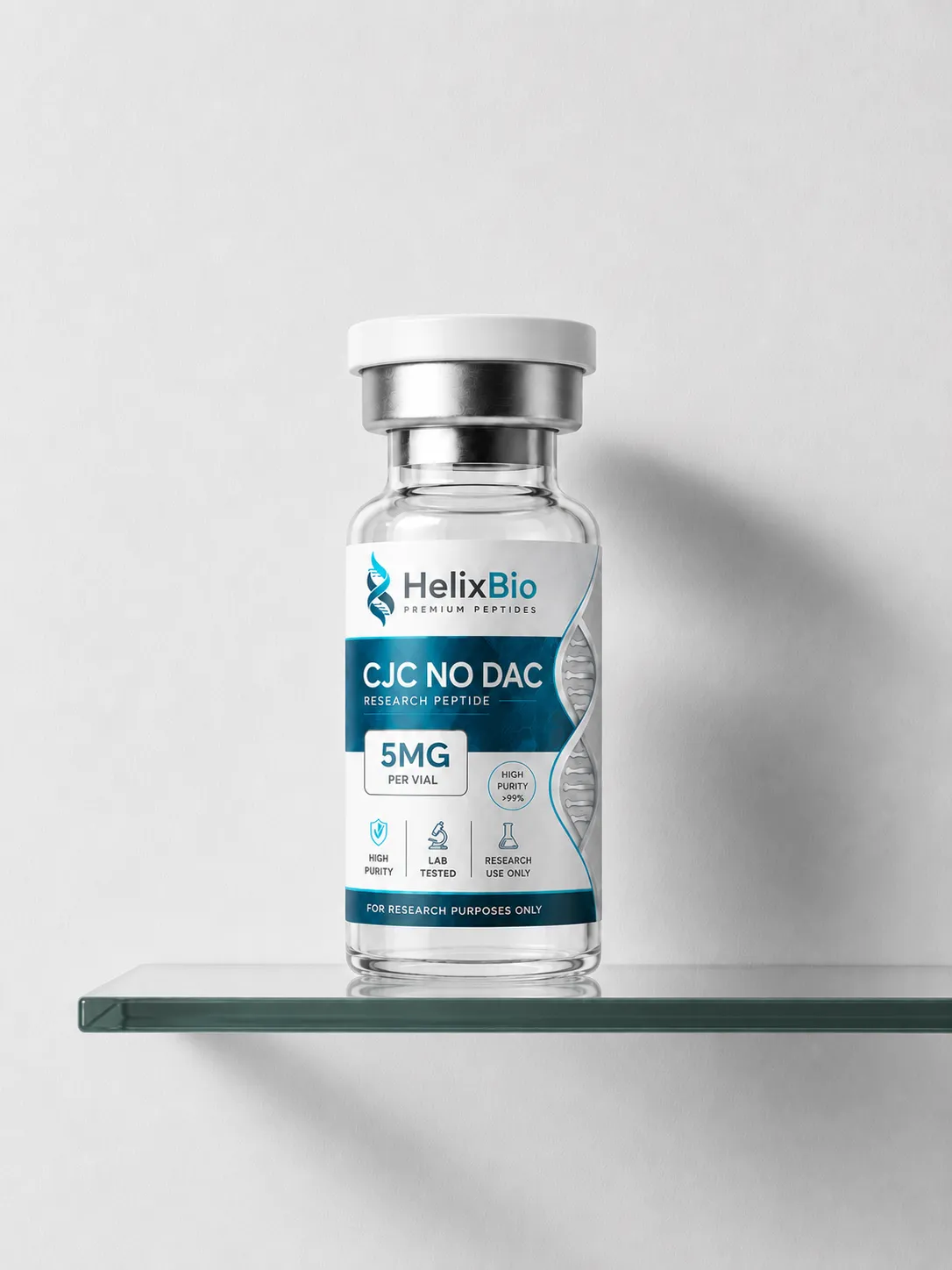
CJC-1295 with DAC
RESEARCH PEPTIDE
CJC-1295 with DAC is a lyophilized, research-use-only peptide from the growth hormone releasing hormone (GHRH) analog family. The DAC — Drug Affinity Complex — is a modification that allows the peptide to bind reversibly to serum albumin in research models, which extends its presence well beyond what a standard GHRH fragment shows. That makes it a useful reference compound for researchers studying longer-duration receptor activity, as opposed to the short, sharp activity window seen with CJC-1295 No DAC. Helix Bio supplies this peptide strictly for laboratory and research applications — it is not intended, labeled, or sold for human use.
CJC-1295 No DAC
RESEARCH PEPTIDE
CJC-1295 No DAC is a lyophilized, research-use-only peptide belonging to the growth hormone releasing hormone (GHRH) analog family. Unlike the original CJC-1295, this version excludes the Drug Affinity Complex (DAC), which gives it a shorter half-life and makes it a common reference compound in receptor-binding and short-duration in vitro studies. Researchers sometimes refer to it by its other common name, Mod GRF 1-29. Helix Bio supplies this peptide strictly for laboratory and research applications — it is not intended, labeled, or sold for human use.
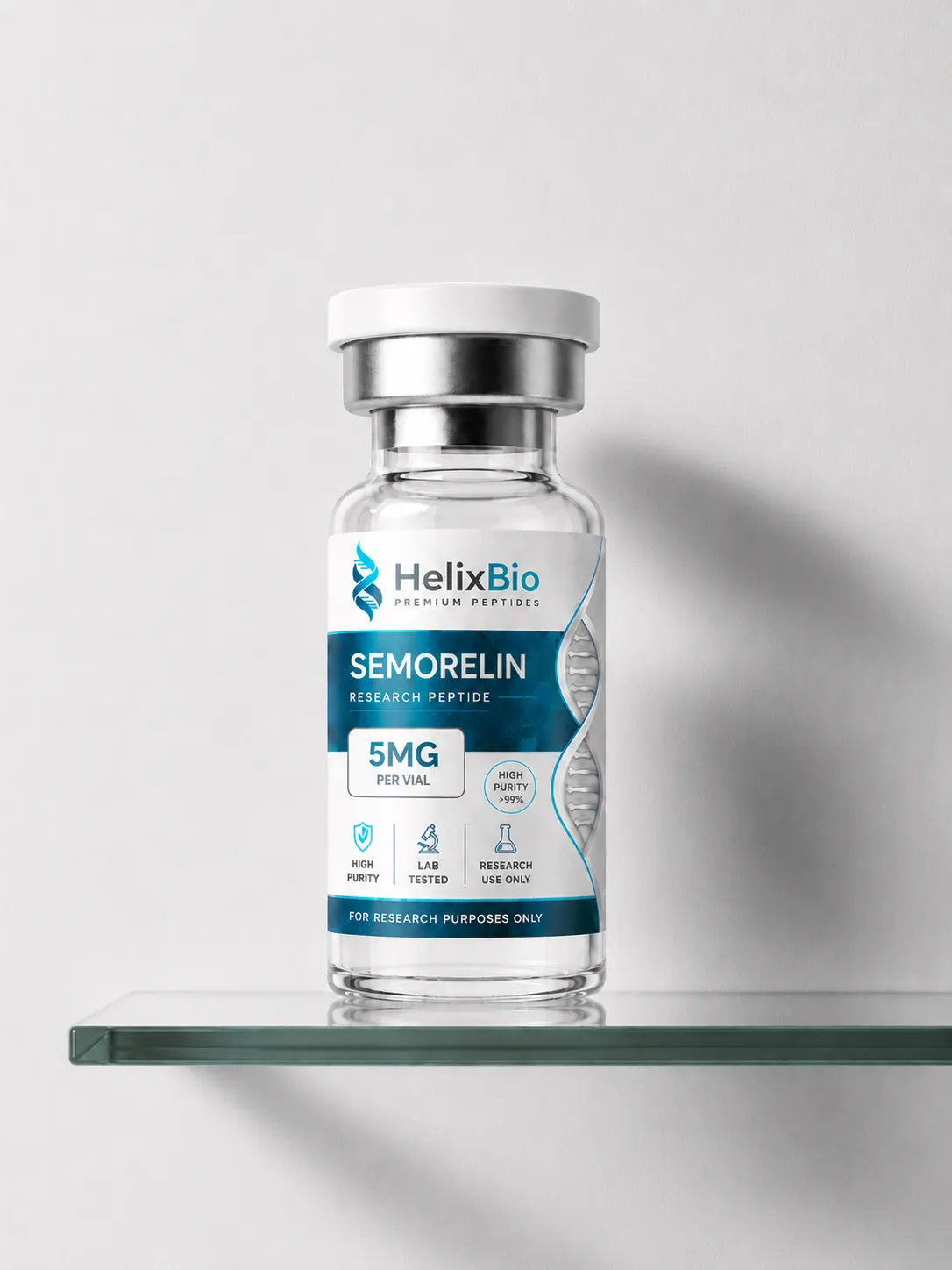
Sermorelin
RESEARCH PEPTIDE
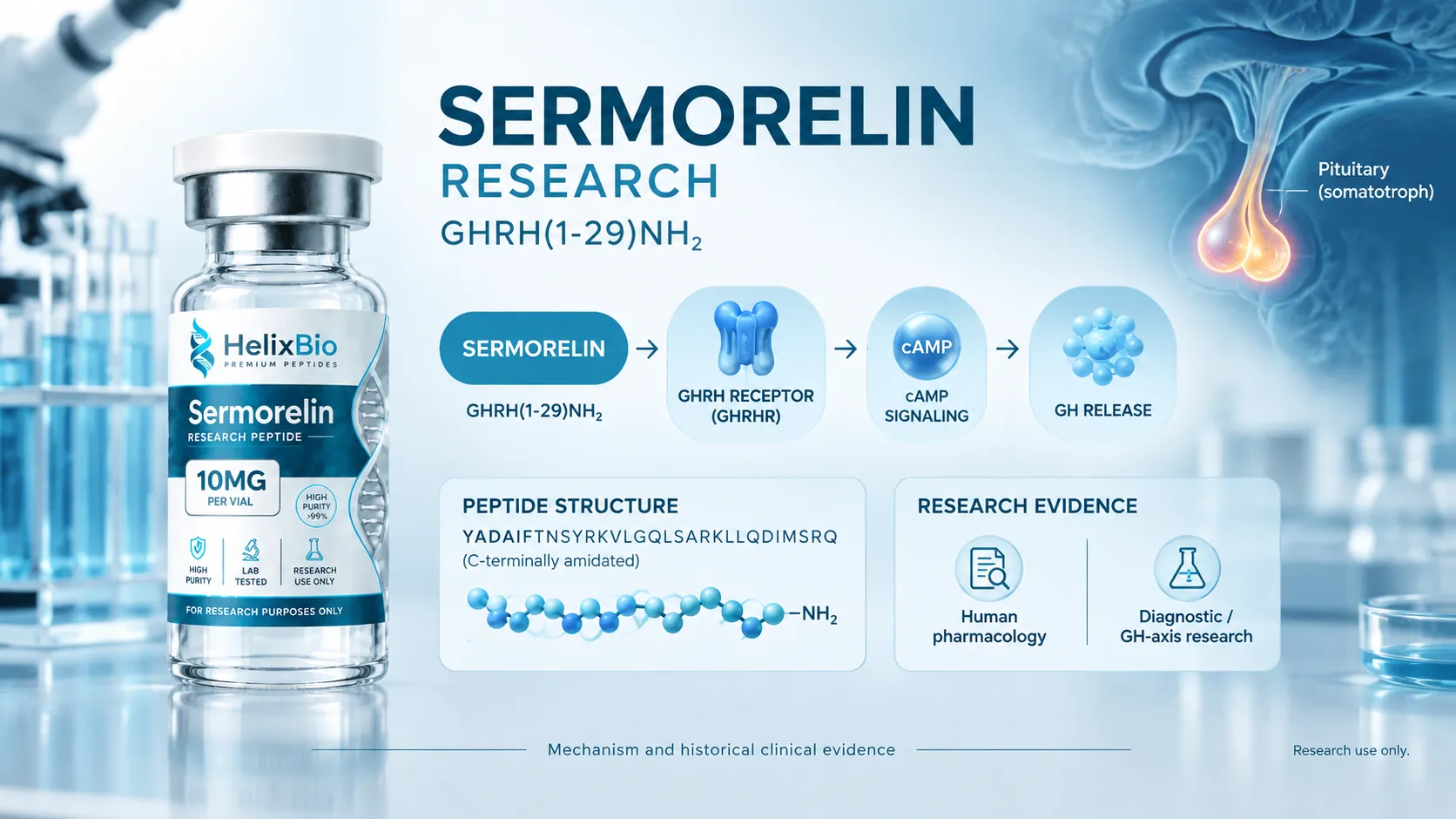
Sermorelin is the common name for GHRH(1-29)NH2, a 29-amino-acid peptide fragment of human growth hormone-releasing hormone. Helix Bio supplies sermorelin acetate as a lyophilized research compound, packaged for laboratory and academic study of the GHRH receptor and the pituitary growth hormone pathway. This listing is for a research chemical only. It is not a drug, dietary supplement, or finished pharmaceutical product, and it is not sold, labeled, or intended for human or animal use of any kind. It is intended exclusively for qualified researchers and laboratories operating under appropriate institutional protocols.
Which is better, CJC-1295 or sermorelin?
Both peptides are analogues of growth hormone releasing hormone. Both act on GHRH receptors in the pituitary. Sermorelin is the native human GHRH(1-29) fragment and clears within minutes. CJC-1295 is an engineered version built to survive far longer in plasma.
That duration gap is the whole comparison. Everything else that gets argued about sits downstream of it, and most of that argument is inference.
Sermorelin vs CJC-1295 at a glance
Property | Sermorelin | CJC-1295 no DAC (modified GRF 1-29) | CJC-1295 with DAC |
|---|---|---|---|
Receptor target | GHRH receptor | GHRH receptor | GHRH receptor |
Reported half-life | Minutes; cleaved by DPP-IV | No published human half-life | 5.8 to 8.1 days (PMID 16352683) |
GH pattern after one administration | Short pulse, tracks the amount given | No published human data | GH raised 2 to 10 fold for 6 days or more |
IGF-1 response | Rose early, then fell back toward baseline in trials | No published human data | Raised 1.5 to 3 fold for 9 to 11 days |
Human evidence base | Multicenter pediatric trials, 1990s | No published human trial under this name | One published healthy-adult trial |
Named on WADA 2026 list | Yes, S2.2.4 | Covered as a GHRH analogue | Yes, S2.2.4 |
Every figure above comes from the primary paper cited, never from a secondary summary.
What does CJC-1295 mean on a label?
Two very different molecules get sold under one name. Sorting them out is the single most useful thing a reader can take from this page.
CJC-1295 with DAC carries a Drug Affinity Complex. A maleimidopropionamide group conjugates the peptide to the free thiol on Cys34 of serum albumin (PMID 15817669). Once bound, the molecule circulates attached to albumin, and FDA gives the DAC free base a molecular weight of 3647.95 g/mol. That conjugation is the reason its half-life runs in days.
CJC-1295 no DAC carries no such group, and its proper name is modified GRF(1-29). A 2026 review in Frontiers in Endocrinology treats the two as separate entities throughout, which is the correct handling (PMID 42395176).
The practical consequence of mixing them up is large. Teichman and colleagues studied the with-DAC form. Pages quoting that half-life beside a no-DAC product attach days-long kinetics to a molecule nobody measured that way. This single conflation corrupts most comparisons available online. For the two forms separately, see our CJC-1295 with DAC monograph and our modified GRF(1-29) page.
How do CJC-1295 and sermorelin differ at the receptor?
Both compounds bind GHRH receptors on pituitary somatotrophs. Neither one opens a new pathway that native GHRH does not already use. The pituitary responds as it responds to its own releasing hormone, and downstream somatostatin feedback still applies in both cases.
These compounds are often filed alongside GHRPs such as ipamorelin. Sorting them into one bucket is a category error worth correcting. GHRPs act on the ghrelin receptor, a separate target with separate kinetics and a separate literature. We cover the distinction in GHRH analogues vs GHRPs.
So the useful question is not which compound is stronger at the receptor. It is how long each one keeps that receptor occupied, and what a pituitary does when the incoming signal stops resembling a pulse. Native GHRH arrives in bursts, and a molecule with a multi-day half-life does not.
What does the sermorelin evidence show?
Sermorelin is GHRH(1-29)-NH2, the shortest fragment of native GHRH that retains biological activity. In plasma it is cleaved rapidly by dipeptidyl peptidase IV, which cuts between residues 2 and 3 (PMID 7937325). Clearance happens fast, and the resulting GH response is correspondingly brief.
The registration-era evidence came from pediatric growth hormone deficiency. One multicenter study enrolled 110 previously untreated prepubertal study subjects. Mean height velocity rose from 4.1 cm per year at baseline to 8.0 cm per year at six months. It then settled back to 7.2 cm per year at twelve months (PMID 8772599). About 74% were rated good responders at the six-month mark. Bone age advanced roughly in step with height age, and investigators reported no excessive IGF-1 generation.
Three further findings from that era rarely appear on comparison pages, and each one matters.
Sermorelin underperformed growth hormone itself
One randomized three-arm study measured both. Mean height velocities reached 9.2 and 9.3 cm per year on GHRH(1-29)-NH2, against 14.6 cm per year on GH (PMID 8329830). A second randomized study reached a similar conclusion about relative effect (PMID 8329826).
Antibodies developed in nearly every treated subject
In that same trial, 39 of 40 study subjects on GHRH(1-29)-NH2 developed GHRH antibodies, which had almost disappeared nine months after treatment stopped (PMID 8329830). Investigators found no correlation between antibody titre and height gain.
The response faded across months
Those assessed with 24-hour GH profiling showed a biphasic pattern, with integrated GH rising early and then falling by three and six months (PMID 8329829). The authors raised desensitization of pituitary GHRH receptors as one candidate explanation, alongside antibodies and somatostatin changes.
The common claim that sermorelin preserves the feedback loop is a fair reading of the no-excessive-IGF-1 finding. It is not a finding of durable effect, and those are separate questions. Our sermorelin monograph sets out the full record.
What does the CJC-1295 evidence show?
CJC-1295 is a deliberately engineered molecule. Its design logic comes from GRF analogue chemistry worked out in the 1990s, which targeted four positions for four separate reasons (PMID 7937325). Substitution at position 2 blocks DPP-IV cleavage, and substitution at position 8 reduces chemical isomerization. Position 27 was altered to prevent oxidation of a methionine residue. The position 15 change is less settled. Campbell and colleagues describe that change as previously demonstrated to enhance receptor binding affinity. FDA's own review of the molecule records no rationale for it. The DAC group was then added on top of that stabilized backbone.
The human dataset amounts to a single paper. Teichman and colleagues ran two randomized, placebo-controlled, double-blind ascending-dose trials in healthy adults aged 21 to 61, lasting 28 and 49 days (PMID 16352683). Their reported findings, exactly as published:
- Mean plasma GH rose 2 to 10 fold, dose-dependently, for six days or more after one administration.
- Mean plasma IGF-1 rose 1.5 to 3 fold, for nine to eleven days.
- The estimated half-life of CJC-1295 was 5.8 to 8.1 days.
- After multiple administrations, mean IGF-1 stayed above baseline for up to 28 days.
- No serious adverse reactions were reported.
Competitor pages quote these as conflicting numbers, offering 1.5 to 3x on one site and 2 to 10x on another. Both figures are correct, and the two do not contradict each other at all. They report two entirely different endpoints from the same trial. The 2 to 10 fold figure describes growth hormone, and the 1.5 to 3 fold figure describes IGF-1. Any page presenting them as rival estimates of one quantity has not read the paper.
Development stopped not long after that trial. ConjuChem withdrew CJC-1295 with DAC from clinical trials in 2006, following the death of a participant in a Phase II study. The data from that trial were never published.
Every figure above belongs to the with-DAC form. None of it has been demonstrated for modified GRF(1-29) in a published human trial.
What is the regulatory status of each in 2026?
Law, agency policy, and commentary get blended constantly on this topic. They are separate things, and this section keeps them separate.
Sermorelin has a genuine approval history. It was approved in 1997 under the brand name Geref for pediatric growth hormone deficiency. EMD Serono discontinued the product in 2008 for commercial reasons, and the applications were withdrawn in 2009. FDA later determined the product had not been withdrawn for reasons of safety or effectiveness. Sermorelin was not among the peptides placed in Category 2 of the interim 503A bulks list in September 2023.
CJC-1295 holds no approval that regulators have identified. FDA surveyed twelve countries, among them Australia, Canada, Japan and the United Kingdom, plus the European Union. It found no approved product containing any form of CJC-1295 in any of them. No registration-track development program appears in the public record either.
The compounding history runs on its own track. CJC-1295 was placed in Category 2 of the interim 503A bulks list in September 2023. Its nominators later withdrew the nomination, and it was removed from Category 2 effective 27 September 2024. In April 2026 FDA moved it to the withdrawn-nominations table. FDA nonetheless brought five CJC-1295 forms before the Pharmacy Compounding Advisory Committee on 4 December 2024. It proposed that none of them be added to the bulks list. Committee votes are advisory, and no final rule has published.
The July 2026 PCAC claim is wrong
Many comparison pages describe a July 2026 PCAC vote that assigned these two compounds to opposing categories. That vote never took place at all. The Pharmacy Compounding Advisory Committee met on 23 and 24 July 2026 and reviewed seven peptides: BPC-157, KPV, TB-500, MOTS-c, Semax, Epitalon, and emideltide. Neither CJC-1295 nor sermorelin appeared on that docket. Our explainer on the July 2026 PCAC vote covers what the committee actually decided.
One rule explains most of the resulting confusion. Removal from Category 2 does not place a substance in Category 1. Category 1 is an interim enforcement-discretion policy covering substances still under evaluation, while Category 2 flags substances FDA identified as raising significant safety concerns. A substance sitting in the withdrawn-nominations table falls outside both. Commercial sources claiming a clean Category 1 versus Category 2 split between these two compounds contradict each other. No primary record supporting that claim was found for either one.
Anti-doping status is the one place both are treated identically. WADA's 2026 Prohibited List names growth hormone releasing hormone and its analogues at S2.2.4, listing CJC-1293, CJC-1295, sermorelin, and tesamorelin together in a single entry. Both are prohibited at all times, in and out of competition. Accredited laboratories have published detection methods for both, including urine assays reaching low picogram-per-millilitre limits (PMID 32971474). Detecting the albumin-bound form takes a different approach, since conjugation hides it from standard peptide screening (PMID 30489688).
Regulatory status and research-use-only supply are separate matters. Research-use-only labelling states a supplier's intended use and is not a regulatory clearance, an approval, or a finding of safety. Compounding categories, anti-doping listings, and approval histories each answer different questions and should never be read as substitutes for one another.
What the research does not show
Absence of evidence is part of the evidence here. These are the gaps that genuinely exist.
No head-to-head trial has ever been published. A PubMed search for records indexing both compounds, querying cjc 1295 and sermorelin across all fields, returns 14 records in total. Every one of them is a narrative review, a doping-control assay development paper, or a class overview. Zero head-to-head trials.
No human efficacy evidence exists for muscle or body composition. An August 2026 scoping review in the American Journal of Sports Medicine examined CJC-1295 among six emerging peptides (PMID 42578445). Roughly 67% of the identified literature used preclinical animal models. Human studies were few and mostly lacked well-controlled or rigorous designs. The authors concluded that claimed musculoskeletal benefits remain unsubstantiated by current human trials.
No published human data covers the no-DAC form. Modified GRF(1-29) has no dedicated human pharmacokinetic trial anywhere in the indexed literature. That gap leaves several cells of the table above genuinely empty. Analytical work fills part of the picture for sermorelin, where doping-control researchers documented rapid degradation above 4 degrees Celsius and below pH 7 (PMID 35298973). Stability data of that kind describes handling behaviour, and it says nothing about effect in any organism.
No basis supports the combination-multiplier claims. Pages citing a specific fold-increase for GHRH analogue plus GHRP combinations are quoting figures with no primary human trial behind them. A 2026 critical review of peptide use in sport reached the same verdict across the class (PMID 41880199). Its authors noted that most published studies examine therapeutic applications under controlled conditions, and not the combined protocols discussed in forums.
When a competitor page declares a winner for fat loss or muscle gain, the useful question is which trial measured it. For these two compounds against each other, no trial did.
The research verdict
Neither compound is better than the other in any general sense. Each one answers a different research question, and that framing is the only honest one available.
Sermorelin is the closer match when the question concerns native GHRH signalling. It is the endogenous fragment itself, and its clearance pathway is characterized. It also carries genuine controlled human trial data. That data comes from a pediatric population and a different decade, which limits how far it travels.
CJC-1295 with DAC is the closer match when the question concerns sustained receptor stimulation. Among the three forms discussed here, it is the only one with published multi-day human pharmacokinetics, and its half-life was directly measured in trial subjects.
Neither compound is a match when the question concerns adult body composition. The trial evidence does not exist for either one, in either direction, and no amount of cross-study reading fills that gap.
For adjacent comparisons in this class, see sermorelin vs tesamorelin, sermorelin vs ipamorelin, and tesamorelin vs ipamorelin.
Helix Bio Chem materials are supplied for laboratory research use only, and not for human use, veterinary use, or compounding. Nothing here is medical, legal, or treatment advice.
Frequently Asked Questions
They are similar at the receptor and different almost everywhere else. Both are GHRH analogues binding the same pituitary receptor. Sermorelin is the native human GHRH(1-29) fragment and clears in minutes, while CJC-1295 with DAC has a reported half-life of 5.8 to 8.1 days.
No published study supports a potency ranking between them. The two have never been compared in a single trial, so any stronger claim is inference across studies with different populations, eras, endpoints, and assays. Duration and potency are not the same property.
Both bind the same receptor, so pairing them would not add a second mechanism the way a GHRH analogue plus a GHRP might. No published study examining the two together in any model was found. Such a design would have no comparative baseline in the literature.
The clearest event is a halted trial. ConjuChem ran a Phase II study of CJC-1295 with DAC in 192 participants with HIV-associated lipodystrophy. Dosing stopped in July 2006 after a participant died, attributed by the attending physician to undiagnosed coronary artery disease. Causality was never established.
No published human trial has measured testosterone as an endpoint for CJC-1295. The GHRH receptor pathway acts on pituitary somatotrophs and the GH-IGF-1 axis, which is separate from gonadotropin release. Claims about testosterone effects trace to forums and vendor copy, not primary data.
The DAC is a Drug Affinity Complex that conjugates the peptide to the free thiol on Cys34 of serum albumin. That conjugation is what produces the multi-day half-life. Without it, the molecule is a stabilized GRF(1-29) analogue with no albumin-binding capacity at all.
Modified GRF(1-29) is the proper name for CJC-1295 without DAC. It is not the same molecule as CJC-1295 with DAC, although listings often use the bare name for both. Any source on this compound should be checked for which form it means before a half-life figure is accepted.
Sermorelin completed a full development programme and was approved in 1997 as Geref for pediatric growth hormone deficiency. CJC-1295 never completed a comparable programme, and development did not progress to registration. Approval reflects a completed regulatory process, not a verdict on which molecule performs better.
Teichman and colleagues estimated the half-life of CJC-1295 with DAC at 5.8 to 8.1 days in healthy adults. Sermorelin clears within minutes, cleaved by dipeptidyl peptidase IV between residues 2 and 3. No published human half-life exists for the no-DAC form.
No high-quality human trial demonstrates this. An August 2026 scoping review found the claimed musculoskeletal benefits of this peptide class unsubstantiated by current human trials, with roughly two thirds of the identified literature preclinical. Fold-increase multipliers quoted on vendor pages have no primary trial behind them.
No such trial has ever been published. A PubMed search for records indexing both compounds returns 14 results, consisting entirely of narrative reviews, doping-control assay papers, and class overviews. Not one of them is a comparative trial in any population.
Doping-control researchers documented rapid degradation of sermorelin above 4 degrees Celsius and below pH 7. Lyophilized material is generally held cold and protected from light, and batch-specific certificates of analysis state identity and purity for a given lot. Stability data describes handling behaviour only.
Yes. WADA's 2026 Prohibited List names growth hormone releasing hormone and its analogues at S2.2.4, listing CJC-1293, CJC-1295, sermorelin, and tesamorelin in a single entry. Both are prohibited at all times, in and out of competition.
Purity states the proportion of the named peptide in a given lot as measured by the stated method, usually HPLC. It is not a statement of sterility, identity confirmation on its own, biological activity, or safety. Identity, purity, and content are separate analytical questions.
- 01Teichman SL, Neale A, Lawrence B, Gagnon C, Castaigne JP, Frohman LA. Prolonged stimulation of growth hormone (GH) and insulin-like growth factor I secretion by CJC-1295, a long-acting analog of GH-releasing hormone, in healthy adults. J Clin Endocrinol Metab. 2006;91(3):799-805. PMID 16352683.
- 02Thorner M, Rochiccioli P, Colle M, et al. Once daily subcutaneous growth hormone-releasing hormone therapy accelerates growth in growth hormone-deficient children during the first year of therapy. Geref International Study Group. J Clin Endocrinol Metab. 1996;81(3):1189-96. PMID 8772599.
- 03Chen RG, Shen YN, Yei J, et al. A comparative study of growth hormone (GH) and GH-releasing hormone(1-29)-NH2 for stimulation of growth in children with GH deficiency. Acta Paediatr Suppl. 1993;388:32-5. PMID 8329830.
- 04Tauber MT, Pienkowski C, Pigeon P, Cataldi M, Rochiccioli P. Growth hormone (GH) profiles in response to continuous subcutaneous infusion of GH-releasing hormone(1-29)-NH2 in children with GH deficiency. Acta Paediatr Suppl. 1993;388:28-30. PMID 8329829.
- 05Neyzi O, et al. Growth response to growth hormone-releasing hormone(1-29)-NH2 compared with growth hormone. Acta Paediatr Suppl. 1993;388:16-21. PMID 8329826.
- 06Campbell RM, Stricker P, Miller R, et al. Enhanced stability and potency of novel growth hormone-releasing factor (GRF) analogues derived from rodent and human GRF sequences. Peptides. 1994;15(3):489-95. PMID 7937325.
- 07Jette L, Leger R, Thibaudeau K, et al. Human growth hormone-releasing factor (hGRF)1-29-albumin bioconjugates activate the GRF receptor on the anterior pituitary in rats: identification of CJC-1295 as a long-lasting GRF analog. Endocrinology. 2005;146(7):3052-8. PMID 15817669.
- 08Timms M, et al. An immuno polymerase chain reaction screen for the detection of CJC-1295 and other growth-hormone-releasing hormone analogs in equine plasma. Drug Test Anal. 2019;11(6):804-812. PMID 30489688.
- 09Dominikowski A, et al. The emerging landscape of performance-enhancing peptides modulating GH-IGF1 axis. Front Endocrinol. 2026;17:1822475. PMID 42395176.
- 10Tewari K, Liu TP, Im C, Hamad C, Petrigliano F, Cheung EC, Kremen TJ. Peptide Supplements and Their Therapeutic Applications in Sports Medicine. Am J Sports Med. 2026. PMID 42578445.
- 11Coutinho LFD, et al. A new era of doping? Use of peptide and peptide-analog drugs in recreational and professional sport and bodybuilding: a critical review. J Sports Med Phys Fitness. 2026;66(7):880-885. PMID 41880199.
- 12Coppieters G, et al. An antibody-free, ultrafiltration-based assay for the detection of growth hormone-releasing hormones in urine at low pg/mL concentrations using nanoLC-HRMS/MS. J Pharm Biomed Anal. 2022;214:114726. PMID 35298973.
- 13Pont L, et al. Comparison of magnetic bead surface functionalities for the immunopurification of growth hormone-releasing hormones prior to liquid chromatography-high resolution mass spectrometry. J Chromatogr A. 2020;1631:461548. PMID 32971474.
- 14World Anti-Doping Agency. The Prohibited List, S2.2.4 Growth Hormone Releasing Factors.
- 15U.S. Food and Drug Administration. FDA Briefing Document, Pharmacy Compounding Advisory Committee, December 4, 2024: CJC-1295-Related Bulk Drug Substances.
- 16aidsmap. Lipodystrophy study halted after patient death. 31 July 2006.
Helix Bio Chem Team
Research & Product Team
Our in-house team tracks published peptide research and translates it into clear, source-cited summaries for the research community.
Reviewed by in-house research chemists
support@helixbiochem.com