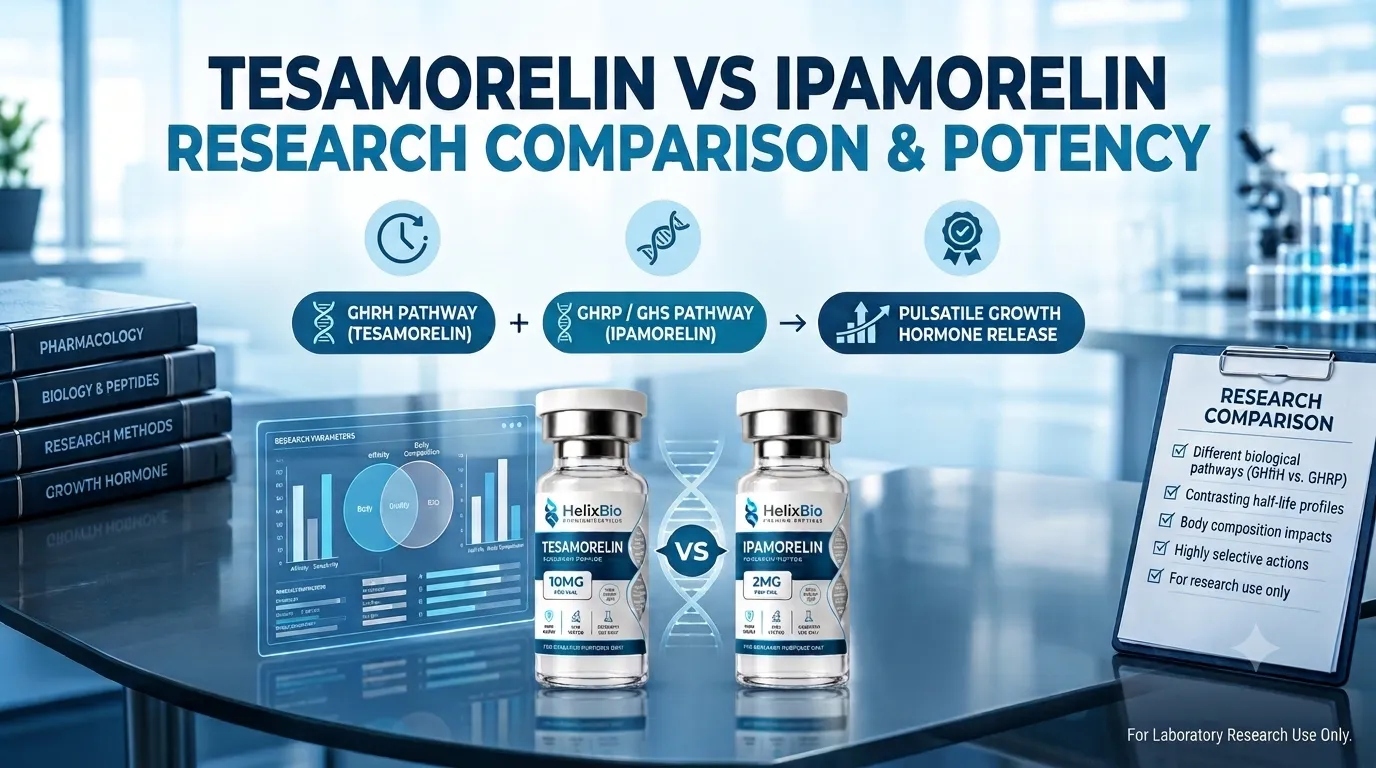
Tesamorelin is a 44-amino-acid GHRH analogue that binds GHRH receptors on pituitary somatotrophs.
Ipamorelin is a pentapeptide of roughly 712 daltons that binds the ghrelin receptor GHS-R1a.
Two Phase 3 trials totaling 806 study subjects reported a 13.1% visceral fat reduction with tesamorelin at 26 weeks against a 2.3% increase on placebo.
All tesamorelin fat-loss evidence comes from adults with HIV-associated lipodystrophy, and no equivalent data exists in other populations.
Ipamorelin has no human trials measuring fat loss, muscle gain, or body composition.
Neither compound has human evidence of muscle gain, and tesamorelin trials reported weight neutrality with lean-mass preservation signals.
Ipamorelin's selectivity, reported by Raun and colleagues in 1998, means selective GH release over cortisol and prolactin, not a proven safety profile.
Tesamorelin holds FDA approval from November 10, 2010, while ipamorelin holds no approval and was discontinued after Phase II.
Two research peptides raise growth hormone through entirely different receptors, and most comparisons stop at that mechanical difference. A second difference matters more. Tesamorelin carries Phase 3 human trial data in a defined patient population, and ipamorelin does not. This article compares the two on mechanism, evidence tier, and documented safety signals, with the gaps stated as plainly as the findings.
Asking which is better only works once the outcome and the evidence tier are named. For visceral fat in adults with HIV-associated lipodystrophy, tesamorelin has randomized controlled trials behind it. Outside that population, neither compound has human outcome data.
Key facts, as of 24 September 2026:
Tesamorelin: FDA-approved as Egrifta for HIV-associated lipodystrophy, with Phase 3 human trial data.
Ipamorelin: no FDA approval and no long-term human safety data; evidence is preclinical and early-phase.
Fat loss: only tesamorelin has human visceral-fat data, from Falutz 2007 (n=412, −15.2% versus +5.0% on placebo at 26 weeks).
Muscle growth: neither compound has human evidence of muscle gain.
Selectivity: Raun 1998 reported dose-dependent GH release from ipamorelin without significant ACTH or cortisol elevation.
What is the difference between tesamorelin and ipamorelin?
Tesamorelin is a 44-amino-acid GHRH analogue that binds GHRH receptors on pituitary somatotrophs. Ipamorelin is a pentapeptide that binds the ghrelin receptor, GHS-R1a. Both trigger pulsatile growth hormone release and downstream IGF-1. They differ in receptor, size, half-life, and the depth of evidence behind them.
Tesamorelin
Ipamorelin
Class
GHRH analogue
Ghrelin receptor agonist
Structure
44 amino acids
Pentapeptide, ~712 Da
Receptor
GHRHR, pituitary somatotrophs
GHS-R1a, pituitary and hypothalamus
GH release
Pulsatile, via GHRH axis
Pulsatile, via ghrelin axis
Half-life
26 min healthy, 38 min HIV-positive
~2 h reported
FDA status
Approved 2010, Egrifta WR 2025
Not approved, investigational
Human outcome trials
Phase 3, N=806
Phase I and II only
Fat-loss evidence
Visceral fat, HIV lipodystrophy
None in humans
Muscle evidence
Lean-mass preservation signals
Animal models only
Think of the pituitary as having two separate doorbells. The GHRH receptor is the body's primary signal for growth hormone release, and tesamorelin presses that one. Ipamorelin presses a second, independent entry point, the ghrelin receptor.
Both routes produce pulsatile release, which preserves the natural rhythm of the GH axis. Neither floods the system with exogenous growth hormone.
Structure explains much of the rest. Tesamorelin runs 44 amino acids with a trans-3-hexenoic acid modification at the N-terminus, which confers resistance to DPP-IV degradation. Ipamorelin is five amino acids, roughly 712 daltons, carrying the sequence Aib-His-D-2-Nal-D-Phe-Lys-NH2.
Endocrine literature describes co-administration of a GHRH analogue with a GH secretagogue as producing supra-additive GH release. The mechanistic rationale for combining them is real. No controlled trial has tested whether tesamorelin plus ipamorelin improves any outcome compared with tesamorelin alone.
Which reduces visceral fat, tesamorelin or ipamorelin?
Tesamorelin is the only one of the two with human fat-loss data, and that data comes from a specific population. Falutz and colleagues published a 26-week randomized, double-blind, placebo-controlled trial in the New England Journal of Medicine in 2007. Visceral adipose tissue fell 15.2% in the tesamorelin arm and rose 5% in the placebo arm.
The placebo arm matters more than it first appears. Study subjects receiving placebo gained visceral fat over the study period, so the net treatment difference exceeds what the 15.2% figure alone suggests.
A second Phase 3 trial enrolled 396 study subjects over the same 26 weeks and reported a 10.9% reduction in visceral fat. Pooled across both trials, 806 study subjects showed a 13.1% reduction against a 2.3% increase on placebo.
Longer data exists beyond the 26-week mark. Pooled Phase 3 results presented at EACS in 2009 showed roughly 18% visceral fat reduction sustained at 52 weeks.
Every one of those figures comes from adults with HIV-associated lipodystrophy. That population qualifier is not optional. The trials were designed in that population, the label is written for that population, and no equivalent data exists for anyone else.
Stanley and colleagues published a six-month randomized trial in JAMA in 2014, reporting visceral fat reduction alongside reductions in liver fat and improvements in triglycerides. The direction of those findings is established, and the exact liver-fat percentage sits outside the sources reviewed for this article.
Ipamorelin has no human fat-loss trials at all. Its animal literature includes GH release and effects on body composition in rodent models. Preclinical signals describe what happens in research models, and they do not establish what happens in people.
The verdict here is not close. For visceral fat, tesamorelin has human randomized evidence in one population and ipamorelin has none anywhere.
Which is better for muscle growth and body composition?
Neither compound has human evidence of muscle gain, and any source claiming otherwise is reading mechanism as outcome.
Tesamorelin trials reported weight neutrality with signals of lean-mass preservation. The label states plainly that the drug is not indicated for weight loss management. Preserving lean mass while visceral fat falls is a different finding from building muscle, and conflating the two misreads the data.
Ipamorelin's muscle case rests on animal work. Svensson and colleagues reported lean-mass preservation in catabolic and aged rats in 2000, and earlier work in 1998 examined bone density. Those are legitimate preclinical findings that generate hypotheses.
What they do not do is predict human body-composition outcomes. The step from rodent lean-mass preservation to human muscle gain has not been taken in any published trial.
Saying this plainly is more useful than hedging. On muscle growth, both compounds sit at the level of rationale, not evidence.
What side effects have been reported for each?
This question cannot be answered head-to-head, because the two compounds have incompatible evidence bases. Tesamorelin has a prescribing label built from its Phase 3 trial program. Ipamorelin has no label and limited human data. Comparing them on safety compares a measured profile against an absence of measurement.
Tesamorelin's label-reported signals cluster in three areas. IGF-1 elevation occurs and the label recommends monitoring it. Glucose intolerance and diabetes risk appear, with the label directing evaluation of glucose status before and during therapy. Fluid retention shows up as edema, arthralgia, and carpal tunnel syndrome, and injection-site reactions are common.
Contraindications on the label are specific. Active malignancy, pregnancy, and disruption of the hypothalamic-pituitary axis all appear.
Ipamorelin's tolerability argument rests on selectivity. Raun and colleagues described it in 1998 as the first selective growth hormone secretagogue. The paper showed dose-dependent GH release without significant ACTH or cortisol elevation. Prolactin, FSH, LH, and TSH were also unaffected.
The selectivity claim needs reading precisely. It means selective for GH release over cortisol and prolactin release, and it does not mean a unique receptor or a proven safety profile. GHRP-2 and GHRP-6 raise cortisol where ipamorelin does not, which is a pharmacological distinction, not a clinical safety finding.
No long-term human safety data exists for ipamorelin. A favorable selectivity profile is a reason to study something further, and it is not a substitute for having studied it. Purity of a research material says nothing about safety in any context. Helix Bio Chem products are sold for laboratory research use only, not for compounding, human use or veterinary use.
What did the results timeline actually measure?
Published trials measured tesamorelin outcomes at 26 weeks and at 52 weeks, and those are study durations, not expectations. That distinction matters because competitor pages routinely convert trial endpoints into promises.
The 26-week mark is where both pivotal Phase 3 trials reported their primary visceral fat outcomes. Pooled extension data presented in 2009 produced the 52-week figure.
One extension finding deserves particular attention. Study subjects switched from tesamorelin to placebo saw visceral fat return toward baseline. Whatever the trials demonstrated, they demonstrated it under continued treatment.
Ipamorelin has no comparable timeline, because it has no body-composition trials to measure one from. Human ipamorelin data covers Phase I pharmacology and a discontinued Phase II program in postoperative ileus.
Has the tesamorelin and ipamorelin combination been studied?
The mechanistic rationale for combining them exists in the endocrine literature, and controlled outcome evidence does not. GHRH analogues and GH secretagogues act on separate receptors, and their co-administration has been described as producing supra-additive GH release.
What exists there is a pharmacology finding. Whether the combination improves any measured outcome over tesamorelin alone has not been tested in a controlled trial. The full evidence review sits in a separate article on the combination.
How do they compare to sermorelin and CJC-1295?
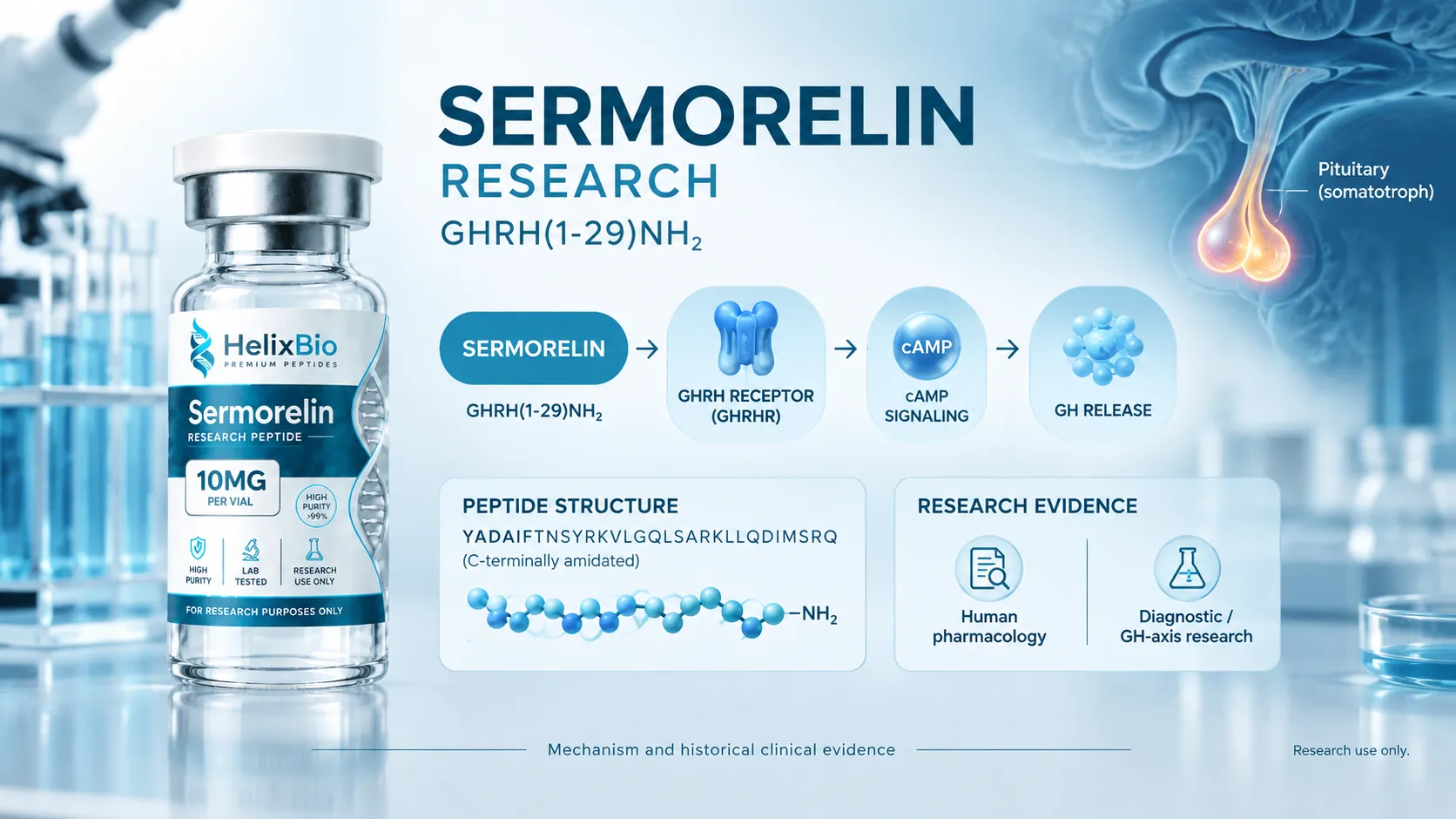
Sermorelin is another GHRH analogue and shares tesamorelin's receptor target. The comparison between them turns on structure and regulatory history, covered in the sermorelin and tesamorelin comparison.
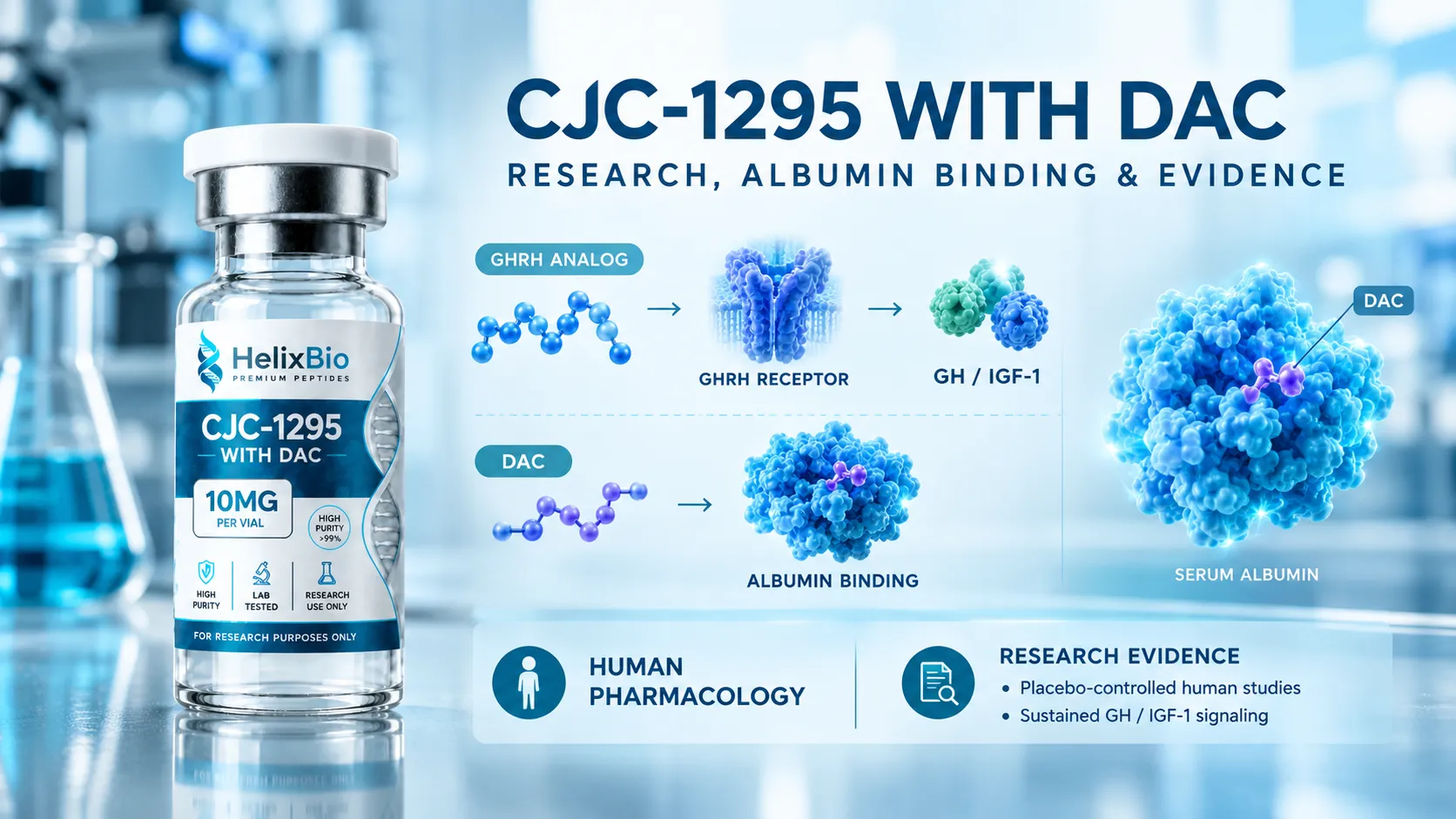
CJC-1295 is a modified GHRH analogue frequently paired with ipamorelin in research discussion, which makes it the more common counterpart in combination literature.
Both comparisons sit outside this article's scope. What carries across all four compounds is the same evidence question. Approved indications and Phase 3 data exist for some, and mechanistic rationale exists for others.
The evidence verdict
Three tiers separate what is known from what is assumed.
Proven in humans covers tesamorelin's visceral fat reduction in adults with HIV-associated lipodystrophy. Two Phase 3 trials totaling 806 study subjects established it, and 52-week pooled data sustained it.
Plausible but untested covers ipamorelin's selectivity profile as a tolerability advantage, and the supra-additive GH release rationale behind combining a GHRH analogue with a secretagogue. Both rest on real pharmacology and neither has outcome trials.
Unknown covers by far the largest territory. Ipamorelin has no human body-composition outcomes. Tesamorelin has no efficacy data outside its approved population. Long-term cardiovascular safety for tesamorelin is unestablished by its own label, and long-term safety for ipamorelin is unestablished by absence of data.
Regulatory status reflects that evidence gap. Tesamorelin received FDA approval on November 10, 2010, and the formulation has evolved since, with Egrifta WR approved in early 2025 and replacing Egrifta SV. Ipamorelin holds no FDA approval for any indication, and its development was discontinued after Phase II.
Got Questions?
Frequently Asked Questions
A mechanistic rationale exists and outcome evidence does not. GHRH analogues and GH secretagogues act on separate receptors, and endocrine literature describes their co-administration as producing supra-additive GH release. No controlled trial has tested whether the pairing improves any measured outcome over tesamorelin alone.
Tesamorelin is the only one with human fat-loss data. Two Phase 3 trials totaling 806 study subjects showed a 13.1% visceral fat reduction at 26 weeks against a 2.3% increase on placebo. Those results come from adults with HIV-associated lipodystrophy. Ipamorelin has no human fat-loss trials.
No published human trial has tested ipamorelin for visceral or abdominal fat. Its animal literature includes body-composition signals in rodent models, which generate hypotheses without establishing human outcomes. Claims that ipamorelin targets visceral fat are mechanistic speculation presented as findings.
Neither has human evidence of muscle gain. Tesamorelin trials reported weight neutrality with lean-mass preservation signals, which differs from building muscle. Ipamorelin's muscle case rests on lean-mass preservation in catabolic and aged rats, reported by Svensson and colleagues in 2000.
The question cannot be answered head-to-head. Tesamorelin has a prescribing label documenting IGF-1 elevation, glucose intolerance risk, fluid retention, and injection-site reactions. Ipamorelin has no label and limited human data, so its profile is unmeasured, which is not the same as favorable.
The tesamorelin label addresses glucose directly. It identifies glucose intolerance and diabetes risk as safety considerations, and it directs evaluation of glucose status before and during therapy. That is a label-reported signal from the trial data.
No human data establishes an answer. Fluid retention appears on the tesamorelin label as edema, arthralgia, and carpal tunnel syndrome. Ipamorelin has no comparable safety documentation, and absence of reported effects reflects absence of study.
No, and the label says so explicitly. Tesamorelin received FDA approval on November 10, 2010 for reduction of excess abdominal fat in HIV-infected adults with lipodystrophy. The label states that it is not indicated for weight loss management, and that long-term cardiovascular safety has not been established.
Ipamorelin holds no FDA approval for any indication. Novo Nordisk developed it under the code NNC 26-0161, and it was first described in 1998. Development was discontinued after Phase II trials in postoperative ileus. It is supplied as a research material.
Extension-phase data speaks to this directly. Study subjects switched from tesamorelin to placebo saw visceral fat return toward baseline. Whatever the trials demonstrated, they demonstrated it under continued treatment and not as a lasting change.
The sources reviewed for this article report no sex-stratified efficacy analyses. Pivotal tesamorelin trials enrolled adults with HIV-associated lipodystrophy, and the published summaries do not break outcomes down by sex. Ipamorelin has no human body-composition trials in either sex.
Storage conditions are specified per lot on the certificate of analysis for each compound. Lyophilized research peptides are generally held frozen or refrigerated and protected from light and moisture until needed for a study.