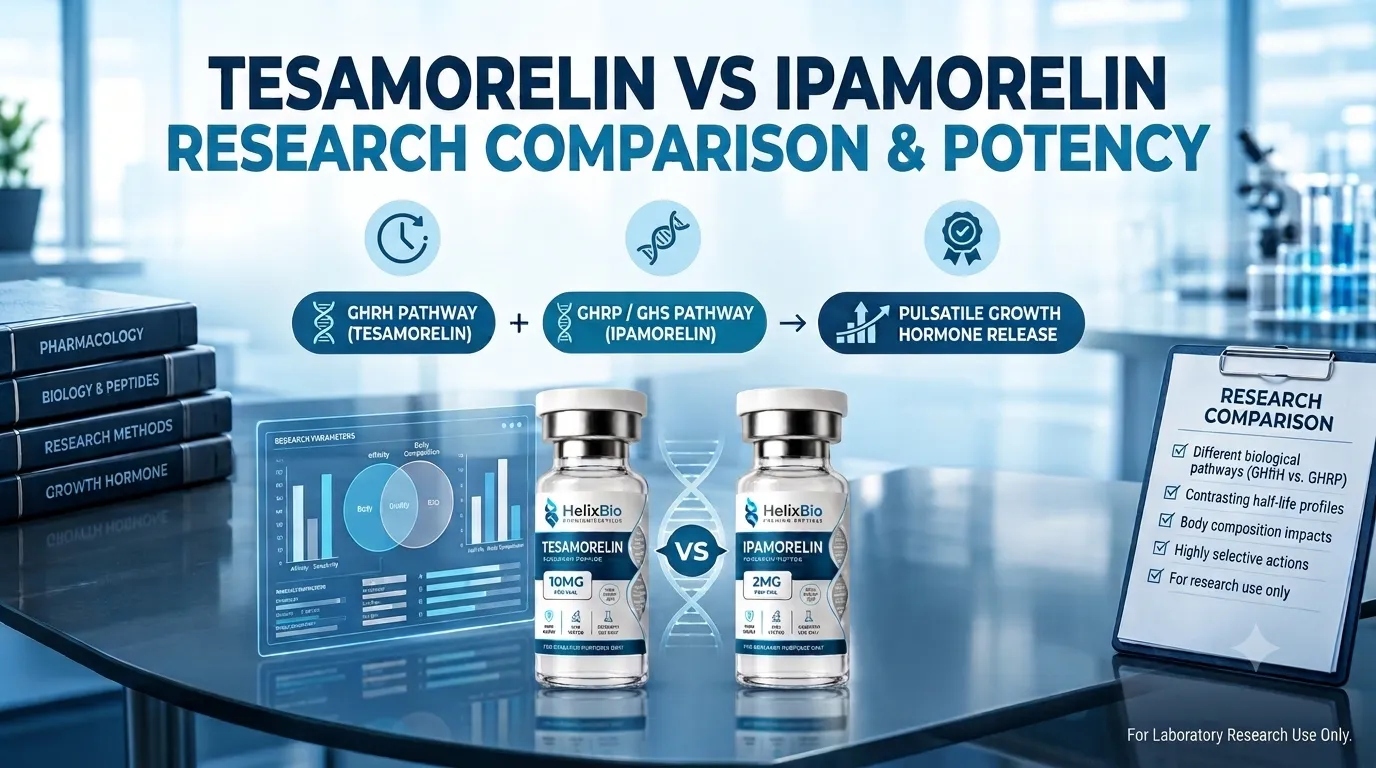
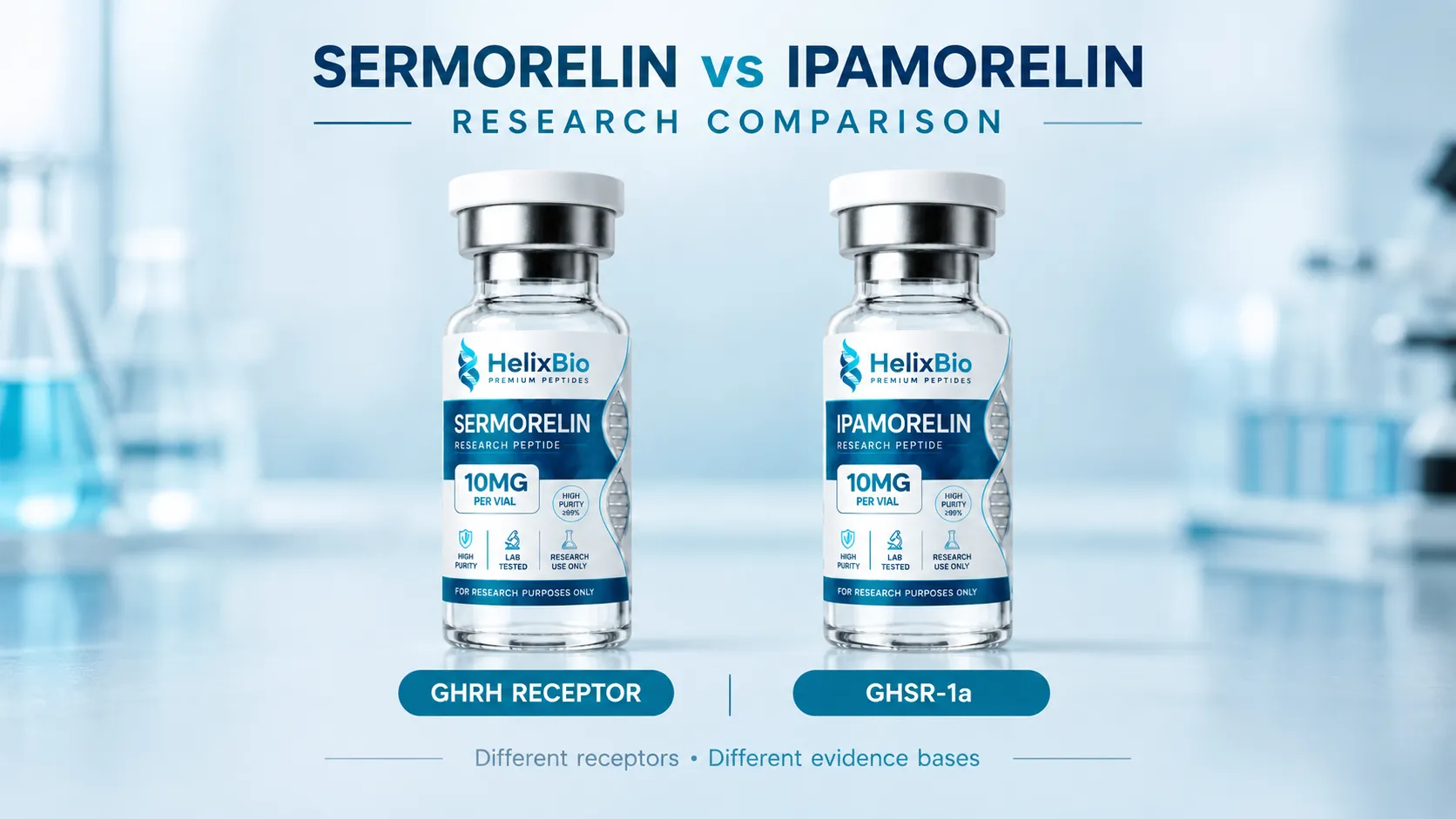
- No published head-to-head trial of sermorelin against ipamorelin was located in the searches performed for this article.
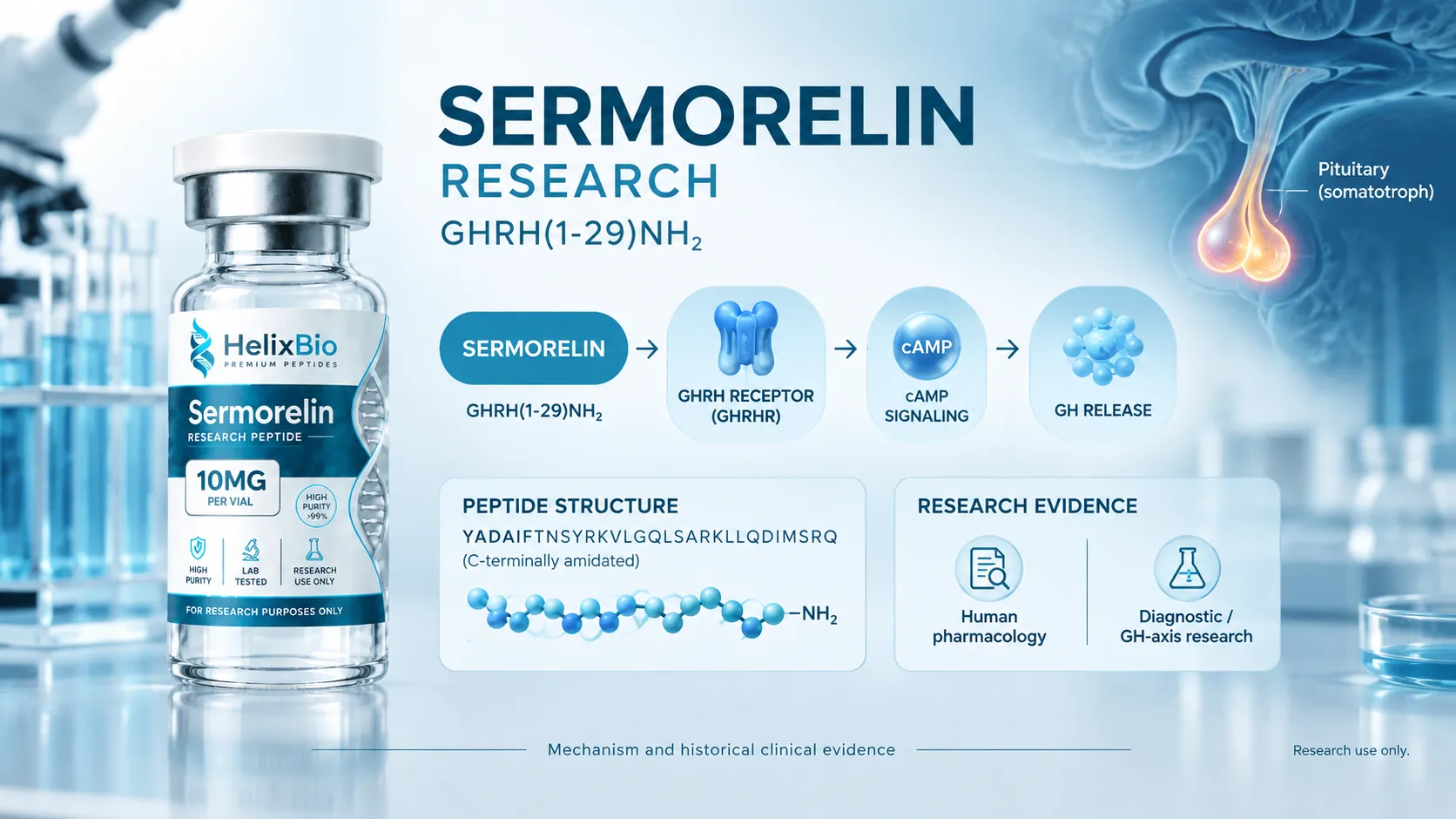
- Sermorelin is GHRH(1-29), a 29-residue fragment of native human GHRH, and acts at the pituitary GHRH receptor.
- Ipamorelin is a synthetic pentapeptide that acts at GHSR-1a, the ghrelin receptor. It is not a GHRH analog.
- Sermorelin's human record is deeper: an open-label pediatric trial, several small older-adult studies, and one randomised trial of a close analog.
- Ipamorelin's human record is two studies: a pharmacokinetic trial in 40 healthy men and a Phase 2 trial in 117 patients that missed its endpoint.
- The claim that ipamorelin spares cortisol and prolactin comes from swine. It is preclinical evidence, not a human finding.
- The one randomised trial usually cited for sermorelin tested [Nle27]GHRH(1-29)-NH2, an analog, not sermorelin itself.
- Sermorelin reached the US market as Geref, with applications withdrawn effective June 18, 2009. Ipamorelin was never FDA approved.
No published trial has compared sermorelin and ipamorelin directly. Sermorelin acts at the GHRH receptor and once reached the market as an approved drug. Ipamorelin acts at the ghrelin receptor and rests on two small human trials, the larger of which missed its endpoint. Every comparison below is indirect.
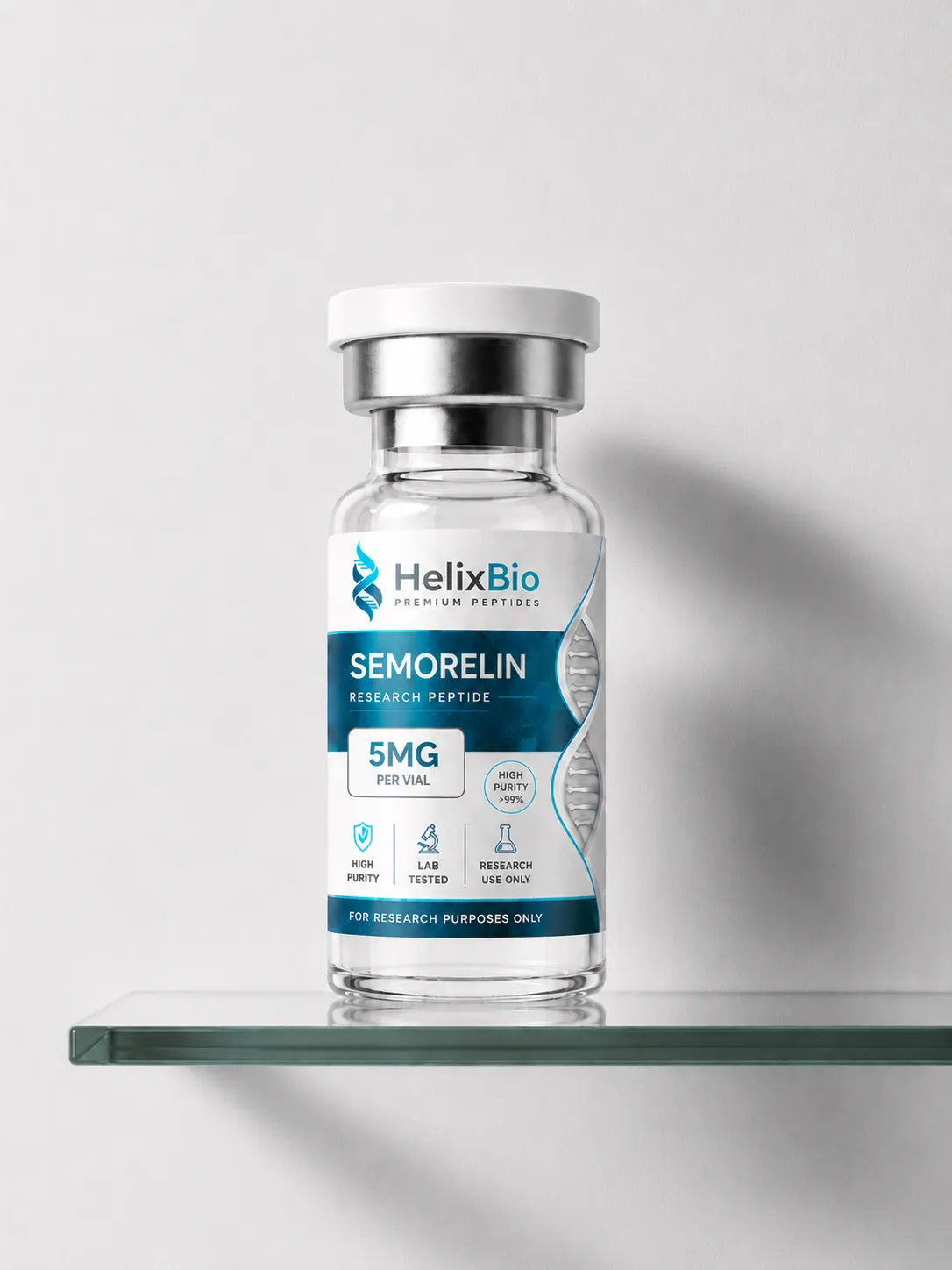
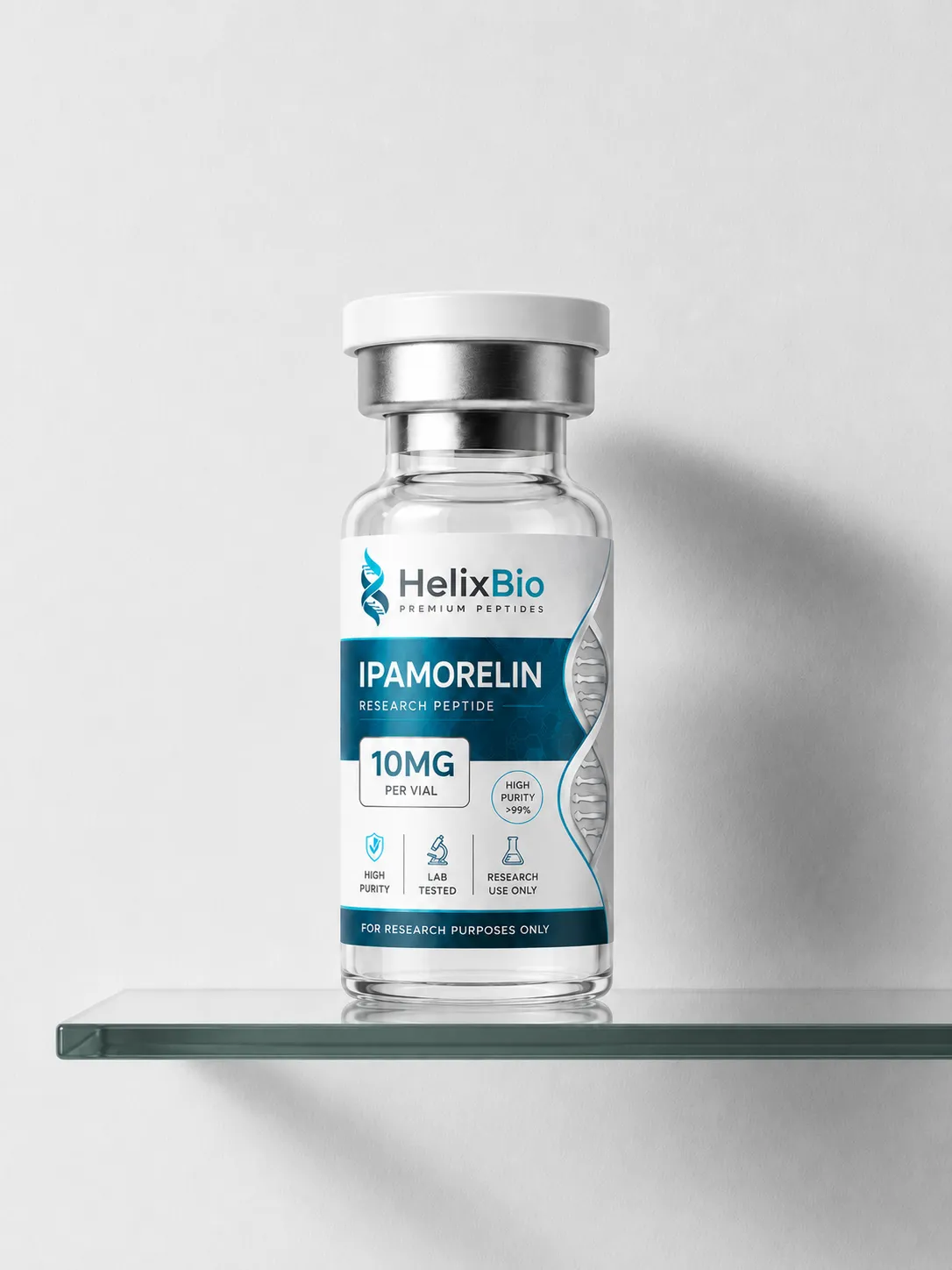
Two compounds, one obvious question, and no trial that answers it. No such study was located in the searches performed for this article, so what follows places two separate evidence bases next to each other.
That gap shapes the whole comparison. Sermorelin carries a human record reaching back to a drug that actually reached the market. Ipamorelin rests on two small human trials, and the larger of the two missed its endpoint. Treating the pair as evenly matched options misreads what has been published.
Helix Bio Chem supplies both compounds as research materials for laboratory use only. Nothing on this page describes dosing, administration, reconstitution, or human use, and no claim here should be read as therapeutic guidance.
Which is better, sermorelin or ipamorelin?
This table sets out what each compound is and what has been measured in people. The evidence rows carry more weight than the mechanism rows. Two compounds can look symmetrical in a grid while their evidence bases differ by an order of magnitude.
Attribute | Sermorelin | Ipamorelin |
|---|---|---|
Peptide class | Synthetic GHRH analog, usually supplied as the acetate salt | Synthetic pentapeptide, a ghrelin mimetic |
Amino acid length | 29 residues, the N-terminal fragment of the 44-residue human GHRH | 5 residues, Aib-His-D-2-Nal-D-Phe-Lys-NH2 |
Receptor target | GHRH receptor on pituitary somatotrophs | GHSR-1a, the ghrelin receptor |
Signaling route | Enters through the same pituitary receptor the hypothalamus uses for native GHRH | Enters through the ghrelin receptor, a separate pathway. It is not a GHRH analog |
Half-life | Short acting, on the order of minutes. Review sources give roughly 10 to 20 minutes, and the figure depends on method (review) | 2 hours terminal half-life after intravenous infusion in healthy men (human PK study) |
GH pulse character | Repeated nightly or twice-daily administration raised nocturnal and 24-hour GH in older adults (human, uncontrolled) | One GH episode per dose, peaking near 0.67 hours after infusion (human PK study) |
Cortisol and prolactin | Not an endpoint in the human trials cited here | No ACTH, cortisol, or prolactin rise in swine (preclinical). No human endpoint located |
Feedback regulation | The signal still passes through somatostatin opposition and IGF-1 feedback (review) | Acts outside the GHRH receptor. Feedback behaviour was not characterised in the human trials located |
Human evidence depth | One open-label pediatric trial, several small older-adult studies, one randomised trial of a close analog | One pharmacokinetic study in 40 men, one Phase 2 trial in 117 patients that missed its endpoint |
Regulatory record | Marketed as Geref. Applications withdrawn effective June 18, 2009, and the FDA determined in 2013 that the withdrawal was not for safety or effectiveness (regulatory record) | Never approved by the FDA for any indication. Phase 2 development for postoperative ileus was discontinued (regulatory record) |
Primary research applications | Pituitary GH secretory capacity, the GH axis in aging, pediatric growth failure | GH secretagogue pharmacology, receptor selectivity, gastrointestinal motility |
Rows labelled preclinical come from animals. Animal findings do not turn into human findings by sitting in the same table as human ones.
What is sermorelin and how does it work?
Native human GHRH runs 44 amino acids long. Sermorelin is GHRH(1-29), the N-terminal fragment that carries the biological activity, and it usually arrives as the acetate salt. The hypothalamus releases GHRH, the pituitary responds, and sermorelin steps into that same signalling chain at the GHRH receptor.
Because the signal enters through the normal receptor, the normal brakes stay in place. Somatostatin continues to oppose GH release at the pituitary. Feedback from circulating IGF-1 continues to operate as well. Review literature treats that preserved feedback as a practical argument for studying GHRH peptides at all. That is framing, not a finding, since reviews sit lower on the evidence ladder than trials.
One caution travels with the whole class. Findings for one GHRH analog do not automatically carry across to another. Our overview of GHRH analogues and GHRPs covers that boundary in more detail. Compound-level identity data for the material itself sits on the sermorelin research material page.
How does ipamorelin differ from sermorelin?
Ipamorelin is a five-residue synthetic peptide, Aib-His-D-2-Nal-D-Phe-Lys-NH2, first described by Raun and colleagues in 1998. It binds GHSR-1a, the ghrelin receptor. Nothing about its structure makes it a GHRH analog, and vendors who file it under that heading are wrong on the pharmacology.
Both compounds end up asking the same gland for the same hormone. Getting there is where they part. One arrives through the GHRH receptor, the other through the ghrelin receptor, and that single difference drives most of what separates them in the literature. Identity details for the material appear on the ipamorelin research material page.
Much of ipamorelin's reputation rests on a single selectivity finding. Raun's group reported GH release without a rise in ACTH or cortisol, and without a prolactin effect. That work was done in swine. It is preclinical evidence, and no human study located here measured those hormones after ipamorelin.
What did the human trials measure?
The sermorelin record
Sermorelin's deepest human data come from children. The Geref International Study Group trial enrolled 110 previously untreated prepubertal GH-deficient children, with 86 eligible for efficacy analysis, in an open-label multicentre study. Height velocity rose from about 4.1 to 8.0 cm per year at six months, and treatment was well tolerated. Open-label design with no control arm keeps this at the uncontrolled human tier.
Older adults came next in the sermorelin literature. Corpas and colleagues gave GHRH(1-29) twice daily to healthy old men in 1992. Both 24-hour GH and IGF-I moved back toward levels seen in young men. That study treated 10 older men, with 9 younger men sampled only at baseline as a reference group. Dose order was randomised, and no placebo arm was included.
Vittone's 1997 study took a different approach in 11 healthy men aged 64 to 76. Six weeks of nightly GHRH(1-29) raised mean nocturnal GH release. Weight, DEXA measures of muscle and fat, muscle histology, glucose, insulin and lipids stayed unchanged. The investigators recorded no significant adverse effects. Their conclusion was that single nightly doses are less effective than multiple daily doses at producing GH-mediated and IGF-I-mediated effects. This was a single-arm study with no placebo group and no randomisation.
Only one randomised controlled trial sits in this part of the record, and it carries a caveat that most comparison pages drop. Khorram's 1997 single-blind, placebo-controlled trial in 19 adults aged 55 to 71 tested [Nle27]GHRH(1-29)-NH2. That is a sermorelin analog, not sermorelin. GH and IGF-I rose in both sexes, and gains in lean mass, insulin sensitivity, well-being and libido appeared in men only.
The ipamorelin record
Ipamorelin's human file is two studies deep. Gobburu's 1999 pharmacokinetic trial infused the compound into 40 healthy men across five dose levels. Terminal half-life came out at 2 hours. GH release appeared as a single episode peaking around 0.67 hours. No cortisol, prolactin, body-composition, or sleep endpoints were collected. Subcutaneous administration was not tested in that protocol.
The second study is the one vendors rarely mention. Beck and colleagues ran a multicentre, double-blind, placebo-controlled Phase 2 trial in 117 bowel resection patients with postoperative ileus. The compound was well tolerated in that population. No key or secondary efficacy endpoint separated it from placebo. Median time to first tolerated meal was 25.3 hours against 32.6 hours for placebo, with p = 0.15. This is the largest published human ipamorelin trial, and it did not meet its endpoint.
Depth of evidence is not the same as size of effect. Sermorelin has been measured more often and in more populations. Nothing in that record establishes it as more effective than ipamorelin for anything, because the comparison has never been run.
Is there evidence for sermorelin or ipamorelin in women?
No female-only human efficacy trial exists for either compound. Two sources carry almost all of the usable information, and both concern GHRH peptides.
Khorram's randomised trial included men and women. GH and IGF-I rose in both sexes, yet the improvements in lean mass, insulin sensitivity, well-being and libido showed up in men only. Sleep quality was unaffected in both sexes. Remember that the molecule tested was an analog of sermorelin.
Estrogen status appears to matter here. Merriam's 2001 review summarised two six-month studies in older adults. IGF-1 rose about 30% in men and about 23% in women who were not taking estrogen. Women on oral estrogen showed no significant rise. Body fat fell by roughly 5 to 8%, with the effect blunted in estrogenized women.
Ipamorelin has nothing comparable in its file. Its bone and muscle data come from female rats, which makes those studies animal evidence, not women-specific clinical evidence.
What are the side effects of sermorelin and ipamorelin?
Adverse-event information for sermorelin and GHRH(1-29) is thin but real. The pediatric trial reported good tolerability. Khorram's analog trial reported transient hyperlipidemia as its only adverse effect. Geref-era label summaries, which are secondary sources, describe injection-site irritation as the most common complaint, at roughly one subject in six. The underlying label was not re-opened in the searches performed for this article.
Ipamorelin's human safety record amounts to one small surgical Phase 2 trial and one pharmacokinetic study. Both of those studies were short in duration. No long-term human safety data for ipamorelin was located for this article.
The selectivity question deserves a plain statement. Evidence that ipamorelin spares cortisol and prolactin traces to swine work. No human endpoint in the studies found here has reproduced it. A compound can be highly pure, correctly identified, and still have an uncharacterised safety profile. Purity data describes what is in the vial and says nothing about what the compound does in a body.
Is sermorelin FDA approved?
Three separate events get collapsed into one sentence on most pages, so they are worth separating. Sermorelin reached the US market as Geref, held by EMD Serono. The FDA's own 2013 Federal Register notice records two approval dates. NDA 19-863 was initially approved on December 28, 1990, and NDA 20-443 on September 26, 1997.
After that, the timeline splits into three. The manufacturer discontinued the product in October 2008 for commercial reasons. Withdrawal of the applications took effect on June 18, 2009. A March 2013 Federal Register determination then found Geref had not been withdrawn for reasons of safety or effectiveness. That determination describes the regulatory record and does not say the compound is safe.
Ipamorelin has no equivalent regulatory history at all. It was never approved by the FDA for any indication anywhere in its development, and Phase 2 work in postoperative ileus was discontinued.
Current compounding status is a separate question this article does not answer. Whether either compound sits in a 503A or 503B category today falls outside what was verified here. The same goes for any Category 2 designation and for advisory committee activity during 2026. Only the FDA's current lists answer that question reliably.
Where do tesamorelin and CJC-1295 fit in?
Readers comparing sermorelin and ipamorelin usually meet two other names quickly. Tesamorelin, marketed as Egrifta, is a GHRH analog and therefore belongs on the sermorelin side of the receptor split. Our sermorelin and tesamorelin comparison handles that pairing in detail.
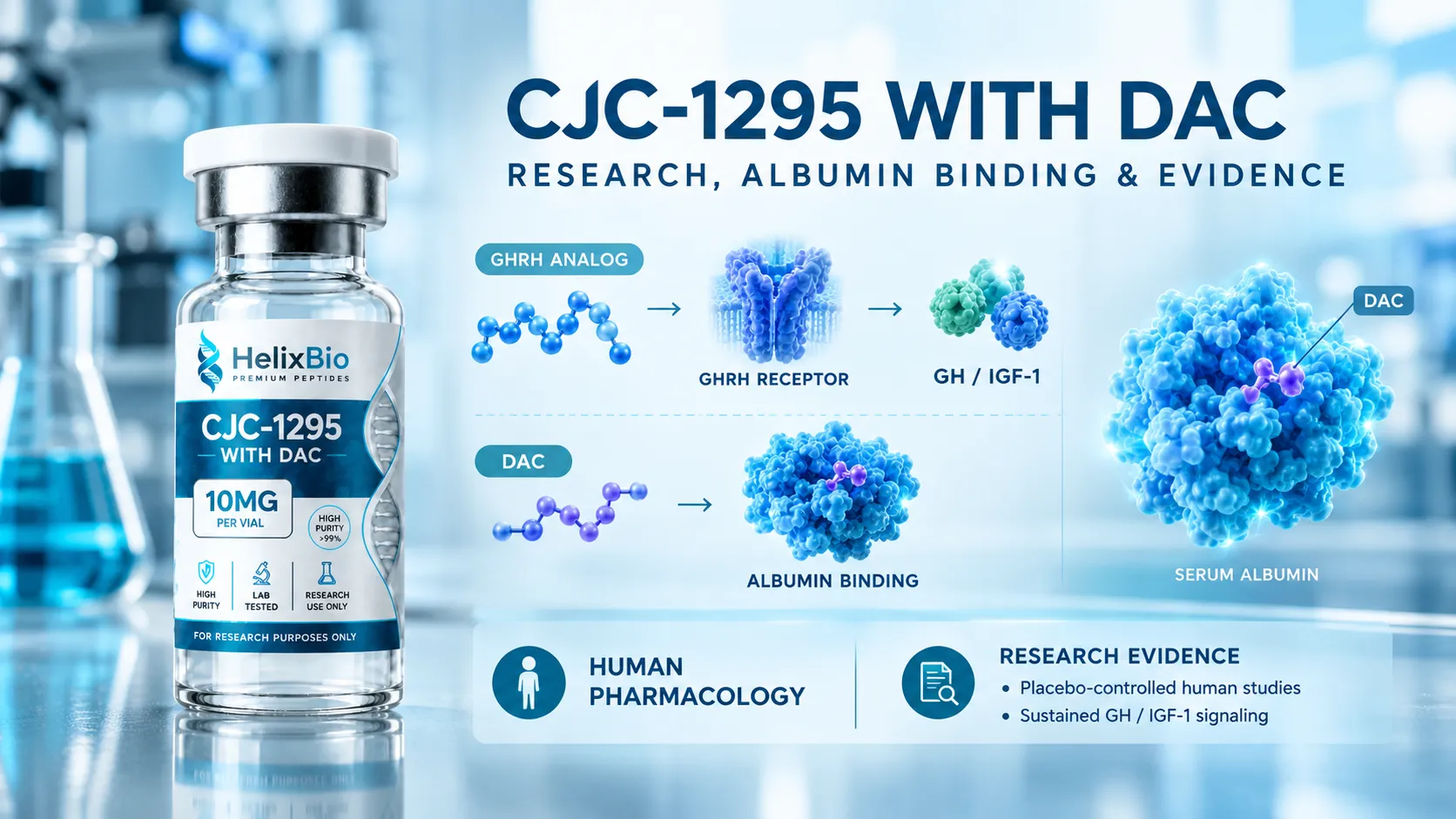
Crossing the receptor line produces a different question entirely, covered in the tesamorelin and ipamorelin comparison. CJC-1295 names more than one molecule, which causes persistent confusion in vendor copy. This article does not evaluate combinations of any of these compounds.
What the evidence does not show
Four claims circulate widely and none of them survives contact with the trial record.
Sleep claims are the first to go. Khorram's randomised trial found sleep quality unaffected in both sexes. For ipamorelin, no human sleep endpoint has been published at all.
Fat loss is the second claim worth checking. Reductions of roughly 5 to 8% in body fat appear in Merriam's review of older-adult GHRH studies, with the effect blunted in women on estrogen. Ipamorelin has no human body-composition endpoint in either of its two published human studies.
Muscle claims rest on thinner ground than they look. The lean-mass gains people cite come from Khorram's trial, which tested an analog of sermorelin, and appeared in men only. Ipamorelin's muscle data are from rats.
Longevity and anti-aging outcomes have not been tested for either compound in any trial located here. Neither has the comparison this article is named for. Anyone claiming one compound is better for sleep, fat loss, or recovery is reasoning past the evidence. The study that could settle such a claim has not been published.
Frequently Asked Questions
None was located in the searches performed for this article. Both compounds have been studied separately, and no published trial has run them against each other in one protocol. Any comparison, including this one, places two separate evidence bases side by side and reasons across the gap.
The receptor. Sermorelin acts at the pituitary GHRH receptor, which is the same receptor native GHRH uses. Ipamorelin acts at GHSR-1a, the ghrelin receptor. Both converge on pituitary growth hormone release by different routes.
Sermorelin, by a wide margin. Its record includes an open-label pediatric trial of 110 enrolled children, several small studies in older adults, and one randomised trial of a close analog. Ipamorelin has one pharmacokinetic study and one Phase 2 trial that did not meet its endpoint.
The selectivity finding comes from swine, where Raun and colleagues reported GH release without an ACTH, cortisol, or prolactin rise. No human study located here measured those hormones after ipamorelin. The claim is preclinical and should be labelled that way.
Very little that is specific. No female-only human efficacy trial exists for either compound. Khorram's randomised trial of a sermorelin analog found GH and IGF-1 rose in both sexes, while lean mass and well-being gains appeared in men only. Merriam's review reports that women on oral estrogen showed no significant IGF-1 rise.
Sermorelin is short acting, on the order of minutes, with review figures around 10 to 20 minutes that vary by method. Ipamorelin showed a terminal half-life of 2 hours after intravenous infusion in healthy men. Subcutaneous half-life figures for ipamorelin were not verified for this article.
Sermorelin reached the US market as Geref under two applications. The manufacturer discontinued it in October 2008 for commercial reasons. Withdrawal took effect on June 18, 2009, and a 2013 Federal Register determination later found it was not withdrawn for safety or effectiveness. Ipamorelin has never been FDA approved, and current compounding status for either compound falls outside this article's verified scope.
Tesamorelin, marketed as Egrifta, is a GHRH analog, so it sits on the same side of the receptor split as sermorelin. CJC-1295 is a name applied to more than one molecule, which makes vendor descriptions unreliable. Separate comparison pages cover each pairing in detail.
Storage and handling conditions belong to the certificate of analysis and the product listing for each lot, not to a comparison article. Researchers should follow the documentation supplied with the specific material. This page does not describe reconstitution or preparation of either compound.
Combination work sits outside this article. No primary source establishing a synergy claim for this specific pair was verified here, and this page evaluates each compound on its own evidence. Claims about combined protocols should be traced to a named study before they are repeated.
Sermorelin has the deeper file, and depth is not the same as superiority. More studies exist, in more populations, over more years. None of them measured sermorelin against ipamorelin, so the published record does not name a winner for any outcome.
- 01Geref International Study Group. Once daily subcutaneous growth hormone-releasing hormone therapy accelerates growth in growth hormone-deficient children during the first year of therapy. J Clin Endocrinol Metab. 1996. PMID 8772599.
- 02Corpas E, Harman SM, Pineyro MA, Roberson R, Blackman MR. Growth hormone (GH)-releasing hormone-(1-29) twice daily reverses the decreased GH and insulin-like growth factor-I levels in old men. J Clin Endocrinol Metab. 1992;75(2):530-5. PMID 1379256.
- 03Khorram O, Laughlin GA, Yen SSC. Endocrine and metabolic effects of long-term administration of [Nle27]growth hormone-releasing hormone-(1-29)-NH2 in age-advanced men and women. J Clin Endocrinol Metab. 1997;82(5):1472-9. PMID 9141536.
- 04Raun K, Hansen BS, Johansen NL, et al. Ipamorelin, the first selective growth hormone secretagogue. Eur J Endocrinol. 1998;139(5):552-61. PMID 9849822. Preclinical, swine.
- 05Gobburu JV, Agerso H, Jusko WJ, Ynddal L. Pharmacokinetic-pharmacodynamic modeling of ipamorelin, a growth hormone releasing peptide, in human volunteers. Pharm Res. 1999;16(9):1412-6. PMID 10496658.
- 06Beck DE, Sweeney WB, McCarter MD. Prospective, randomized, controlled, proof-of-concept study of the ghrelin mimetic ipamorelin for the management of postoperative ileus in bowel resection patients. Int J Colorectal Dis. 2014;29(12):1527-34. PMID 25331030.
- 07Vittone J, Blackman MR, Busby-Whitehead J, et al. Effects of single nightly injections of growth hormone-releasing hormone (GHRH 1-29) in healthy elderly men. Metabolism. 1997;46(1):89-96. PMID 9005976.
- 08Merriam GR, Barsness S, Buchner D, et al. Growth hormone releasing hormone treatment in normal aging. J Anti-Aging Med. 2001;4(4):331-343. Review.
- 09Johansen PB, Nowak J, Skjaerbaek C, et al. Ipamorelin, a new growth hormone-releasing peptide, induces longitudinal bone growth in rats. Growth Horm IGF Res. 1999;9(2):106-13. PMID 10373343. Animal study.
- 10Determination That GEREF (Sermorelin Acetate) Injection Were Not Withdrawn From Sale for Reasons of Safety or Effectiveness. Federal Register, 4 March 2013. Docket No. FDA-2012-P-1071.
Helix Bio Chem Team
Research & Product Team
Our in-house team tracks published peptide research and translates it into clear, source-cited summaries for the research community.
Reviewed by in-house research chemists
support@helixbiochem.com