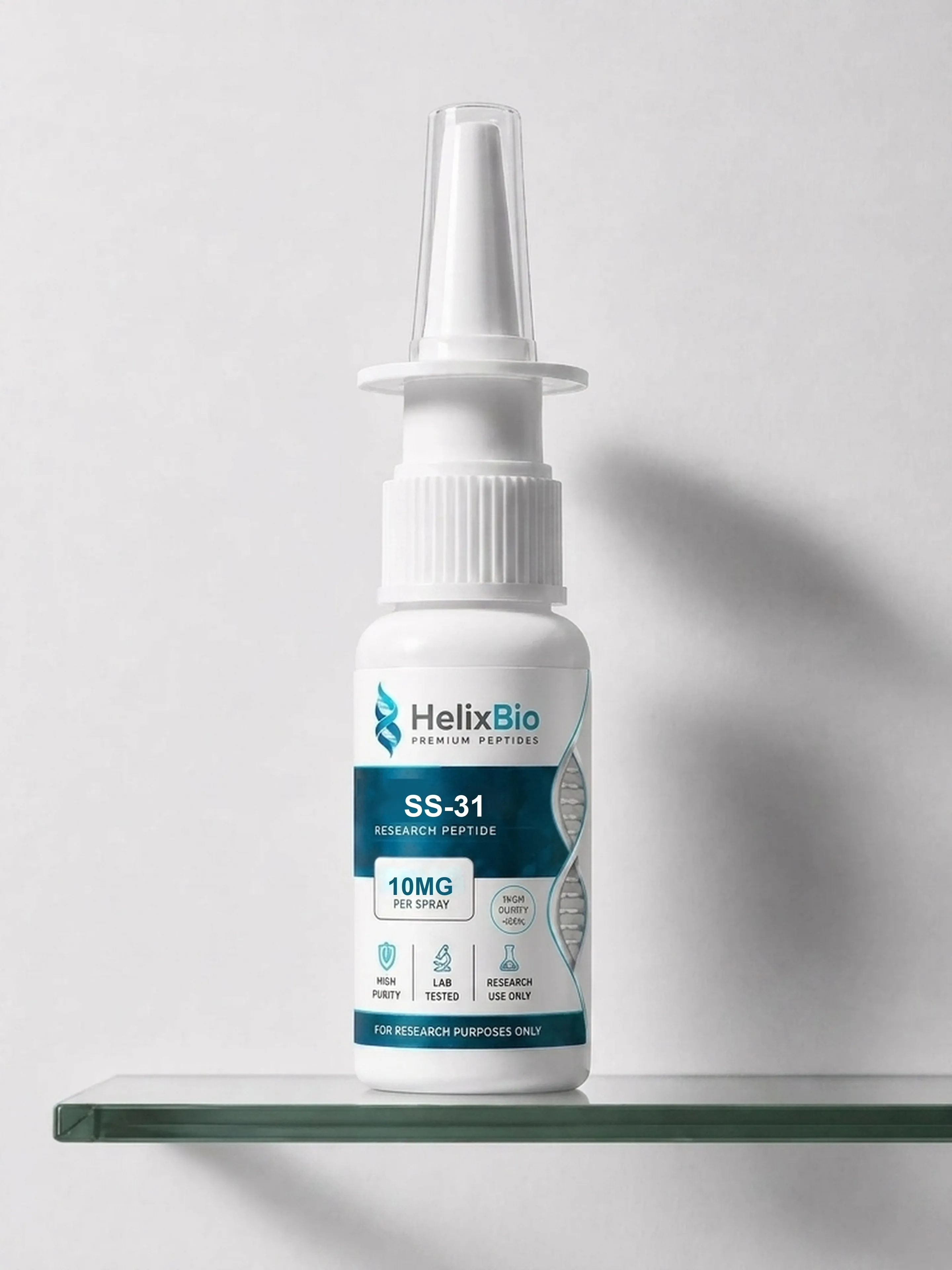
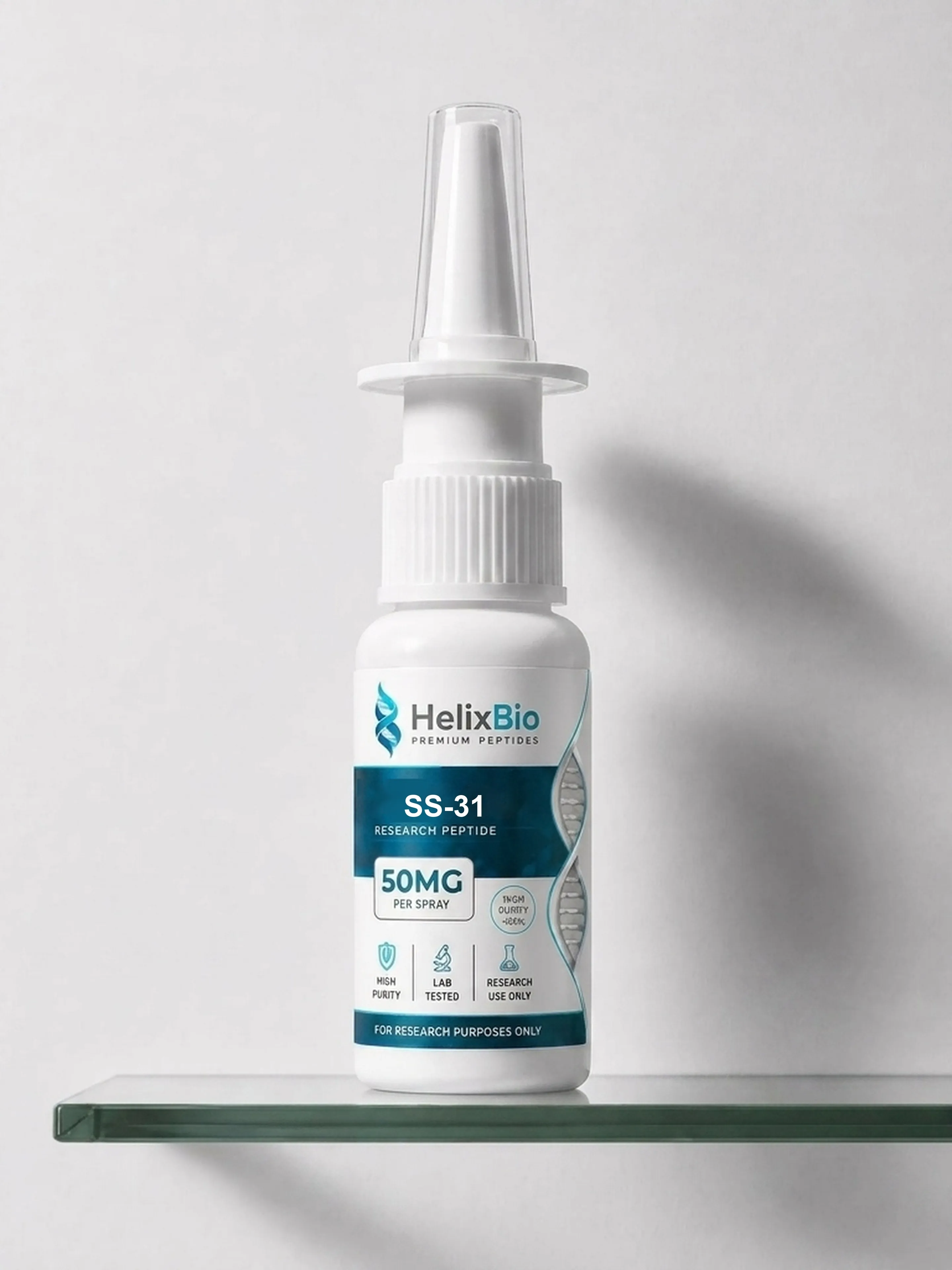
Two of the four residues in SS-31 are not what a peptide chemist would expect. The sequence — D-Arg–Dmt–Lys–Phe–NH₂ — pairs a D-configured arginine with 2′,6′-dimethyltyrosine, a non-proteinogenic residue, in an alternating cationic-aromatic arrangement that gives the molecule a net charge of +3 at neutral pH and an affinity for cardiolipin, the anionic phospholipid of the inner mitochondrial membrane. That combination is why SS-31 has become a reference compound in mitochondrial membrane research. Helix Bio supplies SS-31 Spray as a spray-format research material for qualified laboratory and scientific work. It is not intended for human or veterinary consumption, diagnosis, treatment, or prevention of disease, and it is not a treatment product of any kind.
HPLC certified
Independent analysis
Highest standard
Full traceability
SS-31 is a synthetic tetrapeptide from the Szeto–Schiller family of mitochondria-targeted peptides. Its sequence is D-Arg–Dmt–Lys–Phe–NH₂, where Dmt denotes 2′,6′-dimethyl-L-tyrosine, giving a molecular formula of C₃₂H₄₉N₉O₅ and a molecular weight of approximately 639.8 for the free base. It appears in the literature under several names, including elamipretide, MTP-131 and Bendavia.
The targeting mechanism rests on cardiolipin. Cardiolipin is an anionic phospholipid found essentially only in the inner mitochondrial membrane, which makes it an unusually specific molecular address — no targeting signal sequence is required. SS-31 binds it through two interactions working together: electrostatic attraction between the peptide’s cationic residues and cardiolipin’s anionic phosphate headgroups, and hydrophobic interaction involving the lipid acyl chains. Reported affinity in model membrane systems is in the low-micromolar range.
What distinguishes SS-31 from most compounds it is grouped with is what its accumulation does not require. Triphenylphosphonium-conjugated mitochondrial agents reach the inner membrane because a lipophilic cation is driven across it by the mitochondrial membrane potential, so their targeting weakens precisely where that potential has collapsed. SS-31’s uptake is described in the literature as energy-independent and non-saturable, driven by cardiolipin affinity rather than by membrane potential. For experimental design, that difference determines whether a targeting strategy still functions in a depolarised system.
Experimental work has examined how the peptide partitions into cardiolipin-containing membrane interfaces and alters surface electrostatics without destabilising the bilayer under tested conditions, and how it affects the interaction between cytochrome c and cardiolipin. Studies in aged mitochondria have investigated interactions involving ATP synthase and the adenine nucleotide translocator. These are findings within specific experimental systems, and the well-established biology of cardiolipin in the inner membrane is background to that work rather than evidence about the peptide.
Holding a +3 peptide in aqueous solution raises questions that a lyophilized powder does not.
The cationic character that drives cardiolipin binding is a property of ionisation state, so the vehicle’s pH and ionic strength are not incidental packaging details — they are conditions the peptide is held under between manufacture and use. Formulation parameters that would be established at reconstitution for a dry material are, in a prepared solution, fixed by the supplier and inherited by the experiment.
Salt form and counterion identity are the second question. SS-31 is supplied commercially in more than one salt form, and the counterion contributes to weighed mass, so a stated quantity means something different depending on which form it describes. The approved pharmaceutical product is the hydrochloride; research material is not necessarily the same salt. Where trifluoroacetate is present as a residue of purification, that is worth knowing before the material enters a cell-based assay. The applicable Certificate of Analysis should state the form.
Concentration expressed per millilitre, the mass delivered per actuation, the vehicle composition and the storage regime are product facts belonging to this specific preparation. They should be read from the current Helix Bio product listing and the lot-specific Certificate of Analysis, not inferred from a lyophilized SS-31 presentation, from another spray-format product, or from published research protocols.
Helix Bio does not represent any route of administration for this product. The spray designation describes the physical presentation only.
SS-31 appears across several distinct areas of experimental work:
The existence of published research does not establish that any research-use preparation is safe or effective for use in humans. Elamipretide, the same tetrapeptide, received FDA accelerated approval in September 2025 as an injectable prescription product for a specific rare genetic condition, on the basis of an intermediate endpoint, with continued approval contingent on a confirmatory trial that remains ongoing. That approval belongs to a particular pharmaceutical product and does not extend to research materials. Approval of a drug and the status of a laboratory research chemical are separate facts and should not be conflated.
Confirming the identity of this particular peptide takes more thought than most.
Helix Bio states that its research peptide catalog uses independent HPLC testing for purity assessment and mass spectrometry for molecular identity confirmation, and that batch-specific Certificates of Analysis are available. For the majority of peptides that pairing is a complete answer. For SS-31 it is complete on composition and incomplete on stereochemistry, because mass spectrometry cannot distinguish D-arginine from L-arginine — an all-L analogue of this sequence has the same formula and the same mass. Conventional achiral HPLC will not reliably separate them either.
The dimethyltyrosine is the easier of the two checks. Dmt contributes roughly 28 daltons more than tyrosine would, so a preparation built with plain tyrosine is resolvable by mass alone.
None of this means a lot is wrong. It means that for SS-31 specifically, a mass result confirms the composition rather than the full stereochemical identity, and researchers whose work depends on the D-configuration should ask whether chiral analysis or synthesis-route documentation is available for the lot rather than assuming the standard package covers it.
SS-31 Spray is intended for qualified users working in legitimate laboratory or scientific research environments, including:
It is not intended for personal experimentation, self-administration, human consumption, veterinary use, supplementation, anti-aging intervention, disease management, or medical treatment of any kind.
| Specification | Details |
|---|---|
| Product Name | SS-31 Spray |
| Research Compound | SS-31 |
| Scientific Name | Elamipretide |
| Alternative Names | MTP-131, Bendavia |
| Peptide Family | Szeto–Schiller peptide |
| Peptide Class | Synthetic aromatic-cationic tetrapeptide |
| Sequence | D-Arg–Dmt–Lys–Phe–NH₂ |
| Non-standard residues | D-arginine; 2′,6′-dimethyl-L-tyrosine (Dmt) |
| Amino Acid Count | 4, C-terminally amidated |
| Molecular Formula | C₃₂H₄₉N₉O₅ |
| Molecular Weight | ≈ 639.8 (free base) |
| CAS Number | 736992-21-5 (free base); salt forms carry separate registry numbers — confirm against the COA |
| Net Charge | +3 at neutral pH |
| Molecular Interaction | Cardiolipin, inner mitochondrial membrane |
| Format | Spray-format solution |
| Salt Form / Counterion | Verify current product documentation |
| Concentration | Verify current product specification |
| Total Content | Verify current product specification |
| Vehicle / Formulation | Verify current product documentation |
| Intended Use | Laboratory and scientific research only |
| Human Use | Not intended for human administration |
| Veterinary Use | Not intended for veterinary administration |
| Purity | Verify current lot-specific COA |
| Identity Testing | Refer to applicable Certificate of Analysis |
| Packaging | Verify current product specification |
| Storage | Follow current product label and documentation |
| Shelf Life | Verify current lot documentation |
| Manufacturer / Supplier | Helix Bio |
| Country of Origin | Not specified; verify current documentation |
Specification note: Concentration, salt form, vehicle, purity, storage and shelf life must be taken from the current product documentation and the applicable lot-specific Certificate of Analysis. Values from a lyophilized SS-31 presentation, from another supplier, or from published research protocols do not describe this preparation.
SS-31 has an unusually well-developed biophysical literature for a four-residue peptide, alongside a preclinical record and, more recently, a clinical development history.
The core body of work concerns how SS-31 associates with cardiolipin-containing membranes. Studies using model membrane systems have measured binding to vesicles containing cardiolipin, monolysocardiolipin and other anionic lipids against zwitterionic backgrounds, characterising affinity in the low-micromolar range and describing the dual electrostatic and hydrophobic contributions to binding. Related work has examined how the peptide modifies membrane surface electrostatics without destabilising the bilayer under tested conditions, and how it influences the cytochrome c–cardiolipin interaction.
This makes SS-31 a practical tool compound for membrane biophysics generally, independent of any therapeutic framing.
Experimental studies have investigated SS-31 in relation to mitochondrial respiration, ATP production and oxidative phosphorylation across a range of systems. Work in aged mitochondria has examined interactions involving ATP synthase and the adenine nucleotide translocator, with reported changes in ADP sensitivity and ATP production under the study conditions. Cross-linking mass spectrometry has been used to map the mitochondrial protein interaction landscape of the peptide, identifying interactors associated with cardiolipin and with pathways involved in ATP production.
These are observations within defined experimental systems and their endpoints, and they do not establish outcomes in humans.
SS-31 is regularly grouped with triphenylphosphonium-conjugated compounds such as MitoQ and SkQ1 under the heading of mitochondria-targeted agents. The grouping obscures a real difference in targeting strategy: TPP⁺ conjugates accumulate because the mitochondrial membrane potential drives a lipophilic cation across the inner membrane, whereas SS-31 accumulates by binding cardiolipin, in a manner described as independent of that potential. Researchers comparing targeting approaches — particularly in systems where membrane potential is compromised — should treat these as different strategies rather than variations on one.
Within the Szeto–Schiller family itself, SS-20 (Phe–D-Arg–Phe–Lys–NH₂) is the most useful structural comparator, since it shares the family architecture but lacks the dimethyltyrosine. Findings for one SS peptide should not be attributed to another.
Elamipretide — the same tetrapeptide — has been through clinical development and, in September 2025, received FDA accelerated approval as an injectable prescription product for improving muscle strength in Barth syndrome patients weighing at least 30 kg.
The evidentiary basis is worth reading precisely. The pivotal randomised crossover trial enrolled twelve patients and did not meet its primary endpoints of six-minute walk distance and total fatigue score. Approval rested on knee extensor muscle strength, an intermediate clinical endpoint, with the observed improvement coming from the open-label extension rather than the randomised phase, and continued approval is contingent on verification of clinical benefit in a confirmatory trial that remains ongoing.
That history is relevant background for anyone working with this molecule, and it establishes nothing about a research material. A drug approval concerns one manufactured product, one indication, one route and one population, under pharmaceutical quality systems and medical supervision.
Researchers should evaluate each publication according to the exact compound studied, its salt form, the model, the analytical method and the endpoints, rather than assuming findings transfer between SS peptides, between experimental systems, or from a pharmaceutical product to a laboratory material.
Analytical characterisation matters for any research peptide, because impurities, degradation products, incorrect identity or inconsistent concentration all become uncontrolled variables. For SS-31 there is an additional layer, because two of its four residues are non-standard in ways that the usual analytical package handles unevenly.
Helix Bio states that its peptide materials are subjected to independent HPLC testing for purity and mass spectrometry for molecular identity, and that batch-specific Certificates of Analysis are available for its products.
For a specific SS-31 Spray lot, researchers should consult the applicable COA and product documentation for the actual analytical results. A catalog-level purity statement is not a measured value for the material received.
Researchers should assess, where applicable:
No certification, accreditation, third-party test result or purity value should be assumed unless it is explicitly documented for the relevant product and lot.
Storage and handling requirements should be determined from the current SS-31 Spray product documentation and lot-specific instructions.
General laboratory considerations include:
Storage conditions published for lyophilized SS-31, for reconstituted preparations made in another laboratory, or for other spray-format products do not transfer to this material. A peptide held in solution is subject to different considerations from the same peptide held as a dry powder, and for a peptide whose behaviour depends on ionisation state, the vehicle’s own properties are part of the storage question. Only documentation generated for this formulation and lot describes its actual requirements.
Helix Bio’s website describes research materials as being supplied to laboratories and institutions in the United States and describes tracked shipping and cold-chain handling within its fulfillment process.
Because shipping conditions, packaging specifications, availability, and delivery requirements may change, researchers should review the current Helix Bio shipping information and product listing before ordering.
On receipt, researchers should confirm that the product name matches the order, that packaging is intact, that lot information is recorded, and that the supplied documentation corresponds to the received lot. Product packaging should remain appropriately labeled and handled as research material after delivery, and researchers are responsible for following applicable institutional, federal, state, and local requirements governing research materials.
SS-31 Spray is supplied by Helix Bio strictly as a laboratory and scientific research material. It is not intended for human or veterinary administration, ingestion, inhalation, injection, self-administration, diagnosis, treatment, cure, mitigation, or prevention of any disease or medical condition.
This product is not an approved drug and must not be treated as one. The tetrapeptide known in research literature as SS-31 is the same molecule as elamipretide, which received FDA accelerated approval in September 2025 as an injectable prescription product for improving muscle strength in patients with Barth syndrome weighing at least 30 kg. That approval applies to one specific pharmaceutical product, manufactured under pharmaceutical quality systems, for one indication, by one route, in a genetically confirmed patient population, under medical supervision. It does not extend to research materials, it does not make a laboratory chemical a therapeutic option, and no research-use preparation is a substitute for a prescribed medicine.
The approval was granted under FDA’s accelerated approval pathway on the basis of an intermediate clinical endpoint. Continued approval may be contingent on verification of clinical benefit in a confirmatory trial. Researchers and readers should not interpret an accelerated approval as a completed demonstration of clinical benefit.
This product is not a dietary supplement, consumer wellness product, anti-aging intervention or medical treatment. Preclinical and biophysical research findings do not establish outcomes in humans. Researchers are responsible for determining whether the material is appropriate and lawful for their specific research application and for complying with applicable institutional and regulatory requirements. Anyone seeking treatment for a mitochondrial condition should consult a qualified clinician.
Knowledge Base
Knowledge Base
Knowledge Base
Knowledge Base
Knowledge Base
Knowledge Base
Knowledge Base
Knowledge Base
Knowledge Base
Knowledge Base
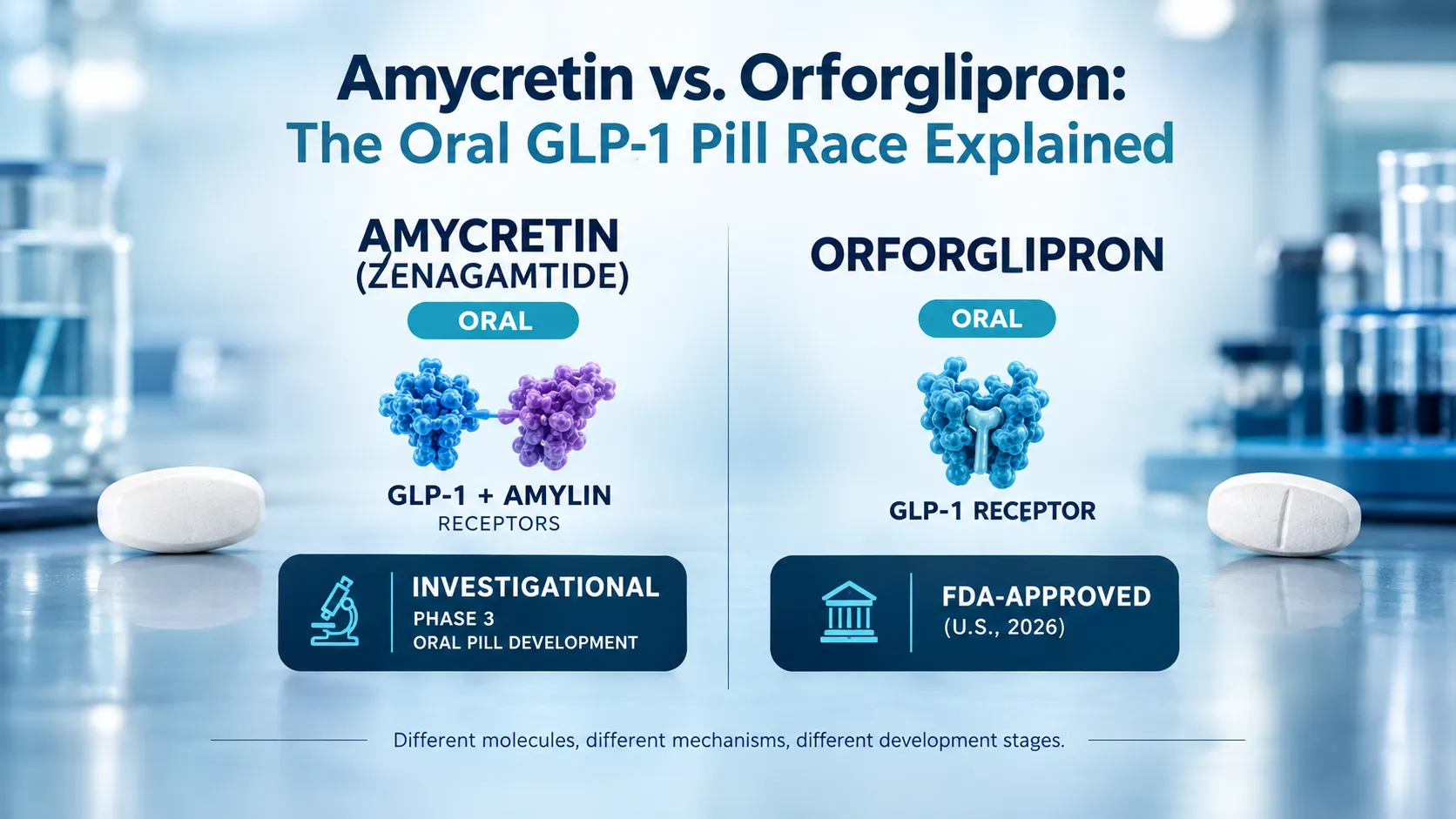
Amycretin is a peptide and orforglipron is not. How that chemistry explains the formulations, trial results, and approval status of both GLP-1 pills.
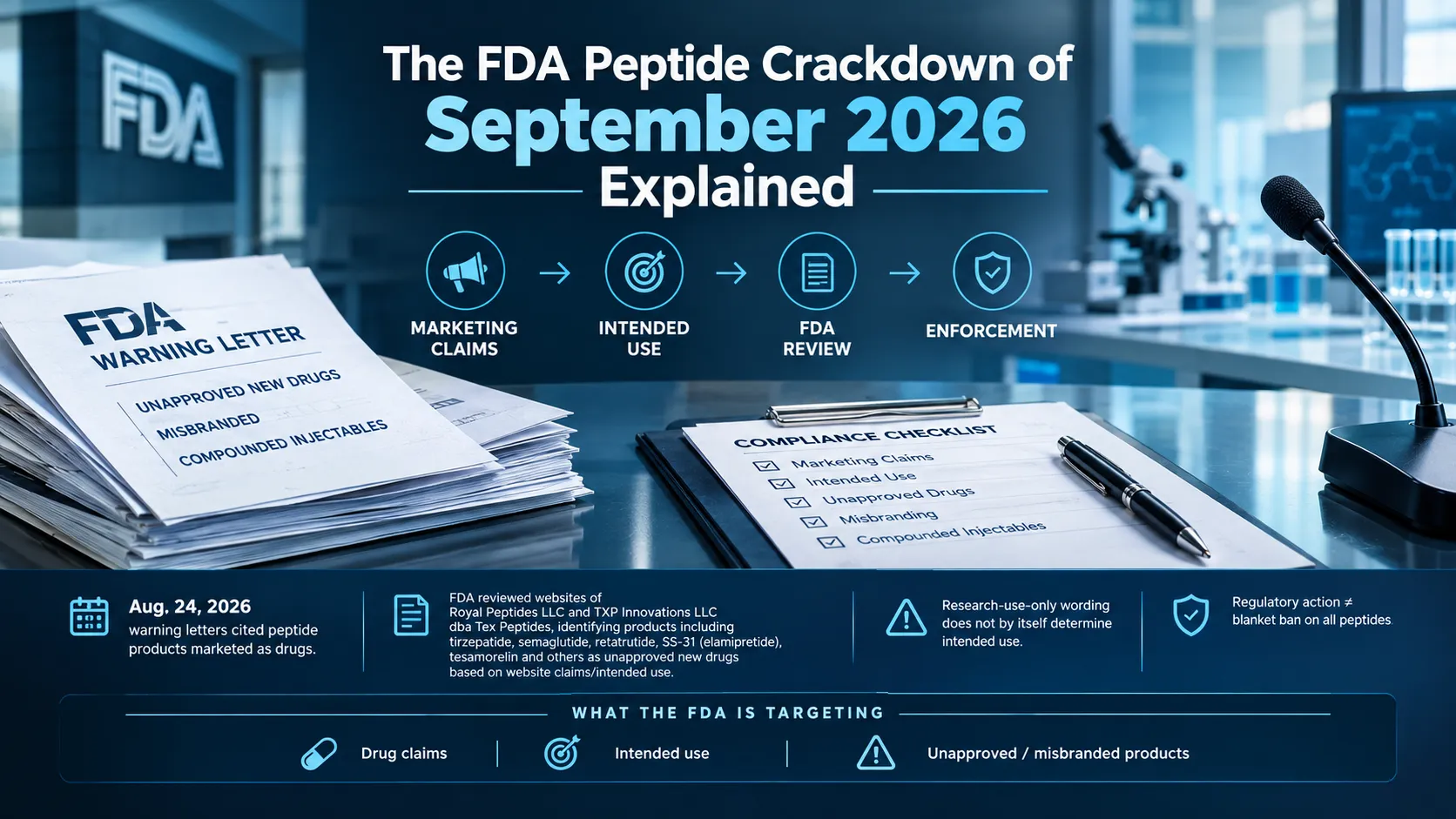
Five peptide sellers got FDA warning letters in September 2026. See who was named, why the research label failed, and the full 2026 enforcement timeline.

In July 2026, the FDA's advisory committee recommended 6 peptides for the 503A bulk list. None are on it yet. What the vote changed and what it didn't.