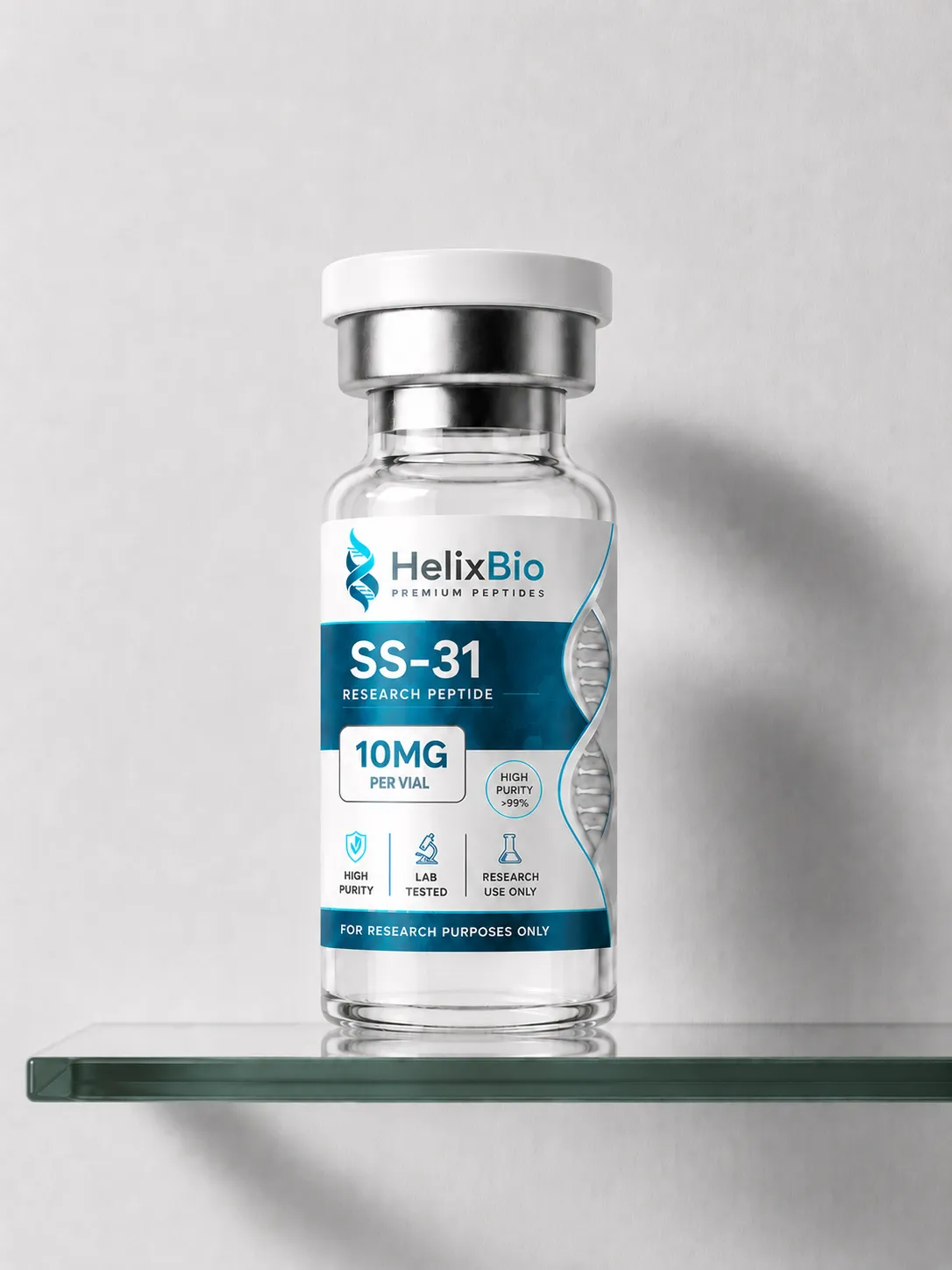
SS-31, also known as elamipretide, MTP-131, or Bendavia, is a synthetic mitochondria-targeted tetrapeptide studied extensively in laboratory research involving mitochondrial membranes, cardiolipin interactions, cellular bioenergetics, oxidative stress models, and mitochondrial protein interactions. SS-31 is particularly relevant to researchers investigating how small cationic-aromatic peptides interact with mitochondrial membranes and influence molecular processes associated with mitochondrial structure and function. Research has identified interactions between SS-31 and cardiolipin-containing membranes, as well as several mitochondrial proteins associated with energy metabolism. Helix Bio supplies research peptides for laboratory and scientific applications. The company's website states that its products are research and laboratory materials rather than products intended for human or veterinary use.
HPLC certified
Independent analysis
Highest standard
Full traceability
SS-31 is a synthetic tetrapeptide belonging to the Szeto-Schiller family of mitochondria-targeted peptides. Its commonly used scientific name is elamipretide, and it is also referred to in research literature as MTP-131 and Bendavia.
Unlike conventional peptides that are designed primarily around a particular receptor or extracellular target, SS-31 has been investigated for its interaction with mitochondrial membranes. Research has focused particularly on cardiolipin, a distinctive phospholipid associated with the inner mitochondrial membrane.
Experimental work indicates that SS-31 can associate with cardiolipin-containing membranes and alter membrane-surface electrostatics without destabilizing the lipid bilayer under the tested conditions. These properties have made SS-31 a useful research tool for investigating mitochondrial membrane biophysics and peptide-membrane interactions.
SS-31 is a short, synthetic tetrapeptide with alternating aromatic and positively charged residues. The peptide belongs to the Szeto-Schiller class of mitochondria-targeted peptides.
Its research relevance comes from several structural characteristics:
Studies comparing SS-31 with related tetrapeptide analogs have examined sequence-dependent differences in membrane binding, conformation, and interactions with cardiolipin-containing membranes.
Researchers may encounter several names for the same compound in scientific literature and databases:
| Name | Context |
|---|---|
| SS-31 | Common research designation |
| Elamipretide | Scientific/development name |
| MTP-131 | Alternative development designation |
| Bendavia | Developmental name used in research literature |
| Szeto-Schiller peptide | Peptide family classification |
| Mitochondria-targeted tetrapeptide | Functional structural description |
Researchers should verify the exact molecular identity and lot documentation rather than relying solely on a product name.
Mitochondria contain a specialized inner membrane that supports several processes involved in cellular energy metabolism. Cardiolipin is an important phospholipid within this membrane and has attracted considerable interest in mitochondrial research.
SS-31 has been investigated because of its interaction with cardiolipin and other components of the mitochondrial inner membrane. Research using biochemical, biophysical, and mass-spectrometry approaches has examined how the peptide associates with mitochondrial structures and proteins.
This makes SS-31 relevant to research models examining:
A Well-Characterized Research Target
SS-31 has been investigated across multiple areas of mitochondrial biology, giving researchers a substantial scientific literature base for understanding its molecular characteristics and experimental context.
Relevant to Mitochondrial Membrane Research
The relationship between SS-31 and cardiolipin-containing membranes is one of the most distinctive aspects of the compound. Research has examined how the peptide partitions into membrane interfaces and changes local surface electrostatics.
Suitable for Mechanistic Research
SS-31 has been investigated using approaches ranging from membrane biophysics to cross-linking mass spectrometry. Research has identified mitochondrial protein interactors associated with oxidative phosphorylation and metabolic pathways, providing useful context for mechanistic laboratory studies.
Useful for Comparative Peptide Studies
Because SS-31 belongs to the Szeto-Schiller peptide family, it can also be relevant to structure-activity research comparing peptide sequence, aromatic residues, charge distribution, membrane binding, and molecular conformation.
Documentation-Focused Supply
Helix Bio states that it provides third-party HPLC and mass-spectrometry testing and batch-specific certificates of analysis for its research peptide products. Researchers should review the COA associated with the specific SS-31 lot being considered.
SS-31 research material may be appropriate for qualified users working in:
It is not intended for consumers seeking treatment, supplementation, anti-aging intervention, disease management, or self-administration.
| Specification | SS-31 |
|---|---|
| Product Name | SS-31 |
| Scientific Name | Elamipretide |
| Alternative Names | MTP-131, Bendavia |
| Peptide Class | Synthetic tetrapeptide |
| Research Family | Szeto-Schiller peptide |
| Research Category | Cellular Health & Longevity |
| Primary Research Area | Mitochondrial biology |
| Molecular Focus | Mitochondrial membranes and cardiolipin |
| Purity | Verify current lot-specific COA |
| Appearance | Verify current product documentation |
| Form | Verify current product listing |
| Packaging | Verify current product listing |
| Storage | Follow product-specific storage documentation |
| Lot Testing | Verify current COA |
| Identity Testing | Mass spectrometry where documented |
| Purity Testing | HPLC where documented |
| Manufacturer/Supplier | Helix Bio |
| Research Use | Laboratory research only |
| Human Use | Not intended for human use |
| Veterinary Use | Not intended for veterinary use |
| Country of Origin | Verify current product documentation |
Important: Product-specific information such as vial size, stated purity, appearance, lot number, and analytical results should be taken from the current SS-31 listing and its corresponding COA. Helix Bio's website states that purity can vary by product and lot, so a generic purity figure should not replace lot-specific documentation.
Mitochondrial Membrane Research
SS-31 is particularly relevant to research involving mitochondrial membranes. Studies have examined its interactions with lipid bilayers and its association with negatively charged membrane components.
Research has reported that SS-31 interacts with cardiolipin-containing membranes and can modify membrane-surface electrostatics without causing membrane destabilization under experimental conditions.
Cardiolipin Research
Cardiolipin is a distinctive phospholipid associated with the mitochondrial inner membrane. Its interaction with proteins and peptides is an important area of mitochondrial biochemistry.
SS-31 research provides a model for investigating how a small cationic-aromatic peptide interacts with cardiolipin-rich membrane environments.
Mitochondrial Bioenergetics
Mitochondrial bioenergetics concerns the processes by which mitochondria generate and manage cellular energy.
Experimental studies have investigated SS-31 in relation to mitochondrial respiration, ATP production, oxidative phosphorylation, and mitochondrial function in different experimental systems. For example, research in aged mitochondria examined SS-31 interactions involving the adenine nucleotide translocator and ATP synthase and reported changes in ADP sensitivity and ATP production under the study conditions.
These findings are experimental observations and should not be interpreted as evidence of a particular effect in humans.
Mitochondrial Protein Interaction Studies
Cross-linking mass spectrometry has been used to investigate the mitochondrial protein interaction landscape of SS-31. One study identified protein interactors associated with cardiolipin and pathways involved in ATP production and metabolic processes.
This makes SS-31 relevant to proteomics, interactomics, mitochondrial protein research, and mechanistic studies.
Oxidative Stress Research
SS-31 has been investigated in experimental models involving mitochondrial stress and oxidative processes. Research has examined endpoints including mitochondrial membrane potential, oxidative stress markers, cellular metabolism, and related molecular pathways.
Results from cell and animal studies should remain within the experimental context in which they were generated and should not be presented as evidence of a human therapeutic outcome.
Structure-Activity Research
SS-31 is also useful as a reference compound for research into mitochondria-targeted peptide structure and function.
Studies of SS-31 and related peptide analogs have examined:
Such studies can help researchers investigate how small structural changes influence peptide-membrane interactions.
Research involving peptides requires reliable identification and appropriate analytical documentation. A product's name alone does not establish molecular identity or purity.
Helix Bio states that its research peptides are independently tested using HPLC and mass spectrometry, with a certificate of analysis supplied for each batch. The website describes HPLC as a method used to verify purity and mass spectrometry as a method used to confirm molecular identity.
For an SS-31 research lot, researchers should review available documentation for:
Why HPLC and Mass Spectrometry Matter
HPLC and mass spectrometry provide different types of analytical information.
HPLC can help assess chromatographic purity by separating components in a sample.
Mass spectrometry can provide molecular-mass information useful for confirming the identity of the target peptide.
Using complementary analytical techniques gives researchers a more informative quality-control picture than relying on a product label alone.
Helix Bio specifically describes third-party HPLC and mass-spectrometry verification as part of its research-peptide quality process.
Storage and handling should follow the current product-specific instructions supplied with the SS-31 research material and its COA.
General laboratory practices include:
For any reconstituted or prepared research solution, researchers should establish stability and storage conditions appropriate to their own experimental system rather than assuming that the conditions for the dry material also apply after preparation.
Helix Bio states that its research peptide products are supplied for laboratory and research purposes and that batches are accompanied by analytical documentation, including certificates of analysis. The website also states that its research peptides are shipped to research laboratories and institutions in the USA.
Current shipping methods, packaging configuration, delivery timeframes, availability, and destination restrictions should be confirmed using the current Helix Bio shipping information before ordering.
Researchers should inspect received materials and verify:
SS-31 supplied by Helix Bio is intended strictly for laboratory and research purposes. It is not intended for human consumption, ingestion, injection, self-administration, veterinary use, diagnosis, treatment, cure, or prevention of any disease or medical condition.
SS-31 (elamipretide) has been investigated in cellular, biochemical, animal, and clinical research contexts. The existence of published research does not mean that a research-use-only SS-31 preparation is approved, safe, effective, or appropriate for human use.
Helix Bio's website states that its products have not been evaluated or approved by the U.S. Food and Drug Administration (FDA), are offered for research and laboratory purposes only, and are not intended to diagnose, treat, cure, or prevent disease. The site also states that its products are not intended for human or veterinary use or for ingestion, injection, or other forms of administration.
Nothing on this page constitutes medical advice, dosing guidance, treatment instructions, or a recommendation for personal use.
Researchers are responsible for determining whether SS-31 is appropriate for their experimental model and for complying with applicable federal, state, local, institutional, laboratory, biosafety, and research requirements.
Knowledge Base
Knowledge Base
Knowledge Base
Knowledge Base
Knowledge Base
Knowledge Base
Knowledge Base
Knowledge Base
Knowledge Base
Knowledge Base
Knowledge Base
Knowledge Base

What bacteriostatic water contains, how it differs from sterile water and saline, where the 28-day opened-vial figure comes from, and what a COA can show.

Do you need a prescription for peptides? It depends on the category. See which peptides need one, which do not, and the dated 2026 FDA rules that apply.

The complete 2026 list of FDA-approved peptides: 47 drugs by category and approval year, which popular peptides are not approved, and pipeline to watch.