SS-31 Peptide (Elamipretide): Sequence, Cardiolipin & FDA Status
Metabolic researchSeptember 8, 202613 min read
SS-31 (elamipretide) is a synthetic mitochondria-targeted tetrapeptide. What the cardiolipin evidence establishes, and what the 2025 FDA approval covers.
SS-31, elamipretide, MTP-131 and Bendavia are four names for the same tetrapeptide; Forzinity is a finished pharmaceutical product containing it as a hydrochloride salt.
The SS-31 sequence is D-Arg-Dmt-Lys-Phe-NH2, where Dmt is the non-proteinogenic residue 2',6'-dimethyltyrosine.
Free-base SS-31 is C32H49N9O5 with an average mass of 639.79 g/mol, CAS 736992-21-5 and PubChem CID 11764719; salt forms weigh more per mole.
SS-31 partitions into the membrane interfacial region with an affinity that scales with anionic surface charge rather than with cardiolipin's specific chemistry.
An SS-family analogue lacking the Dmt residue produced indistinguishable effects on membrane surface potential, which constrains explanations built on Dmt antioxidant chemistry.
Cross-linking mass spectrometry identified SS-31 protein interactors in oxidative phosphorylation and 2-oxoglutarate metabolism, all of them known cardiolipin binders.
FDA granted accelerated approval to Forzinity on 19 September 2025 for Barth syndrome in patients weighing at least 30 kg, with a confirmatory trial required.
The Phase 3 trial in primary mitochondrial myopathy and the Phase 2 trial in geographic atrophy both missed their primary endpoints.
Research-use-only SS-31 is not the approved pharmaceutical product and is not intended for human or veterinary use.
SS-31 is one of the few research compounds whose regulatory status changed recently while its scientific description stayed exactly the same. In September 2025 the FDA granted accelerated approval to Forzinity, an elamipretide hydrochloride injection, for Barth syndrome. That single event made this tetrapeptide the first mitochondria-targeted therapeutic approved in the United States, and it is now cited across supplier pages in a form that implies considerably more than it establishes. This article separates the molecule from the pharmaceutical product, the biophysics from the shorthand, and the preclinical record from the human one.
Featured In This Article
SS-31
RESEARCH PEPTIDE
Highly purified synthetic peptide prepared for rigorous laboratory research.
$94.00
What Is SS-31 Peptide?
SS-31 is a synthetic tetrapeptide with the sequence D-Arg-Dmt-Lys-Phe-NH₂, studied for its tendency to accumulate at the inner mitochondrial membrane and alter the physical properties of that membrane. It belongs to the Szeto-Schiller family of aromatic-cationic peptides, named after Hazel Szeto and Peter Schiller, whose numbering convention gives the compound its designation.
Two features distinguish it from most peptides in a research catalogue. It has no identified receptor. And it is short enough — four residues — that its behaviour is governed by charge distribution and hydrophobicity rather than by folding into a binding conformation. Researchers working with SS-31 as a research material are generally studying peptide-membrane biophysics, mitochondrial bioenergetics, or oxidative stress models rather than receptor pharmacology.
SS-31, Elamipretide, MTP-131, Bendavia, Forzinity
SS-31, elamipretide, MTP-131 and Bendavia all name the same molecule. Forzinity does not — it names a finished pharmaceutical product containing that molecule as a hydrochloride salt. Collapsing the two is the single most common error in secondary writing about this compound, and it matters because approval attaches to products, not to substances.
Name
What it actually is
Where it appears
SS-31
Laboratory designation from the Szeto-Schiller peptide series
Preclinical literature, research catalogues
Elamipretide
International Nonproprietary Name for the molecule
FDA materials, clinical publications, trial registries
MTP-131
Developer code used by Stealth BioTherapeutics
Earlier clinical trial documentation
Bendavia
Earlier development name, cardiovascular programmes
Historical literature, roughly 2010–2016
RX-31
Alternative development designation
Chemical registries, supplier synonym lists
Forzinity
Trade name of an approved injectable product
FDA approval, prescribing information
A useful test: a name that appears in a chemical registry alongside a CAS number describes a substance. A name that appears alongside an indication and a patient weight threshold describes a product.
SS-31 Molecular Profile: Sequence, Structure and Mass
Property
Value
Sequence
D-Arg-Dmt-Lys-Phe-NH₂
Length
4 residues
Molecular formula (free base)
C₃₂H₄₉N₉O₅
Average mass (free base)
639.79 g/mol
Monoisotopic mass (free base)
639.386 Da
CAS
736992-21-5
PubChem CID
11764719
FDA UNII
87GWG91S09
Chemical class
Aromatic-cationic tetrapeptide
What the Sequence Actually Contains
The four residues alternate between charge and aromaticity, which is the structural point of the molecule rather than an incidental feature.
D-Arg carries a guanidinium group that stays protonated across physiological pH. Its D-configuration resists aminopeptidase cleavage at the N-terminus.
Dmt is 2',6'-dimethyltyrosine, a non-proteinogenic residue. The two methyl groups flanking the phenol contribute bulk and hydrophobicity, and the phenol itself has been proposed as a radical-scavenging moiety.
Lys contributes the second positive charge.
Phe supplies a second aromatic ring, and the C-terminal amide removes the negative charge a free carboxylate would carry.
The net result is a peptide carrying roughly +3 charge in a molecule of only 640 daltons — an unusually high charge density for its size.
Two identity problems follow directly from that structure. **Dmt is not a standard amino acid**, so routine amino-acid analysis and automated sequence-assignment workflows may not report it correctly. And the **D-configuration at arginine is mass-silent** — a preparation synthesised with L-Arg has an identical molecular formula and an identical mass spectrum. Mass spectrometry can confirm that a lot has the right mass; it cannot confirm that the first residue has the right handedness.
The 639.79 figure describes the free base. The approved pharmaceutical is a hydrochloride salt, and research material is frequently supplied as an acetate or trifluoroacetate. Those forms weigh more per mole, so a stated milligram quantity means different amounts of peptide depending on which basis a supplier used. The salt form belongs on a certificate of analysis, not in an assumption.
How Does SS-31 Target Mitochondria?
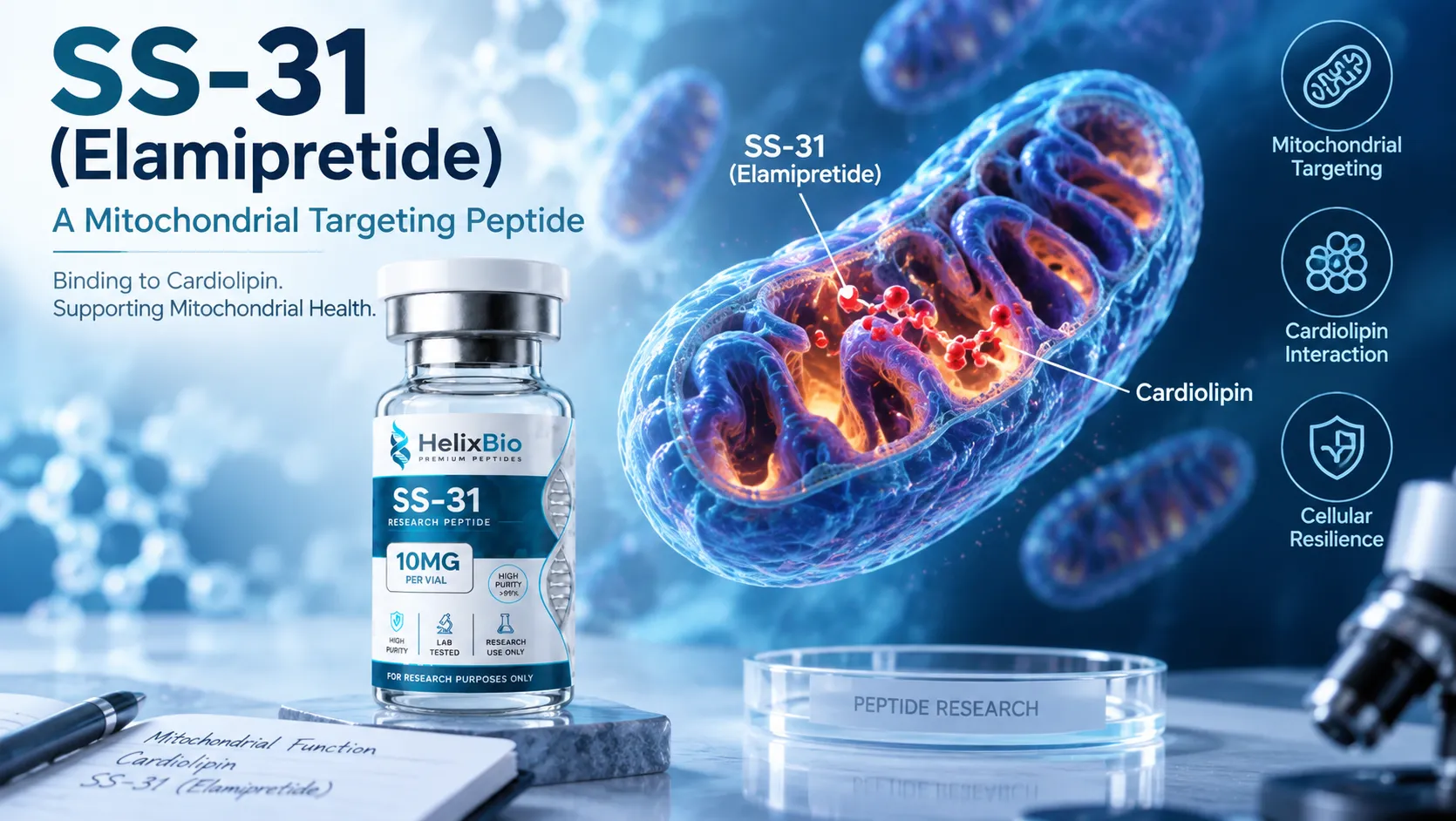
SS-31 concentrates at the inner mitochondrial membrane because that membrane carries a strong negative surface charge, and cardiolipin is the principal reason it does. The peptide partitions into the membrane interfacial region — the crowded zone of lipid headgroups, water and ions that separates bulk solvent from the hydrophobic core — rather than passing through into the matrix and binding a target protein.
What Cardiolipin Is, and Why the Inner Membrane Matters
Cardiolipin is an unusual phospholipid: four acyl chains on a dimeric glycerophosphate backbone, giving it two negative charges and a cone-like shape. In mammalian cells it is found almost exclusively in mitochondria and is concentrated in the inner membrane, where it makes up a substantial fraction of total lipid. It stabilises respiratory chain complexes, participates in cristae curvature, and anchors cytochrome c to the membrane.
That distribution is what makes it a plausible address. A polycationic peptide entering a cell encounters no other compartment with a comparable density of anionic lipid.
What the Binding Evidence Actually Shows
This is where the widely repeated phrasing overshoots. Mitchell and colleagues (J Biol Chem, 2020) examined SS-31 against model and mitochondrial membranes using biophysical and computational methods, and reported three findings that constrain the mechanism.
Binding affinity and binding density scaled with membrane surface charge, not with cardiolipin's specific chemistry.
SS-31 did not destabilise lamellar bilayers even at saturating concentrations, but did cause measurable changes in lipid packing.
SS-20, an SS-family analogue lacking the Dmt residue, was indistinguishable from SS-31 in its effect on membrane surface potential.
That last point is the awkward one for any account built on Dmt's antioxidant chemistry: if a peptide without Dmt tunes surface electrostatics identically, then surface-charge modulation is a property of the cationic scaffold rather than of the distinctive residue. The honest description is electrostatically driven interfacial partitioning at anionic membranes, in which cardiolipin is the dominant contributor because of where it sits and how much charge it carries.
What Research Has Investigated Beyond the Membrane
The lipid picture and the protein picture are not competing accounts. Chavez and colleagues (PNAS, 2020) used chemical cross-linking with mass spectrometry to identify direct protein interactors of SS-31 in mitochondria, and found that every interactor identified was itself a known cardiolipin binder. They clustered into oxidative phosphorylation components and 2-oxoglutarate metabolic enzymes, with cross-linked residues frequently sitting near the regions where those proteins contact cardiolipin.
Cross-linking mass spectrometry, isolated mitochondria
Interactors in OXPHOS and 2-oxoglutarate metabolism
In vitro proteomics
Each row belongs to a category, and the categories do not transfer. A cristae observation in a rat heart is not a human outcome, and an interactome map is a hypothesis generator rather than a demonstrated mechanism of benefit.
What Human Trials Have Found
The human record is larger than most write-ups suggest, and considerably more mixed.
Study
Indication
Design
Main finding
Status
MMPOWER-3
Primary mitochondrial myopathy
Phase 3, randomised, placebo-controlled, n=218
Co-primary endpoints (6-minute walk, fatigue score) not met
Completed; post hoc signal in nuclear DNA subgroup
TAZPOWER
Barth syndrome
Phase 2, randomised crossover, n=12, plus open-label extension
Primary endpoints not met in the randomised phase; knee-extensor strength improved during extension
Basis of accelerated approval
ReCLAIM-2
Non-central geographic atrophy in dry AMD
Phase 2, randomised, double-masked, n=176
Two details in that table repay attention. TAZPOWER is the trial the approval rests on; it enrolled twelve participants, its randomised phase did not separate elamipretide from placebo on either primary endpoint, and the muscle-strength improvement emerged in the open-label extension, where every participant knew they were receiving the compound and there was no concurrent control. And in the ophthalmology programme, the endpoint now serving as the Phase 3 primary — ellipsoid zone attenuation — was a predefined secondary in a trial that missed both of its primaries on nominal p-values.
Is SS-31 FDA Approved?
Forzinity, an elamipretide hydrochloride injection, holds FDA accelerated approval granted 19 September 2025 to improve muscle strength in adult and paediatric patients with Barth syndrome weighing at least 30 kg. Nothing broader than that sentence is approved.
Three qualifications sit inside it.
Accelerated approval is conditional. It was granted on knee-extensor strength as an intermediate endpoint considered reasonably likely to predict benefit. The FDA is requiring a post-approval randomised, double-blind, placebo-controlled confirmatory trial.
One indication only. Mitochondrial myopathy, heart failure and dry AMD remain investigational, and the myopathy programme's Phase 3 trial did not meet its endpoints.
Approval attaches to a product. It covers a specific manufacturer's hydrochloride formulation made under pharmaceutical manufacturing controls, with a label, a defined route and a defined population. A research-use-only SS-31 preparation is a different article entirely: not approved, not manufactured to those standards, and not intended for human or veterinary use.
Barth syndrome closes a neat loop with the mechanism. It is caused by variants in the TAFAZZIN gene, whose product remodels cardiolipin acyl chains. The disease is, at the molecular level, a cardiolipin disorder — which is why a cardiolipin-interacting peptide was tested there first.
Verifying SS-31 Identity in a Research Lot
Documentation for this compound has to answer more questions than it does for a conventional peptide.
Identity by mass spectrometry establishes the molecular mass. Given the Dmt residue and the D-arginine, it does not establish that the correct residue was incorporated in the correct configuration.
Purity by HPLC is a chromatographic area percentage under one stated method. It is a different measurement from peptide content, which requires a quantitative method.
Chemical form — free base, acetate, trifluoroacetate, hydrochloride — determines what a stated milligram figure means.
Batch traceability ties every one of those numbers to the vial in hand rather than to a representative document.
A certificate of analysis is evidence about a material, not evidence about a mechanism. An excellent COA for SS-31 tells a researcher that the vial contains what the label says. It says nothing about whether the compound will do anything in their model, and nothing at all about clinical efficacy. Our guide to [reading a peptide certificate of analysis](/how-to-read-peptide-certificate-of-analysis) covers the field-by-field detail.
Where the Evidence Stops
Four boundaries are worth stating plainly. Selectivity for cardiolipin over other anionic lipids is inferred from mitochondrial cardiolipin abundance rather than demonstrated as chemical specificity. The contribution of Dmt's proposed radical scavenging is not resolved, given that an analogue without it modulates surface potential identically. The downstream chain from altered membrane electrostatics to improved bioenergetics is proposed rather than closed. And the human efficacy record is one narrow accelerated approval against several trials that missed their primary endpoints.
None of that makes SS-31 uninteresting. It makes it a compound whose mechanistic literature is genuinely rich and whose translational literature is genuinely thin — an unusual and useful combination for a research tool.
SS-31 Among Other Mitochondrial Peptides
SS-31 is often grouped with the mitochondrial-derived peptides, which is a category error worth correcting. MOTS-c and Humanin are encoded within the mitochondrial genome and act as signalling molecules through defined cellular pathways; our MOTS-c research overview covers the AMPK evidence in detail. SS-31 is fully synthetic, has no genomic origin, and acts on the physical properties of a membrane rather than through a signalling cascade. The overlap is the organelle, not the mechanism. The same distinction separates it from NAD⁺ precursor approaches, which work on cofactor availability rather than membrane biophysics.
Got Questions?
Frequently Asked Questions
SS-31 is a synthetic tetrapeptide with the sequence D-Arg-Dmt-Lys-Phe-NH2, belonging to the Szeto-Schiller family of aromatic-cationic peptides. It is studied for its tendency to accumulate at the inner mitochondrial membrane and alter that membrane's physical properties. It has no identified receptor.
Yes. SS-31 is the laboratory designation and elamipretide is the International Nonproprietary Name for the same molecule. MTP-131 and Bendavia are earlier development names for it. Forzinity is different: it is a trade name for an approved injectable product containing the molecule as a hydrochloride salt.
The sequence is D-Arg-Dmt-Lys-Phe-NH2. Dmt is 2',6'-dimethyltyrosine, a non-proteinogenic residue, and the C-terminus is amidated. Residues alternate between cationic and aromatic, giving the peptide roughly +3 charge in a molecule of about 640 daltons.
The free base has the formula C32H49N9O5, an average mass of 639.79 g/mol and a monoisotopic mass of approximately 639.386 Da. Salt forms such as the hydrochloride, acetate or trifluoroacetate weigh more per mole, so a stated milligram figure depends on which chemical form a supplier documented.
The CAS registry number for the free base is 736992-21-5. The corresponding PubChem CID is 11764719 and the FDA substance identifier (UNII) is 87GWG91S09. Salt forms carry their own registry numbers and should not be assumed interchangeable with the free base.
MTP-131 is a developer code for the same molecule now known as elamipretide, used by Stealth BioTherapeutics in earlier clinical trial documentation. Researchers reading older literature will also encounter Bendavia, a development name applied largely during the cardiovascular programmes.
SS-31 concentrates at the inner mitochondrial membrane because that membrane carries a strong negative surface charge. Biophysical work reports that the peptide partitions into the membrane interfacial region, with binding affinity and density scaling with surface charge, rather than crossing into the matrix to engage a target protein.
SS-31 interacts with cardiolipin-containing membranes, and cardiolipin is the dominant source of anionic charge in the inner mitochondrial membrane. Published biophysical work found that binding tracked bulk surface charge rather than cardiolipin's specific chemistry, so describing the interaction as chemically selective for cardiolipin overstates what has been demonstrated.
Cross-linking mass spectrometry applied to isolated mitochondria identified direct protein interactors of SS-31, all of them known cardiolipin binders. They clustered into oxidative phosphorylation components and 2-oxoglutarate metabolic enzymes, with cross-linked residues frequently near the regions where those proteins contact cardiolipin.
Forzinity, an elamipretide hydrochloride injection, holds FDA accelerated approval granted on 19 September 2025 to improve muscle strength in patients with Barth syndrome weighing at least 30 kg. That approval covers one product and one indication. Research-use-only SS-31 material is not an approved product and is not intended for human or veterinary use.
Barth syndrome is a rare, life-limiting mitochondrial disease caused by variants in the TAFAZZIN gene, whose product remodels cardiolipin acyl chains. Because the disorder is fundamentally a cardiolipin defect, a cardiolipin-interacting peptide was a mechanistically coherent candidate for study there.
The record is mixed. The Phase 3 MMPOWER-3 trial in primary mitochondrial myopathy (n=218) did not meet its co-primary endpoints, and the Phase 2 ReCLAIM-2 trial in geographic atrophy (n=176) did not meet its co-primary endpoints either. The Barth syndrome accelerated approval rests on TAZPOWER, which enrolled twelve participants and showed the supporting strength improvement in its open-label extension.