- Tesamorelin is a synthetic 44-amino-acid analogue of human growth hormone-releasing hormone with a hexenoyl group attached to its N-terminal tyrosine, which blocks DPP-4 cleavage without changing receptor potency.
- Tesamorelin is a GHRH analogue acting at the GHRH receptor, not a GHRP acting at the ghrelin receptor GHS-R1a; the two classes are mechanistically distinct.
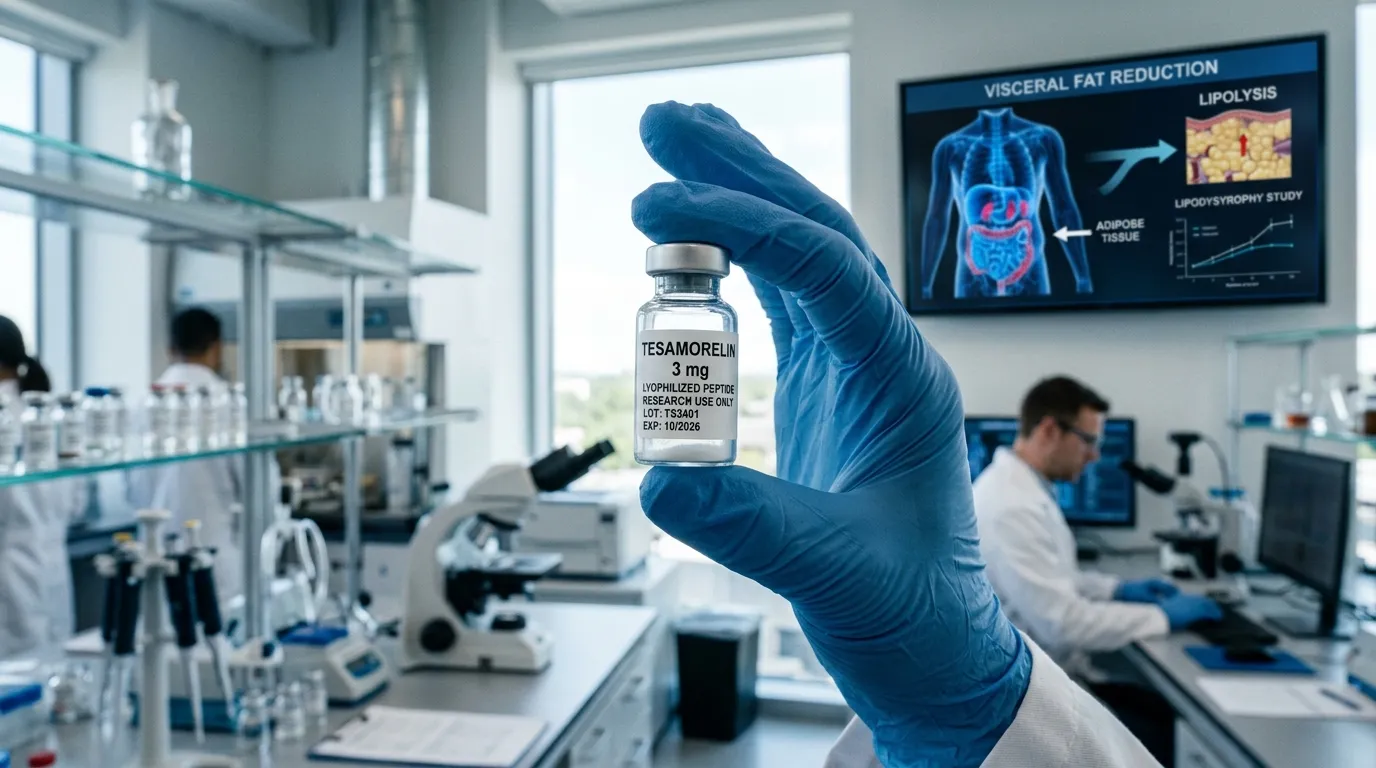
- In Phase 3 randomized trials in adults with HIV-associated lipodystrophy, tesamorelin reduced CT-measured visceral adipose tissue by 14 to 18 percent over 26 weeks while body weight changed by less than half a kilogram.
- FDA labeling states that tesamorelin products are not indicated for weight loss management because the effect is weight-neutral.
- A 2026 meta-analysis of five randomized trials reported a pooled visceral adipose tissue reduction of 27.71 square centimetres and a lean body mass increase of 1.42 kg, with no significant change in BMI or subcutaneous fat.
- A 2019 randomized trial in people with HIV and NAFLD reported a 37 percent relative reduction in hepatic fat fraction over 12 months, with the authors calling for further work on liver histology.
- Tesamorelin reliably raises IGF-1, but labeling treats elevated IGF-1 as a monitored safety parameter of unknown long-term consequence rather than as a measure of benefit.
- Visceral adipose tissue re-accumulated in trial participants switched from tesamorelin to placebo during the 26-week extension phase, indicating the effect is maintenance-dependent.
Tesamorelin sits in an unusual position among research peptides. It is one of very few growth hormone-releasing hormone analogues to have gone through large randomized placebo-controlled trials, earn a specific approved clinical indication, and accumulate more than fifteen years of follow-up literature. It is also one of the most consistently misdescribed compounds in the online peptide space, where it is routinely framed as a fat-loss agent. Those two facts are related: the trial data are strong enough to be quoted widely, and specific enough that most of what gets quoted has been stripped of the population it came from. This article works through what the evidence establishes about tesamorelin's structure, its receptor mechanism, and its measured effects on visceral adipose tissue, hepatic fat, and body composition — and where the extrapolations begin.
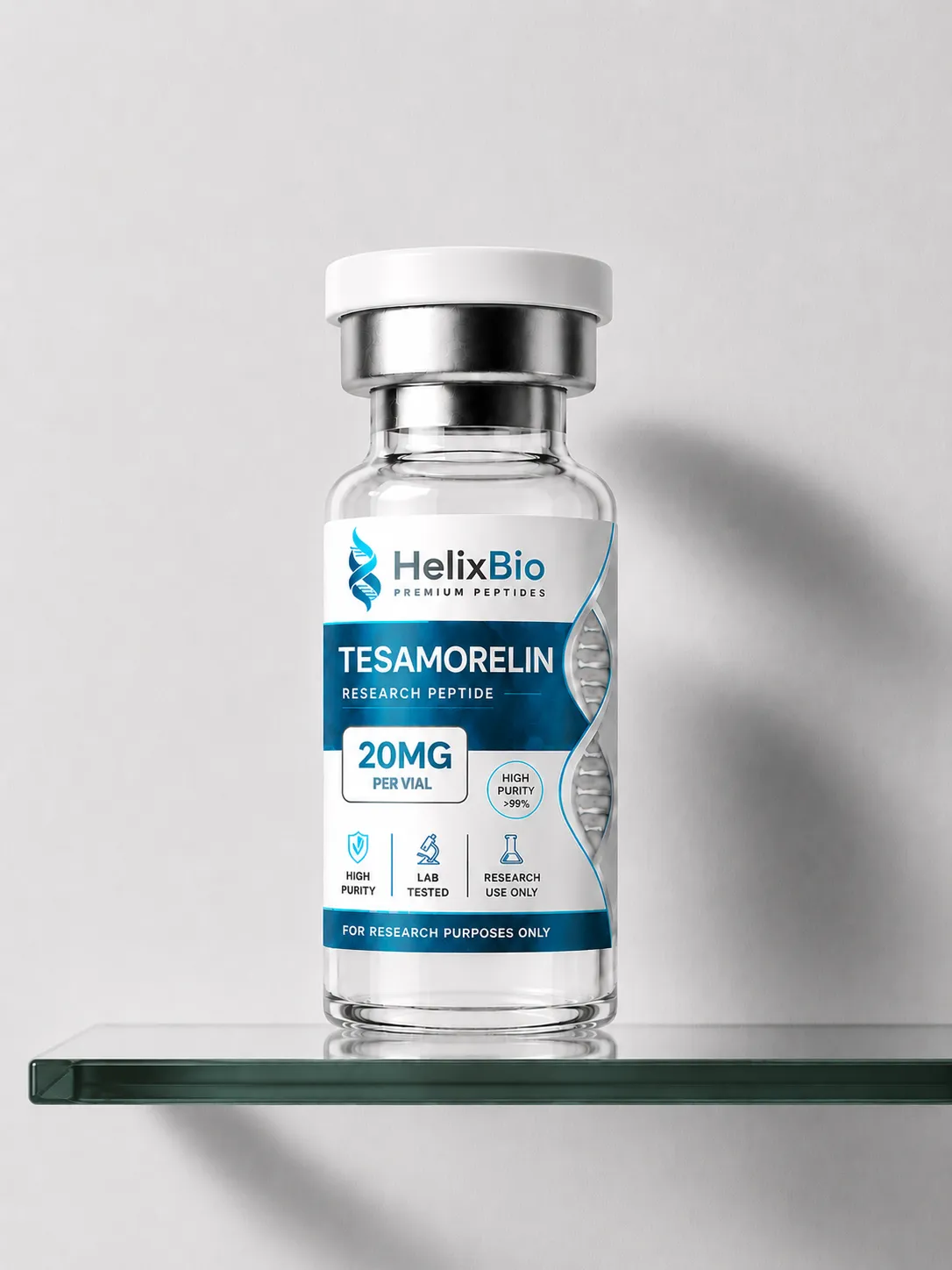
Tesamorelin
RESEARCH PEPTIDE
Tesamorelin is a stabilized, 44-amino-acid analog of human growth hormone-releasing hormone (GHRH), modified with a hexenoyl group that gives it greater resistance to enzymatic breakdown than unmodified GHRH fragments. Helix Bio supplies tesamorelin acetate as a lyophilized research compound for laboratory study of GHRH receptor activity and the growth hormone axis. This listing is for a research chemical only. Tesamorelin also exists as an FDA-approved prescription drug (marketed as Egrifta / Egrifta WR) for a specific clinical indication, but that is a separate, pharmacy-dispensed product manufactured under a New Drug Application. Helix Bio's research-use-only tesamorelin is not that product, is not equivalent to it, and is not sold, labeled, or intended for human or animal use, self-treatment, or off-label use of any kind.
What Is Tesamorelin Peptide?
Tesamorelin is a synthetic analogue of human growth hormone-releasing factor (GRF), also called growth hormone-releasing hormone (GHRH). According to current FDA labeling, it comprises the full 44-amino-acid sequence of human GRF with a hexenoyl moiety — a six-carbon chain carrying a double bond at position 3 — attached to the tyrosine residue at the N-terminal end of the molecule. It is prepared as an acetate salt, and its molecular weight as free base equivalent is 5,135.9 Da.
That structure matters more than it might appear. Native GHRH is cleaved rapidly in circulation, largely by dipeptidyl peptidase-4 acting at the N-terminus. Capping the N-terminal tyrosine with the hexenoyl group blocks that cleavage site while leaving receptor binding intact. FDA labeling states that in vitro, tesamorelin binds and stimulates human GRF receptors with potency similar to endogenous GRF. In other words, the modification is a stability change, not a potency change.
Property | Detail |
|---|---|
Compound class | Synthetic GHRH (GRF) analogue |
Peptide length | 44 amino acids, matching human GRF |
Key modification | Hexenoyl group (C6 chain, double bond at position 3) on the N-terminal tyrosine |
CAS number | 218949-48-5 |
Molecular weight | 5,135.9 Da (free base equivalent) |
Primary receptor | GHRH receptor on pituitary somatotroph cells |
Principal clinical research population | Adults with HIV-associated lipodystrophy and excess abdominal fat |
Approved indication (US) | Reduction of excess abdominal fat in HIV-infected adults with lipodystrophy |
A note on "trans-3-hexenoic acid"
Keyword lists and vendor pages frequently describe the modification as trans-3-hexenoic acid. That phrasing is common and points at the right chemistry, but it is imprecise. The free acid is what the modifying reagent derives from; what is actually present on the molecule is the acyl form — the hexenoyl group described in FDA labeling, attached to the N-terminal tyrosine. Sequence listings written as "trans-3-hexenoyl-Tyr-Ala-Asp..." use the more accurate form. Both terms circulate in the literature, so recognising them as the same modification is useful; treating "trans-3-hexenoic acid" as a distinct chemical entity attached to the peptide is not.
Is Tesamorelin a GHRH or a GHRP?
Tesamorelin is a GHRH analogue. It is not a GHRP, and the two classes are not interchangeable.
Growth hormone-releasing peptides — ipamorelin, GHRP-2, GHRP-6, hexarelin — act at the growth hormone secretagogue receptor GHS-R1a, the same receptor that binds ghrelin. Tesamorelin acts at the GHRH receptor, a separate G protein-coupled receptor on the same somatotroph cells. The two receptor systems converge on growth hormone output, which is why the classes get conflated, but they use different signalling pathways, have different published evidence bases, and are not substitutes for one another in an experimental design. Any comparison table that lists them under one heading without noting the receptor difference is describing an outcome, not a mechanism.
Tesamorelin Mechanism of Action
The pathway runs: tesamorelin binds the GHRH receptor on pituitary somatotrophs, which stimulates the synthesis and pulsatile release of endogenous growth hormone. Growth hormone then acts on receptors across many tissues — hepatocytes, adipocytes, myocytes, chondrocytes, osteoblasts — and some, though not all, of its downstream effects are mediated by IGF-1 produced in the liver and peripheral tissues.
The clinically relevant feature of this design is what it does not do. Tesamorelin does not supply exogenous growth hormone. It stimulates the pituitary to release its own, which means the normal negative-feedback architecture governing growth hormone secretion stays in place. Investigators studying tesamorelin in hepatic fat have described this as the reason a GHRH analogue can raise growth hormone signalling while retaining feedback inhibition that direct growth hormone administration bypasses.
Pharmacodynamically, FDA labeling reports that tesamorelin raises IGF-1 and IGFBP-3, with no clinically significant changes in other pituitary hormones including TSH, LH, ACTH, or prolactin in trial populations. That selectivity is part of why it became a usable clinical tool rather than a broad endocrine intervention.
Tesamorelin and Visceral Adipose Tissue
Visceral adipose tissue (VAT) is the fat depot surrounding the abdominal organs, drained by the portal circulation. It behaves differently from subcutaneous adipose tissue (SAT): it is more metabolically active, more lipolytically responsive, and more strongly associated with insulin resistance, dyslipidaemia, hepatic fat accumulation, and cardiometabolic risk. Two people with identical body weight can carry very different VAT burdens, which is precisely why VAT is measured separately in the tesamorelin literature — usually by CT at the L4-L5 level.
The pivotal evidence comes from two 26-week multicentre randomized double-blind placebo-controlled trials in adults with HIV-associated lipodystrophy and excess abdominal fat (NCT00123253 and NCT00435136), followed by 26-week re-randomized extension phases.
Endpoint | Study population | Study type | Result | Limitation |
|---|---|---|---|---|
VAT at 26 weeks | HIV-associated lipodystrophy, excess abdominal fat | Phase 3 RCT | Mean change −18% (Study 1) and −14% (Study 2) vs +2% and −2% on placebo | Population-specific; 26-week horizon |
VAT pooled estimate | Adults with HIV, 5 RCTs | 2026 meta-analysis | Mean difference −27.71 cm² vs placebo | All included trials in HIV populations |
Body weight at 26 weeks | Same Phase 3 population | Phase 3 RCT | −0.4 kg and +0.5 kg; treatment difference not significant | Weight is not the endpoint the compound moves |
Subcutaneous fat and BMI | Adults with HIV, 5 RCTs | 2026 meta-analysis | No significant reduction | Effect is depot-selective, not generalised |
Hepatic fat fraction at 12 months | Adults with HIV and NAFLD | RCT (n=61) | −37% relative reduction vs placebo | Single population; histology follow-up called for |
VAT after discontinuation | Completed 26 weeks, re-randomized to placebo | Phase 3 extension | VAT rose again by roughly 22% and 16% over the following 26 weeks | Effect is maintenance-dependent |
Two things in that table deserve emphasis. First, every randomized trial pooled in the 2026 meta-analysis published in Obesity Research & Clinical Practice was conducted in adults with HIV. The evidence base is population-specific by construction, not by accident. Second, the extension-phase data show that VAT re-accumulated in participants switched to placebo after 26 weeks. Whatever the compound does, the trials indicate it does not do it permanently.
Why Visceral Fat Falls Without Corresponding Weight Loss
This is the single most misrepresented finding in the tesamorelin literature, and it is stated plainly in FDA labeling: the product is not indicated for weight loss management because it has a weight-neutral effect.
The Phase 3 data bear this out. Across both trials, VAT fell by 14-18% while body weight moved by less than half a kilogram in either direction, and the 2026 meta-analysis found no significant change in BMI or subcutaneous adipose tissue. A depot-selective effect can be large in the depot and invisible on a scale, because visceral fat is a small fraction of total body mass. Simultaneous small increases in lean mass compress the net weight change further.
The practical consequence for interpreting research: VAT reduction and total-body fat loss are separate endpoints measured by separate instruments, and a study reporting one has not demonstrated the other.
Tesamorelin's approved indication is the reduction of excess abdominal fat in HIV-infected adults with lipodystrophy. FDA labeling explicitly states it is not indicated for weight loss management. Research summaries that present it as a general obesity or body-recomposition compound are extending the evidence past the population in which it was generated.
Tesamorelin and Lipolysis
Lipolysis is the enzymatic hydrolysis of stored triglyceride into free fatty acids and glycerol for release from the adipocyte. Growth hormone is a well-characterised lipolytic signal, and this is the proposed route by which a GHRH analogue reaches adipose tissue at all: the compound acts on the pituitary, growth hormone acts on the adipocyte.
Investigators studying tesamorelin in hepatic fat have described its lipolytic effect as being driven by increased endogenous growth hormone while feedback inhibition is preserved. That framing is mechanistically specific and worth keeping intact. "Tesamorelin burns fat" collapses a multi-step endocrine pathway into a claim about the peptide itself, and it obscures the depot selectivity that the trial data actually show. Visceral adipose tissue is more lipolytically responsive than subcutaneous adipose tissue, which offers a plausible partial explanation for why the measured effect concentrated in VAT — though the trials measured the outcome, not the mechanism behind the selectivity.
Tesamorelin and Hepatic Steatosis Research
Hepatic steatosis is ectopic fat: triglyceride accumulating in a tissue not designed to store it. It tracks closely with visceral adiposity, which made liver fat an obvious secondary question once the VAT findings were established.
The first randomized look was a 6-month trial in 50 antiretroviral-treated adults with HIV and abdominal fat accumulation, published in JAMA in 2014. It found reductions in both visceral and liver fat — and the authors described it explicitly as a preliminary study, calling for further work on clinical importance and long-term consequences.
The larger follow-up was a randomized, double-blind, multicentre trial published in The Lancet HIV in 2019, enrolling 61 people with HIV and a hepatic fat fraction of 5% or more measured by proton magnetic resonance spectroscopy. Over 12 months, hepatic fat fraction fell by an absolute 4.1 percentage points more than placebo, a 37% relative reduction from baseline. Thirty-five percent of participants on tesamorelin ended with a hepatic fat fraction below 5%, against 4% on placebo. Fasting glucose and HbA1c did not differ between groups at 12 months. The authors concluded that tesamorelin might be beneficial in people with HIV and NAFLD, and that further studies were needed on long-term effects on liver histology.
That is a genuine, replicated, imaging-confirmed finding in a defined population. It is not a demonstration that tesamorelin treats fatty liver disease generally, and the investigators did not present it as one.
Tesamorelin, Body Composition and Lean Mass
In the Phase 3 trials, lean body mass rose by 1.3 kg and 1.2 kg from baseline at 26 weeks, against small decreases on placebo, while trunk fat fell by 1.0 kg and 0.8 kg. The 2026 meta-analysis pooled a lean body mass increase of 1.42 kg and small reductions in trunk fat and limb fat.
Two caveats belong with those numbers. Lean body mass as measured by DXA is a compartment, not a tissue — it includes body water, and fluid retention is a documented effect of growth hormone stimulation listed in tesamorelin's labeling. A lean-mass increase of this size is therefore consistent with, but not proof of, an increase in contractile muscle tissue. And in the extension phase, participants who continued treatment held their lean mass roughly steady while those switched to placebo lost 1.7-1.8 kg. That pattern reads as maintenance of a shifted body-composition state rather than progressive accrual — closer to lean mass preservation than to hypertrophy.
Does Tesamorelin Increase IGF-1?
Yes, substantially and reliably. In the Phase 3 trials, mean IGF-1 rose by 107 and 108 ng/mL over 26 weeks, against −15 and +3 ng/mL on placebo. FDA labeling reports that 47% of patients treated for 26 weeks had IGF-1 above 2 standard deviation scores and 36% above 3 SDS, with the effect visible as early as week 13.
The interpretive point is that this is a pharmacodynamic marker, not a benefit. IGF-1 confirms the pathway is engaged: the compound reached the GHRH receptor, growth hormone was released, and the liver responded. That is exactly what makes it useful as a readout in mechanism research. But labeling also states that the effects of prolonged IGF-1 elevation are unknown, directs monitoring of IGF-1 during treatment, and lists elevated IGF-1 under warnings rather than efficacy. IGF-1 elevation is how you know the axis is active. It is not the outcome being sought, and treating a rising IGF-1 as evidence of a good result inverts how the trials used it.
Tesamorelin Half-Life and Pharmacokinetics
There is no single correct half-life value to quote, and this is a genuine source of confusion.
Current FDA labeling for the 11.6 mg/vial formulation reports a mean elimination half-life of 11 minutes in healthy subjects after a single 1.28 mg subcutaneous dose. Absolute bioavailability after subcutaneous administration was determined to be less than 4%, median time to peak plasma concentration was 0.15 hours, and mean volume of distribution was 4.8 L/kg. Secondary databases still list values in the 26-38 minute range, drawn from earlier pharmacokinetic work on the original formulation. The values differ because they come from different formulations, different doses, different assays, and different study populations — labeling also notes that extent of absorption was 34% higher in HIV-infected patients than in healthy subjects.
The more useful observation is that plasma half-life is a poor proxy for duration of effect here. A peptide cleared from plasma in minutes still produced measurable VAT and IGF-1 changes on daily administration, because the relevant event is a pituitary secretory pulse, not sustained receptor occupancy. Any research design that reasons from half-life to dosing interval without accounting for that will misjudge the compound.
Tesamorelin vs Ipamorelin vs CJC-1295
All three are studied in the context of growth hormone secretion, and that is roughly where the similarity ends. Our CJC-1295 and ipamorelin research guide covers those two compounds in more depth.
Tesamorelin | Ipamorelin | CJC-1295 | |
|---|---|---|---|
Molecular class | 44-aa GHRH analogue, N-terminally acylated | Pentapeptide GH secretagogue | GHRH(1-29) analogue; DAC and non-DAC forms |
Receptor | GHRH receptor | GHS-R1a (ghrelin receptor) | GHRH receptor |
Stabilisation strategy | Hexenoyl cap blocking DPP-4 cleavage | Structural, not albumin-binding | DAC form covalently binds serum albumin |
Published human PK | FDA-labeled; half-life 11 min (current formulation) | Limited published human pharmacology | Phase 1 data; DAC form reported at roughly 6-8 days |
Highest evidence level | Phase 3 RCTs, meta-analysis, approved indication | Preclinical and early-phase | Phase 1 (Teichman 2006); no completed Phase 3 efficacy trials |
Primary research context | Visceral and hepatic fat in HIV-associated lipodystrophy | Selective GH release without broad pituitary activation | Sustained GH/IGF-1 elevation from infrequent dosing |
The evidence-level row is the one that matters most for study design. Tesamorelin has randomized controlled trials with imaging endpoints in hundreds of participants; the other two do not. Comparing them on "which raises GH more" without noting that asymmetry compares one measured quantity against two estimated ones.
Tesamorelin vs Semaglutide and GLP-1 Research
Asking which is better is not a well-formed question, because they are not attempting the same thing. A GLP-1 receptor agonist reduces energy intake through appetite and satiety signalling; a GHRH analogue changes fat distribution through endocrine signalling to adipose tissue. Both reduce visceral fat; only one reduces body weight. If the endpoint is total body weight, the comparison is not close. If the endpoint is depot-selective VAT reduction at stable body weight, tesamorelin is the compound with that evidence and semaglutide is not being asked the question. Our GLP-1 and GIP agonist research overview covers the incretin side in detail.
Tesamorelin | Semaglutide | |
|---|---|---|
Molecular class | GHRH analogue (44 aa) | GLP-1 receptor agonist |
Primary target | Pituitary GHRH receptor | GLP-1 receptor, including central appetite pathways |
Proximate mechanism | Endogenous GH release, downstream lipolysis | Reduced energy intake via appetite and satiety signalling |
Body weight effect | Weight-neutral per FDA labeling | Large reductions; STEP 1 reported mean 17.3% at 68 weeks in trial completers |
VAT evidence | Direct CT-measured primary endpoint | Measured, but generally as part of overall weight reduction |
Studied population | Adults with HIV-associated lipodystrophy | Adults with overweight or obesity |
Key limitation | Effect reverses on discontinuation; population-specific | Weight regain after withdrawal reported in trial extension |
The one honest parallel between them is the reversibility. Tesamorelin's VAT reduction reversed within 26 weeks of switching to placebo; the STEP 1 extension reported that most of the weight lost with semaglutide was regained after withdrawal. Neither produces a durable change in the absence of continued administration.
What the Clinical Evidence Actually Establishes
Established, in adults with HIV-associated lipodystrophy: tesamorelin reduces CT-measured visceral adipose tissue by 14-18% over 26 weeks, reduces trunk fat, reduces hepatic fat fraction, modestly increases lean body mass, and does so without meaningful change in total body weight or BMI. It reliably raises IGF-1 and IGFBP-3.
Not established: any of the above in populations without HIV, at the level of randomized evidence pooled to date; durable benefit after discontinuation; long-term cardiovascular safety, which labeling states has not been established; or effects on liver histology rather than imaging-measured fat.
Open questions worth naming: labeling reports anti-tesamorelin IgG antibodies in about half of treated patients, with cross-reactivity to endogenous GHRH in roughly 60% of those who seroconverted, though VAT and IGF-1 responses were comparable between antibody-positive and antibody-negative patients. Labeling also records an increased risk of developing an HbA1c of 6.5% or above relative to placebo. Neither is a footnote in a compound that acts through the growth hormone axis.
Research Material Identity and Documentation
For laboratory work, the specification that matters is identity and purity confirmation rather than any marketing claim. Tesamorelin's molecular weight of approximately 5,136 Da and CAS number 218949-48-5 are the reference points that a mass spectrometry result and a batch Certificate of Analysis should be checked against, and the N-terminal acylation is the structural feature most worth confirming, since an unmodified GHRH(1-44) preparation would behave very differently in a stability assay. Our guide to reading a peptide Certificate of Analysis walks through how to verify that documentation batch by batch, and our peptide storage and degradation guide covers the handling variables that affect lyophilised material.
Tesamorelin research material supplied for laboratory use is not a pharmaceutical product and is not equivalent to any approved formulation. Nothing in this article constitutes dosing, administration, reconstitution, or treatment guidance, and no compound discussed here is intended for human or veterinary use.
Frequently Asked Questions
Tesamorelin is a synthetic analogue of human growth hormone-releasing hormone comprising the full 44-amino-acid GRF sequence with a hexenoyl moiety attached to the N-terminal tyrosine. It binds the GHRH receptor on pituitary somatotroph cells and stimulates pulsatile release of endogenous growth hormone. It is studied in research models of the growth hormone axis and adipose tissue metabolism.
Tesamorelin is a GHRH analogue, not a GHRP. GHRPs such as ipamorelin act at the growth hormone secretagogue receptor GHS-R1a, the ghrelin receptor, while tesamorelin acts at the separate GHRH receptor. Both receptor systems sit on the same pituitary cells and converge on growth hormone output, which is why the classes are often conflated in error.
Research models describe an indirect route: tesamorelin stimulates the pituitary GHRH receptor, endogenous growth hormone is released, and growth hormone acts as a lipolytic signal at the adipocyte. Visceral adipose tissue is more lipolytically responsive than subcutaneous adipose tissue, which offers a partial explanation for the depot selectivity seen in trials, though the trials measured the outcome rather than the mechanism behind that selectivity.
Yes. In the Phase 3 trials, mean IGF-1 rose by 107 and 108 ng/mL over 26 weeks against minimal change on placebo, and FDA labeling reports that 47 percent of treated patients exceeded 2 standard deviation scores at 26 weeks. Labeling treats this as a monitored parameter whose long-term consequences are unknown, not as an efficacy measure.
No, and it is not approved for weight loss. Across the Phase 3 trials body weight changed by less than half a kilogram in either direction, and a 2026 meta-analysis of five randomized trials found no significant change in BMI or subcutaneous adipose tissue. FDA labeling names weight loss management as a limitation of use, stating the product is not indicated for it because the effect is weight-neutral.
In two 26-week Phase 3 randomized placebo-controlled trials in adults with HIV-associated lipodystrophy, CT-measured visceral adipose tissue fell by a mean of 18 percent and 14 percent versus small changes on placebo. A 2026 meta-analysis pooled a mean difference of 27.71 square centimetres across five randomized trials, all conducted in HIV populations.
In the 26-week extension phases of the Phase 3 trials, participants re-randomized from tesamorelin to placebo saw visceral adipose tissue rise again by roughly 22 percent and 16 percent over the following 26 weeks, while those continuing on tesamorelin held their reduction. The published evidence describes a maintenance-dependent effect rather than a durable one.
A 2014 JAMA trial in 50 adults with HIV and abdominal fat accumulation reported reductions in both visceral and liver fat, described by its authors as preliminary. A larger 2019 randomized trial in 61 people with HIV and NAFLD reported a 37 percent relative reduction in hepatic fat fraction over 12 months, with 35 percent of the tesamorelin group reaching a hepatic fat fraction below 5 percent versus 4 percent on placebo.
Current FDA labeling reports a mean elimination half-life of 11 minutes in healthy subjects after a single 1.28 mg subcutaneous dose of the 11.6 mg/vial formulation, with absolute bioavailability under 4 percent. Secondary databases list longer values in the 26 to 38 minute range drawn from earlier formulation work, so a single quoted figure should always be tied to its formulation, dose, assay, and population.
They act at different receptors. Tesamorelin is a 44-amino-acid GHRH analogue acting at the GHRH receptor with Phase 3 randomized evidence and an approved clinical indication; ipamorelin is a pentapeptide growth hormone secretagogue acting at GHS-R1a, with a research base that is largely preclinical and early-phase. The evidence asymmetry matters as much as the mechanistic difference when designing a comparison.
Both act at the GHRH receptor, but they use different stabilisation strategies and sit at different evidence levels. Tesamorelin uses an N-terminal hexenoyl cap to block DPP-4 cleavage and has Phase 3 trial data; CJC-1295 with DAC covalently binds serum albumin for a much longer reported circulating half-life and has Phase 1 human pharmacology data from Teichman and colleagues in 2006, without completed Phase 3 efficacy trials.
They target different pathways and different endpoints. Semaglutide is a GLP-1 receptor agonist that reduces energy intake through appetite and satiety signalling and produces large body weight reductions; tesamorelin is a GHRH analogue that shifts fat distribution through endocrine signalling and is weight-neutral. Comparing them on which is better is not a well-formed research question without first specifying the endpoint.
- 01EGRIFTA WR (tesamorelin) for injection, for subcutaneous use. Full Prescribing Information. Theratechnologies Inc., revised March 2025. DailyMed, U.S. National Library of Medicine.
- 02Badran AS, Helal A, Shata KS, Ayesh H. Body composition, hepatic fat, metabolic, and safety outcomes of Tesamorelin, a GHRH analogue, in HIV-associated lipodystrophy: a meta-analysis of randomized controlled trials. Obes Res Clin Pract. 2026 Jan-Feb;20(1):2-12.
- 03Stanley TL, Feldpausch MN, Oh J, Branch KL, Lee H, Torriani M, Grinspoon SK. Effect of tesamorelin on visceral fat and liver fat in HIV-infected patients with abdominal fat accumulation: a randomized clinical trial. JAMA. 2014;312(4):380-389.
- 04Stanley TL, Fourman LT, Feldpausch MN, et al. Effects of tesamorelin on non-alcoholic fatty liver disease in HIV: a randomised, double-blind, multicentre trial. Lancet HIV. 2019;6(12):e821-e830.
- 05Teichman SL, Neale A, Lawrence B, Gagnon C, Castaigne JP, Frohman LA. Prolonged stimulation of growth hormone (GH) and insulin-like growth factor I secretion by CJC-1295, a long-acting analog of GH-releasing hormone, in healthy adults. J Clin Endocrinol Metab. 2006;91(3):799-805.
- 06Effects of Growth Hormone Releasing Hormone in HIV (NCT01263717). ClinicalTrials.gov, U.S. National Library of Medicine.
- 07Wilding JPH, Batterham RL, Davies M, et al. Weight regain and cardiometabolic effects after withdrawal of semaglutide: the STEP 1 trial extension. Diabetes Obes Metab. 2022;24(8):1553-1564.
Helix Bio Chem Team
Research & Product Team
Our in-house team tracks published peptide research and translates it into clear, source-cited summaries for the research community.
Reviewed by in-house research chemists
support@helixbiochem.com