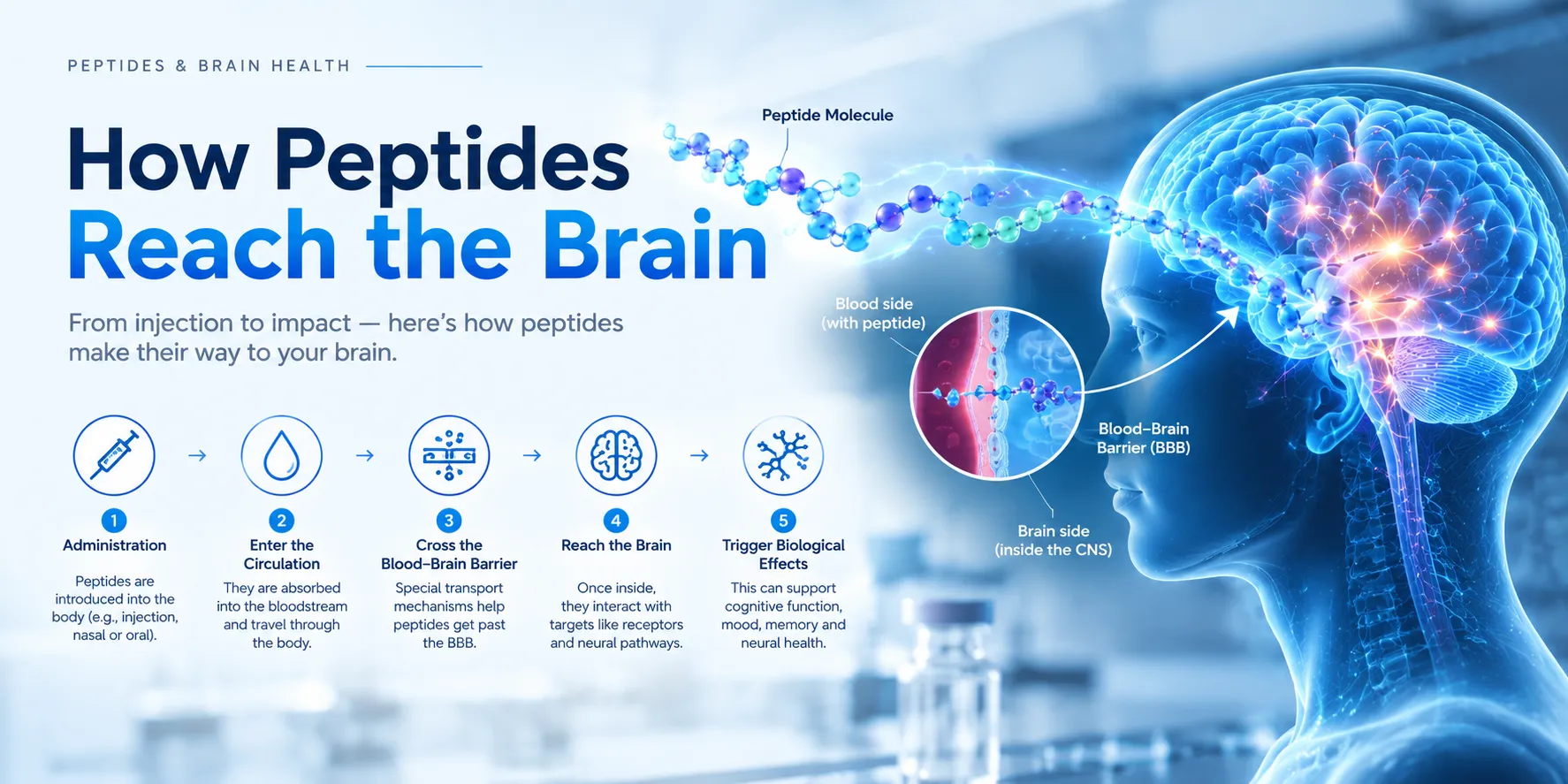
The blood-brain barrier is a property of the brain's capillary endothelium, where continuous tight junctions eliminate any meaningful paracellular route into brain tissue.
Molecular size is one determinant of peptide CNS access among several, alongside proteolytic stability, charge, plasma protein binding, volume of distribution and efflux transport.
Several characterised peptide transport systems at the blood-brain barrier operate in the brain-to-blood direction, so transporter interaction does not imply brain entry.
Crossing the blood-brain barrier and bypassing it by a nose-to-brain route are different mechanisms supported by different types of evidence.
Most of a nasally applied dose is absorbed systemically or cleared rather than transported directly to the brain, so attributing brain exposure to the direct route requires an intravenous comparison.
Esketamine nasal spray, the most widely used intranasal CNS drug, is described by its manufacturer as reaching the brain by systemic absorption rather than nose-to-brain transport.
Olfactory epithelium occupies a far smaller proportion of the nasal cavity in humans than in rodents, which limits the translation of rodent nose-to-brain findings.
Demonstrated CNS access does not establish a functional effect: the peptide-drug conjugate ANG1005 reached human brain tumour tissue and still missed its Phase II efficacy endpoint.
Two claims circulate about peptides and the brain, and they appear to contradict each other. The first is that peptides are too large and too water-soluble to cross the blood-brain barrier. The second is that peptides applied to the nasal cavity reach the brain directly. Both are repeated constantly, often on the same page, and the tension between them is rarely addressed.
The tension resolves once you separate two different questions. Crossing the blood-brain barrier and bypassing it are not the same event, they are not supported by the same evidence, and they are not equally well established. This article works through the mechanisms that have been proposed for peptide CNS access, what kind of evidence supports each one, and where the honest limits of that evidence sit.
The Short Answer: How Peptides Can Reach the Brain
A peptide in the bloodstream can reach brain tissue through four broad mechanisms: passive transmembrane diffusion, which is available almost exclusively to small lipophilic molecules; carrier-mediated transport through a saturable transporter; receptor-mediated transcytosis, in which the peptide binds a receptor on the capillary surface and is ferried through the endothelial cell in a vesicle; and adsorptive-mediated transcytosis, in which a positively charged peptide binds the negatively charged endothelial surface non-specifically and is taken up.
Separately, a compound applied to the nasal cavity may reach the CNS along the olfactory and trigeminal nerve pathways without first entering the general circulation. This is the nose-to-brain route, and it is a different proposition from blood-brain barrier crossing rather than a better version of it.
None of these mechanisms is available to every peptide. Whether any of them applies to a given compound is a compound-specific, route-specific and formulation-specific question, and for most research peptides it has never been directly measured.
Why the Blood-Brain Barrier Is a Hard Problem for Peptides
What the barrier actually is
The blood-brain barrier is not a membrane laid over the brain. It is a property of the brain's own capillaries. The endothelial cells lining those capillaries are joined by continuous tight junctions, so there is no meaningful gap between adjacent cells for a molecule to slip through. Those endothelial cells sit on a basement membrane, wrapped by pericytes and by astrocyte end-feet, and the whole assembly is usually described as the neurovascular unit.
Two consequences follow. There is effectively no paracellular route into the brain, so a molecule must go through the endothelial cell rather than between cells. And the endothelial cell is metabolically active, carrying both a battery of transporters and a set of enzymes, so it is a chemical checkpoint as well as a physical one.
Size is only part of the answer
The most common explanation given for poor peptide brain uptake is molecular weight, and it is incomplete to the point of being misleading. Size matters, but a peptide facing the barrier is usually stopped by something else first.
The factors that determine whether a peptide has any realistic prospect of reaching brain tissue after systemic administration include:
Proteolytic stability. Many peptides are cleaved by peptidases in plasma and at the capillary wall itself within minutes. A compound with a plasma half-life measured in single-digit minutes has a very short window in which to be transported anywhere.
Charge and lipophilicity. Highly charged, highly water-soluble molecules do not partition into lipid membranes. Passive diffusion is largely unavailable to them.
Plasma protein binding. Bound peptide is not free peptide, and only the free fraction is generally available for transport.
Volume of distribution. A peptide distributed widely into peripheral tissue is diluted before it ever presents at the cerebral vasculature.
Efflux. Covered below, and routinely omitted.
Whether a transport system exists at all. Most synthetic peptides have no characterised transporter.
Banks and colleagues laid this out clearly in reviewing peptide delivery to the brain: the physical barrier is reinforced by enzymatic activity, short half-lives, large volumes of distribution, binding proteins and brain-to-blood efflux systems, and any one of these can be the binding constraint. Reducing that to "peptides are too big" discards most of the actual pharmacology.
Efflux runs the other way
This is the part that most explanations skip, and it changes the shape of the problem.
The barrier does not only restrict entry. It actively removes compounds from brain to blood. P-glycoprotein and related ABC transporters sit on the luminal face of the capillary endothelium and pump substrates back into the circulation. For peptides specifically, saturable transport systems have been characterised that operate in the brain-to-blood direction, the system originally described for Tyr-MIF-1 and shared with the enkephalins being the best-studied example.
The practical implication is counterintuitive. Demonstrating that a peptide interacts with a transport system at the barrier does not establish that the peptide gets in. Some of the best-characterised peptide transport systems there are exit routes. A compound can be a transporter substrate and still be excluded from the brain, because the transporter is working against it.
Crossing the Barrier Versus Going Around It
This distinction does most of the work in the rest of the article, so it is worth stating plainly.
Crossing means a peptide present in systemic circulation moves from blood into brain tissue across the capillary endothelium. The evidence standard is a measurement of transport across that barrier.
Bypassing means a peptide reaches CNS tissue by a route that does not require the blood-brain barrier at all, in practice along the nerve pathways connecting the nasal cavity to the brain. The evidence standard is different: it requires showing that material arrived by the direct route rather than by being absorbed into blood and then crossing the barrier conventionally.
The two are frequently collapsed into one claim. They should not be.
Route or mechanism
How it may provide CNS access
Main barrier or limitation
Typical evidence context
Systemic passive diffusion
Lipid-soluble molecules partition through endothelial membranes
Largely unavailable to charged, hydrophilic peptides
Physicochemical modelling; in situ perfusion
Carrier-mediated transport
A saturable transporter moves the peptide across the endothelium
Requires an existing transporter with affinity for that peptide; saturable and competable
Rodent perfusion and radiotracer studies
Receptor-mediated transcytosis
Peptide binds a surface receptor and is vesicle-transported through the cell
Receptor-specific; capacity-limited; conjugate may behave differently from the free peptide
Preclinical models plus a small number of human oncology trials
Adsorptive-mediated transcytosis
No mechanism in that table works equally well for every peptide. Several work for almost none.
The Nose-to-Brain Pathway, Explained
The olfactory pathway
The roof of the nasal cavity carries olfactory epithelium, and the sensory neurons in it project bundled axons upward through perforations in the cribriform plate directly into the olfactory bulb. This is a genuine anatomical opening between the nasal cavity and the brain, and it is the basis of the entire nose-to-brain concept.
Material deposited on olfactory epithelium may move along this route either inside neurons, by internalisation and axonal transport, or outside them, through the perineural and perivascular spaces surrounding the nerve bundles. Modelling of transit times has generally favoured the extracellular route, because intracellular axonal transport appears too slow to account for how quickly tracers are observed in the bulb. Work on cerebral perivascular spaces has shown rapid, widespread tracer distribution after intranasal administration, which supports bulk-flow movement through perivascular compartments rather than transport within nerve cells.
The trigeminal pathway
Branches of the trigeminal nerve innervate much larger areas of the nasal mucosa than the olfactory region, and enter the brain at the level of the pons. This gives a second potential route, one that delivers to brainstem rather than forebrain. Modelled transit along the trigeminal route is substantially slower than the olfactory route: estimates in the literature run to tens of hours to reach the pons, against roughly one to two hours to the olfactory bulb.
That difference matters for interpretation. A compound detected in brain tissue thirty minutes after nasal application did not arrive along the trigeminal nerve.
Direct transport is not the only thing happening
The nasal cavity is highly vascular. Most of an applied dose lands on respiratory epithelium, not olfactory epithelium, and is absorbed into the systemic circulation like any other mucosal drug. Some is swallowed. Some is cleared by mucociliary clearance before it is absorbed at all. Nasal peptidases degrade some of it in place.
So after nasal application, a peptide detected in the brain could have arrived by direct nose-to-brain transport, or by systemic absorption followed by conventional barrier crossing, or by both. Separating those requires a comparison, typically an intravenous arm dosed to produce matched plasma concentrations. Studies without that comparison cannot attribute brain exposure to the direct route, and many do not have it.
The clearest illustration comes from an approved product. Esketamine nasal spray is the most commercially successful intranasal CNS drug in current use, and its manufacturer's own medical information states that nose-to-brain delivery was not studied and is not considered relevant to it: the spray's wide plume angle deposits drug on respiratory epithelium, from which it is absorbed into the bloodstream, with mean absolute bioavailability of roughly 48%. The drug reaches the brain by crossing the blood-brain barrier from blood, in the ordinary way. A nasal presentation, by itself, tells you nothing about which route a compound takes. Format and route are separate questions, and the practical differences between solution-phase and lyophilized research formats concern handling and stability rather than transport.
The rodent-to-human problem
Most nose-to-brain evidence is rodent evidence, and the anatomy does not transfer cleanly.
In rodents, olfactory epithelium occupies a large share of the nasal cavity's lining. In humans it occupies a small fraction of it, confined to a patch at the roof of the cavity. The target for direct transport is therefore proportionally far smaller in humans, and much harder to reach, since conventional nasal sprays are designed to deposit in the lower nasal cavity rather than the olfactory cleft. This is one of the strongest reasons a positive rodent nose-to-brain result should not be read as a human result, and it is rarely stated on pages that quote rodent percentages.
Species differences in nasal anatomy, deposition pattern and enzyme activity mean that a nose-to-brain finding in a rodent model establishes something about that model. It does not establish the same thing about humans, and it establishes nothing about any particular research material.
What "Brain Penetration" Actually Means
"Reaches the brain" is not a single measurement. Different studies mean different things by it, and the differences are large.
Type of evidence
What it shows
What it does not show
Brain tissue detection
Compound-associated signal is present in dissected tissue
Whether the signal is intact peptide; whether it is inside cells or in residual vasculature
CSF measurement
Material reached cerebrospinal fluid
That it reached brain parenchyma, or reached any specific region
Brain-to-blood ratio
Relative concentration between compartments at a time point
Absolute exposure, or whether exposure is functionally meaningful
Radiotracer studies
Where the radioactive label went
Where the intact molecule went, if the label survives metabolism
Pharmacodynamic readout
A CNS-mediated effect occurred
That the peptide itself entered the brain, rather than acting peripherally
The radiotracer distinction is the one most often lost in translation. A widely circulated figure holds that 0.093% of an intranasal dose of Semax reaches the brain. The underlying study is a rat pharmacokinetic experiment using tritium-labelled peptide, and what it reported is more specific and more interesting: 0.093% of introduced radioactivity per gram of brain tissue at two minutes, of which about 80% was intact Semax and the remainder metabolites, with the tripeptide Pro-Gly-Pro dominating the degradation products. The per-gram unit is dropped in almost every secondary citation, the metabolite fraction is dropped in nearly all of them, and the species and route are frequently dropped too.
That is a single-compound, single-route, single-species, single-timepoint result with a partly metabolised label. It is not a general statement about peptides.
When a brain-penetration percentage appears without a species, a route, a formulation, a timepoint and a stated analyte, the figure cannot be interpreted. Those five qualifiers are what turn a number into a finding.
Access is not effect
Even a well-measured demonstration of CNS access does not establish that anything happens as a result. ANG1005 is a peptide-drug conjugate built to exploit LRP1-mediated transcytosis, linking three paclitaxel molecules to the shuttle peptide Angiopep-2. A Phase I study detected drug in recurrent glioma tissue at meaningful concentrations, which is about as direct a demonstration of human barrier transport as this field produces. The subsequent Phase II trial in recurrent high-grade glioma, across 73 patients in three arms, did not meet its primary efficacy endpoint, and no further glioma studies were planned. A separate Phase II in breast cancer brain metastases reported intracranial partial responses in 8 of 58 evaluable patients.
The delivery worked. The outcome did not follow from it. Any framing that treats barrier crossing as the finish line rather than a precondition has skipped the harder half of the problem.
BBB Shuttle Peptides and Transport Strategies
A BBB shuttle peptide is a peptide selected or designed to carry a separate cargo across the blood-brain barrier by engaging a transport mechanism that the cargo alone cannot use. The shuttle is not the therapeutic agent; it is the vehicle.
Two mechanisms dominate. Receptor-mediated transcytosis uses a specific receptor expressed on brain capillary endothelium, Angiopep-2 and LRP1 being the most developed peptide example, and offers selectivity because receptor expression is not uniform across tissues. Adsorptive-mediated transcytosis relies on electrostatic attraction between a cationic peptide and the anionic endothelial glycocalyx, and is inherently non-specific, so the same property that drives brain uptake also drives binding everywhere else.
Two limitations apply to the whole class. Receptor-mediated systems are saturable, so uptake does not scale indefinitely with dose. And conjugation changes the molecule: a shuttle characterised as a free peptide may behave differently once cargo is attached, which is one reason results with shuttle-functionalised nanoparticles have been inconsistent in the literature.
What the Evidence Supports for Specific Peptides
Reliable, compound-specific CNS-access data is far scarcer than the volume of writing on this topic suggests. A few observations hold up.
Intranasal oxytocin has the largest human dataset of any peptide on this question, and it is sobering. Reviewing seven studies that measured cerebrospinal fluid after intranasal administration, Leng and Ludwig concluded that at most around 0.005% of an applied dose appeared in CSF. Studies have also found plasma concentrations peaking well before CSF concentrations, which is difficult to reconcile with a purely direct nose-to-brain route.
Intranasal insulin has the largest randomised human programme. A 289-participant multi-site trial in mild cognitive impairment and Alzheimer's disease found no cognitive or functional benefit over twelve months in the primary intention-to-treat analysis. It also produced an unusually instructive methodological finding: the delivery device malfunctioned frequently for the first 49 participants and had to be replaced mid-trial. The device is a variable in its own right, independent of the molecule and the formulation, and almost no discussion of nose-to-brain delivery accounts for it.
Semax is discussed above. The primary intranasal kinetic data is rodent, single-timepoint, and partly reports metabolites rather than intact peptide, with human CNS access inferred from functional readouts rather than measured directly. The receptor-level pharmacology of Semax and Selank is covered separately in our comparison of the two compounds.
For the large majority of research peptides in circulation, including most of those supplied in solution-phase formats, no direct measurement of CNS access exists in any species. That absence is a finding, and it should be reported as one rather than filled in by analogy.
Common Misconceptions About Peptide Brain Delivery
"Intranasal delivery bypasses the blood-brain barrier." It may permit a fraction of a dose to reach the CNS without crossing the barrier. The remainder is absorbed systemically and faces the barrier normally.
"Peptides cannot cross the barrier because they are too big." Size is one factor among several, and frequently not the limiting one.
"A transporter exists for this peptide, so it gets into the brain." Some peptide transport systems at the barrier run brain-to-blood.
"It was detected in brain tissue, so it crossed." Detection of a label is not detection of an intact molecule, and tissue signal can include residual vascular content.
"A nasal format implies a nose-to-brain mechanism." The most successful approved intranasal CNS drug does not use one.
"It works in rodents, so the route works." Human olfactory epithelium is proportionally much smaller and much harder to reach.
"CNS access means it works." A conjugate has reached human brain tumour tissue and still failed its efficacy endpoint.
What Is Established, and What Remains Uncertain
Reasonably well established: the blood-brain barrier is a property of cerebral capillary endothelium with continuous tight junctions and essentially no paracellular route; efflux transport at the barrier is real and directional; saturable peptide transport systems exist and some operate brain-to-blood; anatomical continuity between the nasal cavity and the CNS along olfactory and trigeminal nerves is well described; and receptor-mediated transcytosis can carry a peptide-drug conjugate into human brain tumour tissue.
Supported but qualified: direct nose-to-brain transport of macromolecules has been demonstrated repeatedly in rodents and in non-human primates, with the extracellular perineural and perivascular route the most likely mechanism.
Genuinely uncertain: what fraction of a nasally applied dose reaches human brain tissue directly, for any given compound; whether the fractions involved are large enough to matter functionally; how much observed brain exposure after nasal application is direct transport versus systemic absorption followed by ordinary barrier crossing; and whether specific research peptides marketed for CNS-adjacent interest reach the CNS at all in humans, since for most of them the measurement has never been made.
This article is provided for scientific and research-education purposes. It is not medical advice and does not provide instructions or recommendations for human use. Helix Bio research materials are supplied for laboratory investigation only, and further compliance and documentation questions are covered in the Helix Bio knowledge base.
Got Questions?
Frequently Asked Questions
Some can, to a limited extent, by specific mechanisms. Transport across the barrier has been characterised for a number of endogenous peptides through saturable carrier systems, receptor-mediated transcytosis and adsorptive-mediated transcytosis. It is a compound-specific property rather than a class property, and for most synthetic research peptides it has never been directly measured.
Because several independent obstacles apply at once. Brain capillary endothelial cells are joined by continuous tight junctions, leaving no paracellular route. Most peptides are charged and hydrophilic, so passive diffusion is unavailable. Many are cleaved by peptidases within minutes, and efflux transporters return some substrates to the blood. Size contributes, but it is usually not the first thing to stop a peptide.
No. Nasal application creates the opportunity for direct nose-to-brain transport, but most of an applied dose lands on respiratory epithelium and is absorbed into the general circulation, cleared by mucociliary action, or degraded by nasal enzymes. Whether any appreciable amount reaches the CNS by the direct route is a separate question that has to be measured for each compound and formulation.
It refers to transport from the nasal cavity to the central nervous system along the olfactory and trigeminal nerves, without passing through the systemic circulation. Olfactory sensory neurons project through the cribriform plate into the olfactory bulb, and trigeminal branches enter at the brainstem. Material appears to move mainly through the extracellular perineural and perivascular spaces around these nerves rather than inside the nerve cells.
Crossing means a compound already in the bloodstream moves across the cerebral capillary wall into brain tissue. Bypassing means it reaches the CNS by a route that never involves that barrier, in practice the nasal nerve pathways. They require different evidence: demonstrating a bypass requires ruling out systemic absorption followed by conventional crossing, usually with a matched intravenous comparison.
Through several methods that answer different questions: brain tissue sampling after administration, cerebrospinal fluid measurement, brain-to-blood concentration ratios, radiolabelled tracer distribution, imaging, and pharmacodynamic readouts. Each has a specific limitation. Tissue detection may include residual vascular content, CSF is not parenchyma, and radiolabel distribution reports where the label went rather than where the intact molecule went.
A peptide selected or designed to carry a separate cargo across the blood-brain barrier by engaging a transport mechanism the cargo cannot use alone. Angiopep-2, which targets the LRP1 receptor on brain capillary endothelium, is the most clinically developed example. The shuttle is a delivery vehicle rather than the active agent, and attaching cargo can change how it behaves.
Generally not. Esketamine nasal spray, the most prominent example, is described in its manufacturer's own medical information as not relying on nose-to-brain delivery: the spray deposits mainly on respiratory epithelium, is absorbed into the bloodstream with roughly 48% absolute bioavailability, and reaches the brain by crossing the blood-brain barrier conventionally. A nasal format does not indicate a direct CNS route.
Not directly. Olfactory epithelium covers a large share of the nasal cavity in rodents but only a small patch at the roof of the cavity in humans, so the target area for direct transport is proportionally much smaller and considerably harder to reach with conventional devices. Nasal enzyme activity and deposition patterns also differ. Rodent results establish a mechanism in that model, not a quantity in humans.
It depends on the pathway. Modelling of transit along the olfactory route to the olfactory bulb has produced estimates on the order of one to two hours, while transit along the trigeminal nerve to the pons has been estimated at tens of hours. Tracer studies have also observed rapid distribution through cerebral perivascular spaces. These are model-dependent estimates from animal work, not human measurements.
No. Access and effect are separate findings. ANG1005, a peptide-drug conjugate designed to cross the barrier via LRP1, was detected in human recurrent glioma tissue at meaningful concentrations in Phase I, and its Phase II trial in recurrent high-grade glioma still failed to meet its primary efficacy endpoint. Demonstrating that a compound arrives is a precondition for activity, not evidence of it.
A combination of properties rather than any single one: resistance to proteolysis, charge and lipophilicity, molecular size and conformation, plasma protein binding, volume of distribution, whether an influx transport mechanism exists for it, and whether it is a substrate for efflux. Route and formulation then modify all of it. Two peptides of similar mass can behave completely differently.