GLOW Peptide Blend: Component Evidence and COA Verification
Recovery protocolsSeptember 17, 202612 min read
GLOW names three separately evidenced molecules. What each component's literature actually establishes, and why one purity figure cannot describe the blend.
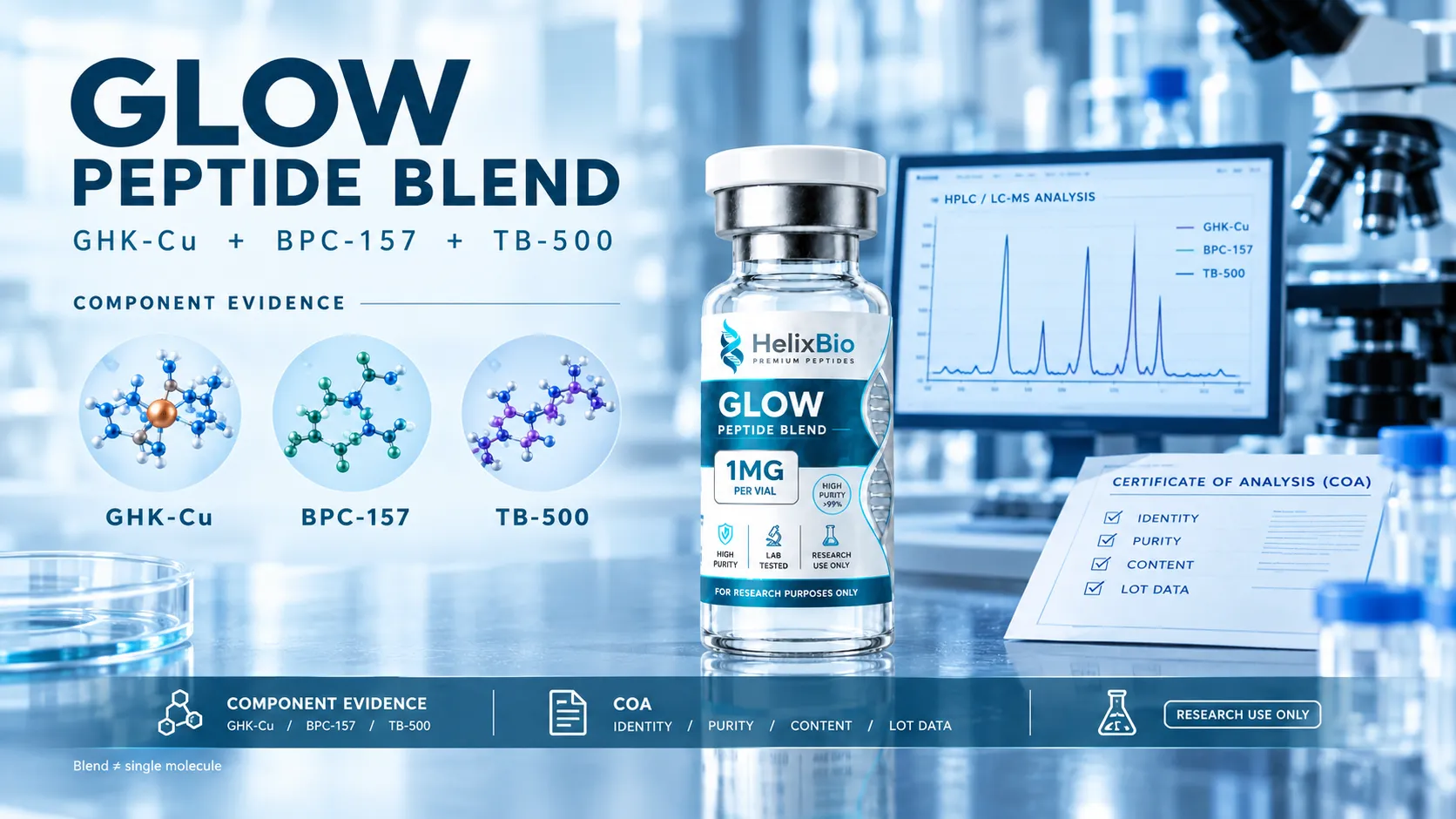
GLOW is a commercial designation for a preparation containing GHK-Cu, BPC-157 and a thymosin beta-4-related material supplied as TB-500; it is not a single molecule and has no monograph or CAS registry entry.
The three components carry three different evidence tiers, and grouping them under one name creates a false impression of a shared evidence base.
Rat wound-chamber work published in the Journal of Clinical Investigation in 1993 found GHK-Cu increased collagen and glycosaminoglycan accumulation, while GHK without copper produced no significant effect in the same model.
BPC-157's published record is overwhelmingly preclinical; a 2025 HSS Journal systematic review included 36 articles, of which 35 were preclinical and one clinical.
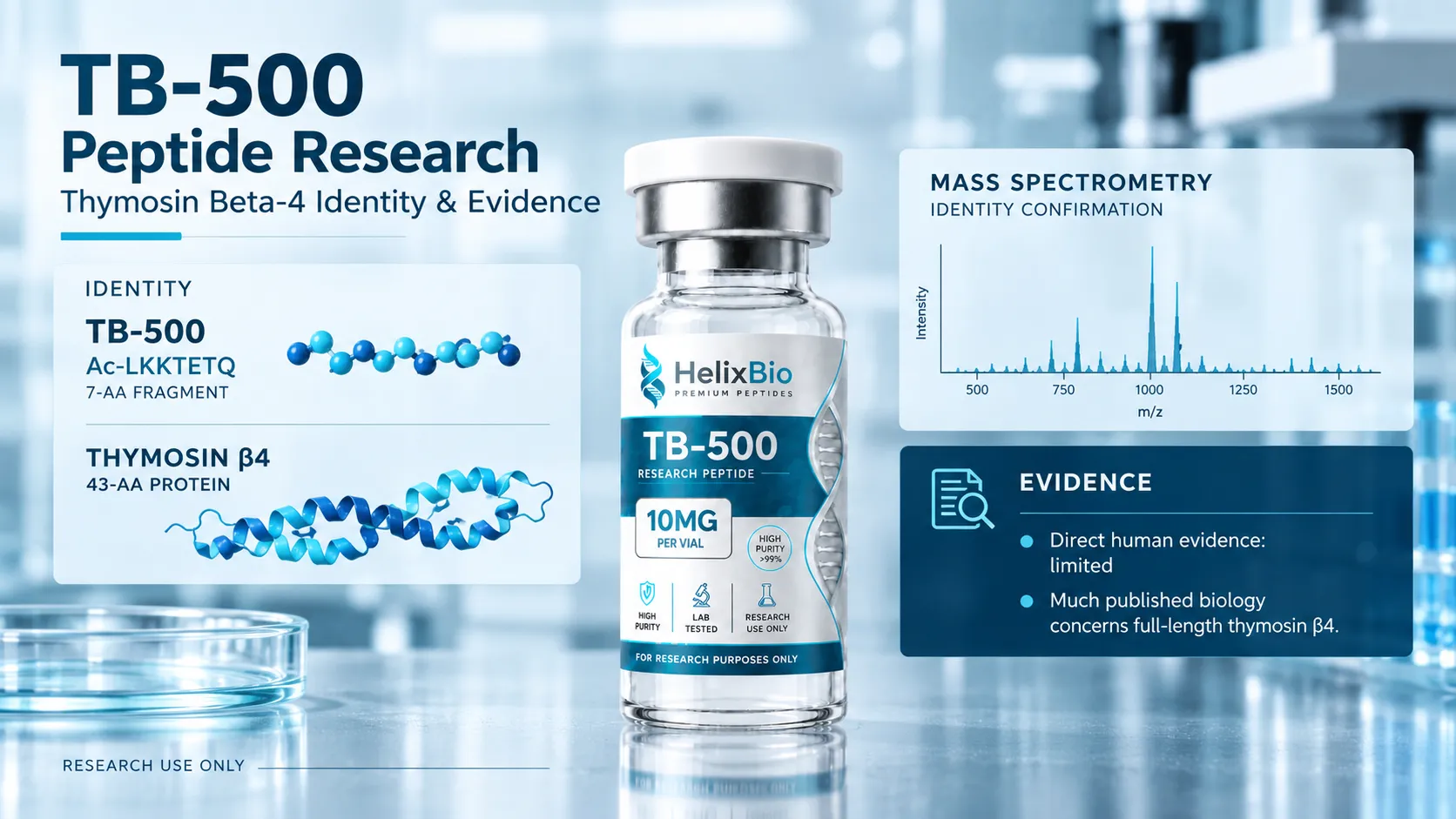
TB-500 is a trade designation covering two different molecules: full-length thymosin beta-4 at roughly 4,963 daltons and the acetylated fragment Ac-LKKTETQ at roughly 889 daltons.
A 2023 anti-doping analysis reported that internet-sold TB-500 products were not systematically consistent with their stated descriptions.
No published study of the three-component GLOW combination was identified in the reviewed literature.
A 2026 rat Achilles study tested BPC-157 and TB-500 together and found no treatment-versus-treatment comparison reached significance on the biomechanical or total histological endpoints, with four animals per group at each endpoint.
Verifying a GLOW lot requires per-component identity and purity, quantitative content for each component, and a copper determination by an elemental method such as ICP-MS.
Evidence for individual components, generated separately in specific models and preparations, does not establish efficacy, safety or synergy for the combination.
GLOW is a product name, not a molecule. It describes a combination of three separately characterised substances sold in one container, and the research question that follows is more awkward than most product pages admit: the three components do not carry equal evidence, and the combination carries almost none of its own.
Featured In This Article
Glow
RESEARCH PEPTIDE
Highly purified synthetic peptide prepared for rigorous laboratory research.
$127.00
This page deals with the evidence layer specifically. What each component's published record establishes, which study designs produced it, where a documented finding stops being transferable, and what a lot document has to show before any of it applies to the material in front of you. The composition comparison against KLOW is covered separately in our GLOW vs KLOW comparison, and the multi-analyte purity argument in the KLOW COA guide.
What GLOW refers to
In Helix Bio's current catalogue, GLOW denotes a preparation containing GHK-Cu, BPC-157, and a thymosin beta-4-related material supplied as TB-500. Helix Bio's own Glow Blend Spray page states that the name has no monograph, no CAS registry entry and no standard definition, and that the proportion of each component varies substantially between vendors.
That is the first thing to carry into any reading of the literature. A published result obtained with one preparation describes that preparation. It does not describe a differently proportioned material sold under the same three-letter name.
Exact quantities for any specific Helix Bio material come from the order documentation and the applicable lot certificate, not from this page. The Glow product page is where that documentation is requested.
GLOW is a research material. Nothing below describes a treatment, a protocol for administration, or an outcome in humans. Several of the studies cited are rodent or cell-culture work, and this is stated for each.
The components carry three different evidence tiers
Grouping three compounds under one name creates a false impression of a shared evidence base. They have nothing of the sort.
Component
Strongest evidence type
Principal limitation
GHK-Cu
In vivo rodent wound models and fibroblast culture, with a defined chemical entity
Findings are cell-level and animal-level; the copper is part of the entity and is not established by peptide methods
BPC-157
Rodent models across gastrointestinal and soft-tissue endpoints
Overwhelmingly preclinical; a large share traces to a small number of associated research groups
TB-500
Depends entirely on which molecule the name refers to in a given lot
Two different molecules are sold under the name, and their literatures are not interchangeable
GHK-Cu, and why the copper is not a detail
The clearest demonstration that GHK-Cu is a distinct entity rather than a tripeptide with copper nearby comes from the rat wound-chamber work of Maquart and colleagues, published in the Journal of Clinical Investigation in 1993. Injections of GHK-Cu into implanted wound chambers produced concentration-dependent increases in dry weight, DNA, total protein, collagen and glycosaminoglycan content, with collagen synthesis stimulated at twice the rate of non-collagen proteins against saline controls. Type I and type III collagen messenger RNA rose; transforming growth factor beta messenger RNA did not.
The detail that matters most for a blend is the control arm. A separate comparison in the same model found that GHK alone produced no significant effect on collagen accumulation, while GHK-Cu did. The metal is not packaging. It is part of what was tested.
Earlier fibroblast culture work from the same group reported stimulation of collagen synthesis beginning between 10 to the minus 12 and 10 to the minus 11 molar, peaking near 10 to the minus 9 molar, independent of any change in cell number.
All of it is rodent and cell-culture evidence. None of it establishes an effect on human skin, and none of it was generated with a three-component blend.
BPC-157
BPC-157 is a synthetic pentadecapeptide, sequence GEPPPGKPADDAGLV, with a molecular weight near 1,419.5 daltons. Its published record sits almost entirely in rodent models. A 2025 systematic review in the HSS Journal identified 544 articles, included 36, and found 35 of those were preclinical and one clinical, with the review reporting no clinical safety data and describing the compound as investigational.
Our BPC-157 monograph covers the structure and mechanism in full. What belongs here is narrower: the compound's evidence is real, it is animal evidence, and it was generated with BPC-157 alone.
TB-500 is a label, not a chemical name
This is the component that most often breaks an evidence argument, because two different molecules reach researchers under the same name.
One is full-length thymosin beta-4, a 43-residue actin-sequestering protein of roughly 4,963 daltons, which carries the great majority of the published actin and cell-migration literature. The other is the acetylated seven-residue fragment Ac-LKKTETQ, of roughly 889 daltons, which analytical work published by Esposito and colleagues in 2012 identified in a marketed TB-500 preparation.
Anti-doping analysis published by Delcourt and colleagues in 2023 examined internet-sold TB-500 and TB-1000 products and reported that their contents were not systematically consistent with their stated descriptions. That is the peer-reviewed basis for treating TB-500 as a trade designation requiring lot confirmation.
Roughly 4,000 daltons separate the two forms. The same milligram figure therefore represents very different molar quantities, and actin-sequestration literature generated with the full-length protein does not automatically describe a seven-residue fragment.
The picture gets one degree more complicated downstream. Work published by Rahaman and colleagues in 2024 reported that the shorter metabolite Ac-LKKTE was active in a fibroblast wound-healing assay while the parent TB-500 material was not, which means the relevant species in an experiment is not necessarily the species weighed into it. For a blend, that is a reason to record which form was supplied rather than to infer it from the label.
Our TB-500 Spray page sets out the identity question at product level.
A single mass-spectrometric run does two jobs on this material at once. It confirms that three intended species are present, and it settles which thymosin-related form the lot contains. The components are well separated in mass, which is unusually helpful here.
Has the combination itself been studied?
No published study of the three-component GLOW combination was identified. Helix Bio's own Glow Blend Spray page states the same finding.
The more interesting answer concerns a subset. Two of GLOW's three components have been tested together in a controlled animal study. Bicer and colleagues, publishing in Joint Diseases and Related Surgery in 2026, compared BPC-157 alone, TB-500 alone, the combination, and control in a rat Achilles tendon transection and repair model.
The result does not support an additive reading. TB-500 alone was the only arm reaching significance on maximum load to failure. The combination beat control on the total histological score where BPC-157 alone did not, but did not differ from control biomechanically, and no treatment-versus-treatment comparison reached significance on the biomechanical or total histological endpoints (one collagen type III measure did differ between the two single-agent arms).
That study also needs its own limits stated. Eight animals per group were randomised, but tendons were split between biomechanical and histological analysis, leaving four per group for each endpoint. There was no a priori power calculation. The test articles were purchased from a research-chemical supplier with no identity or purity data reported, and the TB-500 dose was drawn from the full-length thymosin beta-4 literature. The full reading is in our Wolverine Stack analysis.
There is a design point worth drawing out, because it is routinely misread in both directions. Four arms crossing two compounds is structurally a two-by-two factorial, but the analysis compared groups pairwise rather than fitting an interaction term. No interaction was ever estimated. So the study did not demonstrate synergy, and it also did not rule synergy out. Those are different statements, and only the first is supported.
What this establishes is narrow and worth stating precisely. The nearest thing to combination evidence for any part of GLOW found no added benefit from combining, in one small rodent study using materials whose identity was never verified. It does not prove the combination fails. It removes the assumption that combining is obviously better.
Why component evidence does not add up
Three separate literatures do not become one blend literature by arithmetic. Evidence for a compound is evidence for that compound, in that model, at that concentration, in that preparation. A combination introduces interactions, a fixed non-adjustable proportion, and a shared solution environment, none of which were present in the studies that generated the component findings.
So terms like synergistic, complementary, or clinically proven have nothing behind them for this material. Any observed effect from a fixed blend also cannot be attributed to one component without component-level controls, which a blend alone cannot provide.
Reading a GLOW claim before you use it
Most claims about this material fall apart at one of four questions, and running them in order takes about a minute.
Which molecule? Was the finding generated with GHK-Cu or with copper-free GHK? With full-length thymosin beta-4 or with the acetylated fragment? A claim that does not specify cannot be checked.
Which model? Cultured fibroblasts, a rat wound chamber and a human participant are three different claims. Most of the literature behind all three GLOW components sits in the first two.
Which preparation and proportion? A blend result belongs to the proportion tested. Since the name fixes no proportion, a result obtained with one supplier's material describes that material.
Component or combination? If the study administered one compound, it is component evidence. Stacking three component findings into a blend claim is the single most common error made about this product.
A claim that survives all four is worth citing. Most vendor copy about multi-peptide blends does not survive the first.
What a fixed proportion costs a study
A blend sets its component ratio at manufacture, and the researcher cannot change it afterwards. That is a convenience when a protocol does not need to vary the components, and a real constraint when it does.
The consequence is analytical rather than practical. Any effect observed with the blend cannot be assigned to a specific component without running those components separately in the same design, which means a study built on a fixed blend alone produces a result about that blend and nothing narrower. Researchers who need attribution generally source the components individually, accept the extra handling, and keep the ability to run proper controls.
What documentation has to establish
Because the components differ chemically, verification is not one question but several. The blend-level purity argument is set out in the KLOW COA guide and applies here with one fewer component. Field-by-field reading of a single-compound certificate is covered in our certificate of analysis guide.
What is specific to GLOW:
Per-component identity, with the molecular form of the thymosin-related component named explicitly rather than left as TB-500
Per-component purity, reported separately against each component's own related impurities
Quantitative content for each component, which is what establishes the proportion; a normalised percentage does not
Copper determination by an elemental method such as ICP-MS or atomic absorption, because chromatography and mass spectrometry address the peptide and leave the metal unconfirmed
Methods actually used, not method categories, and a lot number matching the container
Where a general catalogue statement and a lot document disagree, the lot document governs.
What the evidence does not establish
Stating this plainly is part of reading the literature honestly rather than a disclaimer appended to it. The reviewed evidence does not establish efficacy or safety for the GLOW combination, synergy or additivity between its components, superiority over the components used individually, a universal GLOW composition or proportion, a single molecular identity for TB-500 across suppliers, or any human outcome. None of the components is an FDA-approved drug, and a purity figure is not evidence of biological activity, sterility, or suitability for anything.
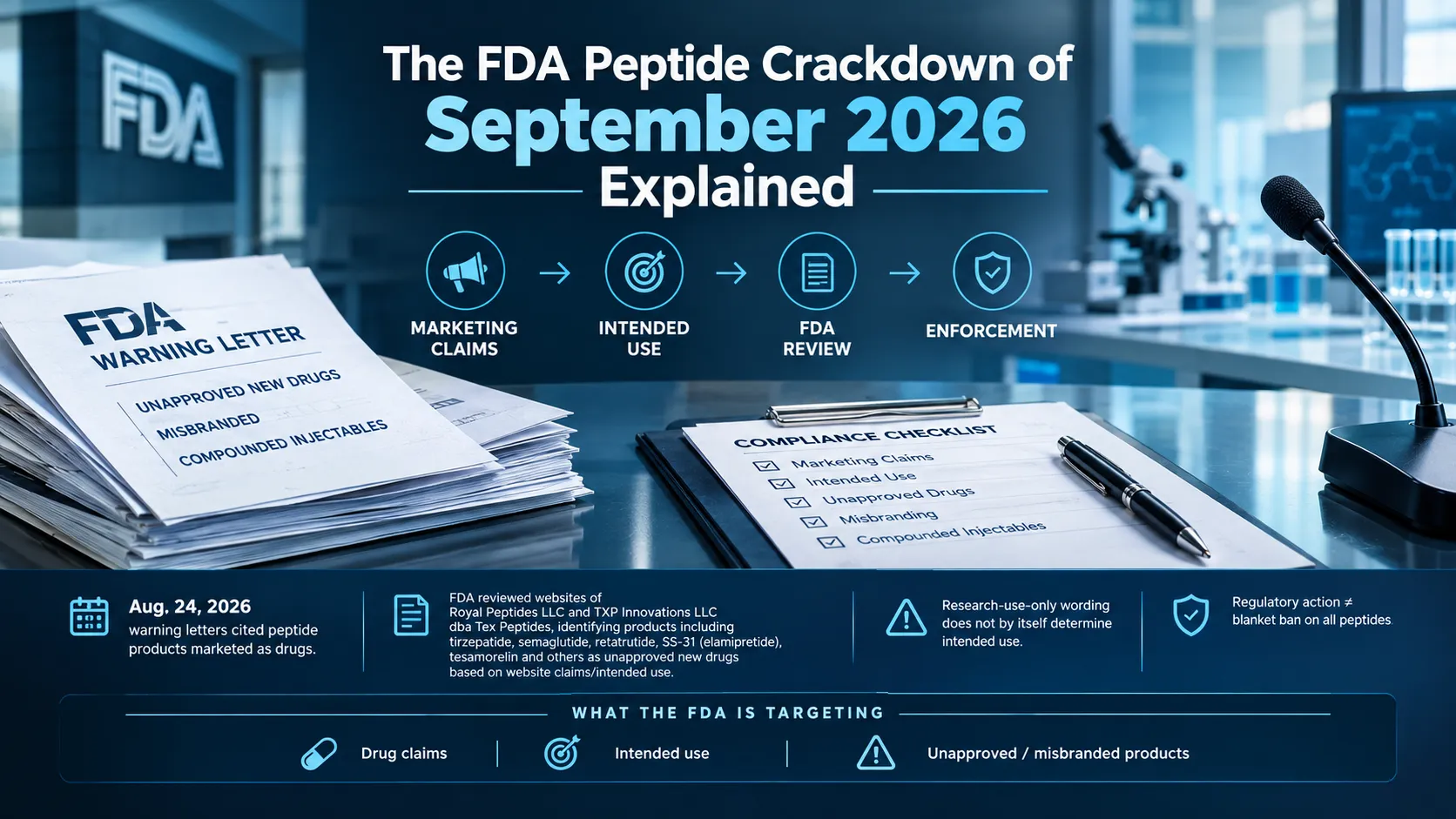
Regulatory positions also differ between the components rather than attaching to the blend, and they have moved recently. Component-level regulatory status is set out on the Glow Blend Spray page and should be confirmed against current FDA sources, since it changes.
Got Questions?
Frequently Asked Questions
GLOW is a commercial product designation for a research preparation containing GHK-Cu, BPC-157 and a thymosin beta-4-related material supplied as TB-500. It is not a single molecule, and it has no monograph, CAS registry entry or standard definition.
No. Helix Bio's own Glow Blend Spray page states that the proportion of each component varies substantially between vendors, and in some cases so does the molecular form of the thymosin-related component. Component quantities for any specific material come from that supplier's product documentation.
No published study of the three-component combination was identified. The available literature concerns the components individually, in specific preparations and specific models.
Yes. A 2026 study in Joint Diseases and Related Surgery compared BPC-157, TB-500, the combination and control in a rat Achilles tendon repair model. No treatment-versus-treatment comparison reached statistical significance on the biomechanical or total histological endpoints, though one collagen type III measure differed between the two single-agent arms, and the effective group size was four animals per endpoint.
Because it changes the result. In rat wound-chamber work, GHK-Cu increased collagen accumulation while GHK without copper produced no significant effect in the same model. Analytically, this means a peptide-only method leaves half the entity unconfirmed.
It is a market label rather than a chemical name. Two molecules are supplied under it: full-length thymosin beta-4, a 43-residue protein of roughly 4,963 daltons, and the acetylated seven-residue fragment Ac-LKKTETQ, of roughly 889 daltons.
Not automatically. The actin-sequestration literature was generated largely with the full-length protein, and a seven-residue fragment is a different molecule. Published analytical work has identified the fragment in a marketed TB-500 preparation, so the lot documentation is what settles which form applies.
No. A chromatographic purity figure is normally expressed by area normalisation against a single target peak, and a blend has three intended peaks, so the figure has no unambiguous meaning. Per-component purity plus quantitative content determination is what characterises a blend.
Per-component identity with the thymosin-related form named explicitly, per-component purity reported separately, quantitative content for each component, a copper determination by an elemental method, the analytical methods actually used, and a lot number matching the container.
Chromatography and mass spectrometry characterise the peptide portion of GHK-Cu. Copper content requires an elemental technique such as ICP-MS, ICP-OES or atomic absorption spectroscopy, which are orthogonal to peptide methods.
No. Evidence for a compound describes that compound in the model and preparation tested. A combination introduces interactions and a fixed proportion that were not present in those studies, so combination claims require direct study of the combination.
Because a fixed-ratio blend provides no component-level control arm. Attributing a result to GHK-Cu, BPC-157 or the thymosin-related component requires running those components separately alongside the blend in the same design.