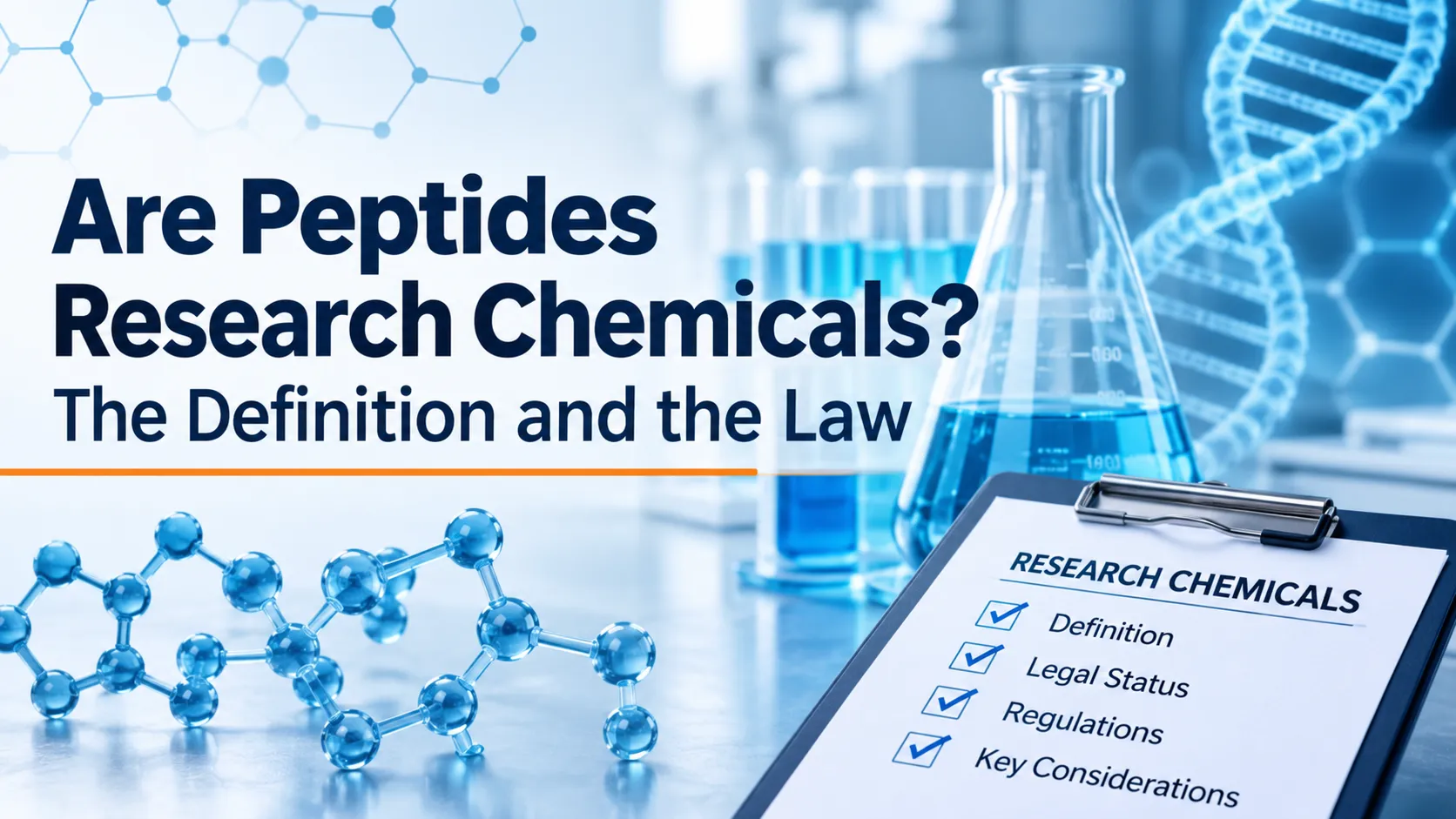
- "Research chemical" is a commercial sales label that appears in no federal statute or regulation, so it places a product in no legal category.
- The phrase carries two separate meanings, a laboratory reagent and a designer-drug marketing term, and the second meaning dominates search results outside the peptide market.
- Peptide describes a molecular structure, while research chemical describes how a product is sold, so the two terms answer different questions.
- Federal law classifies a peptide by objective intended use under 21 CFR 201.128, judged on the seller's conduct rather than the disclaimer on the vial.
- 21 U.S.C. 813(c) states that an absence of human-consumption marketing is by itself insufficient to establish a lack of intent for human consumption.
- Sitting outside DEA scheduling is not the same as being legal, because the Controlled Substances Act and the Food, Drug, and Cosmetic Act are separate statutes.
- Material sold under research-use labelling carries no CGMP obligation, so no law requires testing for identity, purity, sterility, or endotoxin.
- The 503A bulk drug substances list at 21 CFR 216.23 contains exactly six substances, and none of them is a peptide.
"Research chemical" is a sales label, not a chemical class and not a legal category. No federal law defines it, so a peptide sold under it is classified by the seller's conduct, not the vial's words.
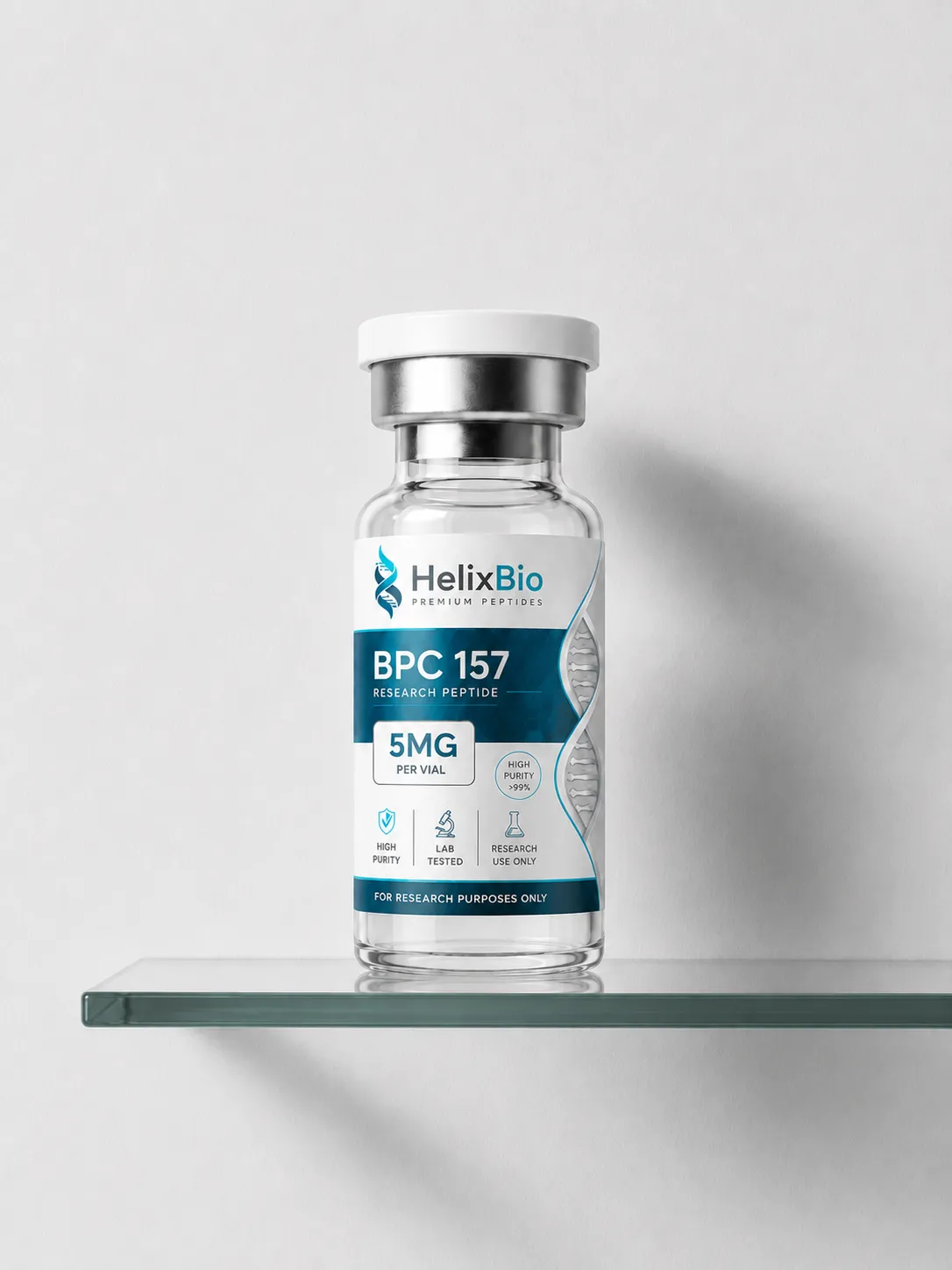
BPC-157
RESEARCH PEPTIDE
BPC-157 is a synthetic pentadecapeptide, a short chain of 15 amino acids derived from a protective protein found in gastric juice. It's one of the most widely studied research peptides in the biotech space, referenced across laboratory literature on tissue repair, angiogenesis, and gastrointestinal research models. Helix Bio's BPC-157 is manufactured for laboratory use, supplied as a lyophilized powder, and backed by a certificate of analysis for every batch. It's intended strictly for qualified researchers, laboratories, and academic institutions — not for human or animal use.
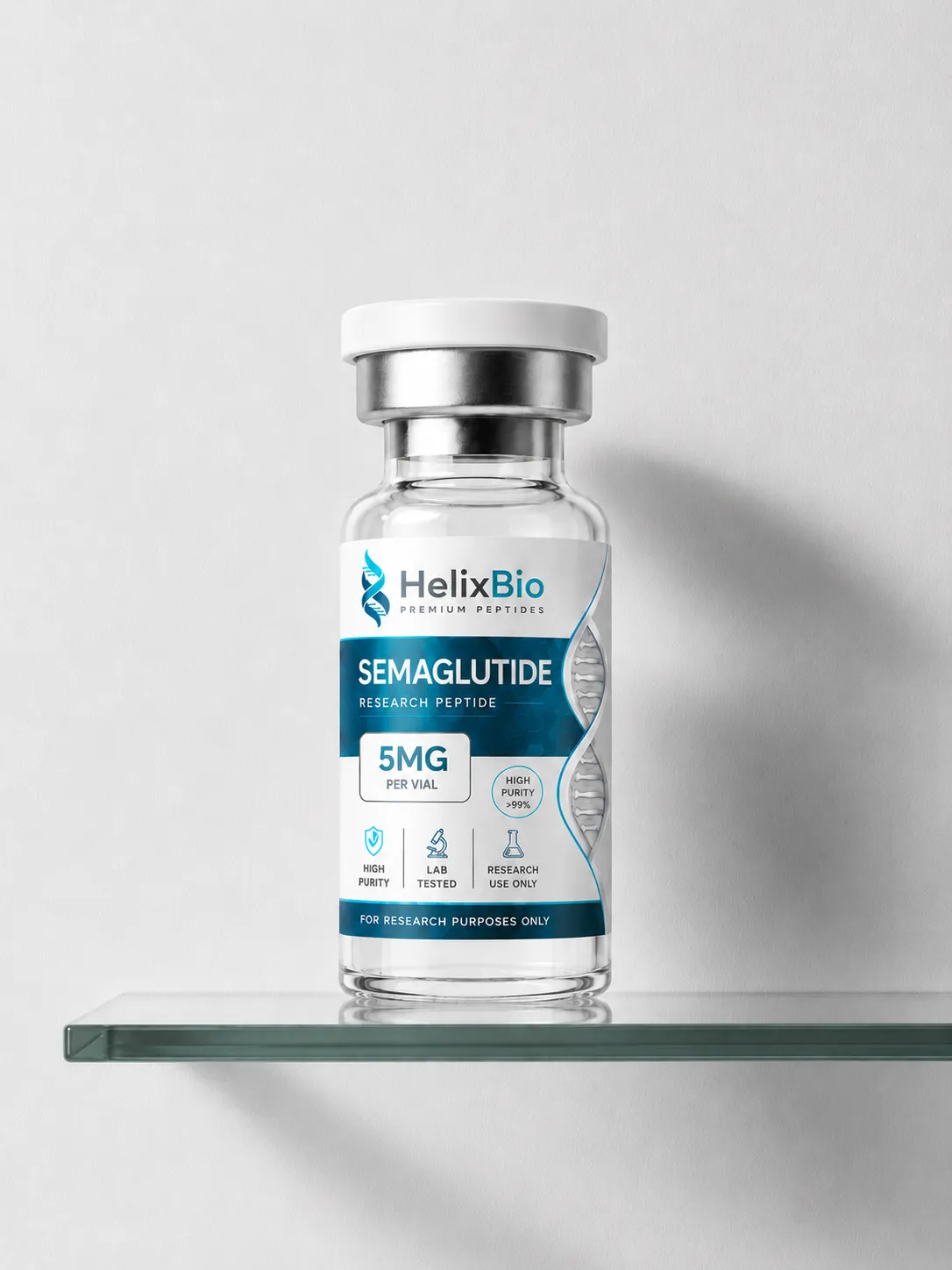
Semaglutide
RESEARCH PEPTIDE
Semaglutide is a synthetic research peptide studied for its activity as a GLP-1 receptor agonist — one of the most extensively documented compounds in incretin pharmacology, with a clinical trial record (the STEP and SUSTAIN programs) that spans over a decade. Developed originally by Novo Nordisk, Semaglutide is the reference point most researchers use when evaluating newer dual- and triple-agonist peptides such as GLP-1TRZ and GLP-3RTA. Helix Bio supplies Semaglutide as a lyophilized powder intended strictly for laboratory and preclinical research, manufactured to a high-purity standard and backed by third-party verification. It is not intended for human consumption, diagnostic use, or any therapeutic application, and it is a separate product from FDA-approved branded medications.
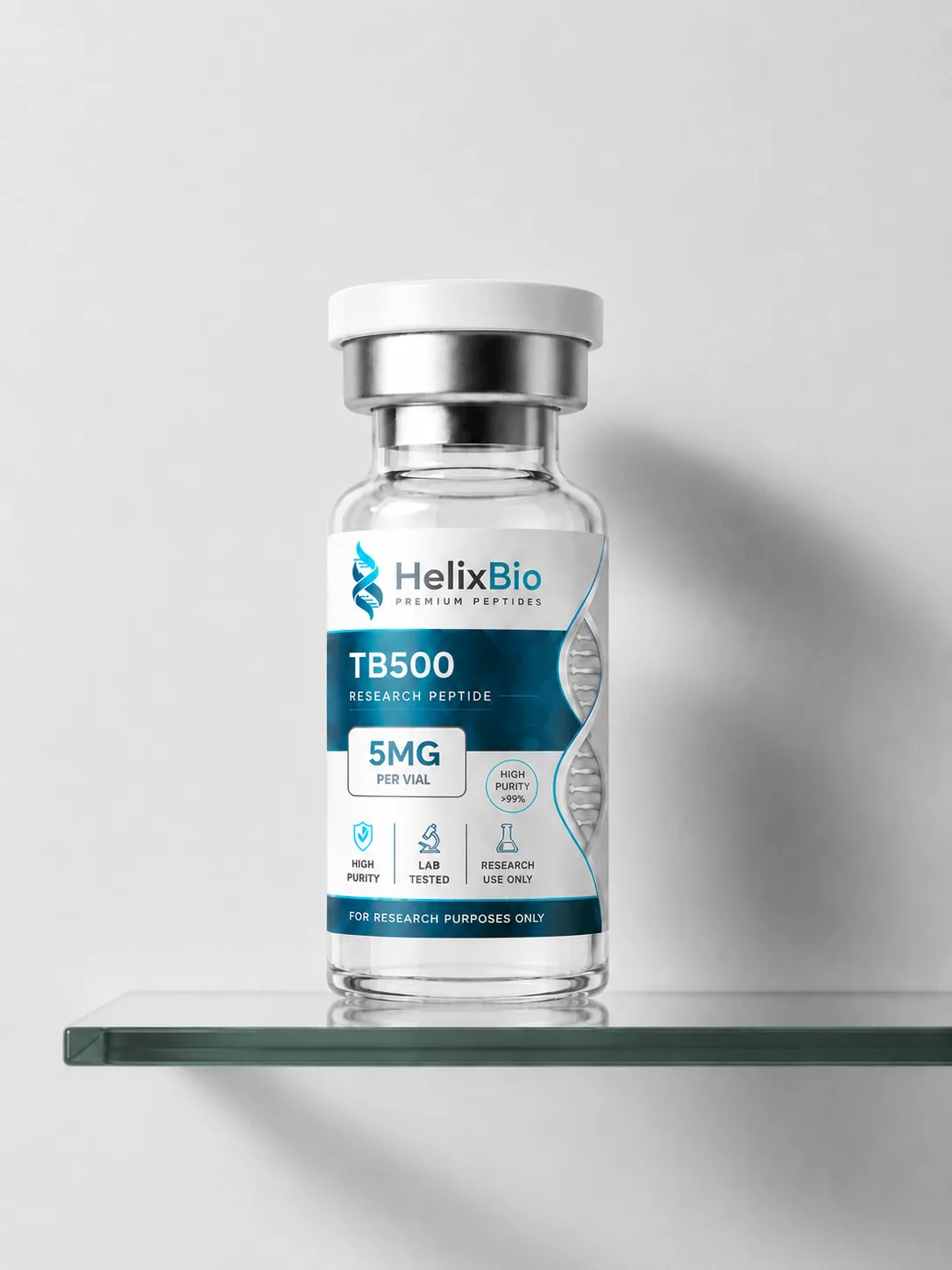
TB-500
RESEARCH PEPTIDE
TB-500 is a synthetic peptide fragment derived from Thymosin Beta-4, a naturally occurring protein involved in actin regulation within cells. It's one of the most referenced research peptides in laboratory literature on cell migration, angiogenesis, and tissue repair models. Helix Bio's TB-500 is manufactured for laboratory use, supplied as a lyophilized powder, and backed by a certificate of analysis for every batch. It's intended strictly for qualified researchers, laboratories, and academic institutions studying cellular repair mechanisms — not for human or animal use.
That answer needs one more piece before it is useful. The phrase carries two separate meanings that collide on the same page of search results. In laboratory supply, a research chemical is a reagent bought for bench work. In the online market the term grew out of the designer-drug trade. Sellers used it to move novel psychoactive substances while printing "not for human consumption" on the box. Peptides were pulled into the second usage, and that is the source of most of the confusion.
Question | Short answer |
|---|---|
Is "research chemical" a chemical classification? | No. It describes how a product is sold, not what it is made of |
Is it a legal category? | No. The term appears in no federal statute or regulation |
Are peptides research chemicals? | Most sold online are sold as research chemicals. That is a fact about the storefront, not the molecule |
Does the label make a sale legal? | No. Federal law looks at the seller's objective intent, not the disclaimer |
What are peptides, then? | A structural class, defined by amino acids joined with peptide bonds |
What decides a peptide's legal status? | Approval status plus the evidence of intended use for the specific product and sale |
This article covers the classification question and the label. It does not repeat the compliance rules, which already live on a companion page. For the RUO framework, 21 CFR 809.10 and the FD&C Act definition in detail, read are research peptides legal in the USA.
What is a research chemical, actually?
Start with the negative finding, because it does most of the work. The definitions section of the Food, Drug, and Cosmetic Act does not define "research chemical". Neither does the Controlled Substances Act. The term is absent from both.
That absence is not a loophole. It means the phrase has no power to place a product in any category at all.
The only real "research use only" rule is for something else
One FDA regulation does govern research-use labelling. 21 CFR 809.10(c)(2)(i) sets the required wording for in vitro diagnostic products still in the laboratory research phase. The sentence it prescribes is about diagnostic procedures, not drugs.
A peptide vial carrying "research use only" has borrowed a label from the diagnostics world. In that world the words have a legal home. On a peptide, they do not.
The label's first life was in the designer-drug trade
The phrase entered wide use in the late 1990s and 2000s. Online sellers moved novel psychoactive substances, including tryptamines and phenethylamines, under the research-chemical heading. The DEA's own vocabulary for these compounds is "designer drugs" and "new psychoactive substances".
Operation Web Tryp is the documented case. In July 2004 the DEA announced ten arrests across five websites selling designer-drug analogues, in the agency's words, under the guise of research chemicals. The products shipped mainly from overseas suppliers and were linked to fatal and non-fatal overdoses.
Peptides are a different product class with a different chemistry. What carried over was the marketing structure, not the pharmacology.
Laboratories are the reason the lab-supply meaning still exists. A genuine reagent purchase by an institution, documented and used at a bench, is an ordinary transaction. The problem is a consumer-facing storefront borrowing that vocabulary.
The five categories, side by side
Most of the confusion in this topic comes from treating five different kinds of statement as if they were five versions of the same statement. They are not. One describes chemistry. One describes marketing. Three describe legal status under three separate statutes.
Category | What kind of statement is it? | Where it is defined | What it establishes | What it does not establish |
|---|---|---|---|---|
Peptide | Chemical structure | Scientific usage, not statute | Amino acids joined by peptide bonds | Legality, quality, approval, purity |
Research chemical | Market label | Nowhere in federal law | How the seller describes the sale | Anything about chemistry, law, or quality |
Drug | Legal classification | 21 U.S.C. 321(g)(1) | Intended for disease use, or to affect the body's structure or function | Whether it is approved |
Dietary supplement | Legal classification | 21 U.S.C. 321(ff) | Dietary ingredient, in an ingestible form | Applies to no injectable peptide |
Controlled substance | Legal classification | 21 U.S.C. 812, schedules in 21 CFR part 1308 | Abuse potential and accepted medical use | Whether a product is legal to sell |
Read down the third column and the point lands. Four rows have an address. One does not.
The rows also are not alternatives. A single vial can sit in several at once, or in none, depending on facts outside the molecule.
Why can the same molecule be a medicine or a research chemical?
Semaglutide makes the point faster than any explanation. The same molecule is an approved prescription drug under a brand name, and is also sold in research vials by online sellers. Nothing about the chemistry differs. The legal status does.
The mechanism is intended use, set out in 21 CFR 201.128. The regulation defines intended uses as the objective intent of the people responsible for an article's labelling. That intent is shown by their expressions, by the product's design or composition, and by the circumstances of distribution. Labelling claims, advertising, and written or spoken statements all count.
So the question is never what the label says the product is for. It is what the seller's conduct shows the product is for.
What FDA has actually written
The agency has put this in writing repeatedly. Five warning letters dated 24 August 2026 went to online peptide sellers, including letter 735127 to Peak Performance Peptides and letter 733652 to NuScience Peptides. The letters conclude that the named products are unapproved new drugs under section 505(a) and drugs under section 201(g)(1).
Letter 735127 carries this footnote, verbatim:
Despite statements on your product labeling marketing your products for "research use only" and "not for human consumption," evidence obtained from your website establishes that your products are intended to be drugs for human use.
The NuScience letter shows how wide the evidence net runs. Bacteriostatic water sold as a reconstitution solvent was itself treated as a drug. A peptide calculator on the site was cited as evidence of intent, because it supplied the means to prepare an injectable dose.
FDA's page on unapproved GLP-1 drugs, published 1 October 2026, uses plainer words. It describes products falsely labeled for research purposes or not for human consumption, sold directly to consumers with dosing instructions.
One precision note. FDA does not use the phrase "research chemical" in the documents reviewed here. The agency writes about research-use labelling, not about a research-chemical category. Anyone telling you FDA has a research-chemical rule is describing something that does not exist.
The clause that already settled this
Here is the part almost nobody covers, and it is the strongest piece of law in this whole topic.
The research-chemical label was built to defeat a test of intent. Congress disarmed that move in the analogue statute it created in 1986 and sharpened in 2018.
21 U.S.C. 813(c) speaks to the label directly:
For purposes of this section, evidence that a substance was not marketed, advertised, or labeled for human consumption, by itself, shall not be sufficient to establish that the substance was not intended for human consumption.
Read that twice. The statute does not say the label is irrelevant. It says the label alone cannot carry the argument. Congress wrote the disclaimer out of the defence in 2018, adding subsection (c) to the very statute the research-chemical trade was designed to dodge.
The Supreme Court added the knowledge piece in McFadden v. United States, 576 U.S. 186 (2015). The government must prove a defendant knew he was dealing with a controlled substance. Knowing it was scheduled satisfies that. So does knowing the features that made it an analogue.
Where the analogy stops, and why it still matters
Be careful here, because overreaching on this point is easy. Peptides are almost never structural analogues of Schedule I or II substances, so the Analogue Act does not usually reach them at all. Nobody should read this section as saying peptides are controlled substances. They generally are not.
The value is structural. A label built to beat an intent test ran into a statute that disregards labels, and it lost. Peptides now sit inside a different statute with the same architecture. FDA's intended-use doctrine does for the FD&C Act what section 813(c) does for the Analogue Act.
Being outside the Controlled Substances Act is not the same as being legal. Those are two different statutes. A peptide can sit entirely outside DEA scheduling and still be an unapproved new drug under the FD&C Act. This is the single most common mistake in the category.
What do the words on the vial actually do?
Two phrases appear on nearly every research vial. They are worth reading closely, because each one says less than buyers assume.
"For research use only" is a statement of declared intent by the seller. It tells you how the seller characterises the sale. It is evidence, and only evidence, in any later analysis of intent.
"Not for human consumption" is a disclaimer about use. It transfers nothing. It does not bind the buyer, does not alter the product, and under section 813(c) cannot by itself establish a lack of intent.
Here is what neither phrase establishes:
- That the product is legal to sell, in any specific transaction
- That the contents match the label
- That anything in the vial was tested
- That a laboratory, a method, or a result exists behind it
- That the product is sterile, or free of endotoxin
- That any regulator has reviewed it
- That the seller holds a licence or registration of any kind
The gap between a seller's statement and objective intent is where enforcement happens. Dosing instructions close that gap. So do disease claims, before-and-after material, reconstitution calculators, coded product names that map onto known drugs, and selling direct to consumers rather than institutions.
Is BPC-157 a research chemical, and what about the others
This is the question most people actually type, with a compound name in front of it. The answer has the same shape every time, which makes it worth learning once.
BPC-157 worked example. BPC-157 is a peptide. It is a structural fact, not a status. It has no FDA-approved application, so there is no approved product to buy. Most sellers offer it under research-use labelling, which means it is sold as a research chemical. That tells you about the storefront. It tells you nothing about what is in the vial, because no testing is required of a product sold that way.
Run the same three steps for any compound. What is the molecule? Is there an approved application for it? How is this particular seller presenting it?
Compound | Is it a peptide? | Approved drug application? | Usually sold as a research chemical? |
|---|---|---|---|
BPC-157 | Yes | No | Yes |
TB-500 | Yes, a peptide fragment | No | Yes |
Ipamorelin | Yes | No | Yes |
CJC-1295 | Yes | No | Yes |
Semaglutide | Yes | Yes, as approved prescription products | Also sold in research vials by online sellers |
Retatrutide | Yes | No, investigational | Yes |
GHK-Cu | Yes, a copper-binding tripeptide | No | Yes |
The semaglutide row is the one to study. An approval attaches to a specific product made and labelled a specific way. Bulk material of the same molecule, sold separately for research, does not inherit that approval. Same molecule, two completely different legal positions.
Three things no row in that table tells you: purity, identity, or whether the vial in front of you matches any document. For the full approval picture, see what peptides are FDA approved.
Are research grade and pharmaceutical grade the same?
The phrase "research grade" sounds like a specification one tier below pharmaceutical grade. It is not. There is no mandatory framework that defines it.
21 CFR 210.1 sets out current good manufacturing practice for the manufacture, processing, packing, and holding of a drug. A drug made outside those rules is adulterated.
Follow that logic to its end and you get the honest version, which cuts both ways.
Material genuinely sold as a research chemical is not being made as a drug. So no CGMP obligation attaches to it. No law requires a research-chemical seller to test for identity, purity, sterility, or endotoxin, to validate a method, or to hold a licence. "Third-party tested" on such a site is a voluntary marketing claim, not a regulatory status.
The reverse applies the moment intended use changes. If FDA concludes the same material is intended for human use, it is a drug, and the full manufacturing framework applies to it, including adulteration.
So the label is not only legally empty. It is the mechanism by which a product steps outside every manufacturing standard a drug would carry. A buyer reading "research use only" is reading a statement that nobody was required to verify the contents.
Pharmaceutical grade, by contrast, means a product made under those drug rules, usually against a USP monograph, with documentation a regulator can inspect.
How do you tell whether a vial matches its label?
No competitor page in this space gives a working sequence, so here is one. Each step is something you can actually check.
Step 1. Read the label for what it claims. Compound name, amount, lot or batch number, and the seller's own identity. A vial with no lot number cannot be matched to any document, which ends the exercise early.
Step 2. Ask which document covers this lot. Not a certificate for the compound in general. The one covering the number printed on your vial.
Step 3. Check who tested it, and for what. The document should name a laboratory, a method, and the property measured. Purity by HPLC and identity by mass spectrometry answer different questions. One without the other leaves a hole.
Step 4. Verify the document at its source. Where the laboratory runs a report lookup, check the number there. A certificate that the issuing laboratory cannot confirm is not evidence. The method for this is in how to verify a peptide lab's testing.
Step 5. Read the seller's own conduct. Dosing guidance, therapeutic claims, human-use imagery, and reconstitution calculators all say one thing. The seller is not operating the way the label claims. That is the same evidence a regulator reads.
Step 6. Decide what the answer is worth. If every step holds, you have a documented research purchase. If a step fails, you have a gap, and the next section is about what to do with it.
What to do when the paperwork does not match
A mismatch usually means a real document is describing something other than what you are holding. Outright fabrication exists and is the rarest case.
- Go to the laboratory first, with the report number. The issuing laboratory's own record is the reference version. If a lookup returns nothing, or different details, stop treating the document as evidence.
- Ask the seller for the lot-matched document. Put the number from your vial in the request. A seller who cannot produce it has told you something useful.
- Write down what differs. Keep the vial, the label, the document, and the correspondence. Any later conversation goes better with a record.
- Do not reason backwards from the gap. A missing document means the evidence is absent, not that the material is defective. The exception is a document reused across batches, because then the paperwork itself cannot be trusted.
Clerical error and deliberate edit look identical from the outside. Describe the discrepancy and ask. Do not publish a conclusion about intent you cannot support.
What can the label not tell you?
Everything above improves what you can establish. This section is about the limits that no amount of document checking reaches.
- Who chose the sample. A laboratory tests what arrives. It does not pick the vial, and it cannot confirm the sample represents the batch.
- What happened afterwards. Filling, labelling, storage, and shipping all sit between a tested sample and your vial.
- Whether the document is the laboratory's. A name on a PDF is a claim about where it came from. Only the laboratory's own record settles that.
- Anything about safety. A purity figure is a measurement. It does not establish sterility, identity, net content, biological activity, or approval status.
For what the published testing evidence actually shows, see peptide purity testing and contamination data.
What happened when researchers tested the market?
Three pieces of public evidence show the stakes. Each carries limits worth stating.
A peer-reviewed market study. Ashraf and colleagues published test-purchase results in the Journal of Medical Internet Research in 2024. They screened 1,080 search-result links and found 317 led to online pharmacies. Of six test purchases from illegal pharmacies, three vials arrived, and none of three ordered pens were delivered at all.
The measurements matter, and so does their unit. Semaglutide content exceeded the label claim by 28.56% to 38.69%. Measured semaglutide as a share of total powder weight in the vial came to 7.7%, 8.97%, and 14.37%. Endotoxin was present in every sample, between 2.1645 and 8.9511 EU/mg.
Do not read those powder-weight percentages against a seller's "99% pure" claim as though they were the same measurement. They are not. The study reports content as a share of total powder weight. A 99% claim is normally a chromatographic peak-area figure. Comparing them directly produces a number that means nothing. The paper's own point is that research-grade purity and pharmaceutical-grade product quality are different things.
A criminal prosecution. The Department of Justice announced the sentence in July 2026. Matthew Kawa of Paradigm Peptides received 70 months in prison on 30 July 2026. The court entered a 5 million dollar money judgment and restitution of 78,317.52 dollars. A co-defendant received 16 months, and both had pleaded guilty in December 2025. The release states the business sold peptides, SARMs, and other drugs for human consumption without approval. It imported the products from overseas and did not test them before sale. Products sold as SARMs were actually testosterone.
One attribution limit. Some trade coverage of that case describes forged certificates. The DOJ release does not use that phrase, and it should not be credited with it.
Regulatory enforcement. The August 2026 warning letters described earlier are the pattern, not an isolated action. A warning letter records the agency's findings and demands correction. It is not a court judgment.
Where the law stands right now, and what changed in 2026
Three points, each dated, each narrow.
No peptide can be lawfully compounded under the 503A bulks route. 21 CFR 216.23 lists the bulk drug substances permitted for 503A compounding. It contains exactly six entries: Brilliant Blue G, cantharidin, diphenylcyclopropenone, N-acetyl-D-glucosamine, squaric acid dibutyl ester, and thymol iodide. None is a peptide.
A separate federal interim enforcement policy covering several peptides for licensed compounders was reported in late October 2026. It is described as non-binding, and as enforcement discretion rather than approval. It does not cover research-use website sales. Treat it as reported rather than settled, and check the Federal Register before relying on it.
State action targets clinicians, not buyers. The Alabama Board of Medical Examiners issued a notice in May 2026. It states that under no circumstances may a physician compound, administer, or dispense a non-FDA-approved or research-grade peptide to a patient. The prohibition extends to advising, recommending, and supplying. Consent forms identifying a product as research grade do not mitigate liability.
Louisiana moved the other way. Act 374 of 2026 bars state licensing boards from prohibiting providers from supplying peptides from facilities that comply with federal compounding law. Read the condition carefully: it protects only compounding that already meets the federal test, and no peptide currently meets it.
No state has banned peptides as such. Claims that California, New York, or Florida have done so circulate widely and are not supported by any statute or bill number we could locate. For the full picture, see peptide laws by state.
One note on taxonomy, since the site uses two. Most pages here describe three categories, which are approved drugs, compounded preparations, and research-labelled material. One page splits research and investigational into separate buckets, giving four. The three-category version is used throughout this article.
Peptides and anti-doping rules
Sport has its own rulebook, and it answers a different question from the law.
The WADA Prohibited List includes a catch-all class, S0, covering substances with no current approval for human therapeutic use by any government health authority. That class reaches a great many research peptides precisely because they are unapproved. Class S2 covers peptide hormones, growth factors, and related substances.
One correction worth carrying, because it is widely stated backwards. Semaglutide and tirzepatide sit on WADA's Monitoring Program, not the Prohibited List. Monitoring means the agency is watching usage patterns. It is not a ban. Verify the current list before relying on either status, since it is revised annually.
What this means if you are buying
The honest summary is short. "Research chemical" tells you how a product is sold. It tells you nothing about chemistry, legality, or quality, and it does not protect anyone.
So the useful questions are not about the label. They are about the document behind the vial, the laboratory behind the document, and whether the seller's own behaviour matches what they claim.
Helix Bio sells products labelled for laboratory research use. That label means the same thing here as anywhere. It describes the sale, not the quality. Lot-specific certificates are available on request rather than published as a public library. Ask for the one covering your lot before ordering, through the certificates page. Peptides and SARMs sit under one catalogue heading across this market. The structural reasons they are not the same compound class are in peptides vs SARMs.
Choosing a supplier is a separate job. The practical sequence is in the sourcing checklist. The account and documentation side is in research peptide account requirements.
Everything discussed here is for laboratory research use only. Nothing on this page is medical or legal advice, and no compound mentioned is offered for human use.
Frequently Asked Questions
Both answers are true in different senses, which is why the question causes so much confusion. Most peptides offered by online suppliers are sold as research chemicals, so the label genuinely describes the transaction. The molecules themselves are peptides, a structural class, and "research chemical" is not a chemical or legal classification that anything can belong to.
In laboratory supply it means a reagent purchased for bench work. In the online market the term came from the designer-drug trade, where suppliers used it alongside "not for human consumption" labelling. Neither usage has a definition in federal statute or regulation.
Under 21 U.S.C. 321(g)(1) an article becomes a drug when it is intended to diagnose, cure, mitigate, treat, or prevent disease, or to affect the structure or function of the body. A peptide offered with objective evidence of human-use intent meets that definition and is an unapproved new drug. The same molecule sold genuinely as a laboratory material does not, though the facts carry the burden.
No, because only one of the two terms has a legal definition. "Drug" is defined by statute and turns on intended use. "Research chemical" is a label a supplier prints, and printing it changes nothing about how the law reads the product.
Pharmaceutical grade means material manufactured under the drug CGMP rules in 21 CFR parts 210 and 211, usually against a USP monograph, with records a regulator can inspect. Research grade has no mandatory framework behind it at all, so the phrase sets no standard. The two are not adjacent tiers of one scale.
It is a disclaimer describing the supplier's declared intent, and it transfers nothing to the buyer. It does not alter the material, establish legality, or confirm that anything in the vial was tested. Under 21 U.S.C. 813(c) that wording cannot by itself establish a lack of intent for human consumption.
The phrase is an assertion of intended use, offered so the supplier can characterise the sale as a laboratory transaction rather than a drug sale. FDA judges intent on the totality of a seller's conduct under 21 CFR 201.128, so the sentence is one piece of evidence among many. In the 2026 warning letters reviewed for this article, that evidence was outweighed by the rest of the sellers' websites.
No. FDA has stated in writing that products carrying research-use labelling were nonetheless intended to be drugs for human use, based on evidence from the sellers' own websites. Dosing instructions, reconstitution calculators, disease claims, and direct-to-consumer sales all count as that evidence.
BPC-157 is a peptide, which is a structural fact rather than a status. It has no FDA-approved application, and suppliers generally offer it under research-use labelling, so it is sold as a research chemical. That describes the storefront and establishes nothing about the identity or purity of a given vial.
Semaglutide is the active ingredient in FDA-approved prescription products, so the molecule itself is an approved drug substance. Bulk material of the same molecule sold separately in research vials does not inherit that approval and is an unapproved new drug when intended for human use. It is the clearest example of one molecule holding two different legal positions.
No. Peptides are chains of amino acids joined by peptide bonds, while anabolic steroids share a steroid ring structure and many are Schedule III controlled substances. The two are often discussed together because online catalogues file them under one heading, which is a shelving convention rather than a chemical relationship.
The WADA Prohibited List includes class S0, a catch-all covering substances with no current approval for human therapeutic use by any government health authority, which reaches many unapproved research peptides. Class S2 separately covers peptide hormones and growth factors. Semaglutide and tirzepatide sit on WADA's Monitoring Program rather than the Prohibited List, and the list is revised annually, so the current version should be checked directly.
- 0121 U.S.C. 813, Treatment of controlled substance analogues, including subsection (c) on human-consumption marketing.
- 0221 U.S.C. 321, Definitions, including (g)(1) drug, (p) new drug, and (ff) dietary supplement.
- 0321 CFR 201.128, Meaning of intended uses [86 FR 41401, August 2, 2021].
- 0421 CFR 216.23, Bulk drug substances that may be used in pharmacy compounding under section 503A [84 FR 4710, February 19, 2019].
- 05U.S. Food and Drug Administration, Warning Letter 735127 to Peak Performance Peptides, August 24, 2026.
- 06U.S. Food and Drug Administration, Concerns with Unapproved GLP-1 Drugs Used for Weight Loss, October 1, 2026.
- 07U.S. Department of Justice, Northern District of Indiana, sentencing announcement in the Paradigm Peptides prosecution, July 30, 2026.
- 08Ashraf AR, et al. Safety and Quality of Illicit Online Pharmacy Semaglutide. Journal of Medical Internet Research. 2024;26:e65440. PMID 39509151.
Helix Bio Chem Team
Research & Product Team
Our in-house team tracks published peptide research and translates it into clear, source-cited summaries for the research community.
Reviewed by in-house research chemists
support@helixbiochem.com