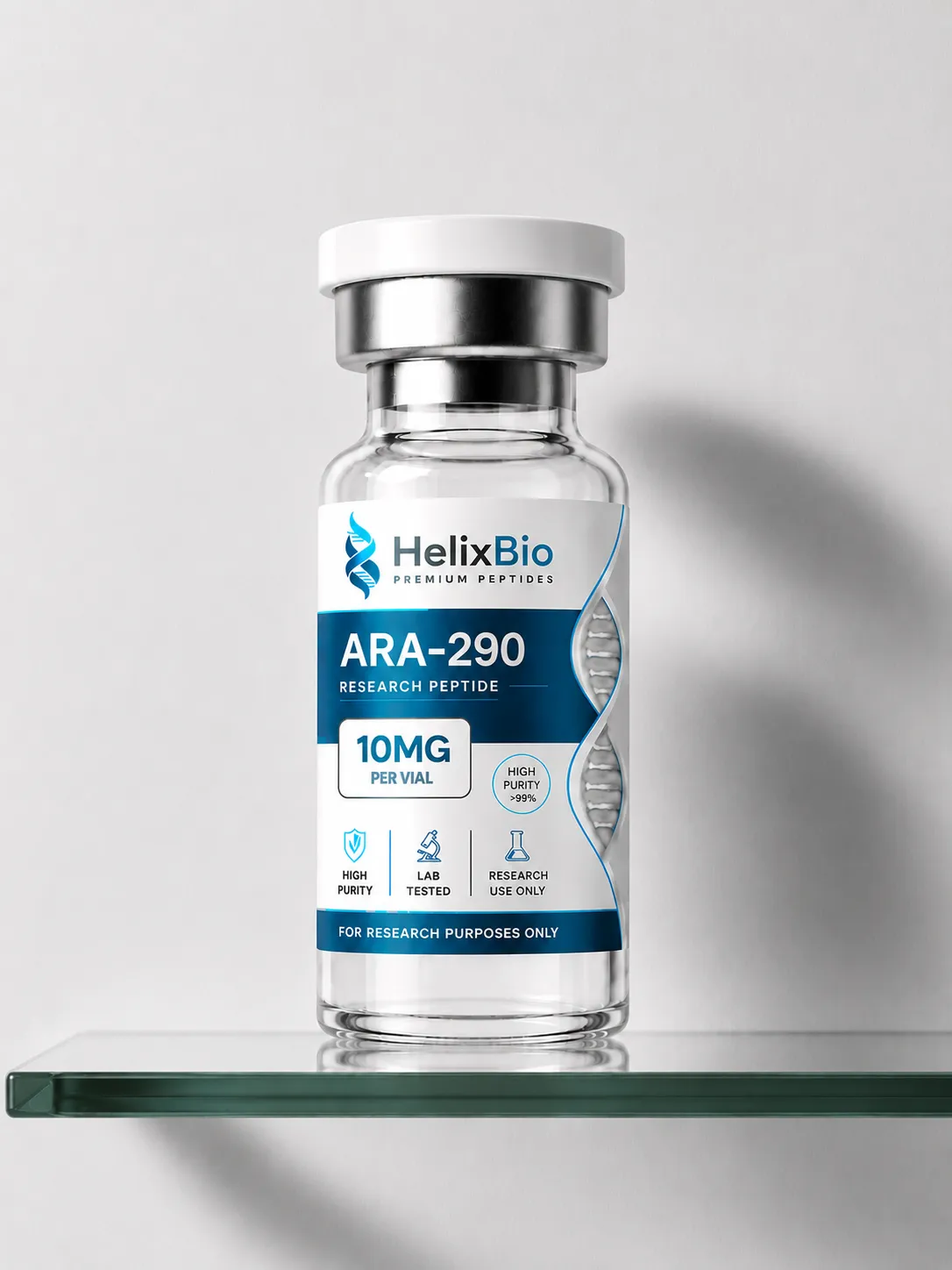
ARA-290, known in the scientific literature as cibinetide, is a small synthetic peptide derived from the structure of erythropoietin (EPO). Helix Bio supplies it strictly for laboratory and academic research use — it is not manufactured, labeled, or sold for human consumption, clinical use, or self-administration, and it is not FDA-approved for any indication. ARA-290 has drawn research interest because it's designed to interact with the innate repair receptor, a receptor complex distinct from the classic erythropoietin receptor that drives red blood cell production. That distinction is why it's often described as a non-hematopoietic EPO analog and why it shows up in published research on tissue protection, nerve fiber biology, and inflammation-related signaling, including third-party clinical research on neuropathic pain and sarcoidosis-associated neuropathy. Helix Bio's ARA-290 ships as a lyophilized powder, is verified through HPLC and mass spectrometry, and includes a certificate of analysis with every batch. This page covers what's known about ARA-290's structure and mechanism, how Helix Bio tests it, and the published research context — useful background before placing a research order.
HPLC certified
Independent analysis
Highest standard
Full traceability
ARA-290 is a short synthetic peptide modeled on a surface region of erythropoietin. Unlike full-length EPO, it's designed not to activate the classic EPO receptor homodimer responsible for red blood cell production, which is the basis for describing it as non-hematopoietic or non-erythropoietic in the literature. Instead, research has focused on its interaction with the innate repair receptor, a complex involving the EPO receptor and CD131 (the beta common receptor).
Third-party sponsors have studied ARA-290 in human clinical trials for conditions including neuropathic pain and sarcoidosis-associated small fiber neuropathy. Those trials are published, third-party clinical research — they are not conducted or sponsored by Helix Bio, and Helix Bio's research-use-only peptide is not the same clinical-grade material used in any trial. ARA-290 is not FDA-approved for any indication in the United States.
Helix Bio provides the specific sequence and batch-level analytical data with order documentation and the certificate of analysis, since exact sequence data matters for citation and protocol accuracy.
Researchers typically request ARA-290 for study designs involving:
ARA-290 from Helix Bio is not sold, marketed, or intended as a drug, supplement, or treatment product, and it is not equivalent to or interchangeable with any clinical-trial or pharmaceutical-grade material.
When you're comparing ARA-290 suppliers, purity you can verify and consistency between batches are what matter most. Helix Bio tests each ARA-290 lot with HPLC and mass spectrometry, then attaches the certificate of analysis to the order so the numbers aren't just a claim on a website.
The peptide ships lyophilized, which holds up better across transit and short-term storage than a pre-dissolved format. Combined with domestic USA manufacturing and shipping, that means shorter transit times and fewer temperature-exposure risks between production and the lab that uses it.
This product is not intended for individual consumers, self-administration, or any use outside a research setting.
| Field | Detail |
|---|---|
| Product Name | ARA-290 (Cibinetide) |
| Category | Erythropoietin-Derived Research Peptide |
| Structure | 11-amino-acid synthetic peptide, helix B-derived |
| Molecular Weight | ~1,400 Da |
| Purity | 98%+ (HPLC verified) |
| Appearance | White to off-white lyophilized powder |
| Storage (unreconstituted) | -20°C, protected from light and moisture |
| Storage (reconstituted) | 2-8°C; follow your protocol's stability window |
| Packaging | Sealed, sterile glass vial |
| Research Use | Laboratory / in vitro research only — not for human use; not FDA-approved |
| Manufacturer | Helix Bio |
| Quality | Third-party lab tested, COA per batch |
| Country of Origin | USA |
ARA-290 (cibinetide) shows up across a specific area of the research literature centered on tissue protection and innate repair receptor signaling. This section summarizes what's studied in third-party published research — it does not describe intended uses for Helix Bio's product beyond laboratory research, and it is not a summary of Helix Bio's own findings.
Much of the ARA-290 literature centers on its proposed interaction with the innate repair receptor, a complex distinct from the classic erythropoietin receptor, and on tissue-protective and cytoprotective signaling more broadly.
Third-party sponsors have conducted published clinical research examining ARA-290 in neuropathic pain and in sarcoidosis-associated small fiber neuropathy. This is third-party clinical-trial literature — it reflects findings reported by outside researchers and does not describe Helix Bio's product as clinically tested or approved.
Published research has also examined ARA-290 in anti-inflammatory signaling models and in ischemia-reperfusion injury research, where tissue-protective mechanisms are a variable of interest.
ARA-290 is structurally derived from erythropoietin but is studied specifically because it does not appear to activate the classic EPO receptor homodimer responsible for red blood cell production. That's the basis for describing it as a non-hematopoietic or non-erythropoietic EPO analog, distinct from erythropoietin itself or from pharmaceutical epoetin alfa products.
Helix Bio verifies ARA-290 purity using HPLC (high-performance liquid chromatography) and confirms peptide identity with mass spectrometry. Both methods target 98% or higher purity per batch, and a certificate of analysis is generated for each lot so researchers can check the specific numbers for the vial they receive rather than relying on a general product description.
Standard lab handling practices apply from manufacturing through shipping: peptides are kept lyophilized until they reach the researcher, packaged to limit moisture exposure, and labeled by lot so results can be tied back to a specific batch. If your institution requires documentation beyond the standard COA, reach out to Helix Bio directly, since requirements vary by lab and by study.
General best practices for handling a lyophilized research peptide like ARA-290:
These are general handling notes, not a substitute for your institution's standard operating procedures or safety data sheet guidance.
ARA-290 ships in sealed, sterile vials, packaged to protect the lyophilized peptide during transit. Because Helix Bio manufactures and ships domestically within the USA, transit times are generally shorter than with overseas suppliers, which reduces the window of temperature exposure between production and delivery.
Specific shipping timelines, carrier options, and packaging methods can vary by order — check current shipping details at checkout or contact Helix Bio directly for order-specific questions.
ARA-290 is sold by Helix Bio strictly for laboratory and research use only (RUO). It is not a drug, dietary supplement, or treatment product, and it is not intended for human or veterinary use, ingestion, injection, or any form of self-administration.
ARA-290 (cibinetide) is an investigational compound. It has been studied in human clinical trials conducted by third-party sponsors for research purposes, but it is not FDA-approved for any indication in the United States. References on this page to clinical or preclinical research reflect third-party published literature, not claims made by Helix Bio, and do not imply that the product sold here is the same clinical-grade material used in any trial.
This product has not been evaluated by the FDA. No statement on this page is intended to diagnose, treat, cure, or prevent any disease. Information about research applications, mechanisms, and published studies is provided for educational purposes — it does not describe intended uses of this product outside a qualified research setting.
By purchasing this product, the buyer confirms they are a qualified researcher, laboratory, or institution acquiring it solely for in vitro or other legally permitted research purposes, and agrees to handle it in compliance with applicable federal, state, and local regulations.
Knowledge Base
Knowledge Base
Knowledge Base
Knowledge Base
Knowledge Base
Knowledge Base
Knowledge Base
Knowledge Base
Knowledge Base
Knowledge Base
Knowledge Base
Knowledge Base
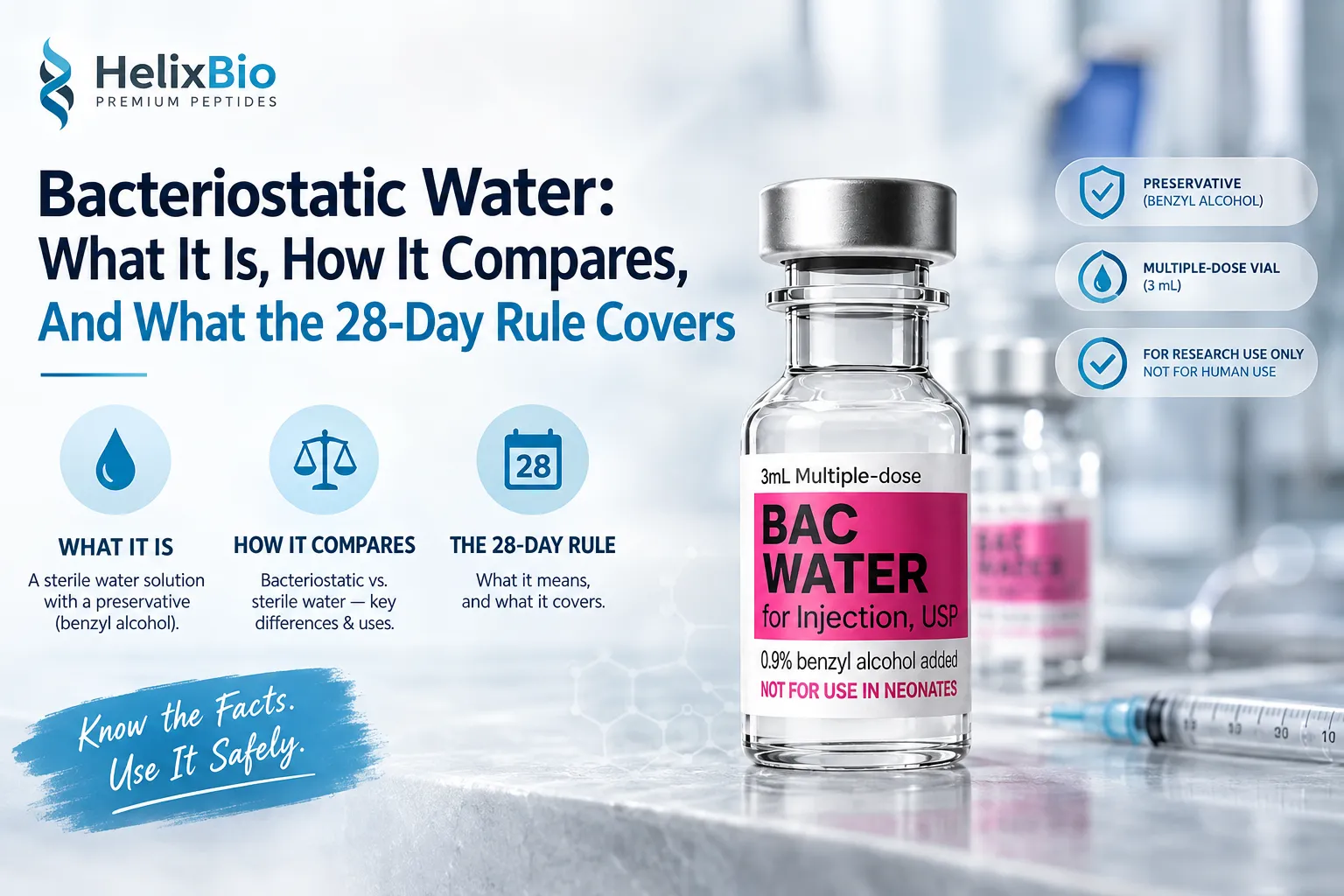
What bacteriostatic water contains, how it differs from sterile water and saline, where the 28-day opened-vial figure comes from, and what a COA can show.
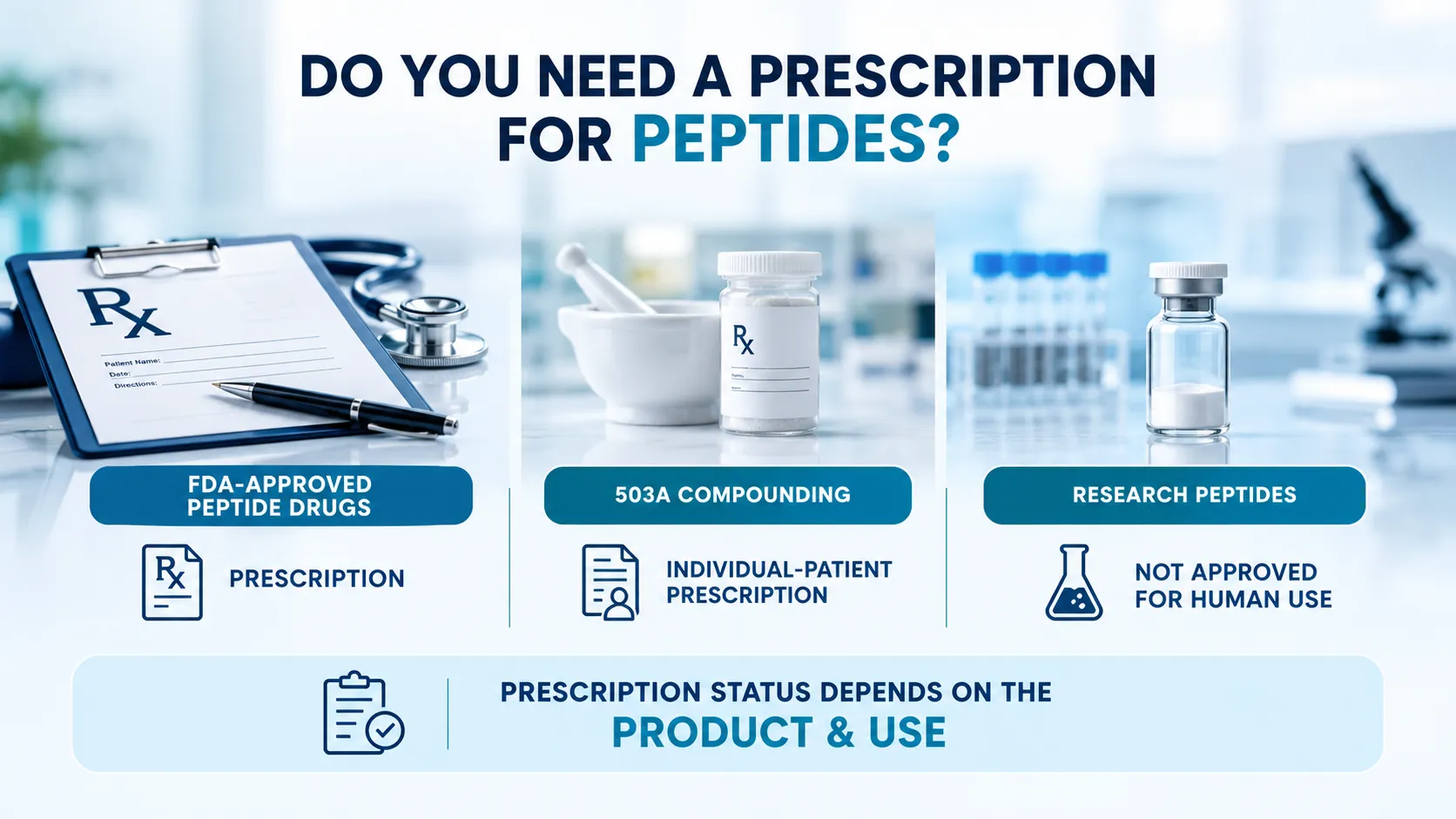
Do you need a prescription for peptides? It depends on the category. See which peptides need one, which do not, and the dated 2026 FDA rules that apply.

The complete 2026 list of FDA-approved peptides: 47 drugs by category and approval year, which popular peptides are not approved, and pipeline to watch.