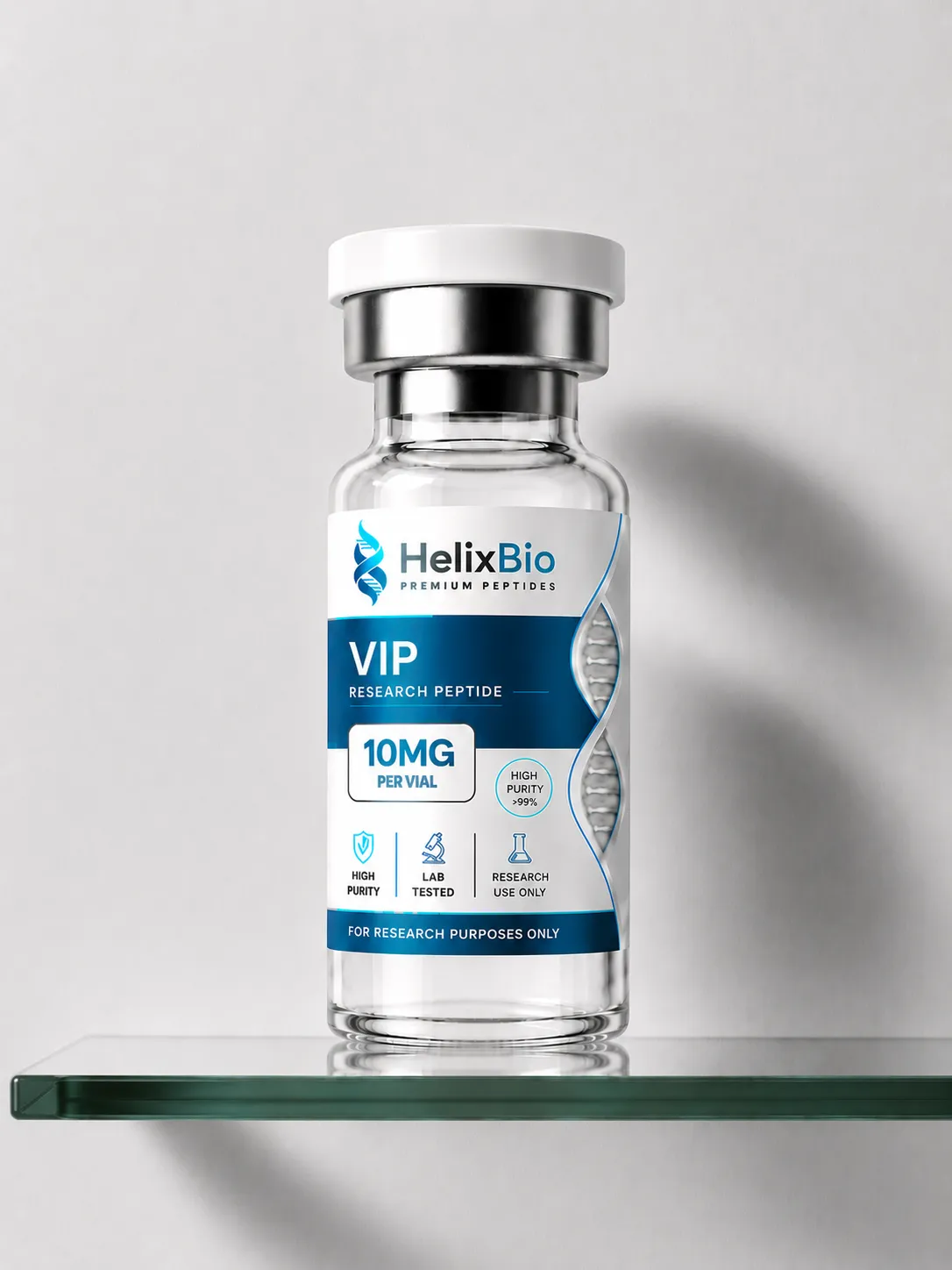
VIP, short for vasoactive intestinal peptide, is a naturally occurring 28-amino-acid neuropeptide belonging to the glucagon/secretin peptide family. It is widely studied in molecular biology, neurobiology, gastrointestinal research, vascular signaling, and receptor pharmacology. VIP research commonly focuses on its interactions with the VPAC1 (VIPR1) and VPAC2 (VIPR2) G protein-coupled receptors and the downstream signaling pathways associated with these receptors. Research literature also examines VIP in relation to smooth muscle, neural signaling, immune-cell biology, and gastrointestinal physiology. Helix Bio supplies VIP as a research-use-only peptide for qualified laboratory and scientific research. It is not intended for human or veterinary administration.
HPLC certified
Independent analysis
Highest standard
Full traceability
What Is VIP?
Vasoactive intestinal peptide, commonly abbreviated VIP, is an endogenous neuropeptide consisting of 28 amino acids. It was first identified in the context of intestinal tissue but has since been studied across numerous biological systems.
VIP belongs to the glucagon/secretin superfamily of peptides. Its molecular structure and signaling characteristics are closely related to pituitary adenylate cyclase-activating peptide (PACAP).
The biological activity of VIP is primarily associated with two receptors:
Both receptors are G protein-coupled receptors and have been extensively investigated in receptor pharmacology and cellular signaling research.
VIP is a 28-amino-acid peptide derived from the larger prepro-VIP precursor. Cellular processing produces the mature peptide used in physiological signaling.
For research purposes, VIP provides a defined peptide ligand for studying receptor activation, signal transduction, and peptide-mediated cellular responses.
VIP is relevant to laboratory research involving:
Research has demonstrated that VIP interacts with both VPAC1 and VPAC2 receptors, making it useful for comparative studies of receptor selectivity and ligand-receptor interactions.
A major area of VIP research is the relationship between the peptide and its two principal receptor subtypes.
VPAC1: VPAC1 is a G protein-coupled receptor expressed across multiple tissues and cell types. Research has examined its role in VIP-mediated signaling and receptor pharmacology.
VPAC2: VPAC2 is another major VIP receptor and has distinct expression patterns and signaling characteristics. Comparative VPAC1/VPAC2 experiments can help researchers investigate receptor subtype selectivity.
The two receptors are sufficiently distinct that researchers can use selective ligands and receptor models to investigate how peptide structure influences receptor recognition and downstream signaling.
VIP receptor activation is associated with G protein-mediated intracellular signaling. Research models commonly investigate downstream second-messenger systems such as adenylate cyclase and cyclic AMP (cAMP).
This makes VIP relevant to experiments examining:
VIP receptor signaling has also been investigated in human immune-cell models, including studies examining VPAC1 and VPAC2 receptor expression in T cells and monocytes.
VIP has an established place in gastrointestinal research because of its distribution in the enteric nervous system and its relationship with intestinal signaling pathways.
Research literature describes VIP as a broadly distributed neuropeptide involved in numerous physiological processes, with particular interest in gastrointestinal and neural signaling.
For laboratory researchers, this makes VIP useful as a molecular tool for studying peptide-mediated communication in gastrointestinal and enteric models.
VIP is particularly useful when a research project requires a well-characterized endogenous neuropeptide ligand for investigating receptor-mediated signaling.
Its established relationship with VPAC1 and VPAC2 makes it relevant to receptor pharmacology, ligand selectivity, and structure-function experiments. Researchers can also study VIP in different cellular contexts to examine how receptor expression and downstream signaling vary between biological models.
Helix Bio's website describes a quality program involving independent HPLC purity testing, mass spectrometry identity confirmation, and batch-specific Certificates of Analysis. The company's site also states that its research materials are supplied for laboratory use rather than human or veterinary administration.
For researchers, the most important consideration is the documentation associated with the specific lot being evaluated. Purity, identity, quantity, storage conditions, and other analytical characteristics should be confirmed against the current product documentation.
VIP is intended for qualified scientific and laboratory users, including:
It is not intended for consumers seeking personal health, cosmetic, wellness, or therapeutic applications.
| Specification | Details |
|---|---|
| Product Name | VIP |
| Full Name | Vasoactive Intestinal Peptide |
| Category | Research Peptide / Neuropeptide |
| Peptide Length | 28 amino acids |
| Peptide Family | Glucagon/Secretin Superfamily |
| Primary Receptors | VPAC1 and VPAC2 |
| Receptor Type | G protein-coupled receptors (GPCRs) |
| Research Areas | Neurobiology, receptor pharmacology, gastrointestinal research, cellular signaling |
| Physical Form | Verify current product listing and lot documentation |
| Purity | Verify current batch-specific COA |
| Identity Testing | Mass spectrometry, according to Helix Bio's stated quality program |
| Purity Testing | HPLC, according to Helix Bio's stated quality program |
| Documentation | Batch-specific Certificate of Analysis |
| Intended Use | Laboratory and scientific research only |
| Human Use | Not intended for human use |
| Veterinary Use | Not intended for veterinary use |
| Supplier | Helix Bio |
| Country of Origin | Verify current product documentation |
Important: Do not infer a specific purity percentage, vial quantity, formulation, or stability period without checking the current VIP product listing and corresponding lot documentation.
VPAC1 and VPAC2 Receptor Research
VIP is a useful ligand for investigating the two primary VIP receptor subtypes, VPAC1 and VPAC2.
Researchers can use VIP in receptor models to examine:
Studies have specifically investigated the amino-acid residues involved in VIP interaction with human VPAC1 and VPAC2, illustrating the value of VIP in molecular receptor research.
GPCR Signaling Research
VPAC1 and VPAC2 are GPCRs. VIP can therefore be used in experimental systems designed to examine peptide-mediated GPCR activation and downstream intracellular signaling.
Research may include measurements of second messengers, receptor-dependent cellular responses, or changes in signaling following ligand exposure.
Neurobiology Research
VIP is classified as a neuropeptide and is distributed throughout multiple neural and peripheral tissues. This makes it relevant to laboratory studies of neuropeptide signaling, neuronal communication, and peptide-mediated cellular regulation.
Gastrointestinal Research
VIP has been extensively studied in gastrointestinal biology. Research applications may involve enteric signaling, gastrointestinal smooth-muscle models, intestinal cell systems, and peptide-mediated regulation of gastrointestinal pathways.
Immune-Cell Research
VIP receptor biology has also been studied in immune-cell models. Research has examined the expression and regulation of VPAC1 and VPAC2 in human T cells and monocytes.
This provides a scientific basis for using VIP as a research reagent in studies examining neuroimmune signaling and receptor expression.
Receptor Structure-Function Studies
Because VIP interacts with more than one receptor subtype, it can be useful in experiments investigating how changes in peptide structure affect receptor recognition and signaling.
Researchers may compare native VIP with receptor-selective analogs or antagonists to investigate molecular determinants of receptor specificity.
Important Research Boundary
These applications describe areas of scientific investigation. They do not establish therapeutic effectiveness, clinical utility, or safety for human use.
Reliable analytical information is important when using peptides in laboratory research. A researcher's experimental results can be affected by peptide identity, purity, degradation, concentration, and storage history.
Helix Bio states that its research peptide catalog uses independent analytical testing and provides a Certificate of Analysis for each batch.
HPLC Purity Testing
High-performance liquid chromatography (HPLC) is commonly used for peptide purity analysis. Chromatographic profiles can help identify the principal peptide component and distinguish it from detectable impurities.
For VIP, the applicable purity result should be taken from the current lot-specific COA rather than assumed from a general catalog statement.
Mass Spectrometry
Mass spectrometry provides molecular-mass information that can be used as part of peptide identity verification.
Using chromatographic and mass-spectrometric information together provides stronger analytical context than relying on a single measurement.
Certificate of Analysis
The applicable Certificate of Analysis should be reviewed before laboratory use. Depending on the batch, documentation may provide information concerning:
A COA is analytical documentation; it should not be interpreted as FDA approval or evidence that a research peptide is suitable for administration to humans or animals.
Storage requirements should always be confirmed using the current Helix Bio product documentation and lot-specific information.
General laboratory handling principles include:
Researchers should not assume stability after reconstitution, repeated freeze-thaw cycles, or prolonged storage unless appropriate stability data are available.
Helix Bio's website presents its catalog as research-use-only materials and states that products are independently tested and accompanied by batch-specific analytical documentation. The site also describes research orders being fulfilled in the USA.
Product-specific packaging, shipping conditions, availability, and handling instructions should be confirmed against the current order and shipping information.
The research-use-only status of VIP remains unchanged during shipping, storage, or receipt.
VIP is supplied by Helix Bio strictly for research and laboratory purposes.
It is not a prescription drug, dietary supplement, food product, or finished pharmaceutical. It is not intended for human or veterinary consumption, ingestion, injection, self-administration, diagnosis, treatment, cure, mitigation, or prevention of any disease or medical condition.
The Helix Bio website states that its products have not been evaluated or approved by the U.S. Food and Drug Administration and are not intended for human or veterinary use.
Scientific literature describing VIP's biological activity should not be interpreted as evidence that this research-use-only product is safe or effective for clinical use.
Researchers are responsible for complying with all applicable federal, state, local, institutional, and laboratory requirements. Experimental work should be performed only by appropriately qualified personnel using established research protocols.
Knowledge Base
Knowledge Base
Knowledge Base
Knowledge Base
Knowledge Base
Knowledge Base
Knowledge Base
Knowledge Base
Knowledge Base
Knowledge Base
Knowledge Base
Knowledge Base
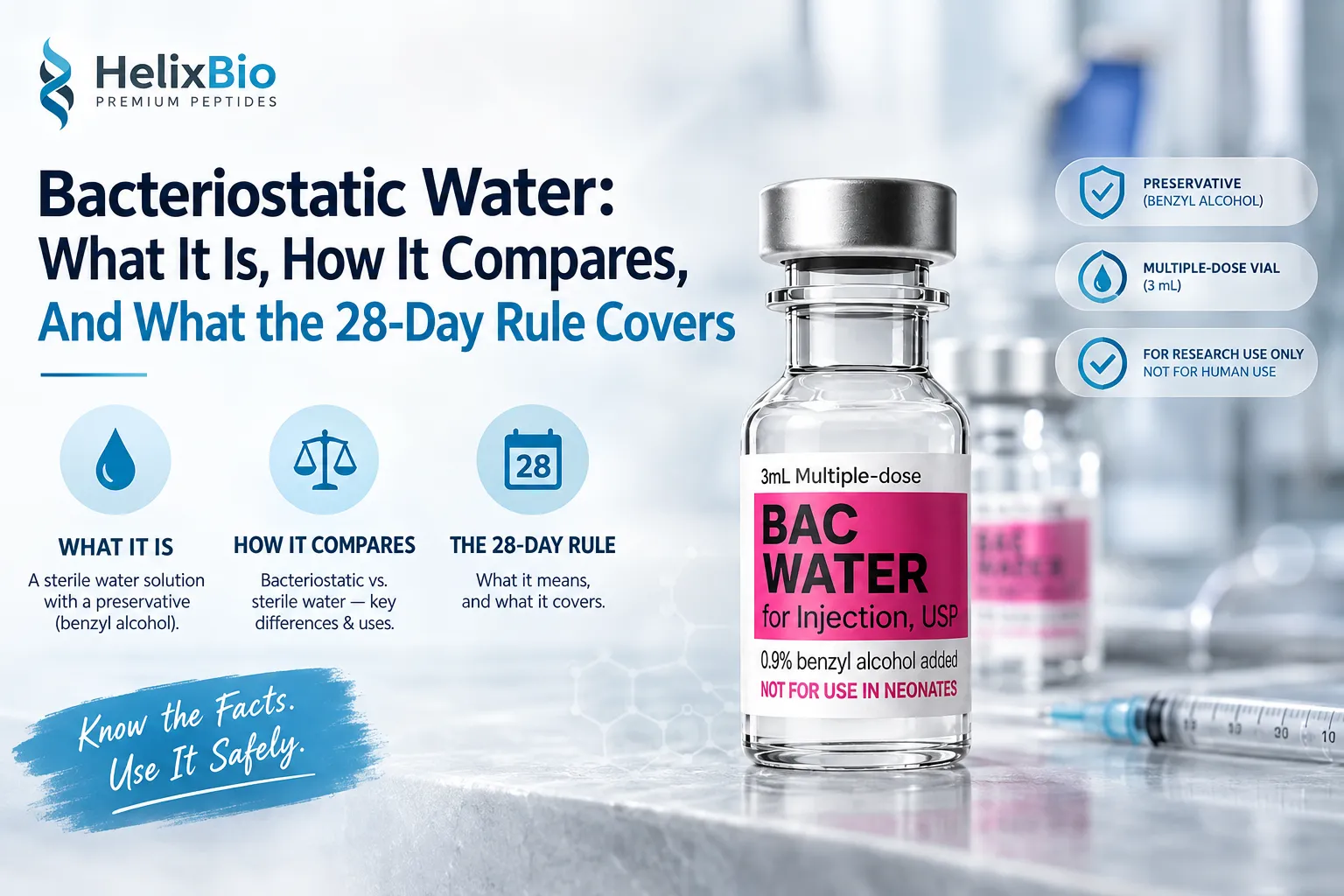
What bacteriostatic water contains, how it differs from sterile water and saline, where the 28-day opened-vial figure comes from, and what a COA can show.
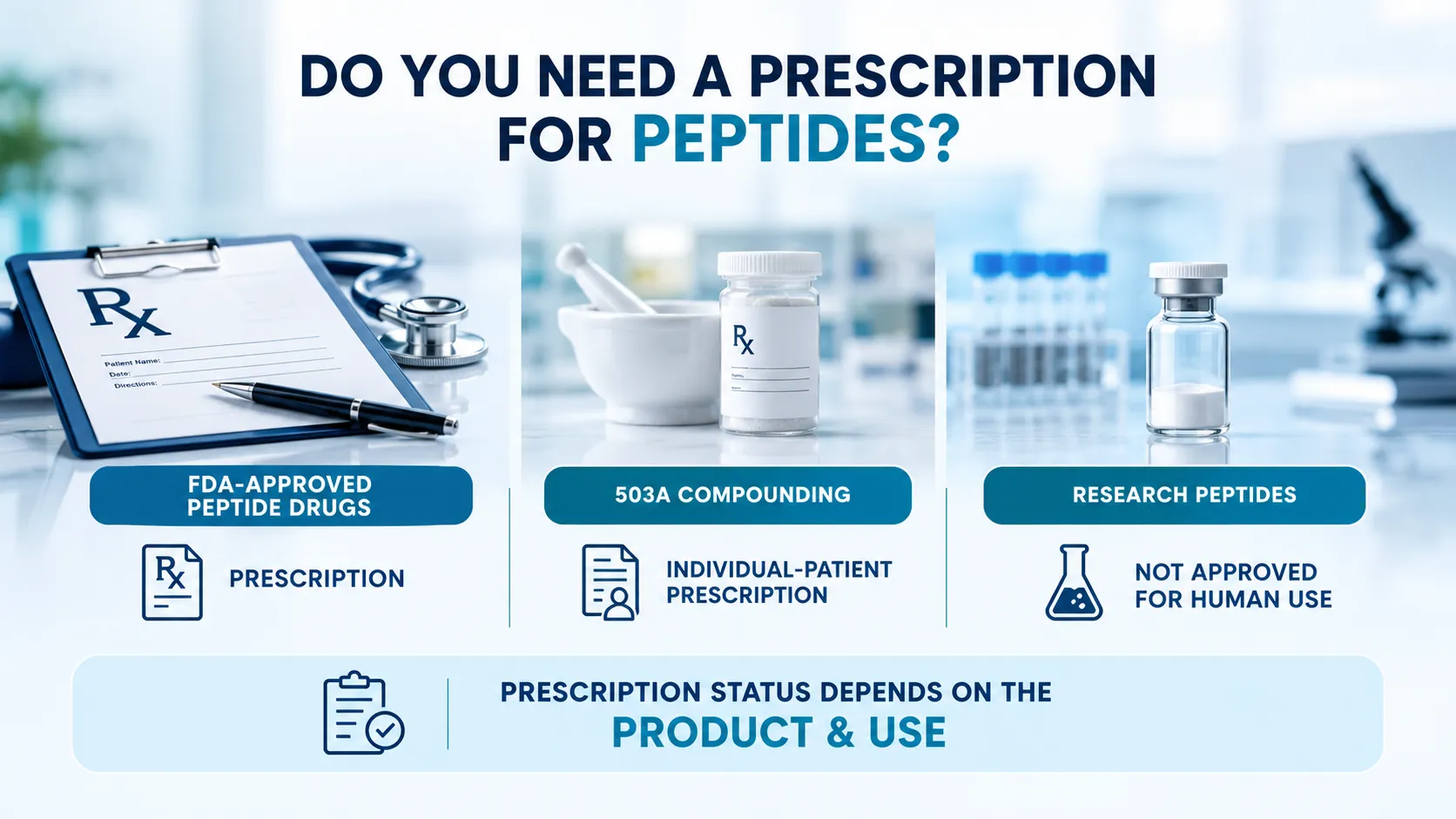
Do you need a prescription for peptides? It depends on the category. See which peptides need one, which do not, and the dated 2026 FDA rules that apply.

The complete 2026 list of FDA-approved peptides: 47 drugs by category and approval year, which popular peptides are not approved, and pipeline to watch.