- Two separate meta-analyses each pooled nineteen trials, and conflating them is the most common error in this topic area.
- Seventeen of the nineteen trials in the broader 2026 review tested oral peptides, accounting for roughly ninety-two per cent of all participants.
- Reported effect sizes are largest for the narrowest intervention, which is oral collagen supplementation taken by mouth.
- Those headline collagen figures come from small subsets selected after extreme heterogeneity forced most studies out of the pooled analysis.
- Human trial evidence for topical GHK-Cu is smaller and weaker than the compound's research profile suggests to most readers.
- One 2026 systematic review of GHK-Cu included twenty studies, of which eighteen were preclinical and only two were randomised controlled trials.
- Measured permeation of GHK-Cu through intact human skin has been described as negligible in the absence of assisted delivery.
- The best-documented topical peptide trial was designed and run by the manufacturer whose product it tested.
Two systematic reviews of peptides and skin ageing each pooled nineteen randomised trials, and they are not the same study. One examined oral and topical peptides together, with seventeen of its nineteen trials testing oral supplements. The other examined only oral hydrolysed collagen, in a different population, five years earlier. Both reviews get cited as evidence that peptide serums work.
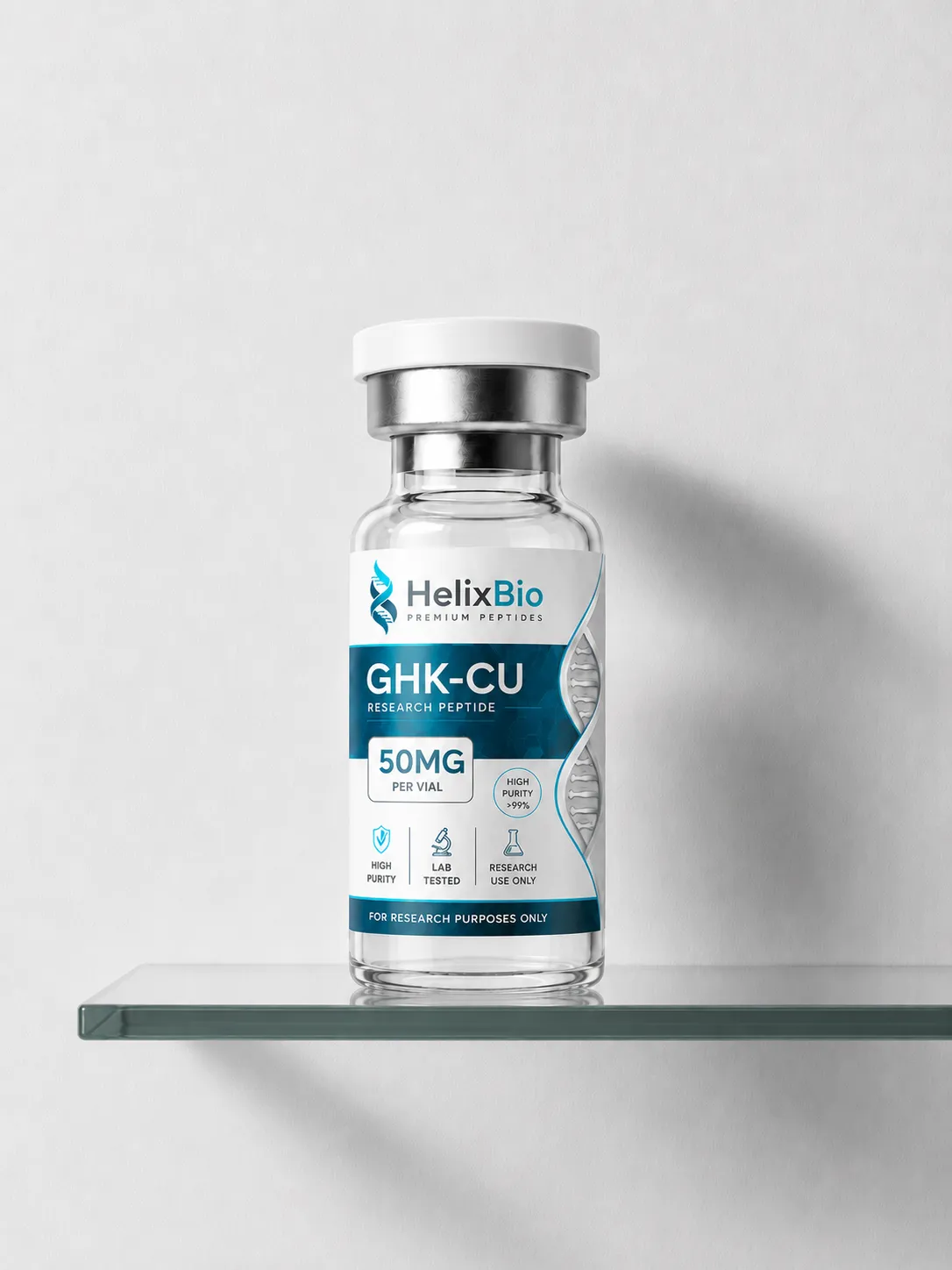
GHK-CU
RESEARCH PEPTIDE
GHK-CU (Glycyl-L-Histidyl-L-Lysine Copper) is a naturally occurring copper-binding tripeptide that has become one of the most extensively studied peptides in regenerative biology, extracellular matrix research, peptide chemistry, and cellular signaling. Researchers investigate GHK-CU in laboratory settings to better understand its interactions with biological pathways involved in tissue remodeling, cellular communication, protein regulation, and copper metabolism. Helix Bio supplies research-grade GHK-CU exclusively for laboratory, analytical, and educational research. This product is supplied strictly for research use only and is not intended for human consumption, veterinary use, therapeutic applications, or diagnostic procedures.
That confusion is the reason this article exists. Our aim is to grade what the published literature establishes for each class of cosmetic-grade peptide. Oral and topical evidence stays apart at every step.
A disclosure belongs here rather than buried in a footer. Helix Bio Chem sells research-grade peptides, and GHK-Cu is among them. Everything below assesses published literature, and the catalogue shaped no verdict in it. Where evidence for a compound we sell turns out to be thin, this article says so directly.
The short answer
Peptides for skin are not one category with one evidence base. The most consistent numbers in this literature belong to oral collagen supplements, and even those rest on small, heavily filtered subsets. Topical peptide evidence is thinner, formulation-specific, and limited by a delivery problem that remains largely unsolved. No current dataset licenses a general claim that peptide serums work.
What this article establishes
- Two separate meta-analyses each pooled nineteen trials, and conflating them is the most common error in this topic area.
- Seventeen of the nineteen trials in the broader 2026 review tested oral peptides, accounting for roughly ninety-two per cent of all participants.
- Reported effect sizes are largest for the narrowest intervention, which is oral collagen supplementation taken by mouth.
- Those headline collagen figures come from small subsets selected after extreme heterogeneity forced most studies out of the pooled analysis.
- Human trial evidence for topical GHK-Cu is smaller and weaker than the compound's research profile suggests to most readers.
- One 2026 systematic review of GHK-Cu included twenty studies, of which eighteen were preclinical and only two were randomised controlled trials.
- Measured permeation of GHK-Cu through intact human skin has been described as negligible in the absence of assisted delivery.
- The best-documented topical peptide trial was designed and run by the manufacturer whose product it tested.
Two reviews, nineteen trials each, and what separates them
Begin with the collision, because nearly every competing guide walks straight into it.
Review | Year and journal | Trials | Participants | Intervention | Route split | Key reported outcomes | What it cannot support |
|---|---|---|---|---|---|---|---|
Nukaly et al. | 2026, Frontiers in Medicine | 19 | 1,341 | Oral and topical peptides | 17 oral, 2 topical | Hydration and brightness improved. Wrinkle reduction MD 0.27, p = 0.04, described by the authors as modest. Oral polypeptide subgroup MD 1.5, p = 0.01 | A claim about topical serums. Only two of nineteen trials tested topical application, and their pooled wrinkle effect was non-significant |
de Miranda et al. | 2021, International Journal of Dermatology | 19 | 1,125 | Oral hydrolysed collagen only | 19 oral, 0 topical | Favourable results for hydration, elasticity and wrinkles after ninety days of ingestion | Anything about topical application, because no topical arm exists in the review |
Danessa et al. | 2025, Indian Journal of Dermatology, Venereology and Leprology | 10 studies | Approximately 660 | Oral collagen supplements only | Oral only | Hydration SMD 1.25, CI 0.77 to 1.74. Elasticity SMD 0.61, CI 0.21 to 1.02. Authors describe both effects as moderate | Topical outcomes, and the elasticity prediction interval crosses zero at −0.12 to 1.34 |
Three findings follow from that table, and each one undercuts a claim in common circulation.
Arithmetic settles the first point beyond argument. Nukaly and de Miranda share a trial count and almost nothing else, differing in year, journal, participant total and intervention. A writer who sees nineteen trials and reaches for whichever figure suits the sentence produces a true-sounding claim with no study behind it.
Direction of effect raises the second problem here. Danessa reports the largest effect sizes in this group, and Danessa studied the narrowest intervention of the three. Standardised mean differences of 1.25 and 0.61 describe people swallowing collagen supplements daily. Nothing in that paper was ever applied to anyone's face.
Caution from the authors themselves supplies a third warning. Nukaly attributes its wrinkle benefit largely to oral polypeptides, at a subgroup effect roughly five times the pooled figure. Extracting the pooled number and attaching it to a serum inverts what the paper actually reported.
Method quality in Nukaly deserves a note, because it is better than the citation pattern suggests. Authors searched MEDLINE, CENTRAL and Web of Science under PRISMA guidelines. Study quality was assessed with the Cochrane Risk of Bias tool, and data synthesised using a random-effects model. The review carries a registration identifier, CRD420250652779. Careful method does not rescue a pooled figure from being misapplied downstream.
Both topical trials in Nukaly can be named, which makes the imbalance concrete. Row eleven is Wang and colleagues, testing topical Argireline on peri-orbital wrinkles in China. Their intervention arm held 45 participants applying twice daily for four weeks. Taub and colleagues occupy row eighteen, testing topical alpha-defensin 5 with beta-defensin 3 in a 31-participant intervention arm in the United States. Neither tested a copper peptide, Matrixyl, or any palmitoyl compound. Pooled across those two studies, the review reports a smaller, non-significant effect on wrinkles for topical peptides.
How peptides are grouped and why grouping predicts nothing
Cosmetic peptide literature sorts molecules by proposed mechanism, and four categories cover most of what appears on labels.
Signal peptides mimic the fragments released when collagen breaks down in tissue. A fibroblast detecting that fragment behaves as though repair were needed nearby. Palmitoyl pentapeptide-4, sold under the Matrixyl trade name, is the standard example here.
Carrier peptides transport trace elements into cells across the membrane. Copper functions as a required cofactor for lysyl oxidase, the enzyme that cross-links collagen and elastin fibres. GHK-Cu belongs in this second category.
Neurotransmitter-inhibiting peptides interfere with the protein machinery driving vesicle release at the neuromuscular junction. Argireline and SNAP-8 are both built on that proposed logic.
Enzyme-inhibiting peptides target the proteases that degrade matrix proteins during ageing and inflammation.
One caution matters considerably more than the taxonomy itself. Category membership predicts a proposed mechanism and tells you nothing about evidence strength. Two peptides sharing a group can sit three tiers apart in what has actually been measured in humans, as the next section shows.
Worth naming a fifth category that keeps appearing in skin guides and should not appear at all. Several competing articles add a regenerative peptides bucket to accommodate BPC-157 and TB-500. Those compounds emerged from wound-repair research, their skin literature is almost entirely animal and cell-based, and neither is a cosmetic ingredient. Placing them beside Matrixyl implies a shared evidence base that does not exist in the published record.
The evidence tiers used in this article
A tier label means nothing unless the scale behind it is published alongside. Competing guides assert tiers without ever defining them, which makes their gradings unfalsifiable. The scale below is defined before any peptide is graded against it.
- Tier 1 covers a peer-reviewed human randomised controlled trial, published in full with methods available.
- Tier 2 applies to human data that is not peer-reviewed in full, such as a conference abstract. It also covers peer-reviewed human data carrying serious design limits.
- Tier 3 describes evidence drawn from animal models or ex vivo tissue preparations.
- Tier 4 marks findings resting on in vitro and cell-culture work alone.
Route appears in every row below, because an oral result and a topical result are different claims about different things.
Peptide or class | Proposed role | Human RCT evidence | Route | Outcomes measured | Tier | Principal limitations |
|---|---|---|---|---|---|---|
Oral collagen peptides | Substrate and signalling via absorbed di- and tripeptides | Multiple pooled reviews. de Miranda 19 studies, 1,125 participants. Pu 26 RCTs, 1,721 patients. Danessa 10 studies reporting SMD 1.25 hydration and 0.61 elasticity | Oral | Hydration, elasticity and wrinkle measures taken by instrument | 1 | Extreme heterogeneity forced subset selection. Industry funding common. Establishes nothing about topical use |
Matrixyl, palmitoyl pentapeptide-4 | Signal peptide mimicking a collagen fragment | One 12-week double-blind split-face trial, 93 women, 3 ppm, Robinson 2005 | Topical | Wrinkle and fine-line measures by instrument and expert grader | 1 | Industry-run trial, Procter & Gamble per PubMed affiliation. Single study. Caucasian female subjects only |
GHK-Cu | Copper carrier and gene-expression modulator | 2026 aesthetic-medicine review included 20 studies, 18 preclinical and 2 RCTs. Most-cited cream trials published only as a JAAD supplement abstract | Topical | Wrinkle volume and depth, patient-reported satisfaction after laser resurfacing | 2 | Human literature described in a 2026 systematic review as thin and fragmented. Permeation negligible without assisted delivery |
Argireline, acetyl hexapeptide | Interferes with SNARE complex formation | Blanes-Mira 2002, 10% emulsion, wrinkle depth reduced up to 30% across 30 days | Topical | Skin topography analysis | 2 | Small volunteer group. Concentration far above most retail formulations. |
SNAP-8, acetyl octapeptide-3 | Same proposed SNARE mechanism, different peptide sequence | No equivalent peer-reviewed human RCT was located for this article | Topical | Mechanistic and formulation studies only | 4 | Evidence does not transfer from Argireline despite the shared proposed mechanism |
BPC-157, TB-500, KPV | Tissue repair and inflammation signalling | None exists for human skin in the published literature | Not cosmetic | Wound models, predominantly rodent | 3 | Research materials rather than cosmetic ingredients. Included here only to mark the boundary |
What the GHK-Cu record actually contains
GHK-Cu carries the longest research history of any peptide in this article and a weaker human file than that history implies to most readers.
Loren Pickart isolated the tripeptide from human plasma in 1973, and five decades of mechanistic work followed. That body of research covers collagen synthesis, angiogenesis, antioxidant enzyme activity and unusually broad gene-expression effects. Depth of mechanism is genuine here, and almost all of it is preclinical.
Two numbers put the clinical record in proportion. A systematic review published in Aesthetic Surgery Journal searched through March 2026 and included twenty studies in total. Eighteen of those were preclinical and two were randomised controlled trials. Reviewers reported improved patient-reported satisfaction following laser resurfacing, alongside reduced wrinkle volume and depth against controls. They also noted methodological variability and a limited number of well-designed trials.
Published separately in 2026, a PRISMA-framed review in Archives of Internal Medicine Research described the human clinical literature as thin and fragmented. Its summary observes that most randomised trials in this area are small and conducted on facial cosmetic creams.
Regulatory position adds context the cosmetic framing tends to omit. The same 2026 review notes FDA Category 2 restriction on injectable compounding as of 2023. Evaluation has continued under the Pharmacy Compounding Advisory Committee through 2026. That status concerns compounded injectable preparations rather than cosmetic topical products, and the two are frequently conflated.
One grading detail deserves rescuing from the footnotes, because it changes how the two most-cited trials should be read. A facial-cream study and an eye-cream study are routinely presented as proof that topical GHK-Cu works. Both were published only as a two-page JAAD supplement abstract rather than as full peer-reviewed papers. Supplement abstracts carry no full methods section, which means design, blinding and analysis cannot be independently scrutinised. That places them at Tier 2 regardless of how often they are cited as definitive.
Readers wanting molecular depth on this compound, including handling and analytical considerations, will find it in our GHK-Cu research guide. This article stays deliberately at category level and does not duplicate that work.
Describing GHK-Cu as the best peptide for skin is not supportable from the record above. Promising remains an accurate characterisation of the compound. Established does not, and the gap between those two words is the whole point of grading evidence.
Matrixyl and the palmitoyl family
Matrixyl holds the cleanest topical human trial in this article, and the trial carries a conflict worth stating plainly.
Robinson and colleagues ran a twelve-week double-blind, placebo-controlled, split-face study on 93 Caucasian women aged 35 to 55. Publication came in the International Journal of Cosmetic Science during 2005. One side of the face received a moisturiser containing palmitoyl pentapeptide-4 at 3 ppm. The other side received the identical moisturiser without the peptide. Instrument measurement and expert grader image analysis both favoured the peptide side significantly.
Methodological quality is unusually good for this field. Split-face control removes most between-subject variation, twelve weeks allows dermal remodelling to register, and randomising left against right controls for facial asymmetry.
Now the complication that most citations omit. The first author's affiliation is The Procter & Gamble Company, Miami Valley Laboratories, according to the PubMed record. A manufacturer designed, ran and reported the trial that validates an ingredient it sells. That does not invalidate the findings, and pre-registration and independent replication would both resolve it. Neither has happened in the twenty years since publication.
Two further limits narrow what the trial supports. Subjects were exclusively Caucasian women within a twenty-year age band, so generalisability beyond that group is untested. Self-assessment produced significant fine-line improvements but only directional effects on other facial parameters, which the authors reported transparently. Tolerability was reported as good, with the peptide described as well tolerated by the skin across the twelve weeks.
One distinction gets lost constantly in product copy and guides alike. Matrixyl refers to palmitoyl pentapeptide-4 specifically. A different commercial blend called Matrixyl 3000 combines palmitoyl tripeptide-1 with palmitoyl tetrapeptide-7. Robinson tested the first of those two formulations. Results do not transfer to the second, and neither transfers to an unrelated product sharing part of an INCI name.
Argireline, SNAP-8, and a mechanism that is not evidence
Blanes-Mira and colleagues published the founding Argireline paper in the International Journal of Cosmetic Science during 2002. An oil-in-water emulsion containing 10% of the hexapeptide reduced wrinkle depth by up to 30% over thirty days in healthy women volunteers. Mechanistic work in the same paper demonstrated interference with SNARE complex formation at a potency the authors compared to botulinum toxin.
Two caveats sit alongside that headline result. The concentration tested was 10%, well above what most retail formulations carry on their labels. Reporting an effect as up to 30% describes a ceiling value rather than an average across participants.
Mechanistic detail from that paper sharpens the picture further. Potency approached that of botulinum toxin A, but efficacy fell far below the neurotoxin, which the authors stated plainly. Testing showed no in vivo oral toxicity and no primary irritation at high doses.
SNAP-8 presents the clearer lesson about mechanism and evidence. Acetyl octapeptide-3 reproduces residues 12 to 19 of SNAP-25 and is proposed to work exactly as Argireline does. No equivalent peer-reviewed human randomised trial for SNAP-8 was located during research for this article. Sharing a mechanism with a studied molecule generates a hypothesis rather than a result, and the two sit at different tiers here for that reason.
Oral collagen peptides and why their numbers travel badly
Oral collagen carries the strongest numbers in this entire topic and the least relevance to anything applied to skin.
Three pooled reviews give consistent direction. de Miranda and colleagues analysed 19 studies covering 1,125 participants in 2021. Their review reported favourable results for hydration, elasticity and wrinkles after ninety days of ingestion. Pu and colleagues pooled 26 randomised controlled trials with 1,721 patients in 2023, finding significant improvement in both hydration and elasticity. Danessa and colleagues reported standardised mean differences of 1.25 for hydration and 0.61 for elasticity in 2025.
One detail in de Miranda's search strategy is worth borrowing. Alongside Medline, Embase and Cochrane, the authors searched the Journal of Negative Results in BioMedicine, a deliberate attempt to surface studies that found nothing. Participants ranged from 20 to 70 years old, and roughly 95% were women.
Pu's analysis adds a note of its own about consistency. Hydration effects varied by collagen source and by supplementation duration in subgroup analysis. Elasticity showed no significant difference across collagen sources at p = 0.21, nor across measurement methods at p = 0.06. Several biases were identified across the included trials.
Subgroup analysis in de Miranda reinforced the two headline outcomes. Improvements in hydration and elasticity held up when studies were grouped rather than pooled whole. Authors concluded that ninety days of hydrolysed collagen ingestion reduces measurable signs of skin ageing. Every word of that conclusion describes something swallowed, and none of it describes a cream. That distinction is the whole reason this section exists.
Read the Danessa figures carefully, because their construction matters more than their magnitude. Initial heterogeneity ran at 99.8% for hydration and 82.4% for elasticity, which is extreme by any conventional standard. Those pooled effect sizes come from subsets selected after heterogeneity exclusion, leaving four studies contributing to hydration and three to elasticity. The authors themselves label both effects moderate rather than large.
One further detail deserves attention from anyone citing the elasticity result. Its prediction interval runs from −0.12 to 1.34, crossing zero. A prediction interval crossing zero means a future study could plausibly find no effect at all. Citing SMD 0.61 without that interval overstates how settled the elasticity finding is.
Mechanism explains why route matters so much here. Ingested collagen is hydrolysed into di- and tripeptides, absorbed through the gut, and distributed systemically through the bloodstream. Some fragments have been detected in skin tissue following ingestion. A serum applied to the stratum corneum faces an entirely different problem, which the next section examines.
Nothing in any of these three reviews supports a claim about topical peptides. Readers encountering clinically proven on a serum box, backed by a collagen meta-analysis, are looking at evidence for a supplement.
The delivery problem
Take the direct answer before the evidence. Measured permeation of GHK-Cu through intact human skin has been described as negligible in the absence of assisted delivery.
That finding comes from the 2026 Archives of Internal Medicine Research review. Microneedle pretreatment raised permeation from negligible amounts to 134 ± 12 nanomoles of peptide and 705 ± 84 nanomoles of copper across nine hours. Work was conducted in vitro and in porcine ex vivo models, so those numbers describe tissue preparations rather than living people. The same review notes that no adequately powered registered human randomised trial of microneedle-delivered GHK-Cu has yet been published.
Worth stating what would settle the question. An adequately powered human randomised trial, measuring peptide concentration at the dermal target after a realistic application regimen, would establish delivery directly. No such trial has been published for GHK-Cu in any vehicle.
Device-assisted delivery has moved ahead of its evidence base. The same 2026 review observes that cosmetic and aesthetic markets are increasingly populated with products pairing microneedle devices and dermarollers with copper peptide serums. Rigorous clinical validation has not kept pace with that commercial expansion. Device pairing also changes the regulatory picture, since a device and a cosmetic are governed separately. Readers encountering a dermaroller bundled with a peptide serum are looking at a delivery hypothesis rather than a tested protocol.
Barrier biology makes the result unsurprising. The stratum corneum excludes hydrophilic molecules above roughly 500 daltons by design. GHK-Cu is small enough to be interesting and charged enough to be obstructed. Matrixyl addresses the same obstacle differently, by attaching a palmitoyl tail that improves lipid solubility and assists passage.
Three consequences follow for anyone reading a claim about a topical peptide.
Ingredient presence is not delivery to a target. An ingredient appearing on a label establishes that it sits in the bottle, not that it reaches a fibroblast in the dermis.
Formulation carries much of any observed result. Vehicle, pH, penetration enhancers and competing actives all affect what crosses the barrier. A finished-product trial tests that product as a whole, not the molecule in isolation.
A positive clinical result does not confirm the proposed mechanism either. Should a formulation improve measured hydration, the moisturiser base may be entirely responsible. Distinguishing the two requires a vehicle-controlled design, which split-face studies like Robinson's provide and most product claims do not.
What a concentration figure on a label can and cannot tell you
Published concentrations vary so widely across this literature that no universal effective range can honestly be stated.
Compare the two best-documented topical trials directly. Robinson used palmitoyl pentapeptide-4 at 3 ppm, which works out to 0.0003% of the formulation. Blanes-Mira used Argireline at a full 10% concentration. Four orders of magnitude separate those two figures, and both studies reported measurable effects. Any guide quoting a single recommended percentage across different peptides is inventing that number.
Several further ambiguities sit inside any percentage printed on a label.
A stated percentage may refer to the pure peptide, to a supplier's trade blend containing a small fraction of active, or to the finished formulation. The same printed number carries a different meaning in each of those three cases.
INCI ordering indicates relative proportion rather than absolute amount. Below the 1% threshold it indicates even less, because ingredients may be listed in any order the manufacturer chooses.
Greater concentration is not automatically better performance. Concentration-response relationships across this literature are frequently biphasic, with low concentrations stimulating matrix synthesis and higher ones shifting toward other effects entirely.
A more useful question than what percentage is which formulation was actually tested, and whether this product matches it. Usually it does not match in any respect that the trial controlled.
How trial protocols are specified and why that does not transfer
Published trials control variables that no retail product discloses to a purchaser.
Robinson's design fixed concentration at 3 ppm and held the vehicle identical on both sides of the face. Application ran twice daily across twelve weeks, measured by instrument and trained grader. Blanes-Mira fixed concentration at 10% within a defined oil-in-water emulsion over thirty days. Nukaly's authors explicitly called for standardised outcomes, because trials in this area measure different things using different instruments.
Each of those controls performs real work in the design. Duration determines whether dermal remodelling has time to register at all, which explains why twelve weeks recurs across studies. Vehicle composition determines how much active material crosses the barrier. Instrument choice determines what counts as an improvement in the first place.
A product sharing an ingredient name with a trial shares none of that specification. It carries a different vehicle, usually an undisclosed concentration, other actives competing for the same barrier, and no measurement protocol whatsoever. Treating the trial as evidence for the product assumes an equivalence that nobody has tested.
This gap separates an ingredient having evidence from a product having evidence. The two are routinely described as though they were the same claim.
Copper peptides measured against retinoids
Comparing these two ingredient classes means comparing evidence depth rather than declaring a winner.
Topical GHK-Cu | Topical retinoids | |
|---|---|---|
Proposed mechanism | Copper delivery to matrix enzymes, broad gene-expression modulation | Retinoic acid receptor binding, altered keratinocyte differentiation and matrix turnover |
Human trial volume | Small. One 2026 review found 2 RCTs among 20 included studies | Large. Decades of randomised trials, including prescription-strength agents |
Regulatory position | Cosmetic ingredient. Separately a research material not approved for human use | Prescription and over-the-counter drug products exist with approved indications |
Delivery evidence | Permeation described as negligible without assisted delivery | Established dermal penetration across multiple formulations |
Tolerability | Few adverse events reported, within a small evidence base | Irritation, dryness and photosensitivity all well characterised |
Retinoids hold the more established record for several photoaging outcomes, and the comparison runs lopsided mainly because one literature is far larger than the other. A thin evidence base is not evidence of absence. It represents an absence of evidence, and those two statements make different claims.
Absence of reported adverse events is likewise not a positive safety finding. Small, short trials detect only the most common effects.
Compatibility as the formulation literature reports it
Popular guidance holds that copper peptides and vitamin C must never be combined. Chemistry supports a narrow version of that claim and not the broad one in circulation.
L-ascorbic acid requires a pH near 2.5 to 3.5 to remain stable in solution. Copper can dissociate from the GHK complex under those acidic conditions. That observation concerns formulation stability for two actives sharing one acidic system.
What does not follow is a general prohibition. Vitamin C derivatives such as magnesium ascorbyl phosphate remain stable at higher pH, where the interaction does not arise at all. No published human study was located that tested whether separating the two in time changes any measured outcome.
Four distinct things get merged in this discussion and should be kept apart. Demonstrated chemical instability under defined conditions is the first. Formulation-dependent compatibility forms a second category entirely. Possible irritation from combining actives is a third consideration. Manufacturer precautionary guidance, often driven by liability rather than data, makes a fourth.
This article reports what the formulation literature establishes about stability. It gives no application instructions of any kind.
Safety, read in research context
Topical cosmetic peptides carry a reassuring reported safety record with meaningful limits on what that record covers.
Nukaly reported peptides generally well tolerated, with minimal adverse events across the pooled trials. Most included studies were small and short in duration, so the finding covers common short-term effects and very little else. Duration is the sharpest limit on all of this. Trials running eight to twelve weeks cannot detect anything that emerges over years of continuous use.
Several areas remain genuinely uncharacterised in the published literature.
Pregnancy and lactation data for cosmetic peptides are sparse across the board. Absence of reported harm does not demonstrate safety in either group.
Wilson's disease raises a reasonable question about copper exposure, given that the condition impairs normal copper handling. Published evidence specifically addressing topical GHK-Cu in this population was not located for this article. Inferring either risk or safety from systemic copper metabolism would exceed what has actually been studied.
Contact irritation and allergy to cosmetic ingredients are well documented as a general phenomenon and are not specific to peptides.
A separate boundary applies on this site and deserves stating without ambiguity. Research-grade peptides, including the GHK-Cu in our own catalogue, are laboratory materials supplied strictly for in-vitro research. They are not cosmetic products and carry no approval for human use by any route. Nothing in this article describes applying them to skin.
Questions this evidence raises
Do peptides work for wrinkles? Some do, within specific formulations, by modest amounts. Nukaly's pooled wrinkle effect was MD 0.27 at p = 0.04, which the authors themselves described as modest. That benefit was attributed largely to oral polypeptides at MD 1.5. Robinson's split-face trial found significant wrinkle and fine-line reduction for one topical formulation. Generalising from either result to peptides as a category remains unsupported.
Are peptides better than retinoids? Retinoids hold a substantially larger human trial record for photoaging outcomes. Peptide trials are fewer, smaller and more formulation-specific than retinoid trials. That describes a difference in evidence volume rather than a demonstrated difference in effect. Head-to-head trials capable of settling the question have not been run at scale.
How long do trials run before measuring a change? Twelve weeks recurs across topical designs, including Robinson's split-face study. de Miranda's collagen analysis concluded on ninety days of ingestion. Study duration is a design choice reflecting how long dermal remodelling takes to register on an instrument. It makes no prediction about any individual person.
Can peptides be combined with retinol? No published human trial was located that tested this combination for either stability or outcome. Absence of evidence is the honest answer here, and it differs from a demonstrated incompatibility.
Should copper peptides and vitamin C be used together? The interaction is real at the low pH that L-ascorbic acid requires for stability, where copper can dissociate from the complex. Derivatives stable at higher pH avoid that chemistry entirely. No outcome study has tested whether separating them in time changes any measured result.
Which peptide has the best evidence for firmness? Oral collagen supplementation holds the largest pooled dataset for elasticity, with Danessa reporting SMD 0.61 at CI 0.21 to 1.02. That figure comes from three studies retained after heterogeneity exclusion, and its prediction interval crosses zero. Among topicals, Matrixyl holds the only full peer-reviewed split-face randomised trial identified here. Those two answers are not interchangeable, because one describes a supplement and the other a cream.
Are copper peptides safe? Reported adverse events in topical cosmetic use are few in number. The evidence base generating that reassurance is small, short-term, and silent on pregnancy, lactation and copper-handling disorders. Research-grade GHK-Cu is a separate matter entirely and carries no approval for human use.
Do topical peptides penetrate skin? Variably, and considerably less than marketing copy implies. GHK-Cu permeation through intact human skin has been described as negligible without assisted delivery. Matrixyl's palmitoyl tail exists specifically to address that obstacle. Penetration is a property of a formulation rather than of a molecule.
Are collagen peptides different from topical peptides? They differ in every respect that matters: route, mechanism, evidence base and reviewing literature. Oral collagen is hydrolysed and absorbed systemically through the gut. Topical peptides must cross a barrier built to exclude them. Evidence for one establishes nothing whatsoever about the other.
What separates cosmetic peptides from research peptides? Regulatory category and intended use separate them. Matrixyl and Argireline are cosmetic ingredients formulated into consumer products at defined concentrations. GHK-Cu, BPC-157, TB-500 and KPV are supplied as research materials for laboratory investigation, approved for no human use, and classified as cosmetics nowhere. Chemistry can overlap between the two groups. Regulatory status and evidence base do not overlap at all.
Where this leaves the evidence
Peptides for skin is not one question with one answer. It is at least three questions wearing a single name.
Oral collagen supplementation holds the largest pooled dataset and the clearest effect sizes, drawn from trials where participants swallowed a supplement daily. Those effect sizes survive only after extreme heterogeneity removes most contributing studies. Topical cosmetic peptides rest on a smaller, formulation-specific record, led by one well-designed split-face trial run by the manufacturer. Research-grade peptides carry laboratory literature and no cosmetic standing of any kind.
Merging those three categories produces most of what gets published on this topic. Keeping them apart is harder, less quotable, and considerably closer to what the studies actually found.
Anyone assessing a specific claim can usefully ask three questions. Which route did the trial test. What exact formulation and concentration did it use. Whether the measured outcome matches the one being advertised. Most claims fail at the first question.
Frequently Asked Questions
Some do, within specific formulations, by modest amounts. Nukaly's pooled wrinkle effect was MD 0.27 at p = 0.04, which the authors themselves described as modest. That benefit was attributed largely to oral polypeptides at MD 1.5. Robinson's split-face trial found significant wrinkle and fine-line reduction for one topical formulation. Generalising from either result to peptides as a category remains unsupported.
Retinoids hold a substantially larger human trial record for photoaging outcomes. Peptide trials are fewer, smaller and more formulation-specific than retinoid trials. That describes a difference in evidence volume rather than a demonstrated difference in effect. Head-to-head trials capable of settling the question have not been run at scale.
Twelve weeks recurs across topical designs, including Robinson's split-face study. de Miranda's collagen analysis concluded on ninety days of ingestion. Study duration is a design choice reflecting how long dermal remodelling takes to register on an instrument. It makes no prediction about any individual person.
No published human trial was located that tested this combination for either stability or outcome. Absence of evidence is the honest answer here, and it differs from a demonstrated incompatibility.
The interaction is real at the low pH that L-ascorbic acid requires for stability, where copper can dissociate from the complex. Derivatives stable at higher pH avoid that chemistry entirely. No outcome study has tested whether separating them in time changes any measured result.
Oral collagen supplementation holds the largest pooled dataset for elasticity, with Danessa reporting SMD 0.61 at CI 0.21 to 1.02. That figure comes from three studies retained after heterogeneity exclusion, and its prediction interval crosses zero. Among topicals, Matrixyl holds the only full peer-reviewed split-face randomised trial identified here. Those two answers are not interchangeable, because one describes a supplement and the other a cream.
Reported adverse events in topical cosmetic use are few in number. The evidence base generating that reassurance is small, short-term, and silent on pregnancy, lactation and copper-handling disorders. Research-grade GHK-Cu is a separate matter entirely and carries no approval for human use.
Variably, and considerably less than marketing copy implies. GHK-Cu permeation through intact human skin has been described as negligible without assisted delivery. Matrixyl's palmitoyl tail exists specifically to address that obstacle. Penetration is a property of a formulation rather than of a molecule.
They differ in every respect that matters: route, mechanism, evidence base and reviewing literature. Oral collagen is hydrolysed and absorbed systemically through the gut. Topical peptides must cross a barrier built to exclude them. Evidence for one establishes nothing whatsoever about the other.
Regulatory category and intended use separate them. Matrixyl and Argireline are cosmetic ingredients formulated into consumer products at defined concentrations. GHK-Cu, BPC-157, TB-500 and KPV are supplied as research materials for laboratory investigation, approved for no human use, and classified as cosmetics nowhere. Chemistry can overlap between the two groups. Regulatory status and evidence base do not overlap at all.
- 01Nukaly HY, Halawani IR, Irtaza HM, et al. Oral and topical peptides for skin aging: systematic review and meta-analysis of randomized controlled trials. Front Med. 2026;13:1618306.
- 02Nukaly HY, et al. Full text, PubMed Central. PMC13037056.
- 03de Miranda RB, Weimer P, Rossi RC. Effects of hydrolyzed collagen supplementation on skin aging: a systematic review and meta-analysis. Int J Dermatol. 2021;60(12):1449-1461.
- 04Pu SY, Huang YL, Pu CM, et al. Effects of Oral Collagen for Skin Anti-Aging: A Systematic Review and Meta-Analysis. Nutrients. 2023;15(9):2080.
- 05Danessa G, Notario D, Regina R. Effects of collagen-based supplements on skin's hydration and elasticity: A systematic review and meta-analysis. Indian J Dermatol Venereol Leprol. 2025;91(6):730-740.
- 06Robinson LR, Fitzgerald NC, Doughty DG, et al. Topical palmitoyl pentapeptide provides improvement in photoaged human facial skin. Int J Cosmet Sci. 2005;27(3):155-160. PMID 18492182.
- 07Blanes-Mira C, Clemente J, Jodas G, et al. A synthetic hexapeptide (Argireline) with antiwrinkle activity. Int J Cosmet Sci. 2002;24(5):303-310.
- 08A Systematic Review of the Mechanisms and Therapeutic Applications of GHK-Cu in Topical Microneedle Delivery. Archives of Internal Medicine Research. 2026;9:269-293. PMC13604022.
- 09The Regenerative Potential of GHK-Cu in Aesthetic Medicine. Aesthetic Surgery Journal. 2026.
Helix Bio Chem Team
Research & Product Team
Our in-house team tracks published peptide research and translates it into clear, source-cited summaries for the research community.
Reviewed by in-house research chemists
support@helixbiochem.com