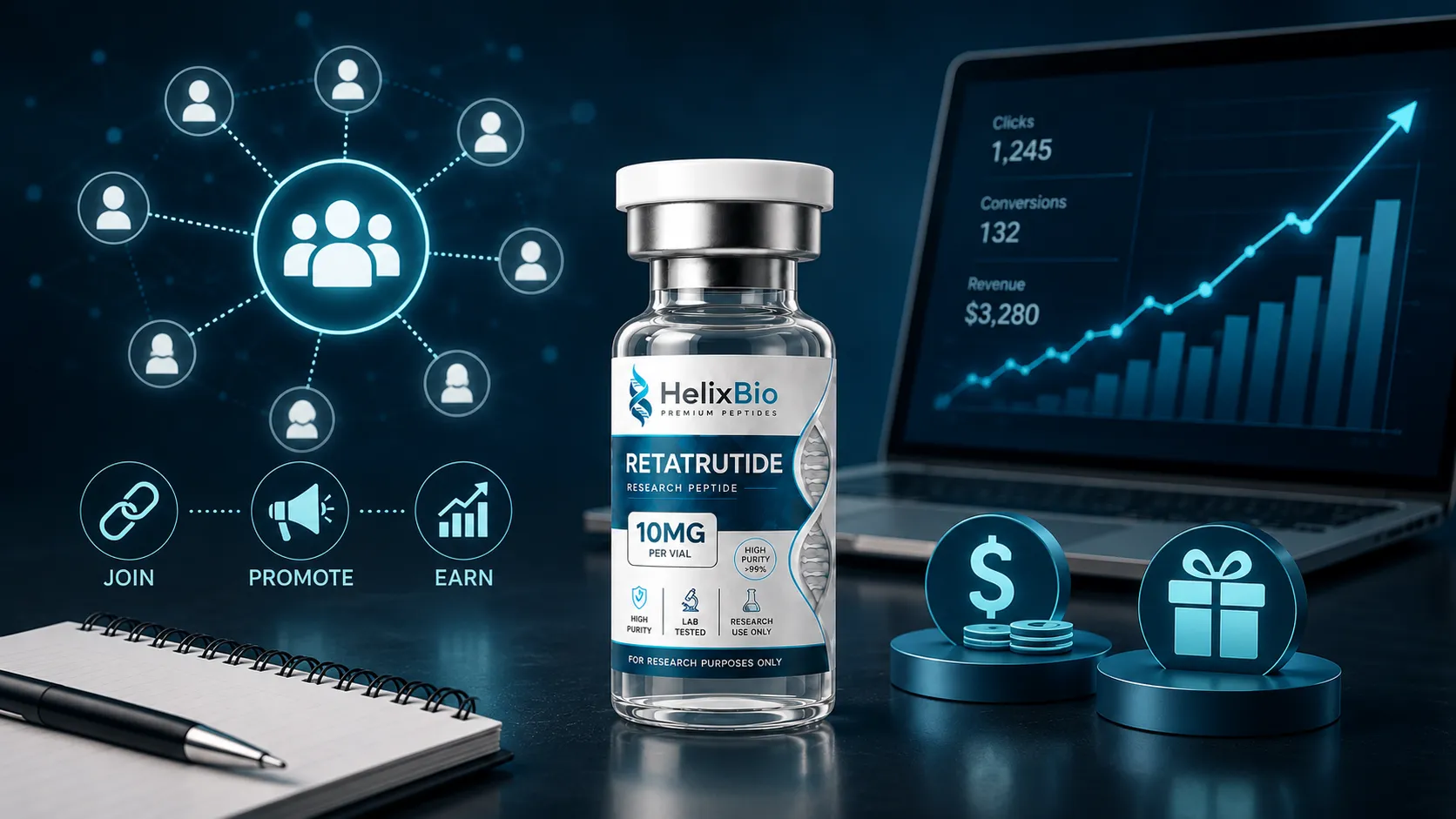
- Affiliate tracking in the research-use-only peptide market relies on two attribution methods: cookie-based referral links and unique discount codes applied at checkout.
- Dual attribution credits an affiliate whether the customer clicks a referral link or enters a discount code, capturing conversions that link-only tracking loses to cross-device browsing and cookie expiry.
- Commission rates for research peptide affiliate programs typically fall between 10% and 20%, placing them at the upper end of the physical supplement range.
- Cookie windows in the RUO peptide category are commonly 7 to 30 days, shorter than general e-commerce, and a short window matters less when permanent discount-code tracking runs alongside it.
- Affiliate commissions are normally held until an order's return window closes and then released on a monthly payout schedule via PayPal, Stripe, or bank transfer.
- The FTC Endorsement Guides (16 CFR Part 255) require affiliates to disclose their commission relationship clearly and conspicuously, before or alongside the recommendation, on every platform.
- Affiliates promoting research-use-only compounds must not publish dosing instructions, administration guidance, or therapeutic claims, because doing so reframes an RUO product as an unapproved drug.
- Google Ads and Meta advertising policies restrict paid promotion of unapproved substances, which makes organic educational content the primary sustainable channel for RUO affiliate marketing.
Affiliate marketing is one of the primary ways research-use-only (RUO) peptide suppliers reach new laboratories, independent researchers, and scientific-content audiences — yet almost none of the published material on the subject explains how these programs actually function. This guide covers the mechanics of the category: how referral tracking works when both links and discount codes are in play, what commission rates and cookie windows are typical compared with the broader supplement vertical, how payouts are calculated and released, and — most importantly — the compliance rules that separate a durable research peptide affiliate program partnership from one that gets an account terminated or an advertiser flagged.
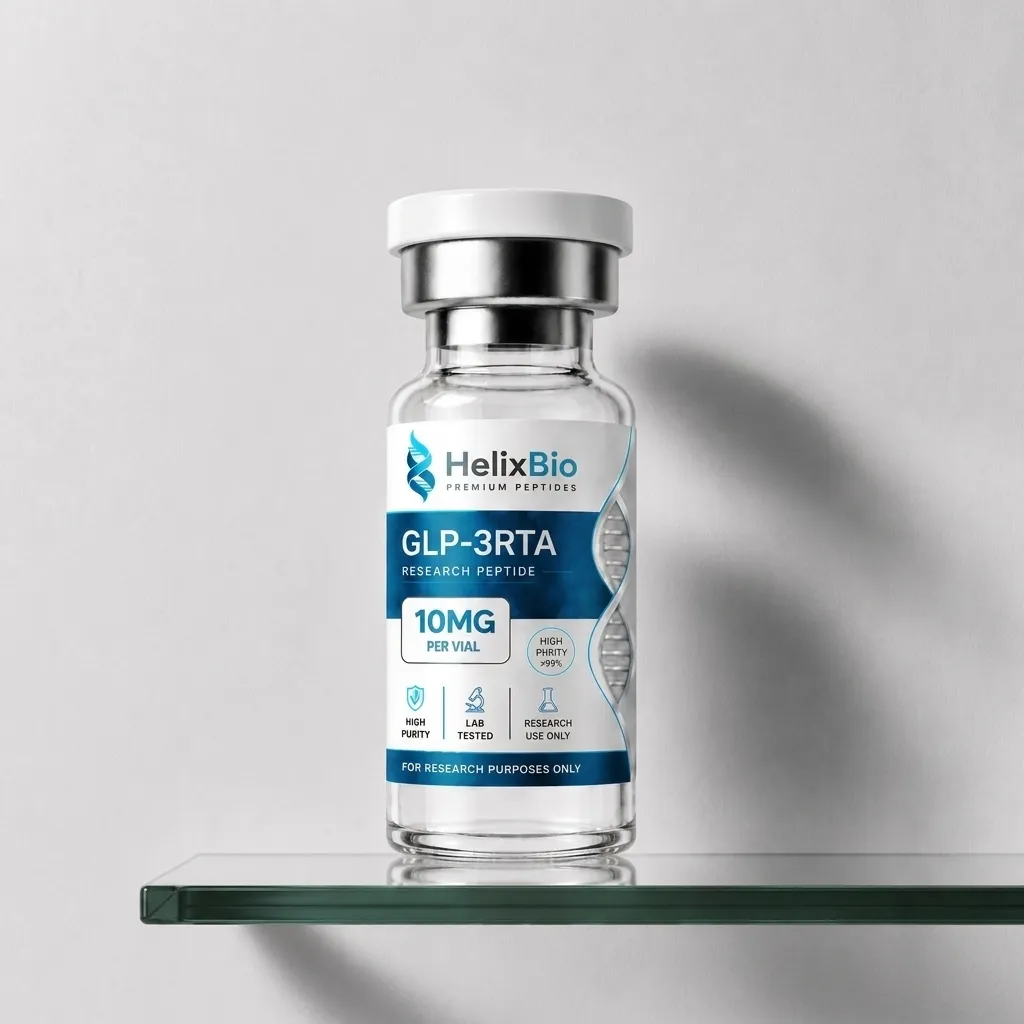
GLP-3RTA
RESEARCH PEPTIDE
GLP-3RTA is a synthetic research peptide studied for triple hormone receptor agonism — activity across the GLP-1, GIP, and glucagon receptors within a single molecule. That three-receptor mechanism has made it one of the most closely watched areas of metabolic and endocrine research, setting it apart from single- or dual-agonist peptides such as Semaglutide and GLP-1TRZ. Helix Bio supplies GLP-3RTA as a lyophilized powder intended strictly for laboratory and preclinical research, manufactured to a high-purity standard and backed by third-party verification. It is not intended for human consumption, diagnostic use, or any therapeutic application.
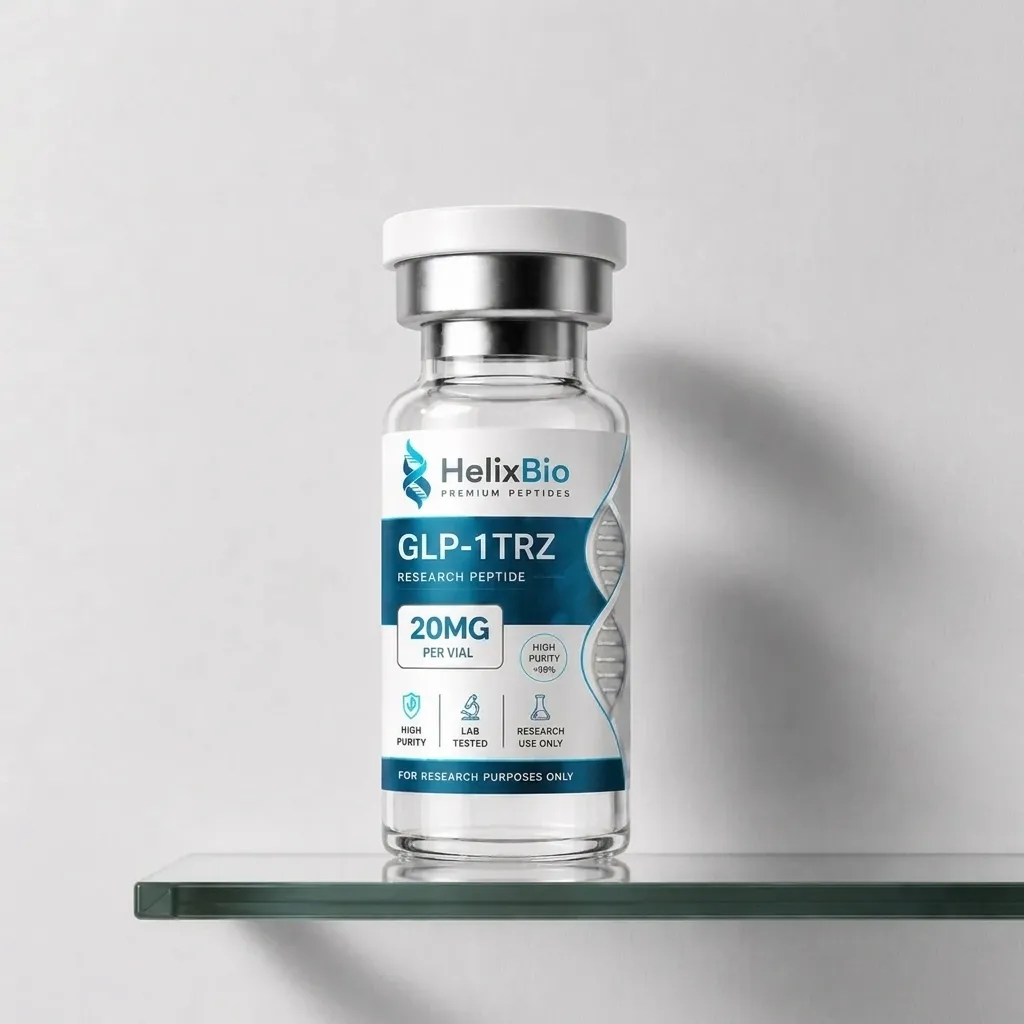
GLP-1TRZ
RESEARCH PEPTIDE
GLP-1TRZ is a synthetic research peptide studied for its activity as a dual GIP/GLP-1 receptor agonist — engaging two distinct incretin receptor pathways within a single molecule. It sits between single-receptor compounds like Semaglutide and the newer triple-agonist GLP-3RTA, making it a common middle point of comparison in incretin research. Helix Bio supplies GLP-1TRZ as a lyophilized powder intended strictly for laboratory and preclinical research, manufactured to a high-purity standard and backed by third-party verification. It is not intended for human consumption, diagnostic use, or any therapeutic application, and it is a separate product from FDA-approved branded medications.
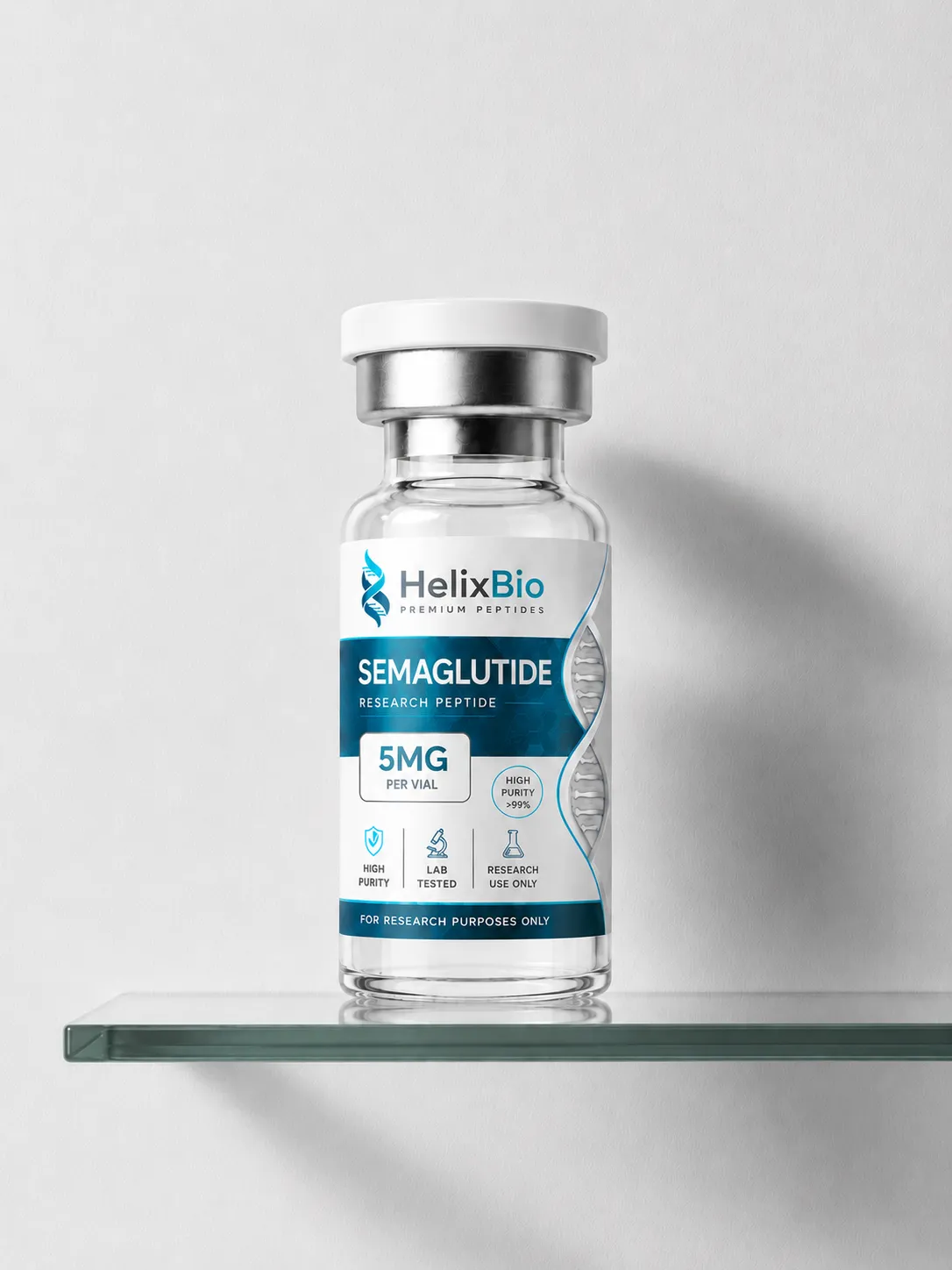
Semaglutide
RESEARCH PEPTIDE
Semaglutide is a synthetic research peptide studied for its activity as a GLP-1 receptor agonist — one of the most extensively documented compounds in incretin pharmacology, with a clinical trial record (the STEP and SUSTAIN programs) that spans over a decade. Developed originally by Novo Nordisk, Semaglutide is the reference point most researchers use when evaluating newer dual- and triple-agonist peptides such as GLP-1TRZ and GLP-3RTA. Helix Bio supplies Semaglutide as a lyophilized powder intended strictly for laboratory and preclinical research, manufactured to a high-purity standard and backed by third-party verification. It is not intended for human consumption, diagnostic use, or any therapeutic application, and it is a separate product from FDA-approved branded medications.
The compliance section matters more here than in any other affiliate vertical. Research peptides are sold strictly for laboratory use, which means an affiliate's content is subject to both Federal Trade Commission (FTC) endorsement rules and the ad-platform policies that govern health-adjacent claims. Getting that framing wrong is the single most common reason affiliates in this space lose ad accounts, get search visibility suppressed, or have commissions reversed. Everything below is written for people evaluating or already running promotions for RUO suppliers, and it closes with a worked example using the published terms of the Helix Bio affiliate program.
How Affiliate Tracking Works in the Research-Use-Only Market
Affiliate tracking answers a single question: which partner should be credited for a given order? In the RUO peptide market, that question is harder than it looks, because buyers frequently discover a supplier through one channel and purchase through another. A researcher may read a comparison article on a laptop, then place the order days later from a phone after hearing a discount code mentioned in a video.
Two attribution methods dominate the category, and the strongest programs run both simultaneously.
Link attribution (cookie-based tracking)
Link attribution assigns each affiliate a unique referral URL. When a visitor clicks that link, the supplier's site writes a first-party cookie to the visitor's browser recording the affiliate ID and the timestamp. If that visitor completes a purchase before the cookie expires, the order is attributed to the affiliate automatically.
Link attribution is frictionless — the customer does nothing — but it is fragile. Cookies are lost when a visitor switches devices, browses in private mode, clears their browser data, or lets the cookie window lapse. Safari's Intelligent Tracking Prevention and similar browser-level restrictions have shortened the effective life of tracking cookies across the entire affiliate industry, which is why link-only programs increasingly under-report conversions.
Discount-code attribution (coupon tracking)
Discount-code attribution assigns each affiliate a unique coupon code. When a customer enters that code at checkout, the order is credited to the affiliate regardless of how they arrived at the site, what device they are on, or whether any cookie ever existed.
Code attribution is device-independent and permanent, which makes it far more reliable for audio, video, podcast, and offline placements where a clickable link is impractical. Its weakness is the mirror image of link tracking: a customer who clicks a link but forgets to apply the code produces no code-based record at all, and public coupon-aggregator sites can siphon codes away from the creator who published them.
Why dual attribution matters in this niche
Dual attribution means both systems run in parallel and the checkout resolves which touchpoint to credit. Programs that only offer one method systematically under-pay their partners.
Attribution method | How credit is assigned | Main strength | Main failure mode |
|---|---|---|---|
Link (cookie) | Cookie set on click, read at checkout | Zero effort for the customer | Lost to cross-device, private browsing, cookie expiry |
Discount code | Code entered manually at checkout | Works on any device, never expires | Requires the customer to remember and apply it |
Dual tracking | Either signal can credit the sale | Captures both click-through and code-driven buyers | Requires clear rules on which touchpoint wins |
Sub-ID / campaign links | Separate link variants per placement | Shows which content actually converts | Only as useful as the reporting behind it |
When comparing programs, ask which touchpoint wins when a customer clicks one affiliate's link and then applies a different affiliate's code at checkout. Most dual-tracking programs — including Helix Bio's — credit the touchpoint actually used at checkout, meaning the code applied to the order takes precedence over an earlier click.
Sub-ID or campaign-level links are the third piece worth asking about. Being able to generate distinct link variants per article, email, or platform is what turns affiliate reporting from a vanity number into a content-strategy input, because it shows which specific pages produce revenue rather than just traffic.
Commission Rates and Cookie Windows: What Is Actually Typical
Commission rates in affiliate marketing are a function of gross margin, repeat-purchase behavior, and how much competition exists for good partners. Research peptides occupy an unusual position: margins resemble specialty supplements, but the addressable audience is narrower and the content requirements are stricter.
The ranges below reflect commonly published program terms across adjacent verticals and are useful as a benchmark rather than a guarantee — individual programs vary widely, and tiered structures can lift a headline rate for high-volume partners.
Vertical | Typical commission range | Typical cookie window | Repeat-purchase behavior |
|---|---|---|---|
Research peptides / RUO compounds | 10–20% | 7–30 days | High; consumable inventory replenished by ongoing projects |
Sports nutrition and supplements | 5–15% | 30–45 days | High; subscription models common |
Mass-market vitamins via large marketplaces | 1–5% | 24 hours–7 days | Very high, but credit rarely reaches the affiliate |
Lab consumables and reagents | 3–10% | 30–90 days | High, but purchasing runs through procurement |
Digital health and DTC subscriptions | 20–40% or flat bounty | 30–60 days | Recurring, often with lifetime-value bonuses |
Two patterns are worth noting. First, a 15% commission rate sits at the upper end of the physical-product supplement range and near the top of the RUO peptide category, because these are consumable goods with real cost of goods sold, not digital products with near-zero marginal cost. Second, cookie windows in this niche tend to be shorter than in general e-commerce — 7 days is common — and a shorter window is far less punishing when discount-code tracking runs alongside it, since the code never expires the way a cookie does.
How cookie length actually affects earnings
Cookie length matters most for high-consideration purchases with long research cycles. Research-grade compounds are usually bought by people who already know what they want, so the gap between first click and order is typically short. The practical effect is that a 7-day window plus permanent code attribution often outperforms a 30-day cookie with no code tracking at all — a comparison most affiliates never think to run.
A second variable is whether the program is last-click or first-click. Last-click attribution, the industry norm, credits the most recent affiliate touch before purchase. Affiliates producing top-of-funnel educational content should understand that their contribution can be overwritten by a coupon site capturing the final click.
Customer-facing discounts and conversion
Many RUO programs pair the affiliate commission with a customer discount — commonly 10–15% off a first order. This is not a giveaway; it is a conversion mechanism. A discount gives the audience a concrete reason to act, raises the conversion rate on every link shared, and makes code attribution work by giving the customer a reason to enter the code in the first place.
Payout Mechanics, Thresholds, and Timing
Payout terms are where affiliate programs differ most and disclose least. Four variables determine when money actually arrives.
Approval and clearing period. Commissions are almost never paid at the moment of sale. They are held until the order's return or refund window closes, so that refunded orders do not create clawbacks. A program that pays instantly is either absorbing refund risk itself or will reverse commissions later.
Payout schedule. Monthly is the industry standard for physical-goods programs. Net-30 and net-60 schedules also appear, meaning commissions earned in one month are released 30 or 60 days after that month closes.
Payout methods. PayPal, Stripe, and direct bank transfer (ACH or wire) are the common options. Method matters more than it seems: transfer fees, currency conversion, and country availability can quietly reduce net earnings for international partners.
Minimum thresholds. Many programs hold balances until they reach a floor — $50 and $100 are typical — before releasing a payment. A low or absent threshold is meaningfully better for smaller publishers, who might otherwise wait months to receive their first payment.
Before joining any program, confirm three numbers in writing: the clearing period before a commission becomes payable, the minimum payout threshold, and whether commissions are reversed on refunds. Those three terms determine real-world cash flow far more than the headline commission rate does.
Tax documentation is the final piece. U.S.-based affiliates are typically required to submit a Form W-9 and may receive a Form 1099-NEC once earnings pass the reporting threshold; non-U.S. affiliates are usually asked for a Form W-8BEN. This is administrative reality, not tax advice — affiliates earning meaningful income should consult a qualified tax professional.
Compliance Rules for Promoting Research-Use-Only Compounds
This is the section that separates sustainable RUO affiliate businesses from short-lived ones. Research peptides are sold under a research-use-only designation, which means they are supplied for laboratory investigation and are not intended for human or veterinary use, ingestion, or administration of any kind. That designation follows the product into the affiliate's content.
FTC disclosure requirements
The FTC's Endorsement Guides (16 CFR Part 255) require that any material connection between an endorser and a seller be disclosed clearly and conspicuously. An affiliate commission is a material connection. In practice, the FTC's published guidance for creators establishes several requirements:
- The disclosure must be placed where audiences will actually see it — before or alongside the recommendation, not buried at the end of a page, behind a "more" link, or in a bio.
- It must be in plain language. "I earn a commission from purchases made through this link" is unambiguous; vague tags are not.
- It must appear in the medium the audience consumes — spoken aloud in video and audio, superimposed on screen for visual-only formats, and repeated in long content.
- It applies to every platform, including short-form video, livestreams, email newsletters, and organic social posts.
The FTC's 2024 rule on consumer reviews and testimonials (16 CFR Part 465) added further exposure by prohibiting fake or materially misrepresented reviews and undisclosed insider testimonials. For affiliates, the practical consequence is that fabricated "results" content is now a distinct legal risk on top of the endorsement rules.
Why RUO affiliates cannot make health, dosing, or therapeutic claims
A research compound has no approved human use. Any affiliate content that describes a dose, an administration route, a personal protocol, a bodily outcome, or a therapeutic benefit reframes an RUO product as an unapproved drug — and does so in the affiliate's own voice, on the affiliate's own property.
That creates three separate problems: it violates the supplier's program terms and can void commissions; it exposes the affiliate to FTC action for deceptive health claims, which require competent and reliable scientific evidence; and it converts otherwise compliant supplier content into a compliance liability by association.
The workable alternative is not vaguer writing — it is more precise writing. Describe what the published literature examined, in which model system, and what it measured. Cite the study rather than extrapolating from it. Educational depth is what earns citations and rankings in this niche anyway; claims are what get pages removed.
Non-compliant framing | Compliant research framing |
|---|---|
"Take 2mg twice weekly for best results" | "Researchers in this study administered the compound at the stated interval in a rodent model" |
"This peptide burns fat and builds lean mass" | "In vitro and animal research has examined this peptide's effect on lipolysis markers" |
"Safe, effective, and clinically proven" | "Investigational; not approved by the FDA for any human indication" |
"My results after 8 weeks" | "Findings reported in the referenced trial, with sample size and endpoints noted" |
"Cures, treats, or prevents [condition]" | "Studied in preclinical models for its interaction with [pathway]" |
Research-use-only compounds are not for human or veterinary use, ingestion, injection, or any form of administration. Affiliate content that supplies dosing instructions, administration guidance, or therapeutic claims falls outside every legitimate RUO program's terms and is grounds for immediate removal from the program. Review the [Helix Bio medical disclaimer](/medical-disclaimer) and program [terms and conditions](/terms-and-conditions) before publishing.
How advertising platforms treat RUO content
Ad-platform policy is stricter than search-engine ranking policy, and the two are frequently confused. Organic, educational RUO content can rank; paid promotion of the same content is heavily restricted.
Channel | Typical treatment of RUO peptide content | Practical implication for affiliates |
|---|---|---|
Google Ads | Healthcare and medicines policies restrict unapproved substances and speculative treatments; certification requirements apply to many health categories | Paid search for research compounds is largely unavailable; expect disapprovals |
Meta (Facebook/Instagram) ads | Ad standards restrict unsafe substances, unapproved supplements, and personal-health claims | Paid social is generally not a viable channel for this category |
Organic search | No prohibition on educational RUO content; quality and expertise signals govern | The primary sustainable channel — depth and citations win |
Email marketing | Permitted, subject to CAN-SPAM and honest subject lines | Reliable owned channel; disclosure still required |
Organic social and video | Permitted with disclosure, but community standards on medical claims still apply | Keep claims research-framed; disclose within the content itself |
Affiliate brand bidding | Prohibited by most programs, including Helix Bio | Never bid on the supplier's brand name in paid search |
The strategic takeaway is that in the RUO category, organic content is not one channel among many — it is effectively the channel. That is precisely why deeply researched, accurately framed educational content outperforms promotional content here.
A practical pre-publish checklist
- Affiliate disclosure appears above the first affiliate link, in plain language.
- No dose, route, frequency, or administration instruction appears anywhere in the content.
- No claim of treating, curing, preventing, or improving any human condition.
- Research findings are attributed to a named, real, verifiable source.
- Research-use-only status and the not-for-human-consumption statement appear explicitly.
- No personal testimonials, before/after framing, or fabricated results.
- Links point only to current, approved product, category, or shop pages.
- No use of the supplier's logo or trademarks outside approved assets.
Worked Example: The Helix Bio Affiliate Program
Applying the framework above to a live program makes the abstractions concrete. The published terms of the Helix Bio program are as follows.
Program term | Helix Bio |
|---|---|
Commission rate | 15% on every qualified sale |
Customer discount | 15% off for referred customers |
Cookie window | 7 days |
Attribution model | Dual — unique referral link plus personal discount code |
Payout schedule | Monthly |
Payout methods | PayPal, Stripe, or bank transfer |
Earnings cap | None |
Cost to join | Free; no minimum audience size required |
Technical setup | None — no pixels, code, or integration required |
Reporting | Real-time dashboard for clicks, conversions, and pending commission |
Read against the benchmarks earlier in this article, the structure is coherent: the 15% rate sits at the top of the physical-product supplement range, and the comparatively short 7-day cookie is offset by permanent discount-code attribution, which is the part most programs omit. The 15% customer discount does double duty — it improves conversion and gives the customer a reason to enter the code, which is what makes the code half of dual tracking function at all.
The program's published standards also mirror the compliance rules above rather than contradicting them: no medical, dosing, or human-use claims; no bodybuilding, athletic-performance, or weight-loss outcome framing; no brand-term bidding in paid search; FTC-consistent disclosure required; and all messaging kept consistent with research-use-only labeling. A supplier that publishes prohibited-practice rules of that specificity is one that has thought about affiliate risk, which is itself a useful evaluation signal.
Affiliates promoting the catalog have the supporting material to write accurately: third-party HPLC and mass-spectrometry testing documentation, a detailed research peptide FAQ library, a peptide reconstitution calculator, and product pages framed for laboratory use. Program details and the partner application are on the affiliate program page, and questions about approved content can go through support.
How to Evaluate Any Research Peptide Affiliate Program
Use these questions on any program in the category, not just this one:
- Does the program run dual attribution, or link tracking alone?
- What is the cookie window, and is attribution first-click or last-click?
- When does a commission clear, and are commissions reversed on refunds?
- What is the minimum payout threshold, and which payout methods are available?
- Are commissions paid on the pre-discount order value or the post-discount total?
- Does the program publish written content standards and prohibited practices?
- Does the supplier publish third-party purity testing that content can reference?
- Is reporting real-time and link-level, or a delayed monthly summary?
A program that answers all eight clearly is one an affiliate can build long-term content around. In a category where organic educational content is the only reliable acquisition channel, that transparency is worth more than a few percentage points of headline commission.
Frequently Asked Questions
A research peptide affiliate program is a partnership in which a supplier pays a commission on sales generated through an affiliate's unique referral link or discount code. In the research-use-only market these programs also impose content standards that prohibit medical, dosing, or human-use claims, because the products are supplied strictly for laboratory research.
Commission rates in the research peptide category commonly range from 10% to 20% of order value, with 15% representing a competitive rate for a physical-goods program. Rates sit above mass-market supplement marketplaces, which often pay 1% to 5%, because the audience is narrower and the content requirements are stricter.
Broad sports-nutrition and supplement programs typically pay 5% to 15%, while research peptide programs cluster at 10% to 20%. Digital health subscriptions can pay more on a percentage basis, but those are recurring services with near-zero marginal cost rather than consumable physical inventory.
A 7-day cookie window means a purchase made within seven days of clicking a referral link is still credited to that affiliate. Because research compound buyers usually purchase soon after researching, a 7-day window combined with permanent discount-code tracking often captures more sales than a longer cookie with no code attribution.
Dual attribution exists because each method fails in a different way: cookies are lost to cross-device browsing, private windows, and expiry, while codes require the customer to remember to apply them. Running both means a sale is credited whichever path the customer actually takes.
In most dual-tracking programs, the touchpoint actually used at checkout takes precedence, so the affiliate whose code is applied to the order receives the commission. This is standard last-touch resolution and is worth confirming in a program's written terms before promoting.
Commissions are normally calculated after the order's return or refund window closes, then paid on the program's regular monthly schedule rather than immediately at the point of sale. This clearing period protects both parties from commissions being paid on orders that are later refunded.
Many programs, including Helix Bio's, have no minimum audience requirement and review applications for fit with content standards rather than follower count. Applicants are typically asked for their primary platform, estimated monthly reach, and promotion methods so the supplier can assess content compliance.
The FTC Endorsement Guides require any material connection between an endorser and a seller to be disclosed clearly and conspicuously, and an affiliate commission is a material connection. The disclosure must be placed before or alongside the recommendation in plain language, and must be spoken aloud or displayed on screen in audio and video formats.
No. Research-use-only compounds have no approved human use, so any dosing, administration, or protocol guidance reframes them as unapproved drugs and violates both supplier program terms and FTC rules on unsubstantiated health claims. Compliant content describes what published studies measured in specific model systems instead.
Generally no. Google's healthcare and medicines policies and Meta's advertising standards both restrict unapproved substances and personal-health claims, so paid promotion of research compounds is routinely disapproved. Organic search, email, and compliant organic social are the practical channels for this category.
Compare the attribution model, cookie window, commission clearing period, minimum payout threshold, payout methods, and whether commissions are calculated on pre-discount or post-discount order value. Also check whether the supplier publishes written content standards and third-party purity testing, since both make compliant content far easier to produce.
- 01Federal Trade Commission. Guides Concerning the Use of Endorsements and Testimonials in Advertising, 16 CFR Part 255.
- 02Federal Trade Commission. Disclosures 101 for Social Media Influencers.
- 03Federal Trade Commission. The FTC's Endorsement Guides: What People Are Asking.
- 04Federal Trade Commission. Final Rule on the Use of Consumer Reviews and Testimonials, 16 CFR Part 465 (announced August 14, 2024).
- 05Google Ads Help. Healthcare and medicines advertising policy.
- 06Meta. Advertising Standards.
- 07U.S. Food and Drug Administration. Distribution of In Vitro Diagnostic Products Labeled for Research Use Only or Investigational Use Only: Guidance for Industry and FDA Staff.
- 08Helix Bio. Affiliate Program terms, commission structure, and content standards.
Helix Bio Chem Team
Research & Product Team
Our in-house team tracks published peptide research and translates it into clear, source-cited summaries for the research community.
Reviewed by in-house research chemists
support@helixbiochem.com