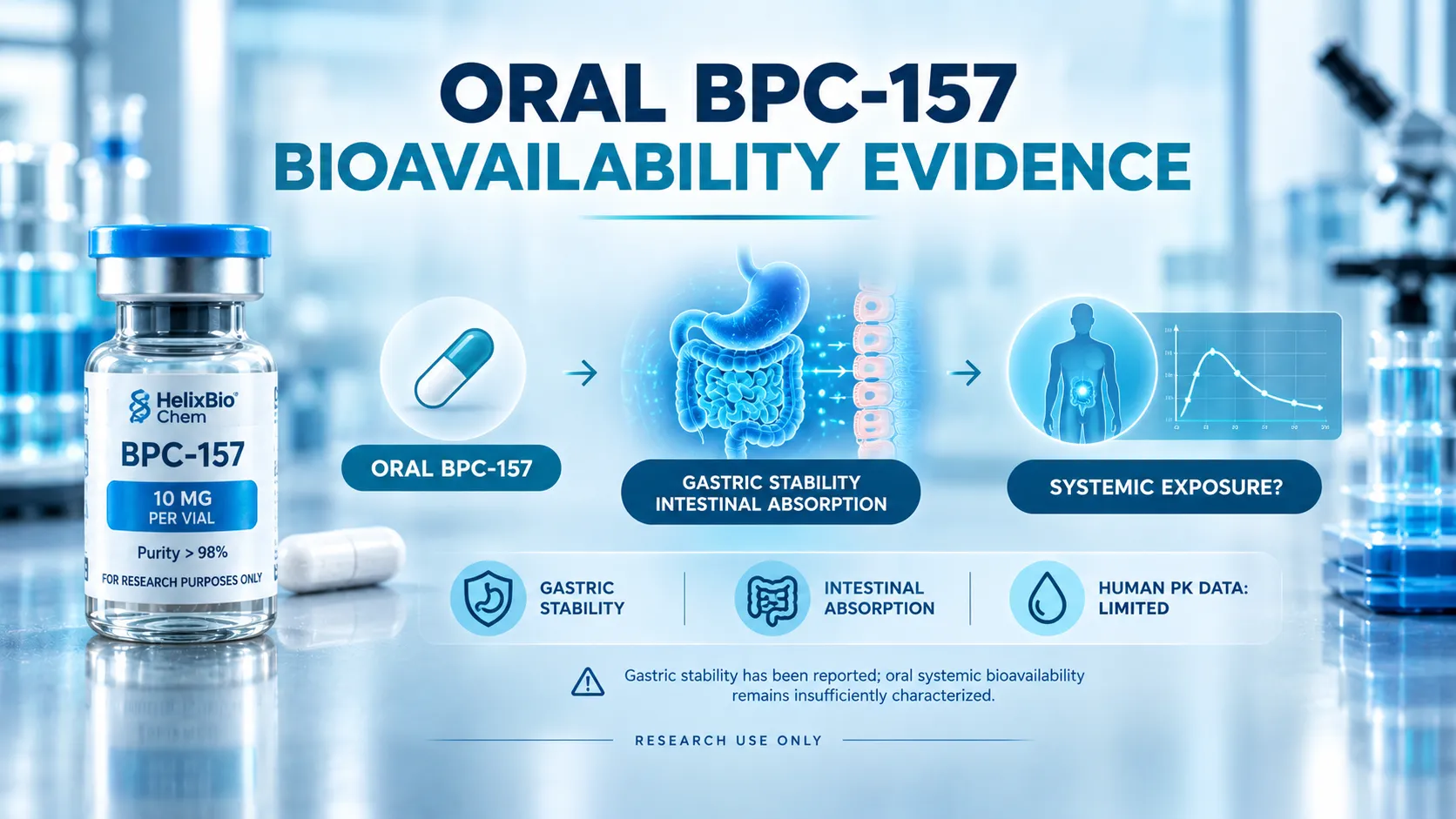
- No oral bioavailability figure for BPC-157 has ever been published in any species.
- The 2022 He et al. pharmacokinetic study tested intravenous and intramuscular routes only, with no oral dosing anywhere in its full text.
- The May 2026 MDPI Pharmaceutics review lists BPC-157 oral bioavailability as "Unknown" and does not mention the arginate form at all.
- Patent gastric-juice data favor the di-L-arginine salt, with the advantage depending heavily on pH. At pH 2.0 both forms lose over 95% of the peptide.
- The "roughly 95% versus roughly 2%" vendor framing matches no row in any of the patent's three gastric tables. The near-96% acetate figure comes from a thermal aging table.
- PubMed searches return zero indexed records for the arginate form, against 231 for BPC-157 generally.
- Federal Register Doc. 2026-07361 names BPC-157 for PCAC consideration, and FDA's briefing document opposed adding it, while the reported vote count has no primary record.
- BPC-157 is named in section S0 of the current WADA Prohibited List, prohibited at all times, and has been listed since 2022.
No oral bioavailability figure for BPC-157 has ever been published in peer-reviewed literature. Not a percentage, not a range, not in any species. The 2022 pharmacokinetic study that people cite for absorption numbers tested intravenous and intramuscular dosing only. Neither "oral," nor "orally," nor "gavage" appears anywhere in its full text. The May 2026 review in MDPI Pharmaceutics lists BPC-157 oral bioavailability as "Unknown" in its comparator table.
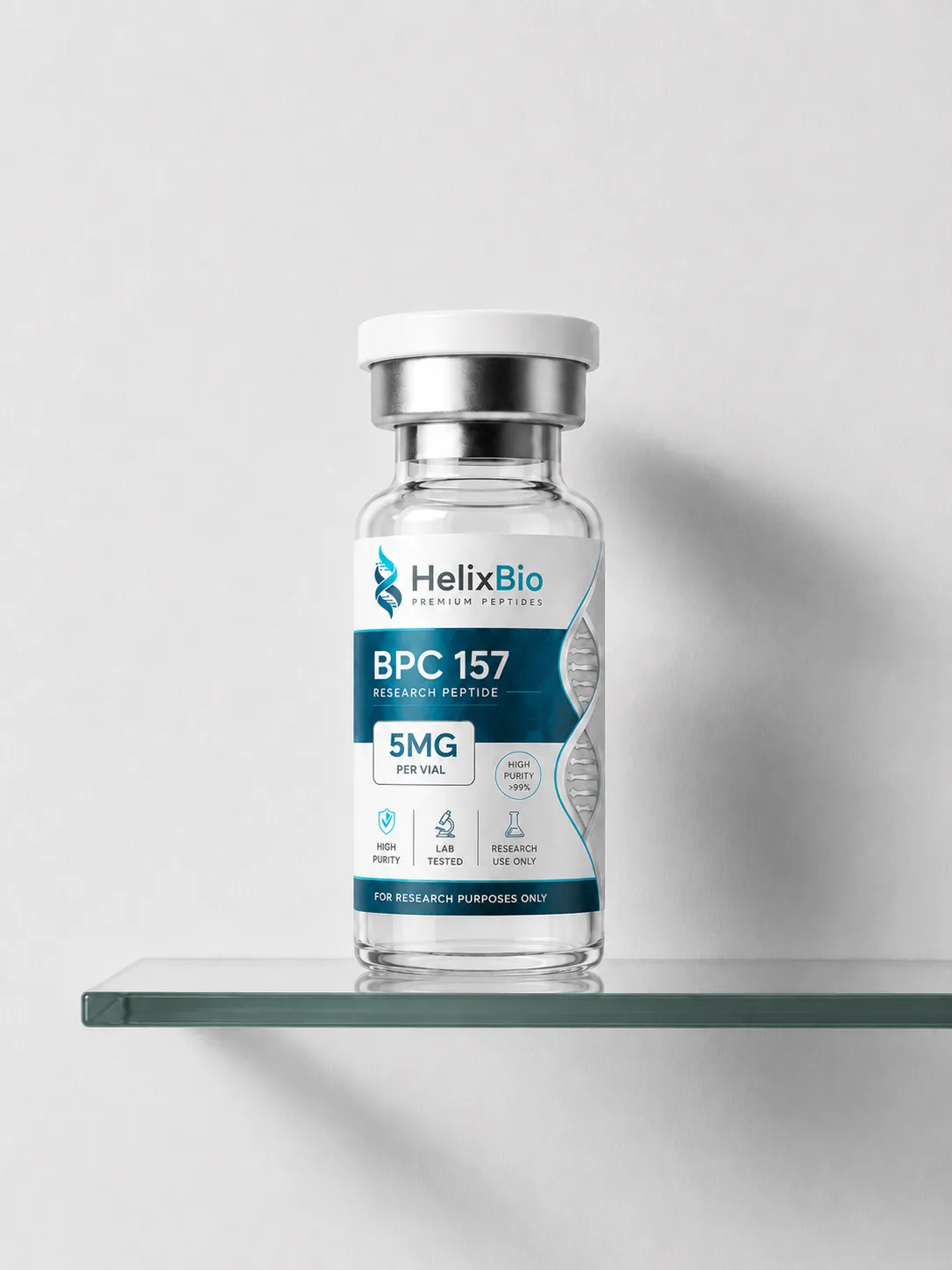
BPC-157
RESEARCH PEPTIDE
BPC-157 is a synthetic pentadecapeptide, a short chain of 15 amino acids derived from a protective protein found in gastric juice. It's one of the most widely studied research peptides in the biotech space, referenced across laboratory literature on tissue repair, angiogenesis, and gastrointestinal research models. Helix Bio's BPC-157 is manufactured for laboratory use, supplied as a lyophilized powder, and backed by a certificate of analysis for every batch. It's intended strictly for qualified researchers, laboratories, and academic institutions — not for human or animal use.
How much oral BPC-157 actually reaches circulation?
Here is the short version. Gastric stability for BPC-157 is documented in vitro. Systemic absorption after oral dosing has never been quantified in any species. The arginate salt does show a real stability advantage in patent testing, and that advantage depends heavily on pH. No human data exists for the arginate form at all.
Every claim below carries an evidence tier, so you can see what rests on what. The tiers used here are patent data (in vitro), animal PK, peer-reviewed review, FDA record, secondary reporting, and no published data. When a number comes from a table, this article names the table.
Why do most peptides fail when taken orally?
Most peptides do not survive a trip through the stomach. Pepsin cleaves them, acid unfolds them, and what reaches the small intestine is fragments. That is the main reason injectable delivery became the research default, and why oral peptide drugs stayed rare for decades. Approved oral peptides exist, but they got there through engineering. Oral semaglutide needed an absorption enhancer called SNAC. Cyclosporine needed a specialized formulation to get across. Desmopressin works across the mouth's lining at a smaller molecular size.
BPC-157 entered this conversation because it behaves oddly. The peptide was originally derived from a fragment found in human gastric juice. Testing shows it holds up in acidic, protease-rich conditions that destroy most peptides. That finding is genuine and it is interesting. It is also the source of nearly every overstated oral claim you will encounter.
Here is the distinction this entire article enforces. Surviving the stomach and reaching the bloodstream are two different events. A peptide can stay intact in gastric juice and still never cross the gut wall in meaningful quantity. The May 2026 MDPI Pharmaceutics review (peer-reviewed review) puts it directly. Gastric stability is necessary but not sufficient to establish oral bioavailability. The review then lists what else has to happen. A peptide must also survive intestinal enzymes and cross the epithelial lining. It also has to escape first-pass metabolism in the liver and clear lymphatic handling. For BPC-157, none of those four steps has been measured.
Background on the peptide's structure and proposed mechanisms sits in our BPC-157 overview. This page stays on the absorption question and the salt chemistry.
How does BPC-157 arginate differ from the acetate?
Start with what does not change. Both forms carry the same 15-amino-acid sequence, GEPPPGKPADDAGLV, and the same molecular weight near 1419 daltons. The peptide itself is identical in both. What differs is the counterion, the charged partner that pairs with the peptide to form a stable, handleable solid.
Three terms cover most of what you will see on product pages.
Free base is the peptide with no added counterion. Acetate pairs it with acetic acid, the standard salt form for synthetic peptides. Most research material has historically used the acetate. Arginate pairs the peptide with the amino acid arginine. In the patent that generated the stability data, the tested form is a di-L-arginine salt. The ratio is 1 to 2, meaning two arginine molecules for every peptide.
The naming gets messy fast, so here is the map. BPC-157 arginate, pentadeca arginate, PDA, and pentadecapeptide arginate all point at the same thing. In the patent literature it appears as Arg-BPC. The patent calls the peptide itself "bepecin." A vendor listing "PDA peptide" and one listing "BPC-157 arginate" describe the same molecule. Both name a single salt form. Product-page discussion of these forms lives on our BPC-157 product page.
Now the part that matters most for anyone weighing the two.
PubMed searches run on 2026-09-28 return zero results for the arginate form specifically. No human trial, no case report, no clinical study of any kind, and no animal work on the salt form either. The general BPC-157 literature is not small, with 231 PubMed-indexed records for the peptide. Those zeros are real negatives, not a search that failed. The comparison between acetate and arginate rests entirely on in-vitro patent chemistry.
One boundary on that negative, stated plainly. Zero PubMed hits means no indexed peer-reviewed record exists. It does not rule out unpublished commercial testing, and it does not mean the salt form was never studied anywhere by anyone. What it means is that nothing you can read, check, or cite has been published.
What do the gastric stability studies actually show?
The stability figures everyone quotes trace back to one document, patent WO2014142764A1, filed by Diagen D.O.O. and published 2014-09-18. Gastric testing lives in Tables 4, 5 and 6. The figures below were checked against the patent text on 2026-09-28.
Testing conditions were consistent across all three tables. Artificial gastric juice held 0.08 mol hydrochloric acid and 0.03 mol sodium chloride. Pepsin went in at 1.0 g per 1000 ml of water. Peptide went in at 10 mg per 5 ml and was held at 37 degrees Celsius. Measurement used HPLC with UV detection at 210 nm. Three forms were tested side by side, labeled in the patent as BPC acetate, BPC Na-salt, and Arg-BPC.
One reading note before the numbers, because it trips people up. The tables are titled "Pentadecapeptide content decrement," which sounds like a report of how much was lost. Values start at 100 and fall from there, so they actually read as percent remaining. Every figure below is percent of the peptide still intact.
Condition | Arg-BPC | BPC acetate | BPC Na-salt | Table |
|---|---|---|---|---|
pH 2.0, 2.5 hours | 4.9% | 2.1% | 2.7% | Table 4 |
pH 3.0, 5.0 hours | 84.9% | 0.08% | 10.1% | Table 5 |
pH 4.0, 5.0 hours | 89.8% | 56.4% | 78.3% | Table 6 |
Read across those rows and the story is not "arginate is stable." The story is that pH decides almost everything. At pH 3.0 the gap is enormous, with the arginine salt holding 84.9% against 0.08% for the acetate. Both forms do reasonably well at pH 4.0, and the gap narrows there. At pH 2.0, which sits inside the range of normal fasting human stomach acid, everything degrades fast. Arg-BPC retains 4.9% and the acetate retains 2.1%. Both have lost over 95% of the peptide.
That pH 2.0 row is the one vendor pages skip. It is also the row a careful reader should sit with longest.
Every figure in the table above comes from artificial gastric juice in a tube. In-vitro stability does not establish that the peptide reaches circulation. No oral bioavailability figure has ever been measured for BPC-157 in any species.
Four checks on claims circulating about this patent, each verified against the document.
The "roughly 95% versus roughly 2% at five hours" framing matches no single row in any of the three gastric tables. It appears to blend figures from different pH conditions, so it is not a figure to rely on.
A figure near 96% for the acetate form does appear in the patent, and it is not a gastric measurement. It sits in Table 1, which tests standing at 50 degrees Celsius and 65% relative humidity. That is an accelerated-aging protocol for shelf stability. The acetate reads 95.97% at 10 days there. Shelf stability and survival in stomach acid are separate questions, and conflating them produces a claim the patent never makes.
The "1,000 times more stable" claim appears nowhere in the patent. Not as a phrase, not as a fold-change, not as any multiplier. The patent presents tabulated percentages and leaves it there.
No free-base arm was tested in any of the three gastric tables. Comparisons of free base against either salt in gastric conditions have no basis in this document.
Two limits apply to the whole dataset. No peer-reviewed study compares these salt forms head to head. The only stability comparison available comes from a patent, filed by a party with a commercial interest in one of the forms. And every figure here is in vitro. A tube of artificial gastric juice is not a person, and the patent contains no bioavailability or pharmacokinetic data whatsoever.
Has oral BPC-157 bioavailability ever been measured?
This is the section that answers the question in the title, and the answer is an absence.
He and colleagues published the first formal ADME study of BPC-157 in December 2022. It ran in Frontiers in Pharmacology (animal PK, PMID 36588717, DOI 10.3389/fphar.2022.1026182). It remains the only study to characterize the peptide's full pharmacokinetic profile in any species. The work used Sprague-Dawley rats and beagle dogs. Each group held six animals per timepoint, three male and three female.
Here is what the study actually measured.
Rat intramuscular absolute bioavailability came in at 18.82%, 14.49%, and 19.35% at 20, 100, and 500 micrograms per kilogram. Dog intramuscular bioavailability ran higher, at 45.27%, 47.64%, and 50.56% at 6, 30, and 150 micrograms per kilogram. Elimination was rapid in both species. Rat half-life after intravenous dosing was 15.2 minutes, with intramuscular values spanning 7.87 to 29.7 minutes. Dogs cleared it faster still, at 5.27 minutes intravenously and 20.0 to 29.3 minutes intramuscularly. Every value came in under 30 minutes.
Two caveats on those dog numbers appear on no competitor page. The standard deviations are large, reported as plus or minus 24.85, 18.09, and 27.01 respectively. A bioavailability of 45.27% with a deviation near 25 points is a wide, uncertain estimate. Quoting the bare figure hides that spread. Worth knowing too, the same six dogs crossed over through all four dosing cycles. These were not six fresh animals per group.
Routes tested were single intravenous, single intramuscular at three ascending doses, and intramuscular once daily for seven days. A separate tritium-labeled arm used intramuscular dosing only.
Oral dosing was never tested. The full text contains no instance of "oral," "orally," "per os," "gavage," or "intragastric." Neither "subcutaneous" nor "sublingual" appears either. Gastrointestinal words do appear, and every one refers to something else. Some point to the peptide's origin in gastric juice or its documented acid stability. Others describe tissue-protective effects, or name stomach and intestine as sampled tissues in the distribution work. Not one refers to a route of administration. Any oral bioavailability percentage attributed to this paper was invented somewhere downstream of it.
Two more details from the full text are worth carrying, because both are easy to misread. The study reports a half-life of 102 hours for total radioactivity, against under 30 minutes for the intact peptide. Those two figures measure different things. The tritium label follows proline into the body's normal amino acid pool. It keeps reading long after the peptide itself is gone. A "102 hour half-life" claim for BPC-157 therefore misreads the tracer. Table 2 in that paper also carries a caption describing doses "ranging between 5 and 120" micrograms per kilogram. That caption contradicts its own rows and all surrounding text, where the doses are 20, 100, and 500. Treat it as a published typo.
The MDPI Pharmaceutics review from May 2026 reaches the same place from a different direction. Its full citation is 18(5):625, DOI 10.3390/pharmaceutics18050625, PMID 42198317 (peer-reviewed review). Its comparator table lists BPC-157 oral bioavailability as "Unknown." The entry sits beside semaglutide, cyclosporine, oxytocin, and desmopressin, all of which have measured figures. According to the review, claiming oral bioavailability from gastric stability alone is unsupported by direct evidence. It describes oral feasibility as unverified in rigorously designed pharmacokinetic studies. No oral bioavailability data exists in any species under standardized fasting and fed conditions.
This review also does something useful for the salt question by saying nothing about it. Nowhere in its text does the word "arginate" appear. An 18,000-word review with more than 100 references, written specifically about BPC-157 formulation and delivery, does not discuss the arginate form. Nobody should cite that review to support a salt-superiority claim.
Against that record, two vendor claims fall apart on contact.
A "99.9% oral bioavailability" figure contradicts the published literature outright. No oral bioavailability figure of any size has ever been measured for this peptide. A "10 to 30% relative" oral figure, which circulates in comparison articles, is derived by working backward from animal dose ratios in efficacy studies. It is an inference from how much was given, not a measurement of how much was absorbed. Calling it a bioavailability figure misrepresents what it is.
One correction is worth making here, because a peer-reviewed source got there first. Human pharmacokinetic data for BPC-157 does exist, barely. The MDPI review describes a two-subject pilot by Lee and Burgess. One man aged 58 and one woman aged 68 received intravenous dosing. Results showed a half-life under 30 minutes and primary renal clearance. Two subjects cannot characterize variability between people. The age range introduces kidney-function decline as a confounder. Intravenous dosing says nothing about absorption, and the bioanalytical method was not fully reported. Across all three published human studies of BPC-157, enrollment is 30 subjects in total. None was a randomized controlled trial. The review puts the ratio of preclinical to qualifying clinical studies at roughly 544 to 1.
How do oral, injectable and nasal routes compare?
The table below sorts the three routes by what has actually been measured. Evidence tier gets its own column, because the difference between "animal PK" and "no published data" is the whole point.
Route | What studies exist | Evidence tier | What remains unknown |
|---|---|---|---|
Oral capsule | Gastric-juice stability for acetate, Na-salt and arginine salt, patent WO2014142764A1, Tables 4 to 6 | Patent data (in vitro) | Bioavailability in any species. Intestinal survival. Gut-wall permeability. First-pass loss. Whether observed gut effects are local or systemic. |
Subcutaneous or intramuscular injection | He et al. 2022 intramuscular bioavailability, 14 to 19% in rats and 45 to 51% in dogs, with wide deviations. One two-subject human intravenous pilot. | Animal PK, plus a two-subject uncontrolled human pilot | Subcutaneous pharmacokinetics in any species. Adequately powered human PK. Volume of distribution. Plasma protein binding. |
Nasal spray | None | No published data | Everything. The MDPI review states that no preclinical or clinical data exist for intranasal BPC-157. |
Read the middle column and the hierarchy is clear. Injection is the only route with measured absorption numbers, and those numbers come from rats and dogs. Oral has stability data and no absorption data. Nasal has neither, which leaves any nasal-specific absorption claim unsupported.
Something the table cannot show deserves saying. When a compound is given by mouth, it may produce an effect in the gut. That effect can come from the peptide acting directly on the gut lining. It need never enter the bloodstream at all. The MDPI review flags this as the most consequential ambiguity in the oral BPC-157 literature. A compound that works locally in the gut with no measurable systemic exposure is pharmacologically a topical treatment for that tissue. It is not an absorbed oral drug, and the two would need entirely different development paths. Published work on oral BPC-157 does not consistently distinguish between them.
Competitor pages get some of this right and deserve credit for it. Peptidefox.com does publish a patent-derived stability table, which is more sourcing than most. Brainflow.co keeps its pages current, and freshness has real value in a field where the regulatory picture moves. Where those pages fall short is the leap from stability data to absorption percentages, which the underlying documents do not support.
What is the regulatory status of BPC-157 in 2026?
This section separates what sits on the primary federal record from what only exists in trade coverage. The distinction matters, because much of what circulates about BPC-157's 2026 status is sourced more thinly than its confident phrasing suggests.
Start with the primary record. Federal Register Doc. 2026-07361 was published April 16, 2026 under Docket No. FDA-2025-N-6895, at 91 FR 20465 to 20467. It announced a Pharmacy Compounding Advisory Committee meeting. The committee met July 23 and 24, 2026, at FDA's White Oak Campus in Silver Spring. Sessions ran 8:00 a.m. to 4:30 p.m. Eastern on the first day, and 8:00 a.m. to 3:50 p.m. on the second. The notice names the substances under consideration, and BPC-157 is among them. It lists "BPC-157 (free base), BPC-157 acetate" on the July 23 agenda, for the indication ulcerative colitis, alongside KPV, TB-500 and MOTS-c.
FDA also published its own position before the meeting. The agency's briefing document concludes that the criteria weigh against placing both forms on the 503A bulks list. It cites inadequate chemical characterization, insufficient evidence of effectiveness, immunogenicity risk, and impurity controls. A separate FDA questions document put the vote to the committee directly. It asks "Should BPC-157 (free base) be placed on the list?" and poses the same question for the acetate.
FDA's current substance pages carry one more verifiable fact. BPC-157 appears in the table of bulk drug substances "nominated but withdrawn." FDA describes that table as substances previously in category 2 of its interim policies. The nominators themselves withdrew those nominations. BPC-157 appears in none of categories 1, 2 or 3 of FDA's current 503A nominations list, updated May 14, 2026.
Now the secondary reporting, attributed as such. The specific date of the original category 2 placement is not stated on any FDA page located. Trade accounts put the removal in April 2026. The only FDA-side date evidence is a page-revision stamp of 04/22/2026, which is not a stated effective date. Reports that the committee voted to recommend BPC-157, against FDA staff position, appear in trade and vendor coverage. The frequently repeated 8-6-1 vote count circulates in that same coverage. No primary vote record has been published. FDA.gov carries no minutes, transcript or roll call for the meeting. Anyone citing that count should attribute it, and should not present it as an FDA record.
Worth keeping in proportion, advisory committee recommendations do not bind FDA. As of FDA's May 2026 substance lists, BPC-157 does not appear on the 503A bulks list. The full account of the vote and its context sits in our PCAC vote explainer.
On WADA, a correction is needed. BPC-157 is currently prohibited in sport. It is named explicitly in section S0, Non-Approved Substances, of the current World Anti-Doping Agency Prohibited List. That list took effect 1 January 2026. S0 substances are prohibited at all times, in and out of competition. This listing is not a recent development. BPC-157 appears in S0 in the 2022, 2023, 2025 and 2026 editions. The 2024 WADA Prohibited List itself names BPC-157 in S0.
That last point needs stating clearly, because a peer-reviewed source gets it wrong. The May 2026 MDPI review describes the 2022 listing as temporary. It says the decision was "later reversed." Checked against the list documents themselves, no reversal happened. BPC-157 has been named in S0 continuously since it was added for 2022. A peer-reviewed venue is not a guarantee against an error, and on this particular point the review should not be relied on.
Where this leaves the oral question
Three findings carry the weight here. Oral bioavailability for BPC-157 has never been measured, in any species, by anyone. The 2022 pharmacokinetic study most often cited for it tested injection routes only. Arginate's stability advantage is real in the patent's tubes, and it swings hard with pH. That advantage has never been confirmed in a living system or in any peer-reviewed source. Regulatory status is mid-transition, with the committee meeting and FDA's opposing staff position both on the primary record. The reported vote outcome is not.
What ties those together is a habit worth keeping. A documented property and a demonstrated outcome are different claims, and the gap between them is where most confident marketing lives. Our BPC-157 product page covers the salt-form discussion. For the regulatory sequence see the PCAC vote explainer.
Helix Bio Chem materials are supplied for laboratory research use only, and not for human use, veterinary use, or compounding. Nothing on this page is medical advice, a dosing recommendation, or a statement of safety or efficacy for any use in humans or animals. The compounds discussed are not approved drugs.
Frequently Asked Questions
No figure has ever been published. The May 2026 MDPI Pharmaceutics review lists BPC-157 oral bioavailability as "Unknown," reporting no oral data in any species under standardized conditions. Percentages circulating on vendor pages are not traceable to any measurement in the literature.
No head-to-head human data exists, so the comparison cannot be made from evidence. Injectable has animal pharmacokinetic data, with intramuscular bioavailability of 14 to 19% in rats and 45 to 51% in dogs. Oral has no absorption measurement in any species at all.
It is the same 15-amino-acid peptide paired with arginine as its counterion. The patent that tested it used a di-L-arginine salt at a 1 to 2 ratio. Pentadeca arginate and PDA are alternative names for this form, and the peptide sequence itself is unchanged.
The peptide sequence is identical, and only the salt form differs. That distinction matters for in-vitro stability data, where the arginine salt performs better at some pH values. It has no demonstrated consequence in any living system, because no study has ever measured one.
The difference is the counterion, and nothing else. Patent gastric-juice testing favors the arginine salt, with the advantage depending strongly on pH. No peer-reviewed study compares the two forms head to head, and no human data exists for the arginate form.
Because it holds up unusually well in acid. The peptide came from a fragment in human gastric juice and resists pepsin and low pH in testing. Stability is not bioavailability, and surviving the stomach does not establish that the peptide reaches the bloodstream in any amount.
In the patent's artificial gastric juice, yes, with heavy pH dependence. At pH 3.0 after five hours, the arginine salt retained 84.9% against 0.08% for the acetate. Both forms collapsed at pH 2.0 after 2.5 hours, to 4.9% and 2.1%, and no peer-reviewed source has confirmed this.
The committee met July 23 and 24, 2026, and its Federal Register notice names BPC-157 free base and acetate for consideration, for ulcerative colitis. FDA's own briefing document opposed adding it. Reported vote outcomes come from press coverage, with no primary vote record published anywhere.
No, it is not approved for any indication. It appears on no FDA bulks list for compounding, and FDA's current 503A nominations list does not include it in any category. BPC-157 remains a research-use-only compound with no approved pharmaceutical formulation.
Yes, and the listing goes back several years. It is named explicitly in section S0, Non-Approved Substances, on the World Anti-Doping Agency Prohibited List effective 1 January 2026. S0 status means prohibited at all times, and BPC-157 has appeared in S0 in every edition since 2022.
- 01He et al. 2022, Frontiers in Pharmacology 13:1026182, PMID 36588717, DOI 10.3389/fphar.2022.1026182
- 02Mateescu et al. 2026, Pharmaceutics 18(5):625, PMID 42198317, DOI 10.3390/pharmaceutics18050625
- 03Patent WO2014142764A1, New stable pentadecapeptide salts, Diagen D.O.O., published 2014-09-18
- 04Pharmacy Compounding Advisory Committee; Notice of Meeting. Federal Register Doc. 2026-07361, 91 FR 20465, April 16, 2026, Docket No. FDA-2025-N-6895
- 05FDA BPC-157 briefing document for the Pharmacy Compounding Advisory Committee, July 2026
- 06FDA Pharmacy Compounding Advisory Committee meeting questions, July 23-24, 2026
- 07FDA Bulk Drug Substances Nominated for Use in Compounding Under Section 503A, revised May 14, 2026
- 08World Anti-Doping Agency Prohibited List, section S0, effective 1 January 2026
Helix Bio Chem Team
Research & Product Team
Our in-house team tracks published peptide research and translates it into clear, source-cited summaries for the research community.
Reviewed by in-house research chemists
support@helixbiochem.com