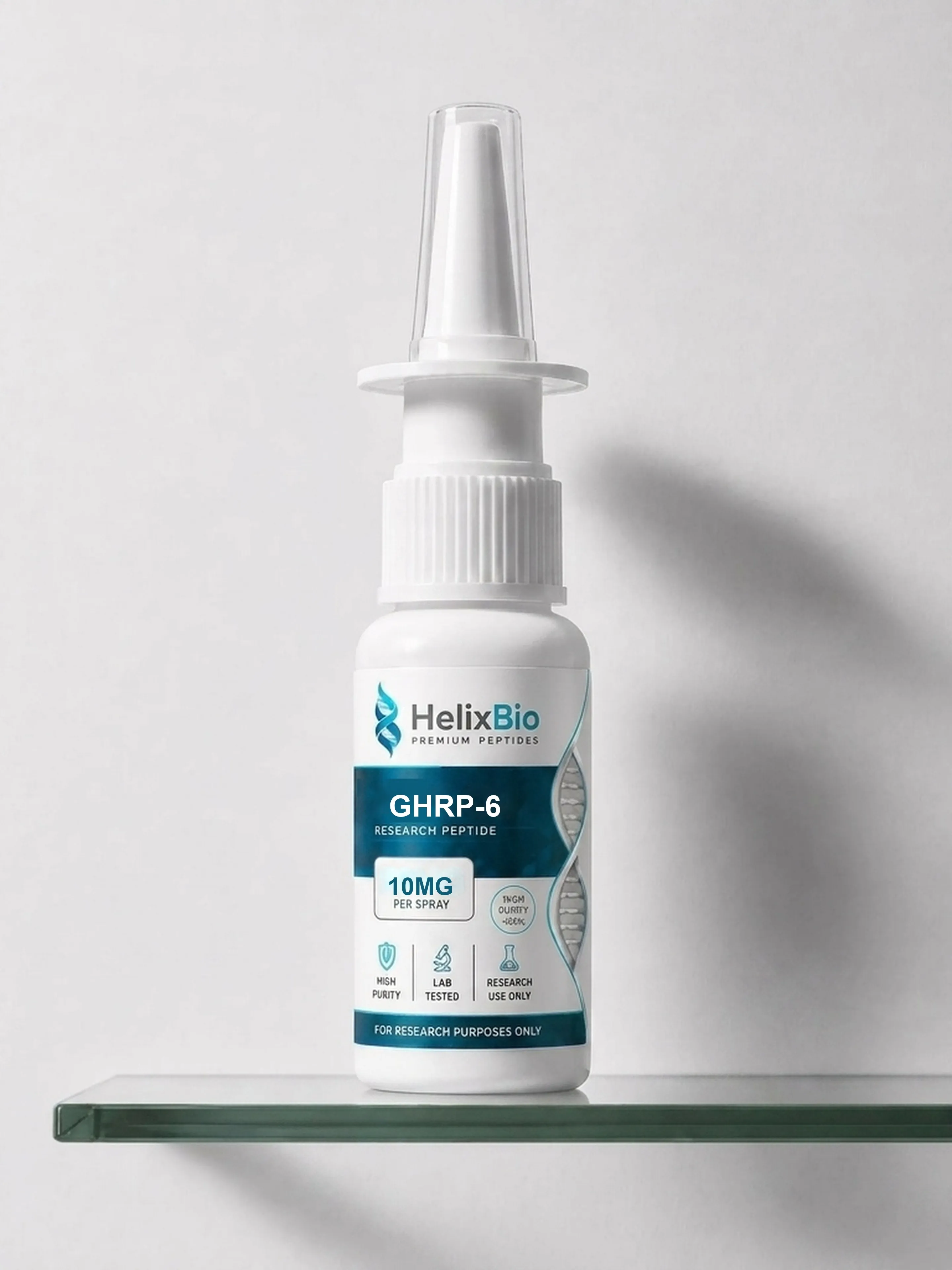
GHRP-6 Spray is a research-use preparation containing GHRP-6, a synthetic hexapeptide with the sequence His-D-Trp-Ala-Trp-D-Phe-Lys-NH₂. GHRP-6 belongs to the growth hormone secretagogue class and is studied for its interaction with the growth hormone secretagogue receptor GHSR1a — the receptor that was cloned in 1996 using GHRP-6 and related peptides as reference ligands, three years before its endogenous ligand ghrelin was identified. Helix Bio supplies research materials for qualified laboratory and scientific applications. GHRP-6 Spray is offered strictly for research use and is not intended for human or veterinary consumption, diagnosis, treatment, or prevention of disease.
HPLC certified
Independent analysis
Highest standard
Full traceability
GHRP-6 is a six-residue synthetic peptide, His-D-Trp-Ala-Trp-D-Phe-Lys-NH₂, with the molecular formula C₄₆H₅₆N₁₂O₆ and an average molecular weight of 873.03 g/mol as the free base. It carries two D-amino acids — D-tryptophan at position 2 and D-phenylalanine at position 5 — and a C-terminal amide. Those three modifications are not incidental. They are what separate GHRP-6 from an all-L hexapeptide that peptidases would clear almost immediately, and they are the features analytical work has to confirm rather than assume.
The compound came out of structure-activity work on met-enkephalin analogues carried out by Bowers, Momany and colleagues, reported in Endocrinology in 1984. It is often described in commercial material as a ghrelin mimetic, which reverses the actual sequence of events. Ghrelin was not identified until 1999. GHRP-6 came first, and it was the tool that led to the receptor: Howard and colleagues cloned the orphan growth hormone secretagogue receptor in Science in 1996 using GHRPs as reference ligands, and ghrelin was subsequently purified as that receptor’s natural ligand.
At the receptor, GHSR1a activation has been characterised in terms of phosphoinositide turnover, protein kinase C activation and mobilisation of intracellular calcium. That is receptor-level pharmacology from cellular and preclinical systems. It describes what the receptor does when engaged, not what any preparation does in a living subject.
A spray-format material differs from a lyophilised vial in ways that matter before an experiment starts. It arrives as a prepared solution rather than a dry powder, so there is no reconstitution step, and the concentration is set by the manufacturer rather than chosen at the bench. The solvent system, any excipients, and the stability profile of a peptide already in solution are all properties of that specific preparation and not of GHRP-6 as a compound.
That distinction cuts both ways in the literature too. GHRP-6 has been studied by non-injected routes more thoroughly than most research peptides, and the results are worth reading carefully rather than quoting selectively. Frieboes and colleagues compared oral, intranasal and sublingual GHRP-6 against placebo in healthy young men in the Journal of Neuroendocrinology in 1999, having previously shown that repeated intravenous boluses raised growth hormone, corticotropin and cortisol and increased stage 2 sleep. None of the non-intravenous formulations produced significant sleep-pattern changes. In conscious dogs, Nelson and colleagues estimated intranasal bioavailability at 34.4–44.9% in Life Sciences in 1991 — a figure derived indirectly from growth hormone response curves rather than from measured plasma peptide, in a different species, using a different preparation.
Neither result describes this or any other commercial material. They describe experiments. Route, species, formulation and analytical method all changed between them, and each of those changes matters.
Product documentation and lot-specific analytical information should be reviewed before a material enters an experimental workflow.
GHRP-6 has been investigated across several areas of endocrine and receptor research, including:
The existence of published research does not establish that GHRP-6 Spray is safe or effective for use in humans. GHRP-6 is not an FDA-approved drug in the United States. On FDA’s list of bulk drug substances nominated for use in compounding under section 503A, updated 14 May 2026, GHRP-6 appears in Category 3 — substances nominated without adequate support. Category 3 reflects insufficient supporting information for evaluation; it is a distinct designation from Category 2, which identifies significant safety concerns.
The most useful thing a supplier can tell a researcher about GHRP-6 is how to confirm it is actually GHRP-6.
Three peptides in this class are routinely conflated and routinely mislabelled: GHRP-6 at 873.03 g/mol, GHRP-2 at 817.99, and ipamorelin at roughly 711.86. They share overlapping sequence motifs — GHRP-6 and GHRP-2 have the same C-terminal tetrapeptide, Ala-Trp-D-Phe-Lys-NH₂ — but they are separated by 55 Da and 161 Da respectively, which is far more than enough for mass spectrometry to resolve unambiguously. A Certificate of Analysis that reports a molecular ion consistent with 873 is doing real identity work. One that reports only a purity percentage is not.
Two further points a researcher should check rather than assume. GHRP-6 is normally supplied as the acetate salt, and 873.03 is the free-base mass — so net peptide content and the basis on which it is reported determine how much peptide is actually present. And for a solution product, concentration can be expressed on either basis, which means the number on the label needs its basis stated to be interpretable.
Helix Bio states that its research peptide catalogue uses independent HPLC testing for purity assessment and mass spectrometry for molecular identity confirmation, and that batch-specific Certificates of Analysis are available. For GHRP-6 Spray specifically, the applicable lot documentation is what establishes the analytical result — a general catalogue statement is not a substitute for it.
GHRP-6 Spray is intended for qualified users working in legitimate laboratory or scientific research environments, including:
The product is not intended for personal experimentation, self-administration, human consumption, veterinary use, or medical treatment.
| Specification | Details |
|---|---|
| Product Name | GHRP-6 Spray |
| Research Category | Growth Hormone Secretagogue / Research Peptide |
| Compound | GHRP-6 |
| Scientific Name | Growth hormone-releasing peptide-6 |
| Synonyms | [His¹,Lys⁶]-GHRP; SK&F 110679; growth hormone-releasing hexapeptide |
| Chemical Class | Synthetic hexapeptide |
| Compound Class | Growth hormone secretagogue (GHS) |
| Sequence | His-D-Trp-Ala-Trp-D-Phe-Lys-NH₂ |
| Amino Acid Count | 6 |
| Modifications | D-Trp (position 2), D-Phe (position 5), C-terminal amide |
| Molecular Formula | C₄₆H₅₆N₁₂O₆ (free base) |
| Molecular Weight | 873.03 g/mol (free base) |
| Monoisotopic Mass | 872.44 Da |
| CAS Number | 87616-84-0 |
| Receptor / Target | Growth hormone secretagogue receptor 1a (GHSR1a) |
| Format | Spray solution |
| Salt Form | Refer to current lot-specific product documentation |
| Concentration | Refer to current product listing |
| Fill Volume | Refer to current product listing |
| Intended Use | Research and laboratory investigation only |
| Human Use | Not intended for human consumption |
| Veterinary Use | Not intended for veterinary use |
| Purity | Refer to current lot-specific product documentation |
| Identity Testing | Refer to applicable Certificate of Analysis |
| Packaging | Refer to current product listing |
| Storage | Follow current product-specific documentation |
| Manufacturer | Helix Bio |
| Country of Origin | Not specified; verify current product documentation |
GHRP-6 has one of the longer experimental records of any compound in the growth hormone secretagogue class, spanning receptor characterisation, comparative pharmacology and route-of-administration research.
Receptor and Signalling Research. GHRP-6 occupies an unusual position in receptor biology: it is one of the ligands that led to the identification of its own receptor. Howard and colleagues cloned the growth hormone secretagogue receptor in 1996 while its endogenous ligand was still unknown, and GHRPs served as reference ligands in that work. Ghrelin was purified as the natural ligand in 1999. GHRP-6 remains a reference agonist in GHSR1a assay work for that reason.
Comparative GHRP Pharmacology. GHRP-6, GHRP-2 and hexarelin share a common design lineage from Bowers and Momany’s met-enkephalin structure-activity work, and the differences between them are small and specific. GHRP-6 and GHRP-2 share the identical C-terminal tetrapeptide Ala-Trp-D-Phe-Lys-NH₂ and differ at positions 1 and 2 — histidine versus D-alanine, and D-tryptophan versus D-2-naphthylalanine. Comparison pages frequently report a single-position difference; the sequences show two. Hexarelin differs from GHRP-6 by methylation of the position-2 tryptophan, and the CD36 binding-site work often cited across this class was carried out with hexarelin rather than GHRP-6.
Growth Hormone Axis Research in Preclinical Models. GHRP-6 has been studied in rodent, canine and primate models examining growth hormone release, hypothalamic activation and interactions with GHRH-mediated signalling. A 2025 study in Endocrinology reported that intranasal GHRP-6 in mice increased food intake, raised Fos expression in the arcuate nucleus and elevated serum growth hormone, while intranasal ghrelin and MK-0677 under the same conditions did not. These are animal findings in defined experimental systems and do not describe human outcomes.
Route-Comparison Research. GHRP-6 is one of relatively few research peptides with a published human route-comparison literature. Frieboes and colleagues examined oral, intranasal and sublingual administration against placebo in healthy young men in 1999, following earlier work with intravenous boluses. Oral bioavailability across the peptidyl secretagogues as a class is generally cited as under 1%. Nelson and colleagues estimated intranasal bioavailability of 34.4–44.9% in conscious dogs in 1991, derived from growth hormone response curves rather than measured plasma peptide concentrations. Johansen and colleagues compared intranasal pharmacokinetics of GHRP-6, GHRP-2 and ipamorelin directly in rats in 1998.
Each of these studies used a specific compound, species, preparation and endpoint. Findings should be read against those parameters rather than generalised across them — and none of them characterises a commercial spray formulation.
Analytical quality matters here for a reason specific to this compound. GHRP-6 sits in a family of closely related synthetic hexapeptides that share sequence motifs, are sold under similar names, and are frequently substituted for one another in mislabelled material. A purity figure alone cannot detect that kind of error, because a highly pure sample of the wrong peptide still reports as highly pure.
The identity check that does detect it is mass. GHRP-6 has an average molecular weight of 873.03 g/mol against 817.99 for GHRP-2 and roughly 711.86 for ipamorelin. Those separations — 55 Da and 161 Da — are well within routine mass spectrometry resolution.
Helix Bio states that its peptide materials are subjected to independent HPLC testing for purity and mass spectrometry for molecular identity, and that batch-specific Certificates of Analysis are available. For a specific GHRP-6 Spray lot, the applicable COA and product documentation carry the actual analytical results.
Researchers should assess, where applicable:
No certification, regulatory approval, or quality claim should be inferred unless it is explicitly documented by the manufacturer or the relevant regulatory authority.
Storage and handling requirements should be determined from the current GHRP-6 Spray product documentation and lot-specific instructions.
General laboratory considerations include:
Storage conditions established for lyophilised GHRP-6 do not transfer to a prepared solution. A peptide already in solution has a different stability profile from the same peptide as a dry powder, and the solvent system, container and closure all contribute to it. Guidance for this product should come from this product’s documentation.
Helix Bio’s website describes research materials as being supplied to laboratories and institutions in the United States and describes tracked shipping and cold-chain handling within its fulfilment process.
Because shipping conditions, packaging specifications, availability and delivery requirements may change, researchers should review the current Helix Bio shipping information and product listing before ordering.
Product packaging should remain appropriately labelled and handled as research material after delivery. Researchers are responsible for following applicable institutional, federal, state and local requirements governing research materials.
GHRP-6 Spray is sold by Helix Bio for research and laboratory purposes only. It is not intended for human or veterinary consumption, self-administration, diagnosis, treatment, cure, mitigation, or prevention of any disease or medical condition.
GHRP-6 is not an FDA-approved drug in the United States. FDA approval status should not be inferred from published research, product availability, laboratory use, or any regulatory discussion concerning compounding. FDA explains that unapproved drugs have not undergone the agency’s standard review for safety, effectiveness and quality. On FDA’s section 503A nominated bulk drug substances list updated 14 May 2026, GHRP-6 is listed in Category 3 — nominated without adequate support.
This product is not a dietary supplement, consumer wellness product, or medical treatment. Researchers are responsible for determining whether a material is appropriate for their intended experimental application and for complying with applicable institutional and regulatory requirements.
Knowledge Base
Knowledge Base
Knowledge Base
Knowledge Base
Knowledge Base
Knowledge Base
Knowledge Base
Knowledge Base
Knowledge Base
Knowledge Base
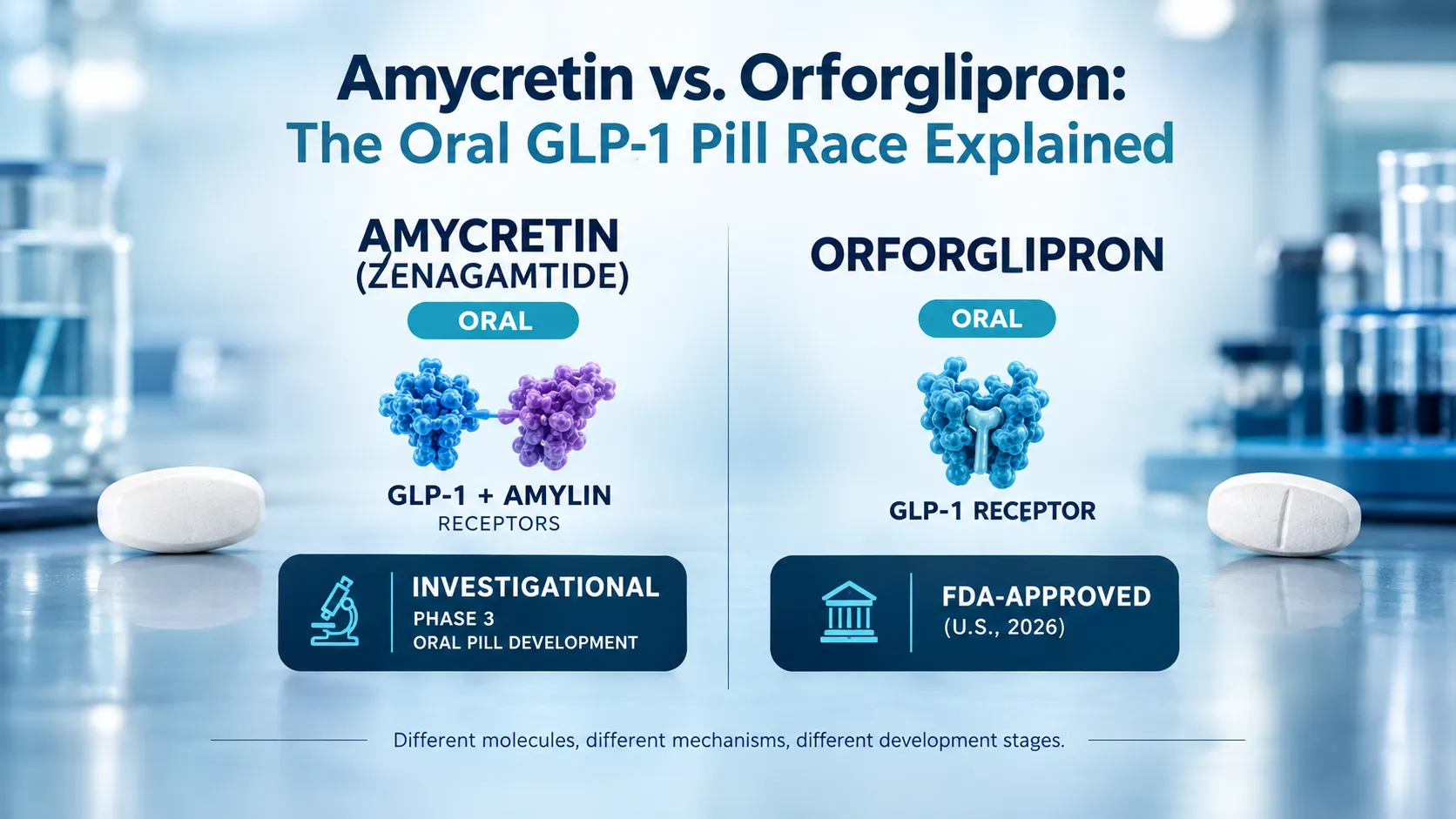
Amycretin is a peptide and orforglipron is not. How that chemistry explains the formulations, trial results, and approval status of both GLP-1 pills.
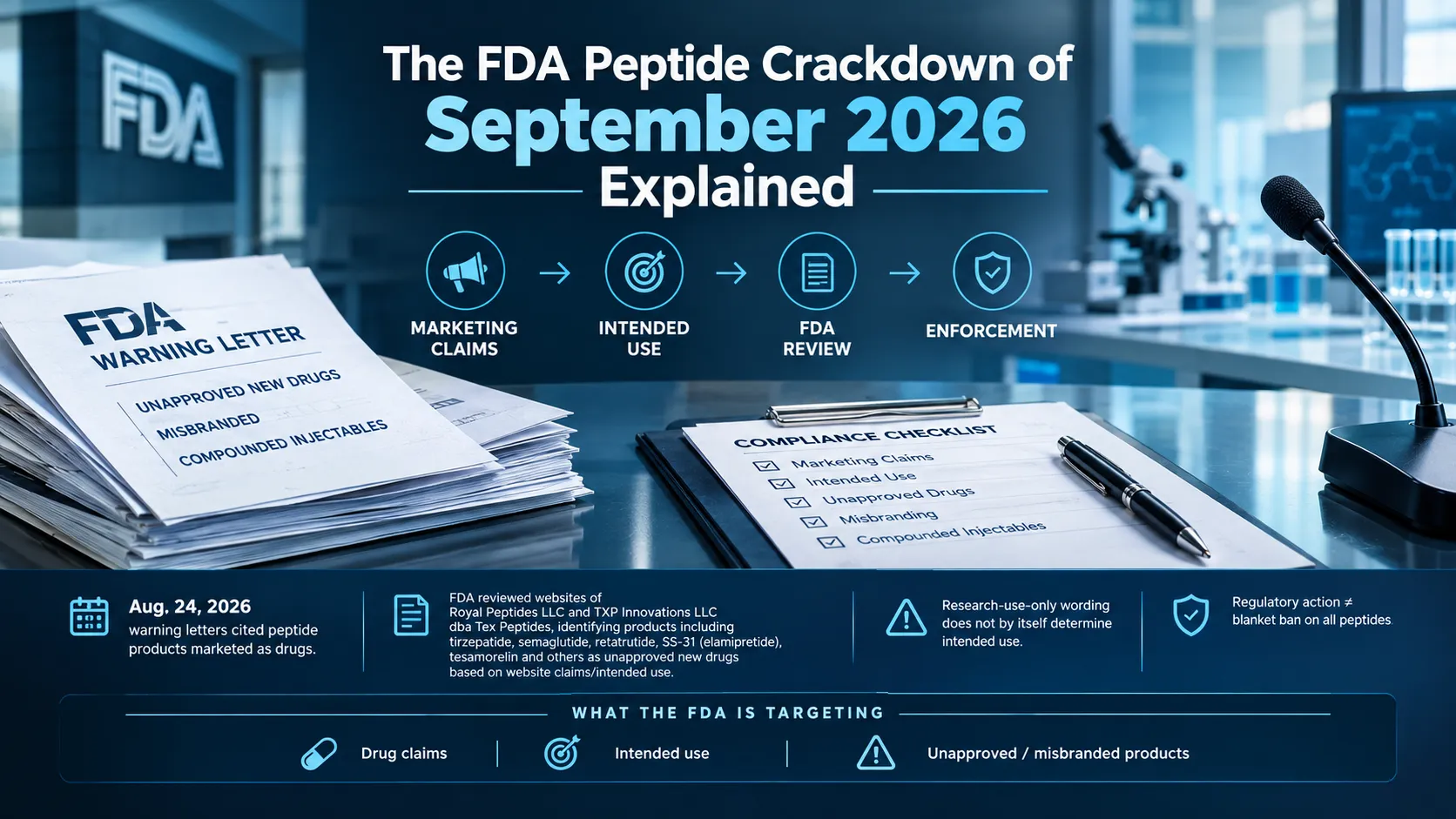
Five peptide sellers got FDA warning letters in September 2026. See who was named, why the research label failed, and the full 2026 enforcement timeline.
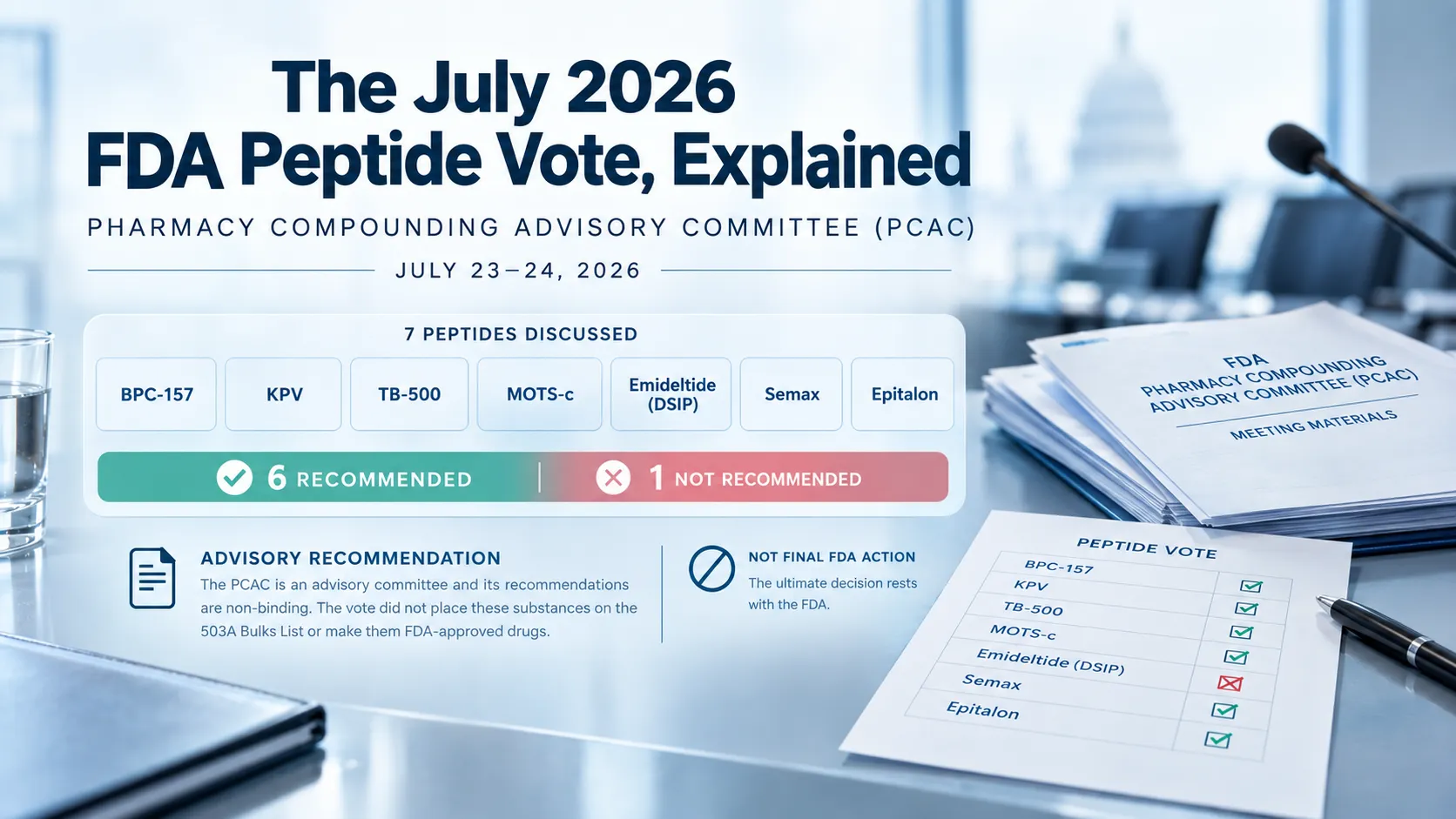
In July 2026, the FDA's advisory committee recommended 6 peptides for the 503A bulk list. None are on it yet. What the vote changed and what it didn't.