GHRP-6 Mechanism: What the Research Evidence Establishes
Growth researchSeptember 17, 202612 min read
GHRP-6 research spans cryo-EM structures, rodent feeding studies and human GH provocation tests. What each evidence tier establishes, and where it stops.
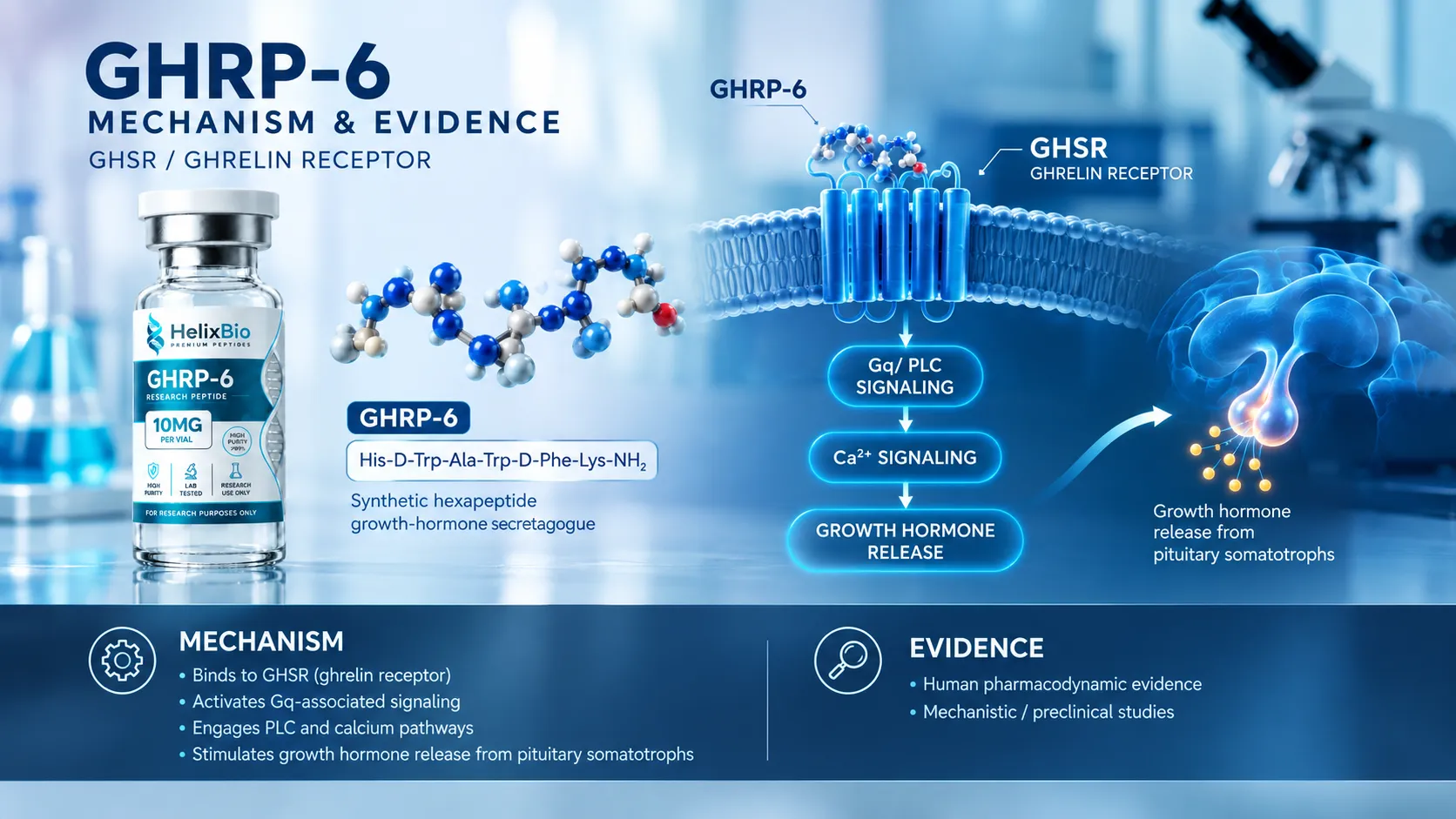
GHRP-6 and ghrelin occupy the same orthosteric pocket of the ghrelin receptor, but cryo-EM structures published in 2021 show GHRP-6 bound in an inverted orientation relative to ghrelin.
GHRP-6 was synthesised in 1984, used as a reference ligand to clone the growth hormone secretagogue receptor in 1996, and predates the 1999 identification of ghrelin by fifteen years.
In nine healthy men, a GHRH antagonist reduced the maximal GH response to intravenous GHRP-6 from 33.8 to 6.2 micrograms per litre, supporting an important endogenous GHRH contribution under those conditions.
A residual GH response persisted under GHRH antagonism, so the study does not establish that GHRP-6 has no GHRH-independent action.
The claim that GHRP-6 increases appetite is supported by rodent, murine and goldfish studies; no controlled human trial measuring food intake after GHRP-6 was identified.
Intracerebroventricular GHRP-6 increased food intake in rats through a pathway blocked by an NPY Y1 receptor antagonist, with hypothalamic c-Fos activation occurring independently of whether animals ate.
Published human GHRP-6 studies were designed as acute growth hormone provocation tests in small groups of healthy volunteers, not as outcome trials.
The nearest human negative finding on slow-wave sleep in this class used GHRP-2 rather than GHRP-6, which is itself an illustration of how readily results are transferred between closely related secretagogues.
A growth hormone concentration measured after a single bolus is an intermediate biomarker and does not establish a downstream IGF-1, tissue or clinical effect.
GHRP-6 is not an FDA-approved drug in the United States and appears in Category 3 of FDA's section 503A nominated bulk drug substances list updated 14 May 2026, meaning nominated without adequate supporting information.
Almost every page written about GHRP-6 states the same three things: it activates the ghrelin receptor, it releases growth hormone, and it increases appetite. All three statements have published support. None of them rests on the same kind of evidence, and the differences matter more than the claims do. A cryo-EM structure, a rat brain injection and a human provocation test answer different questions, and a claim built from one cannot be transferred to another. This page sorts the GHRP-6 literature by what each study actually measured, in what system, and what the result can and cannot carry.
Featured In This Article
GHRP-6
RESEARCH PEPTIDE
Highly purified synthetic peptide prepared for rigorous laboratory research.
$72.00
GHRP-6 Spray
RESEARCH PEPTIDE
Highly purified synthetic peptide prepared for rigorous laboratory research.
$71.99
For the compound's chemical identity, sequence, mass and formulation details, see the GHRP-6 product page and the GHRP-6 Spray page. This article covers the evidence layer only.
The evidence tiers, and why GHRP-6 needs them
GHRP-6 was synthesised before its receptor was identified and fifteen years before its endogenous counterpart was found. That unusual history left the literature stratified in a way few research peptides are: structural work, cellular assays, rodent studies and human endocrine testing were done decades apart, by different groups, asking different questions. Reading them as one body of evidence is where most secondary writing goes wrong.
Evidence level
What GHRP-6 research establishes here
What this level cannot establish
Structural
GHRP-6 occupies the GHSR orthosteric pocket; its binding pose is resolved
That the same signalling occurs in an intact organism
Animal (preclinical)
Food intake, arcuate nucleus activation, GH release in rodents and other species
Human appetite, human GH physiology, human outcomes
Human pharmacology
A reproducible acute GH response to intravenous administration
Efficacy, benefit, or durability of any effect
Clinical outcome
No adequately designed trial identified establishing a therapeutic outcome
Everything downstream of it
Each row is a separate question. A claim that crosses rows without new evidence is an extrapolation, not a finding — and that is the single most common error in GHRP-6 writing.
What the receptor structure actually shows
The strongest receptor-level evidence for GHRP-6 is recent and rarely cited in commercial material. In 2021, Wang and colleagues published cryo-electron microscopy structures of the Gq-coupled ghrelin receptor bound to two different ligands: ghrelin at 2.9 Å resolution, and GHRP-6 at 3.2 Å. Both occupy the same orthosteric pocket.
They do not occupy it the same way. Ghrelin inserts its N-terminus deep into the helix bundle. GHRP-6 binds in what the authors describe as an upside-down orientation relative to ghrelin, with its C-terminus inserted into the bundle and its N-terminus facing the extracellular vestibule. Both ligands displace the same salt bridge between E124 and R283 to activate the receptor, but they arrive at that displacement from opposite directions.
This is the most precise available answer to a question the whole category gets wrong. GHRP-6 is routinely called a ghrelin mimetic. Structurally it is a same-pocket agonist with an inverted binding pose, which is a narrower and more interesting claim. It also sets a hard limit: a structure describes how a molecule sits in a receptor. It says nothing about what happens in an animal.
Receptor activation is not the same as signaling agreement
Cellular pharmacology for the growth hormone secretagogue class has been consistent on calcium and phosphoinositide signalling, and inconsistent elsewhere. That inconsistency is worth stating plainly rather than smoothing over.
Wu and colleagues, working with Bowers and Clarke in 1996, compared GHRP-6 and GHRP-2 directly in ovine and rat somatotrophs. GHRP-2 raised intracellular cAMP; GHRP-6 did not. A GHRH-receptor antagonist reduced the GHRP-2 response but not the GHRP-6 response. That is one in vitro study, published before the receptor was fully characterised, in two species. It should not be read as settling GHRP-6's signalling profile. It should be read as evidence that results in this class do not automatically generalise across compounds, species or assay systems, which is exactly what most comparison pages assume.
Earlier work by Cheng and colleagues had already shown GHRP-6 acting synergistically with GH-releasing factor on cAMP accumulation in rat pituitary cell culture. Synergy in a cell culture and synergy in a person are separate findings, and the second requires its own evidence.
The GHRH finding that constrains every mechanism claim
The most important human mechanistic result for GHRP-6 is also the least quoted. Pandya and colleagues, working with Bowers, Barkan and Jaffe, published it in the Journal of Clinical Endocrinology & Metabolism in 1998.
Nine healthy men aged 20 to 30 were studied on two occasions. Each received either saline or a specific GHRH antagonist intravenously, followed twenty minutes later by an intravenous bolus of GHRP-6. Blood was sampled every ten minutes across three hours.
With saline pretreatment, the maximal GH increase over baseline was 33.8 ± 4.8 µg/L. With the GHRH antagonist, it was 6.2 ± 1.8 µg/L. Area under the curve fell from 1701 ± 278 to 376 ± 113 µg·min/L.
Read precisely, the study found that antagonising GHRH substantially reduced the GH response to GHRP-6 in these nine subjects, supporting an important contribution from endogenous GHRH to the GH response observed under those conditions. The authors' own conclusion is that endogenous GHRH is necessary for most of the GH response to GHRP-6 in humans.
What it does not say is that GHRP-6 has no GHRH-independent action. A residual response remained. Nor does it speak to the appetite literature, to non-intravenous routes, or to any species other than humans. It is a nine-subject acute pharmacology study with one antagonist at one dose, and its value lies in showing that the two pathways interact rather than running in parallel. For the receptor-level distinction between the GHSR and GHRH systems, see the GHRH analogues versus GHRPs comparison.
"GHRP-6 works independently of GHRH" is a claim the human data do not support. The GHRH pathway carried most of the measured GH response in the only published human antagonist study of this kind.
Where the appetite claim actually comes from
The appetite association is the most widely repeated statement about GHRP-6 and the most poorly sourced. Tracing it changes what can honestly be said.
Finding
System
What it establishes
Intracerebroventricular GHRP-6 increased food intake and reduced core temperature
Rats
Central orexigenic action in a rodent model
Effect abolished by an NPY Y1 receptor antagonist
Rats
A specific downstream mediator in that model
c-Fos activation in arcuate, paraventricular and lateral hypothalamic nuclei, independent of whether animals ate
Rats
Neuronal activation is not secondary to feeding
Orexin-containing neurons activated; melanin-concentrating hormone neurons not
Rats
Pathway specificity within the rodent hypothalamus
Intraperitoneal GHRP-6 stimulated feeding, blocked by capsaicin pretreatment
Goldfish
Vagal-afferent mediation in a non-mammalian model
Every row is an animal study. The rodent work is careful, mechanistically specific and internally consistent. What is absent is a controlled human trial measuring food intake after GHRP-6 administration. Published human GHRP-6 studies were designed as growth hormone provocation tests, and several predate ghrelin's identification entirely — appetite was not their endpoint and was frequently not measured.
So the defensible statement is that GHRP-6 stimulates feeding in rodent models through identified hypothalamic circuitry, and that the human appetite literature for this specific compound is thin to absent. The statement "GHRP-6 increases appetite" carries an implied species it does not name.
What the human record contains
Human GHRP-6 research exists, and it is narrower than its reputation. The consistent, reproducible finding is an acute GH response to intravenous administration — visible in Pandya's saline arm, and in studies examining GHRP-6 alongside GHRH in normal subjects, obese subjects and patients with hypercortisolism. Those studies established that GHRP-6 and GHRH release GH by mechanisms that respond differently to the same physiological perturbations, which is a mechanistic result rather than a clinical one.
The negative human findings deserve equal weight, and reading them requires the same care. Moreno-Reyes and colleagues published work in 1998 titled, without ambiguity, as evidence against a role for the growth hormone-releasing peptide axis in human slow-wave sleep regulation, reporting no enhancement of slow-wave sleep; that study administered GHRP-2 rather than GHRP-6 to seven healthy men, so it bears on the class rather than on this compound. Later route-comparison work in healthy young men found that oral, intranasal and sublingual preparations produced no significant sleep-pattern changes, although intranasal administration did significantly raise overnight GH, and the same group's earlier intravenous work had raised GH, corticotropin and cortisol and increased stage 2 sleep.
Two boundaries follow. Human GHRP-6 data are acute provocation pharmacology in small groups of healthy volunteers, not outcome trials. And a hormone response is an intermediate measurement, not a benefit.
Why a growth hormone response is not an outcome
The gap between the human pharmacology tier and the clinical outcome tier is the one most GHRP-6 writing steps over without noticing, so it is worth making explicit.
A GH concentration measured thirty minutes after an intravenous bolus is a biomarker. It demonstrates that the pituitary responded. It does not demonstrate that anything followed from the response, and three specific things stand between the two.
The first is duration. Provocation studies measure a single acute pulse over a few hours. Nothing in the human GHRP-6 record describes what repeated administration does to the response itself, and receptor systems commonly attenuate under sustained stimulation.
The second is the downstream axis. GH acts substantially through IGF-1, and IGF-1 responses have their own kinetics, their own binding proteins and their own regulation. A GH peak does not license a claim about IGF-1, and neither licenses a claim about tissue.
The third is the counterfactual. Pandya's own data show why. The GH response measured after GHRP-6 was carried mostly by endogenous GHRH, which means the compound's contribution in an intact person is partly a modulation of an existing system rather than an independent input. Interpreting the peak as GHRP-6's own effect overstates it.
None of this argues that the GH finding is unreal. It is one of the better-replicated results in the class. It argues that the finding answers the question it was designed to answer, and that questions about benefit were never put to it.
What this research does not establish
No therapeutic outcome. No adequately designed clinical trial establishing a therapeutic outcome for GHRP-6 was identified. Receptor occupancy, GH release and rodent feeding are each upstream of that question.
No human appetite finding. The orexigenic literature is animal work. Transferring it to humans is an inference, not a citation.
No body-composition, recovery, or performance claim. These appear nowhere in the primary GHRP-6 literature at any evidence level.
No formulation-specific pharmacokinetics. Route figures in circulation come from specific experimental preparations in specific species. They do not describe any commercial material.
No claim that structure implies function. The 2021 structures resolve a binding pose. Binding pose does not predict an organism-level outcome.
No regulatory endorsement. GHRP-6 is not an FDA-approved drug in the United States, and on FDA's section 503A nominated bulk drug substances list updated 14 May 2026 it appears in Category 3, meaning nominated without adequate supporting information for evaluation. Category 3 is distinct from Category 2, which identifies significant safety concerns. Absence of approval is not a statement about legality in any given jurisdiction. The FDA 503A bulks list explainer covers how these categories work.
How to trace a GHRP-6 claim to its source
The practical skill this literature demands is provenance checking. Four questions resolve most disputed statements about GHRP-6.
Which species? Rodent, canine, ovine, goldfish and human results all exist for this compound and they do not agree on everything.
Which route and which system? Intracerebroventricular injection, intravenous bolus, intranasal delivery and an isolated somatotroph culture are four different experiments.
Which endpoint? GH concentration, c-Fos expression, food intake, sleep architecture and receptor occupancy are not interchangeable.
Is the source primary? A substantial share of GHRP-6 claims online cite other vendor pages, review articles, or nothing at all. A review restating a 1984 result is not the 1984 result.
The reverse-pharmacology history is a useful reminder here. When Howard and colleagues cloned the growth hormone secretagogue receptor in Science in 1996, the accompanying perspective by Conn and Bowers described the route as unusual precisely because a synthetic ligand existed before the natural one was known. Ghrelin was identified as that endogenous ligand in 1999. GHRP-6 did not copy ghrelin; it was one of the tools that led to it. Any page describing GHRP-6 as a ghrelin derivative has the chronology backwards, and that is a fast way to judge whether a source checked its own claims.
It establishes that GHRP-6 binds and activates the growth hormone secretagogue receptor, that it produces an acute growth hormone response after intravenous administration in humans, and that it stimulates feeding in rodent models. It does not establish any therapeutic outcome.
Not in the usual sense of the phrase. Cryo-EM structures published in 2021 show GHRP-6 and ghrelin occupying the same orthosteric pocket of the receptor, but GHRP-6 binds in an inverted orientation with its C-terminus inserted into the helix bundle. GHRP-6 also predates ghrelin's identification by fifteen years.
The human evidence argues against that framing. In nine healthy men, a GHRH antagonist reduced the maximal GH response to GHRP-6 from 33.8 to 6.2 micrograms per litre, indicating that endogenous GHRH carried most of the measured response under those experimental conditions. A smaller residual response remained.
Yes, but narrowly. The human literature consists mainly of acute growth hormone provocation studies in small groups of healthy volunteers, often conducted alongside GHRH, and several were published before ghrelin was identified. No adequately designed clinical outcome trial was identified.
No controlled human trial measuring food intake after GHRP-6 administration was identified in this review. The orexigenic findings come from rat, mouse and goldfish studies. Human GHRP-6 studies were designed around growth hormone endpoints and frequently did not measure appetite at all.
Intracerebroventricular GHRP-6 increased food intake in rats and transiently lowered core body temperature, with the feeding effect abolished by an NPY Y1 receptor antagonist. c-Fos activation appeared in the arcuate, paraventricular and lateral hypothalamic nuclei even in animals denied food, indicating the activation was not secondary to eating.
GHRP-6 acts at the growth hormone secretagogue receptor, GHSR1a. The receptor was cloned in 1996 using synthetic secretagogues as reference ligands, and GHRP-6 has since been resolved bound to it by cryo-electron microscopy at 3.2 angstrom resolution.
Not entirely. Calcium mobilisation and phosphoinositide turnover are consistently reported for this receptor class, but a 1996 comparison in ovine and rat somatotrophs found GHRP-2 raised intracellular cAMP while GHRP-6 did not. That is one in vitro study in two species and should be read as a caution against generalising across compounds and assay systems.
No. Receptor occupancy, receptor activation, hormone release, physiological response and clinical outcome are five separate evidence levels. Each requires its own study design, and a result at one level does not transfer to the next without new data.
A GH concentration measured after a single bolus is an intermediate biomarker. It does not address what repeated administration does to the response, what happens downstream through IGF-1, or how much of the peak was carried by the endogenous GHRH the compound interacts with.
Ask which species, which route and experimental system, which endpoint was measured, and whether the source is primary literature rather than a review or vendor page. Most disputed statements about GHRP-6 resolve once the species and endpoint are named.
GHRP-6 is not an FDA-approved drug in the United States. On FDA's section 503A nominated bulk drug substances list updated 14 May 2026 it appears in Category 3, meaning nominated without adequate supporting information for evaluation, which is distinct from Category 2 covering significant safety risks.