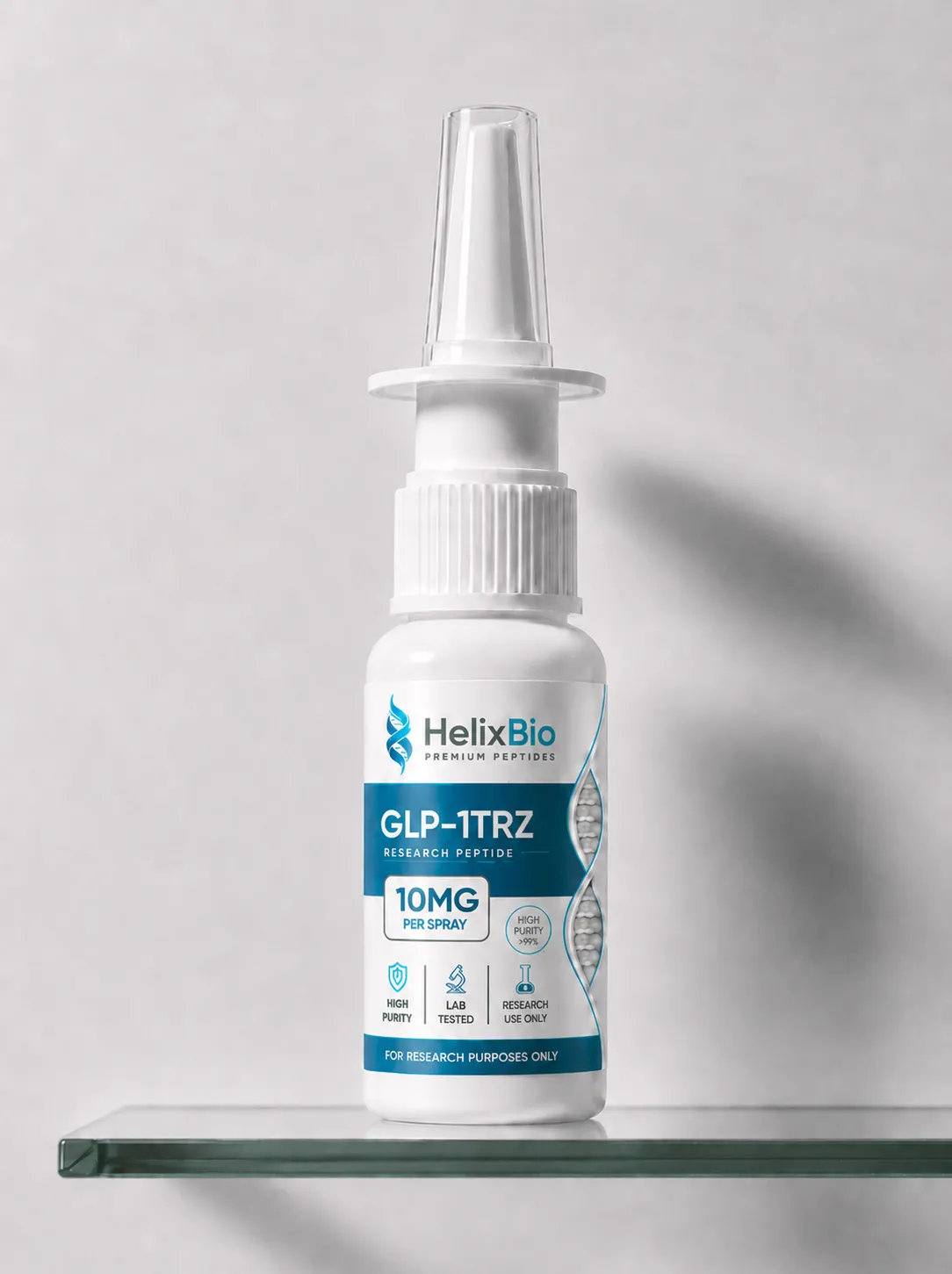
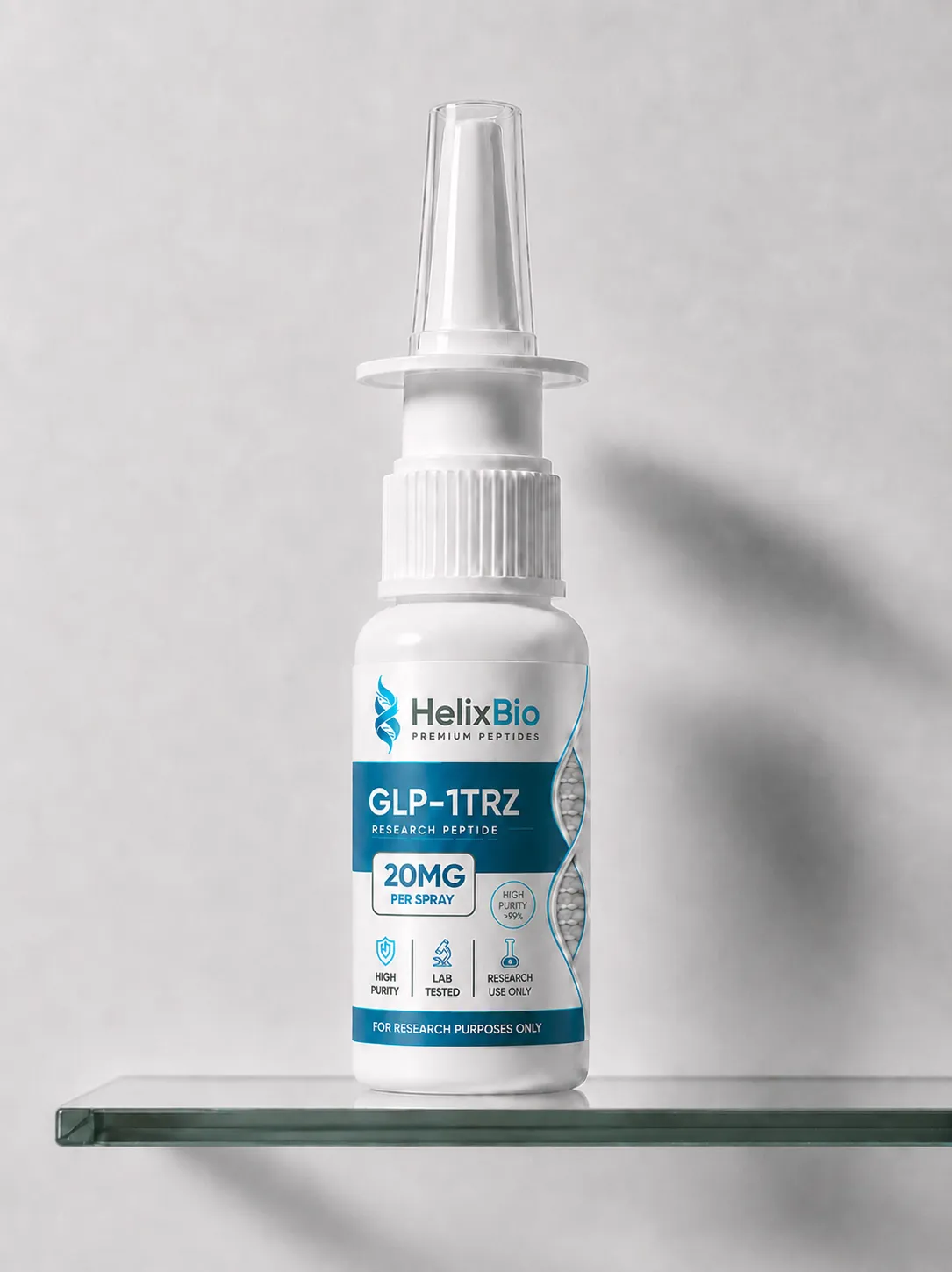
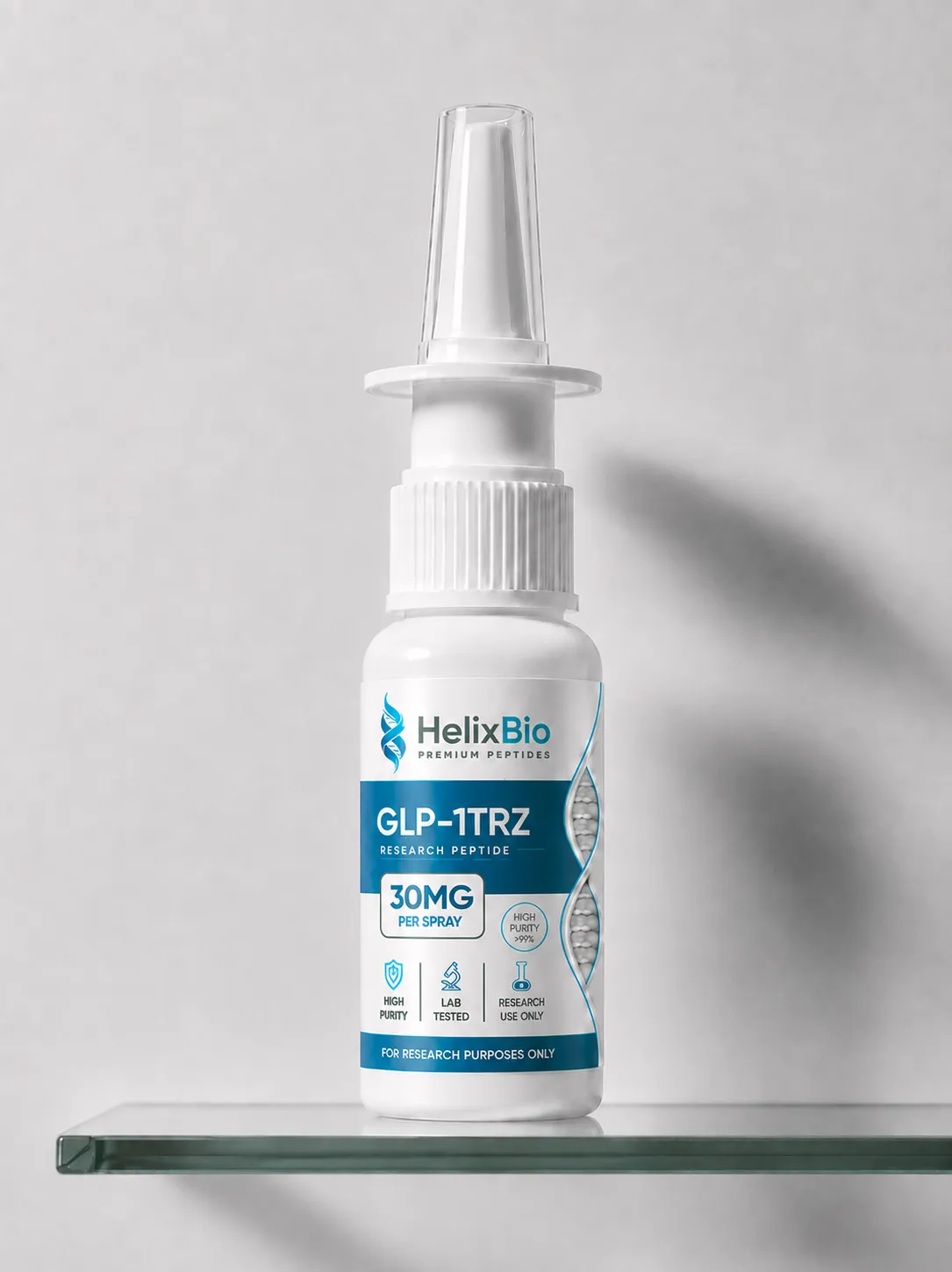
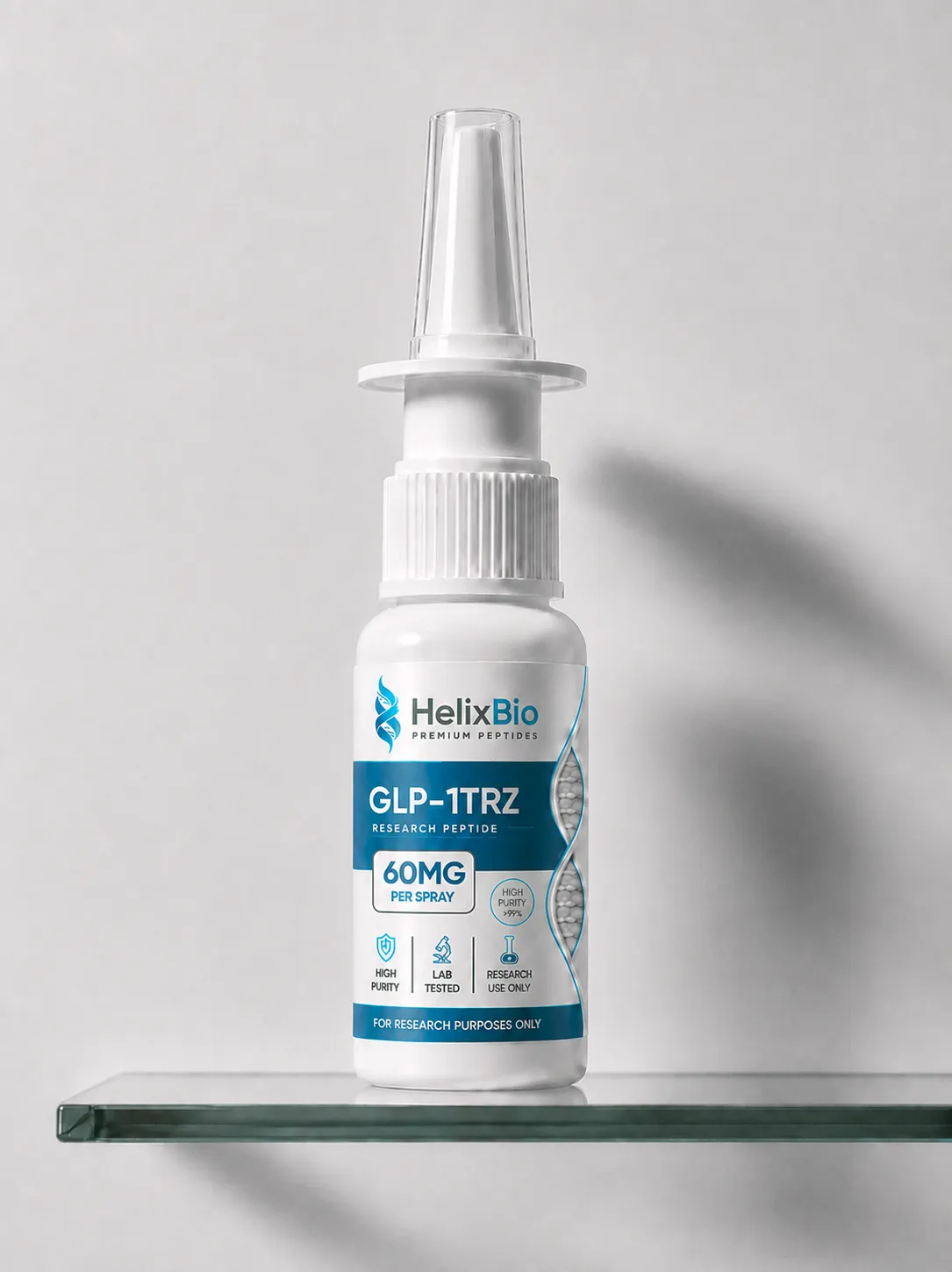
GLP-1TRZ Spray is a research-use material supplied by Helix Bio as a prepared spray-format solution rather than as a lyophilised solid. The compound it contains, its concentration and its supporting analytical data are recorded in the product documentation and the lot-specific Certificate of Analysis, which are the authoritative record for any given lot. Helix Bio supplies research materials for qualified laboratory and scientific applications. GLP-1TRZ Spray is offered strictly for research use. It is not intended for human or veterinary consumption, ingestion, injection, inhalation, self-administration, cosmetic use, or the diagnosis, treatment, cure or prevention of any disease or condition. The word "Spray" describes the physical presentation of the material and does not indicate a route of administration.
HPLC certified
Independent analysis
Highest standard
Full traceability
§7 Product Description + §8 Key Features + §9 Why Choose, with §14 folded in.
GLP-1TRZ is a Helix Bio product designation. It is not scientific nomenclature and should not be read as one. Abbreviated product names of this kind are common across the research-materials market and are not standardised between suppliers — comparable labels have been applied to materially different peptides by different sellers, which makes a product name an unreliable guide to what a container holds.
What identifies a research material is the compound name as the manufacturer states it, confirmed by mass spectrometry, together with the concentration and analytical data belonging to the specific lot. Those are recorded in the product documentation and the Certificate of Analysis. Researchers evaluating this material should work from that documentation rather than from the product name, and should check it against the container label before the material enters a workflow.
Supplying a material as a prepared solution rather than as a lyophilised solid changes which variables the receiving laboratory controls, and that distinction matters more than the packaging suggests.
A solid arrives characterised by mass and purity. The laboratory chooses the solvent, the concentration and the moment of dissolution, and can record all three. A prepared solution arrives with those decisions already made. Its useful specification is concentration rather than mass, and concentration is only interpretable alongside the basis on which it is stated — whether it refers to net peptide or to gross material including counterion, residual solvent and water. Two solutions labelled with the same figure on different bases are not the same material.
The vehicle matters for the same reason. Composition, pH and any preservative or stabiliser affect solubility, adsorption to container surfaces and degradation over time, and none of that is visible from a label. Elapsed time and storage conditions since preparation sit outside the laboratory's control entirely.
For any prepared solution the documentation therefore has to answer more than it does for a solid: concentration and its basis, fill volume and total content, vehicle composition, the date of preparation or testing, and any retest or in-use period. Results and storage conditions should not be carried across from a different format of a related material.
Helix Bio positions its catalogue for research and laboratory purposes only. Product documentation and lot-specific analytical information should be reviewed before a material is incorporated into an experimental workflow.
The existence of published scientific literature concerning any compound does not establish that a research material containing it is safe or effective for use in humans. Published clinical evidence is generated using specific pharmaceutical formulations, administered by specific routes, under regulated conditions, in defined populations. Such evidence describes those products. It does not describe a research material, was not generated using one, and should not be read as indicating anything about the safety, performance or suitability of this preparation. Regulatory approval of a pharmaceutical product applies to that product alone and does not transfer.
Researchers evaluating a research material need more than a product name, and in this segment that is not a figure of speech. Product names here are frequently abbreviations chosen for commercial rather than descriptive reasons, and they carry no guarantee of what is inside. Identity, concentration, purity, analytical method and traceability determine whether a material is fit for an experiment, and all of them live in documentation rather than on a label.
Helix Bio states that its research materials undergo independent HPLC testing for purity assessment and mass spectrometry for molecular identity confirmation, and that batch-specific Certificates of Analysis are available. Those two measurements answer different questions and are stronger together than either alone: mass spectrometry addresses what the material is, while chromatography addresses what proportion of it is the main species under a given method.
For GLP-1TRZ Spray specifically, researchers should establish the compound identity and the concentration basis from current lot documentation before the material enters a workflow, rather than relying on a general catalogue description.
Qualified users in legitimate laboratory and scientific research environments: academic and institutional research laboratories, analytical chemistry laboratories, biotechnology research groups, contract research organisations, and qualified scientific researchers working under appropriate institutional oversight.
It is not intended for personal experimentation, self-administration, human or veterinary use, cosmetic use, or any medical or weight-management purpose.
§10 Specifications + §12 Research/Applications.
| Specification | Details |
|---|---|
| Product Name | GLP-1TRZ Spray |
| Product Format | Prepared spray-format solution |
| Compound | Refer to current product documentation and Certificate of Analysis |
| Concentration | Refer to current product listing and lot documentation |
| Fill Volume | Refer to current product listing |
| Total Content | Refer to current product listing and lot documentation |
| Vehicle / Formulation | Refer to current product documentation |
| Appearance | Refer to current product documentation |
| Purity | Refer to current lot-specific Certificate of Analysis |
| Identity Testing | Mass spectrometry, where documented |
| Purity Testing | HPLC, where documented |
| Lot / Batch | Refer to applicable Certificate of Analysis |
| Storage | Follow current product-specific documentation |
| Packaging | Refer to current product listing |
| Intended Use | Research and laboratory investigation only |
| Human Use | Not intended for human consumption or application |
| Veterinary Use | Not intended for veterinary use |
| Manufacturer / Supplier | Helix Bio |
| Country of Origin | Refer to current product documentation |
Prepared-Solution Method Work
A material supplied as a solution is directly usable in analytical work that does not require the laboratory to control the dissolution step, including method development, method transfer and system suitability work where a defined solution is the convenient starting point.
Stability and Degradation Characterisation
Solutions have degradation pathways that solids do not, and characterising them for a specific vehicle and storage condition is legitimate research in its own right. Forced-degradation work, stability-indicating method development and studies of adsorption to container surfaces all begin from a prepared solution.
Formulation Science
Vehicle composition, pH, ionic strength and excipient selection influence solubility, self-association and stability. A supplied formulation provides a defined starting point for comparative formulation work.
Analytical Documentation Practice
Comparison of chromatographic purity, mass confirmation and content determination across lots supports laboratory work on specification-setting and incoming-material qualification.
Researchers should evaluate any published work according to its model, methodology, concentration, formulation and endpoints rather than assuming that findings from one experimental system apply to another.
§11 Purity & Quality + §13 Storage & Handling + §15 Shipping & Packaging.
Analytical documentation matters for any research material, and it matters more for a prepared solution, because the solution has already been through a step the receiving laboratory did not perform and cannot reconstruct from the label.
Helix Bio states that its research materials undergo independent HPLC testing for purity and mass spectrometry for molecular identity confirmation, and that batch-specific Certificates of Analysis are available.
It is worth being precise about what a purity figure establishes. Reported purity is usually chromatographic purity by area normalisation: the proportion of detected peak area attributable to the main peak under one particular method. That is narrower than it appears. It does not by itself establish identity, which requires mass confirmation. It does not report peptide content — the proportion of the material that is the compound rather than counterion, water or residual solvent — which is a separate determination and can differ substantially from the chromatographic figure. And it cannot resolve related species that co-elute under the method used. A purity figure is most useful read alongside the method, the identity data and a content determination.
For a specific lot of GLP-1TRZ Spray, the documentation should be reviewed for:
No certification, regulatory approval or quality claim should be inferred unless it is explicitly documented by the manufacturer or by a relevant regulatory authority. A general catalogue statement about testing practice is not a substitute for the data belonging to the lot supplied.
Storage and handling requirements should be taken from the current product documentation and the lot-specific instructions supplied with the material.
Storage guidance should not be inferred from a lyophilised preparation, from a pharmaceutical formulation, or from another supplier's material. A solid and a prepared solution do not share a degradation profile, and formulation and packaging both affect stability.
Helix Bio's website describes research materials as supplied to laboratories and institutions in the United States, with tracked shipping and cold-chain handling as part of its fulfilment process.
Shipping conditions, packaging specifications, availability and delivery requirements can change. Researchers should review the current Helix Bio shipping information and the product listing before ordering.
On delivery, the package should be inspected and the product name and lot information checked against the accompanying documentation. Packaging should remain appropriately labelled and handled as research material. Researchers are responsible for complying with applicable institutional, federal, state and local requirements governing research materials.
§16. Deliberately stronger than the catalogue default for this category.
GLP-1TRZ Spray is supplied by Helix Bio for research and laboratory purposes only. It is not intended for human or veterinary consumption, ingestion, injection, inhalation, nasal or oral administration, self-administration, or the diagnosis, treatment, cure, mitigation or prevention of any disease or medical condition, including diabetes, obesity or any metabolic condition.
The word "Spray" on this page describes the physical presentation of the material. It does not indicate or imply any route of administration.
This product is not a medicine, a dietary supplement or a weight-management product. Nothing on this page constitutes medical advice, dosage guidance, administration instructions or a recommendation for personal use, and no statement here should be read as describing an effect on body weight, appetite, blood glucose or any other physiological measure in humans.
Where scientific or clinical literature is referenced, it concerns specific molecular entities studied in specific pharmaceutical formulations by specific routes under regulated conditions. Regulatory approval of any pharmaceutical product, and the clinical evidence supporting it, applies to that product alone. It does not transfer to a research material, does not describe this material, and should not be read as evidence about it.
Researchers are responsible for determining whether this material is appropriate for their experimental system and for complying with applicable institutional, safety, intellectual-property and regulatory requirements.
Knowledge Base
Knowledge Base
Knowledge Base
Knowledge Base
Knowledge Base
Knowledge Base
Knowledge Base
Knowledge Base
Knowledge Base
Knowledge Base
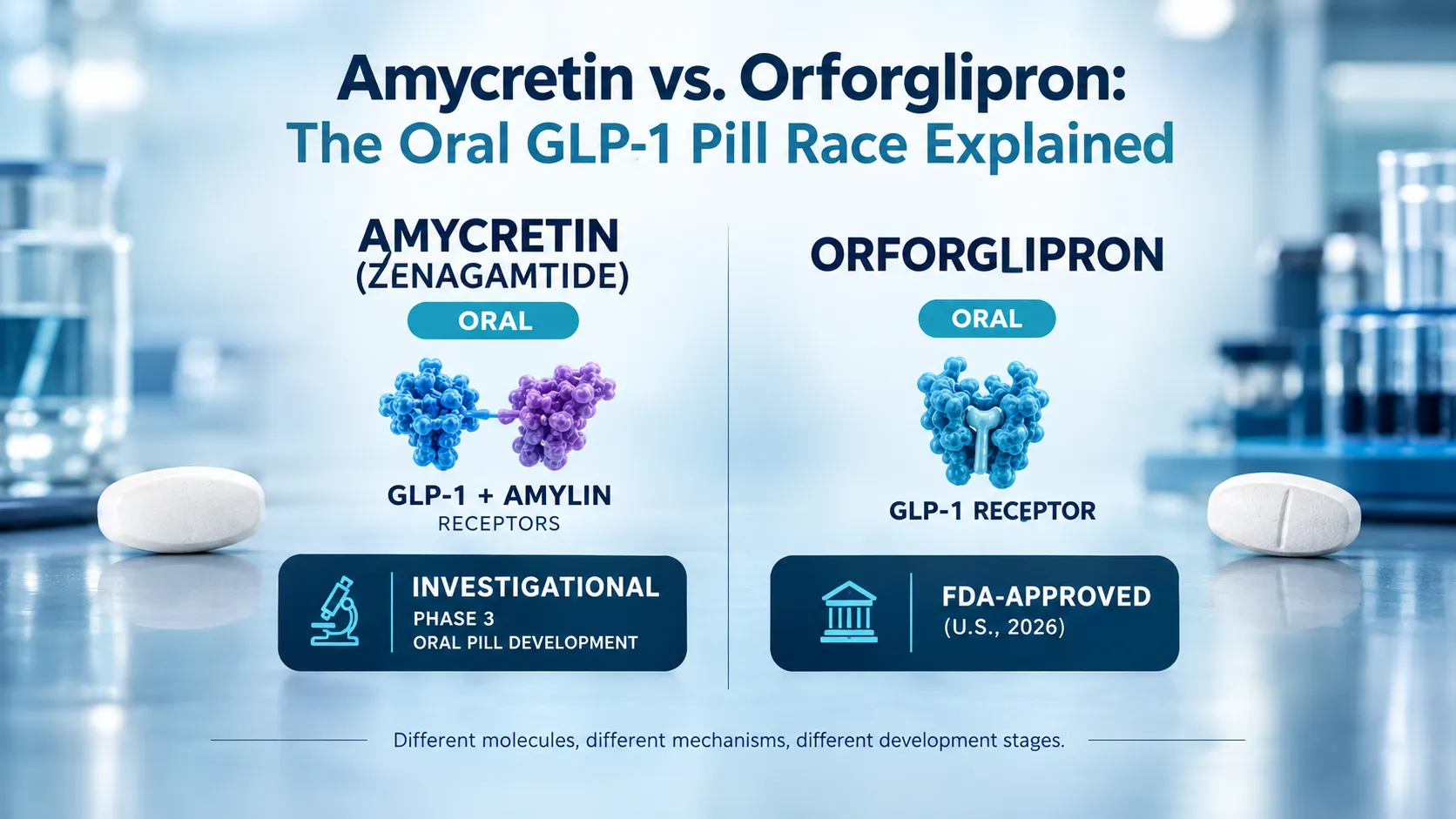
Amycretin is a peptide and orforglipron is not. How that chemistry explains the formulations, trial results, and approval status of both GLP-1 pills.
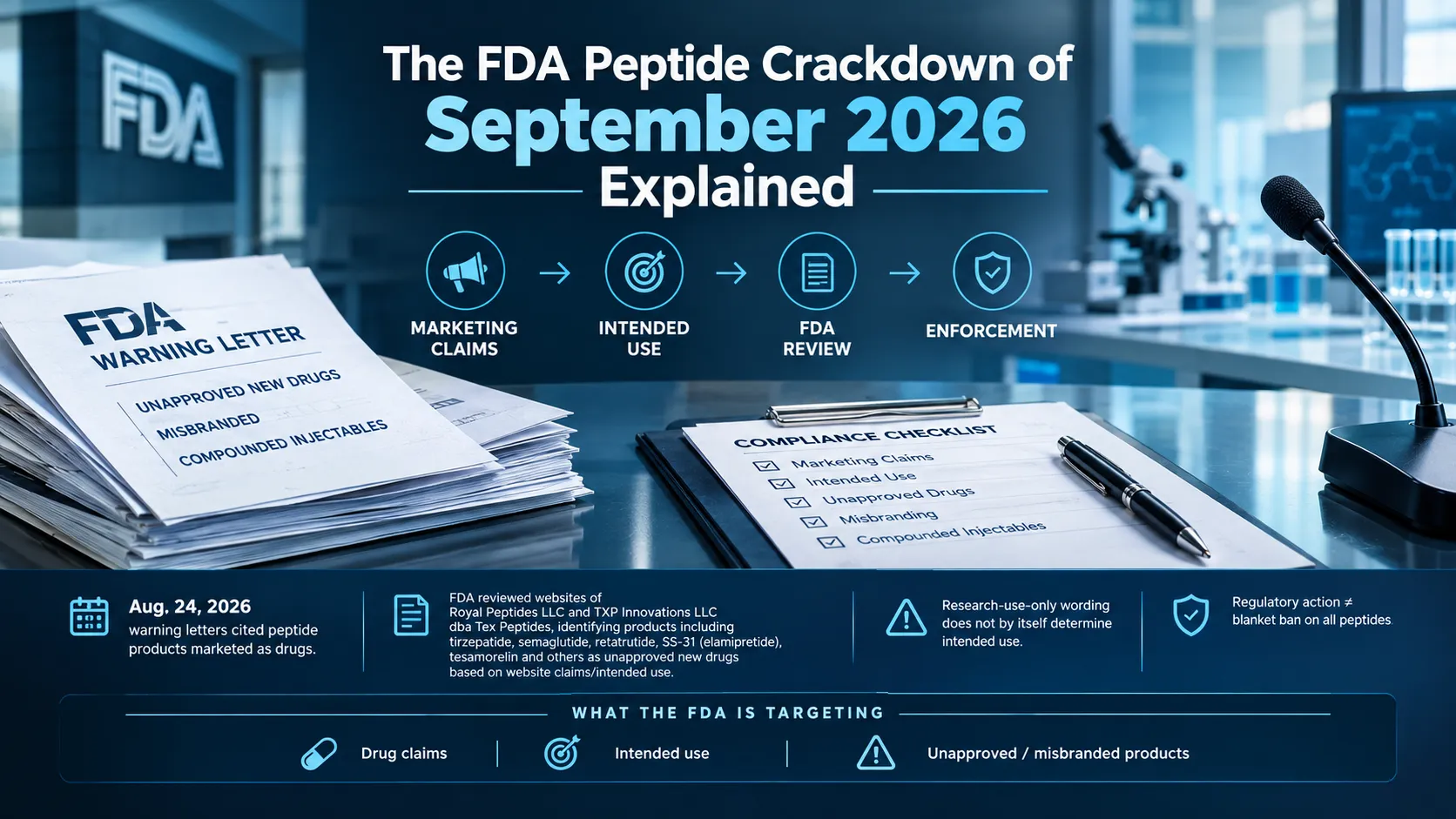
Five peptide sellers got FDA warning letters in September 2026. See who was named, why the research label failed, and the full 2026 enforcement timeline.
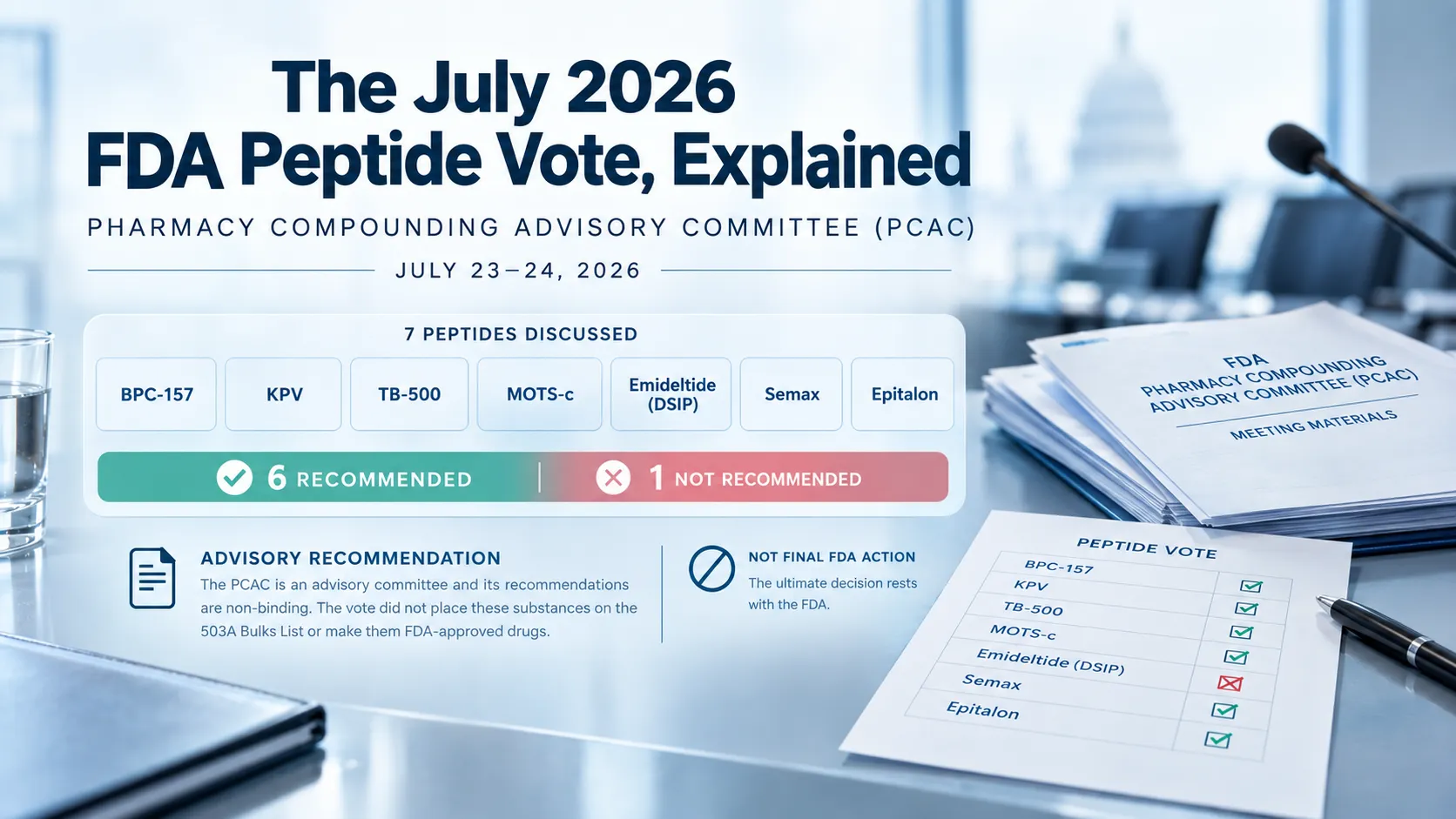
In July 2026, the FDA's advisory committee recommended 6 peptides for the 503A bulk list. None are on it yet. What the vote changed and what it didn't.