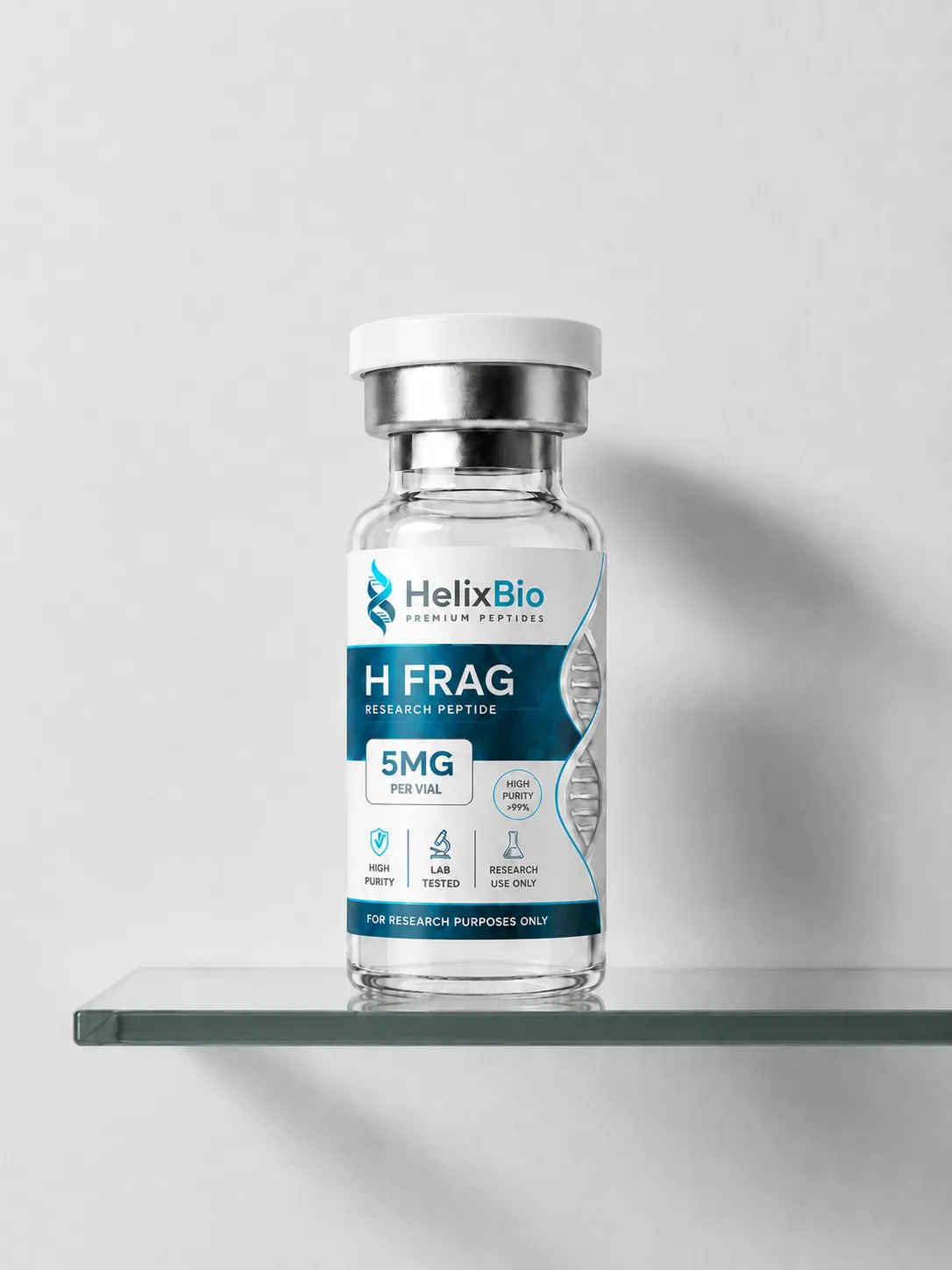
One oxygen atom is the entire chemical difference between this peptide and the compound it is most often confused with. H Frag is Helix Bio’s designation for hGH Fragment 176-191, the sixteen-residue C-terminal segment of human growth hormone, sequence FLRIVQCRSVEGSCGF, closed by the native Cys182–Cys189 disulfide the parent hormone carries in the same position. Swap the opening phenylalanine for a tyrosine and you have AOD-9604 — a different molecule, with a different registry number and a different evidence base. Supplied here in vial format as a research material for qualified laboratory use. Not intended for human or veterinary consumption, or for the diagnosis, treatment, cure or prevention of any disease.
HPLC certified
Independent analysis
Highest standard
Full traceability
Human growth hormone is a 191-residue polypeptide secreted by somatotroph cells of the anterior pituitary. Structure-function work through the 1980s and 1990s set out to determine whether the hormone’s effects on lipid metabolism could be separated from its growth-promoting and insulin-antagonising effects by dissecting the molecule into defined regions. The C-terminal window spanning residues 176 to 191 came out of that work as the region of interest, and hGH Fragment 176-191 is the synthetic peptide corresponding to it.
The choice of window was not arbitrary. Full-length growth hormone carries two disulfide bridges, and the smaller of the two closes a short loop between Cys182 and Cys189. Those two residues sit inside the 176-191 window, which means this fragment is one of the few excisable regions of the hormone whose native structural constraint survives excision intact. Cut almost anywhere else in the molecule and you get a linear peptide with no memory of the fold.
What the fragment does not do is reproduce the hormone in miniature. The receptor binding surface of growth hormone is assembled from residues that sit far apart in the sequence and are brought together only by the four-helix-bundle fold. Sixteen residues cannot rebuild it. A fragment of a hormone is a defined region of a well-characterised protein, not a lower dose of the protein.
hGH Fragment 176-191 is a hexadecapeptide with the sequence Phe-Leu-Arg-Ile-Val-Gln-Cys-Arg-Ser-Val-Glu-Gly-Ser-Cys-Gly-Phe, written FLRIVQCRSVEGSCGF in single-letter notation. The two cysteines sit at fragment positions 7 and 14 — Cys182 and Cys189 in full growth hormone numbering — and form an intramolecular disulfide that closes a loop across the second half of the peptide.
As a free peptide the molecule has the formula C₇₈H₁₂₃N₂₃O₂₂S₂ and an average mass of 1799.10 g/mol, registered under CAS 66004-57-7. Reference standards of this compound are typically supplied as the trifluoroacetate salt, which is why registry entries commonly write the formula with a variable trifluoroacetic acid component appended.
They differ at one position, and the difference is smaller than the market generally assumes.
hGH Fragment 176-191 begins with the native phenylalanine at hormone position 176. AOD-9604 carries a tyrosine there instead. Tyrosine is phenylalanine with a hydroxyl group on the ring, so the substitution adds a single oxygen atom and changes nothing else: identical carbon, hydrogen, nitrogen and sulfur counts, identical length at sixteen residues, identical Cys7–Cys14 disulfide. The mass difference is 15.99 daltons — 1799.10 against 1815.08 — and the registry numbers are 66004-57-7 and 221231-10-3 respectively.
The two names disagree by a residue only because of a numbering convention. Describe the tyrosine as replacing residue 176 and you get “176-191.” Describe it as added in front of residue 177 and you get “177-191 plus tyrosine.” Both readings are in circulation, including in regulatory documents, and that is the mechanical reason listings across the supply market drift between the two names. It is also why listings can be found today advertising “HGH Fragment 176-191” while publishing the tyrosine sequence and the 1815 mass in the same specification block.
This is the practical point a researcher receiving either compound needs, and it is the reason a mass result alone should not be treated as an identity result.
Sixteen daltons is the mass of one oxygen atom, which is also the most common artefact increment in peptide mass spectrometry. This peptide carries a disulfide, and disulfides oxidise further under ordinary handling and time in solution — to sulfoxide at +16 and sulfone at +32. A partially oxidised lot of hGH Fragment 176-191 therefore produces a species at the same nominal mass as clean AOD-9604.
High-resolution accurate mass narrows the question but does not close it, because both the substitution and the oxidation add the same element. What closes it is sequence-level evidence: tandem mass spectrometry separates the two cleanly at the N-terminal ion series, since the first residue differs and every b-ion carries that difference. The y-ion series is identical between them and will not help.
There is also a cheap orthogonal check available, and it comes from a composition detail almost nobody states. This sequence contains no tryptophan and no tyrosine. Its only aromatic residues are two phenylalanines, so its absorbance at 280 nm derives from the cystine bridge alone and is very weak. AOD-9604, carrying one tyrosine, has a real 280 nm chromophore roughly an order of magnitude stronger. A solution of this fragment showing a substantial 280 nm band is a lot worth asking questions about.
The same composition fact has a consequence that matters for anyone planning quantitation: peptide content for this compound cannot be established by A280. It has to come from gravimetric determination, amino acid analysis or quantitative NMR. For the same reason, chromatographic purity should be acquired at approximately 214 nm; a 280 nm chromatogram will under-report this peptide against any tyrosine- or tryptophan-containing impurity present.
Reading this literature accurately means tracking which compound generated each finding, because the two are routinely conflated.
The metabolic research programme belongs to AOD-9604. Heffernan and colleagues reported in 2001 that in obese mice and β3-adrenergic-receptor knockout mice, the lipid-metabolism effects of both growth hormone and AOD-9604 were substantially reduced when the β3-adrenergic receptor was absent, while IGF-1 did not rise significantly in the AOD-9604 groups. That work is the origin of the β3-adrenergic mechanism and of the “lipolysis without IGF-1” description attached to this whole family of compounds. It was carried out with AOD-9604, in mice.
The human data also belong to AOD-9604. It went through a clinical programme of roughly six sponsor-run trials. Safety and tolerability reports from that programme are in the literature. The pivotal efficacy trial did not separate from placebo, and the programme was discontinued.
hGH Fragment 176-191 itself has no dedicated human study programme. Where the bare fragment appears in the literature, it appears as a synthetic reference material, as a comparator in analytical and anti-doping method development, or in in-vitro work — including, as one example well outside the metabolic narrative, as a functionalising ligand on doxorubicin-loaded chitosan nanoparticles in a breast cancer cell model published in 2022.
Transferring AOD-9604’s findings to this fragment requires evidence that the substitution at position one does not alter the result. That evidence has not been published. Helix Bio states this rather than borrowing the claim.
Three distinct classes get filed together in peptide catalogues, and only one of them describes this compound.
A growth hormone fragment is a piece of the hormone itself — this molecule. A GHRH analogue — sermorelin, CJC-1295, tesamorelin — acts at the growth hormone-releasing hormone receptor on pituitary somatotrophs to stimulate release of the hormone. A growth hormone secretagogue — ipamorelin, GHRP-2, GHRP-6 — reaches the same endpoint through the ghrelin receptor GHSR-1a.
This fragment is none of the latter two. It does not act upstream on the growth hormone axis and it is not a releasing agent of any kind. Researchers comparing across those classes should read each compound’s own page rather than reasoning by category.
H Frag is supplied as a research material for in-vitro and laboratory investigation by qualified users. It is not a drug, dietary supplement, cosmetic or consumer product, and Helix Bio provides no dosing, administration or experimental protocol guidance for it.
Appropriate applications include analytical method development and validation, peptide characterisation, reference and comparator use in chromatographic and mass-spectrometric assays, disulfide and peptide-stability chemistry, and controlled cell-based or preclinical research designed and approved by the receiving institution. Researchers are responsible for determining whether the material suits their experimental design and for complying with institutional, federal, state and local requirements governing research chemicals.
Helix Bio lists this compound in two presentations, and the difference is chemical rather than packaging.
A peptide already in solution is exposed continuously to its vehicle. For this molecule specifically, that exposure runs directly into the identity problem described above: the disulfide is the reactive feature, oxidation adds the same sixteen daltons that separates this compound from AOD-9604, and thiol-disulfide exchange in solution can open and rescramble the loop. A dry solid slows that chemistry substantially, which is why an analytical reference standard of this compound is supplied as a solid rather than a solution.
The practical distinctions follow from that. Storage guidance written for one presentation does not carry across to the other. Concentration and fill volume are properties of a solution product; fill mass and reconstitution are properties of a solid. And a laboratory that needs to weigh out a defined quantity — for a calibration curve, a spiking standard or a dose-response series — needs the solid, because a supplied solution fixes the concentration at whatever the manufacturer chose.
For a compound this widely mislabelled, the useful question is not what a product page claims but what the paperwork shows.
A certificate for hGH Fragment 176-191 and a certificate for AOD-9604 are not interchangeable, and because the expected masses sit only sixteen daltons apart, a certificate that reports a mass without stating the basis it was measured against has not actually established identity. Before a lot enters an experimental workflow: check the compound name and sequence on the certificate; check the observed mass against the free-peptide figure and confirm which salt basis applies; read the chromatographic purity figure alongside the method and wavelength that produced it; confirm that the lot number on the certificate matches the container; and check the test date.
There is one further check specific to a solid presentation. Where the material is supplied as a salt — and reference standards of this compound generally are — a milligram figure on a label is a figure for the salt, not for the peptide. Peptide content depends on counter-ion content and on residual water, neither of which is fixed, and neither of which can be inferred from the label. Any calculation that treats the labelled mass as peptide mass will be wrong by a margin that varies lot to lot.
Helix Bio makes lot-specific documentation available so these checks can be performed. A general catalogue statement is not a substitute for the certificate covering the material in hand.
H Frag is intended for qualified users in legitimate laboratory and scientific research environments: academic and institutional research groups, biotechnology and pharmaceutical laboratories, contract research organisations, analytical laboratories developing or validating peptide methods, and educational research institutions.
It is not intended for personal experimentation, self-administration, human consumption, veterinary use, athletic use, or any medical purpose.
| Specification | Details |
|---|---|
| Product Name | H Frag |
| Compound | hGH Fragment 176-191 |
| Common Synonyms | HGH Frag 176-191; hGH (176-191); growth hormone fragment 176-191; somatotropin (176-191) |
| Compound Class | Synthetic cyclic peptide fragment of human growth hormone |
| Peptide Length | 16 amino acids |
| Sequence | Phe-Leu-Arg-Ile-Val-Gln-Cys-Arg-Ser-Val-Glu-Gly-Ser-Cys-Gly-Phe (FLRIVQCRSVEGSCGF) |
| Structural Feature | Intramolecular disulfide, Cys7–Cys14 (Cys182–Cys189 in hGH numbering) |
| Parent Molecule | Human growth hormone, residues 176–191 of 191 |
| Molecular Formula (free peptide) | C₇₈H₁₂₃N₂₃O₂₂S₂ |
| Average Mass (free peptide) | 1799.10 g/mol |
| CAS Number | 66004-57-7 |
| Aromatic Residues | Two phenylalanine; no tryptophan, no tyrosine |
| Related but Distinct Compound | AOD-9604 — N-terminal tyrosine variant, CAS 221231-10-3, 1815.08 g/mol |
| Format | Vial |
| Physical Form | Refer to current product listing and lot documentation |
| Fill Mass | Refer to current product listing |
| Salt Form | Refer to the applicable Certificate of Analysis |
| Purity | Refer to lot-specific Certificate of Analysis |
| Identity Testing | Refer to the applicable Certificate of Analysis |
| Storage | Follow the storage conditions supplied with the product |
| Regulatory Status | Not an FDA-approved drug |
| Anti-Doping Status | Named on the WADA Prohibited List, section S2.2.3 |
| Intended Use | Research and laboratory investigation only |
| Human Use | Not intended for human consumption |
| Veterinary Use | Not intended for veterinary use |
| Supplier | Helix Bio |
The existence of published research does not establish that this material is safe or effective for any use in humans.
Three checks matter for this compound, and the third is the one most often skipped.
Chromatographic purity by reversed-phase HPLC reports how much of the material is the intended species relative to related impurities. It is meaningful only alongside the method, the gradient and the detection wavelength that produced it. For this peptide the wavelength is not a detail: acquire at approximately 214 nm, because a 280 nm chromatogram under-reports a peptide with no tyrosine or tryptophan.
Mass-spectrometric identity confirms which species that is. Because the expected mass sits sixteen daltons from a widely traded analogue, and because sixteen daltons is also a routine oxidation increment, a single nominal-mass number is not sufficient on its own. The reported mass should be stated against a defined basis — free peptide or salt — and tandem fragmentation is what separates this compound from AOD-9604 at the sequence level.
Content determination establishes how much peptide is present as distinct from how pure it is. These are different questions, and salt and water content sit between them. Amino acid analysis or quantitative NMR answers it; UV absorbance at 280 nm does not, for this molecule.
Before use, researchers should confirm: the compound name and sequence on the certificate; the observed mass and the basis it is reported against; the chromatographic purity figure, the method and the wavelength; the salt form; the lot number and its match to the container; and the test date.
Storage requirements for this material should be taken from the documentation supplied with the specific lot. Storage conditions published for a solution presentation of this compound do not transfer to a solid, and vice versa — the two have different stability profiles, and for a disulfide-containing peptide the difference is substantial rather than nominal.
General laboratory practice applies. Keep the container closed when not in use, minimise unnecessary temperature cycling and light exposure, maintain laboratory labelling and inventory records, and follow institutional procedures for handling research peptides. Where material is reconstituted for use, aliquoting to avoid repeated freeze-thaw cycling is standard practice for any peptide expected to be used across multiple sessions. Material should not be used beyond a stated storage period or retest date without appropriate laboratory qualification.
H Frag is supplied by Helix Bio for research and laboratory purposes only. It is not intended for human or veterinary consumption, self-administration, or the diagnosis, treatment, cure, mitigation or prevention of any disease or medical condition. It is not a dietary supplement, a cosmetic, a wellness product, a weight-management product or a medical treatment of any kind.
hGH Fragment 176-191 is not an FDA-approved drug. It is not the active ingredient in any approved drug product, it has no United States Pharmacopeia monograph, and it has not been nominated to the 503A or 503B bulk drug substances lists. Approval status should not be inferred from published research, from commercial availability, from laboratory use, or from the regulatory history of the related compound AOD-9604 — whose own review concluded with the Pharmacy Compounding Advisory Committee voting against inclusion on the 503A bulks list in December 2024. Unapproved drugs have not undergone the agency’s review for safety, effectiveness and quality.
Growth hormone fragments, including hGH 176-191 by name, are prohibited at all times under section S2.2.3 of the World Anti-Doping Agency Prohibited List.
Researchers are responsible for determining whether this material is appropriate for their intended application and for complying with all applicable institutional and regulatory requirements.
Knowledge Base
Knowledge Base
Knowledge Base
Knowledge Base
Knowledge Base
Knowledge Base
Knowledge Base
Knowledge Base
Knowledge Base
Knowledge Base
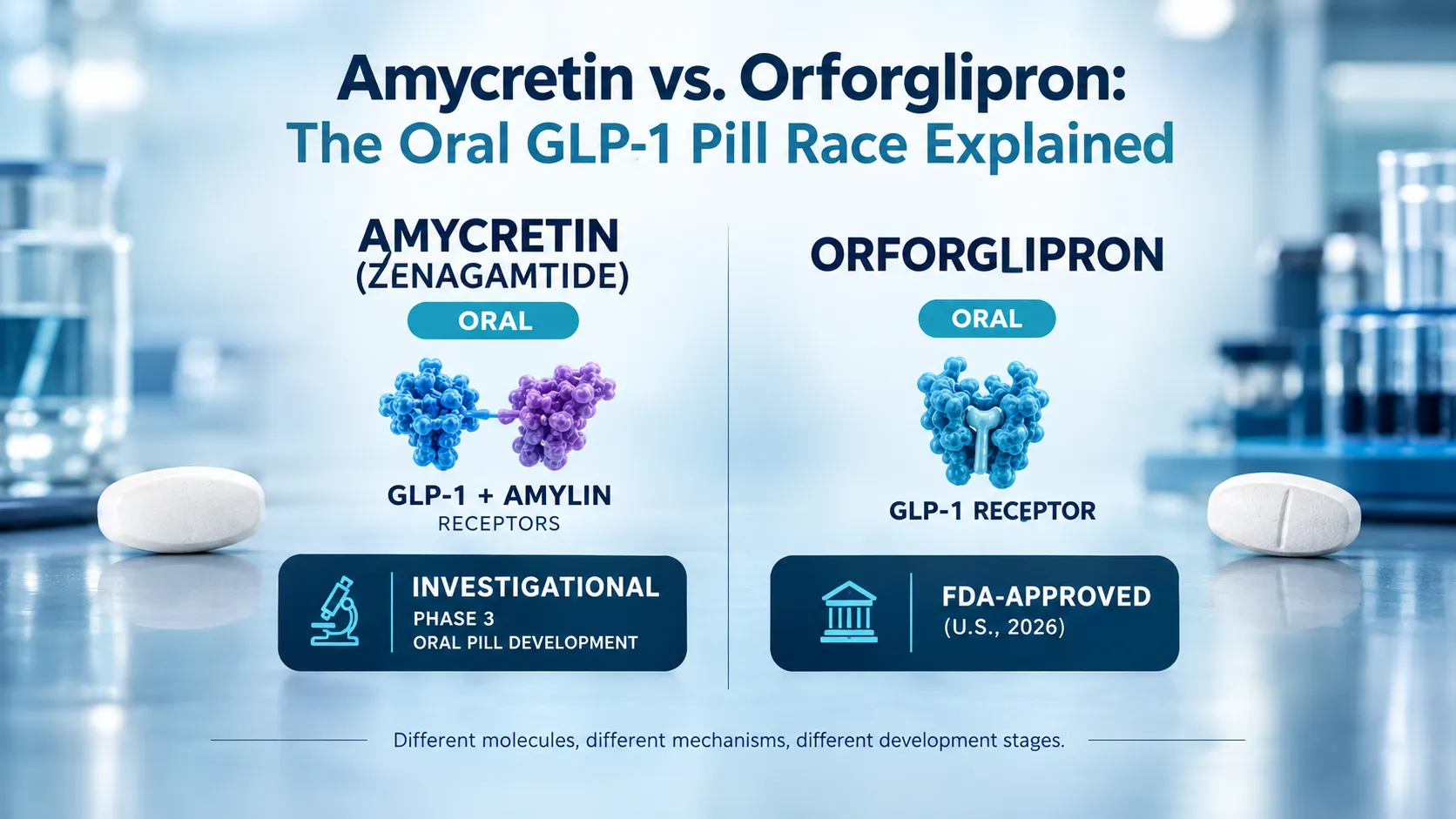
Amycretin is a peptide and orforglipron is not. How that chemistry explains the formulations, trial results, and approval status of both GLP-1 pills.
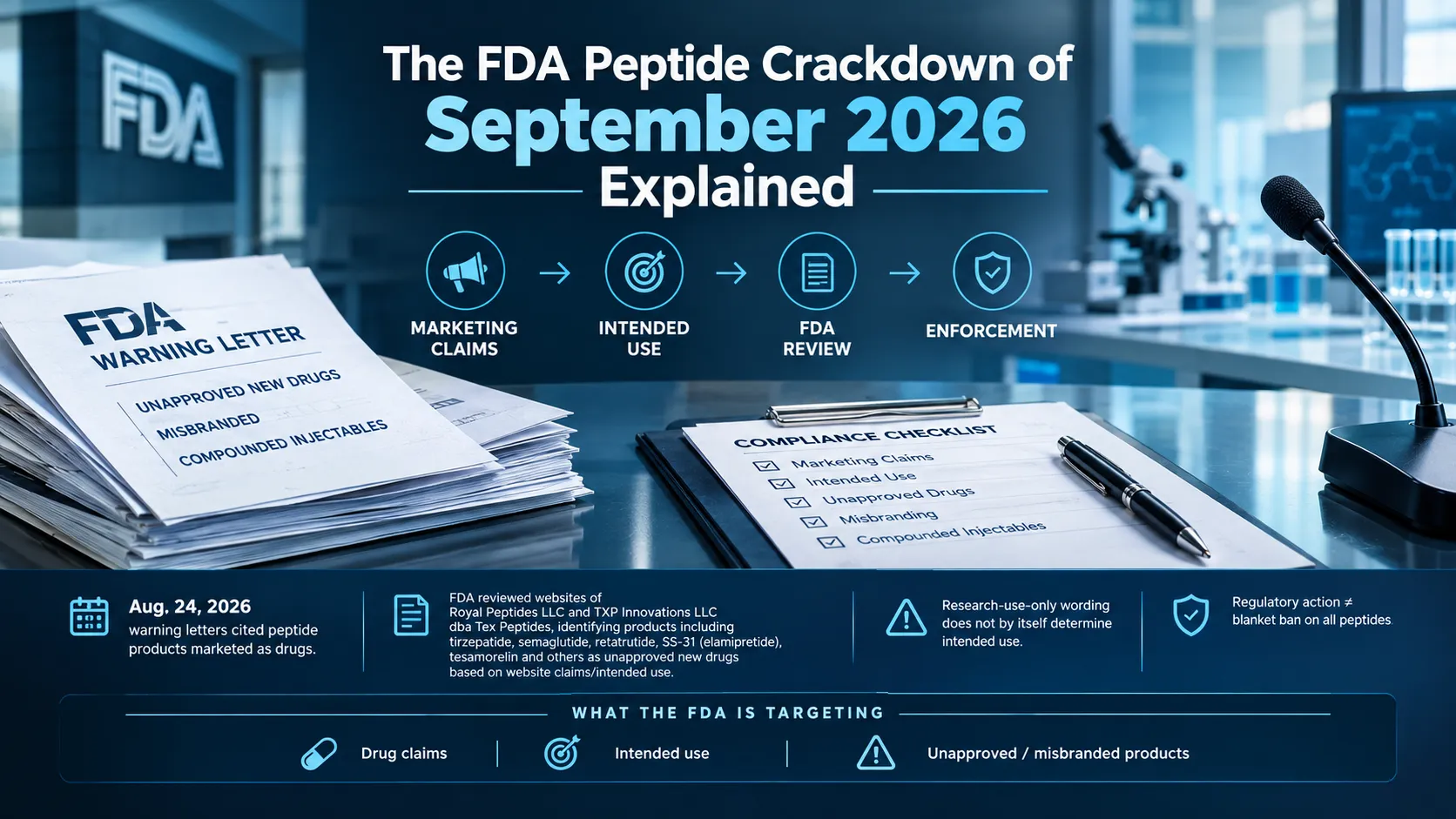
Five peptide sellers got FDA warning letters in September 2026. See who was named, why the research label failed, and the full 2026 enforcement timeline.
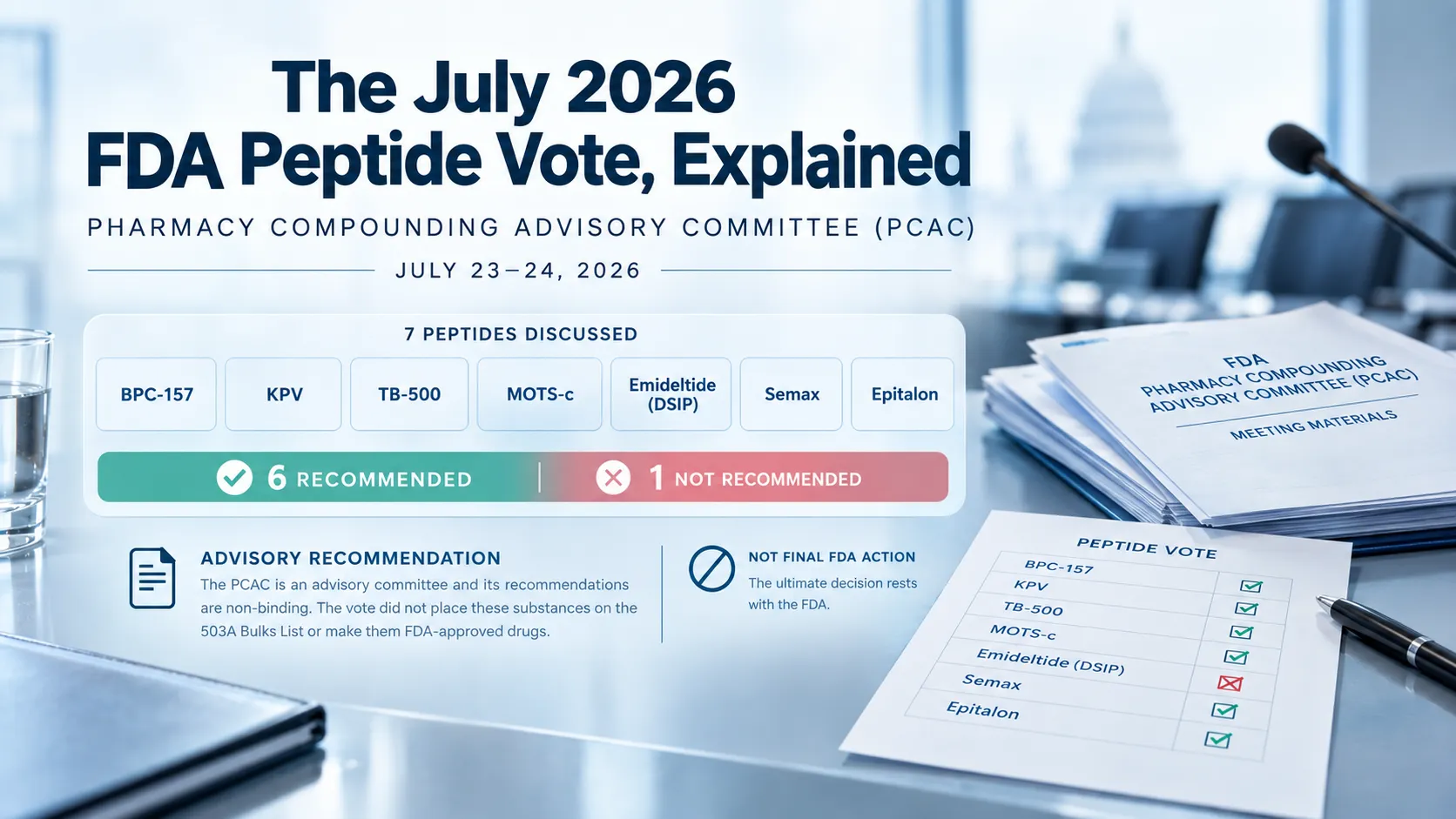
In July 2026, the FDA's advisory committee recommended 6 peptides for the 503A bulk list. None are on it yet. What the vote changed and what it didn't.