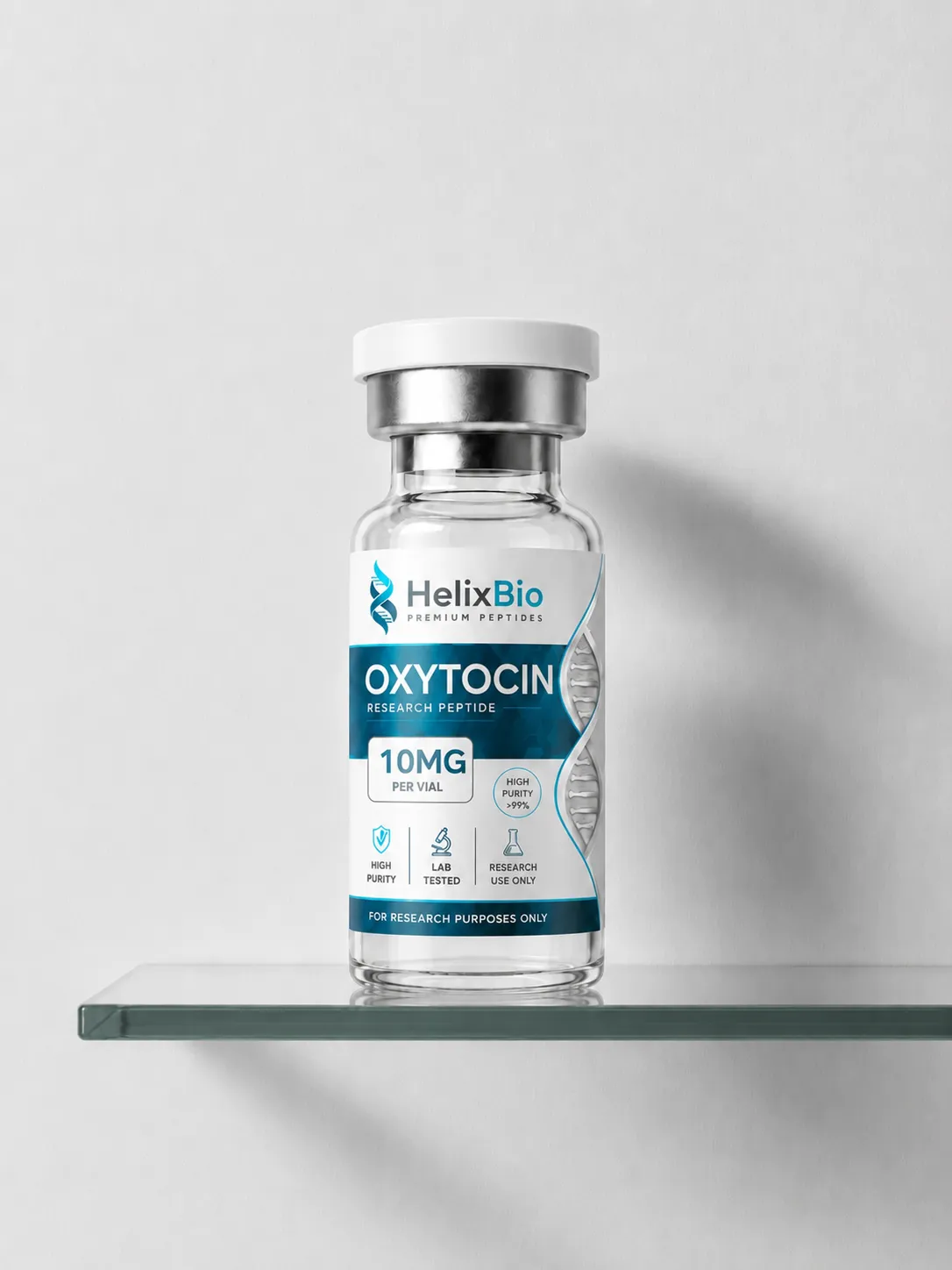
Nine amino acids, closed into a ring by a single disulfide bridge between the cysteines at positions 1 and 6 — that compact architecture is what makes oxytocin recognisable to its receptor and what makes it one of the most thoroughly characterised peptide hormones in biology. Helix Bio supplies oxytocin in vial format as a reference material for laboratory work on OXTR pharmacology, peptide-receptor interaction, and neuroendocrine signalling. This is a research-use-only material. It is not intended for human or veterinary use, ingestion, injection, or any other form of administration, and it is not a pharmaceutical oxytocin product. Confirm identity, purity and lot details against the current Certificate of Analysis before bringing the material into an experimental workflow.
HPLC certified
Independent analysis
Highest standard
Full traceability
Oxytocin is a cyclic nonapeptide produced in the magnocellular neurons of the hypothalamic paraventricular and supraoptic nuclei, then transported to the posterior pituitary for release. It is cleaved from a larger precursor, oxytocin-neurophysin 1, alongside the neurophysin carrier protein that binds it.
Its full sequence is Cys-Tyr-Ile-Gln-Asn-Cys-Pro-Leu-Gly-NH2, written CYIQNCPLG-NH2 in single-letter notation. The first six residues form a closed ring through a Cys1–Cys6 disulfide bond; the remaining three extend as a short tail ending in a glycinamide rather than a free acid. Both the ring closure and the C-terminal amidation are required for full activity at the receptor, so neither is a structural detail that can be treated as optional.
The molecule carries the formula C43H66N12O12S2 and a molecular weight of 1007.19 g/mol, registered under CAS 50-56-6 and catalogued as PubChem CID 439302.
Oxytocin holds a particular place in peptide chemistry: it was the first polypeptide hormone to be chemically synthesised, in 1953, work recognised with the Nobel Prize in Chemistry in 1955. Seven decades of synthesis and analysis since then mean its identity, structure and analytical behaviour are unusually well documented for a peptide of any size.
The active research compound is oxytocin. Physical form, salt form, fill mass, and any excipients or vehicle are properties of the specific lot and are stated on the current product documentation and Certificate of Analysis, 10mg.
Salt form deserves attention on this molecule specifically. Research oxytocin is commonly supplied as a trifluoroacetate or acetate salt, and the counter-ion contributes mass that is not oxytocin. A stated milligram figure therefore means different amounts of peptide depending on whether it refers to the salt or the free base, and on the water content of a hygroscopic lyophilizate. Check which basis the COA reports before calculating a stock concentration.
Nothing about vial packaging implies sterility, a particular physical form, or any route of administration. The vial is a container.
Oxytocin serves as a reference ligand and study compound in laboratory work including:
Oxytocin’s long analytical history makes it useful as a system-suitability and method-development standard as well as a pharmacological tool — a cyclic, disulfide-bridged, amidated peptide just over 1,000 Da is a demanding and informative test article for a chromatographic or mass-spectrometric method.
The material is positioned as a research reference standard, not as a pharmaceutical preparation. Evaluate it on identity, purity, lot documentation and method compatibility.
Analytical and documentation considerations specific to this molecule:
The useful question for a reference peptide is not whether a supplier claims high purity, but whether the documentation lets you verify what you received.
Oxytocin makes that verification unusually tractable. Its molecular weight is exact and published, its sequence is unambiguous, its CAS and PubChem records are stable, and its principal degradation products have known, resolvable analytical signatures. A researcher with a COA and a mass spectrometer can confirm most of what matters.
Helix Bio states that its research materials are supported by batch-specific documentation, with HPLC used to assess purity and mass spectrometry used to support identity confirmation, and that a Certificate of Analysis is available for each batch. Match the lot number on the vial to the lot number on the COA before use.
For this compound specifically, worth confirming on the documentation: the reported mass and whether it corresponds to free base or salt; the chromatographic method and whether it resolves oligosulfide and dimer species; the lot number and test date; and the stated storage condition for the physical form supplied.
Oxytocin in vial format is intended for qualified users conducting legitimate laboratory research, including:
It is not intended for consumers, and it is not intended for anyone seeking a health, wellness, reproductive, behavioural or therapeutic product.
| Specification | Details |
|---|---|
| Product Name | Oxytocin |
| Active Research Compound | Oxytocin |
| Synonyms | OT; OXT; α-hypophamine; oxytocic hormone |
| Compound Class | Cyclic peptide hormone / neuropeptide |
| Peptide Length | 9 amino acids (nonapeptide) |
| Sequence (1-letter) | CYIQNCPLG-NH2 |
| Sequence (3-letter) | Cys-Tyr-Ile-Gln-Asn-Cys-Pro-Leu-Gly-NH2 |
| Structural Features | Cys1–Cys6 disulfide bridge; C-terminal glycinamide |
| Molecular Formula | C43H66N12O12S2 |
| Molecular Weight | 1007.19 g/mol |
| CAS Number | 50-56-6 |
| PubChem CID | 439302 |
| ChEBI | CHEBI:7872 |
| Molecular Target | Oxytocin receptor (OXTR), UniProt P30559 |
| Research Category | Sexual & Hormonal Research Compounds |
| Product Format | Vial 10mg |
| Purity | Refer to the current lot-specific COA |
| Lot Testing | Review batch-specific analytical documentation |
| Manufacturer / Supplier | Helix Bio |
| Intended Use | Laboratory and scientific research only |
| Human Use | Not intended |
| Veterinary Use | Not intended |
Oxytocin receptor pharmacology. OXTR is a 389-residue class A G protein-coupled receptor encoded on human chromosome 3p25.3 and catalogued as UniProt P30559. It is the only oxytocin receptor identified to date, which makes oxytocin an unusually clean agonist for receptor studies — there is no second subtype to deconvolute. Research covers binding affinity, functional response, receptor distribution, desensitisation and internalisation.
Gq/11 signalling. The principal transduction route runs through Gq/11 to phospholipase C, which hydrolyses PIP2 into IP3 and diacylglycerol. IP3 mobilises calcium from intracellular stores while DAG activates protein kinase C. Coupling to Gi/o has also been reported, and how pathway selection varies across tissues remains an open research question rather than a settled account.
Neuroendocrine signalling. Oxytocin is synthesised in hypothalamic magnocellular neurons and released from the posterior pituitary. Research models examine synthesis, axonal transport, release dynamics, and the relationship between central and peripheral pools.
Reproductive and smooth-muscle physiology. OXTR is expressed in myometrium and mammary myoepithelium. Calcium-dependent activation of myosin light-chain kinase links receptor signalling to contraction. This is the best-characterised physiological role and the basis of the approved obstetric indication for pharmaceutical oxytocin — a clinical application, distinct from anything supplied here.
Comparative neuropeptide chemistry. Oxytocin and arginine vasopressin share seven of nine residues and differ only at positions 3 and 8. Studying them side by side isolates how two substitutions produce entirely separate receptor systems, and is a standard approach to peptide structure–activity relationships.
Peptide stability and analytical method development. Oxytocin’s degradation chemistry is well mapped, which makes it a useful and demanding test article. Its characteristic degradants — oligosulfides and covalent dimers — challenge a chromatographic method in ways a simple linear peptide does not.
Behavioural and social neuroscience — read with care. A substantial literature examines oxytocin in social cognition, affiliation and stress. That literature is also actively contested on pharmacokinetic grounds, particularly for intranasal administration, where analyses of cerebrospinal fluid measurements suggest only a very small fraction of an administered dose reaches the central nervous system. Findings in this area should be read against the specific model, species, route and endpoint of each study rather than generalised.
The two molecules are frequently confused, and the distinction is precise enough to be worth stating plainly.
| Oxytocin | Arginine vasopressin | |
|---|---|---|
| Sequence | CYIQNCPLG-NH2 | CYFQNCPRG-NH2 |
| Residue 3 | Isoleucine | Phenylalanine |
| Residue 8 | Leucine | Arginine |
| Molecular formula | C43H66N12O12S2 | C46H65N15O12S2 |
| Molecular weight | 1007.19 | 1084.23 |
| CAS Number | 50-56-6 | 113-79-1 |
| Receptor system | OXTR (single receptor) | V1a, V1b, V2 |
Seven of nine positions are identical. Both are cyclic nonapeptides with a Cys1–Cys6 disulfide and a C-terminal amide, and both originate in the hypothalamic–posterior pituitary system. Two substitutions separate them.
Those substitutions produce a 77 Da mass difference, which is comfortably resolvable by routine mass spectrometry and therefore a practical identity check rather than an academic point. The concern is not theoretical: the FDA-approved oxytocin injection label notes that the hormone is prepared synthetically precisely to avoid contamination with vasopressin, a legacy of the era when both were extracted from pituitary tissue.
Structural similarity does not imply shared receptor activity. Evidence generated at vasopressin receptors does not describe oxytocin receptor behaviour, and the two literatures should not be merged.
High-performance liquid chromatography separates the target peptide from process-related and degradation-related species, and the resulting area-percent figure is the standard purity measure for a synthetic peptide.
For oxytocin there is a method-specific caveat worth knowing. The molecule’s characteristic degradants include trisulfide and tetrasulfide variants and covalently linked dimers, and a chromatographic method that does not resolve those species will report a purity figure that overstates the intact peptide content. When reviewing a COA for this compound, the method is as informative as the number.
Helix Bio states that HPLC testing is used to verify the purity reported for its research materials. Rely on the documentation supplied with the specific lot rather than any catalogue-level figure.
Mass spectrometry supports identity confirmation by measuring molecular mass. For oxytocin the expected value is approximately 1007.19 for the free base.
Two comparisons make the result particularly informative. A mass near 1084 rather than 1007 indicates arginine vasopressin rather than oxytocin — a 77 Da separation that no reasonable instrument would miss. A peak 32 Da above the expected mass corresponds to the trisulfide degradant, a species first characterised during regulatory stability testing of the injectable pharmaceutical product.
Helix Bio states that mass spectrometry is used alongside HPLC to confirm molecular identity and evaluate purity.
A batch-specific Certificate of Analysis connects analytical results to a particular production lot. Confirm that the lot number on the material received matches the lot number on the document.
For oxytocin, the fields worth reading closely:
Follow the storage condition stated on the product documentation and Certificate of Analysis for the specific lot supplied.
Two properties of this molecule are worth understanding regardless of the specific instruction. First, oxytocin’s disulfide bridge is the initiation point for its main degradation routes, and those routes are aqueous: β-elimination of the disulfide leads to oligosulfide formation and covalent dimerisation, while the amide groups at Gln4, Asn5 and the C-terminal glycinamide are subject to deamidation. Published accelerated-stability work places maximum aqueous stability near pH 4.5, with degradation accelerating in both more acidic and more alkaline conditions.
Second, that chemistry is why physical form matters. A dry solid in a sealed vial is not exposed to these solution-phase pathways while it remains dry. Storage guidance written for one physical form does not transfer to another, and guidance written for a pharmaceutical oxytocin preparation does not transfer to a research material at all.
General laboratory practice applies: review the label and COA on receipt, keep the material identified and segregated from anything intended for human or veterinary use, maintain lot traceability, use appropriate PPE and institutional handling procedures, and do not use the material outside its stated research purpose.
Helix Bio describes its research materials as laboratory products shipped with tracked delivery and protective handling. Packaging configuration and shipping conditions vary by product and order — confirm current details before purchasing.
On receipt, verify the product name, lot number, packaging integrity, material condition, COA availability, and stated storage requirement. Isolate and review any damaged, mislabelled or questionable material before use.
Oxytocin supplied by Helix Bio is offered strictly for research and laboratory purposes. It is not intended for human or veterinary use and is not intended for ingestion, injection, nasal administration, or any other form of administration.
This product is not intended to diagnose, treat, cure or prevent any disease or medical condition. It is not a substitute for an approved pharmaceutical product, a prescription medication, medical advice, or professional healthcare.
Oxytocin is the active ingredient in FDA-approved pharmaceutical products indicated for specific obstetric uses. Those products are manufactured, tested, labelled and regulated as medicines. This research material is none of those things, and no approval, indication, specification or safety finding attaching to a pharmaceutical oxytocin product applies to it.
The scientific information on this page is provided for research context and education. Published findings involving oxytocin — including obstetric, physiological and behavioural research — are not evidence that this research material is safe, effective or appropriate for human use.
This product has not been evaluated or approved by the U.S. Food and Drug Administration for any use described on this page. Researchers are responsible for compliance with applicable law, institutional requirements, laboratory safety procedures and research protocols.
Knowledge Base
Knowledge Base
Knowledge Base
Knowledge Base
Knowledge Base
Knowledge Base
Knowledge Base
Knowledge Base
Knowledge Base
Knowledge Base
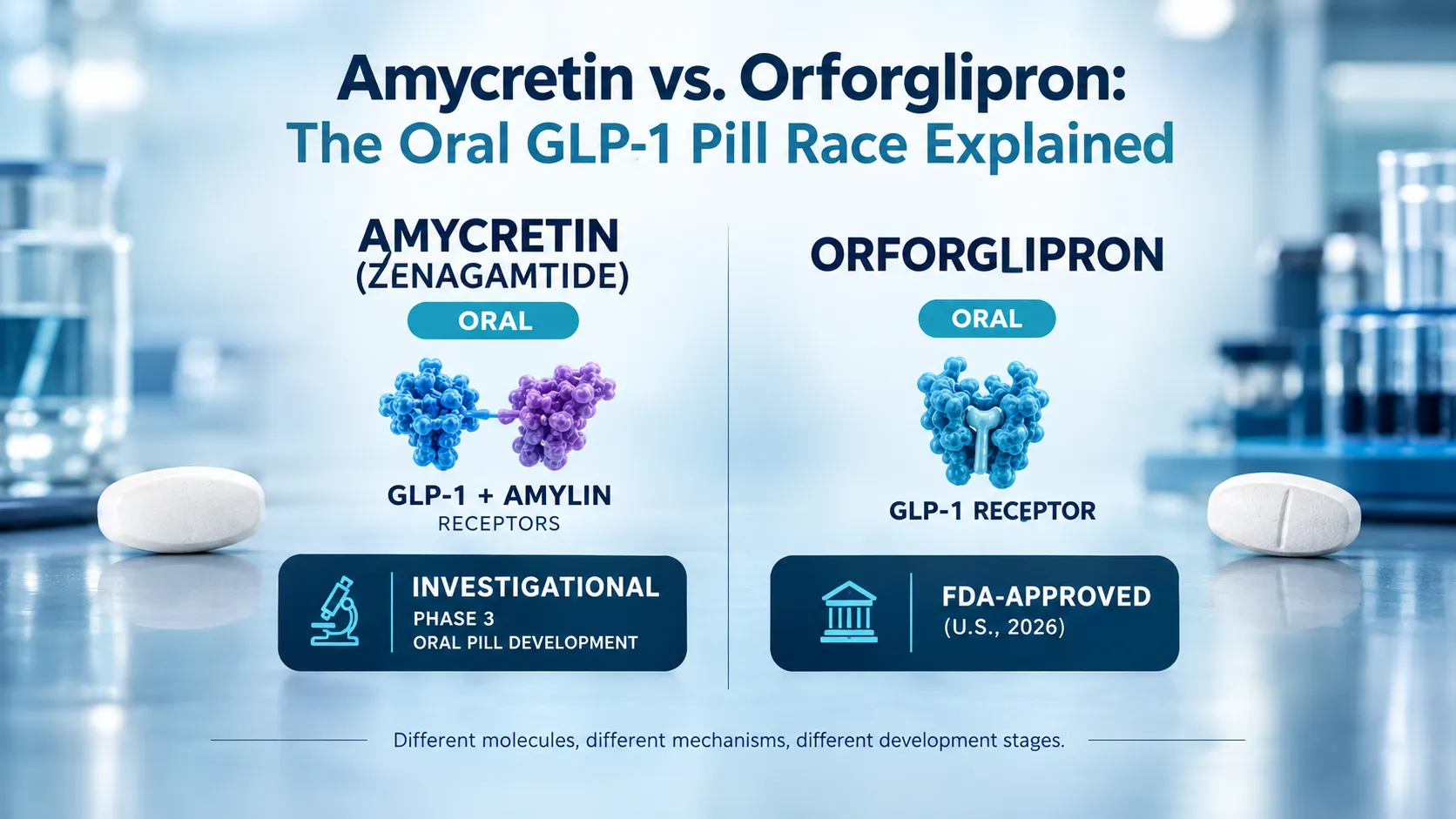
Amycretin is a peptide and orforglipron is not. How that chemistry explains the formulations, trial results, and approval status of both GLP-1 pills.
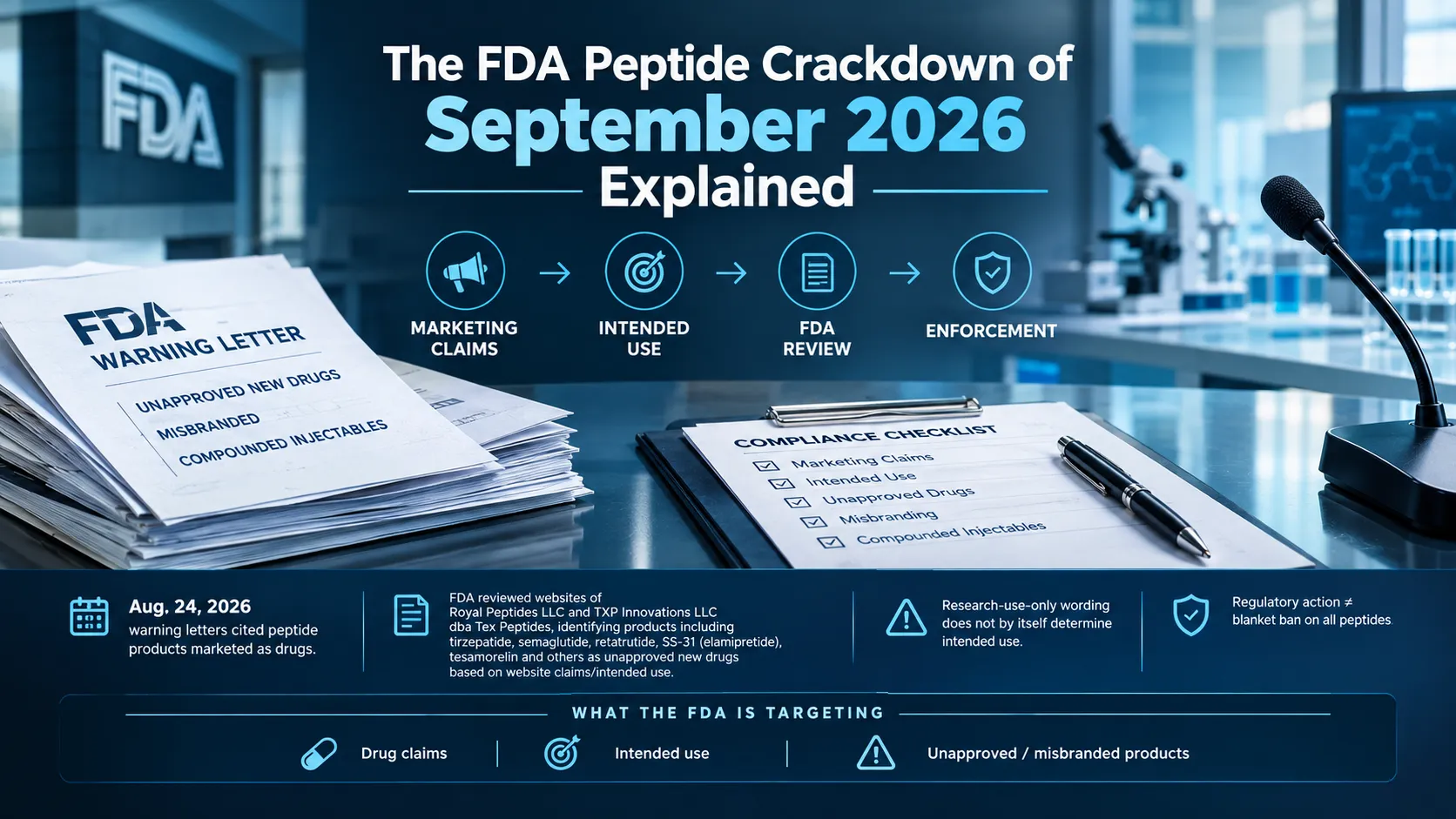
Five peptide sellers got FDA warning letters in September 2026. See who was named, why the research label failed, and the full 2026 enforcement timeline.

In July 2026, the FDA's advisory committee recommended 6 peptides for the 503A bulk list. None are on it yet. What the vote changed and what it didn't.