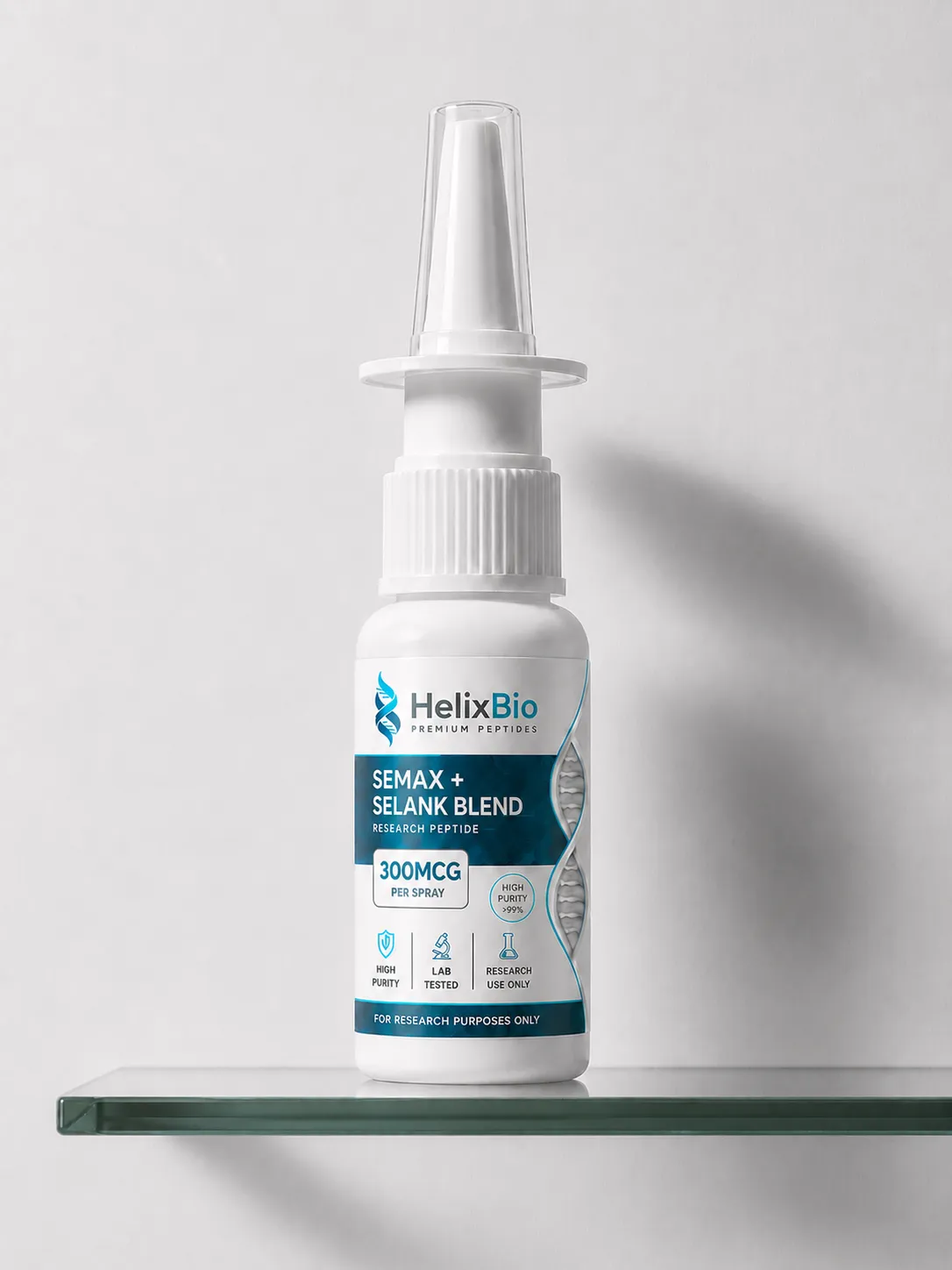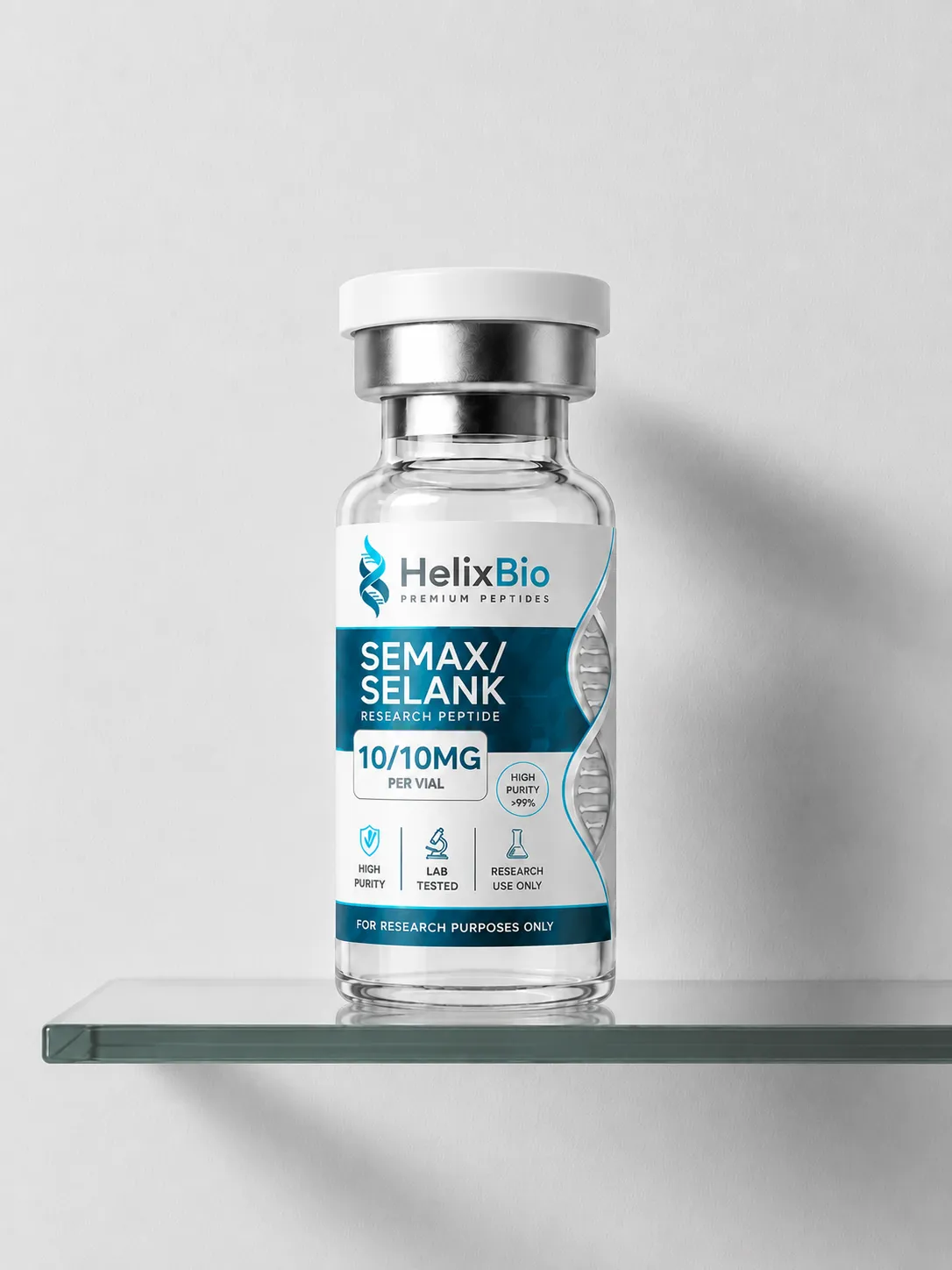
Semax and Selank were built to the same template and are not the same molecule. Each is a synthetic heptapeptide made by taking a short biologically interesting sequence — the ACTH(4-7) fragment in one case, the endogenous tetrapeptide tuftsin in the other — and extending it at the C-terminus with Pro-Gly-Pro. Helix Bio supplies the two together as a single vial-format research material for qualified laboratory work only, not for human or veterinary use. What that material is not is a third compound. This blend contains two separate molecular entities that retain their own sequences, their own molecular weights and their own separate bodies of published research. Nothing in that literature examines the two administered together, and the page below keeps component evidence, combination evidence and Helix product data in three clearly separated layers.
HPLC certified
Independent analysis
Highest standard
Full traceability
Semax is a synthetic heptapeptide with the sequence Met-Glu-His-Phe-Pro-Gly-Pro. Its first four residues correspond to the ACTH(4-7) fragment of adrenocorticotropic hormone; the Pro-Gly-Pro that follows is an addition, and it is what makes Semax a distinct molecule rather than a natural fragment. Published research on Semax has concentrated on neurotrophic signalling, with the best-developed line concerning BDNF and TrkB expression in rodent hippocampus.
Selank is also a synthetic heptapeptide, with the sequence Thr-Lys-Pro-Arg-Pro-Gly-Pro. Its first four residues are tuftsin, an endogenous tetrapeptide, and it too carries an added C-terminal Pro-Gly-Pro. Its research literature runs in different directions: allosteric modulation of GABA receptor signalling, inhibition of enkephalin-degrading enzyme activity, and gene-expression changes in rodent frontal cortex.
The shared Pro-Gly-Pro is not a coincidence, and it is the most interesting structural fact about this particular pairing. Both peptides were designed by the same approach — take a fragment of interest, append a proline-rich terminus associated with the enzymatic stability profile of this peptide class. The result is two molecules that are siblings in construction and near-opposites in composition. Semax carries the pair’s only sulfur atom and both of its aromatic side chains; Selank carries both of its strongly basic residues and no sulfur at all. At neutral pH they sit at opposite ends of the charge scale.
That combination — structurally parallel, chemically divergent — is what defines this product as a research material. It is a defined two-analyte system in which the components can be told apart by several independent handles, which is a different proposition from either single-peptide vial and from a blend whose components happen to be unrelated.
The product contains two peptide components, each a distinct molecular entity:
| Component | Sequence | Molecular formula | Molecular weight (free base) | CAS | PubChem CID |
|---|---|---|---|---|---|
| Semax | Met-Glu-His-Phe-Pro-Gly-Pro | C₃₇H₅₁N₉O₁₀S | 813.92 | 80714-61-0 | 122178 |
| Selank | Thr-Lys-Pro-Arg-Pro-Gly-Pro | C₃₃H₅₇N₁₁O₉ | 751.88 | 129954-34-3 | 11765600 |
The two components differ by 62.04 g/mol on a free-base basis. Both are seven-residue peptides.
Component ratio, per-component content, total peptide content, salt form and the basis of any stated mass are lot-specific and must be read from the current product documentation and Certificate of Analysis. Peptide mass can be quoted on a free-base basis, a salt basis or a net-peptide basis, and the three are not interchangeable. Where a blend is prepared from separately manufactured components, each component may carry its own counter-ion load.
This material is supplied for laboratory and scientific research only. Research contexts in which a defined two-peptide system of this kind is relevant include:
Experimental interpretation should account for the properties of each component separately. The presence of two peptides in one vial does not create a single pharmacological entity, and results obtained with this material are not interchangeable with results obtained using either component alone.
A blend is a convenience for a workflow and a complication for an analysis, and it is worth being clear about both.
The convenience is that a defined two-component material removes a preparation step and fixes the proportion, which supports reproducibility across a run. The complication is that the analytical questions change. A single area-normalised purity percentage, which is what a single-peptide certificate reports, is not a defined quantity on a two-analyte chromatogram — each component sits in the other’s denominator. Useful documentation for a material like this reports per-component chromatographic purity together with a quantitative determination of content and ratio.
There is a further wrinkle particular to this pair. Because Semax and Selank share the same C-terminal Pro-Gly-Pro, C-terminal degradation of either component can liberate the same fragment. A Pro-Gly-Pro peak on a blend chromatogram cannot be assigned to one component or the other without additional work — which is not true on either single-peptide chromatogram. Researchers evaluating a blend of these two peptides should know that before they interpret an impurity profile, not afterwards.
Helix Bio’s stated quality approach uses reversed-phase HPLC for chromatographic purity and LC-MS for identity and molecular-weight confirmation, with batch-specific analytical documentation. For this product, the documentation to ask for is the two-component version of that: confirmation of both molecular masses, per-component purity, and the determined ratio.
Qualified users conducting legitimate laboratory or scientific research, including academic research laboratories, biotechnology laboratories, analytical and method-development laboratories, molecular biology and biochemistry laboratories, neurobiology research programmes, pharmaceutical research environments, and educational research institutions.
It is not intended for consumers, for self-experimentation, or for any diagnostic, preventive or therapeutic purpose.
| Field | Detail |
|---|---|
| Product Name | Semax + Selank Blend |
| Product Type | Two-component synthetic peptide blend |
| Category | Cognitive & Nootropic / Research Peptide |
| Component 1 | Semax |
| Semax Sequence | Met-Glu-His-Phe-Pro-Gly-Pro |
| Semax Molecular Formula | C₃₇H₅₁N₉O₁₀S |
| Semax Molecular Weight | 813.92 g/mol (free base basis) |
| Semax CAS | 80714-61-0 |
| Semax PubChem CID | 122178 |
| Component 2 | Selank |
| Selank Sequence | Thr-Lys-Pro-Arg-Pro-Gly-Pro |
| Selank Molecular Formula | C₃₃H₅₇N₁₁O₉ |
| Selank Molecular Weight | 751.88 g/mol (free base basis) |
| Selank CAS | 129954-34-3 |
| Selank PubChem CID | 11765600 |
| Component Ratio | Confirm against current lot documentation |
| Component Amounts | Confirm against current lot documentation |
| Total Peptide Content | Confirm against current lot documentation |
| Mass Basis | Confirm against current lot documentation (free base / salt / net peptide) |
| Salt Form | Confirm against current lot documentation |
| Format | Vial |
| Physical Form | Confirm against current product documentation |
| Purity | Per-component; confirm against current lot COA |
| Identity Testing | Confirm both component masses against current lot documentation |
| Storage | Follow product label and current lot documentation |
| Packaging | Confirm current product specifications |
| Lot Testing | Review applicable batch-specific COA |
| Manufacturer / Supplier | Helix Bio |
| Country of Origin | Confirm with supplier documentation |
| Intended Use | Laboratory and scientific research only |
| Human Use | Not intended for human use |
| Veterinary Use | Not intended for veterinary use |
Product specifications vary by formulation and lot. The applicable Certificate of Analysis and product documentation take precedence over general catalogue information.
Component research — Semax. Published work has examined Semax in relation to neurotrophic signalling, with reported changes in BDNF protein and BDNF/TrkB expression in rodent hippocampus, and transcriptomic work in ischaemic rat cortex reporting broad changes in immune-response gene clusters. Reference sources describe the mechanism as not established; interaction with melanocortin receptors and inhibition of enkephalin-degrading enzymes are both raised as candidates rather than settled. Full component-level coverage sits on the standalone Semax product page.
Component research — Selank. Published work has examined allosteric modulation of GABA receptor signalling, concentration-dependent inhibition of enkephalin hydrolysis, BDNF expression in hippocampus and prefrontal cortex, and gene-expression changes in rodent frontal cortex. Results are not uniform across models — a cell-culture study in IMR-32 neuroblastoma cells found no direct change in the GABAergic gene mRNA levels examined. Full component-level coverage sits on the standalone Selank product page.
Combination research. No published study administering Semax and Selank together has been identified. This is worth stating carefully, because one frequently cited paper is easy to misread. Panikratova and colleagues (2020) examined resting-state functional connectivity in 52 healthy participants using a three-arm design — Semax, or Selank, or placebo. The two peptides were studied alongside each other in separate arms, not in combination. It is a comparison study, and it does not establish anything about a mixture of the two.
Nothing on this page should be read as indicating that combining these peptides produces synergistic, additive or otherwise combined effects. Evidence for either component individually does not transfer to the blend.
Analytical and method-development research. The blend is a defined two-analyte system with an unusually tight component separation. The 62.04 g/mol gap between Semax and Selank is small by blend standards — for comparison, the components of a tesamorelin-and-ipamorelin preparation sit roughly 4,424 Da apart — while remaining comfortably resolvable at unit mass resolution. Independent confirmatory handles exist in both directions: Semax contributes the pair’s only sulfur atom, at the N-terminal methionine, and Selank contributes its only guanidine group, at arginine.
Degradation and stability research. The two components do not degrade alike. Semax’s N-terminal methionine oxidises to the sulfoxide, a +16 g/mol change readily seen by mass spectrometry; Selank carries no comparable oxidation-labile residue. A two-component preparation of these peptides therefore has a degradation profile weighted toward one of its two components, which is directly relevant to how stability data for the material should be interpreted.
Comparative peptide chemistry. Two heptapeptides of the same length, built by the same design strategy from different parents, with divergent side-chain composition and opposite net charge at neutral pH, constitute a well-matched pair for structure-behaviour work — retention behaviour, ion-exchange behaviour, enzymatic susceptibility, and the influence of a shared C-terminal motif on two otherwise dissimilar sequences.
Quality control for a two-component peptide preparation asks different questions than for a single peptide, and the difference is substantive rather than procedural.
Purity. A single area-normalised HPLC purity percentage is not a defined quantity for this product. On a chromatogram containing two intended analytes, each component contributes to the other’s total peak area. Useful documentation reports per-component chromatographic purity, together with a quantitative determination of content and the component ratio — three figures rather than one.
Identity. Both molecular masses should be confirmed, not one. The expected free-base masses are 813.92 for Semax and 751.88 for Selank, 62.04 apart. Where chromatographic co-elution or peak assignment is in question, the elemental asymmetry between the components provides independent confirmation in either direction.
Impurity assignment. Because both components terminate in Pro-Gly-Pro, C-terminal degradation of either can produce the same fragment. A Pro-Gly-Pro peak in a blend chromatogram is not attributable to a single component without further work. This is specific to this pairing and does not arise on either single-peptide chromatogram.
Mass basis. Peptide mass may be reported on a free-base, salt or net-peptide basis. Semax is commercially supplied as a trifluoroacetate or acetate salt; Selank as an acetate or diacetate. Where a blend is prepared from separately manufactured components, counter-ion content is the sum of two independent salt loads, and a single figure on a label does not resolve how much of the vial contents is peptide.
Naming. Regulatory records note that “Semax” is a common name rather than a United States Adopted Name, and that multiple salts and derivatives — including different active moieties — have been encountered commercially under that same common name. Confirming the exact moiety and salt form for each component against lot documentation is a substantive identity check, not a formality.
Researchers evaluating a specific lot should review: batch or lot number; per-component HPLC purity; mass-spectrometry confirmation of both component masses; determined component ratio and content; stated mass basis; salt form for each component; testing date; storage requirements; and correspondence between the vial label and the certificate.
Storage requirements follow the product label and the lot-specific documentation supplied with the material. Storage conditions appropriate to one peptide are not automatically appropriate to a two-component preparation of two chemically dissimilar peptides, and conditions documented for standalone Semax or standalone Selank should not be assumed to apply to this material.
General laboratory handling considerations:
Reconstitution, where applicable, is a laboratory preparation procedure governed by the experimental protocol, the product documentation and institutional standard operating procedures. Solvent, concentration and subsequent storage are determined by qualified laboratory personnel. No preparation ratio on this page should be read as an instruction, and none is given.
Helix Bio describes documented handling and shipping practices for research materials, including cold-chain handling and tracked shipping. Shipping availability, packaging configuration, transit conditions and applicable restrictions vary. Review the current Helix Bio shipping information and product documentation before ordering.
Semax + Selank Blend is supplied strictly for research and laboratory purposes. It is not intended for human or veterinary use, ingestion, injection, inhalation or any other form of administration, and it is not intended to diagnose, treat, cure, mitigate or prevent any disease or medical condition.
This product has not been evaluated or approved by the U.S. Food and Drug Administration for human or veterinary use. Helix Bio is not a compounding pharmacy and does not operate as a compounding facility as defined under Section 503A of the Federal Food, Drug and Cosmetic Act.
The two components of this product do not currently occupy the same position in the U.S. regulatory record, and neither position applies to research-use-only material. Both selank acetate (TP-7) and semax were placed in Category 2 of FDA’s interim 503A bulk drug substances list in September 2023. Selank acetate was removed from Category 2 effective 27 September 2024 following withdrawal of its nomination by the nominator, and has not been the subject of a live nomination since. Semax was removed from Category 2 on 15 April 2026 as one of twelve peptides referred for further evaluation, and was reviewed at the Pharmacy Compounding Advisory Committee meeting of 23–24 July 2026, where the Committee recommended inclusion of both semax free base and semax acetate on the 503A Bulks List. That recommendation is advisory and non-binding; FDA’s own briefing document recommended against inclusion, and the agency has not issued a final determination.
The 503A framework governs which bulk substances a compounding pharmacy may use to compound a prescription drug product. It has no application to research-use-only materials and authorises nothing for consumer purchase or human administration.
Findings from animal, cellular or human research discussed on this page are provided for scientific and educational context and are not evidence of equivalent effects for this research material. No published study administering Semax and Selank in combination has been identified, and evidence for either component individually does not establish anything about the blend. Researchers and institutions are responsible for compliance with applicable federal, state, local, institutional, biosafety and laboratory requirements, and for reviewing current lot-specific documentation before use.
Knowledge Base
Knowledge Base
Knowledge Base
Knowledge Base
Knowledge Base
Knowledge Base
Knowledge Base
Knowledge Base
Knowledge Base
Knowledge Base
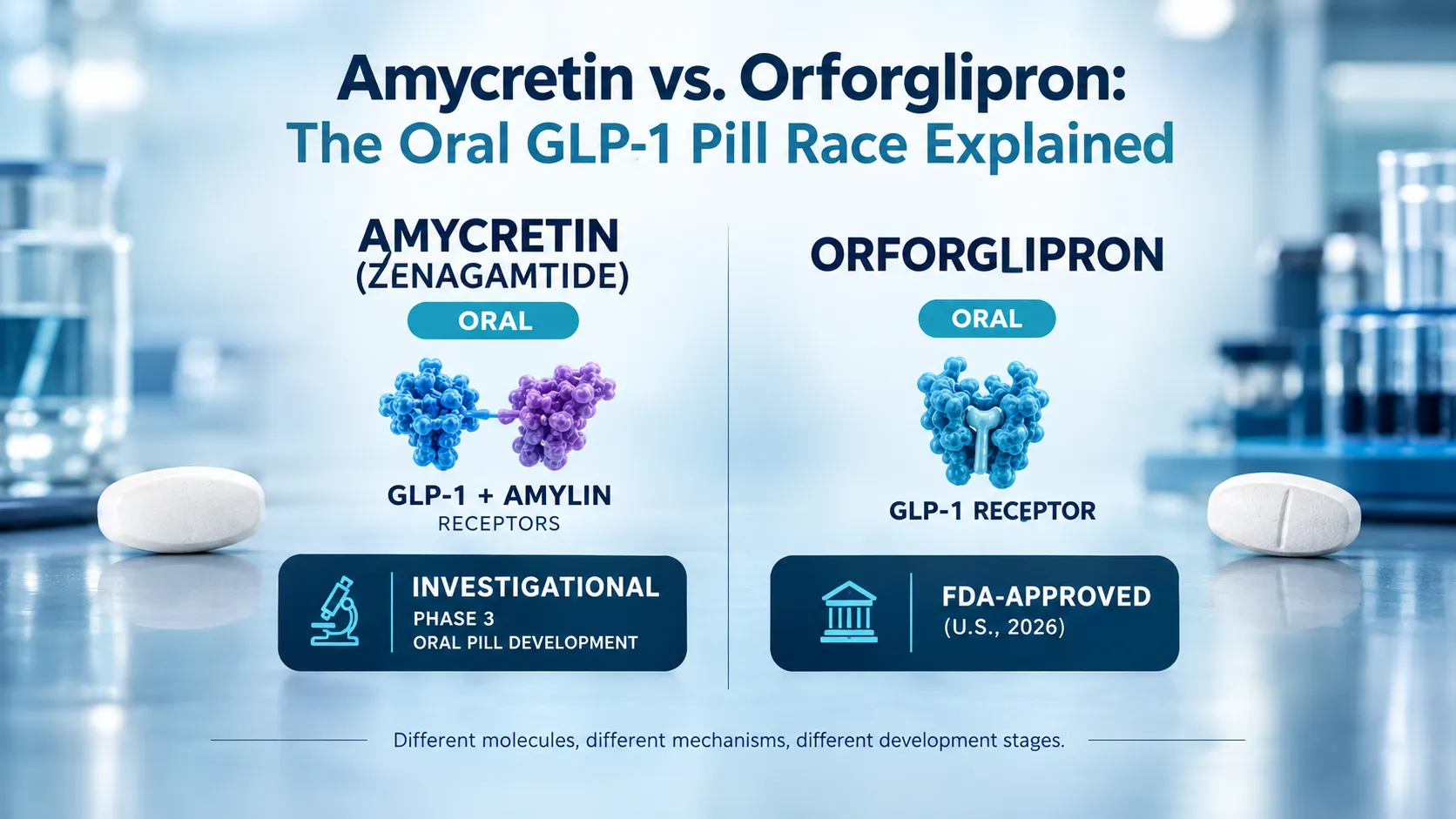
Amycretin is a peptide and orforglipron is not. How that chemistry explains the formulations, trial results, and approval status of both GLP-1 pills.
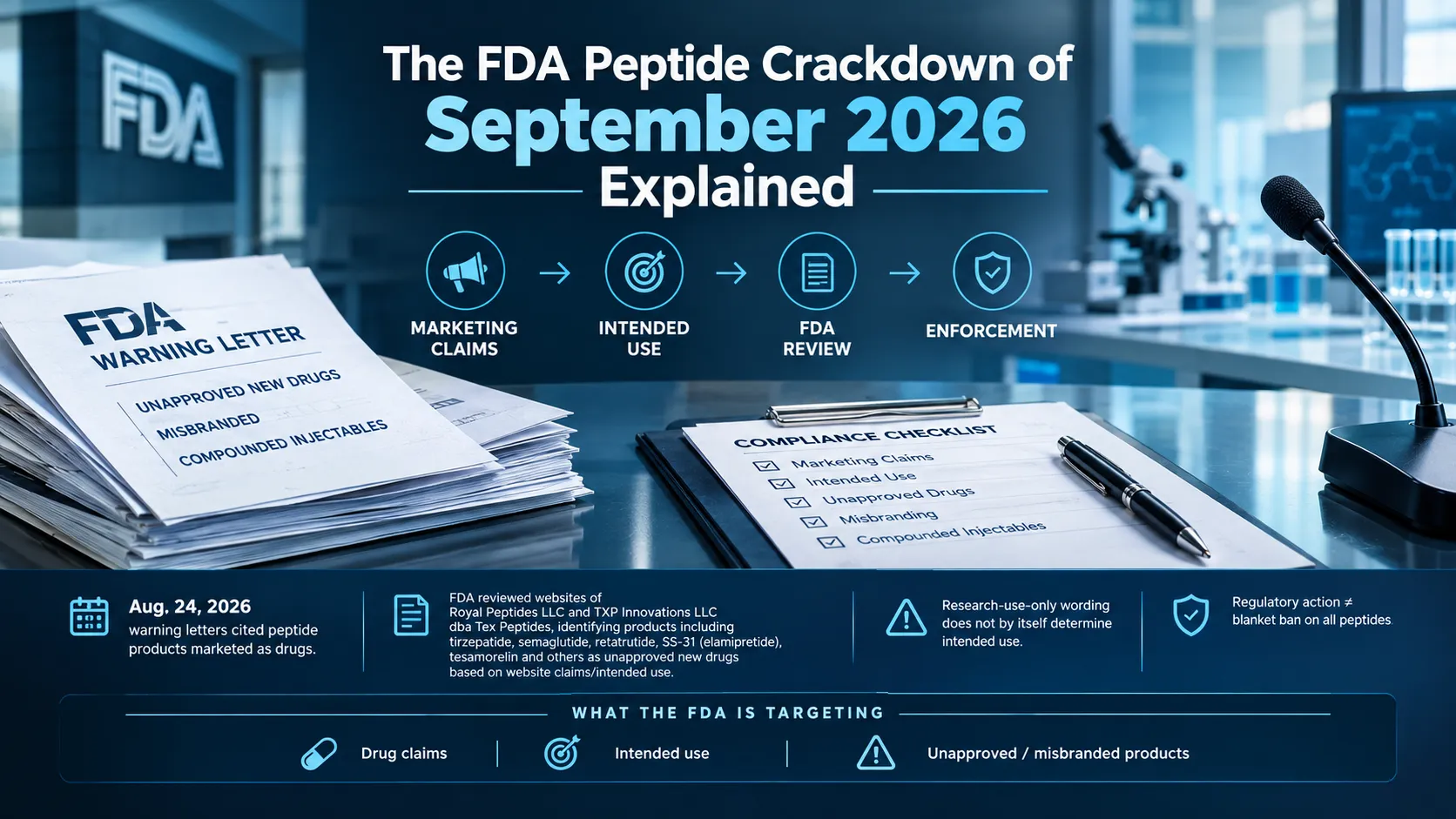
Five peptide sellers got FDA warning letters in September 2026. See who was named, why the research label failed, and the full 2026 enforcement timeline.
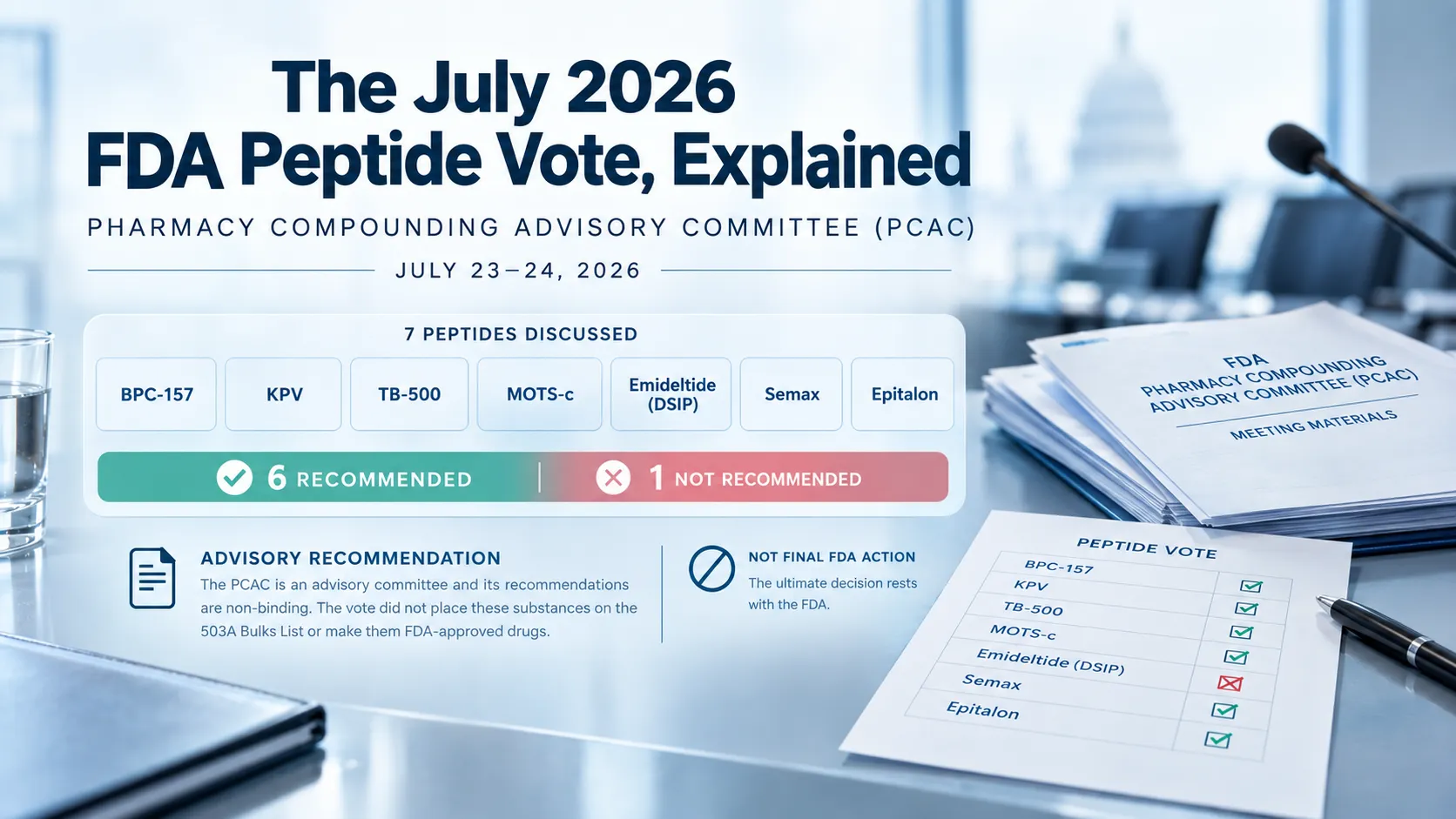
In July 2026, the FDA's advisory committee recommended 6 peptides for the 503A bulk list. None are on it yet. What the vote changed and what it didn't.