Research on Semax spans cell-culture and rodent experiments, historical Russian clinical studies, and analytical/regulatory questions relevant to anyone sourcing it as a research material. These evidence types answer different questions: a transcriptional change in rat cortex, a plasma biomarker change in a small human study, and a formal FDA regulatory action are three separate kinds of information. This article keeps those distinct and summarizes Semax's current U.S. regulatory standing.
What Is Semax?
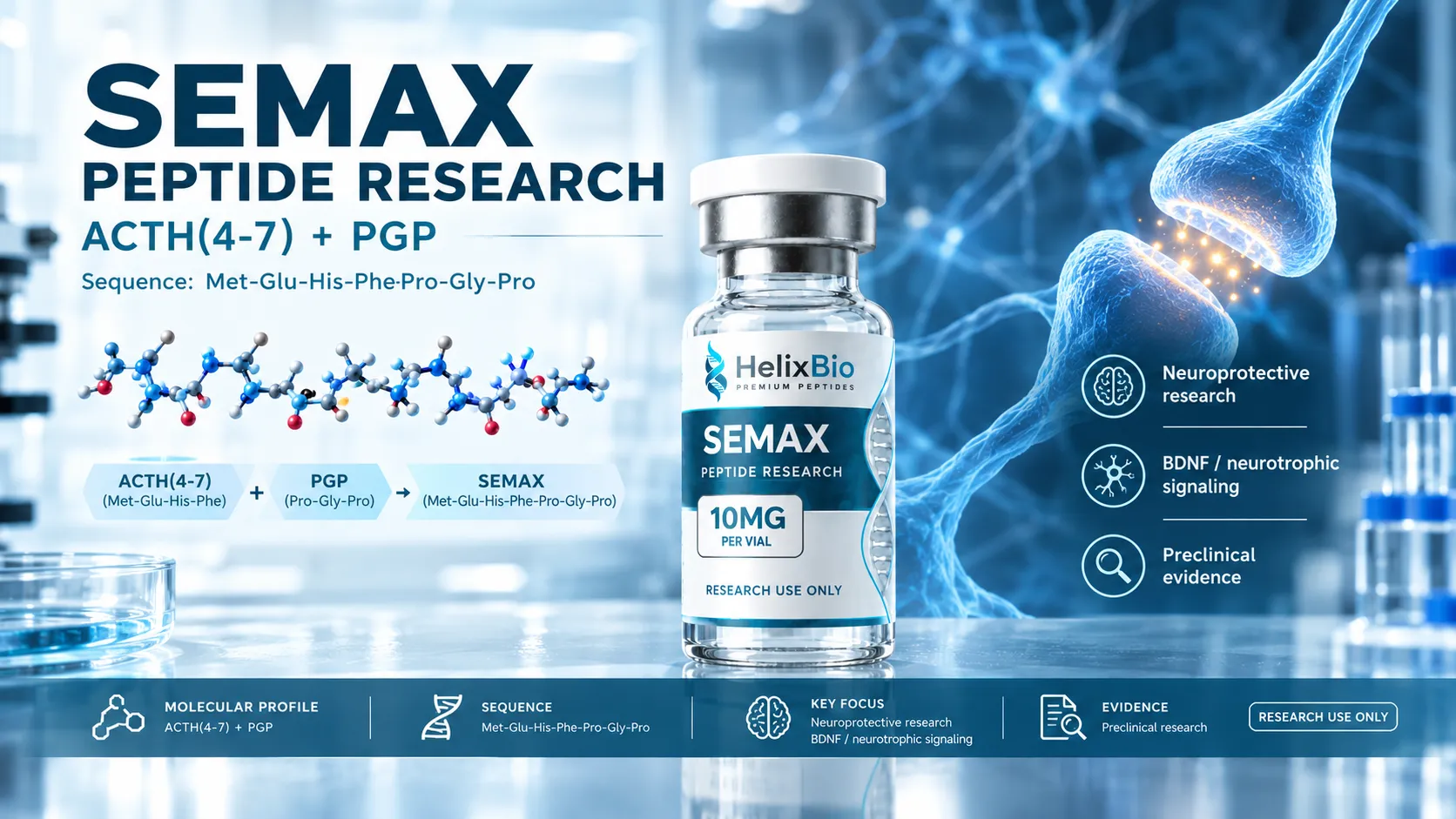
Semax's complete sequence is Met-Glu-His-Phe-Pro-Gly-Pro (MEHFPGP): molecular formula C37H51N9O10S, molecular weight 813.93 g/mol (CAS 80714-61-0 free base; PubChem CID 9811102), a single sulfur atom from its N-terminal methionine, free N- and C-termini, no disulfide bridges.
The molecule is best understood as two segments:
- Met-Glu-His-Phe — the ACTH-derived N-terminal segment, corresponding to ACTH(4-7).
- Pro-Gly-Pro — a C-terminal sequence that has been described in the literature in relation to the molecule's metabolic stability, added by the Soviet-era research group (led by academicians Nikolai Myasoedov and Igor Ashmarin at the Institute of Molecular Genetics of the Russian Academy of Sciences) that first developed the compound.
Semax should be treated as this complete seven-residue entity, not as a shorthand for either component alone. Free-base Semax and Semax acetate are also distinct chemical forms; a mass figure that does not specify which form is being reported is scientifically incomplete, since the acetate counter-ion adds mass that free base does not carry.
Why Both ACTH(4-7) and ACTH(4-10) Appear in the Literature
Semax's first four residues are genuinely identical to ACTH(4-7). Some sources instead describe the complete seven-residue molecule as an ACTH(4-10) analogue, because those seven residues sit in the position ACTH(4-10) occupies on the parent hormone — with Pro-Gly-Pro substituted for the native residues that would otherwise appear there. One formal synonym reflects this directly: (Pro8,Gly9,Pro10)-ACTH-(4-10) — a positional relationship and a substitution, not an identity claim. Neither label means Semax is unmodified ACTH(4-10), and neither means Semax retains all of native ACTH's biological activity. The sequence itself remains the most precise reference point.
Semax Evidence Map
Neuroprotective Mechanisms: What Has Actually Been Studied
The mechanistic case for Semax rests almost entirely on rodent and cell-culture research — associations and effects reported in those specific systems, not a confirmed receptor-level mechanism of action in humans.
BDNF and NGF Signaling
The foundational finding here comes from Shadrina and colleagues (Neurosci Lett. 2001;308(2):115-8), who reported that Semax applied to primary glial cell cultures from newborn rat basal forebrain produced a rapid increase in both BDNF and NGF mRNA. This is a cell-culture, gene-expression finding — it demonstrates that Semax can alter neurotrophin transcription in isolated glial cells, not that it produces a clinical neuroprotective effect in a human brain.
Later work extended this to intact rats dosed intranasally, reporting increased BDNF protein in rat basal forebrain, and separately described a time-dependent, region-specific pattern of Bdnf and Ngf expression change after a single dose — not a simple, uniform increase. These remain gene- and protein-level animal findings; they do not establish a human clinical outcome, and should not be read as proof that neurotrophin elevation is the operative mechanism behind any reported human effect.
Ischemia and Stroke-Related Mechanisms
A separate body of work examines Semax in rodent cerebral ischemia models, typically permanent or transient middle cerebral artery occlusion. Dmitrieva and colleagues (Cell Mol Neurobiol. 2010;30(1):71-79; PMID 19633950) reported that Semax activated transcription of Bdnf, TrkC, and TrkA at 3 hours post-occlusion and Nt-3 and Ngf later, and that this effect was more selective to the ischemic cortex than the effect of Pro-Gly-Pro alone. A related genome-wide analysis (Medvedeva et al., BMC Genomics. 2014;15:228) reported that Semax predominantly affected immune- and vascular-related gene expression in ischemic rat cortex.
These are experimental, mechanistic animal findings. They describe measured gene-expression changes in rat brain tissue after Semax exposure — not that Semax produces measurable functional neuroprotection in a human stroke patient, which is a separate question addressed by the human research below.
Inflammatory Signaling
The Medvedeva 2014 study is again the primary anchor: it reported that Semax influenced immune-cell-activity genes as early as 3 hours post-occlusion, more pronounced by 24 hours, alongside vascular-related gene changes. This describes a measured change in an experimental rodent model — it does not establish a clinically validated anti-inflammatory mechanism confirmed at the protein, functional, or human level.
Monoaminergic Findings
A smaller set of rodent neurochemical studies has examined Semax's effects on dopamine- and serotonin-related markers, alongside older Russian pharmacology work describing some shared properties with alpha-MSH, including reported effects on striatal monoamine transmission. This evidence is preclinical, rodent-specific, and comparatively sparse — a proposed mechanism, not a confirmed human neurochemical effect.
Human Research
Human data on Semax is limited in volume and concentrated almost entirely in Russian clinical literature. The two most cited studies are summarized below; their design and reporting differ substantially from the characteristics normally expected of contemporary pivotal trials in U.S. drug development, and should be read with that difference in mind rather than as settled, generalizable evidence.
The sources reviewed for this article did not identify large, internationally registered randomized trials that independently reproduced these findings — a comprehensive systematic review was outside this article's scope, so that observation should not be overstated in either direction.
Human vs. Preclinical Evidence
Human evidence. Two non-randomized Russian studies (1997, n=30 vs. 80 controls; 2018, n=110) reporting associations between Semax and faster neurological recovery measures, higher plasma BDNF, and improved functional scores after ischemic stroke.
Preclinical evidence. Increased BDNF/NGF mRNA and protein in rat glial cultures and brain tissue; altered neurotrophin and Trk-receptor transcription in rodent ischemia models; changes in immune- and vascular-related gene expression after experimental stroke; scattered rodent dopamine/serotonin findings.
Mechanistic inference. Based on the gene-expression data above, without being a confirmed receptor-level mechanism: that Semax's ACTH-derived N-terminus and its neurotrophin-transcription effects are connected, and that Pro-Gly-Pro helps the molecule persist long enough for that signaling to occur.
Still unestablished. That animal neurotrophin changes translate directly into human neuroprotection; that Semax has one validated mechanism of action; that the 1997 or 2018 findings would replicate in a blinded, placebo-controlled international trial; or that this evidence supports use outside the acute-stroke and rehabilitation contexts actually studied.
Several broader conclusions aren't supported by this literature either: a change in BDNF or NGF isn't itself proof of functional neuroprotection; a plasma biomarker change isn't a direct measurement of brain tissue activity; historical Russian studies don't establish current FDA approval; ischemic-stroke evidence doesn't extend to unrelated conditions; and documented medical use abroad isn't equivalent to FDA approval domestically.
Semax and Pro-Gly-Pro
Because Pro-Gly-Pro is the piece of Semax not derived from ACTH, one study is worth isolating. Fadyukova and colleagues (Bull Exp Biol Med. 2005), in a paper titled "C-terminal Pro-Gly-Pro tripeptide in contrast to full-length neuropeptide semax exhibits no neuroprotective effect in experimental cerebral ischemia," reported that isolated Pro-Gly-Pro did not reproduce the neuroprotective outcome seen with full-length Semax in the rat ischemia model tested.
This sits alongside the transcription work described above, which found that Pro-Gly-Pro alone does activate some neurotrophin and Trk-receptor transcription — just less selectively than full-length Semax. The two findings use different endpoints (a neuroprotective outcome versus transcriptional activation) and shouldn't be flattened into one conclusion. Together they support a narrow point: isolated Pro-Gly-Pro doesn't reproduce the specific neuroprotective effect reported for full-length Semax in that model — the basis for treating Semax as a defined seven-residue entity rather than reducing it to "PGP," not a claim that Pro-Gly-Pro lacks biological activity of its own.
Analytical Identity and Certificate of Analysis (COA)
A certificate of analysis for a research peptide should answer several distinct questions, not one.
Identity — does the material correspond to the intended molecular entity? Mass spectrometry (ESI-MS or MALDI-TOF) can support this by comparing observed mass against Semax's theoretical 813.93 g/mol for the free-base formula.
Purity — what proportion of chromatographically detectable material corresponds to the principal component under the stated method? This is what reversed-phase HPLC typically reports as a percentage of peak area. Purity alone doesn't confirm identity; a clean chromatographic peak can appear for the wrong molecule if identity hasn't been separately verified.
Content or assay — how much material is actually present, distinct from what proportion of it is pure.
Chemical form — free base versus acetate. Results comparing molecular mass should specify which form is being reported, since free-base and acetate are not directly interchangeable on a mass basis.
Traceability — can a result be tied to a specific lot, test date, method, and analytical record.
One HPLC percentage doesn't, by itself, establish complete molecular identity. RP-HPLC provides purity information; LC-MS can add mass confirmation; and where identity questions are closer — distinguishing closely related peptides, for example — additional analytical evidence may provide further structural or identity confirmation. This article does not assert a specific acceptance specification any product listing must meet; that's a product-page and documentation matter, separate from this research reference.
Current U.S. Regulatory Status
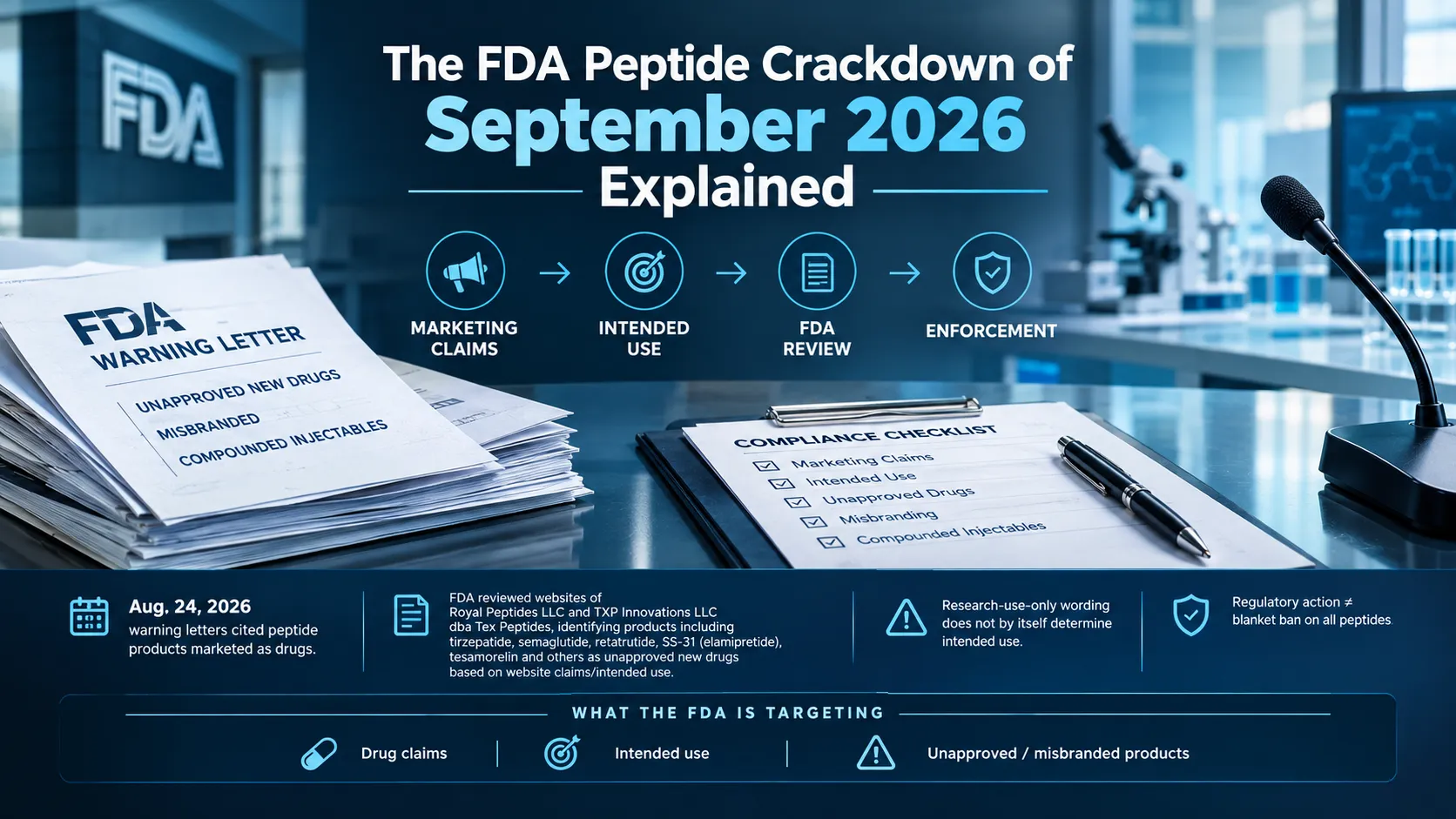
As of this article's publication check, Semax free base and Semax acetate are not components of an FDA-approved drug, and FDA materials state there is no applicable USP or National Formulary drug-substance monograph for either form. Under Section 503A of the FD&C Act, a compounding pharmacy may use a bulk drug substance only if it meets a USP/NF monograph, is a component of an FDA-approved drug, or appears on FDA's 503A Bulks List — for Semax, neither of the first two applies, which is why its status runs through the third pathway.
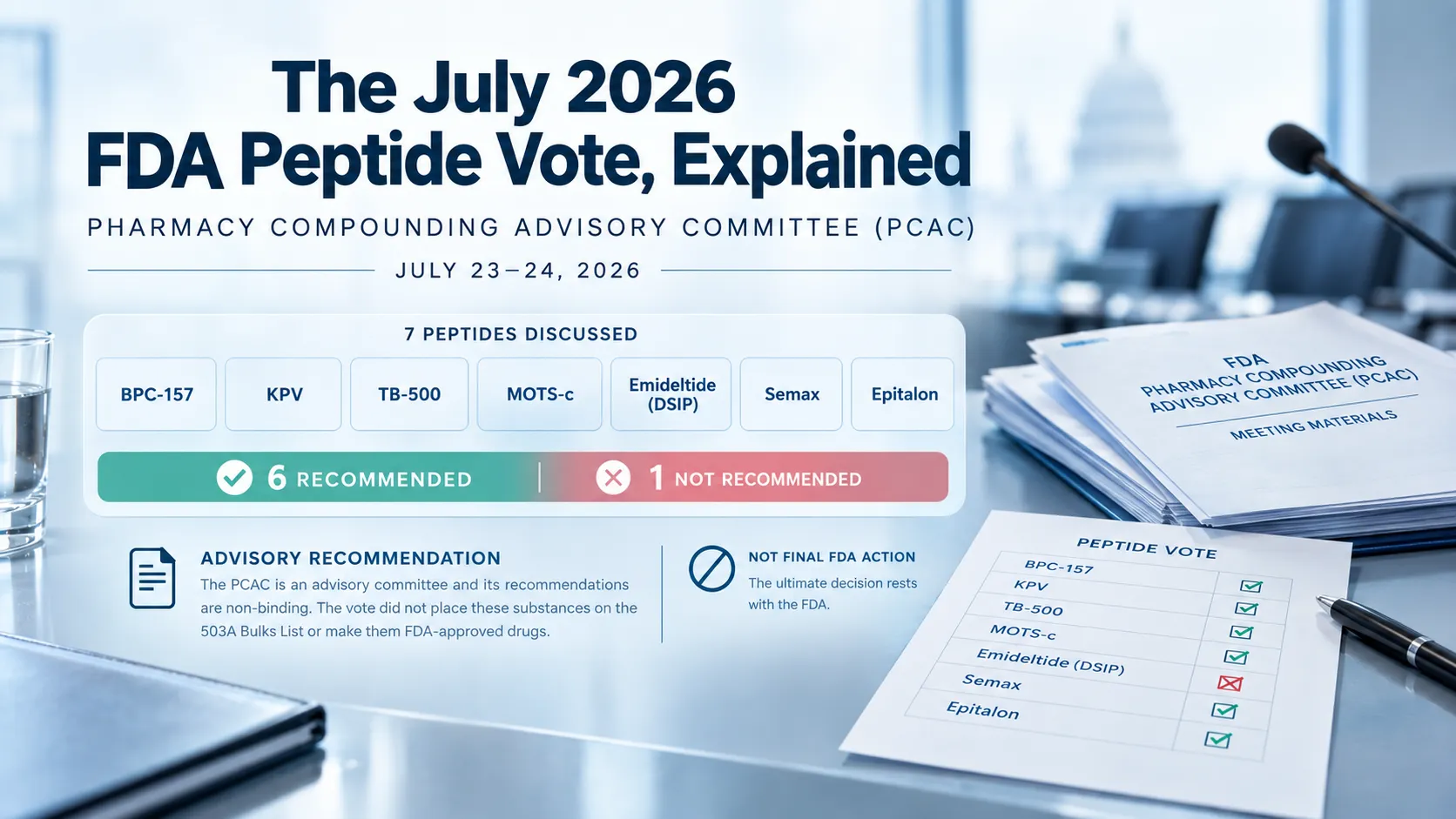
FDA evaluated Semax-related bulk drug substances (free base and acetate) for possible 503A Bulks List inclusion and presented that evaluation to its Pharmacy Compounding Advisory Committee (PCAC) on July 24, 2026, alongside Epitalon and Emideltide; BPC-157, KPV, TB-500, and MOTS-c were discussed the prior day in the same two-day meeting. FDA's own briefing materials didn't recommend including the Semax substances. The committee nonetheless voted, in a narrow, non-binding recommendation, to recommend six of the seven nominated substances — including Semax — for the list; Emideltide was the one voted against.
This needs to be read precisely: a PCAC recommendation is advisory only. It is not final FDA action, doesn't place a substance on the 503A Bulks List by itself, and doesn't mean compounding pharmacies are currently authorized to compound with Semax. As of the sources checked for this article, no later, final FDA action on the July 2026 recommendations had been identified — verify current status against fda.gov directly, since agency action can move.
A few distinctions are worth holding separately: "not an FDA-approved drug" doesn't by itself mean illegal in every context; "evaluated for the 503A Bulks List" isn't the same as "approved"; and documented medical use of Semax in Russia doesn't change its U.S. regulatory status. Legal status more broadly can depend on jurisdiction, product form, intended use, and distribution pathway — this article doesn't resolve that for every reader's situation. Helix Bio's own research-use-only positioning is a separate, company-level business policy, distinct from both FDA's status for Semax and jurisdiction-specific legal questions.
Semax and Selank
For disambiguation only, not a ranking — see the dedicated Semax vs. Selank comparison.
The two shouldn't be treated as interchangeable simply because both are synthetic heptapeptides sharing a C-terminal Pro-Gly-Pro sequence.