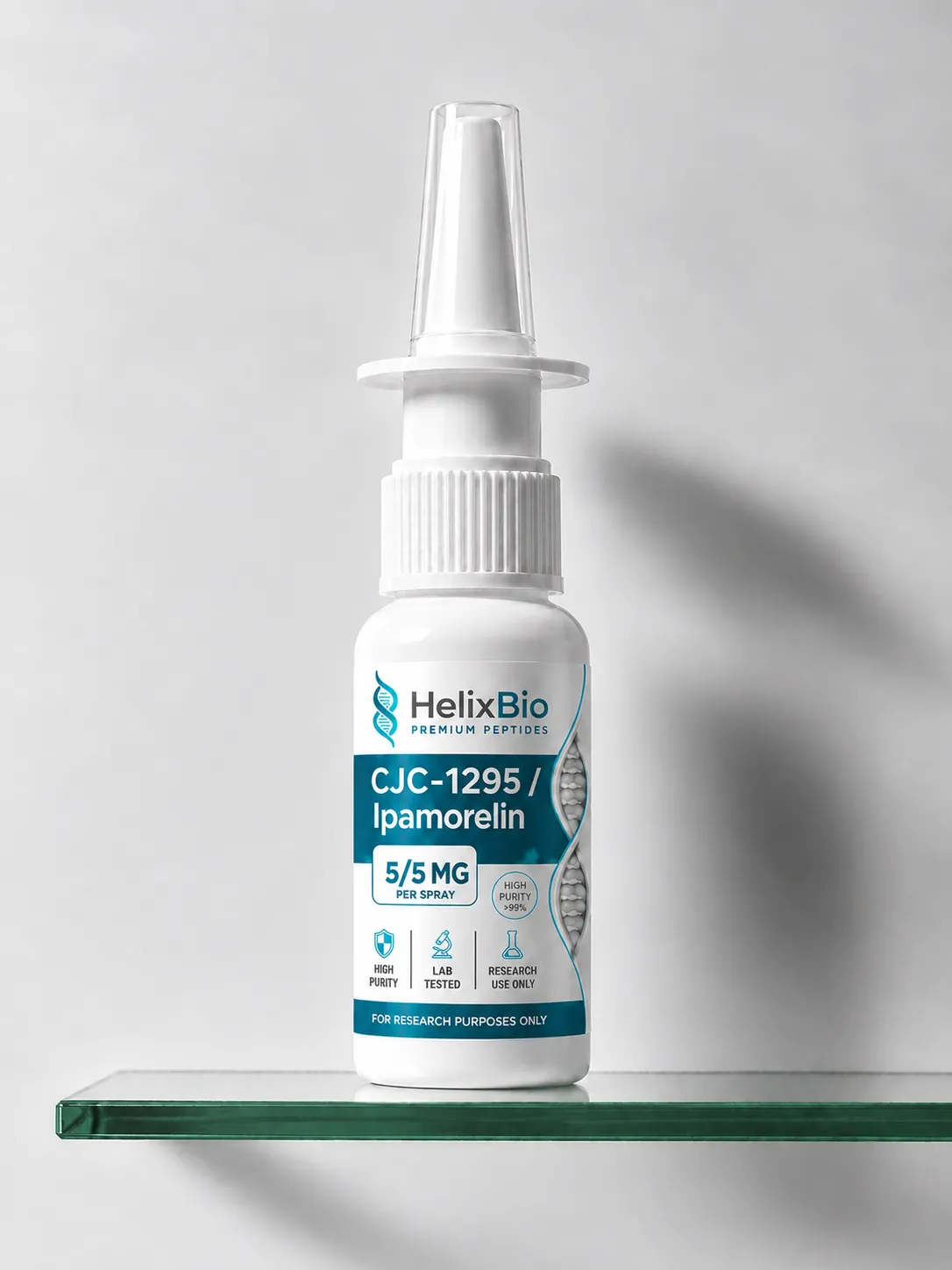
CJC-1295 / Ipamorelin Spray is a research-use peptide blend formulation combining two distinct synthetic peptides: CJC-1295, a growth hormone-releasing hormone (GHRH) analogue, and Ipamorelin, a selective ghrelin-receptor (GHSR-1a) agonist. Each component is associated with published research into a separate branch of growth-hormone-axis signaling, and both are supplied together in this Spray formulation for laboratory investigation. Helix Bio supplies research materials for qualified laboratory and scientific applications. CJC-1295 / Ipamorelin Spray is offered strictly for research use and is not intended for human or veterinary consumption, diagnosis, treatment, or prevention of disease.
HPLC certified
Independent analysis
Highest standard
Full traceability
CJC-1295 is a synthetic peptide analogue of growth hormone-releasing hormone (GHRH). Scientific and vendor literature commonly cross-references the shorter, non-albumin-conjugated form as Modified GRF (1-29). A distinct, longer-acting form — CJC-1295 With DAC — carries an additional chemical group that covalently binds circulating albumin; the two forms are not pharmacokinetically interchangeable. Which exact form is present in this blend has not been confirmed against current Helix product documentation (see Product Specifications).
Ipamorelin is a synthetic pentapeptide (Aib-His-D-2-Nal-D-Phe-Lys-NH2) first characterized by Raun and colleagues in 1998 as a selective agonist of the growth-hormone-secretagogue receptor, GHSR-1a. Published research describes it as producing growth hormone release with comparatively limited effect on other pituitary hormones relative to earlier growth-hormone-releasing peptides (GHRPs).
This product combines CJC-1295 and Ipamorelin as two separate molecular entities in a single Spray formulation, rather than as one compound. CJC-1295 engages the GHRH receptor on anterior pituitary somatotrophs; Ipamorelin engages the separate ghrelin/GHSR-1a receptor system. Both pathways are associated with growth hormone release in the published literature, but through distinct receptors and distinct upstream signaling.
No published study of this exact combination was identified in this review. Evidence describing GHRH-analogue-plus-secretagogue combination effects in the literature generally involves GHRH paired with other secretagogues, not CJC-1295 specifically paired with Ipamorelin. This page does not claim synergy, additive effect, or enhanced potency for the combination — component-level mechanisms are described individually, and no claim is made that the blend has been shown to outperform either peptide alone.
A spray format can be relevant when researchers are studying peptide formulation science, delivery-format comparison, or analytical reproducibility across a multi-component preparation in controlled experimental models. "Spray" describes this product's physical presentation; it does not by itself establish an administration route, and no route-specific claim is made for this product.
For laboratory work, researchers should distinguish between the scientific literature surrounding each individual component and the specifications of this particular commercial blend material — and should confirm which exact CJC-1295 form is present before applying form-specific literature to this product. Experimental results depend on factors such as peptide identity, purity, formulation, experimental model, analytical method, and study design.
The existence of published research on either component individually does not establish that this combined product is safe or effective for use in humans. Neither CJC-1295 nor Ipamorelin is an FDA-approved drug in the United States.
A two-component blend raises an identity question a single-compound product doesn't: researchers need confirmation of which exact form of each peptide is present, not just a generic assurance of quality. This matters more for CJC-1295 in particular, given how inconsistently the name is used across the market to describe two molecularly distinct forms.
Helix Bio states that its research peptide catalog uses independent HPLC testing for purity assessment and mass spectrometry for molecular identity confirmation. The company also states that batch-specific Certificates of Analysis are available for its products.
For CJC-1295 / Ipamorelin Spray, researchers should verify the applicable product documentation and current lot information — including which CJC-1295 form is present — rather than relying solely on a general product description.
CJC-1295 / Ipamorelin Spray is intended for qualified users working in legitimate laboratory or scientific research environments, including:
The product is not intended for personal experimentation, self-administration, human consumption, veterinary use, or medical treatment.
| Specification | Details |
|---|---|
| Product Name | CJC-1295 / Ipamorelin Spray |
| Research Category | Growth Hormone Axis / Research Peptide Blend |
| Product Components | CJC-1295 (form not confirmed — see below) and Ipamorelin |
| Component 1 — Compound | CJC-1295 |
| Component 1 — Form | Not confirmed against current product documentation — No DAC vs. With DAC unresolved |
| Component 1 — Sequence | Refer to confirmed form once established |
| Component 2 — Compound | Ipamorelin |
| Component 2 — Sequence | Aib-His-D-2-Nal-D-Phe-Lys-NH2 |
| Blend Ratio | Not documented — no ratio published or inferred |
| Format | Spray formulation |
| Intended Use | Research and laboratory investigation only |
| Human Use | Not intended for human consumption |
| Veterinary Use | Not intended for veterinary use |
| Purity | Refer to current lot-specific COA — see Purity & Quality Standards for the two-analyte testing note |
| Identity Testing | Refer to applicable Certificate of Analysis |
| Packaging | Refer to current product listing |
| Storage | Follow current product-specific documentation |
| Manufacturer | Helix Bio |
| Country of Origin | Not specified; verify current product documentation |
CJC-1295 identifiers for reference once form is confirmed: No DAC — C152H252N44O42, ≈3,367.9 g/mol, PubChem CID 91976842; With DAC — ≈3,647.2 g/mol, PubChem CID 56841945. Ipamorelin identifiers: C38H49N9O5, ≈711.9 g/mol, PubChem CID 9831659, CAS 170851-70-4.
CJC-1295 and Ipamorelin each have a documented individual research history; the combination itself has a much narrower evidence base.
Research on the GHRH(1-29) analogue class, including CJC-1295, has examined GHRHR binding on anterior pituitary somatotrophs and downstream pulsatile growth hormone release. Much of the specific pharmacodynamic literature published under the "CJC-1295" name describes the DAC-conjugated form; evidence for the shorter form is comparatively limited.
Research on Ipamorelin, beginning with Raun et al. (1998), has examined GHSR-1a-mediated growth hormone release and its comparative selectivity against other pituitary hormones relative to earlier GHRP-class secretagogues.
No directly-cited study of the CJC-1295/Ipamorelin combination specifically was located in this review. Combination-effect literature involving a GHRH analogue and a growth-hormone secretagogue more commonly involves CJC-1295 or GHRH paired with GHRP-6 or GHRP-2 rather than with Ipamorelin. This distinction should be maintained by anyone citing combination literature for this product.
Multi-component peptide preparations, including two-analyte Spray blends, are relevant to research examining formulation stability, co-formulation behavior between peptides of substantially different molecular weight, and analytical method development for mixed-peptide samples.
Analytical quality is important when working with research peptides, and a two-component blend adds a step most single-compound pages don't need: a single area-normalized purity figure on a two-analyte chromatogram doesn't, by itself, tell a researcher the purity of each component individually or confirm the relative amount of each. Per-component identity and purity, not just a blended total, is what actually verifies this product.
Helix Bio states that its peptide materials are subjected to independent HPLC testing for purity and mass spectrometry for molecular identity. It also states that batch-specific Certificates of Analysis are available for its products.
For a specific CJC-1295 / Ipamorelin Spray lot, researchers should consult the applicable COA and product documentation for the actual analytical results, including whether purity and identity are reported per-component. A general catalog statement should not be treated as a substitute for lot-specific documentation.
Researchers should assess, where applicable:
No certification, regulatory approval, or quality claim should be inferred unless it is explicitly documented by the manufacturer or relevant regulatory authority.
Storage and handling requirements should be determined from the current CJC-1295 / Ipamorelin Spray product documentation and lot-specific instructions.
Storage guidance should not be inferred from protocols for CJC-1295 alone, Ipamorelin alone, another blend, or a non-Spray preparation of either component, because formulation, conjugation chemistry (if the DAC form is present), and packaging can all affect stability.
Helix Bio's website describes research materials as being supplied to laboratories and institutions in the United States and describes tracked shipping and cold-chain handling within its fulfillment process.
Because shipping conditions, packaging specifications, availability, and delivery requirements may change, researchers should review the current Helix Bio shipping information and product listing before ordering.
Product packaging should remain appropriately labeled and handled as research material after delivery. Researchers are responsible for following applicable institutional, federal, state, and local requirements governing research materials.
CJC-1295 / Ipamorelin Spray is sold by Helix Bio for research and laboratory purposes only. It is not intended for human or veterinary consumption, self-administration, diagnosis, treatment, cure, mitigation, or prevention of any disease or medical condition.
"Spray" describes this product's physical format and does not by itself establish an administration route. Helix Bio does not represent this product as intended for nasal, intranasal, mucosal, oral, sublingual, or any other specific route of use.
Neither CJC-1295 nor Ipamorelin is an FDA-approved drug in the United States. FDA approval status should not be inferred from published research, product availability, or laboratory use. This page does not claim that combining the two components produces a synergistic, additive, or enhanced effect beyond what is individually documented for each.
This product is not a dietary supplement, consumer wellness product, or medical treatment. Researchers are responsible for determining whether a material is appropriate for their intended experimental application and for complying with applicable institutional and regulatory requirements.
Knowledge Base
Knowledge Base
Knowledge Base
Knowledge Base
Knowledge Base
Knowledge Base
Knowledge Base
Knowledge Base
Knowledge Base
Knowledge Base
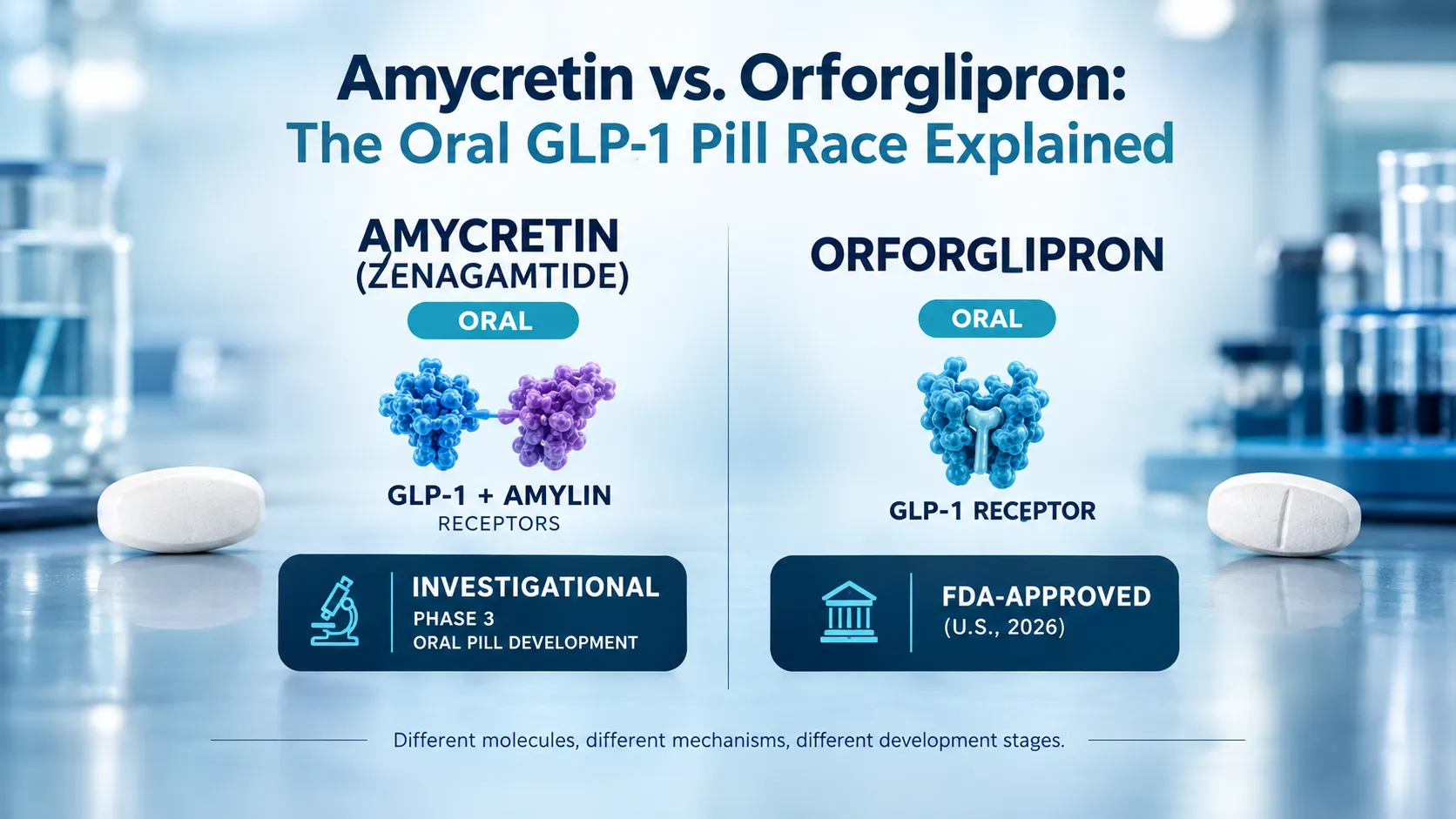
Amycretin is a peptide and orforglipron is not. How that chemistry explains the formulations, trial results, and approval status of both GLP-1 pills.
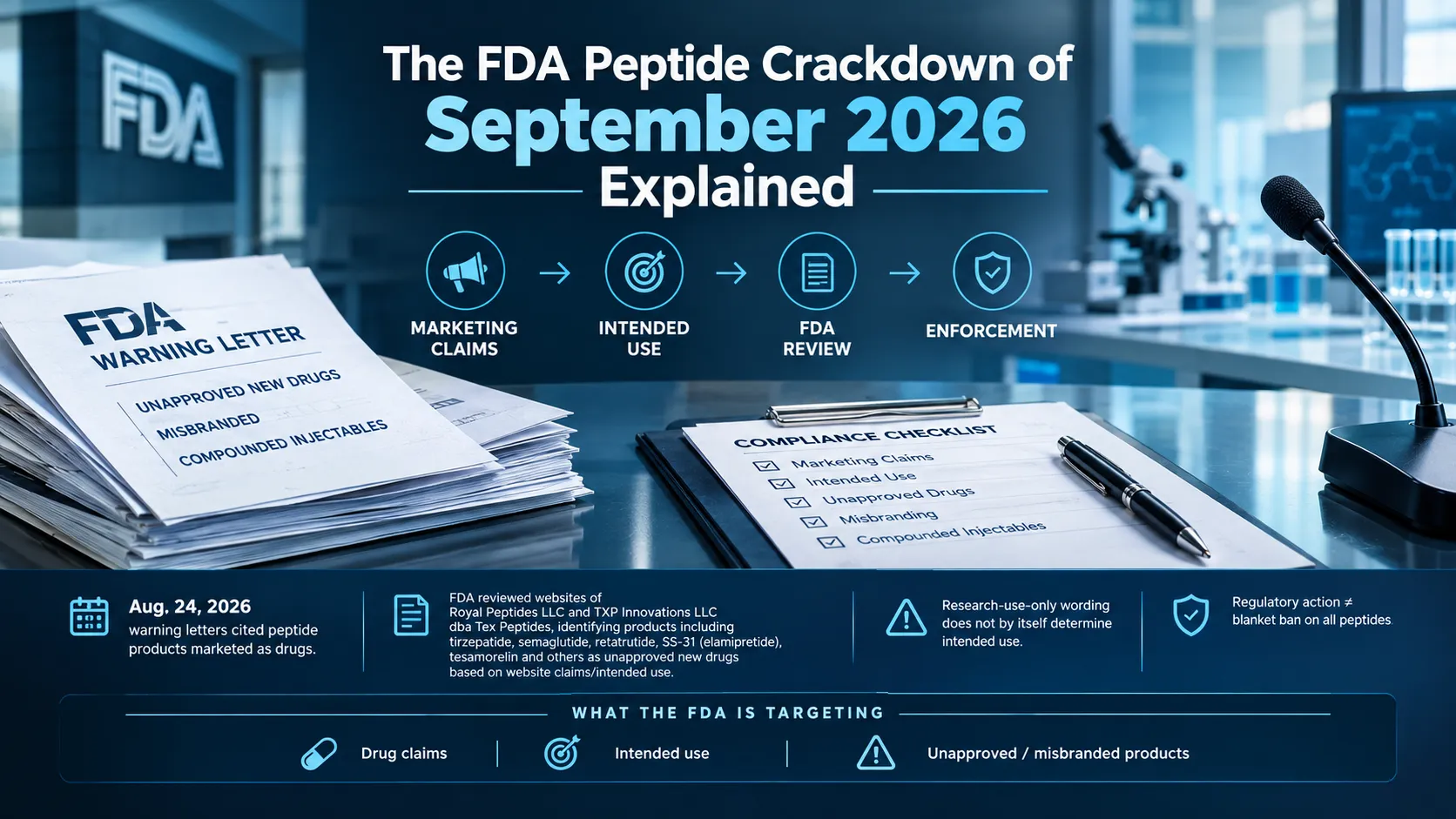
Five peptide sellers got FDA warning letters in September 2026. See who was named, why the research label failed, and the full 2026 enforcement timeline.
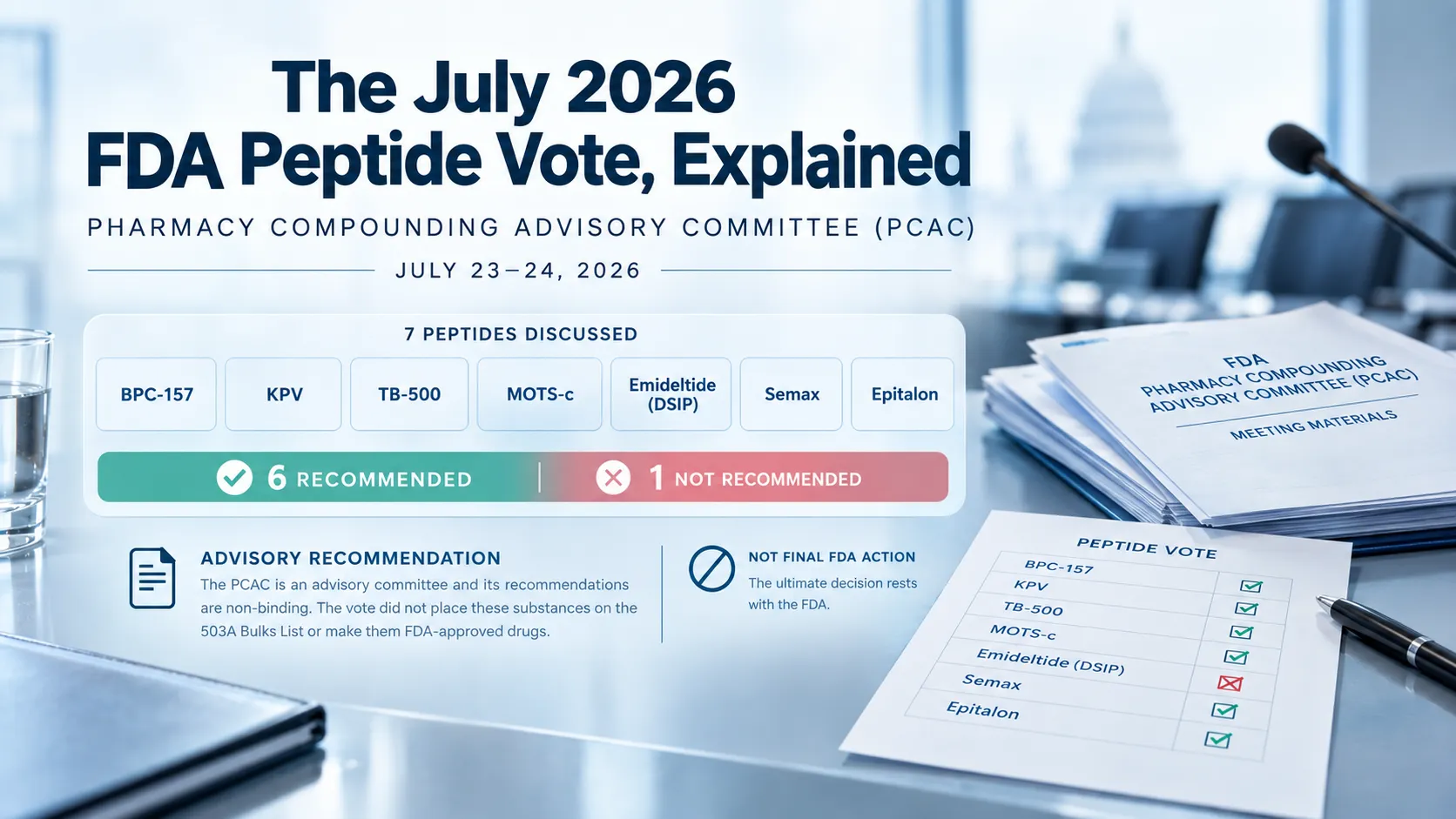
In July 2026, the FDA's advisory committee recommended 6 peptides for the 503A bulk list. None are on it yet. What the vote changed and what it didn't.