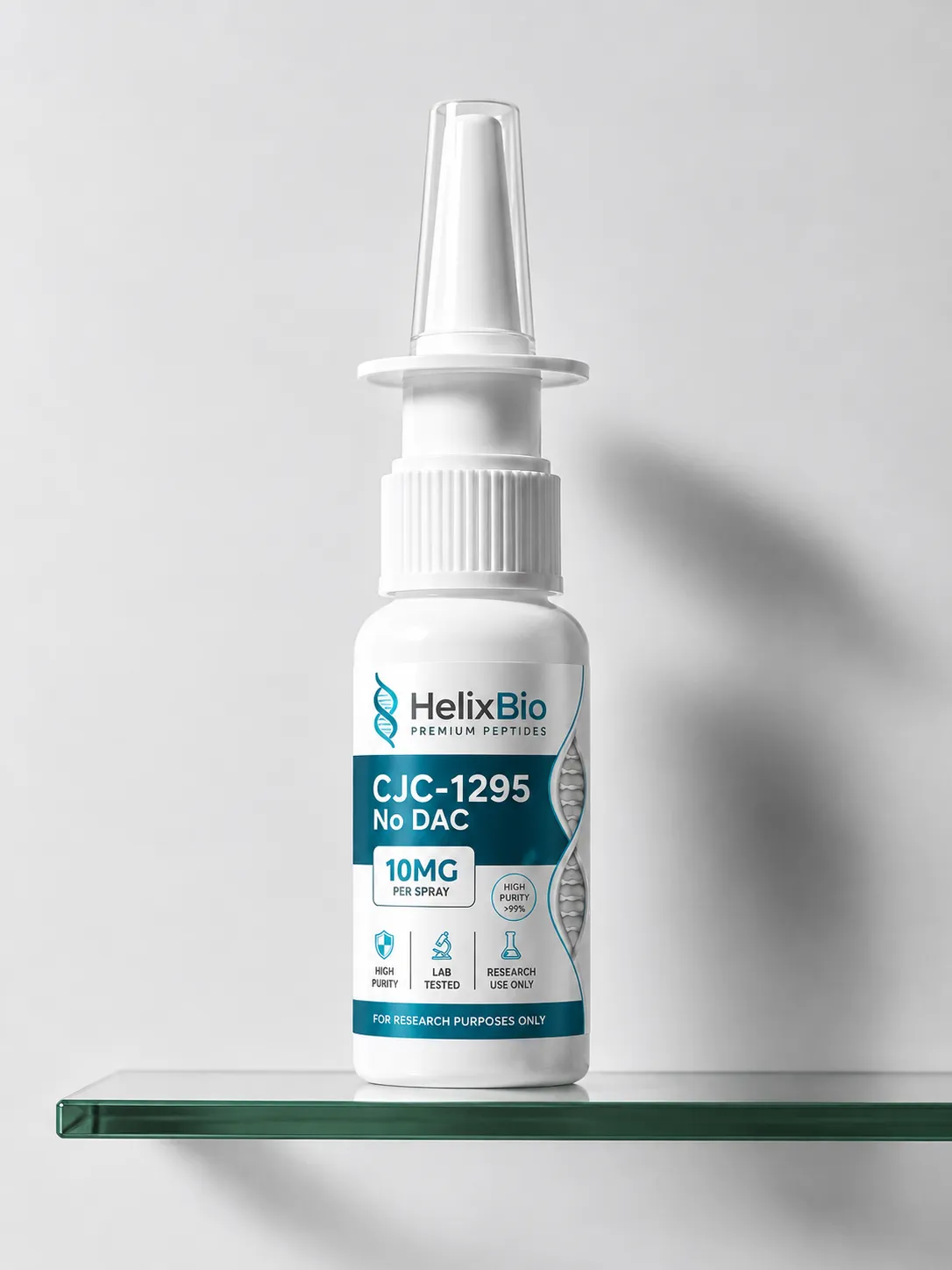
CJC-1295 No DAC Spray is a research-use peptide formulation containing CJC-1295 No DAC, a synthetic 29-residue analogue of growth hormone-releasing hormone (GHRH) associated with laboratory research into GHRH-receptor signaling, pituitary somatotroph biology, and peptide pharmacology. CJC-1295 No DAC — commonly cross-referenced as Modified GRF (1-29) — is structurally distinct from CJC-1295 With DAC, and published research has examined GHRH-receptor activity in cellular and animal models. Helix Bio supplies research materials for qualified laboratory and scientific applications. CJC-1295 No DAC Spray is offered strictly for research use and is not intended for human or veterinary consumption, diagnosis, treatment, or prevention of disease.
HPLC certified
Independent analysis
Highest standard
Full traceability
CJC-1295 No DAC is a synthetic 29-residue peptide commonly identified by the sequence Tyr-D-Ala-Asp-Ala-Ile-Phe-Thr-Asn-Ser-Tyr-Arg-Lys-Val-Leu-Gly-Gln-Leu-Ser-Ala-Arg-Lys-Leu-Leu-Gln-Asp-Ile-Met-Ser-Arg. Scientific and vendor literature describes it as an analogue of the first 29 amino acids of human growth hormone-releasing hormone, GHRH(1-29), carrying four substitutions — D-Ala², Gln⁸, Ala¹⁵, and Leu²⁷ — and it is commonly cross-referenced as Modified GRF (1-29).
This is a distinct molecule from CJC-1295 With DAC, which carries an additional chemical group that covalently binds circulating albumin. Foundational pharmacology publications using the "CJC-1295" name specifically studied the DAC-conjugated form; that data should not be assumed to describe this No DAC material without confirming which exact form was studied.
Research on CJC-1295 No DAC has examined its interaction with biological systems associated with the growth hormone axis, including studies of GHRH-receptor (GHRHR) binding on anterior pituitary somatotrophs. Published experimental work associated with the broader "CJC-1295" name has investigated cellular, animal, and — for the DAC-conjugated form specifically — human models. These findings provide research context but should not be interpreted as evidence of clinical efficacy or as a medical recommendation for this No DAC product.
A spray format can be relevant when researchers are studying peptide formulation science, delivery-format comparison, or analytical reproducibility in controlled experimental models. "Spray" describes this product's physical presentation; it does not by itself establish an administration route, and no route-specific claim is made for this product.
For laboratory work, researchers should distinguish between the scientific literature surrounding the "CJC-1295" name generally and the specifications of this particular commercial research material — and, specifically, should confirm whether cited literature describes the No DAC or With DAC form before applying it to this product. Experimental results depend on factors such as peptide identity, purity, formulation, experimental model, analytical method, and study design.
Helix Bio positions its peptide catalog for research and laboratory purposes only. Product documentation and lot-specific analytical information should be reviewed before a material is incorporated into an experimental workflow.
CJC-1295 No DAC and the broader "CJC-1295" name have been investigated in several areas of basic and translational research, including:
The existence of published research does not establish that CJC-1295 No DAC Spray is safe or effective for use in humans. CJC-1295 is not an FDA-approved drug in the United States, and regulatory status should be distinguished from scientific interest or experimental literature.
Researchers evaluating peptide materials generally need more than a product name. Identity, purity, analytical documentation, storage requirements, and traceability can all affect the interpretation of experimental results — and this matters more than usual for CJC-1295, given how inconsistently the "CJC-1295" name is applied across the market to two molecularly distinct products.
Helix Bio states that its research peptide catalog uses independent HPLC testing for purity assessment and mass spectrometry for molecular identity confirmation. The company also states that batch-specific Certificates of Analysis are available for its products.
For CJC-1295 No DAC Spray, researchers should verify the applicable product documentation and current lot information rather than relying solely on a general product description.
CJC-1295 No DAC Spray is intended for qualified users working in legitimate laboratory or scientific research environments, including:
The product is not intended for personal experimentation, self-administration, human consumption, veterinary use, or medical treatment.
| Specification | Details |
|---|---|
| Product Name | CJC-1295 No DAC Spray |
| Research Category | Growth Hormone Axis / Research Peptide |
| Compound | CJC-1295 No DAC |
| Chemical Class | Synthetic peptide — GHRH(1-29) analogue |
| Related Peptide | Modified GRF (1-29); structurally related to Sermorelin |
| Sequence | Tyr-D-Ala-Asp-Ala-Ile-Phe-Thr-Asn-Ser-Tyr-Arg-Lys-Val-Leu-Gly-Gln-Leu-Ser-Ala-Arg-Lys-Leu-Leu-Gln-Asp-Ile-Met-Ser-Arg |
| Format | Spray formulation |
| Intended Use | Research and laboratory investigation only |
| Human Use | Not intended for human consumption |
| Veterinary Use | Not intended for veterinary use |
| Purity | Refer to current lot-specific product documentation |
| Identity Testing | Refer to applicable Certificate of Analysis |
| Packaging | Refer to current product listing |
| Storage | Follow current product-specific documentation |
| Manufacturer | Helix Bio |
| Country of Origin | Not specified; verify current product documentation |
CJC-1295 No DAC has a documented research history connected to the broader "CJC-1295" and GHRH-analogue literature, particularly in endocrinology and peptide biology.
Researchers have investigated GHRH(1-29) analogues, including CJC-1295 No DAC, in relation to GHRH-receptor (GHRHR) binding on anterior pituitary somatotrophs and downstream pulsatile growth hormone release. Much of the specific pharmacodynamic data published under the "CJC-1295" name describes the DAC-conjugated form; No DAC-specific pharmacodynamic evidence is comparatively limited.
These studies can provide background for basic endocrine research but should not be extrapolated directly into human therapeutic outcomes.
CJC-1295 No DAC is a synthetic 29-residue peptide related structurally to Sermorelin (GRF(1-29)), differing by four substitutions. Its defined amino-acid sequence makes it relevant to structure-function studies examining how peptide composition and molecular modifications influence receptor interactions.
Because "CJC-1295" has been applied inconsistently across the market to two molecularly distinct products, comparative and analytical research relevant to this compound often focuses on confirming which exact form is present in a given study or product lot, and on distinguishing pharmacokinetic data reported for the DAC-conjugated form from data specific to No DAC.
Published studies associated with the GHRH-analogue class have also examined receptor-binding and cellular signaling systems relevant to CJC-1295 No DAC. Researchers should evaluate each publication according to its model, methodology, exact compound form, and endpoints rather than assuming that findings from one experimental system, or from the DAC-conjugated form, apply universally.
Analytical quality is important when working with research peptides because impurities, degradation products, incorrect identity, or inconsistent concentration can introduce unwanted variables into an experiment. For CJC-1295 No DAC specifically, confirming which form — No DAC or With DAC — a lot actually contains is itself part of identity verification, since the two differ by roughly 279 Da in molecular weight.
Helix Bio states that its peptide materials are subjected to independent HPLC testing for purity and mass spectrometry for molecular identity. It also states that batch-specific Certificates of Analysis are available for its products.
For a specific CJC-1295 No DAC Spray lot, researchers should consult the applicable COA and product documentation for the actual analytical results. A general catalog statement should not be treated as a substitute for lot-specific documentation.
Researchers should assess, where applicable:
No certification, regulatory approval, or quality claim should be inferred unless it is explicitly documented by the manufacturer or relevant regulatory authority.
Storage and handling requirements should be determined from the current CJC-1295 No DAC Spray product documentation and lot-specific instructions.
General laboratory considerations include:
Storage guidance should not be inferred from research protocols for CJC-1295 With DAC, or from other CJC-1295 No DAC preparations, because formulation, conjugation chemistry, and packaging can affect stability.
Helix Bio's website describes research materials as being supplied to laboratories and institutions in the United States and describes tracked shipping and cold-chain handling within its fulfillment process.
Because shipping conditions, packaging specifications, availability, and delivery requirements may change, researchers should review the current Helix Bio shipping information and product listing before ordering.
Product packaging should remain appropriately labeled and handled as research material after delivery. Researchers are responsible for following applicable institutional, federal, state, and local requirements governing research materials.
CJC-1295 No DAC Spray is sold by Helix Bio for research and laboratory purposes only. It is not intended for human or veterinary consumption, self-administration, diagnosis, treatment, cure, mitigation, or prevention of any disease or medical condition.
"Spray" describes this product's physical format and does not by itself establish an administration route. Helix Bio does not represent this product as intended for nasal, intranasal, mucosal, oral, sublingual, or any other specific route of use.
CJC-1295 is not an FDA-approved drug in the United States. FDA approval status should not be inferred from published research, product availability, or laboratory use. FDA explains that unapproved drugs have not undergone the agency's standard review for safety, effectiveness, and quality.
This product is not a dietary supplement, consumer wellness product, or medical treatment. Researchers are responsible for determining whether a material is appropriate for their intended experimental application and for complying with applicable institutional and regulatory requirements.
Knowledge Base
Knowledge Base
Knowledge Base
Knowledge Base
Knowledge Base
Knowledge Base
Knowledge Base
Knowledge Base
Knowledge Base
Knowledge Base
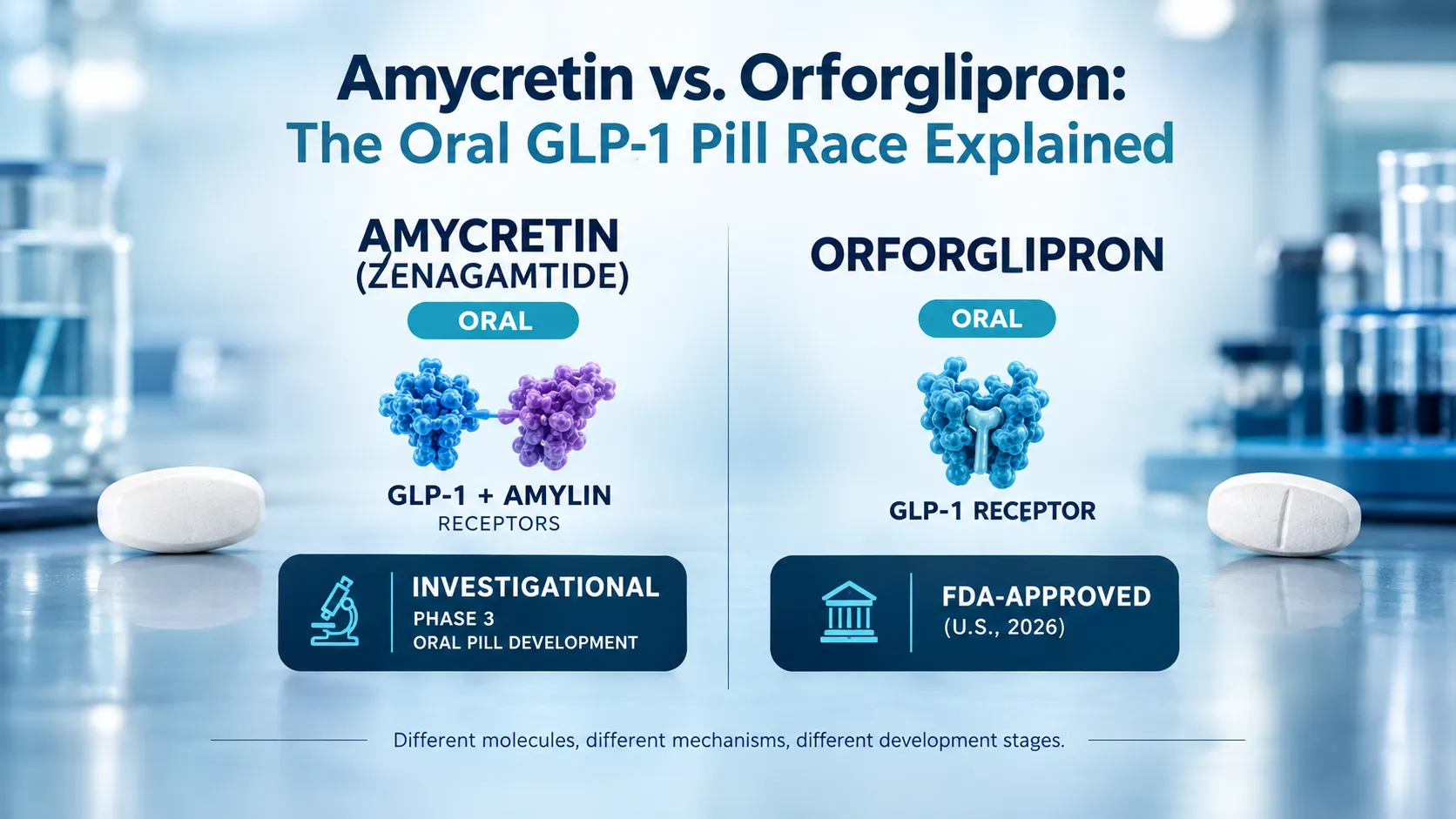
Amycretin is a peptide and orforglipron is not. How that chemistry explains the formulations, trial results, and approval status of both GLP-1 pills.
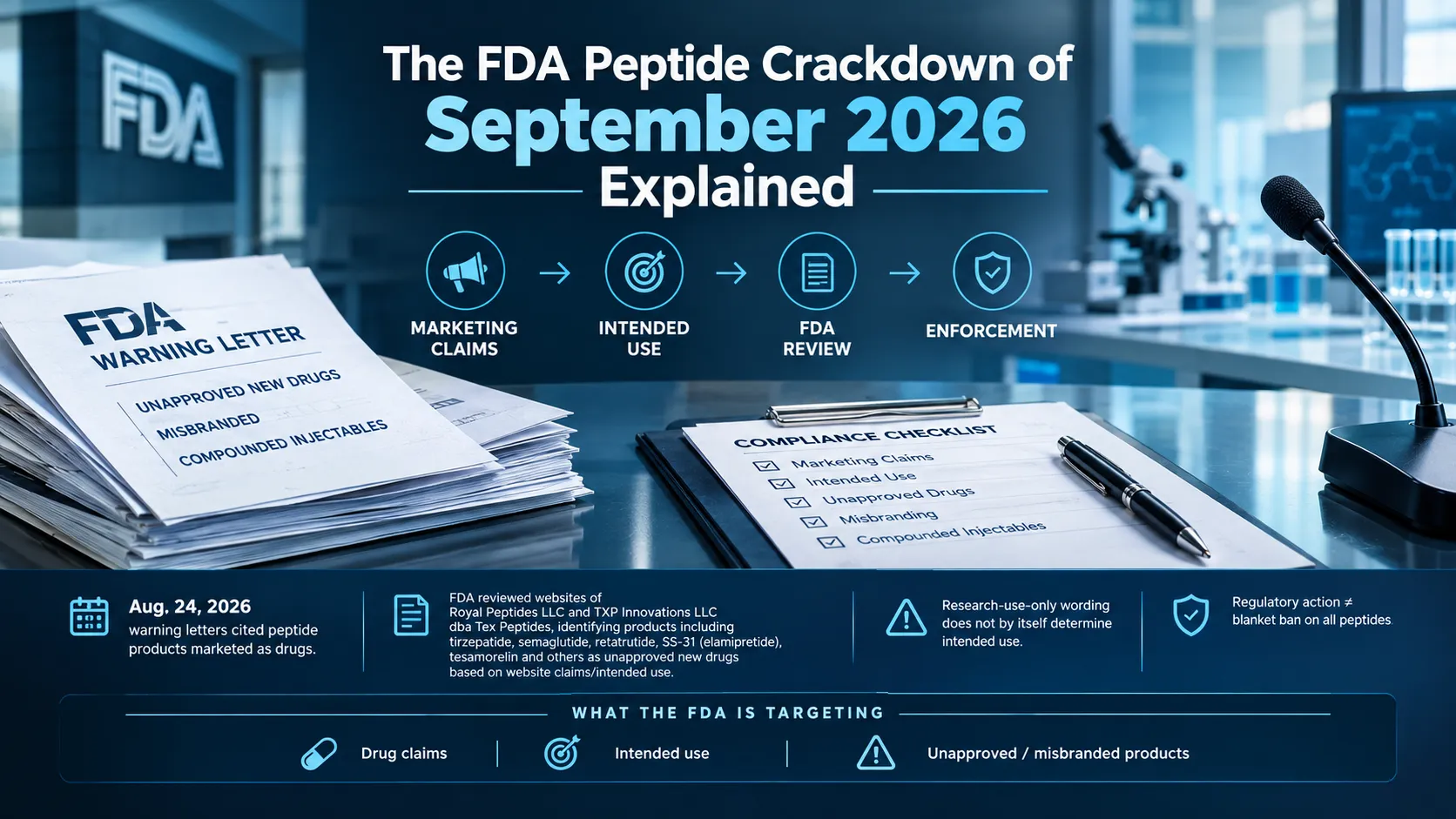
Five peptide sellers got FDA warning letters in September 2026. See who was named, why the research label failed, and the full 2026 enforcement timeline.

In July 2026, the FDA's advisory committee recommended 6 peptides for the 503A bulk list. None are on it yet. What the vote changed and what it didn't.