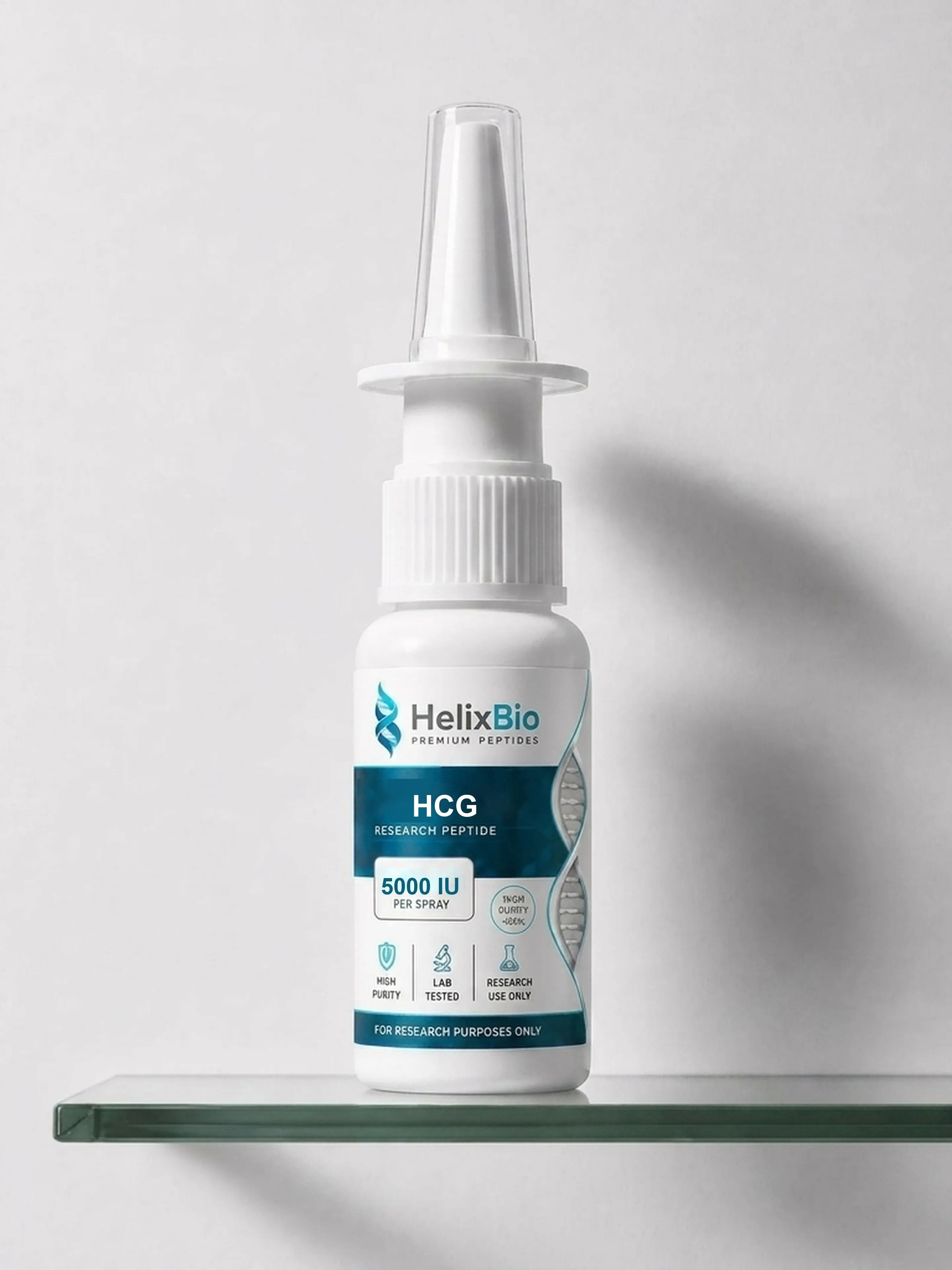
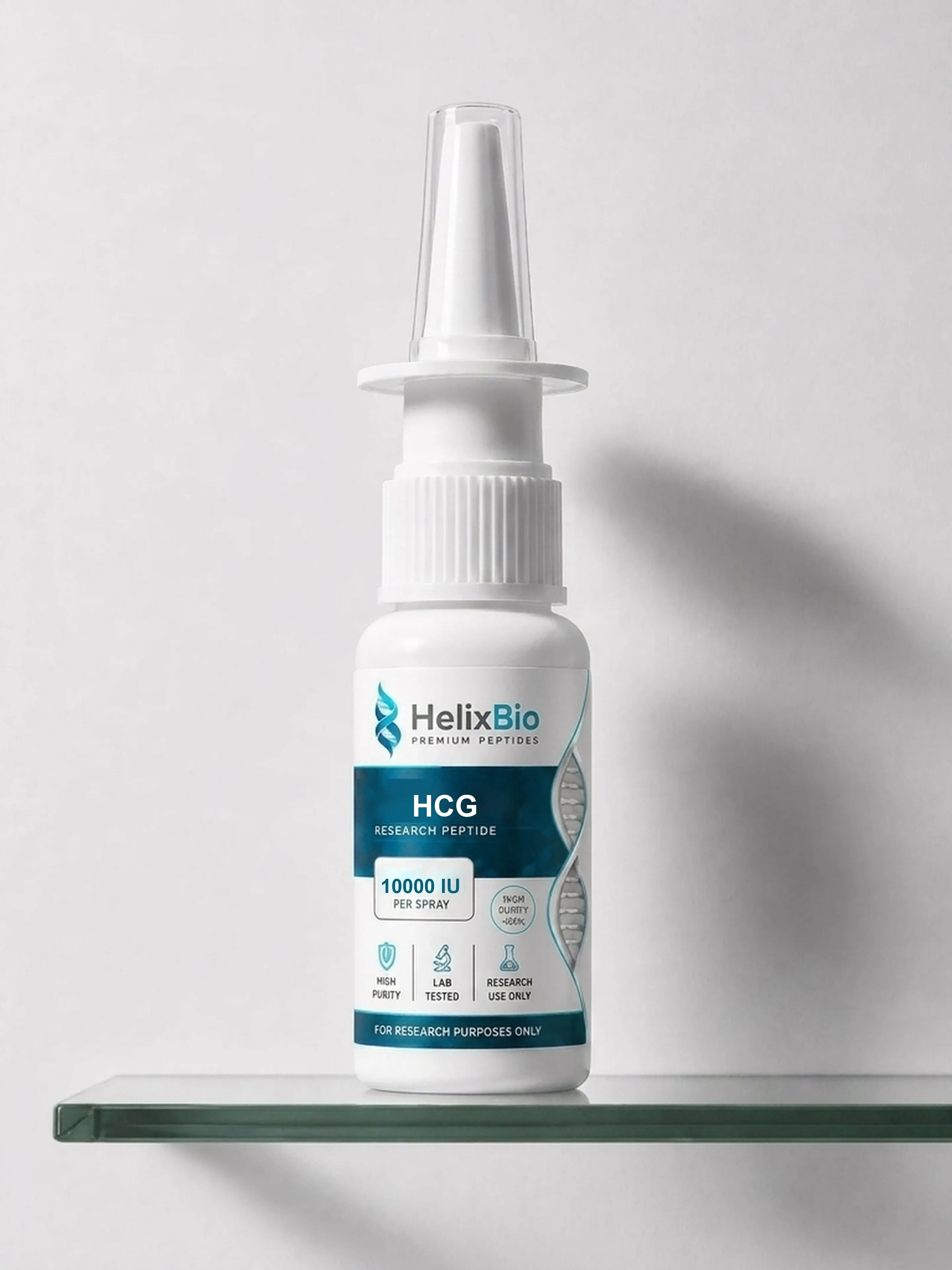
Human chorionic gonadotropin is not a peptide in the sense that most of this catalogue is. It is a heterodimeric glycoprotein hormone — two different chains, held together without a covalent bond, with close to a third of the molecule’s mass made up of attached carbohydrate. That structure governs how the material behaves, how it is characterised, and what can reasonably be concluded from work done with it. HCG Spray is Helix Bio’s spray-format presentation of this hormone, supplied for qualified laboratory and scientific investigation. Helix Bio supplies HCG Spray strictly as a research material. It is not intended for human or veterinary use, ingestion, injection, nasal administration, or any other form of administration, and it is not offered as a medication, a dietary supplement or a weight-management product. Lot-specific documentation should be reviewed before the material enters any experimental workflow.
HPLC certified
Independent analysis
Highest standard
Full traceability
Human chorionic gonadotropin (hCG) is a glycoprotein hormone produced by the syncytiotrophoblast of the placenta. It belongs to a family of four human glycoprotein hormones — chorionic gonadotropin, luteinizing hormone, follicle-stimulating hormone and thyroid-stimulating hormone — that share an identical alpha subunit and differ in their beta subunits. The beta subunit is what confers each hormone’s receptor and biological specificity.
The intact hormone is a heterodimer. Its alpha subunit is a 92-residue mature chain encoded by CGA on chromosome 6; its beta subunit is a 145-residue mature chain encoded by the CGB gene cluster on chromosome 19. The two associate non-covalently, and both carry attached sugars. Adding the two polypeptide chains together gives roughly 26 kDa, while the mass usually quoted for the hormone is close to 37 kDa. The difference is glycosylation, and it is not incidental — it is a substantial fraction of the molecule.
One structural feature separates hCG from every other member of its family. The beta subunit carries an additional C-terminal extension of about 24 residues bearing four serine-linked oligosaccharides, referred to in the literature as the carboxy-terminal peptide, or CTP. The LH beta subunit has no equivalent. Sequence analysis attributes the extension to a single-base deletion and a two-base insertion in the chorionic gonadotropin beta gene relative to the LH beta coding sequence, which lengthens the open reading frame. This extension is the accepted explanation for hCG’s much longer circulating survival compared with the other glycoprotein hormones, and it proved useful enough that fusing the CTP onto unrelated proteins became a general half-life-extension strategy in protein engineering.
Three things frequently treated as one entity are in fact three: intact hCG, the free alpha subunit and the free beta subunit. They differ in structure and behaviour, and the clinical term “beta-hCG” describes an immunoassay directed at a beta-subunit epitope rather than a distinct molecule that was isolated and measured.
The word spray here describes the physical presentation of the material and nothing more. It carries no route of administration, and Helix Bio’s HCG Spray is not intended for administration by any route.
What the format does change is the material’s physical state, and for a glycoprotein that is a meaningful change. HCG is a large, heavily glycosylated, non-covalently associated dimer, and its behaviour in solution is not the same as its behaviour as a solid. Subunit dissociation, adsorption to container surfaces and loss of measurable activity are all properties of solution-phase glycoprotein handling rather than theoretical concerns. A researcher moving between a solid-format hormone preparation and a prepared solution should treat them as different materials with different handling profiles, not as the same material in different packaging.
There is a second point specific to this hormone. There is no established body of human pharmacokinetic literature on intranasally administered hCG. Searches in that area return work on much smaller molecules — intranasal GnRH and intranasal kisspeptin, both short peptides — or veterinary formulation work in cattle. At roughly 37 kDa, hCG is an order of magnitude larger than any peptide currently supplied in spray format in this catalogue. Nothing about the spray presentation should be read as implying that any route has been characterised for this hormone, because it has not been.
hCG has a long history as a laboratory reagent, distinct from its history as a medicine. In research settings it appears principally as a ligand for the luteinizing hormone / choriogonadotropin receptor (LHCGR), which allows investigators to study receptor binding, activation and downstream signalling in a system where the ligand’s structure is well characterised.
Because hCG and LH act at the same receptor while differing in structure and residence time, the pair is useful for questions about how ligand properties shape a signalling outcome when the receptor is held constant. That comparison is only informative if the two are kept distinct, which a good deal of published and commercial material fails to do.
Work involving hCG spans receptor pharmacology and signal transduction, glycoprotein structure–function studies, placental and reproductive endocrinology, and analytical and assay development, where hCG is among the most extensively characterised protein analytes in existence because of its long-standing role in diagnostic immunoassay. The existence of this literature establishes scientific interest in the hormone. It does not establish that any particular research material is suitable for any particular experiment, and it does not establish safety or effectiveness for any use in humans.
Evaluating a glycoprotein hormone research material takes more work than evaluating a synthetic peptide, and the difference is worth understanding before ordering rather than after.
A synthetic peptide has one defined sequence and one theoretical mass. It can be sensibly described by a chromatographic purity figure and confirmed by a single mass measurement. A glycosylated heterodimer offers neither convenience. Its glycans are heterogeneous, so it presents as a distribution of masses rather than one; its two chains can dissociate; and its biological potency depends on structural features that a purity percentage does not capture. This is the reason glycoprotein hormone preparations are conventionally described by assayed potency in International Units per milligram, by electrophoretic purity, and by limits on cross-contamination with related gonadotropins — rather than by the single HPLC purity figure that suits a synthetic peptide.
For HCG Spray specifically, the material’s identity, source, concentration, vehicle and assayed potency are properties of the individual lot. Researchers should obtain and read the applicable lot documentation, and should not infer any of these values from this description, from another supplier’s datasheet, from a pharmaceutical hCG preparation, or from Helix Bio’s general catalogue statements about testing methodology.
HCG Spray is intended for qualified users working in legitimate laboratory or scientific research environments, including:
The product is not intended for personal experimentation, self-administration, human consumption, veterinary use, medical treatment, fertility management, hormone management or weight management.
| Specification | Details |
|---|---|
| Product Name | HCG Spray |
| Scientific Name | Human chorionic gonadotropin |
| Synonyms | hCG, HCG, chorionic gonadotropin, human chorionic gonadotrophin |
| Research Category | Sexual & Hormonal — glycoprotein hormone |
| Compound Class | Heterodimeric glycoprotein hormone |
| Structure | Two non-covalently associated glycosylated chains |
| Alpha Subunit | 92-residue mature chain; gene CGA; UniProt P01215 |
| Beta Subunit | 145-residue mature chain; gene CGB3; UniProt P0DN86 |
| Distinguishing Feature | ~24-residue carboxy-terminal peptide on the beta subunit bearing four O-linked oligosaccharides |
| Molecular Weight | ~36.7 kDa for the glycosylated hormone; ~25.8 kDa polypeptide contribution. Glycoprotein mass is heterogeneous and preparation-dependent |
| CAS | 9002-61-3 |
| Associated Receptor | LHCGR (luteinizing hormone / choriogonadotropin receptor) |
| Biological Origin | Placental syncytiotrophoblast |
| Specification | Details |
|---|---|
| Format | Spray-format prepared solution |
| Source / Form | Refer to current lot-specific product documentation |
| Strength | Refer to current product listing |
| Concentration | Refer to current lot-specific product documentation |
| Fill Volume | Refer to current product listing |
| Vehicle | Refer to current lot-specific product documentation |
| Purity | Refer to current lot-specific product documentation |
| Assayed Potency | Refer to current lot-specific product documentation |
| Identity Testing | Refer to the applicable Certificate of Analysis |
| Lot / Test Date | Refer to the applicable Certificate of Analysis |
| Packaging | Refer to current product listing |
| Storage | Follow current product-specific documentation |
| Manufacturer | Helix Bio |
| Country of Origin | Not specified; verify current product documentation |
| Intended Use | Research and laboratory investigation only |
| Human Use | Not intended for human consumption or administration |
| Veterinary Use | Not intended for veterinary use |
hCG appears across several distinct research areas. They are separated here because the evidence in each has a different character, and treating them as one body of support would misrepresent all of them.
Receptor Biology and Signalling. hCG is a ligand for LHCGR, a G protein-coupled receptor also activated by LH. This shared receptor makes hCG a standard tool in studies of gonadotropin receptor binding, activation and downstream signalling. It also makes precision necessary: findings about the receptor are findings about the receptor, and findings generated with LH are not automatically transferable to hCG. The two ligands differ structurally and in how long they persist, and those differences are themselves a legitimate research subject rather than a technicality.
Glycoprotein Structure–Function. hCG is one of the better-characterised glycoprotein hormones structurally, with published crystallographic work on the heterodimer. It is used in research examining how subunit assembly, cystine-knot folding and glycosylation contribute to hormone stability, secretion and receptor interaction. The carboxy-terminal peptide of the beta subunit has been studied directly in this context, including work in which the CTP was transferred onto other proteins to test whether its effect on circulating survival travels with the sequence.
Placental and Reproductive Endocrinology. As a placentally produced hormone, hCG features in research on trophoblast biology, corpus luteum maintenance and steroidogenic signalling. Much of this literature is descriptive or mechanistic biology rather than intervention research, and it should be read as such.
Analytical and Assay Development. hCG is among the most measured protein analytes in laboratory medicine, which has produced an unusually deep methodological literature on its detection, standardisation and the distinction between intact hormone and free subunits. This makes it a useful reference analyte in assay development and analytical method work.
Across all four areas, findings should be evaluated according to the model, the species, the exact hCG species studied — intact hormone or subunit — the preparation used, the concentrations involved and the endpoints measured. Results obtained in one experimental system do not automatically apply to another, and none of this literature was generated using this product.
Analytical documentation matters for any research material, because identity, purity and concentration all feed directly into how an experiment is interpreted. For a glycoprotein hormone it matters in a slightly different way than it does for a synthetic peptide, and the difference is worth being explicit about.
Two things follow from hCG’s structure. The first is that its glycans are heterogeneous — a preparation contains a population of related glycoforms rather than a single species — so a single exact mass does not describe it and a mass measurement confirms the analyte family rather than pinning one molecule. The second is that its biological activity depends on structural features beyond primary sequence, which is why potency is conventionally determined by assay and reported in International Units rather than calculated from mass. This is also why hCG preparations are typically sold by unit content rather than by weight.
Glycoprotein hormone preparations are conventionally characterised using approaches suited to that class of molecule, which commonly include electrophoretic purity assessment, assayed potency expressed in International Units per milligram, and stated limits on contamination by related gonadotropins such as LH, FSH and TSH. That last measure is worth noting: because the four glycoprotein hormones share an alpha subunit, cross-gonadotropin contamination is a real and specific quality question for this class in a way it is not for synthetic peptides.
For any given HCG Spray lot, the applicable Certificate of Analysis and product documentation are the authority for the actual analytical results. A general catalogue statement about testing methodology is not a substitute for lot-level documentation, and testing approaches appropriate to synthetic peptides are not necessarily the approaches appropriate to a glycoprotein hormone.
Researchers should assess, where applicable:
No certification, regulatory approval or quality claim should be inferred unless it is explicitly documented by the manufacturer or a relevant regulatory authority.
Storage and handling requirements should be taken from the current HCG Spray product documentation and the instructions supplied with the specific lot received.
General laboratory considerations include:
Storage conditions published for pharmaceutical hCG preparations, for solid-format research hCG, or for other Helix Bio spray products should not be applied to this material. Formulation, vehicle, concentration and packaging all affect stability, and a glycoprotein hormone held in solution does not necessarily behave like the same hormone held as a solid.
Helix Bio’s website describes research materials as being supplied to laboratories and institutions, and describes tracked shipping and appropriate handling within its fulfilment process.
Because shipping conditions, packaging specifications, availability and delivery requirements may change, researchers should review the current Helix Bio shipping information and the current product listing before ordering.
Product packaging should remain appropriately labelled and handled as research material after delivery. Researchers are responsible for following applicable institutional, federal, state and local requirements governing research materials, and for confirming that a given material may lawfully be acquired and held for their intended purpose in their jurisdiction.
HCG Spray is supplied by Helix Bio for research and laboratory purposes only. It is not intended for human or veterinary consumption, self-administration, diagnosis, treatment, cure, mitigation or prevention of any disease or medical condition, and it is not intended for administration by any route.
Approved prescription drug products containing chorionic gonadotropin exist in the United States for defined medical indications. Their existence carries no implication for this material. Drug approval attaches to a specific product, from a specific manufacturer, at a specific strength, administered by a specific route, for a specific indication. Helix Bio’s HCG Spray is not an approved drug product, is not a generic or alternative version of one, and has not been evaluated by any regulatory authority for safety or effectiveness.
Nothing on this page should be read as supporting any use of chorionic gonadotropin for weight management or weight loss. In the United States, labelling and advertising for chorionic gonadotropin has been required since 1975 to state that it has no known effect on fat mobilisation, appetite or body fat distribution and has not been demonstrated to be effective adjunctive therapy in the treatment of obesity. Nothing here should be read as supporting any fertility, testosterone, hormone-management or athletic use either.
This product is not a drug, dietary supplement, cosmetic or food product. Published research involving chorionic gonadotropin does not establish that this material is safe or effective for any use in humans or animals, and research conducted with pharmaceutical hCG preparations does not validate this formulation.
Researchers are responsible for determining whether a material is appropriate for their intended experimental application and for complying with all applicable institutional and regulatory requirements.
Knowledge Base
Knowledge Base
Knowledge Base
Knowledge Base
Knowledge Base
Knowledge Base
Knowledge Base
Knowledge Base
Knowledge Base
Knowledge Base
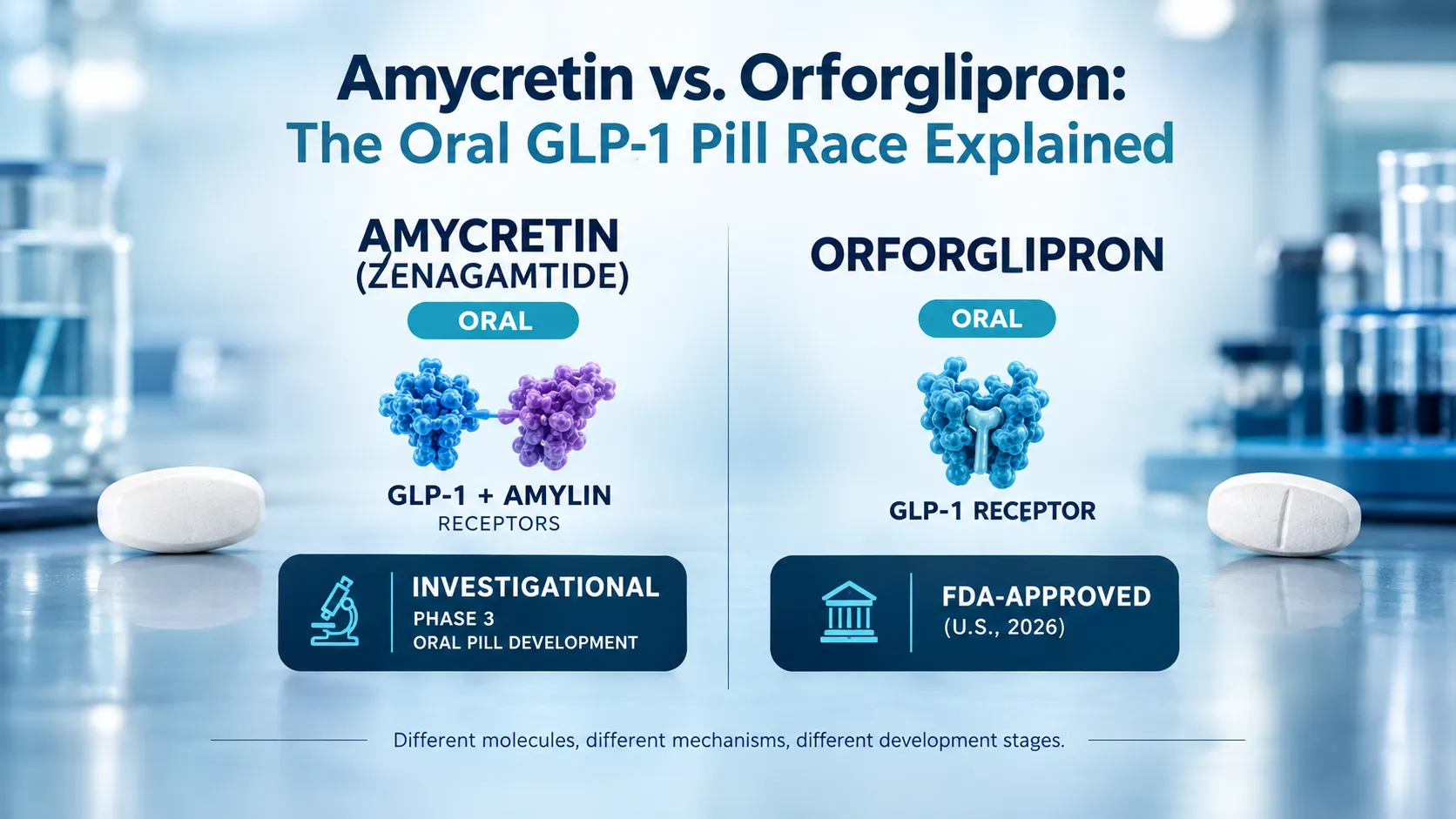
Amycretin is a peptide and orforglipron is not. How that chemistry explains the formulations, trial results, and approval status of both GLP-1 pills.
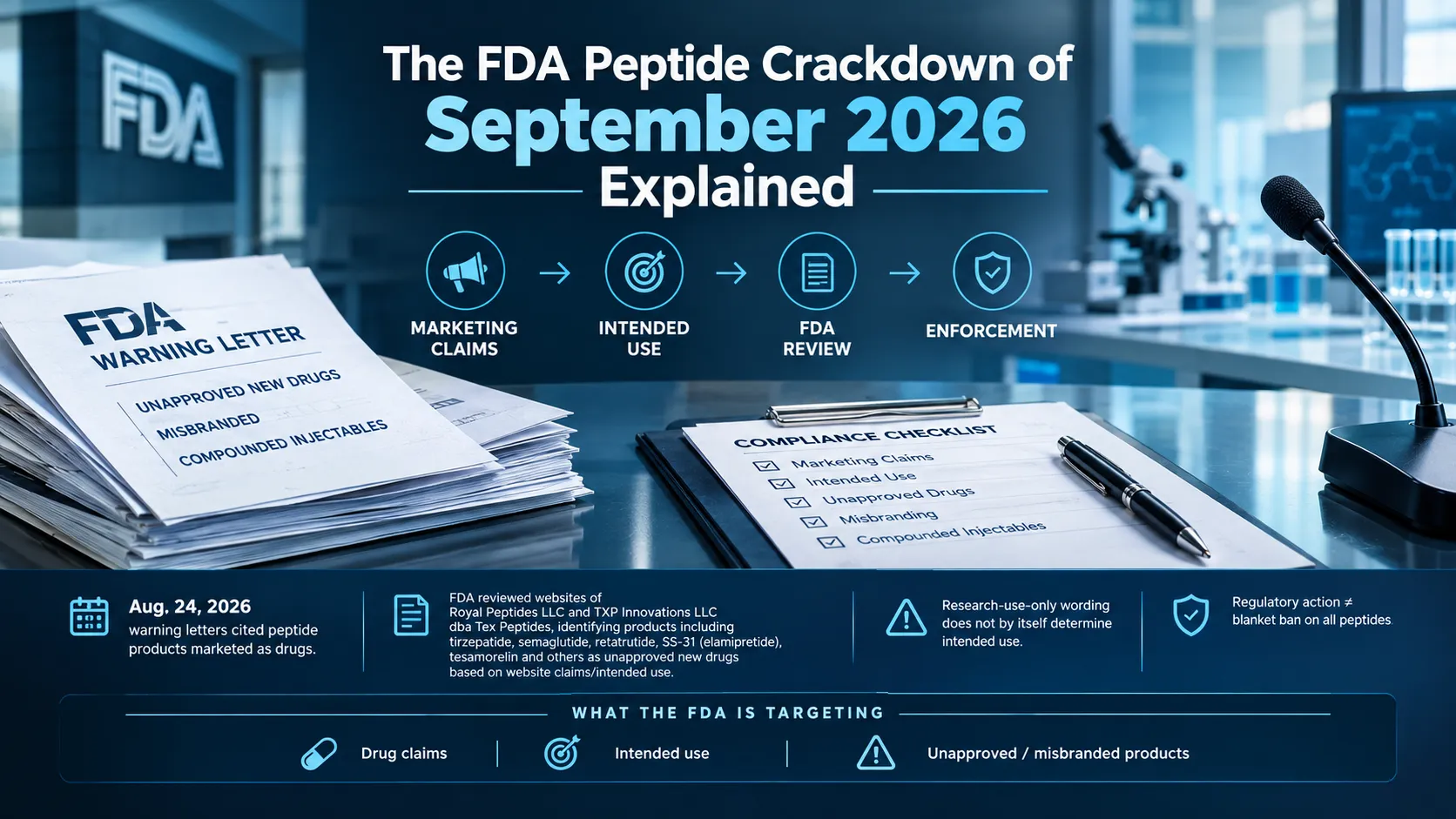
Five peptide sellers got FDA warning letters in September 2026. See who was named, why the research label failed, and the full 2026 enforcement timeline.

In July 2026, the FDA's advisory committee recommended 6 peptides for the 503A bulk list. None are on it yet. What the vote changed and what it didn't.