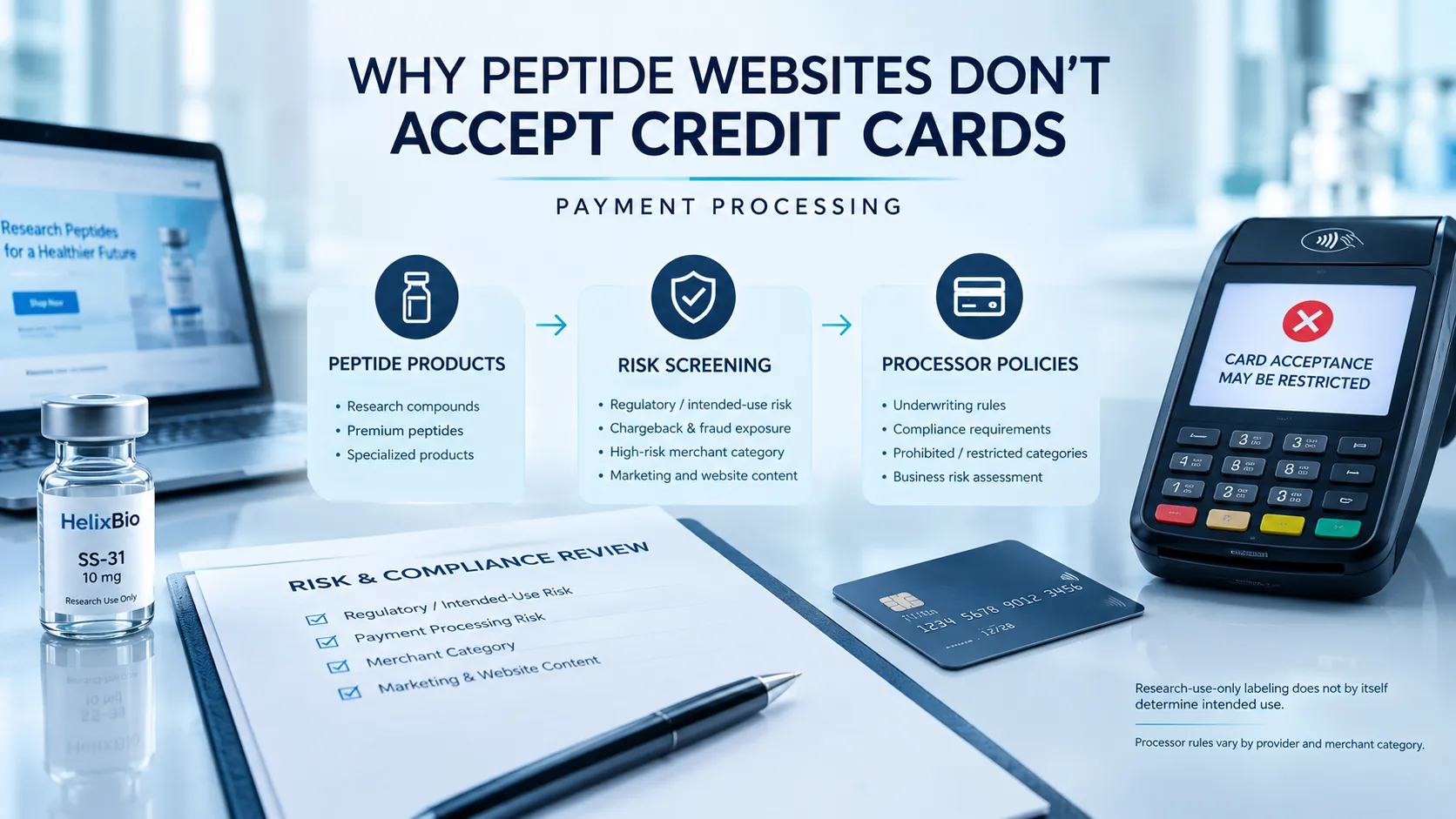
- Processors classify peptides as restricted or high-risk, so standard merchant accounts get denied or terminated.
- A MATCH listing stays for five years and makes new card approvals very difficult.
- Termination often reflects the category and the contract, not the individual vendor's conduct.
- Reason code 10, Violation of Standards, is broad and gives terminating acquirers wide latitude.
- Crypto, Zelle, and Cash App dominance in this market is a payment-processing story first.
- Chainalysis data shows the 2026 shift accelerating, from $12 million to $32 million in one quarter.
- Card acceptance alone is not a legitimacy signal, and its absence is not disqualifying.
- Gray-market crypto data and US research-vendor processing problems are two different stories.
Most peptide websites cannot take credit cards because payment processors treat peptides as a restricted, high-risk category. Vendors get declined during underwriting, or approved and then terminated months later. Some end up on the MATCH list, which follows a business for five years. Crypto, Zelle, and Cash App fill the gap.
What stops peptide websites from taking cards?
Card acceptance is not a right. It is a commercial relationship, and processors write the terms.
Stripe places peptides and research chemicals on its restricted businesses list, which means extra due diligence and, in many cases, prior approval. Stripe's own policy FAQ is more specific than most summaries admit. It says Stripe supports the sale of many peptides with limitations. Research-purpose peptides may be sold only where preventive measures stop non-research buyers from purchasing. Where a seller states no purpose at all, Stripe assumes the peptides are for human consumption.
Shopify Payments runs on Stripe's infrastructure, so the same restrictions reach Shopify merchants. Square's published prohibitions target internet and telephone-order pharmacies and pharmacy referral services. PayPal's restrictions on pharmaceuticals and nutraceuticals in card-not-present sales are widely reported by merchant-services commentators.
The practical result is the same across all of them. A peptide seller either never gets card checkout, or gets it and loses it without much warning.
Helix Bio Chem supplies peptides as research materials for laboratory use only. Nothing on this page describes dosing, administration, reconstitution, or use in humans.
How credit card processing actually works for online sellers
A card payment is not a single company's decision. Behind any checkout sits an acquiring bank, which sponsors the merchant into the card networks and carries the financial liability when things go wrong.
That liability drives every decision further up the chain. If a merchant cannot refund a disputed charge, the acquirer covers it. So acquirers underwrite the business before approving it, and they keep monitoring afterward.
Underwriting assigns a merchant category code and a risk profile. Categories associated with unapproved pharmaceuticals, nutraceuticals, and research chemicals sit at the risky end. Platforms like Stripe, Square, and PayPal are aggregators, which approve quickly and review later. A dedicated high-risk merchant account works the opposite way, with slow underwriting up front and more stability afterward.
What high-risk processing costs
Specialist high-risk processing costs more than standard processing, and often involves a rolling reserve.
A rolling reserve is not a fee. It is the merchant's own revenue, withheld as collateral and released later. Actual terms vary by volume, chargeback history, and negotiation.
How does the MATCH list end card processing?
MATCH stands for Member Alert to Control High-Risk Merchants, and Mastercard maintains the database. Acquiring banks, not Mastercard, report terminated merchants into it, along with a reason code.
Records stay on MATCH for five years before automatic removal. Mastercard does not assess whether a listing is accurate. Processors generally cannot remove an entry on request, with narrow exceptions for clerical error and for resolved PCI non-compliance. A listed merchant is not formally banned from card acceptance. In practice, new applications become very hard to win.
Reason code 10 is Violation of Standards, the broadest entry on the list. It covers any breach of the rules governing card acceptance, which gives a terminating acquirer wide latitude.
A real case worth reading carefully
Peptide Tech LLC v. Avidia Bank, D. Mass. 1:25-cv-13179, filed in October 2025, shows how this plays out in court. Peptide Tech is a Wyoming merchant selling peptides marketed as research chemicals. In December 2024, following Avidia's report under a violation-of-standards designation, the merchant was placed on MATCH.
The merchant sued, alleging that the termination was arbitrary and that the bank misled the card brands about its products' regulatory status. The court granted the bank's motion to dismiss all five counts. It held that the merchant agreement gave the bank sole discretion to terminate, so exercising that right was not a deceptive act. The fraud-flavored claim failed the heightened pleading standard, partly because the complaint itself conceded that Mastercard never disclosed the basis for the finding.
Two things follow from that ruling. The dismissal resolved the pleading stage, not the underlying facts, and the allegations were never adjudicated. And the outcome turned on contract language, not on whether the products were legal.
Why do processors treat peptides as high-risk?
Four pressures push the category into the same bucket, and they are worth separating.
First, classification. Most US vendors describe their products as research chemicals sold for research use only. That label sits inside a category processors already treat as restricted.
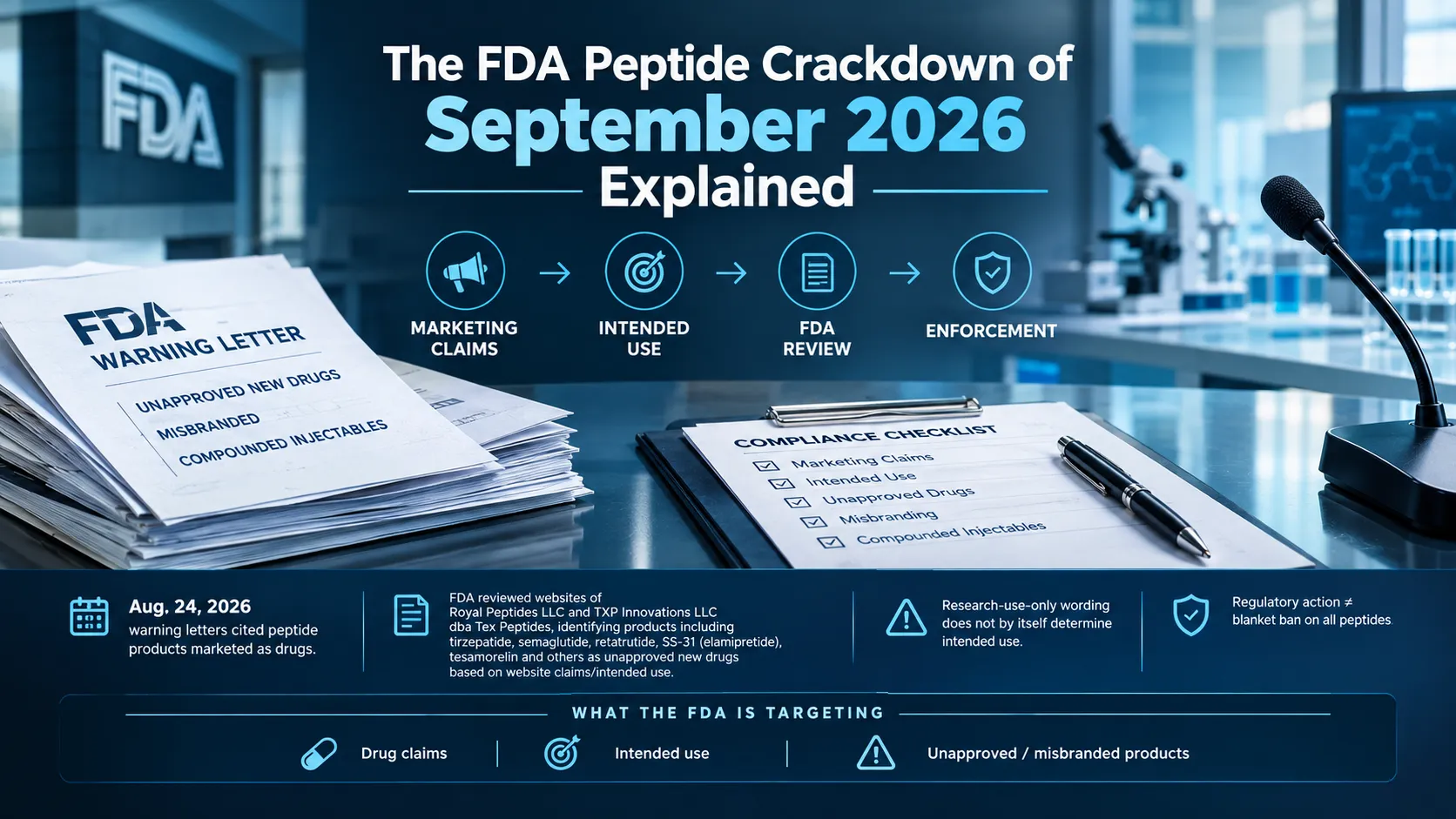
Second, regulatory adjacency. Many peptides are prescription-only or unapproved for human use, and enforcement activity around the wider market has been heavy. Processors price that uncertainty in advance. Our guide to whether research peptides are legal in the USA sets out the current position. Our explainer on the September 2026 FDA crackdown covers the enforcement side.
Third, chargeback dynamics. A compliant RUO vendor cannot make human-use efficacy claims. Buyers who expected an outcome have nothing to hold the vendor to, and some dispute the charge. High-risk merchant account providers cite exactly this pattern when pricing the category.
Fourth, reputational exposure. Banks weigh headline risk alongside financial risk, and that judgment is theirs to make.
The 2026 shift toward cryptocurrency
Chainalysis published on-chain data on June 4, 2026. Crypto flowing to gray-market peptide vendors jumped from $12 million in Q4 2025 to $32 million in Q1 2026. That is a 159% rise in a single quarter. The network has grown for six consecutive quarters. It is now pacing past a $100 million annual run rate. Larger payments have been skewing toward stablecoins.
Bloomberg covered the same market on July 20, 2026, syndicated by MoneyWeb. It put the Q1 figure at a 700% year-on-year increase. Its explanation of the payment problem was blunt. Banks and card networks "often won't work with suppliers in that gray area" because of the regulatory risk around unproven health claims.
That data describes the overseas gray market in unapproved compounds sold direct to consumers, much of it shipped from labs abroad without prescriptions. It is a different story from a US research-use vendor losing a merchant account. Both stories involve payment friction, and they are not the same story. Treat any article that merges them with suspicion.
Does accepting cards mean a peptide vendor is legitimate?
Card checkout is a convenience signal. It is weak evidence about the seller behind it.
One reason for that is transaction laundering. A seller in a restricted category obtains processing under an unrelated storefront, often something bland like apparel or essential oils, and routes sales through it. Legal commentators covering the peptide market, including Spodek Law Group, have flagged the federal exposure. Bank fraud under 18 U.S.C. § 1344 carries penalties of up to 30 years in prison and fines up to $1,000,000.
A second reason to distrust the card logos is payment-method churn. Industry outlets reported that Peptide Sciences closed abruptly in March 2026. It had been one of the largest online sellers. The same reporting describes it cycling through peer-to-peer apps, crypto, and cards. That reporting is secondary and was not confirmed by the company. The pattern it describes is still the useful part. A checkout page whose payment methods keep changing often reflects processor churn, not flexibility.
How can you tell a legitimate peptide vendor from a scam?
Read the whole checkout, not the card logos.
Encouraging signals. Several established payment methods. A named legal entity with a real address. Batch-specific certificates of analysis, which our guide to reading a peptide COA covers in detail. Support that answers before you buy. Refund and shipping policies that actually exist.
Caution signals. Crypto as the only option, since a settled crypto payment has no dispute mechanism. Zelle or Venmo instructions naming a private individual, not a business. Payment methods that change from month to month.
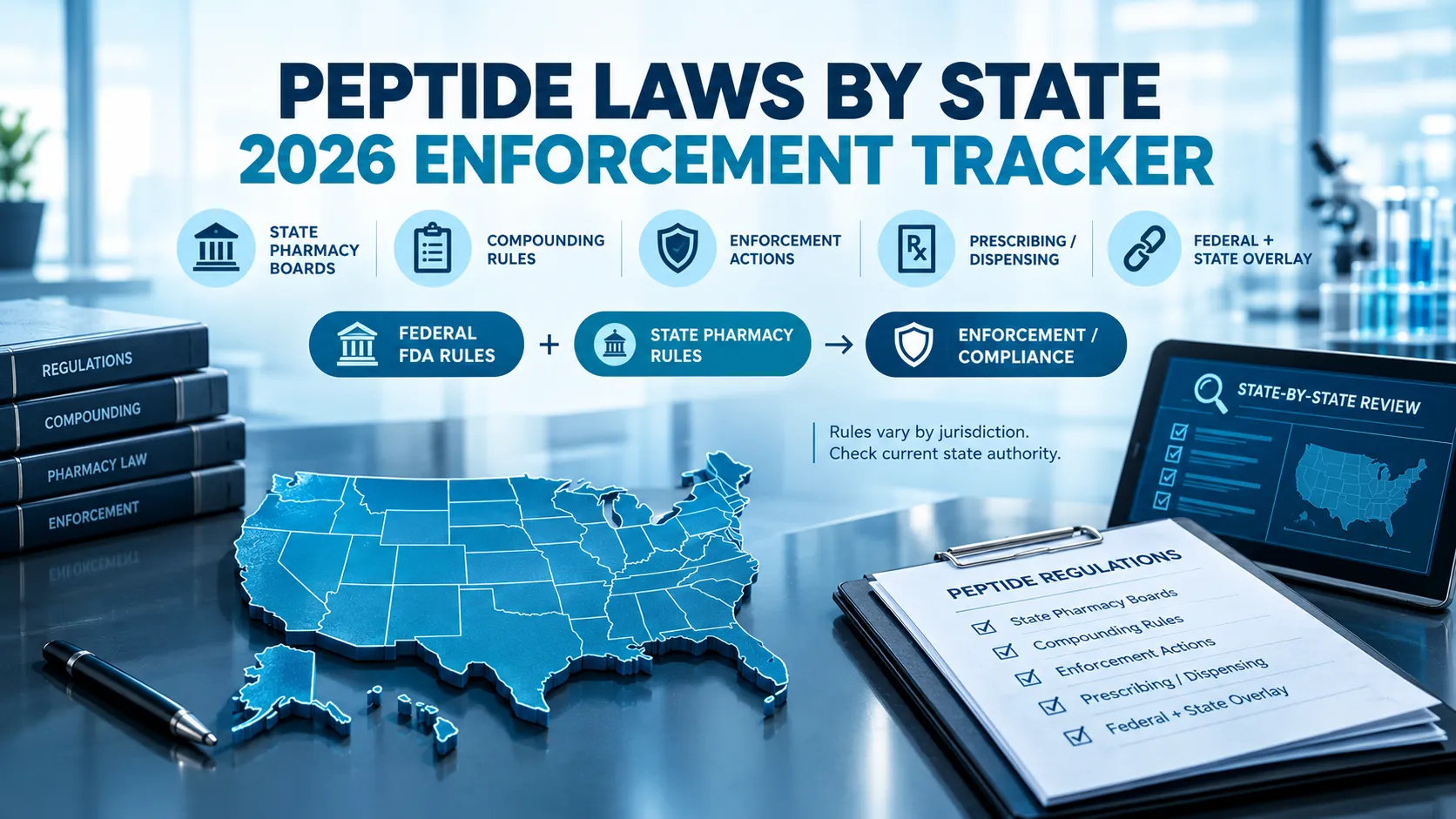
That checklist needs one balancing fact alongside it. Plenty of legitimate US vendors do keep card processing through specialist high-risk processors, and plenty of legitimate vendors do not. Absent card payments is common in this category, and on its own it proves nothing either way. Use the fuller checklist in our guide to buying research peptides online, and check the state-level picture in our 2026 enforcement tracker.
What card processing costs a vendor that keeps it
We can speak to this directly, because Helix Bio Chem is on the paying side of it.
Our current payment options are listed on our checkout page.
Keeping card checkout required a specialist high-risk processor. It costs us a 5% processing fee on every order. That is the concrete version of the economics described above, and it is the reason many vendors in this category stop trying.
We are not claiming this makes us the right vendor for anyone. It makes one narrow point about cost and underwriting. When a peptide site has no card option, cost and underwriting are usually the explanation, not character.
Frequently Asked Questions
Processors classify peptides as restricted or high-risk. Vendors get declined at underwriting, terminated later, or priced out of specialist processing.
Crypto needs no acquiring bank and no underwriting. For a vendor with no card option, it is often the fastest way to keep selling.
Paying by card gives you a dispute path that crypto and Zelle do not. It tells you nothing about product quality.
No. It does mean you have no chargeback recourse, so vendor diligence matters more before you pay.
A Mastercard database of merchants terminated by acquiring banks. Entries carry a reason code and remain for five years.
Underwriting outcomes differ from one vendor to the next. Some vendors pay for specialist high-risk processing, some were declined, and some were terminated.
Cards through high-risk processors, Zelle, and sometimes crypto. No single payment method proves that a vendor is legitimate.
Both settle quickly and reverse poorly. Treat a personal-name recipient on either as a serious warning.
Sometimes, through a specialist high-risk processor. A MATCH entry makes approval much harder for up to five years.
Chainalysis tracked a 159% quarterly jump to $32 million in Q1 2026, driven by overseas gray-market demand and closed banking access.
- 01Chainalysis, "Inside the $100M Gray Market Peptide Crypto Boom," 4 June 2026.
- 02Bloomberg, "'Wild West' of Untested Peptides Has Americans Paying in Crypto to Get Their Fix," 20 July 2026 (syndicated by MoneyWeb).
- 03Greenberg Traurig, "Massachusetts Court Rejects Attempt to Recast Breach of Contract as Chapter 93A Claim in Merchant Services Case," National Law Review, 9 June 2026 (Peptide Tech LLC v. Avidia Bank, D. Mass. No. 1:25-cv-13179).
- 04Stripe, "Prohibited and Restricted Businesses List FAQs," pharmaceutical and peptides section.
- 05Mastercard, Security Rules and Procedures, Merchant Edition, 4 August 2026, Chapter 11 (MATCH Pro System), sections 11.10 and 11.14.
- 0618 U.S.C. § 1344, Bank fraud.
Helix Bio Chem Team
Research & Product Team
Our in-house team tracks published peptide research and translates it into clear, source-cited summaries for the research community.
Reviewed by in-house research chemists
support@helixbiochem.com