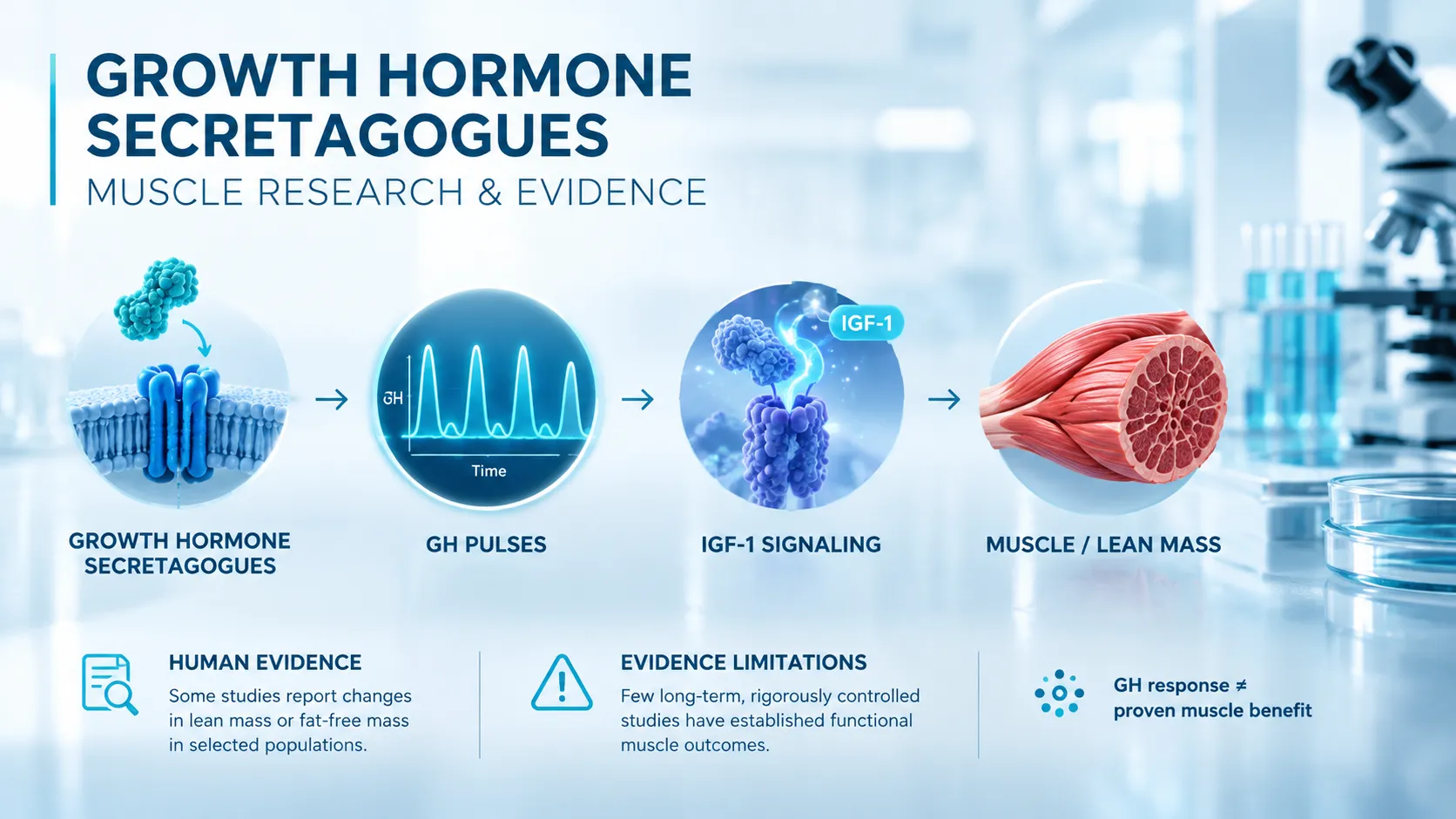
Human studies of growth hormone secretagogues report modest lean mass changes in selected populations, while direct muscle and strength evidence is much thinner.
Growth hormone, IGF-1, lean mass, muscle tissue and strength are separate endpoints. A change at one level does not prove a change at the next.
Tesamorelin's lean body mass gains of 1.2 to 1.42 kg come entirely from trials in adults with HIV and excess abdominal fat.
No qualifying human muscle endpoint trial was located for GHRP-2, GHRP-6 or ipamorelin, and CJC-1295's human data measured only GH and IGF-1.
In trials of three non-peptide ghrelin receptor agonists, lean mass rose each time but function improved in only one population.
The frequently cited older-adult lean mass study used [Nle27]GHRH(1-29)-NH2, a modified analogue, not sermorelin.
No qualifying human muscle trial in healthy trained adults was located in this review.
Growth hormone secretagogues can raise growth hormone and IGF-1 in people. What they do to muscle is a separate question. The answer depends on which molecule was tested, in whom, and on which endpoint. Human research on growth hormone secretagogues shows modest changes in lean mass in selected populations, but direct muscle and strength evidence is much thinner, especially for the peptide secretagogues themselves. This review sorts the published human studies by exact molecule and by the kind of muscle result each one reported. It describes research findings only and contains no dosing, handling or protocol guidance.
Which compounds this review covers, and why some are not peptides
A growth hormone secretagogue is any compound that makes the pituitary release more of its own growth hormone. Two receptor routes do most of that work. GHRH analogues act at the GHRH receptor, and ghrelin mimetics act at the ghrelin receptor, also called GHS-R1a. Our comparison of GHRH analogues and GHRPs explains the signaling, so this page uses the split only to organize evidence.
The review covers seven core compounds:
GHRH receptor side: sermorelin, CJC-1295 in its DAC and non-DAC forms, and tesamorelin.
Ghrelin receptor side: GHRP-2, GHRP-6 and ipamorelin.
Oral ghrelin receptor agonist: MK-677 (ibutamoren), which is a small molecule and not a peptide.
Two more non-peptide ghrelin receptor agonists, capromorelin and anamorelin, appear only as comparators. They sit outside the core set. They are included because their trials measured lean mass and strength in the same people.
IGF-1 LR3, MOTS-c, BPC-157 and TB-500 are left out. None of them works by releasing pituitary growth hormone, so none is a secretagogue.
Five kinds of muscle result, and why they are not a chain of proof
Studies in this field report five different kinds of result. Each kind answers a different research question.
Growth hormone in blood shows that the pituitary responded.
IGF-1, a growth factor made mostly in the liver, shows that the hormone axis engaged.
Lean mass is everything on a body scan that is not fat or bone, including water.
Muscle tissue measures include CT muscle area, muscle density and fiber size.
Strength and function cover grip, leg strength, walking tests and stair climbs.
These are categories of evidence, not steps in a guaranteed sequence. A change at one level is never proof of a change at the next. One study in this review found higher growth hormone with unchanged IGF-1. Two found more lean mass with unchanged strength.
Two measurement details change how results should be read. DXA scanning, short for dual-energy X-ray absorptiometry, sorts the body into fat, bone and lean mass. Its lean compartment includes water, organs and connective tissue as well as muscle. CT muscle density is read in Hounsfield units, and a rise mainly signals less fat inside the muscle.
One trial went further than DXA. In the MK-677 study discussed below, intracellular water, a rough marker of cell mass, rose 0.8 kg while it fell 1.0 kg on placebo.
Before reading any muscle claim, find the endpoint. Growth hormone and IGF-1 are hormone evidence. DXA lean mass is body-composition evidence. Only direct tissue and strength measures speak to muscle itself.
What each human study actually measured
The table lists every human study located with a muscle-related endpoint for the core peptides. It also shows one excluded analogue, because it is so often cited under the wrong name.
Compound
Exact molecule tested
Population
Design and size
Endpoint
Result
Main limitation
Tesamorelin
Tesamorelin
Adults with HIV and excess abdominal fat
Two phase 3 randomized trials, 26 weeks
DXA lean body mass
+1.3 kg and +1.2 kg, against -0.2 kg and -0.03 kg on placebo
HIV only; no strength test
Tesamorelin
Tesamorelin
Adults with HIV, five trials pooled
2026 meta-analysis
Lean body mass
Tesamorelin has by far the largest human dataset, and every trial with a lean mass endpoint was conducted in adults with HIV. One larger randomised trial ran outside that population, in 152 adults aged 55 to 87, but its endpoints were cognitive and its body-composition reporting covered percent body fat rather than lean mass. In the label's extension phase, people kept on tesamorelin held their lean mass steady. People switched to placebo lost 1.7 to 1.8 kg. The CT analysis kept only the tesamorelin participants whose visceral fat fell by at least 8%, while leaving the placebo group unfiltered. That filter breaks the original randomization, so it cannot show cause. Our tesamorelin research overview covers the visceral fat and IGF-1 record.
The sermorelin row needs particular care in reading. The study gave GHRH(1-29) nightly and was partly funded by the company that made sermorelin, but the abstract does not state the exact form. Two strength measures improved while IGF-1 did not change. Without a control group, the change cannot be attributed to the peptide.
CJC-1295's human data come from the long-acting DAC form and measured hormones only. No human trial of the non-DAC form was located. Ipamorelin's single human pharmacokinetic study is covered in our ipamorelin evidence review.
Which peptide secretagogues lack a direct human muscle endpoint
No qualifying human muscle endpoint trial was located for GHRP-2, GHRP-6, or ipamorelin. The same holds for CJC-1295 in either form. Our review of the tesamorelin and ipamorelin pairing found no controlled study of that combination at any level.
For GHRP-2, the closest evidence comes from rats and mice. In arthritic rats, 8 days of GHRP-2 prevented a rise in two muscle-wasting genes, MuRF1 and MAFbx. In burned rats, GHRP-2 reduced muscle protein breakdown. In growth-hormone-deficient mice, six weeks of GHRP-2 raised total body weight while worsening the body-composition profile typical of those animals. These findings concern breakdown and body composition in animals. They do not establish muscle growth in any species. The human GHRP-2 record, covered in our GHRP-2 research article, is hormonal and diagnostic.
For GHRP-6, no muscle study using the unmodified peptide was located in this review. Our GHRP-6 mechanism review traces what its record does contain.
The trials that measured strength alongside lean mass
The clearest test of the lean mass question comes from three non-peptide ghrelin receptor agonists. Each trial measured lean or fat-free mass and at least one strength or function outcome in the same people.
No change in strength or function; not powered for function
Capromorelin
395 adults aged 65 to 84 at risk of decline
Randomized, four dose groups vs placebo, stopped early
Lean body mass +1.4 kg vs +0.3 kg at 6 months
Tandem walk 0.9 seconds faster at 6 months; stair climb improved at 12 months
Anamorelin
979 adults with advanced lung cancer and cachexia
Two phase 3 randomized trials, 12 weeks
Lean mass rose in all three trials. Function improved modestly in one, among older adults already at risk of decline, and not in the other two. The anamorelin trials made lean mass and handgrip co-primary endpoints, so the split result was a planned test.
Populations, strength tests and statistical power all differed, so the three results cannot be pooled into one answer. In the MK-677 trial, fasting glucose and cortisol also rose. None of these comparators is a peptide, and their results do not transfer to the peptide secretagogues.
Why most positive results come from people who were losing muscle
The lean mass gains in this review come from older adults, adults with HIV and abdominal fat, and patients with cancer cachexia. The uncontrolled GHRH(1-29) study recruited men with low IGF-1. No qualifying human muscle trial in healthy trained adults was located in this review.
Animal work shows a similar pattern. GHRP-2 reduced breakdown signals in rats with arthritis or burns. In healthy mice, it added fat rather than lean mass. One reading is that the clearest signals appear where tissue is being lost. That is an interpretation of a pattern, not a tested finding.
Injected growth hormone shows a related split in young, fit adults. A 2008 systematic review of 27 study samples found lean body mass rose 2.1 kg. Strength and exercise capacity did not appear to improve. That review studied growth hormone itself, not secretagogues, so it is context rather than evidence for any compound here.
Muscle claims that do not survive an exact-molecule check
Claim as it circulates
What was actually tested
Why it does not transfer
Sermorelin raised lean mass in older men
[Nle27]GHRH(1-29)-NH2
A modified analogue, not sermorelin
GHRP-6 drives muscle cell growth
A GHRP-6-biotin conjugate in mouse muscle cells
A different molecule, in cell culture
Secretagogues protect muscle in chemotherapy cachexia
Hexarelin and JMV2894 in rats
Neither is a core compound here
CJC-1295 has human evidence
The DAC form, with GH and IGF-1 endpoints
Silent on the non-DAC form and on muscle
Tesamorelin builds muscle in adults
CT area and density in HIV responders
A selected subgroup; density mostly reflects less fat
U.S. regulatory context for the compounds discussed
Approval, compounding status and research-use labeling are separate questions. FDA's compounding categories describe whether the agency intends to act against compounders using a substance. None of these categories is an approval. The 503A entries below come from FDA's list updated May 14, 2026. The 503B entries come from the list updated March 21, 2025, and safety wording from FDA's page current as of April 22, 2026.
Compound
FDA-approved product today
Approval history
503A category
503B category
FDA-stated safety concern
Sermorelin
None
Approved as Geref in 1990 and 1997; approvals withdrawn effective June 18, 2009, at the maker's request; FDA found the withdrawal was not for safety or effectiveness
Not listed
Sermorelin acetate in Category 1
None listed
Tesamorelin
EGRIFTA SV and EGRIFTA WR, for excess abdominal fat in adults with HIV and lipodystrophy
First approved 2010; regulated as a biologic since 2020; EGRIFTA WR approved 2025
Not listed
Not listed
Label warnings include glucose intolerance
Capromorelin and anamorelin appear here only as research comparators, and their regulatory status is outside this article's scope.
Research-use-only status is a third, separate category. It means material is sold for laboratory work. It does not make a compound approved. An approved drug with the same active ingredient does not make research material equivalent to it.
This page summarizes published research only. Nothing here is guidance for dosing, administration or human use. Research-use-only material is not intended for any form of administration to people or animals.
What this evidence does not establish
Higher growth hormone does not guarantee higher IGF-1, and higher IGF-1 does not establish muscle gain.
More DXA lean mass does not establish more contractile muscle.
More lean mass does not establish more strength or better function.
Animal findings on muscle breakdown do not establish human muscle outcomes.
Results from one molecule, form or salt do not transfer to another.
Tesamorelin's results in HIV do not establish effects in adults without HIV.
An approved indication is not a muscle indication, and a past approval is not a current one.
No combination of these compounds has a controlled muscle trial.
The accurate summary is narrow. Some secretagogues raised lean mass modestly in selected populations. Direct muscle and strength evidence is thin, inconsistent across trials, and largely absent for the peptides themselves.
Got Questions?
Frequently Asked Questions
The human evidence does not support a simple yes or no. Some compounds raised lean mass modestly in older adults, adults with HIV or patients with cachexia. Strength results were inconsistent, and few trials measured muscle tissue directly.
GHRH analogues such as sermorelin, CJC-1295 and tesamorelin act at the GHRH receptor. GHRPs such as GHRP-2, GHRP-6 and ipamorelin act at the ghrelin receptor, GHS-R1a. Both routes increase pituitary growth hormone release.
Tesamorelin has DXA lean mass data and a CT muscle analysis in adults with HIV. Among non-peptide comparators, MK-677, capromorelin and anamorelin have trials measuring lean mass together with strength or function.
In a two-year randomized trial in 65 adults aged 60 to 81, MK-677 raised fat-free mass by 1.1 kg. Placebo recipients lost 0.5 kg. Strength and function did not change, although the authors noted the study was not powered for functional endpoints.
In adults with HIV, tesamorelin increased DXA lean body mass by 1.2 to 1.3 kg in its phase 3 trials. An exploratory CT analysis of visceral fat responders found small increases in trunk muscle area and density, which mainly reflects less fat within muscle. No strength outcome was reported.
No qualifying human muscle endpoint trial was located for either compound. CJC-1295's human studies used the long-acting DAC form and measured GH and IGF-1, and ipamorelin's human pharmacokinetic study measured GH after intravenous infusion.
No qualifying human muscle endpoint trial was located for either peptide. GHRP-2 reduced muscle-wasting gene expression and protein breakdown in rat injury models, and did not increase lean mass in healthy mice.
Lean mass on a DXA scan is everything that is not fat or bone, including water, organs and connective tissue. Muscle mass is one part of that compartment, so a lean mass gain is not proof of more contractile muscle.
No. Sermorelin was approved as Geref in 1990 and 1997, and FDA withdrew those approvals effective June 18, 2009, at the manufacturer's request. FDA later determined the products were not withdrawn for reasons of safety or effectiveness.
No compound in this review is approved for muscle growth. Tesamorelin is approved only for reducing excess abdominal fat in adults with HIV and lipodystrophy.
Not on its own. In one GHRH(1-29) study, growth hormone rose while IGF-1 did not change. Trials of injected growth hormone in fit young adults found higher lean mass without clear strength gains.
No qualifying human muscle trial in healthy trained adults was located in this review. The human lean mass data come mainly from older adults, adults with HIV and patients with cancer cachexia.
MK-677, also called ibutamoren, is an orally active small molecule, not a peptide. It acts at the ghrelin receptor like GHRP-2, GHRP-6 and ipamorelin, but its trial results do not transfer to those peptides.
It does not establish muscle hypertrophy in healthy adults, strength gains from any peptide secretagogue, or effects of any combination of these compounds. It also does not establish that tesamorelin's HIV results apply to other populations.