GHRP-2 Research: Human Pharmacology and Diagnostic Evidence
Growth researchSeptember 17, 202613 min read
GHRP-2 has a real human literature and one national diagnostic approval. What those studies measured, and why none of it establishes a therapeutic effect.
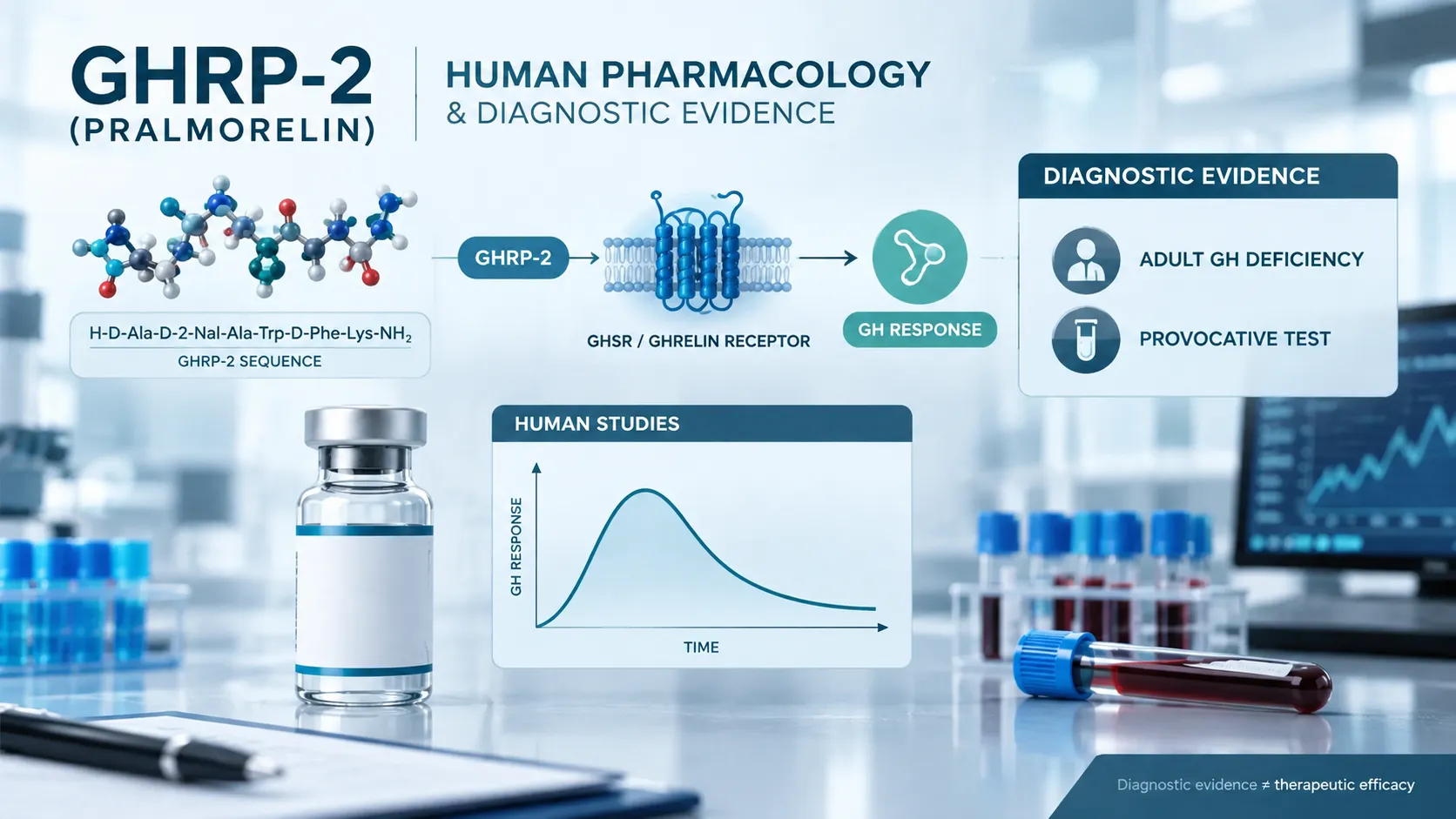
GHRP-2, pralmorelin, KP-102 and GPA-748 are names for one synthetic hexapeptide, split across a research literature and a Japanese diagnostic literature.
Most published human GHRP-2 research measures serum growth hormone over a few hours, which is pharmacology rather than outcome evidence.
Chronic administration of either GHRP-2 or GHRH converted an additive combined GH response into a synergistic one in human research, so the interaction class depends on prior exposure.
GHRPs do not release growth hormone independently of GHRH; a GHRH antagonist eliminated most of the GH response to GHRP-6 in healthy men.
GHRP-2 increased food intake by about 36 percent at a single buffet meal in seven lean healthy men, an acute human finding that does not extend to body weight or body composition.
Pralmorelin is approved in Japan as a single-use diagnostic agent for growth hormone deficiency, with a receiver-operating-characteristic cut-off of 15.0 micrograms per litre reported in the development literature; the thresholds applied in Japanese practice differ again by age group and assay.
A growth hormone peak is interpretable only alongside the stimulus used, the population tested and the assay that measured it.
Diagnostic approval in one country is not therapeutic approval anywhere, and GHRP-2 is not FDA-approved for any indication.
GHRP-2 is named explicitly at S2.2.4 of the WADA Prohibited List as a GH-releasing peptide, prohibited at all times.
Published studies used pharmaceutical-grade preparations characterised for those programmes, which establishes nothing about the identity or purity of any commercial research lot.
GHRP-2 is a synthetic growth hormone secretagogue that also carries the international nonproprietary name pralmorelin and the development codes KP-102 and GPA-748. Those names are not variants of a family. They are one molecule recorded in two separate literatures, one of which is a national diagnostic approval in Japan. That split is why GHRP-2 has more human data behind it than almost any other compound in its class, and also why that data is so often misread.
Featured In This Article
GHRP-2
RESEARCH PEPTIDE
Highly purified synthetic peptide prepared for rigorous laboratory research.
$72.00
This page covers the evidence layer only. What the human studies measured, how GHRP-2 behaves alongside GHRH, what the diagnostic research established, and where each of those findings stops. The chemistry sits elsewhere: the sequence, formula, mass and the position-by-position differences from GHRP-6 are handled in the GHRP-2 versus GHRP-6 structural comparison, and the receptor and signaling biology of the whole class in GHRH analogues versus GHRPs. Neither is repeated here.
What the human record actually contains
The honest summary is narrow and specific. GHRP-2 has a substantial body of acute human endocrine pharmacology, concentrated in the 1990s and early 2000s and largely produced by one research lineage. It has one national regulatory approval, in Japan, and that approval is diagnostic. It has no approved therapeutic indication anywhere.
The distinction that matters most is between a measured hormone concentration and a clinical outcome. Almost everything published on GHRP-2 in humans measures serum growth hormone over a few hours. Very little measures what happens to a person afterwards.
Evidence area
What was measured
Where it stops
Acute GH response
Serum GH over minutes to hours after experimental exposure
Says nothing about sustained GH output or any downstream endpoint
GHRH interaction
GH response to each agent alone and combined
The additive-versus-synergistic classification is not fixed; it moves with prior exposure
Chronic administration
Axis behaviour over days to weeks in small groups
No controlled outcome trial; desensitisation depends on schedule
Diagnostic testing
Peak GH after a single challenge, against a threshold
Identifies a secretory deficit; treats nothing
Appetite
Food intake at one buffet meal in seven men
No body weight, body composition or repeated-exposure data
Therapeutic efficacy
Not established in any indication
No approval, no pivotal outcome trial
GHRP-2 and GHRH: the finding that rules out a simple answer
This is where most writing on GHRP-2 goes wrong, usually by flattening a conditional result into a slogan.
The settled part is that a GHRP and GHRH given together produce a larger acute GH response than either alone in humans. That much has been reproduced across populations and is covered at class level in the receptor-mechanism stacking guide. Two receptors, two signaling routes, one cell type.
The part almost nobody reports is what Bowers and Granda-Ayala described in 1996. Younger and older men and women received chronic GHRP-2, GHRH, or both for periods of seven to thirty days. Chronic administration of either agent alone converted an additive GHRP-2-plus-GHRH response into a synergistic one, and the kind of synergy produced by prior chronic GHRP-2 differed from the kind produced by prior chronic GHRH. Whether the response desensitised over time depended in part on schedule and frequency.
Read carefully, that result says something unusual. Additive versus synergistic is not a fixed property of the GHRP-2/GHRH pair. It is a property of the pair in a subject with a particular exposure history. Two studies can report different interaction classes, both correctly, because they tested different states of the same axis. Any page that answers "is GHRP-2 plus GHRH synergistic?" with a flat yes or no has not read the conditional.
Study exposure conditions are reported here as evidence, not as procedure. Infusion rates, schedules and durations from published research describe what investigators did under medical supervision in a controlled setting. They are not transferable to any other context and are deliberately omitted from this page.
A second layer sits underneath. GHRPs do not release GH independently of the GHRH system, a claim repeated constantly in commercial writing. Pandya and colleagues gave a specific GHRH antagonist before GHRP-6 to nine healthy men and most of the GH response disappeared, with the maximal rise over baseline falling from roughly 34 to roughly 6 micrograms per litre. That study used GHRP-6 rather than GHRP-2, which is precisely why it should be cited as class evidence and not quietly relabelled.
How the response changes with the person
The GH response to GHRP-2 is not a constant. It moves with physiological state, and several human studies were designed specifically to show that.
Wideman, Veldhuis and colleagues examined GHRP-2 alongside L-arginine in men and women, at rest and with exercise. The supra-additive interaction seen at rest was blunted in relative magnitude by exercise, and sex controlled the relative but not the absolute size of that interaction. The authors' interpretation was mechanistic rather than clinical: exercise likely releases both GHRH and somatostatin, and the observed pattern is consistent with GHRP-2 acting partly by opposing central somatostatin tone.
Illness moves it further. In men with prolonged critical illness, GH, TSH and LH secretion were suppressed at baseline, and a five-day GHRP-2 infusion reactivated GH secretion and normalised serum IGF-1, IGFBP-3 and the acid-labile subunit. That is a striking endocrine result and a poor therapeutic one: it demonstrates that a suppressed axis remains responsive, not that responding to it helps the patient. Only low T4 and high IGFBP-1 independently predicted mortality in that cohort.
Three variables therefore have to be read off every GHRP-2 study before its number means anything: age, sex, and the physiological state of the axis at baseline.
The appetite question has a human answer, and it is smaller than it sounds
Most writing treats GHRP-2 and appetite as an animal-model story. It is not. Laferrère, Abraham, Russell and Bowers infused seven lean healthy men with GHRP-2 or saline and then measured intake at an ad libitum buffet meal. Subjects ate 35.9 plus or minus 10.9 percent more on GHRP-2 than on saline, every subject increased intake on a per-kilogram basis, and the effect was statistically significant. Serum GH rose as expected. Macronutrient composition of what they ate did not differ.
The result is real and it is human. It is also seven men, one meal, one acute exposure, all lean, all male. No body weight was measured, no repeated exposure was tested, and nothing in the design speaks to appetite over days. "GHRP-2 increased food intake at a single meal in seven lean men" is the claim the study supports. "GHRP-2 increases appetite in people" overshoots it, and "GHRP-2 affects body composition" is not in the paper at all.
The diagnostic literature, and what a provocative test is
This is the part of the GHRP-2 record with genuine regulatory weight, and the part most consistently overstated.
A growth hormone provocative test challenges the pituitary with a stimulus and measures the peak serum GH that follows. The logic is that a somatotroph population with adequate reserve responds and one without does not. The test measures secretory capacity at a moment. It is a measurement instrument, and measuring a deficiency is categorically different from treating one.
Pralmorelin was developed for exactly this. Its diagnostic rationale is that it raises plasma GH markedly in healthy subjects largely regardless of sex, obesity or age, while the response in GH-deficient patients is significantly lower. Receiver-operating-characteristic analysis produced a peak GH cut-off of 15.0 micrograms per litre separating GH-deficient patients from healthy controls. Kaken holds the Japanese rights; the product reached approval in Japan as a single-use diagnostic agent, and no equivalent approval exists in the United States or Europe.
The threshold is where careful reading pays. A GHRP-2 cut-off is not portable. Japanese paediatric GH-deficiency criteria apply a peak GH threshold for the GHRP-2 test that differs from the threshold used for other stimulation tests in the same guidance, because a more potent stimulus produces higher peaks in everyone and the line has to move with it. Assay choice matters on top of that: Japanese GH measurement kits were standardised in 2005 and subsequent nationwide surveys found inter-kit variation large enough to require correction formulas for some analysers.
So a GH peak is meaningful only as a triple: which stimulus, which population, which assay. A number quoted without all three is not a diagnostic result.
The test establishes
The test does not establish
Peak GH after a defined single challenge
That GH output outside the test is abnormal
Whether a response falls above or below a validated threshold
That the threshold transfers to another country, age group or assay
Secretory capacity of the somatotroph population
Any benefit from stimulating that capacity
That one national regulator accepted a diagnostic dossier
That the compound is approved as a treatment anywhere
What this research does not establish
Each line below is a boundary, not a hedge.
Receptor activation is not clinical benefit. That GHRP-2 engages GHS-R1a is receptor pharmacology. It predicts nothing about outcomes.
GH release is not therapeutic efficacy. A serum concentration measured over four hours is a pharmacodynamic marker, not an endpoint.
Diagnostic approval is not treatment approval. Japan licensed a measurement tool. No regulator anywhere has approved GHRP-2 to treat anything.
One national approval is not global status. Approval, importation, sale, possession and use are separate legal questions that resolve differently by jurisdiction.
A single human study is not a universal response. The interaction studies show the same axis giving different answers by age, sex, illness and prior exposure.
Animal endocrine findings are not human outcomes. Where a claim rests on rodent work, it stays labelled as rodent work.
The literature's material is not this material. Published studies used pharmaceutical-grade preparations characterised for that programme. That says nothing about the identity, salt form or purity of any vial sold today, which is a documentation question answered by the certificate of analysis for the specific lot.
Regulatory position, stated in separate boxes
These are four different questions and collapsing them is the most common error on the topic.
United States. GHRP-2 is not FDA-approved for any indication and has not completed the drug approval process. Its position within the compounding framework is a separate matter again, covered in the 503A bulks list explainer.
Japan. Pralmorelin is approved as a diagnostic agent for assessing GH deficiency. The approval covers a specific formulation used once as a challenge, not ongoing administration.
Sport. The World Anti-Doping Agency names GHRP-2 explicitly. It appears at S2.2.4 of the Prohibited List as "GHRP-2 (pralmorelin)" within the GH-releasing peptides, prohibited at all times, in and out of competition.
Not FDA-approved does not mean illegal everywhere, and approved in Japan does not mean approved anywhere else. Both errors appear routinely on pages selling this compound.
Reading the source literature without being misled
Three habits catch most of the misattribution in circulation.
Check which compound a study actually used. Class findings get relabelled constantly, and the GHRH-antagonist result above is the clearest example: it is GHRP-6 evidence that appears on page after page as GHRP-2 evidence.
Check who ran it. A large share of the human GHRP-2 record traces to one investigator group. Internal consistency across those papers is not independent replication, and saying so is not a criticism of the work.
Check what the endpoint was. If the outcome variable is a hormone concentration, the study is pharmacology. Pharmacology is genuine evidence, and it is not evidence of benefit.
Got Questions?
Frequently Asked Questions
Yes. Pralmorelin is the international nonproprietary name for the same synthetic hexapeptide called GHRP-2 in the research literature. The two names track two different bodies of writing about one molecule, which is why searches under each name return different material.
KP-102 is a development code for GHRP-2, appearing in the pharmaceutical record alongside the related codes KP-102 D, KP-102 LN and GPA-748. Development codes identify a programme and sometimes a specific formulation, so a code appearing on documentation does not by itself confirm what is in a container.
Yes, more than most compounds in its class. The human record is concentrated in acute endocrine pharmacology from the 1990s and early 2000s, plus a Japanese diagnostic development programme. What it largely lacks is controlled research measuring downstream outcomes rather than hormone concentrations.
It shows that experimental GHRP-2 exposure raises serum growth hormone in defined settings, that the size of the response varies with age, sex and physiological state, and that the axis remains responsive even when suppressed by critical illness. It does not show a therapeutic effect on any endpoint.
Given together, the two produce a larger acute GH response than either alone, because they act at separate receptors on the same cell type. Whether that combined response is additive or supra-additive is not fixed: human research found that prior chronic administration of either agent converted an additive response into a synergistic one.
No, and this is one of the most frequently repeated errors about the class. In a human study using a specific GHRH antagonist, most of the GH response to GHRP-6 was eliminated. GHRPs act at a distinct receptor but depend on an intact endogenous GHRH signal for a maximal response.
Yes. Pralmorelin was developed as a provocative testing agent and is approved in Japan as a single-use diagnostic for assessing growth hormone deficiency. This is the only national regulatory approval GHRP-2 has received in any jurisdiction.
It measures peak serum growth hormone after a single controlled challenge, and compares that peak against a validated threshold. The test assesses secretory capacity of the pituitary at one moment; it does not measure day-to-day growth hormone output and it does not treat anything.
Because a more potent stimulus produces higher peaks in everyone, including healthy subjects, so the threshold separating deficient from non-deficient has to be revalidated for each stimulus. Japanese criteria apply a different peak threshold for the GHRP-2 test than for other stimulation tests, and measurement kit differences require further correction.
One controlled human study reported that seven lean healthy men ate about 36 percent more at a single ad libitum meal during GHRP-2 infusion than during saline. That is a genuine acute human result in a very small, narrow sample, and it establishes nothing about appetite over time, body weight or body composition.
They differ at two positions, both at the N-terminus, and share an identical C-terminal core, which puts them about 55 daltons apart. The structural detail, the mass arithmetic and the analytical consequences are covered in the dedicated comparison article rather than here.
Both act at GHS-R1a, but they come from different structural lineages: ipamorelin is a pentapeptide lacking the central Ala-Trp dipeptide and containing no tryptophan, so describing it as a modified GHRP-2 is incorrect. Their human evidence bases also differ in kind, with GHRP-2 carrying a diagnostic development programme that ipamorelin does not.
No. GHRP-2 is not approved by the FDA for any indication and has not completed the drug approval process. Its approval in Japan is diagnostic and specific to that jurisdiction and formulation, and does not extend to therapeutic use anywhere.
Yes. The World Anti-Doping Agency names it explicitly at S2.2.4 of the Prohibited List, listed as GHRP-2 (pralmorelin) among the GH-releasing peptides, prohibited both in and out of competition.
No. Published work used preparations characterised for those specific programmes, and identity, salt form and purity of any current lot are documentation questions answered only by that lot's certificate of analysis. A compound name shared with a study is not evidence about a container.