Peptide Concentration Calculation: Reconstitution and Dilution Math
Recovery protocolsSeptember 15, 202613 min read
Peptide concentration is mass divided by volume. The formulas for reconstitution, dilution and aliquots, and the assumptions the arithmetic cannot check.
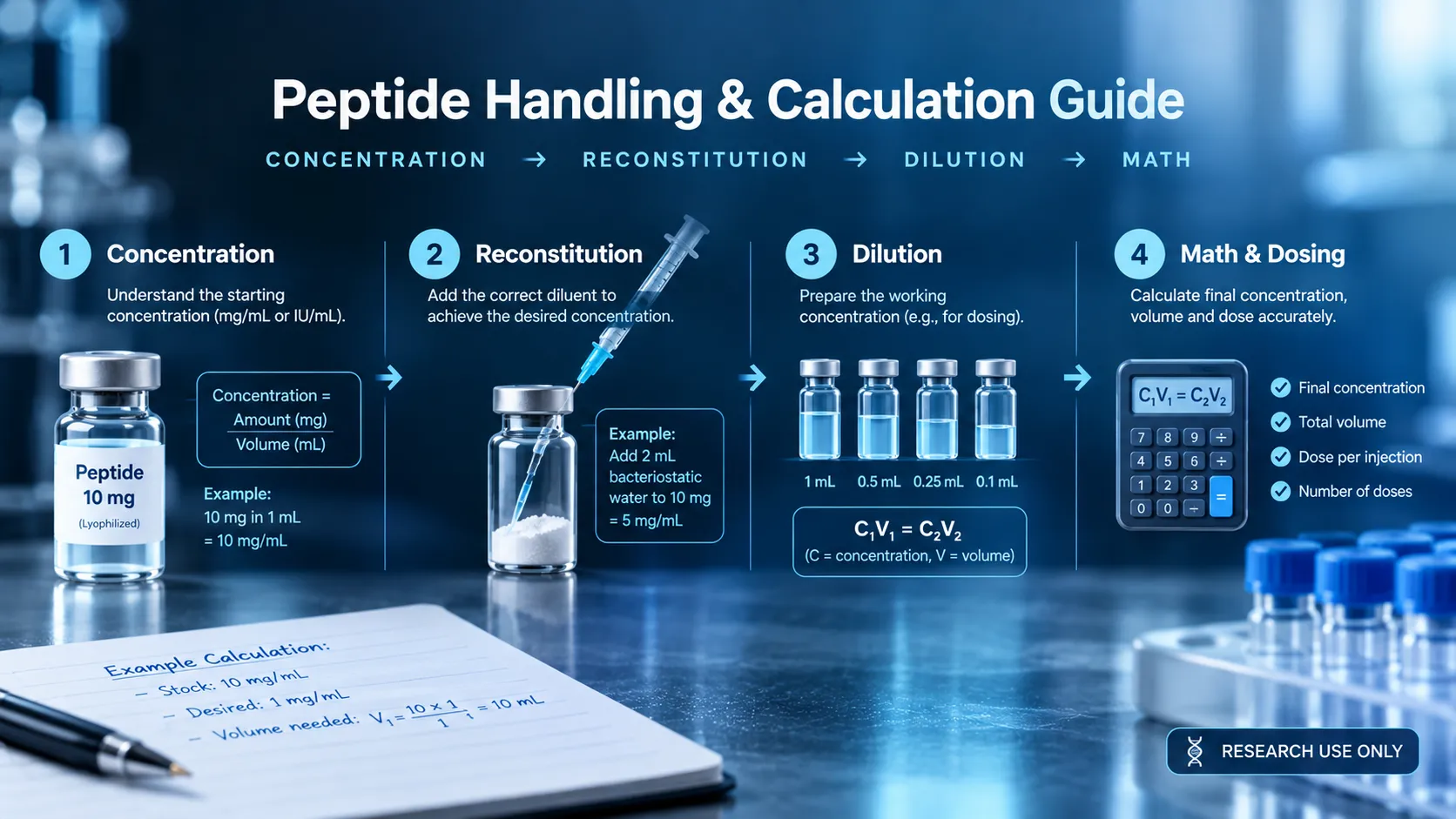
Peptide mass concentration is calculated as C = m / V, where mass in mg divided by solution volume in mL returns a result in mg/mL.
The same relationship rearranges to m = C x V for the amount in a stated volume and V = m / C for the volume containing a stated amount.
Reconstitution creates a concentration, dilution lowers an existing one, and aliquoting removes a portion at unchanged concentration; they are three distinct operations.
The dilution equation C1V1 = C2V2 applies when the amount of solute is conserved between the starting and final solutions and the units on both sides are compatible.
C1V1 = C2V2 returns the volume of stock solution required, not the volume of diluent; the diluent volume is the final volume minus the stock volume.
A dry vial has no starting concentration, so the dilution equation cannot be applied until the first solution has been prepared.
Lyophilized synthetic peptides are usually isolated as salts, so the weighed mass includes counterion and residual water as well as peptide.
Net peptide content is the percentage of total weighed mass that is peptide, and it is a different measurement from HPLC purity.
Converting mass concentration to molarity requires the molecular weight, so two preparations at the same mg/mL can differ several-fold in molar concentration.
A concentration calculation cannot establish identity, purity, sterility, complete dissolution, recovery from surfaces, or the analytically measured concentration of the finished solution.
Peptide concentration is mass divided by volume. Ten milligrams of material dissolved in 2 mL of diluent gives 5 mg/mL, and every other solution calculation in the laboratory is a rearrangement of that one relationship. The arithmetic almost never fails on its own. What fails are the assumptions underneath it: that the mass printed on the label is the mass of peptide, that the volume added is the volume of the final solution, and that all of the material dissolves and stays dissolved. This guide sets out the calculations first, then examines each assumption in turn, so the number you end up with can be read for what it is. Everything below concerns laboratory solution mathematics for research materials.
Featured In This Article
BAC Water
RESEARCH PEPTIDE
Highly purified synthetic peptide prepared for rigorous laboratory research.
$10.00
Concentration Is a Ratio, Not a Property of the Vial
A vial does not have a concentration. It has a mass of solid. Concentration only exists once a volume is defined, which is why the same vial can legitimately produce many different concentrations depending on how much diluent is added. The peptide quantity does not change when more liquid goes in; the ratio does.
Mass concentration is written:
C = m ÷ V
Quantity
Symbol
Typical laboratory units
Mass concentration
C
mg/mL, mcg/mL, mg/L
Mass of solute
m
mg, mcg
Volume of solution
V
mL, µL, L
The same relationship rearranges two ways, and between them these three forms cover most bench calculations:
m = C × V gives the amount contained in a stated volume of solution.
V = m ÷ C gives the volume that contains a stated amount.
The result carries the units you put in. Milligrams divided by millilitres returns mg/mL; micrograms divided by millilitres returns mcg/mL. Because 1 mg equals 1,000 mcg, mixing the two inside a single expression produces an error of exactly three orders of magnitude, which is large enough to be obvious and small enough to survive a quick glance at the page. Converting everything to one unit pair before substituting anything is the cheapest safeguard available. The full set of mg, mcg, mL and µL conversions is covered separately.
Reconstitution, Dilution and Aliquoting Are Three Different Operations
These three are often described interchangeably, and the vocabulary matters because each one holds something different constant.
Operation
Starting material
What changes
What stays constant
Governing equation
Reconstitution
Dry or lyophilized solid
A concentration comes into existence
Total peptide mass
C = m ÷ V
Dilution
An existing solution
Concentration falls
Total peptide mass transferred
C1V1 = C2V2
Aliquoting
An existing solution
The amount removed
Concentration
V = m ÷ C
Reconstitution creates a concentration where none existed. Dilution lowers one that already exists. Aliquoting removes a portion at a concentration that does not change at all. A dry vial has no C1, so the dilution equation cannot be applied to it until the first solution has been made.
Worked Example: Mass Concentration from a Vial
Nominal mass 10 mg, stated solution volume 2.0 mL:
C = 10 mg ÷ 2.0 mL = 5 mg/mL, equivalently 5,000 mcg/mL.
Read that as a ratio rather than a total. Each millilitre of the solution is calculated to contain 5 mg; the vial as a whole still contains the 10 mg it started with.
Dilution Mathematics and Where C1V1 = C2V2 Applies
The dilution relationship is:
C1 × V1 = C2 × V2
C1 and V1 describe the starting solution and the volume taken from it. C2 and V2 describe the final solution and its total volume. The equation holds because the amount of solute transferred is the same on both sides of the operation. It is conservation of mass rewritten in terms of concentration, so it applies whenever solute is conserved and the units on each side are compatible, and it does not apply where solute is created, consumed, or removed.
To prepare 5.0 mL of a 1 mg/mL solution from a 5 mg/mL stock:
The number the equation returns is the stock volume, not the diluent volume. Reaching 5.0 mL total requires 4.0 mL of diluent added to that 1.0 mL, and this is only true if the two volumes are additive, which is a reasonable working assumption for dilute aqueous preparations and a poor one in other solvent systems. Stating which volume a figure refers to, every time, removes an entire category of error.
Calculating an Aliquot Volume
Once concentration is known, the volume corresponding to any target laboratory amount follows from the same relationship:
V = m(target) ÷ C
From a 5,000 mcg/mL solution, an aliquot containing 250 mcg is:
250 mcg ÷ 5,000 mcg/mL = 0.05 mL, or 50 µL
Two practical notes sit behind that clean number. Small volumes carry proportionally larger transfer error, so the same 250 mcg drawn from a more dilute solution is measured more reliably. And the calculation describes the volume, not the recovery: what leaves the pipette and what arrives in the receiving vessel are separate questions.
When Molarity Is the Right Unit
Mass concentration answers how much material is present. Molar concentration answers how many molecules are present, which is what binding studies, receptor work and stoichiometric comparisons actually require. Converting between the two needs the molecular weight:
moles = mass ÷ molecular weight
M = moles ÷ litres of solution
A peptide with a molecular weight near 1,000 g/mol at 1 mg/mL sits at roughly 1 mM. A peptide near 5,000 g/mol at the same 1 mg/mL sits at roughly 0.2 mM. The mass concentrations are identical and the molar concentrations differ fivefold, which is why two preparations described as "1 mg/mL" are not comparable across compounds without the molecular weight in hand.
One detail is easy to miss here. The molecular weight used must sit on the same mass basis as the material weighed out. A free-base molecular weight applied to a salt-form powder will overstate molarity, for the reason set out in the next section.
Nominal Mass Is Not Necessarily Net Peptide Mass
This is the largest gap between a calculated concentration and a measured one, and it has nothing to do with arithmetic.
Lyophilized synthetic peptides are usually isolated as salts. Trifluoroacetate is the common counterion because trifluoroacetic acid is used in cleavage and purification, and it associates with basic residues such as lysine, arginine and histidine along with a free N-terminal amine. Acetate and chloride forms also exist. Residual water is present as well, since lyophilized peptide powders are hygroscopic. The weighed mass therefore covers peptide plus counterion plus moisture plus trace residual solvent.
Net peptide content is the percentage of that total mass which is actually peptide. A theoretical estimate uses only the counterion contribution:
For a peptide of molecular weight 1,000 carrying two trifluoroacetate counterions (MW about 114), that is 1,000 ÷ 1,228, or roughly 81 percent. The measured value is determined by quantitative amino acid analysis or elemental analysis and is typically lower than the theoretical figure, because water and residual solvents are not in the formula.
The consequence for concentration is direct. A powder weighing 10 mg at 80 percent net peptide content contains 8 mg of peptide. Dissolved in 2.0 mL, the peptide concentration is 4 mg/mL, not the 5 mg/mL the nominal arithmetic returns. Nothing in the calculation can detect that 20 percent difference.
Net peptide content and purity are different measurements and are not interchangeable. Purity, usually reported as HPLC area percent, describes how much of the peptidic material is the intended sequence. Net peptide content describes how much of the total weighed mass is peptide at all. A lot can be 99 percent pure and still be well under 99 percent peptide by weight. Check which basis a lot-specific certificate reports before treating a labelled mass as peptide mass.
Where a certificate of analysis reports the figure, reading it field by field settles the question for that lot. Where it does not, the nominal mass is an assumption rather than a measurement, and the resulting concentration inherits that status.
Added Volume Is Not Necessarily Final Volume
C = m ÷ V takes the volume of the finished solution. The number usually entered is the volume of diluent added, and those two are not identical. Dissolved solid displaces its own volume, liquid is held up in the syringe and needle used for the transfer, and the volume delivered by a device is only as accurate as its calibration.
The sensitivity is easy to see. Holding a nominal 10 mg fixed:
Solution volume
Calculated concentration
1.9 mL
5.26 mg/mL
2.0 mL
5.00 mg/mL
2.1 mL
4.76 mg/mL
A five percent volume error moves the concentration by five percent in the opposite direction. The relationship is inverse and proportional, so volume precision sets the ceiling on how precisely the concentration is known. These figures are arithmetic illustrations of that sensitivity, not measurements of any particular material.
What the Calculation Does Not Establish
A calculation returns a value derived from the inputs supplied to it. It has no access to the material. Everything in the second column below is an assumption the arithmetic makes silently, and the third column is what would be needed to replace the assumption with evidence.
The result tells you
Only if this is true
Established instead by
Concentration in mg/mL
The stated mass is peptide mass
Net peptide content on the lot certificate
Concentration in mg/mL
The stated volume is the final volume
Calibrated volumetric measurement
Amount per aliquot
All material dissolved fully
Visual inspection at minimum, assay if it matters
Amount in solution
Nothing was lost to surfaces
Recovery testing for that peptide and container
Anything about the molecule
The vial holds the intended compound
Mass spectrometry for identity
Anything about composition
Adsorption deserves particular attention because it is invisible and can be severe. Peptide loss to glass and plastic surfaces varies unpredictably with sequence, charge, container material and concentration. In one systematic study of three cationic membrane-active peptides, only 10 to 20 percent of the peptide was recovered from 1 µM solutions held in glass or polypropylene containers, and the authors warned that 90 percent or more might be lost at typical experimental concentrations. That result is specific to those peptides and those conditions rather than a general rule, but it establishes the size of the effect that calculated concentration cannot see. Dilute working solutions are the most exposed, since the same absolute loss represents a far larger fraction of what is present.
Sterility, degradation state and biological activity sit entirely outside the arithmetic as well. None of them is a function of mass and volume.
How Calculator Inputs Map onto the Mathematics
A tool does the same algebra faster and without transcription slips, which is a genuine advantage. It does not resolve any of the assumptions above; it inherits them from whatever is typed in.
Vial mass becomes m, and is nominal unless a net peptide content figure says otherwise.
Diluent volume becomes V, and is an added volume standing in for a final volume.
Resulting concentration is the quotient of those two.
A target laboratory amount, divided by that concentration, returns a volume.
Once the variables and their units are clear, the peptide concentration and reconstitution calculator will run the arithmetic. What it produces is a calculated value, and the distinction between that and an analytically measured one holds regardless of which tool performs the division. Preparation technique itself, including diluent choice and handling, is covered in the reconstitution and stability guide.
Errors That Recur
Applying the dilution equation to a dry vial, where no starting concentration exists yet.
Reporting the stock volume from C1V1 = C2V2 as though it were the diluent volume.
Reusing a concentration figure after the preparation was made at a different volume.
Treating a nominal labelled mass as net peptide mass.
Comparing mg/mL figures across different compounds as if they represented equal numbers of molecules.
Entering µL where the equation expects mL.
Treating an aggregate figure on a multi-component preparation as though it described each component, a problem that blend certificates make explicit.
Record the four numbers that define any preparation at the moment it is made: nominal mass and its basis, diluent volume and what measured it, calculated concentration with units, and the lot number. A concentration without those four is not reproducible, and the lot number is what connects the calculation back to the analytical documentation.
Where the Arithmetic Ends
The calculation is exact and the material is not. C = m ÷ V will always return the right answer for the inputs given, which is precisely why the inputs deserve the scrutiny. Mass basis, final volume, dissolution and recovery each sit between the calculated number and the concentration actually present in the vessel, and each is settled by documentation or measurement rather than by dividing again. The useful habit is to carry units through every step, state which volume a figure describes, and treat a calculated concentration as a well-founded expectation rather than a result.
Got Questions?
Frequently Asked Questions
Mass concentration is calculated as C = m / V, where m is the mass of peptide and V is the volume of the finished solution. Using mg and mL returns a result in mg/mL; using mcg and mL returns mcg/mL.
Divide the mass in milligrams by the solution volume in millilitres. A nominal 10 mg in 2.0 mL calculates to 5 mg/mL, which is the same as 5,000 mcg/mL.
Reconstitution dissolves a dry or lyophilized solid so that a concentration exists for the first time, and is governed by C = m / V. Dilution lowers the concentration of a solution that already exists, and is governed by C1V1 = C2V2.
It applies when a portion of an existing solution is transferred into a larger final volume and the amount of solute is conserved, with compatible units on both sides. It does not apply to a dry vial, because no starting concentration exists until the material is dissolved.
No. Solving for V1 gives the volume of stock solution needed. The diluent volume is the final volume minus that stock volume, assuming the two volumes are additive.
No. Adding diluent changes the concentration, not the total quantity of peptide present. The same nominal mass spread across a larger volume simply produces a lower mg/mL figure.
Divide the target laboratory amount by the concentration: V = m / C. From a 5,000 mcg/mL solution, an aliquot containing 250 mcg corresponds to 0.05 mL, or 50 microlitres.
Molarity is appropriate when the experiment depends on the number of molecules present rather than the mass, such as receptor binding or stoichiometric work. Converting requires the molecular weight, since moles equal mass divided by molecular weight.
Yes, and the difference can be large. At 1 mg/mL, a peptide near 1,000 g/mol sits around 1 mM while one near 5,000 g/mol sits around 0.2 mM.
Not necessarily. Lyophilized peptides are commonly isolated as salts, so the weighed powder includes counterion and residual water alongside the peptide itself. The net peptide content figure on a lot-specific certificate is what resolves this.
The calculation assumes the nominal mass is peptide mass, the added volume is the final volume, dissolution is complete, and nothing is lost to container surfaces. Each of those can be false to a degree the arithmetic cannot detect.
No. A calculator performs arithmetic on the values entered into it and has no access to the material. Identity is established by mass spectrometry and purity by chromatographic analysis, both reported per lot.