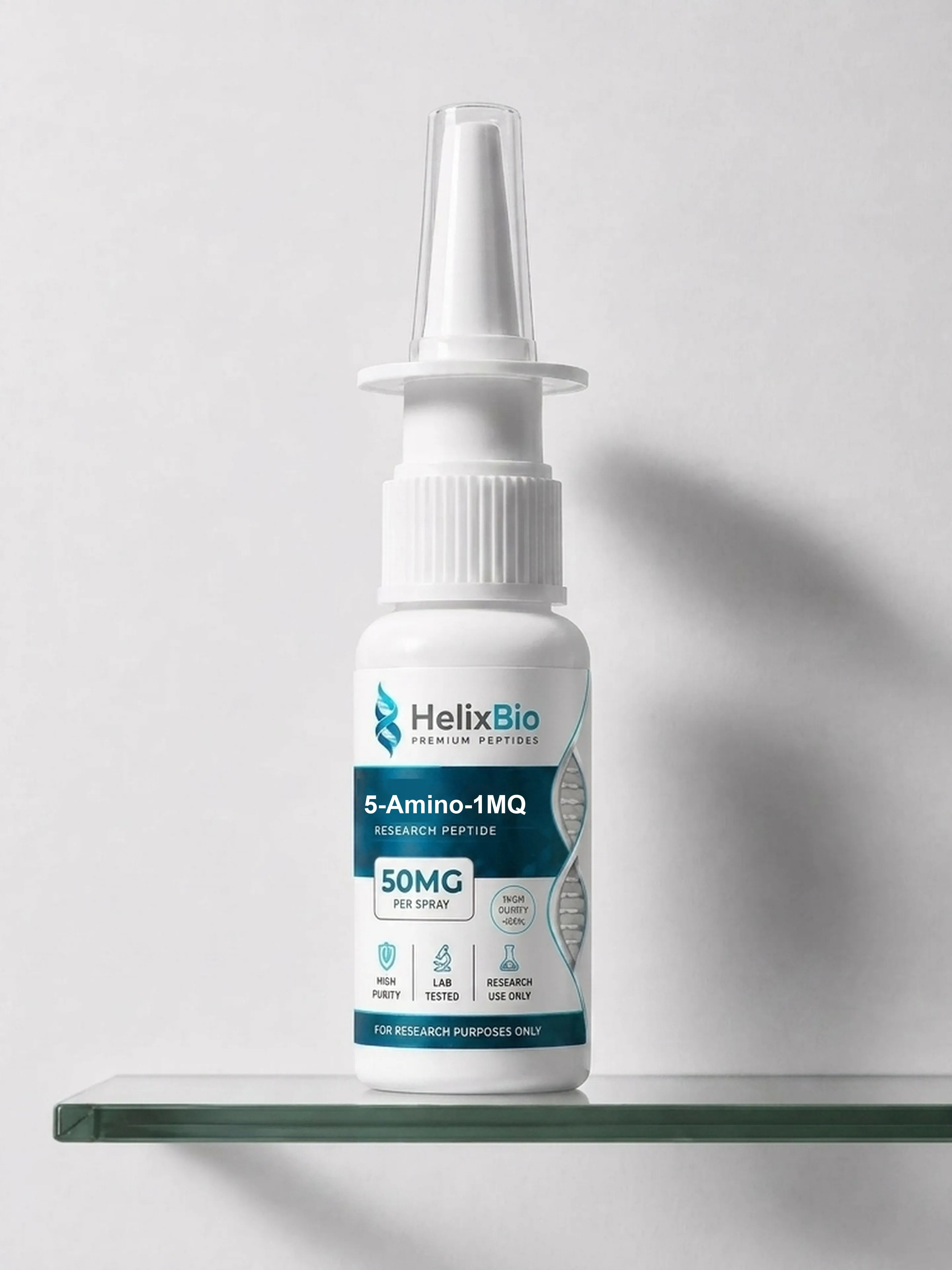
5-Amino-1MQ Spray is a research-use liquid formulation of 5-amino-1-methylquinolinium, a synthetic small-molecule inhibitor of nicotinamide N-methyltransferase (NNMT). Despite appearing in peptide catalogues, 5-Amino-1MQ is not a peptide. It is a quinolinium salt with no amino acid sequence, and it works by inhibiting an enzyme rather than by binding a receptor. Published research on the compound is preclinical, drawn from cultured adipocytes, myoblasts, and rodent models. Helix Bio supplies this material for laboratory research only.
HPLC certified
Independent analysis
Highest standard
Full traceability
5-Amino-1MQ is the working shorthand for 5-amino-1-methylquinolinium, a synthetic organic cation built on a quinoline scaffold. Researchers use it as a selective, membrane-permeable inhibitor of nicotinamide
N-methyltransferase, a cytosolic enzyme that transfers a methyl group from S-adenosylmethionine to nicotinamide. The compound was developed through medicinal chemistry work on the methylquinolinium scaffold and has since become the reference tool compound for NNMT inhibition in metabolic and skeletal muscle research.
The classification matters more here than on most product pages. 5-Amino-1MQ is routinely catalogued alongside peptides, and a large share of the search traffic around it uses the word “peptide” outright. It is not one. Peptides are amino acid chains joined by peptide bonds; 5-Amino-1MQ is a single bicyclic aromatic cation with a molecular weight of 159.21 g/mol for the free ion. That difference determines how the material is handled, how it is characterised analytically, and which experimental models it fits.
Because the compound is supplied as a salt rather than as a free base, the counter-ion carries real weight. The iodide and chloride forms differ by roughly 47% in the mass of active cation delivered per milligram of
solid. In a solution product such as this one, the concentration on the label is only interpretable once the mass basis is known. The Product Details tab sets out the molecular identity and the mass-basis arithmetic in full.
5-Amino-1MQ is a synthetic small molecule, specifically a quaternary quinolinium cation carrying an amino substituent at the 5-position and a methyl group on the ring nitrogen. Its systematic name is
5-amino-1-methylquinolin-1-ium. Researchers encounter it under several labels, including 5-amino-1MQ, 5A1MQ, and the generic vendor abbreviation NNMTi. All refer to the same cation.
The compound is not a peptide, not a peptide analogue, and not a nucleotide precursor. It contains no amino acids and no peptide bonds. Analytically it behaves like a small organic salt, which means identity confirmation relies on chromatographic and spectrometric methods appropriate to small molecules rather than the sequence-confirmation approaches used for peptides.
| Property | Value |
|---|---|
| Systematic name | 5-amino-1-methylquinolin-1-ium |
| Common synonyms | 5-Amino-1MQ, 5A1MQ, 5-amino-1-methylquinolinium, NNMTi |
| Compound class | Synthetic small molecule; quinolinium (quaternary ammonium) cation |
| Cation formula | +C10H11N2 |
| Cation molecular weight | 159.21 g/mol |
| PubChem CID | 950107 (cation) |
| CAS 42464-96-0 | Registered to the iodide salt, C10H11N2·I, MW 286.11 g/mol |
| Chloride salt | C10H11ClN2, MW 194.66 g/mol |
| Molecular target | Nicotinamide N-methyltransferase (NNMT, EC 2.1.1.1) |
| Peptide sequence | None — not a peptide |
| Format | Aqueous spray solution |
| Intended use | Laboratory research only |
Two salt forms circulate in the research supply chain. The iodide is the form to which CAS 42464-96-0 is registered and the form stocked by reference-standard suppliers. The chloride also appears commercially, frequently listed under the same CAS number, which is a labelling error rather than a genuine ambiguity in the registry.
The distinction is not cosmetic. Iodide contributes 126.90 g/mol to a 286.11 g/mol formula unit, so the active cation accounts for 55.6% of the mass. Chloride contributes 35.45 g/mol to a 194.66 g/mol unit, putting the cation at 81.8%. The practical result:
Two materials labelled “50 mg” therefore differ by about 47% in delivered active mass. For a solution product the same arithmetic governs concentration: a stated figure means one thing if it refers to the salt and another if it refers to the free cation. Researchers should record which basis applies before calculating working concentrations, and should specify the salt form explicitly in any protocol or publication.
Reported molecular weights for this compound vary widely across commercial listings, including values that are simply wrong. Anchoring to the cation weight of 159.21 g/mol and stating the salt separately avoids the confusion.
This product is supplied as a liquid spray rather than as a lyophilised solid. That changes what the material is suited to and what documentation it needs. A solution has a concentration rather than a mass, so the useful specification is amount per unit volume together with the vehicle composition. It also has a different stability profile from dry powder, and it cannot inherit storage conditions or shelf-life estimates from powder-form data.
The published in vivo literature on 5-Amino-1MQ used systemic administration in rodents. No published work characterises the pharmacokinetics or formulation stability of this compound in an aqueous spray.
Laboratories working with the solution format should treat formulation behaviour as something to establish empirically rather than something the literature has already settled.
Nicotinamide N-methyltransferase is a cytosolic enzyme that methylates nicotinamide. It takes a methyl group from S-adenosylmethionine (SAM) and transfers it to nicotinamide, producing 1-methylnicotinamide (MNA) and S-adenosylhomocysteine. The enzyme is expressed at high levels in liver and adipose tissue, and its expression rises in aged skeletal muscle.
5-Amino-1MQ occupies the nicotinamide substrate site on NNMT and blocks the methyl transfer. Because the reaction is prevented, less SAM is consumed and less MNA is produced. Nicotinamide that would otherwise have been methylated and excreted remains available to the NAD+ salvage pathway.
Researchers study the downstream consequences of that shift, including cellular NAD+ availability, sirtuin
activity, and the size of the methyl-donor pool.
The chain runs in order: NNMT inhibition, then reduced SAM consumption and reduced MNA output, then nicotinamide retained for NAD+ salvage, then altered NAD+/NADH balance and downstream sirtuin signalling. Each step in that sequence has been measured in experimental systems; none of it has been
measured in humans.
The compound is membrane-permeable, which is why it works in intact cells rather than only in isolated enzyme assays, and it was characterised as selective against structurally related methyltransferases and NAD+ salvage enzymes.
Metabolic research in rodents. Neelakantan and colleagues (2018) tested a series of small-molecule NNMT inhibitors including 5-Amino-1MQ in diet-induced obese mice. The work characterised membrane permeability using parallel artificial membrane and Caco-2 assays, tested selectivity against related methyltransferases, and measured effects on lipogenesis and intracellular metabolite levels in cultured adipocytes. In the animal arm, researchers measured reductions in fat mass and improvements in metabolic markers relative to controls. These are described endpoints in a mouse model, not effects attributed to any product.
Skeletal muscle and regeneration. A 2019 study from the same group reported that NNMT inhibition activated senescent muscle stem cells in aged mice and improved regenerative capacity after injury, with corresponding increases in myofiber cross-sectional area and contractile function. The same treatment promoted myoblast differentiation in cultured C2C12 cells, with accompanying changes in cellular NAD+/NADH redox state. NNMT is overexpressed in aged skeletal muscle, which is the rationale for studying it in sarcopenia and regeneration models.
Later work. NNMT inhibition has since been examined alongside exercise in aged mice, and independent groups have developed structurally distinct NNMT inhibitor series. Findings from those programmes describe the enzyme target, not this specific compound, and should not be attributed to 5-Amino-1MQ without checking which inhibitor was used.
The evidence base for 5-Amino-1MQ is entirely preclinical. It consists of enzyme assays, cell culture work in adipocytes and myoblasts, and rodent studies. There are no published human trials. Searches of the ClinicalTrials.gov registry return no registered studies for 5-Amino-1MQ, for 5-amino-1-methylquinolinium, or for NNMT inhibitors as a class. There is no Investigational New Drug application on the public record.
Metabolic targets have a poor translation record from rodent models to human outcomes. Findings described above should be read as measurements taken in specific experimental systems under specific conditions, and not as predictions about any other species or context.
Researchers frequently encounter 5-Amino-1MQ next to NAD+ precursors and mitochondrial peptides, and the mechanisms are genuinely different.
| Compound | Class | Mechanism |
|---|---|---|
| 5-Amino-1MQ | Small molecule, quinolinium salt | Inhibits NNMT; conserves nicotinamide and SAM |
| NMN, NR | Small molecules, nucleoside / nucleotide precursors | Supply substrate into the NAD+ salvage pathway |
| MOTS-c | 16-residuemitochondrial-derived peptide | Peptide signalling associated with AMPK-linked pathways |
NAD+ precursors add substrate. NNMT inhibition reduces the loss of substrate and, separately, preserves the methyl-donor pool, an effect precursor supplementation does not produce. The two approaches are studied as complementary rather than as competitors, and no head-to-head human data exists for any of these comparisons.
Analytical documentation matters more for this compound than the category average, because two distinct problems circulate in the supply chain. The first is salt-form mislabelling, where chloride material is listed under the iodide CAS number. The second is arithmetic error, with molecular weights reported that correspond to neither salt nor the free cation. Both are avoidable by reading the lot documentation rather than the product title.
For any lot of 5-Amino-1MQ, the documentation should establish the following:
A certificate of analysis is only useful if it corresponds to the material received. Check that the lot number on the certificate matches the label, that the test date is consistent with the manufacturing date, and that the reported method matches the analyte. A catalogue-level quality statement is not a substitute for a
lot-specific result, and no purity figure should be assumed from a product page.
Our guide to reading a certificate of analysis covers the general verification process in more detail. [Link to
/how-to-read-peptide-certificate-of-analysis]
Storage and stability guidance for this product must come from its own documentation. Solution-format material does not share the stability profile of lyophilised powder, and conditions published for solid
5-Amino-1MQ should not be applied to a spray. Where a supplier has not established stability data for the specific formulation, that gap should be treated as an experimental variable rather than filled with an assumption.
Standard laboratory practice applies: keep the container closed when not in use, maintain accurate labelling and inventory records, avoid unnecessary temperature cycling, and follow institutional procedures for handling research chemicals.
5-Amino-1MQ Spray is supplied by Helix Bio for laboratory research and analytical use only. It is not intended for human or veterinary consumption, for administration by any route, or for the diagnosis, treatment, cure, mitigation, or prevention of any disease or condition. It is not a dietary supplement, a cosmetic, or a consumer product.
5-Amino-1MQ is not an FDA-approved drug in the United States. It has no approved indication and no approved label. No Investigational New Drug application for the compound appears on the public record, and no clinical trial of 5-Amino-1MQ is registered on ClinicalTrials.gov at any phase.
The compound was not among the bulk drug substances reviewed by the FDA Pharmacy Compounding Advisory Committee at its meeting of 23–24 July 2026, which considered a separate set of peptide substances. Its regulatory position should not be inferred from proceedings concerning other compounds, and availability for research purchase does not indicate regulatory review of any kind.
The research summarised on this page was conducted in enzyme assays, cultured cells, and rodent models. Findings from those systems describe what was measured under those conditions. They do not establish safety or efficacy in humans, and nothing on this page should be read as suggesting a human application.
Materials are supplied to qualified researchers, laboratories, and institutions conducting legitimate scientific work. Purchasers are responsible for determining whether a material suits their intended experimental application, and for complying with applicable institutional, federal, state, and local requirements governing the acquisition, handling, storage, and disposal of research chemicals in their jurisdiction.
Knowledge Base
Knowledge Base
Knowledge Base
Knowledge Base
Knowledge Base
Knowledge Base
Knowledge Base
Knowledge Base
Knowledge Base
Knowledge Base
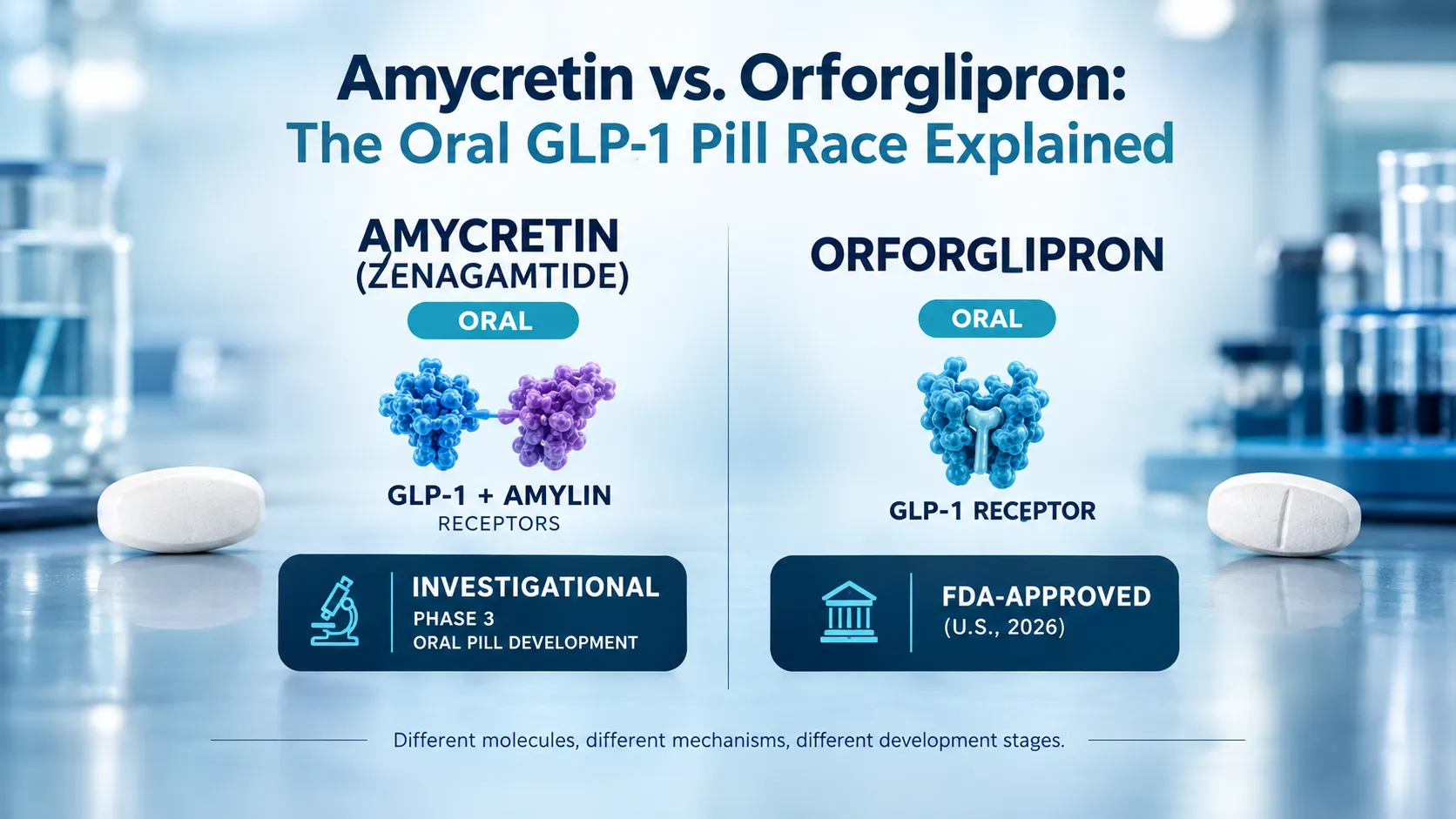
Amycretin is a peptide and orforglipron is not. How that chemistry explains the formulations, trial results, and approval status of both GLP-1 pills.
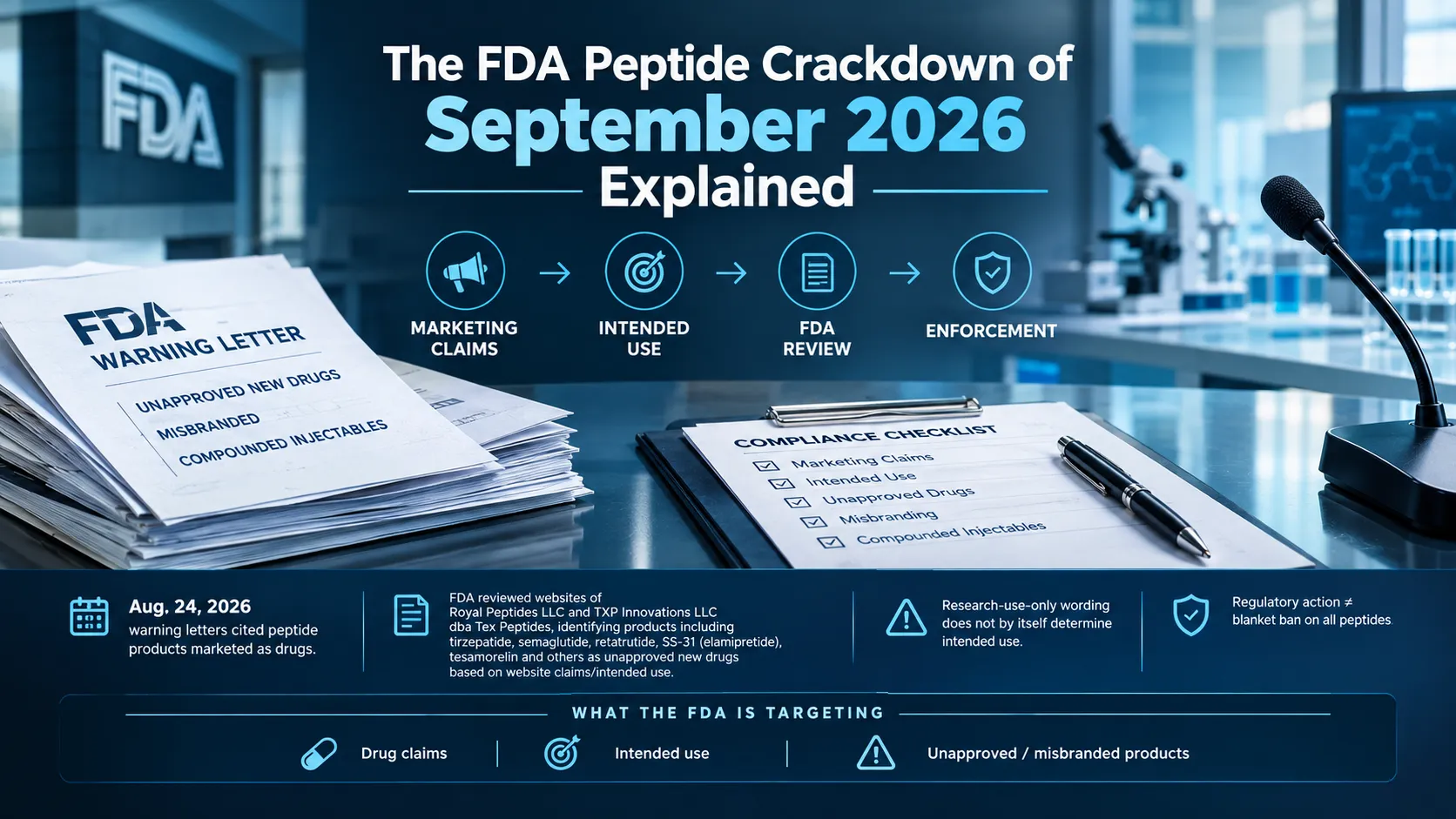
Five peptide sellers got FDA warning letters in September 2026. See who was named, why the research label failed, and the full 2026 enforcement timeline.

In July 2026, the FDA's advisory committee recommended 6 peptides for the 503A bulk list. None are on it yet. What the vote changed and what it didn't.