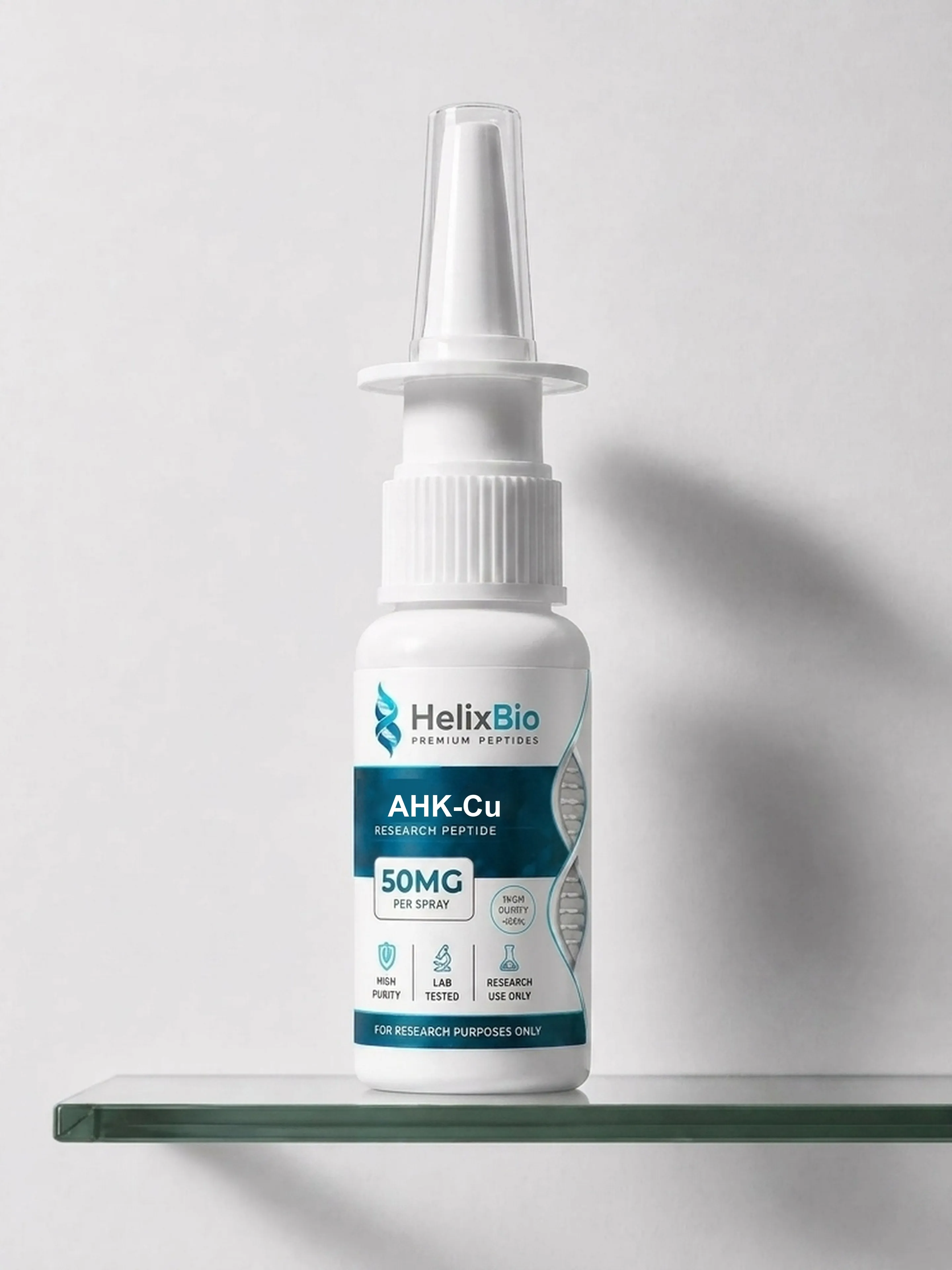
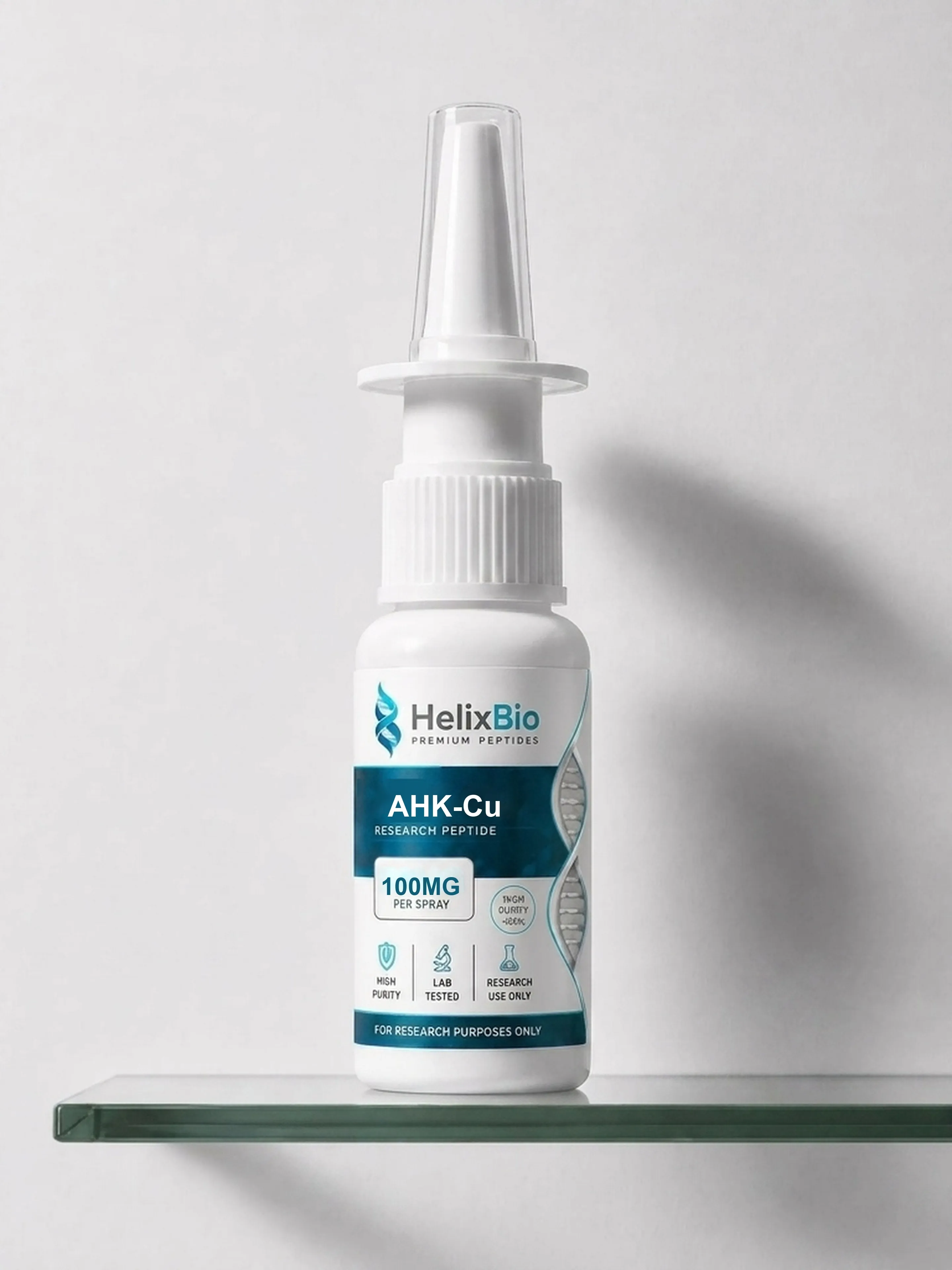
One methyl group separates AHK-Cu from the copper peptide most people mean when they say “copper peptide.” AHK-Cu is the copper(II) complex of the synthetic tripeptide L-alanyl-L-histidyl-L-lysine; GHK-Cu is the copper complex of glycyl-L-histidyl-L-lysine, an endogenous peptide first isolated from human plasma. Alanine carries a methyl where glycine carries a hydrogen. Everything else about the two molecules — the histidine, the lysine, the copper coordination — is the same, and their published evidence bases are not. Helix Bio supplies AHK-Cu Spray as a prepared-solution research material for qualified laboratory and scientific applications. It is offered strictly for research use and is not intended for human or veterinary consumption, diagnosis, treatment, or prevention of disease.
HPLC certified
Independent analysis
Highest standard
Full traceability
AHK-Cu is a copper(II) complex of a three-residue synthetic peptide, L-alanyl-L-histidyl-L-lysine. The free peptide has the formula C₁₅H₂₆N₆O₄ and a molecular weight near 354.4 g/mol; the copper complex is commonly reported as C₁₅H₂₄CuN₆O₄. In cosmetic-ingredient nomenclature it is designated copper tripeptide-3, and it is supplied commercially in salt forms including the hydrochloride, CAS 682809-81-0.
Copper binding follows the pattern shared across this small family of peptides: the terminal amine, the histidine imidazole and a backbone nitrogen together form a square-planar coordination site with high affinity for copper(II). AHK and GHK share that motif, which is why the two complexes behave comparably as coordination chemistry and why their distinction has to be made on identity rather than on binding behaviour.
The naming deserves attention because it is a genuine source of error. AHK-Cu is copper tripeptide-3. GHK-Cu is copper tripeptide-1. The two designations differ by a single digit, are routinely transposed in commercial listings, and at least one widely consulted chemical database lists AHK-Cu among the synonyms for GHK — meaning a synonym search can return the wrong substance with no visible sign anything went wrong. Identity here is worth confirming rather than assuming.
The mass separation between the two peptides is 14.03 daltons, the mass of a methyl group. On a high-resolution instrument that is unambiguous. It is not, however, a gap that survives a casual nominal-mass check, and it sits in the range of mass shifts that turn up routinely in peptide analysis for other reasons. Distinguishing AHK from GHK is a deliberate analytical step.
A spray-format material arrives as a prepared solution rather than a dry powder. There is no reconstitution step, and the concentration, solvent system and any excipients are set by the manufacturer rather than chosen at the bench.
For a metal–peptide complex that difference reaches further than it does for a plain peptide. A lyophilised powder is characterised once and stored dry. A complex already in solution is in an environment where coordination chemistry is active: speciation for peptides of this type depends on pH and on whatever else in the solvent system can compete for copper. What fraction of the copper is complexed rather than free, in any particular prepared solution, is a property of that specific formulation and is established by measurement rather than by inference from the compound’s chemistry.
None of that is a criticism of prepared solutions, and none of it is a claim about this product. It is the set of questions worth putting to a supplier of any copper-complex solution, alongside the ordinary ones about concentration and storage. The answers belong in product documentation.
Product documentation and lot-specific analytical information should be reviewed before a material enters an experimental workflow.
AHK-Cu has been examined in a narrower set of contexts than the copper-peptide category as a whole. Published and directly relevant areas include:
The broader copper-peptide literature — wound healing, extracellular matrix biology, gene-expression profiling, anti-inflammatory work — is substantially GHK-Cu literature. It provides context for the chemistry but does not constitute evidence about AHK-Cu, and findings from one should not be attributed to the other.
AHK-Cu is not an FDA-approved drug in the United States. On FDA’s list of bulk drug substances nominated for use in compounding under section 503A, updated 14 May 2026, AHK-Cu does not appear in any of the three categories. GHK-Cu, by contrast, is listed in Category 1 for non-injectable routes, under evaluation. Absence from the list reflects that the substance was not nominated for that process; it is neither a safety finding nor an endorsement.
Two things are worth a supplier saying plainly about this compound.
The first is how to confirm what the material is. For a copper–peptide complex, identity is a two-part determination and a single number does not cover it. Reversed-phase HPLC and mass spectrometry characterise the peptide — and for this peptide specifically, the target is a mass consistent with roughly 354 rather than roughly 340, the 14.03 Da methyl difference that separates AHK from GHK. Copper is a separate question entirely, answered by an elemental method such as ICP-MS or atomic absorption spectroscopy, and it is not implied by any peptide purity figure. A certificate reporting peptide purity alone has characterised half the substance.
The second is that AHK-Cu is not the copper peptide with the large literature. GHK-Cu is. Most of what circulates about copper peptides — collagen, matrix remodelling, wound-healing models, gene-expression work — comes from GHK-Cu research, and applying it to AHK-Cu is not supported. Researchers wanting the extensively studied compound should be looking at GHK-Cu, which Helix supplies separately. Researchers wanting AHK-Cu specifically should know that its own published record is narrow and is described honestly in the research section below.
Helix Bio states that its research peptide catalogue uses independent HPLC testing for purity assessment and mass spectrometry for molecular identity confirmation, and that batch-specific Certificates of Analysis are available. For AHK-Cu Spray specifically, the applicable lot documentation is what establishes the analytical result.
AHK-Cu Spray is intended for qualified users working in legitimate laboratory or scientific research environments, including:
The product is not intended for personal experimentation, self-administration, human consumption, veterinary use, cosmetic application, or medical treatment.
| Specification | Details |
|---|---|
| Product Name | AHK-Cu Spray |
| Compound | AHK-Cu |
| Scientific Name | Copper(II) complex of L-alanyl-L-histidyl-L-lysine |
| Synonyms | Copper tripeptide-3; Ala-His-Lys copper complex |
| Peptide | L-alanyl-L-histidyl-L-lysine |
| Sequence | Ala-His-Lys |
| Amino Acid Count | 3 |
| Compound Type | Peptide–copper(II) complex |
| Peptide Molecular Formula | C₁₅H₂₆N₆O₄ |
| Peptide Molecular Weight | approximately 354.4 g/mol |
| Complex Molecular Formula | C₁₅H₂₄CuN₆O₄ (as commonly reported) |
| CAS Number (hydrochloride form) | 682809-81-0 |
| Copper Coordination | ATCUN-type: terminal amine, histidine imidazole, backbone nitrogen |
| Related Compound | GHK-Cu (copper tripeptide-1), differing by one methyl group |
| Format | Spray solution |
| Salt Form | Refer to current lot-specific product documentation |
| Concentration | Refer to current product listing |
| Fill Volume | Refer to current product listing |
| Copper Content | Refer to current lot-specific product documentation |
| Intended Use | Research and laboratory investigation only |
| Human Use | Not intended for human consumption |
| Veterinary Use | Not intended for veterinary use |
| Cosmetic Use | Not intended for cosmetic or topical application |
| Purity | Refer to current lot-specific product documentation |
| Identity Testing | Refer to applicable Certificate of Analysis |
| Packaging | Refer to current product listing |
| Storage | Follow current product-specific documentation |
| Manufacturer | Helix Bio |
| Country of Origin | Not specified; verify current product documentation |
The Primary AHK-Cu Study. The substantive published record on AHK-Cu rests largely on one paper: Pyo and colleagues, Archives of Pharmacal Research, 2007. Human scalp hair follicles were maintained in organ culture for twelve days — 240 follicles from three volunteers, thirty per condition — alongside cultured human dermal papilla cells. AHK-Cu at 10⁻¹² to 10⁻⁹ M stimulated follicle elongation ex vivo and dermal papilla cell proliferation in vitro. At 10⁻⁹ M the Bcl-2/Bax ratio was elevated and the cleaved forms of caspase-3 and PARP were reduced.
One finding is regularly reported as more settled than the paper states. Flow cytometric measurement of apoptotic dermal papilla cells showed a reduction that was not statistically significant — the authors say so in the abstract. Commercial summaries generally omit the qualifier.
The study is ex vivo and in vitro. Its title says so. Human tissue in culture is not a human trial, and no controlled human clinical trial of AHK-Cu was identified in preparing this page.
What Belongs to GHK-Cu and Not to AHK-Cu. Three claims are attached to AHK-Cu across the commercial market more often than any others: that it stimulates dermal fibroblast proliferation, elevates VEGF, and reduces TGF-β1 secretion. In the Pyo paper those statements appear in the introduction, as background describing the tripeptide-copper complex class, drawn largely from work on GHK-Cu. They are not that study’s measured endpoints, which were follicle elongation, dermal papilla cell proliferation and the apoptosis markers above.
This matters beyond bookkeeping. GHK-Cu has hundreds of publications spanning wound-healing models, extracellular matrix biology, gene-expression profiling and anti-inflammatory work. AHK-Cu has a small fraction of that. A researcher choosing between them on the strength of a merged literature is choosing on a false premise.
Coordination Chemistry. Both AHK and GHK bind copper(II) through the ATCUN-type motif — terminal amine, histidine imidazole and a backbone nitrogen forming a square-planar site. That shared motif makes the pair useful in structure-activity work asking what a single side-chain change does when the coordination sphere is held constant. The glycine-to-alanine substitution alters side-chain sterics and hydrophobicity without altering the donor set.
Analytical Differentiation. The 14.03 Da separation between the two peptides is a small target by the standards of peptide analysis, which makes this pair a legitimate subject for method development. Copper complexes bring their own analytical handles — the natural copper isotope pattern is a distinctive signature in mass spectra — and distinguishing complexed from free metal requires elemental methods that sit outside routine peptide workflows.
Evidence Boundaries. Everything published on AHK-Cu comes from cell culture and tissue culture. Findings in those systems describe those systems. They do not establish safety or effectiveness for any use in humans, they do not transfer to any commercial formulation, and they should not be extended by analogy to GHK-Cu’s larger record.
A copper–peptide complex raises a question a plain peptide does not: purity of what?
Three different numbers can reasonably be called purity here. Peptide purity, determined chromatographically, describes the tripeptide component. Copper content, determined by an elemental method, describes how much metal is present. Complex stoichiometry describes the relationship between them. A certificate reporting one of these has not reported the others, and a single unqualified purity percentage does not indicate which was measured.
Identity has the same two-part structure. The mass target for the peptide component is consistent with roughly 354 rather than the roughly 340 of GHK — a 14.03 Da separation that is decisive on a high-resolution instrument and easy to miss on a coarse one. Copper presence and quantity are a separate determination requiring ICP-MS, atomic absorption spectroscopy or an equivalent method.
Helix Bio states that its peptide materials are subjected to independent HPLC testing for purity and mass spectrometry for molecular identity, and that batch-specific Certificates of Analysis are available. For a specific AHK-Cu Spray lot, the applicable COA and product documentation carry the actual analytical results.
Researchers should assess, where applicable:
No certification, regulatory approval, or quality claim should be inferred unless explicitly documented by the manufacturer or the relevant regulatory authority.
Storage and handling requirements should be determined from the current AHK-Cu Spray product documentation and lot-specific instructions.
General laboratory considerations include:
Three transfers to avoid. Storage conditions published for lyophilised AHK-Cu do not apply to a prepared solution. Conditions established for GHK-Cu preparations do not apply either — a related compound is not the same compound. And handling guidance written for cosmetic copper-peptide formulations describes those products, which are formulated for a different purpose entirely. Guidance for this material should come from this material’s documentation.
Helix Bio’s website describes research materials as being supplied to laboratories and institutions in the United States and describes tracked shipping and cold-chain handling within its fulfilment process.
Because shipping conditions, packaging specifications, availability and delivery requirements may change, researchers should review the current Helix Bio shipping information and product listing before ordering.
Product packaging should remain appropriately labelled and handled as research material after delivery. Researchers are responsible for following applicable institutional, federal, state and local requirements governing research materials.
AHK-Cu Spray is sold by Helix Bio for research and laboratory purposes only. It is not intended for human or veterinary consumption, self-administration, topical or cosmetic application, diagnosis, treatment, cure, mitigation, or prevention of any disease or medical condition.
AHK-Cu is not an FDA-approved drug in the United States. On FDA’s list of bulk drug substances nominated for use in compounding under section 503A, updated 14 May 2026, AHK-Cu does not appear in any of the three categories. GHK-Cu, for non-injectable routes, is listed in Category 1 and remains under evaluation. Absence from a nomination list is neither a safety finding nor an endorsement; it indicates that the substance was not nominated for that process.
AHK-Cu appears in cosmetic and personal-care contexts, and material written for those contexts is not scientific evidence and does not describe this product. This material is not a cosmetic ingredient supplied for formulation, not a dietary supplement, not a consumer wellness product, and not a medical treatment.
Researchers are responsible for determining whether a material is appropriate for their intended experimental application and for complying with applicable institutional and regulatory requirements.
Knowledge Base
Knowledge Base
Knowledge Base
Knowledge Base
Knowledge Base
Knowledge Base
Knowledge Base
Knowledge Base
Knowledge Base
Knowledge Base
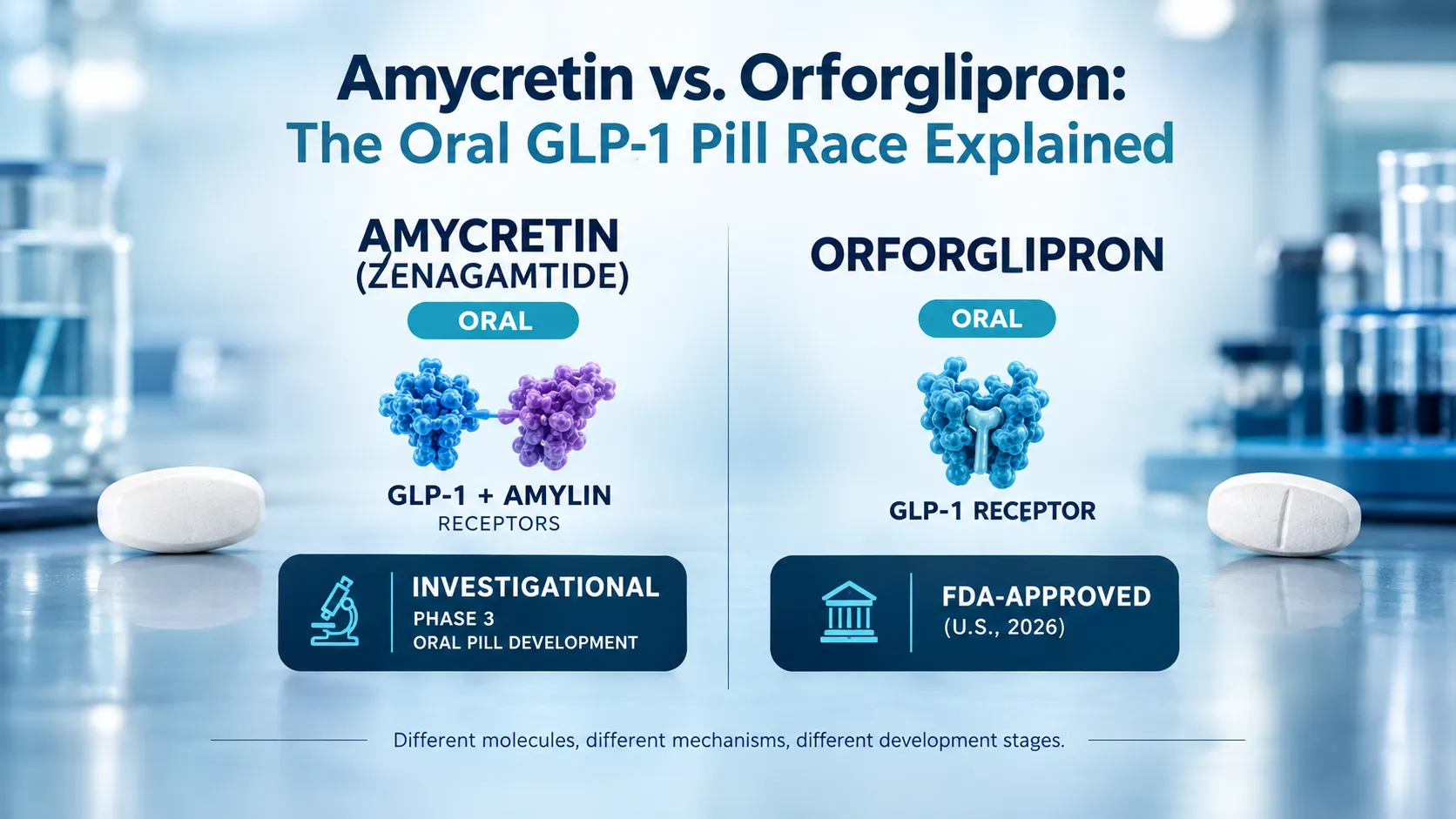
Amycretin is a peptide and orforglipron is not. How that chemistry explains the formulations, trial results, and approval status of both GLP-1 pills.
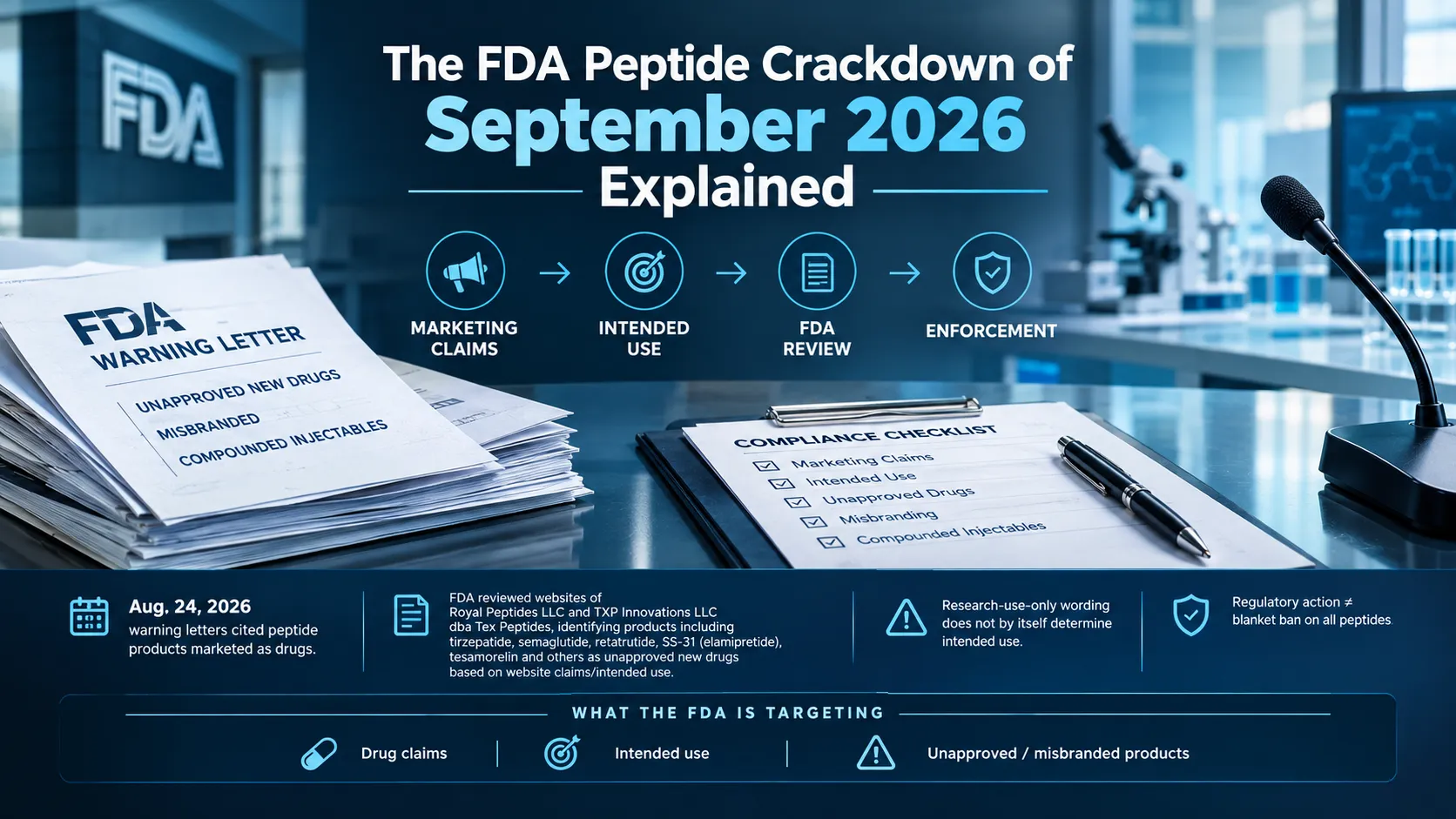
Five peptide sellers got FDA warning letters in September 2026. See who was named, why the research label failed, and the full 2026 enforcement timeline.
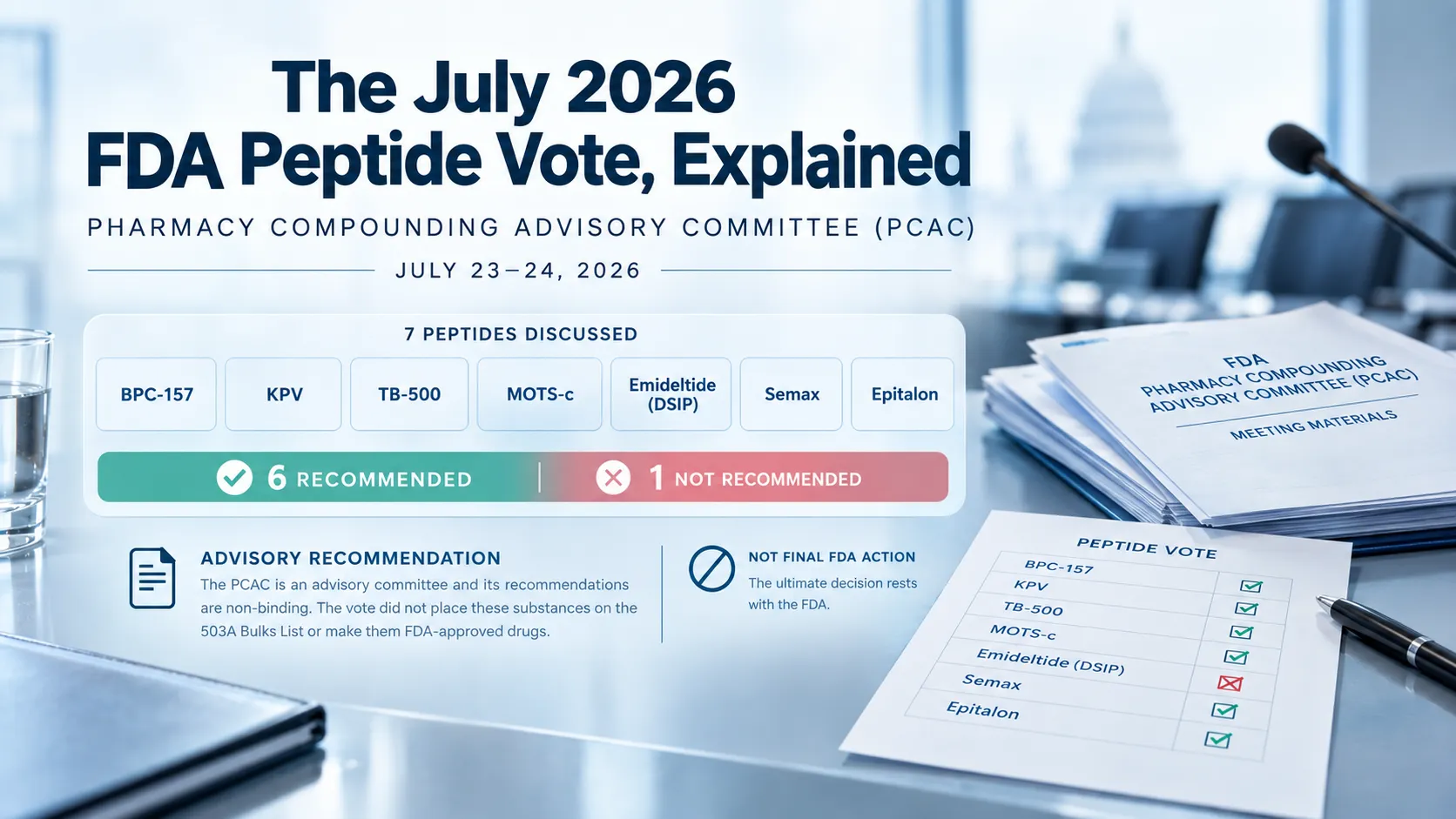
In July 2026, the FDA's advisory committee recommended 6 peptides for the 503A bulk list. None are on it yet. What the vote changed and what it didn't.