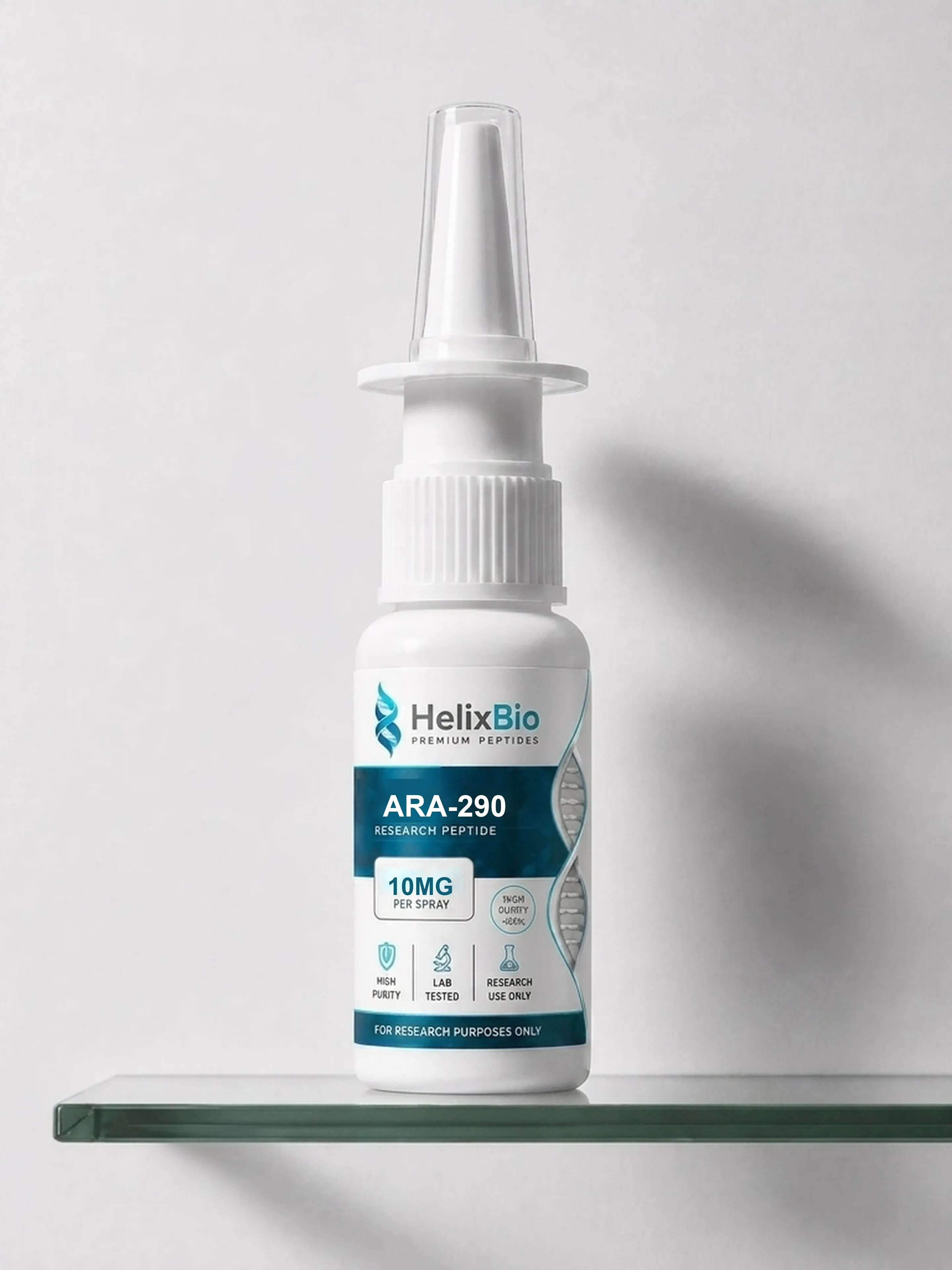
Eleven amino acids taken from a single face of erythropoietin make up ARA-290, known by its International Nonproprietary Name cibinetide and in the literature as the helix B surface peptide. The residues correspond to a region of erythropoietin oriented away from the receptor interface that drives red blood cell production, and the peptide was designed to separate erythropoietin’s tissue-protective signalling from its erythropoietic signalling. Published research on ARA-290 spans peptide chemistry, receptor biology, inflammatory signalling and small nerve fibre models, including randomised controlled human studies. Helix Bio supplies this material as a Spray-format research preparation for qualified laboratory and scientific applications. It is not intended for human or veterinary use, ingestion, injection, nasal administration, or any other form of administration.
HPLC certified
Independent analysis
Highest standard
Full traceability
ARA-290 is a linear eleven-residue peptide with the sequence pGlu-Glu-Gln-Leu-Glu-Arg-Ala-Leu-Asn-Ser-Ser, terminating in a free carboxylic acid. Its molecular formula is C₅₁H₈₄N₁₆O₂₁ and its molecular weight is 1257.32 g/mol. It was developed at Araim Pharmaceuticals from work by Michael Brines and Anthony Cerami on erythropoietin’s non-haematopoietic activity, and appears in the literature as cibinetide, HBSP or pHBSP.
The first residue deserves attention because it is frequently misreported. It is pyroglutamate — the cyclised, N-terminally blocked form of glutamine — not glutamine itself. Several commercial descriptions give the sequence as beginning with an unblocked glutamine, which describes a different molecule. The cyclisation removes ammonia, so the linear glutamine-terminated analogue is approximately 17 daltons heavier at around 1274.4 g/mol. The difference is easily resolved by mass spectrometry.
Erythropoietin is a 165-residue glycoprotein. ARA-290 reproduces eleven of those residues from the helix B surface, a region facing away from the erythropoietin receptor binding interface. The peptide has no erythropoietic activity, and the distinction is not cosmetic: findings about erythropoietin describe a molecule roughly fifteen times larger with a different receptor engagement profile, and they do not transfer to this peptide.
The compound is the same whether supplied as a powder or a prepared solution. The chemical environment is not, and for this particular sequence that difference is worth understanding before a material enters a workflow.
Residue 9 is asparagine, followed immediately by serine. Asparagine residues deamidate spontaneously in aqueous conditions through a cyclic succinimide intermediate, yielding aspartate and isoaspartate; the reaction is favoured at neutral to mildly alkaline pH and its rate depends strongly on the residue that follows. Asn-Ser sits in the faster tier of that sequence dependence, well above bulky neighbours such as isoleucine or valine. The mass change is approximately 0.98 daltons, and the isoaspartate product carries a backbone rearrangement rather than a simple substitution.
For researchers, three practical points follow. A prepared aqueous solution is the environment in which this reaction runs, so the intact fraction is a lot-, vehicle-, pH- and time-dependent quantity rather than a fixed property of the compound. A sub-dalton shift is easy to miss on a routine identity check and may or may not resolve chromatographically. And storage conditions taken from lyophilised material do not describe the solution case. These are questions for the applicable product documentation, not assumptions to carry over from literature describing powder.
Researchers should also keep the scientific literature on ARA-290 separate from the specifications of any commercial research material. Published human findings concern subcutaneously administered material in controlled clinical studies and do not validate any particular preparation, concentration or format.
ARA-290 has been examined in the following areas:
The existence of published research does not establish that ARA-290 Spray is safe or effective for use in humans. ARA-290 is not approved by FDA or in any EU member state for any indication. It holds US orphan drug and fast track designations for neuropathic pain in sarcoidosis and EU orphan designation for sarcoidosis; these are development incentives, not approvals. Development did not progress beyond Phase 2b, and no Phase 3 results have been published.
Researchers evaluating an ARA-290 material face a specific verification problem. The compound’s defining structural feature — the pyroglutamate at position 1 — is stated incorrectly across a large share of the commercial descriptions in circulation. A material described with an unblocked glutamine N-terminus is not the peptide the published trials studied.
Helix Bio states that its research peptide catalog uses independent HPLC testing for purity assessment and mass spectrometry for molecular identity confirmation, and that batch-specific Certificates of Analysis are available. For this compound the mass result answers the question directly: approximately 1257.3 g/mol corresponds to the pyroglutamate-blocked peptide, while a result near 1274.4 indicates the linear glutamine form.
For ARA-290 Spray specifically, researchers should verify the applicable product documentation and current lot information rather than relying on a general product description. A sitewide statement describes the catalog’s testing approach; it is not a lot-level analytical result for this material.
ARA-290 Spray is intended for qualified users working in legitimate laboratory or scientific research environments, including:
The product is not intended for personal experimentation, self-administration, human consumption, veterinary use or medical treatment.
| Specification | Details |
|---|---|
| Product Name | ARA-290 Spray |
| Research Category | Healing & Recovery / Research Peptide |
| Compound | ARA-290 |
| Scientific Name | Cibinetide (INN, USAN) |
| Synonyms | ARA290, ARA 290, HBSP, pHBSP, helix B surface peptide |
| Chemical Class | Synthetic linear peptide, 11 residues |
| Related Protein | Erythropoietin, helix B surface region |
| Sequence | pGlu-Glu-Gln-Leu-Glu-Arg-Ala-Leu-Asn-Ser-Ser-OH |
| Amino-Acid Residues | 11 |
| N-Terminus | Pyroglutamate (cyclised, blocked) |
| C-Terminus | Free acid |
| Molecular Formula | C₅₁H₈₄N₁₆O₂₁ |
| Molecular Weight | 1257.32 g/mol |
| CAS Number | 1208243-50-8 |
| PubChem CID | 91810664 |
| UNII | 9W5677JKDA |
| Proposed Target | Erythropoietin receptor / β-common receptor (CD131) complex |
| Erythropoietic Activity | None reported |
| Format | Prepared Spray solution |
| Intended Use | Research and laboratory investigation only |
| Human Use | Not intended for human consumption |
| Veterinary Use | Not intended for veterinary use |
| Purity | Refer to current lot-specific product documentation |
| Identity Testing | Refer to applicable Certificate of Analysis |
| Concentration | Refer to current product listing |
| Fill Volume | Refer to current product listing |
| Packaging | Refer to current product listing |
| Storage | Follow current product-specific documentation |
| Manufacturer | Helix Bio |
| Country of Origin | Not specified; verify current product documentation |
ARA-290 has an unusually well-defined research record for a peptide of its size, concentrated in receptor biology, inflammation and small nerve fibre work.
Receptor Biology The proposed mechanism is selective engagement of a complex of the erythropoietin receptor and the β-common receptor (CD131), described by Brines and Cerami as the innate repair receptor and reported to be locally upregulated at sites of injury, hypoxia or metabolic stress, signalling through JAK2/STAT5 and PI3K/Akt. This model should be understood as supported but not settled: a 2018 study in Scientific Reports investigating the association directly reported that the extracellular regions of the two receptors do not specifically associate in vitro, with or without erythropoietin or ARA-290 present, and found no requirement for the β-common receptor under anaemic stress in mice. The functional and biophysical literatures are not currently reconciled, and researchers designing mechanistic work should read both.
Small Nerve Fibre and Neuropathic Pain Research Randomised, placebo-controlled human studies in sarcoidosis-associated small nerve fibre loss have used corneal confocal microscopy as a structural endpoint. A Phase 2b dose-ranging study of 64 participants across three dose levels over 28 days met its pre-specified primary endpoint on corneal nerve fibre area at the middle dose, with a supporting increase in skin GAP-43-positive nerve fibre length. Preclinical rodent work has examined peripheral nerve injury models and spinal microglial responses.
Peptide Chemistry and Analytical Characterisation The compound is a useful subject for structure-function and stability work in its own right. The pyroglutamate N-terminus is a defined chemical blocking strategy with a specific mass consequence, and the Asn-Ser motif provides a well-characterised degradation route with a sub-dalton signature. Both make ARA-290 relevant to analytical method development for short peptides where identity and integrity must be separated.
Inflammation and Tissue Injury Models Preclinical studies have examined ARA-290 in renal ischaemia–reperfusion, cisplatin nephrotoxicity, and experimental colitis models, and a Phase 2 human study examined metabolic and neuropathic endpoints in type 2 diabetes. These are experimental findings across different systems and species and should not be read as demonstrated clinical outcomes.
Researchers should evaluate each publication according to its model, species, dose, administration route and endpoints. For this compound, note in particular that all human administration in the published record was subcutaneous, and that plasma half-life is reported at roughly two minutes in rodent and rabbit models — observed effects outlast measurable exposure by a wide margin, which is a feature of the mechanism as proposed rather than an incidental detail.
Analytical quality matters for any research peptide because impurities, degradation products, incorrect identity or inconsistent concentration introduce uncontrolled variables. For ARA-290 two considerations apply that do not apply to a simple linear peptide with unreactive termini.
The first is N-terminal form. Because the pyroglutamate is what blocks the N-terminus and defines the molecule the published literature studied, the observed mass is the practical check: approximately 1257.3 g/mol for the correct compound, approximately 1274.4 for the unblocked linear analogue. A purity figure alone cannot distinguish them, since a highly pure preparation of the wrong molecule still reports as highly pure.
The second is deamidation. The Asn-Ser motif at positions 9 and 10 is deamidation-prone, and the resulting aspartate and isoaspartate species differ from the parent peptide by roughly 0.98 daltons. That shift is small enough to be missed on an identity check that is not looking for it, and chromatographic separation of the species is not guaranteed. Helix Bio states that its peptide materials undergo independent HPLC testing for purity and mass spectrometry for molecular identity, and that batch-specific Certificates of Analysis are available. For a specific ARA-290 Spray lot, researchers should consult the applicable COA for the actual analytical results.
Researchers should assess, where applicable:
No certification, regulatory approval or quality claim should be inferred unless explicitly documented by the manufacturer or a relevant regulatory authority. Sitewide catalog statements are not a substitute for lot-specific documentation.
Storage and handling requirements should be determined from the current ARA-290 Spray product documentation and lot-specific instructions. Prepared solutions and lyophilised powders have different stability profiles, and for a sequence carrying a deamidation-prone motif the difference is not marginal.
General laboratory considerations include:
Storage guidance should not be inferred from research protocols for lyophilised ARA-290, from erythropoietin preparations, or from another Spray-format product, because formulation, vehicle pH and packaging all affect the relevant degradation chemistry.
Helix Bio’s website describes research materials as being supplied to laboratories and institutions in the United States and describes tracked shipping and cold-chain handling within its fulfillment process.
Because shipping conditions, packaging specifications, availability and delivery requirements may change, researchers should review the current Helix Bio shipping information and product listing before ordering. For a prepared solution carrying a temperature-sensitive degradation route, transit temperature history is a more consequential variable than it is for lyophilised material.
Product packaging should remain appropriately labelled and handled as research material after delivery. Researchers are responsible for following applicable institutional, federal, state and local requirements governing research materials.
ARA-290 Spray is sold by Helix Bio for research and laboratory purposes only. It is not intended for human or veterinary consumption, self-administration, ingestion, injection, nasal administration, any other form of administration, or the diagnosis, treatment, cure, mitigation or prevention of any disease or medical condition.
ARA-290 is not approved by the U.S. Food and Drug Administration or in any European Union member state for any indication. Orphan drug and fast track designations are development incentives that ease a regulatory pathway; they are not approvals and are not statements of efficacy or safety. No marketing application has been submitted, and development did not progress beyond Phase 2b.
Published research findings, including randomised controlled studies, describe outcomes in defined experimental and clinical research settings. They do not establish that this material is safe or effective for any use, and they do not validate any commercial preparation.
This product is not a dietary supplement, consumer wellness product or medical treatment. Researchers are responsible for determining whether a material is appropriate for their intended experimental application and for complying with applicable institutional and regulatory requirements.
Knowledge Base
Knowledge Base
Knowledge Base
Knowledge Base
Knowledge Base
Knowledge Base
Knowledge Base
Knowledge Base
Knowledge Base
Knowledge Base
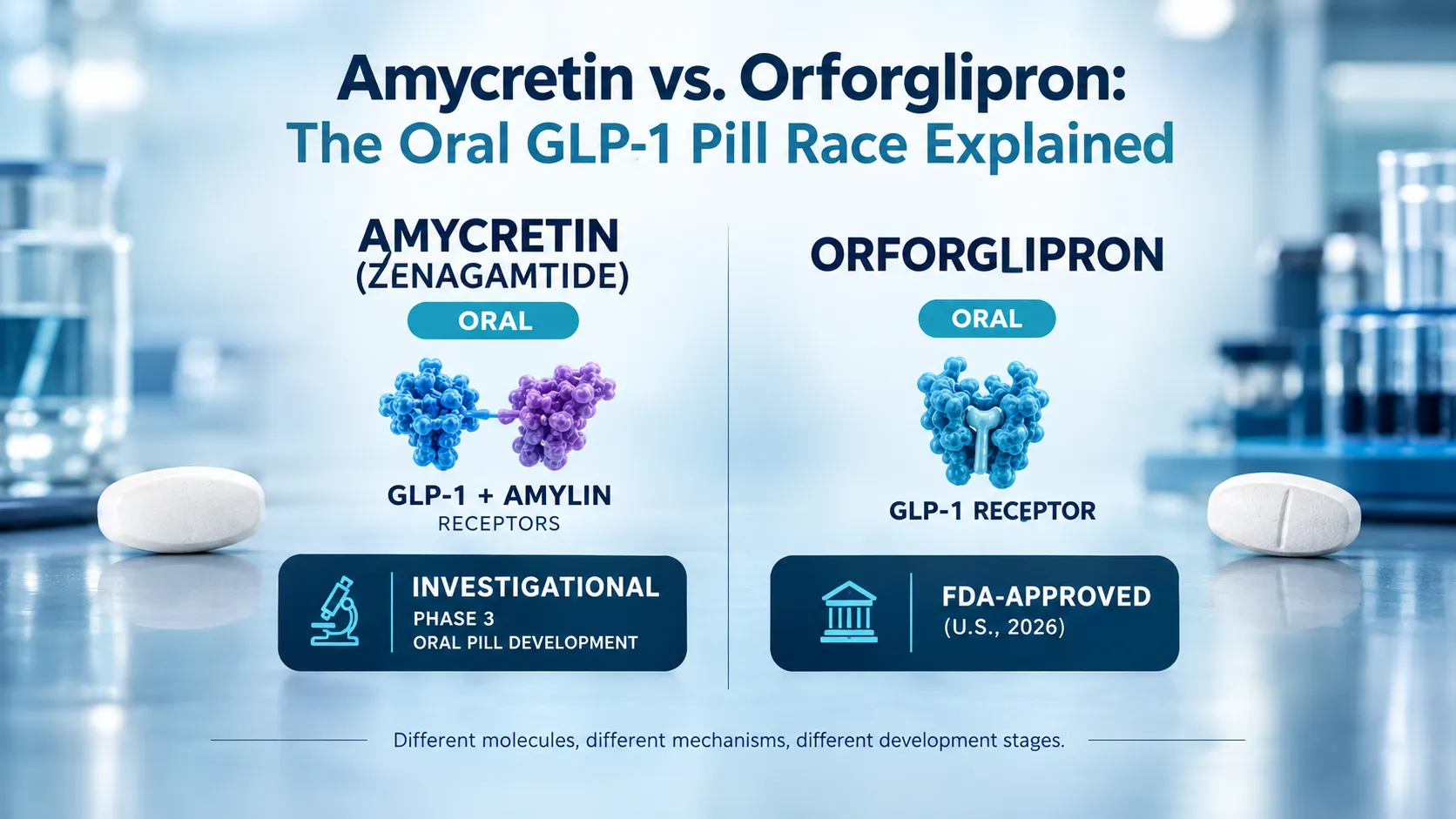
Amycretin is a peptide and orforglipron is not. How that chemistry explains the formulations, trial results, and approval status of both GLP-1 pills.
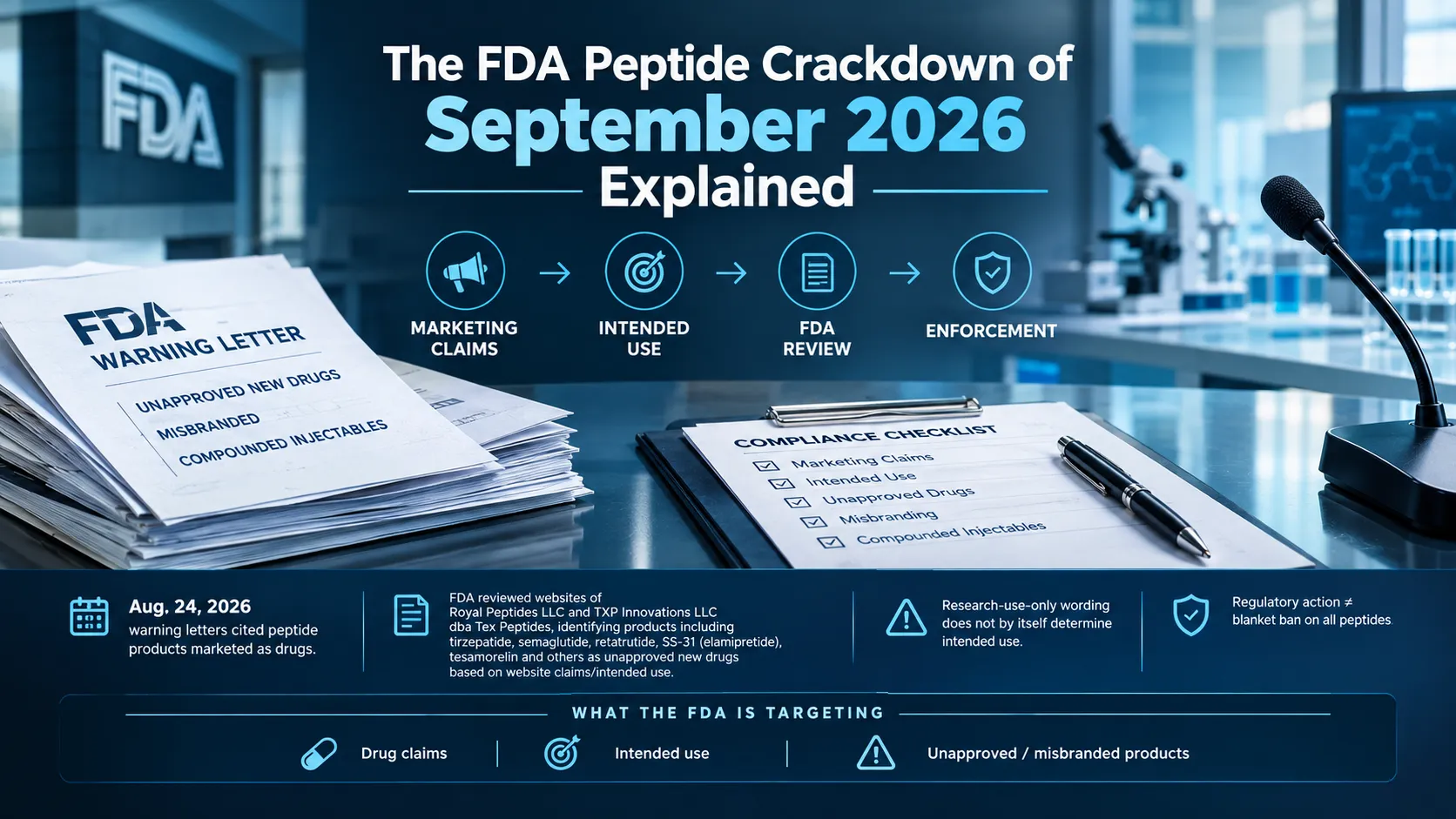
Five peptide sellers got FDA warning letters in September 2026. See who was named, why the research label failed, and the full 2026 enforcement timeline.

In July 2026, the FDA's advisory committee recommended 6 peptides for the 503A bulk list. None are on it yet. What the vote changed and what it didn't.