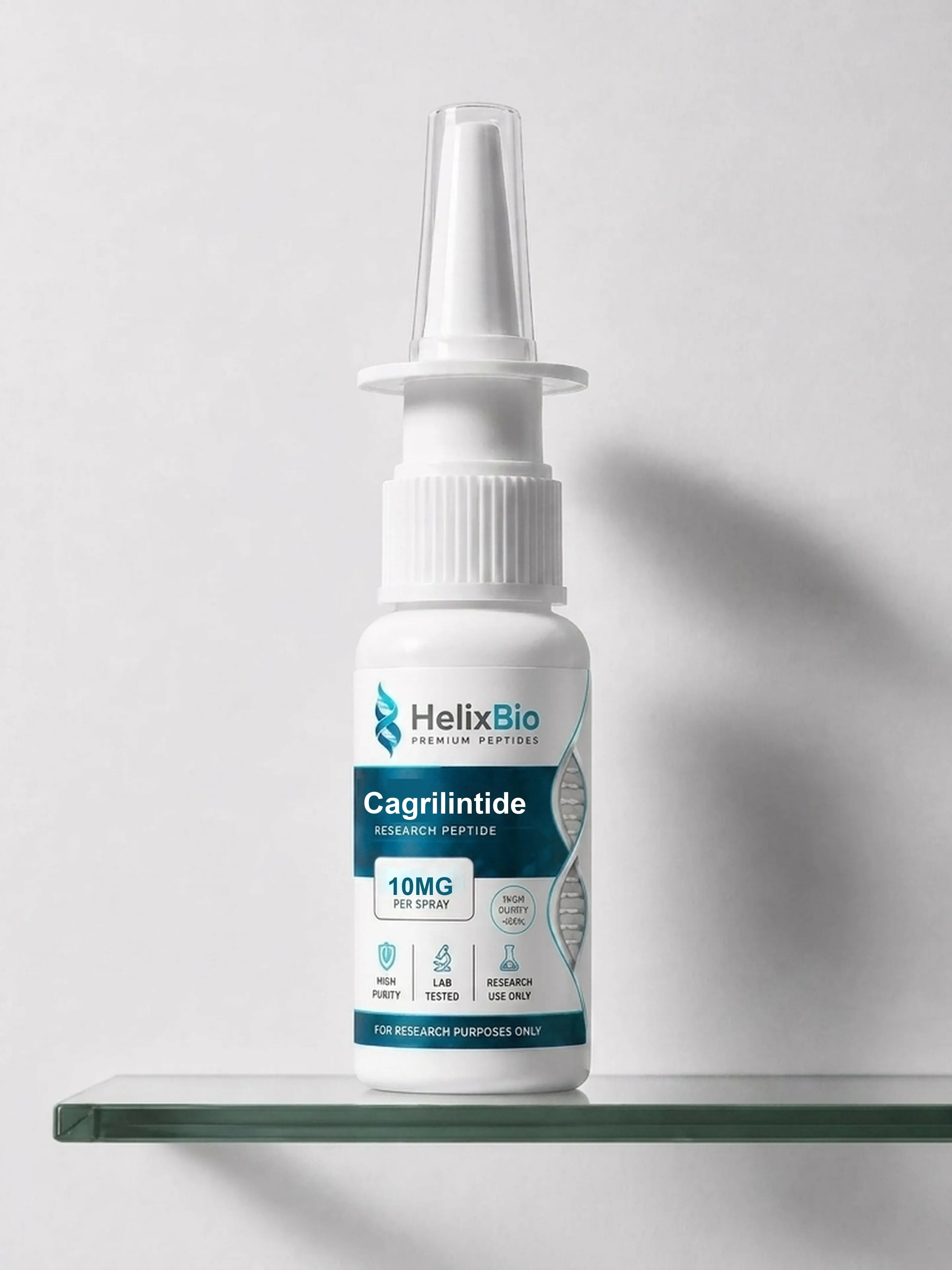
Cagrilintide Spray is a research-use preparation of cagrilintide, a long-acting acylated analogue of human amylin developed by Novo Nordisk under the code AM833. Cagrilintide is a non-selective agonist at the amylin receptors (AMY1R, AMY2R, AMY3R) and the calcitonin receptor — a pharmacological class distinct from the GLP-1 receptor agonists it is frequently grouped with. Helix Bio supplies cagrilintide as a research material for qualified laboratory use. It is not a medicine, not a dietary supplement, and not intended for human or veterinary administration. Cagrilintide is not approved by the FDA in any form.
HPLC certified
Independent analysis
Highest standard
Full traceability
Cagrilintide is a synthetic, lipidated analogue of amylin — the pancreatic hormone co-secreted with insulin, also called islet amyloid polypeptide. It was developed at Novo Nordisk and appears in the medicinal chemistry literature as compound 23, and in trial documentation as AM833 and NN0174-0833.
The design problem cagrilintide was built to solve is specific and worth understanding, because it explains almost everything about the molecule. Native human amylin aggregates readily into amyloid fibrils, which makes it impractical as a drug substance. The only amylin analogue previously brought to market, pramlintide, is stable enough to formulate but clears quickly enough that it requires three injections a day. Kruse and colleagues used amylin rather than calcitonin as the structural starting point and screened acylation attachment points until they arrived at a variant that resisted fibrillation and carried a fatty diacid capable of binding albumin in circulation. The result was a peptide with a reported elimination half-life of roughly 159 to 195 hours, against 20 to 45 minutes for pramlintide.
Three misidentifications are common enough in search behaviour that they are worth stating plainly.
Cagrilintide is not a GLP-1 receptor agonist. It does not bind the GLP-1 receptor. It acts on the amylin receptors and the calcitonin receptor, which are a separate branch of class B GPCRs. The reason cagrilintide and semaglutide are studied together is precisely that their mechanisms do not overlap.
Cagrilintide is not CagriSema. CagriSema is a fixed-dose combination of cagrilintide and semaglutide. This product is the single agent. Trial results reported for CagriSema are not results for cagrilintide.
Cagrilintide is not amylin, and not pramlintide. It is an engineered analogue that differs from both in fibrillation behaviour, half-life, and receptor binding kinetics.
Cagrilintide's structure retains the disulfide-bridged N-terminal loop and C-terminal amidation characteristic of the amylin family, and adds a C20 fatty diacid attached to a lysine side chain through a γ-glutamate spacer. That acyl chain is what binds circulating albumin and produces the extended half-life.
| Identifier | Value |
|---|---|
| INN | Cagrilintide |
| Development codes | AM833, NN0174-0833 |
| CAS Registry Number | 1415456-99-3 |
| PubChem CID | 171397054 |
| Molecular formula | C194H312N54O59S2 |
| Monoisotopic mass | 4,406.25 Da |
| InChIKey | LDERDVMBIYGIOI-IZVMHKDJSA-N |
| Compound class | Acylated amylin analogue; dual amylin and calcitonin receptor agonist |
| Originator | Novo Nordisk A/S |
Molecular identity data above is drawn from the PubChem compound record. Product-level values — concentration, fill volume, formulation and lot analytics — are separate from compound identity and are stated in the product listing and Certificate of Analysis, not inferred from the literature.
Cagrilintide Spray is supplied for laboratory and scientific research. Helix Bio makes no representation that it is safe or effective for any use in humans or animals, and does not supply it for administration to either.
Cagrilintide has an unusually well-defined research context for a compound of this type, because its development programme is public and peer-reviewed. Areas where the published work is genuinely informative include amylin receptor pharmacology, RAMP-dependent receptor phenotype, peptide acylation and albumin-mediated half-life extension, amyloid fibrillation and peptide stability engineering, and comparative studies of dual amylin/calcitonin receptor agonists against selective agonists.
What the literature does not establish is anything about this specific research material. Published findings describe cagrilintide as characterised and administered in those studies. They are not claims about the Helix Bio preparation.
Amylin receptors are not standalone proteins. Each one is a heterodimer of the calcitonin receptor with a receptor activity-modifying protein — RAMP1, RAMP2 or RAMP3 — producing the AMY1R, AMY2R and AMY3R phenotypes respectively. Because cagrilintide engages the calcitonin receptor core as well as the RAMP-modified complexes, it is classified as a dual amylin and calcitonin receptor agonist rather than a selective amylin agonist.
Cao and colleagues resolved cryo-EM structures of cagrilintide bound to Gs-coupled active AMY1R, AMY2R, AMY3R and CTR and published them in Nature Communications in 2025. That dataset — all four receptors, one ligand — is the structural basis for describing the compound as non-selective, and it is the kind of primary evidence that separates a documented research compound from a catalogue entry.
REDEFINE 1 randomised 3,417 adults with obesity, or overweight with at least one related complication and without type 2 diabetes, across four arms: the cagrilintide–semaglutide combination, semaglutide 2.4 mg alone, cagrilintide 2.4 mg alone, and placebo. The cagrilintide monotherapy arm produced a mean body weight change of −11.5%, against −14.9% for semaglutide alone, −20.4% for the combination, and −3.0% for placebo, on the treatment policy estimand at 68 weeks.
Cagrilintide is the weakest single agent of that group. Its significance in the programme is additive rather than standalone, and any research framing that treats it as an equivalent alternative to a GLP-1 agonist misreads the trial.
Every published human trial and every preclinical study cited above used subcutaneous administration. The compound's pharmacokinetic design — albumin binding from a subcutaneous depot — is built around that route.
Researchers evaluating a spray format should treat route as an open variable rather than an established one. There is no published pharmacokinetic characterisation of cagrilintide delivered intranasally, and results obtained with a spray preparation cannot be compared directly against subcutaneous trial data.
Cagrilintide is harder to verify than most catalogue peptides, and the reasons are specific to the molecule.
It is a large, acylated, disulfide-containing peptide of roughly 4.4 kDa. Purity by HPLC alone will not tell you whether the acyl chain is intact, whether the disulfide has formed correctly, or whether the C-terminal amide is present — and all three are load-bearing for receptor engagement. Mass spectrometry is the test that distinguishes correctly assembled cagrilintide from a truncated or de-acylated variant of similar retention time. Ask which technique produced the identity result, not just what the purity number was.
The amylin backbone also has a documented tendency toward fibrillation, which is the entire reason cagrilintide was engineered the way it was. Aggregation is therefore a more relevant stability question for this compound than for most, and appearance on receipt is worth recording.
Finally, check what the documentation is actually describing. A Certificate of Analysis characterises a synthesis lot. It does not characterise the formulation, the concentration in a spray preparation, or the behaviour of the material after dilution.
Cagrilintide Spray is supplied to qualified researchers working in laboratory settings — academic and institutional laboratories, biotechnology and pharmaceutical research groups, contract research organisations, and analytical laboratories conducting receptor pharmacology, peptide chemistry or metabolic signalling work.
It is not supplied for personal experimentation, self-administration, human consumption, veterinary use, clinical practice, or compounding.
| Specification | Details |
|---|---|
| Product name | Cagrilintide Spray |
| Active compound | Cagrilintide |
| Synonyms | AM833; NN0174-0833 |
| Compound class | Acylated amylin analogue |
| Pharmacological class | Dual amylin and calcitonin receptor agonist (DACRA) |
| Molecular formula | C194H312N54O59S2 |
| Monoisotopic mass | 4,406.25 Da |
| CAS Registry Number | 1415456-99-3 |
| PubChem CID | 171397054 |
| Format | Spray preparation |
| Originator | Novo Nordisk A/S |
| Regulatory status | Investigational; not FDA approved |
| Intended use | Laboratory research only |
| Human use | Not intended for human consumption or administration |
| Veterinary use | Not intended for veterinary use |
Amylin receptor pharmacology. Cagrilintide is one of the few DACRA compounds with published structural data across the full receptor complement, which makes it a practical reference ligand for work distinguishing AMY1R, AMY2R and AMY3R responses from calcitonin receptor responses.
Peptide engineering and half-life extension. The acylation strategy — a C20 diacid on a γ-glutamate spacer — is documented in the primary medicinal chemistry literature alongside the alternatives that were rejected, which makes cagrilintide an unusually well-annotated case study in albumin-binding half-life extension.
Fibrillation and peptide stability. The molecule exists because native amylin aggregates. Comparative stability work against amylin and pramlintide has a clear structural rationale behind it.
Comparative metabolic signalling. Because the amylin and GLP-1 pathways are separate, cagrilintide is used in the literature to isolate amylin-mediated effects from incretin-mediated ones rather than to replicate them.
Analytical documentation for a research peptide should be read as a description of a specific synthesis lot, not as a property of the product name. For cagrilintide specifically, the results worth locating are the identity confirmation method, the purity result and the technique that produced it, and the lot number those results belong to.
Review the Certificate of Analysis supplied with the material and confirm that the lot number on the documentation matches the lot on the container. General catalogue statements about testing practice are not a substitute for lot-specific results.
Follow the storage conditions supplied with this product. Storage guidance for a formulated spray preparation is not interchangeable with guidance for lyophilised powder, and conditions published for cagrilintide drug product in clinical trial formulations describe a different formulation entirely.
General laboratory practice applies: keep the container closed when not in use, avoid unnecessary temperature cycling, protect from light and heat, maintain accurate labelling and inventory records, inspect for cloudiness or particulate matter before use, and follow institutional procedures for handling research materials. Do not extrapolate a shelf life that the supplied documentation does not state.
Cagrilintide Spray is supplied by Helix Bio for laboratory and scientific research only. It is not intended for human or veterinary consumption, self-administration, diagnosis, treatment, cure, mitigation or prevention of any disease or condition. It is not a dietary supplement, cosmetic, food, or medical product.
Cagrilintide is not approved by the FDA. Novo Nordisk submitted a New Drug Application for CagriSema — a fixed-dose combination of cagrilintide 2.4 mg and semaglutide 2.4 mg — on 18 December 2025, and that application remained under FDA review at the time of writing. Cagrilintide as a single agent has not been submitted for approval. The existence of published clinical trials, a pending application, or commercial availability of research material does not constitute approval, and nothing on this page should be read as indicating that cagrilintide has been found safe or effective for any use.
Purchasers are responsible for determining whether this material is appropriate for their intended experimental application and for complying with all applicable institutional, federal, state and local requirements.
Knowledge Base
Knowledge Base
Knowledge Base
Knowledge Base
Knowledge Base
Knowledge Base
Knowledge Base
Knowledge Base
Knowledge Base
Knowledge Base
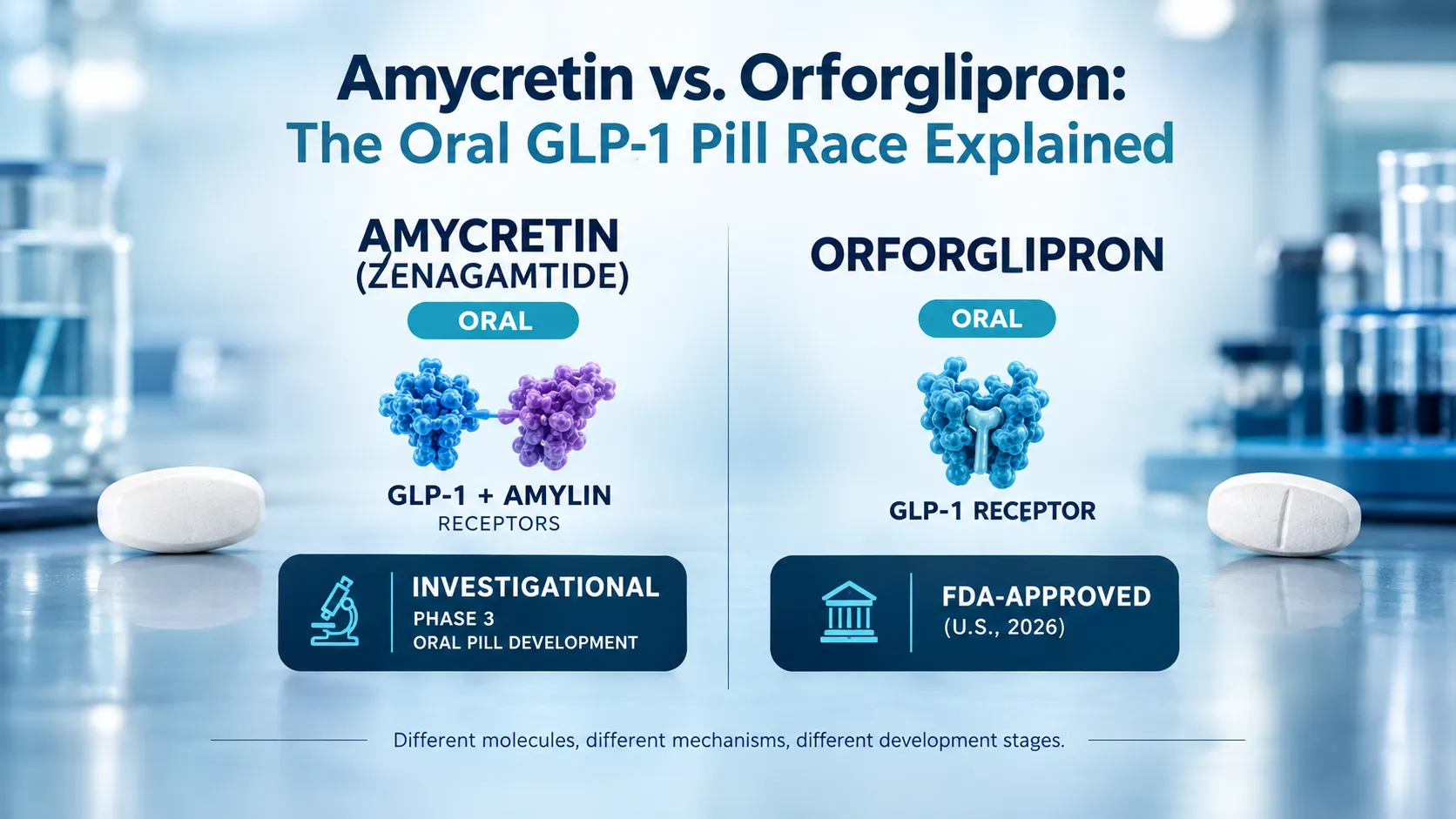
Amycretin is a peptide and orforglipron is not. How that chemistry explains the formulations, trial results, and approval status of both GLP-1 pills.
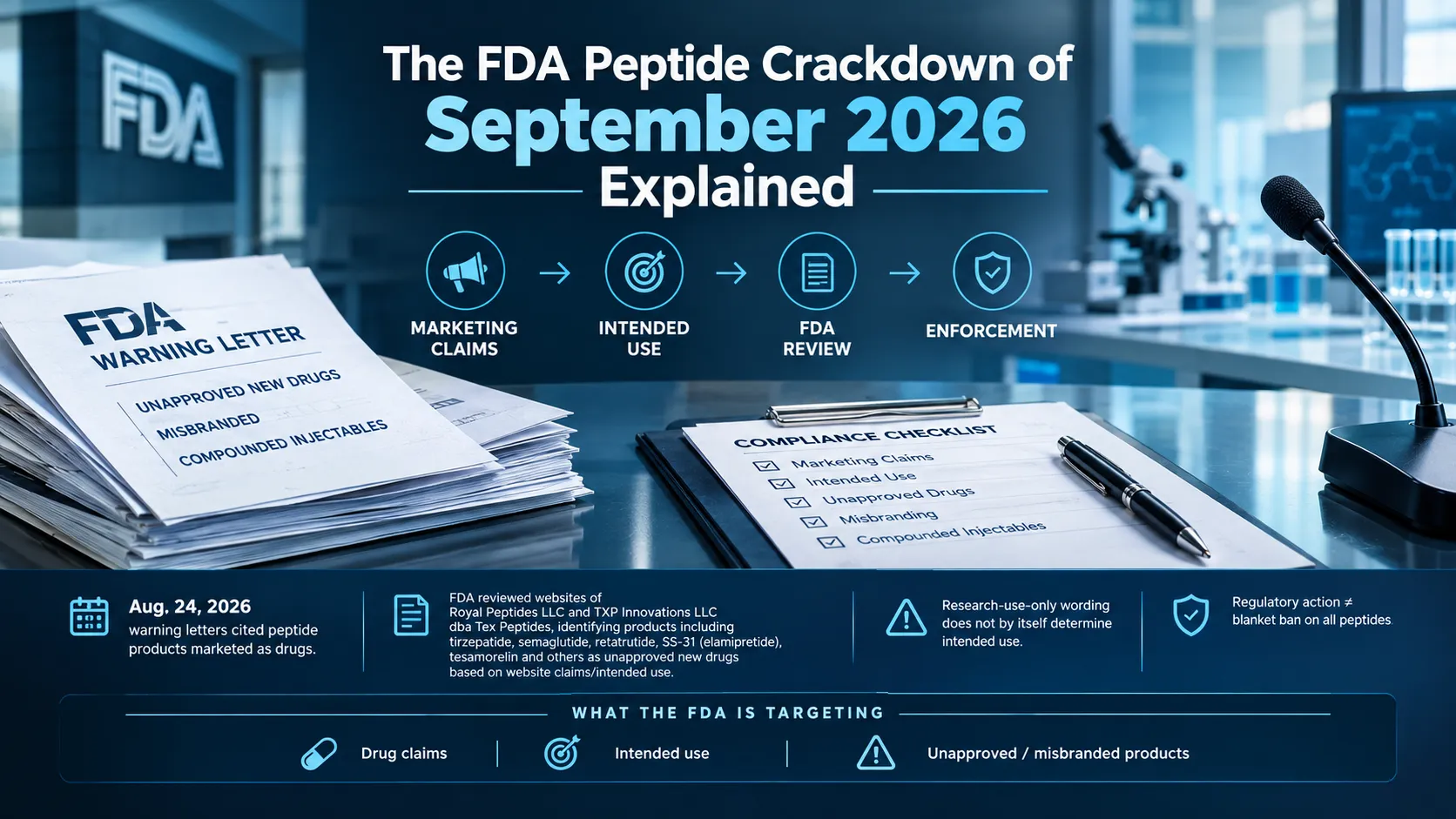
Five peptide sellers got FDA warning letters in September 2026. See who was named, why the research label failed, and the full 2026 enforcement timeline.

In July 2026, the FDA's advisory committee recommended 6 peptides for the 503A bulk list. None are on it yet. What the vote changed and what it didn't.