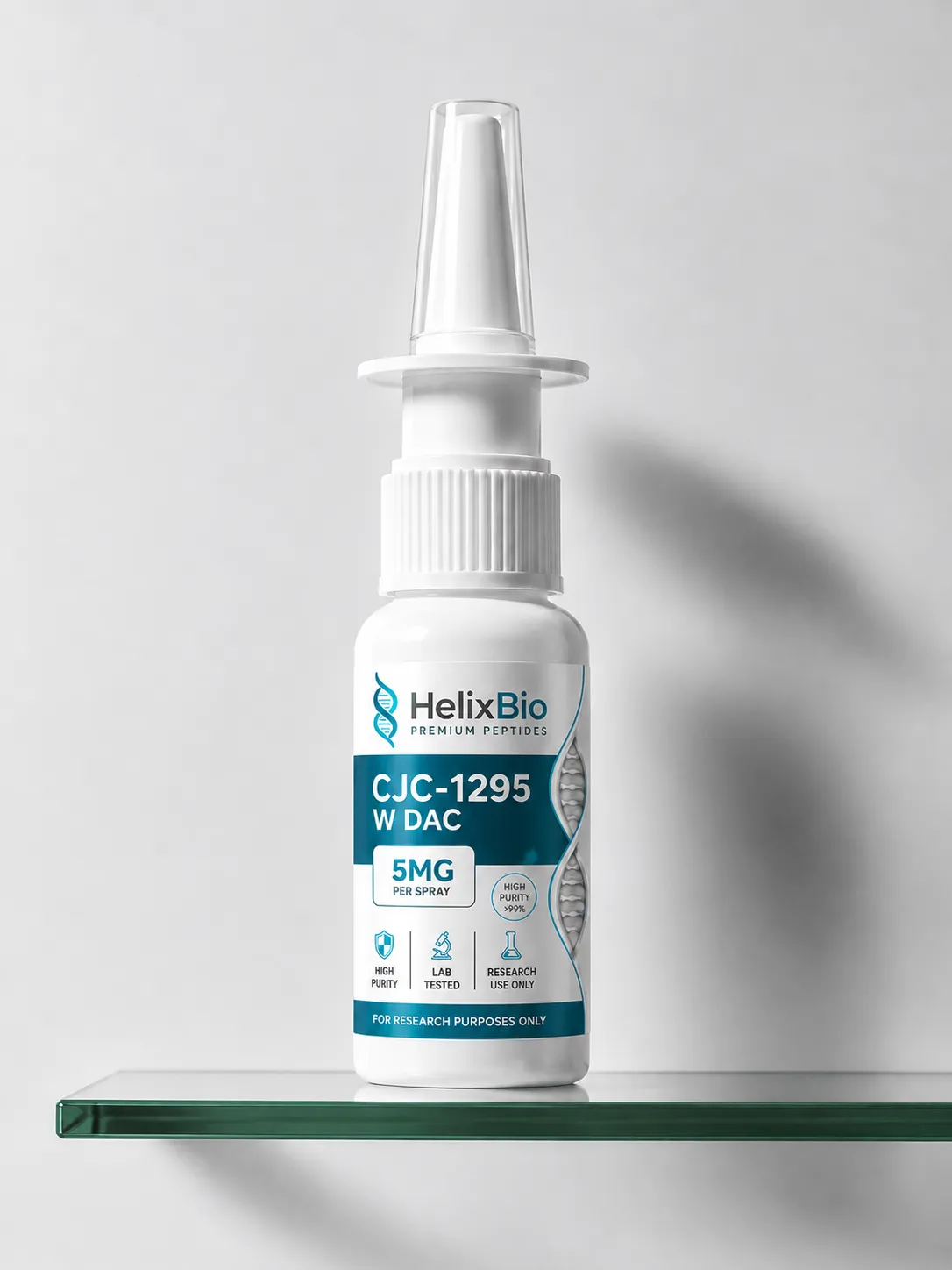
CJC-1295 With DAC Spray is a research-use preparation containing CJC-1295 with DAC, a synthetic 30-residue analogue of growth hormone-releasing hormone carrying a drug affinity complex on its C-terminal lysine. The compound is also designated DAC:GRF and is structurally distinct from CJC-1295 no DAC, which lacks that modification and is 279 daltons lighter. Published research on the DAC construct concerns GHRH receptor activation, albumin bioconjugation chemistry, and growth hormone axis pharmacology. Helix Bio supplies research materials for qualified laboratory and scientific applications. CJC-1295 With DAC Spray is offered strictly for research use and is not intended for human or veterinary consumption, ingestion, injection, nasal administration, or any other form of administration.
HPLC certified
Independent analysis
Highest standard
Full traceability
CJC-1295 with DAC is a modified GHRH analogue developed by ConjuChem Biotechnologies. Its backbone is the 1–29 fragment of human growth hormone-releasing hormone carrying four substitutions — D-Ala at position 2, Gln at 8, Ala at 15, Leu at 27 — with a thirtieth residue, lysine, added at the C-terminus. The ε-amine of that lysine bears a maleimidopropionyl group. That group is the DAC.
The full sequence is Tyr-D-Ala-Asp-Ala-Ile-Phe-Thr-Gln-Ser-Tyr-Arg-Lys-Val-Leu-Ala-Gln-Leu-Ser-Ala-Arg-Lys-Leu-Leu-Gln-Asp-Ile-Leu-Ser-Arg-Lys(Nε-maleimidopropionyl), amidated at the C-terminus. Molecular formula C₁₆₅H₂₆₉N₄₇O₄₆; molecular weight 3647.25 g/mol.
DAC stands for drug affinity complex, and the term describes a reaction rather than a binding preference. A maleimide undergoes Michael addition with a free thiol to form a covalent thioether bond. In circulation the intended partner is Cys34 of human serum albumin, the one free cysteine on that protein. The construct’s documented pharmacokinetic behaviour belongs to the resulting bioconjugate, not to the free peptide.
That distinction is what separates this compound from CJC-1295 no DAC, also known as Modified GRF (1-29). The no-DAC form shares the same 29-residue backbone and the same receptor target but has no maleimide and no conjugation mechanism. Terminology in this field is genuinely inverted: formal pharmacological nomenclature uses “CJC-1295” for the DAC construct, while the research-material market commonly uses the same name for the 29-mer. Several published papers equate the two incorrectly.
A prepared spray solution and a lyophilised powder are not interchangeable presentations of the same material, and for a maleimide-bearing construct the difference is chemical rather than convenience.
Maleimide rings are subject to hydrolysis in aqueous solution, opening to the corresponding maleamic acid. The ring-opened species is unreactive toward thiols, and the rate of ring opening increases with pH. Bioconjugation reagent suppliers routinely advise against aqueous storage of maleimide-bearing compounds intended for later reaction. This is established maleimide chemistry, described here as a property of the functional group rather than as a statement about any particular preparation.
For researchers, the practical consequence is that the conjugation-competent fraction of a prepared CJC-1295 with DAC solution is a lot-, vehicle-, pH- and time-dependent quantity rather than a fixed property of the compound. It should be established from the applicable product documentation and lot-specific analytical results, not assumed from literature describing lyophilised material. Where a study design depends on the DAC mechanism specifically, that fraction is the variable that matters most.
Researchers should also distinguish the scientific literature on CJC-1295 with DAC from the specifications of any particular commercial research material. Published pharmacokinetic findings concern subcutaneously administered material in controlled clinical studies and do not validate any commercial preparation, any concentration, or any format.
CJC-1295 with DAC has been examined in the following areas:
The existence of published research does not establish that CJC-1295 With DAC Spray is safe or effective for use in humans. CJC-1295 is not an FDA-approved drug in the United States in any form. Clinical development was discontinued in 2006. CJC-1295-related bulk drug substances were removed from Category 2 of FDA’s interim 503A list as of 27 September 2024 following withdrawal of their nomination; that removal is not an approval and does not authorise compounding. CJC-1295 was not among the substances reviewed at the July 2026 Pharmacy Compounding Advisory Committee meeting.
Researchers evaluating a CJC-1295 material face a problem that most peptide purchases do not present: two distinct compounds circulate under one name. Identity confirmation is not a formality here. It determines whether the published pharmacokinetic literature applies to the material at all.
Helix Bio states that its research peptide catalog uses independent HPLC testing for purity assessment and mass spectrometry for molecular identity confirmation, and that batch-specific Certificates of Analysis are available for its products. For this compound, the mass spectrometry result carries unusual weight: 3647.25 g/mol identifies the DAC construct, while approximately 3367.9 g/mol identifies the no-DAC form. The two are separated by roughly 279 daltons and are readily distinguished.
For CJC-1295 With DAC Spray specifically, researchers should verify the applicable product documentation and current lot information rather than relying on a general product description. Sitewide quality statements describe the catalog’s testing approach; they are not lot-level analytical results for this material.
CJC-1295 With DAC Spray is intended for qualified users working in legitimate laboratory or scientific research environments, including:
The product is not intended for personal experimentation, self-administration, human consumption, veterinary use or medical treatment.
| Specification | Details |
|---|---|
| Product Name | CJC-1295 With DAC Spray |
| Research Category | Growth Hormone Secretagogue / Research Peptide |
| Compound | CJC-1295 with DAC |
| Synonyms | DAC:GRF, CJC-1295 DAC |
| Chemical Class | Synthetic GHRH analogue, 30 residues |
| Related Peptide | GHRH(1-29) / modified GRF(1-29) scaffold |
| Sequence | Tyr-D-Ala-Asp-Ala-Ile-Phe-Thr-Gln-Ser-Tyr-Arg-Lys-Val-Leu-Ala-Gln-Leu-Ser-Ala-Arg-Lys-Leu-Leu-Gln-Asp-Ile-Leu-Ser-Arg-Lys(Nε-maleimidopropionyl)-NH₂ |
| Amino-Acid Residues | 30 |
| Molecular Formula | C₁₆₅H₂₆₉N₄₇O₄₆ |
| Molecular Weight | 3647.25 g/mol |
| CAS Number | 446262-90-4 |
| PubChem CID | 56841945 |
| UNII | 62RC32V9N7 |
| CJC-1295 Form | With DAC |
| DAC Status | Present — Nε-maleimidopropionyl on Lys30 |
| Format | Prepared spray solution |
| Intended Use | Research and laboratory investigation only |
| Human Use | Not intended for human consumption |
| Veterinary Use | Not intended for veterinary use |
| Purity | Refer to current lot-specific product documentation |
| Identity Testing | Refer to applicable Certificate of Analysis |
| Concentration | Refer to current product listing |
| Fill Volume | Refer to current product listing |
| Packaging | Refer to current product listing |
| Storage | Follow current product-specific documentation |
| Manufacturer | Helix Bio |
| Country of Origin | Not specified; verify current product documentation |
CJC-1295 with DAC has a specific and reasonably well-documented experimental record, concentrated in endocrine pharmacology and bioconjugate chemistry.
GHRH Receptor Pharmacology The GRF(1-29) fragment retains full agonist activity at the GHRH receptor, a class B GPCR on anterior pituitary somatotrophs signalling through Gs, adenylyl cyclase, cAMP and PKA. Jetté and colleagues (2005) demonstrated that hGRF(1-29)–albumin bioconjugates activate the GRF receptor on rat anterior pituitary and identified CJC-1295 as the long-lasting analogue within that series. The four backbone substitutions were introduced for protease resistance; D-Ala at position 2 blocks the DPP-4 cleavage site at the Tyr1-Ala2 bond.
Albumin Bioconjugation Chemistry The maleimidopropionyl group is a thiol-selective electrophile. Its reaction with a free cysteine thiol proceeds by Michael addition to a covalent thioether, chemoselective for thiols in roughly the pH 6.5–7.5 range and losing that selectivity toward amines above it. Human serum albumin presents a single free cysteine at position 34, which is the intended partner in circulation. The construct is consequently studied as an example of albumin-based half-life extension rather than as a simple receptor ligand.
Formulation and Analytical Chemistry Maleimides hydrolyse in aqueous media to ring-opened maleamic acids that no longer react with thiols, at rates that increase with pH and that depend on the chemical environment adjacent to the ring. This makes analytical characterisation of any prepared solution of a maleimide-bearing peptide a distinct research question, and makes mass-based identity confirmation more informative than purity percentage alone. The relevant separations are 3647.25 g/mol for the intact construct, roughly 18 daltons higher for the ring-opened species, and roughly 279 daltons lower for the no-DAC form.
Growth Hormone Axis Research Human studies of the DAC construct in healthy adults reported prolonged elevation of GH and IGF-1 following subcutaneous administration, with pulsatile GH secretion persisting rather than being abolished during continuous stimulation. These findings characterise axis pharmacology in a controlled clinical setting. They do not establish safety or efficacy for any use, and they do not transfer to the no-DAC form or to any other administration route or format.
Researchers should evaluate each publication according to its construct, model, methodology, concentration, administration route and endpoints. In this compound’s literature the first of those is the one most often reported ambiguously.
Analytical quality matters for any research peptide because impurities, degradation products, incorrect identity or inconsistent concentration introduce uncontrolled variables. For CJC-1295 with DAC, two further considerations apply that do not apply to a simple linear peptide.
The first is form confirmation. Because CJC-1295 exists in two distinct forms sold under overlapping names, a purity figure alone does not establish what the material is. A mass result of approximately 3647 g/mol indicates the DAC construct; approximately 3368 g/mol indicates the no-DAC form. Purity and identity are separate questions and both need answering.
The second concerns the maleimide itself. Hydrolytic ring opening converts the maleimide to a maleamic acid with a mass increase of 18 daltons and loss of thiol reactivity. A chromatographic purity percentage reported by area normalisation will not necessarily distinguish those species; a mass spectrometry result can. Helix Bio states that its peptide materials are subjected to independent HPLC testing for purity and mass spectrometry for molecular identity, and that batch-specific Certificates of Analysis are available. For a specific CJC-1295 With DAC Spray lot, researchers should consult the applicable COA for the actual analytical results.
Researchers should assess, where applicable:
No certification, regulatory approval or quality claim should be inferred unless it is explicitly documented by the manufacturer or a relevant regulatory authority. Sitewide catalog statements are not a substitute for lot-specific documentation.
Storage and handling requirements should be determined from the current CJC-1295 With DAC Spray product documentation and lot-specific instructions. Prepared solutions and lyophilised powders have different stability profiles, and for a maleimide-bearing compound the difference is not marginal.
General laboratory considerations include:
Storage guidance should not be inferred from research protocols for lyophilised CJC-1295, from CJC-1295 no DAC, or from another spray-format product, because formulation, vehicle and packaging all affect stability and because the maleimide group’s aqueous behaviour has no counterpart in the no-DAC form.
Helix Bio’s website describes research materials as being supplied to laboratories and institutions in the United States and describes tracked shipping and cold-chain handling within its fulfillment process.
Because shipping conditions, packaging specifications, availability and delivery requirements may change, researchers should review the current Helix Bio shipping information and product listing before ordering. For a prepared solution, transit temperature history is a more consequential variable than it is for lyophilised material.
Product packaging should remain appropriately labelled and handled as research material after delivery. Researchers are responsible for following applicable institutional, federal, state and local requirements governing research materials.
CJC-1295 With DAC Spray is sold by Helix Bio for research and laboratory purposes only. It is not intended for human or veterinary consumption, self-administration, ingestion, injection, nasal administration, any other form of administration, or the diagnosis, treatment, cure, mitigation or prevention of any disease or medical condition.
CJC-1295 is not an FDA-approved drug in the United States in any form. Clinical development was discontinued in 2006. FDA approval status should not be inferred from published research, product availability, laboratory use, or from any regulatory discussion concerning pharmacy compounding. CJC-1295-related bulk drug substances were removed from Category 2 of FDA’s interim 503A bulks list as of 27 September 2024 following withdrawal of their nomination; removal from that category is not an approval and does not authorise compounding.
CJC-1295 is listed among prohibited growth hormone-releasing factors under Section S2 of the World Anti-Doping Agency Prohibited List.
This product is not a dietary supplement, consumer wellness product or medical treatment. Researchers are responsible for determining whether a material is appropriate for their intended experimental application and for complying with applicable institutional and regulatory requirements.
Knowledge Base
Knowledge Base
Knowledge Base
Knowledge Base
Knowledge Base
Knowledge Base
Knowledge Base
Knowledge Base
Knowledge Base
Knowledge Base
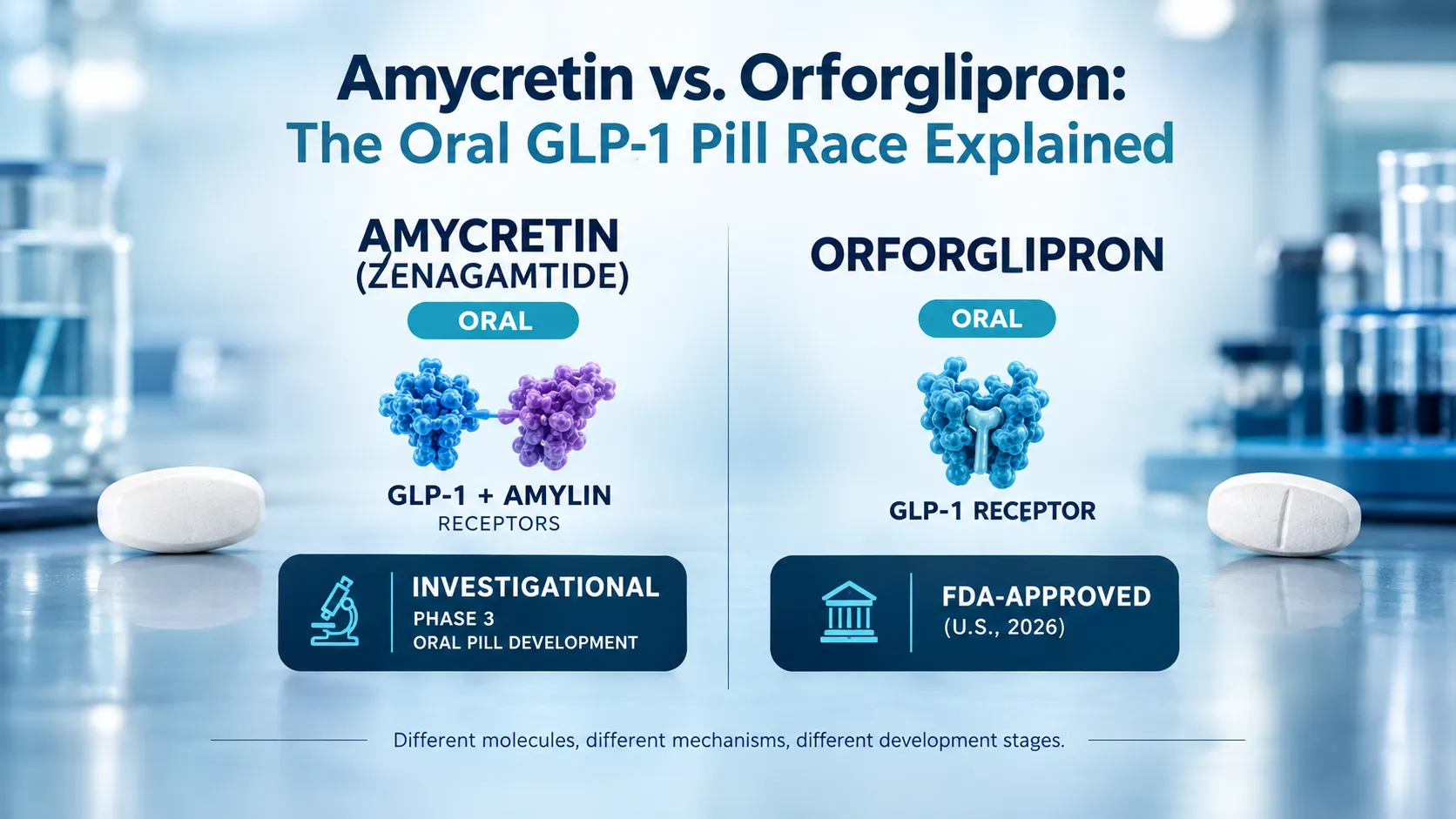
Amycretin is a peptide and orforglipron is not. How that chemistry explains the formulations, trial results, and approval status of both GLP-1 pills.
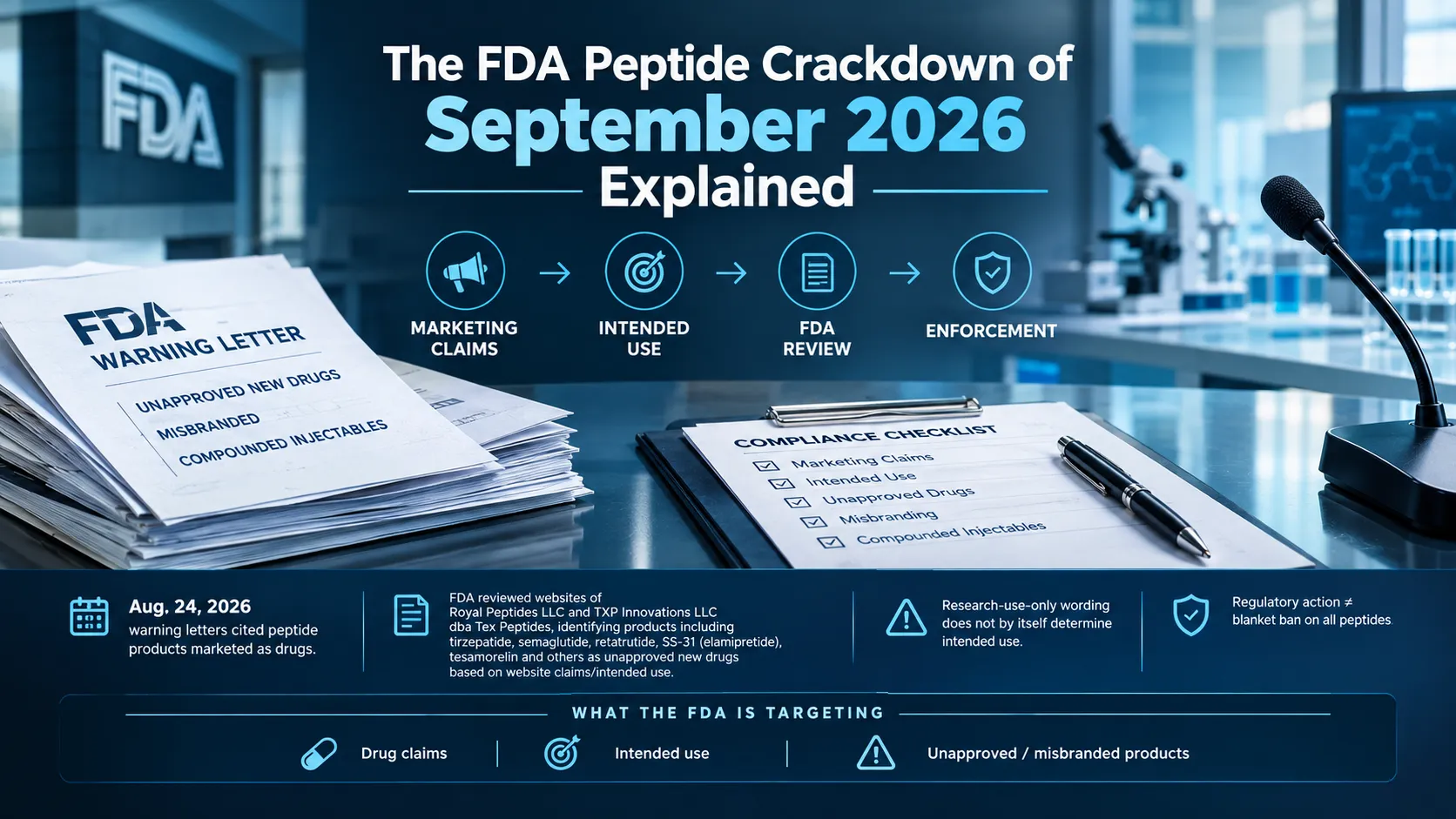
Five peptide sellers got FDA warning letters in September 2026. See who was named, why the research label failed, and the full 2026 enforcement timeline.

In July 2026, the FDA's advisory committee recommended 6 peptides for the 503A bulk list. None are on it yet. What the vote changed and what it didn't.