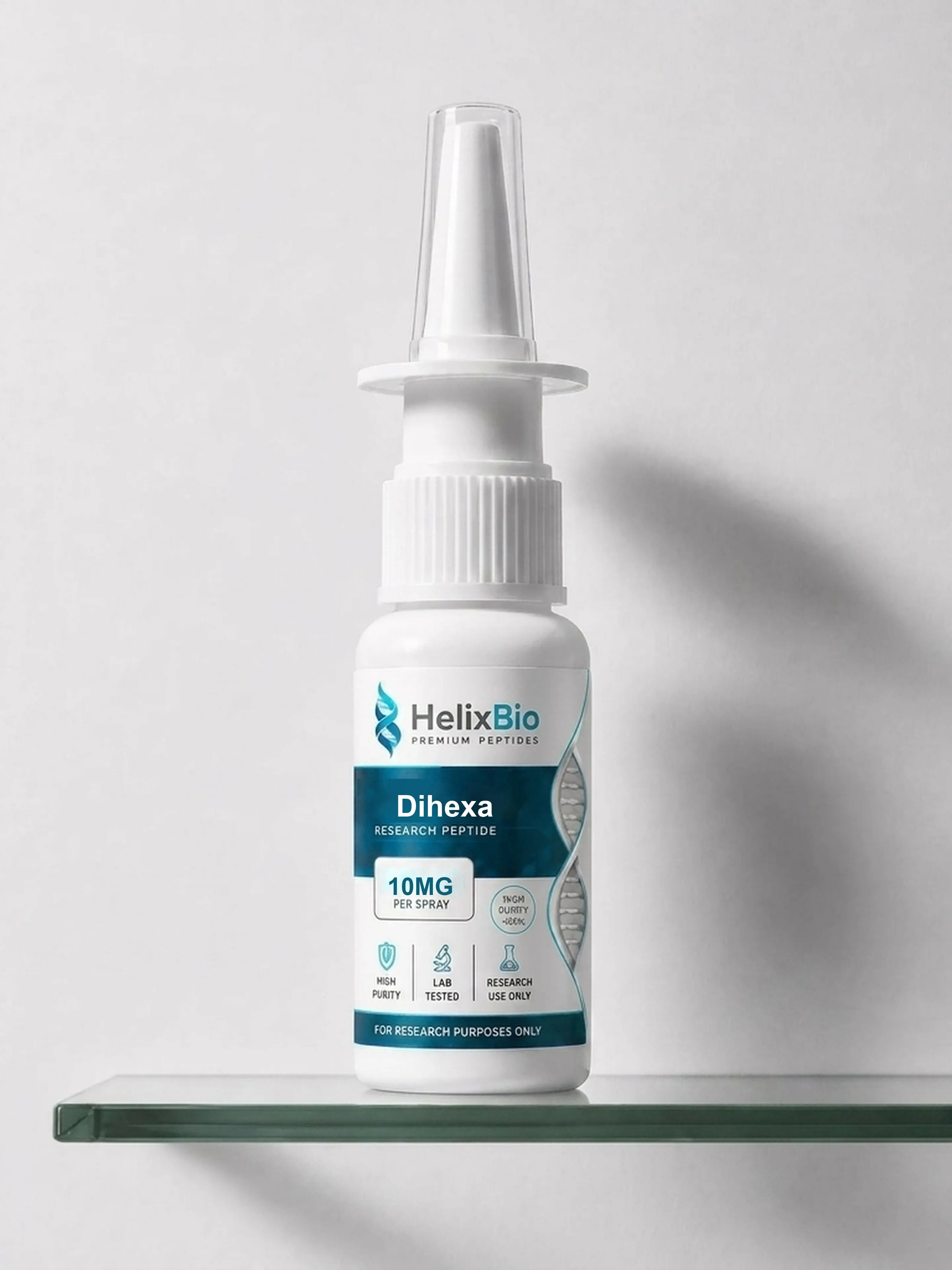
Two amino acids, two synthetic caps, 504.67 g/mol. Dihexa — developmental code PNB-0408 — is a peptidomimetic small molecule built from a tyrosine-isoleucine core with a hexanoyl group at one end and a 6-aminohexanamide at the other, developed at Washington State University from work on angiotensin IV. Those modifications were the point: they raised lipophilicity and removed the bonds that peptides get cleaved at, producing a compound studied in rodent models of cognition and in hepatocyte growth factor pathway research. Helix Bio supplies this material as a Spray-format research preparation for qualified laboratory and scientific applications. It is not intended for human or veterinary use, ingestion, injection, nasal administration, or any other form of administration.
HPLC certified
Independent analysis
Highest standard
Full traceability
Dihexa is formally N-hexanoic-Tyr-Ile-(6) aminohexanoic amide, or by IUPAC name 6-[(2S,3S)-2-[(2S)-2-hexanamido-3-(4-hydroxyphenyl)propanamido]-3-methylpentanamido]hexanamide. Its molecular formula is C₂₇H₄₄N₄O₅, its molecular weight is 504.67 g/mol, and its CAS registry number is 1401708-83-5.
It is widely listed as a peptide, and that description does not hold up. Only two residues in the molecule are proteinogenic, and both ends of the chain are synthetic: a six-carbon acyl cap at the N-terminus and a six-carbon amide extension at the C-terminus. Nothing about the molecule behaves like a peptide in handling terms either — it was engineered specifically to resist proteolysis and to cross lipid membranes. Peptidomimetic small molecule is the accurate description, and it is the one this page works from, because it changes how the material should be characterised and dissolved.
The compound descends from angiotensin IV, a hexapeptide fragment of the renin-angiotensin system with procognitive activity in rodent models. Researchers at Washington State University progressively truncated and modified that parent structure to produce metabolically stable, brain-penetrant analogues, and Dihexa is the endpoint of that programme. The relationship is one of provenance rather than equivalence: Dihexa retains two residues from that lineage and adds two synthetic caps, and angiotensin IV’s own pharmacology — including its interaction with insulin-regulated aminopeptidase — should not be attributed to Dihexa without direct evidence.
Note also that commercial molecular data for this compound is inconsistent. At least one circulating monograph reports a different formula and weight entirely, and database identifiers are cited inconsistently across reference pages. CAS 1401708-83-5 and UNII 9WYX65A5C2 are the identifiers that resolve reliably.
The lipophilicity that makes Dihexa interesting is also what makes its format a real question rather than a packaging detail.
Supplier characterisation sheets describe Dihexa as insoluble in water, with DMSO as the practical solvent. Reported DMSO solubility figures vary substantially between vendors, which is itself a reason to work from lot-specific documentation rather than a general number. Published in vivo work has used mixed vehicle systems rather than aqueous ones — one study in an Alzheimer’s mouse model prepared the compound in a combination of DMSO, PEG300, polysorbate and saline.
For a prepared spray solution, two questions follow directly, and neither can be answered from the scientific literature: what co-solvent system the material is formulated in, and whether it is in true solution or suspension. Both belong in product documentation. The default assumption that applies to most of a peptide catalogue — that a research material dissolves readily in aqueous media — does not apply here, and a researcher who carries it over will get a cloudy vial rather than a working stock.
Researchers should also keep the Dihexa literature separate from the specifications of any commercial preparation. Published findings describe defined experimental systems, mostly in rodents, and do not validate any particular concentration, vehicle or format.
Dihexa has been examined in the following areas:
The existence of published research does not establish that Dihexa Spray is safe or effective for use in humans, and part of that published record has been formally corrected — several foundational papers from the originating laboratory were retracted in 2025 following a research-integrity investigation. Dihexa is not an FDA-approved drug in the United States and has never entered human clinical trials. Dihexa-related bulk drug substances were removed from 503A Category 2 in April 2026 as a procedural step, and Dihexa acetate is one of five substances scheduled for a Pharmacy Compounding Advisory Committee meeting before the end of February 2027.
Two questions matter more for this material than for a typical catalogue compound, and neither is answered by a product name.
The first is what the material actually is. Because Dihexa is routinely mislabelled as a peptide and because commercial molecular data for it disagrees between sources, identity confirmation here is a small-molecule exercise rather than a peptide one: chromatographic purity against a reference standard, mass confirmation near 504.7, and structural confirmation where available. A purity percentage from a peptide-style assay does not answer the question on its own.
The second is what it is dissolved in. Helix Bio states that its research catalog uses independent HPLC testing for purity assessment and mass spectrometry for molecular identity confirmation, and that batch-specific Certificates of Analysis are available. Those establish the compound. For a lipophilic material supplied as a prepared solution, the formulation record — co-solvent system, concentration, and whether the preparation is a solution or a suspension — establishes whether it is usable as supplied, and that is a separate document to ask for.
For Dihexa Spray specifically, researchers should verify the applicable product documentation and current lot information rather than relying on a general product description. A sitewide statement describes the catalog’s testing approach; it is not a lot-level analytical result.
Dihexa Spray is intended for qualified users working in legitimate laboratory or scientific research environments, including:
The product is not intended for personal experimentation, self-administration, human consumption, veterinary use or medical treatment.
| Specification | Details |
|---|---|
| Product Name | Dihexa Spray |
| Research Category | Cognitive & Nootropic / Research Compound |
| Compound | Dihexa |
| Developmental Code | PNB-0408 |
| Scientific Name | N-hexanoic-Tyr-Ile-(6) aminohexanoic amide |
| IUPAC Name | 6-[(2S,3S)-2-[(2S)-2-hexanamido-3-(4-hydroxyphenyl)propanamido]-3-methylpentanamido]hexanamide |
| Synonyms | PNB-0408, Hexanoyl-Tyr-Ile-Ahx-NH₂ |
| Compound Class | Peptidomimetic small molecule |
| Structural Description | Tyr-Ile core with N-terminal hexanoyl cap and C-terminal 6-aminohexanamide |
| Parent Compound | Angiotensin IV (provenance, not equivalence) |
| Molecular Formula | C₂₇H₄₄N₄O₅ |
| Molecular Weight | 504.67 g/mol |
| CAS Number | 1401708-83-5 |
| UNII | 9WYX65A5C2 |
| Proposed Target | Hepatocyte growth factor / c-Met pathway (see research section for evidence status) |
| Aqueous Solubility | Low; refer to current product documentation for the formulated vehicle |
| Format | Prepared Spray solution |
| Intended Use | Research and laboratory investigation only |
| Human Use | Not intended for human consumption |
| Veterinary Use | Not intended for veterinary use |
| Purity | Refer to current lot-specific product documentation |
| Identity Testing | Refer to applicable Certificate of Analysis |
| Concentration | Refer to current product listing |
| Vehicle and Co-Solvent | Refer to current product documentation |
| Fill Volume | Refer to current product listing |
| Packaging | Refer to current product listing |
| Storage | Follow current product-specific documentation |
| Manufacturer | Helix Bio |
| Country of Origin | Not specified; verify current product documentation |
Dihexa’s research record is preclinical, concentrated in rodent cognition and growth-factor pathway work, and it comes with a documented correction to part of its own literature.
Angiotensin IV Analogue Chemistry The compound is the endpoint of a structure-activity programme that truncated and modified angiotensin IV to produce metabolically stable, brain-penetrant analogues. The N-terminal hexanoyl cap and C-terminal aminohexanamide raise lipophilicity and remove proteolytically labile bonds. That makes Dihexa a useful subject in its own right for work on how peptide-derived compounds can be converted into orally absorbed small molecules.
Hepatocyte Growth Factor and c-Met Pathway Research The proposed mechanism is that Dihexa binds hepatocyte growth factor and potentiates its activity at the c-Met receptor, with downstream effects through PI3K/AKT on dendritic spine formation. Two precisions matter. The proposal concerns binding to HGF rather than direct agonism at c-Met, so descriptions saying the compound activates c-Met misstate even the proposed mechanism. And the specific evidence for that binding, including the widely quoted picomolar affinity figure, comes from work that has since been retracted.
Evidence Integrity and What Survives It Two papers from the originating Washington State University laboratory were retracted in April 2025 after an institutional investigation found falsified or fabricated figures, and a third has carried an expression of concern since 2021. Between them, those papers are the source of the HGF binding affinity figure and of the frequently repeated claim that Dihexa is seven orders of magnitude more potent than BDNF — a figure that referred to picomolar activity in a cell-culture spinogenesis assay rather than potency in any general sense. Independent work published since does not depend on them: a 2021 study in an APP/PS1 mouse model reported cognitive rescue, reduced neuronal loss and reduced glial activation over three months of administration, attributing the effect to PI3K/AKT signalling, without replicating the HGF binding data. Researchers evaluating this compound should read the retraction notices alongside the original citations.
Cognitive and Neuronal Models Published preclinical work spans scopolamine-induced impairment models, aged rodents and transgenic Alzheimer’s models, with endpoints including spatial memory tasks, dendritic spine density and markers of glial activation. All of it is animal or cell-culture work. No human clinical trial of Dihexa has been published. The nearest human data in the same pathway class comes from a different molecule — fosgonimeton, developed by a company founded to commercialise this research programme — whose Phase 2/3 Alzheimer’s trial failed its primary endpoint in 2024 and was discontinued. That result is context for the pathway, not evidence about Dihexa.
Researchers should evaluate each publication according to its model, species, vehicle, dose route and endpoints, and should check the current status of any paper cited for mechanism.
Analytical quality matters for any research material because impurities, degradation products, incorrect identity or inconsistent concentration introduce uncontrolled variables. For Dihexa, the relevant analytics are small-molecule analytics, and two considerations are specific to this compound.
The first is that identity confirmation should not rest on peptide logic. The molecule has two residues and two synthetic caps; there is no sequence to confirm. What answers the question is chromatographic purity against a reference standard, a mass result near 504.7 consistent with C₂₇H₄₄N₄O₅, and structural confirmation by NMR where the manufacturer provides it. Given that published molecular data for Dihexa is inconsistent across commercial sources, the reference figures used for comparison matter as much as the result.
The second is concentration in a lipophilic system. For a compound with low aqueous solubility supplied as a prepared solution, a stated concentration is only meaningful alongside the vehicle it refers to and confirmation that the material is fully dissolved. Helix Bio states that its materials undergo independent HPLC testing for purity and mass spectrometry for molecular identity, and that batch-specific Certificates of Analysis are available. For a specific Dihexa Spray lot, researchers should consult the applicable COA and product documentation.
Researchers should assess, where applicable:
No certification, regulatory approval or quality claim should be inferred unless explicitly documented by the manufacturer or a relevant regulatory authority. Sitewide catalog statements are not a substitute for lot-specific documentation.
Storage and handling requirements should be determined from the current Dihexa Spray product documentation and lot-specific instructions. A prepared solution of a lipophilic compound has different handling requirements from a solid, and from the aqueous peptide preparations that make up most of this catalogue.
General laboratory considerations include:
Storage guidance should not be inferred from solid-form Dihexa, from another supplier’s preparation, or from the catalogue’s peptide products, because vehicle composition and packaging determine the relevant behaviour.
Helix Bio’s website describes research materials as being supplied to laboratories and institutions in the United States and describes tracked shipping and cold-chain handling within its fulfillment process.
Because shipping conditions, packaging specifications, availability and delivery requirements may change, researchers should review the current Helix Bio shipping information and product listing before ordering. For a prepared solution of a poorly water-soluble compound, transit temperature history is relevant to whether the material remains in solution on arrival.
Product packaging should remain appropriately labelled and handled as research material after delivery. Researchers are responsible for following applicable institutional, federal, state and local requirements governing research materials.
Dihexa Spray is sold by Helix Bio for research and laboratory purposes only. It is not intended for human or veterinary consumption, self-administration, ingestion, injection, nasal administration, any other form of administration, or the diagnosis, treatment, cure, mitigation or prevention of any disease or medical condition.
Dihexa is not an FDA-approved drug in the United States and has never entered human clinical trials. No cognitive, memory, neurological or therapeutic benefit is claimed or implied. Published findings describe animal and cell-culture experiments and do not establish outcomes in humans.
Part of Dihexa’s published mechanistic literature has been formally retracted following a research-integrity investigation, and a further paper carries an expression of concern. Researchers should verify the current status of any publication before relying on it. Dihexa-related bulk drug substances were removed from 503A Category 2 in April 2026 as a procedural step for further evaluation, and Dihexa acetate is scheduled for consideration at a Pharmacy Compounding Advisory Committee meeting before the end of February 2027. Removal from a category is not authorisation to compound, and an advisory recommendation is not an approval.
This product is not a dietary supplement, consumer wellness product or medical treatment. Researchers are responsible for determining whether a material is appropriate for their intended experimental application and for complying with applicable institutional and regulatory requirements.
Knowledge Base
Knowledge Base
Knowledge Base
Knowledge Base
Knowledge Base
Knowledge Base
Knowledge Base
Knowledge Base
Knowledge Base
Knowledge Base
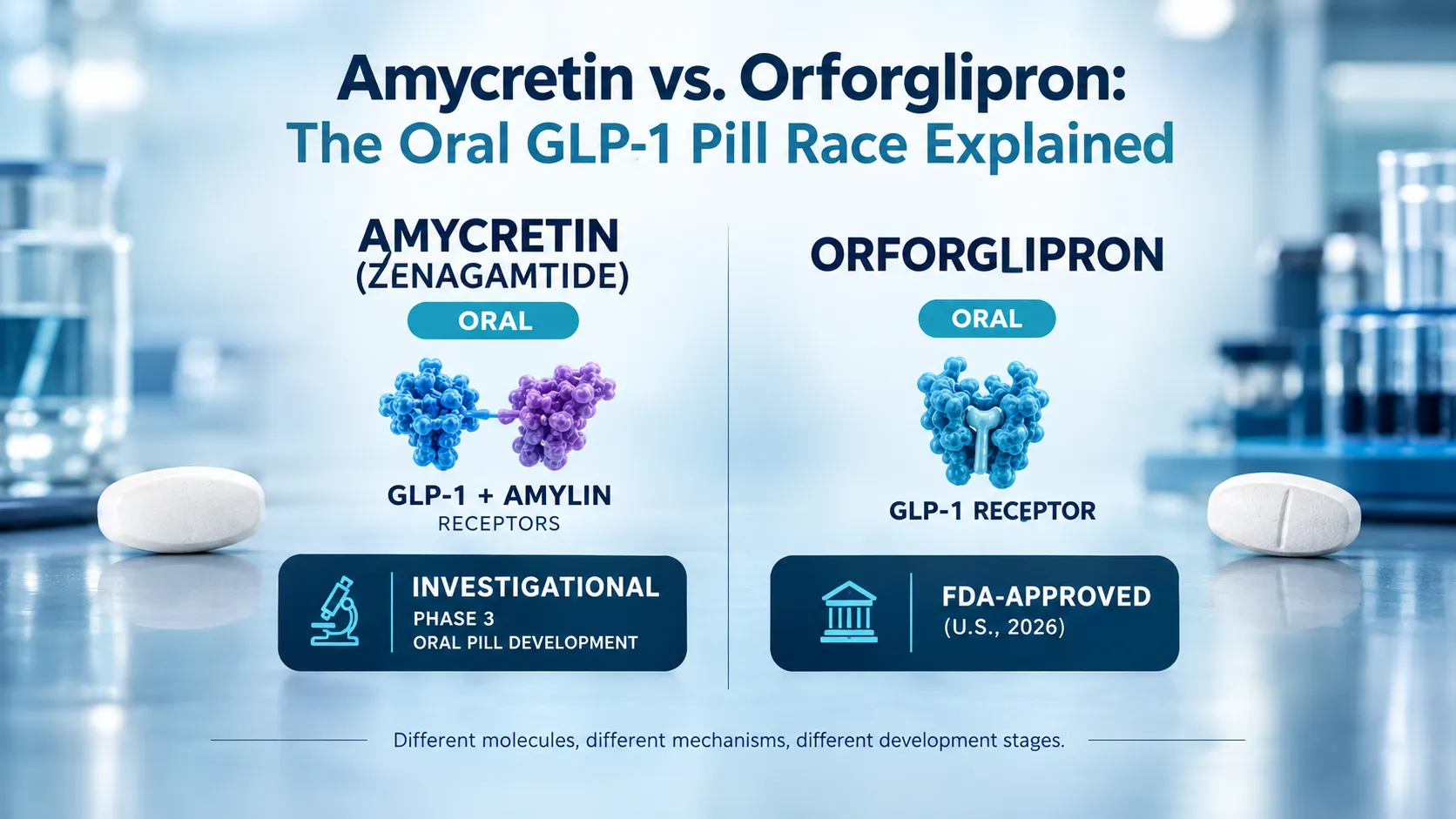
Amycretin is a peptide and orforglipron is not. How that chemistry explains the formulations, trial results, and approval status of both GLP-1 pills.
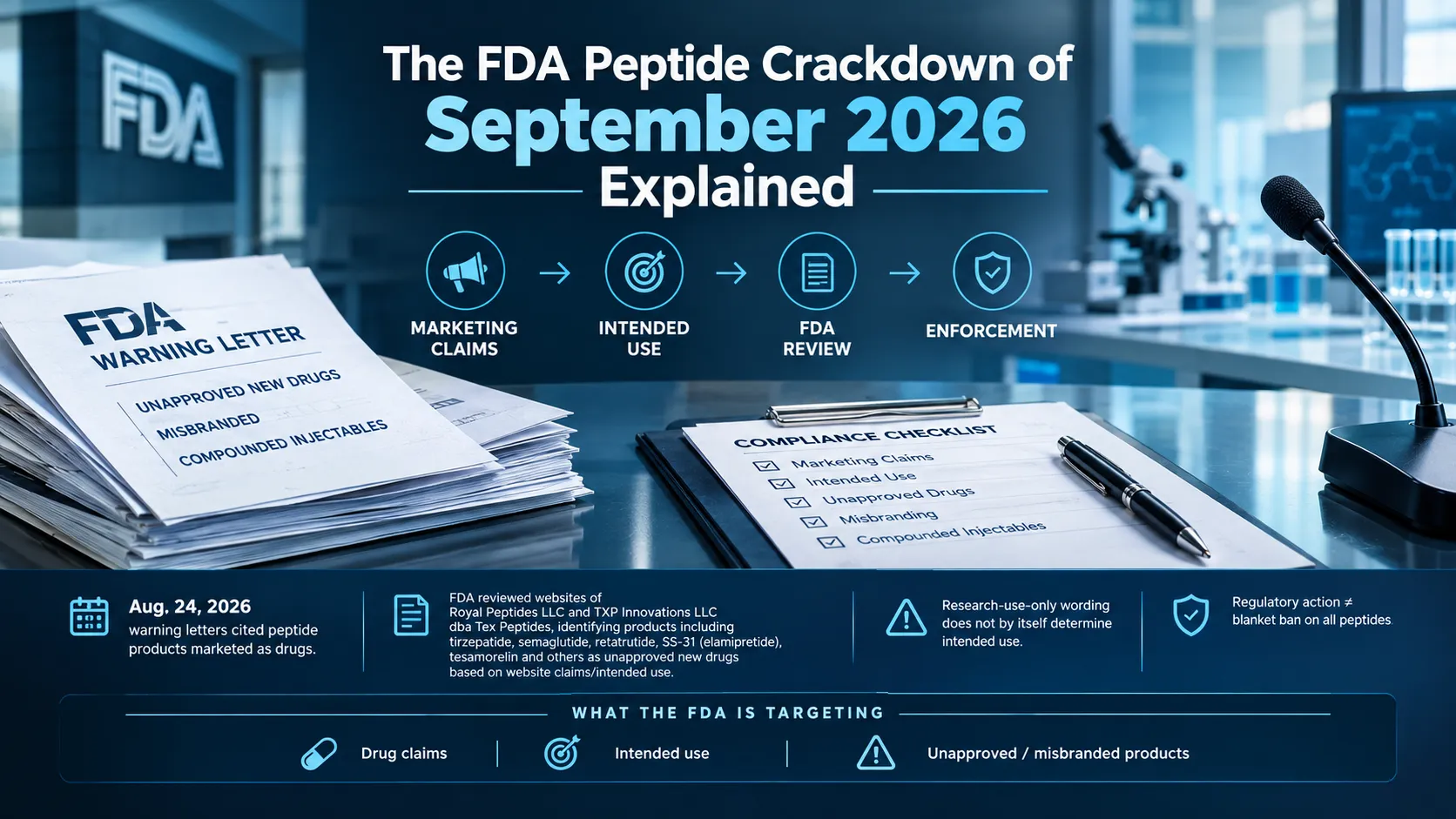
Five peptide sellers got FDA warning letters in September 2026. See who was named, why the research label failed, and the full 2026 enforcement timeline.
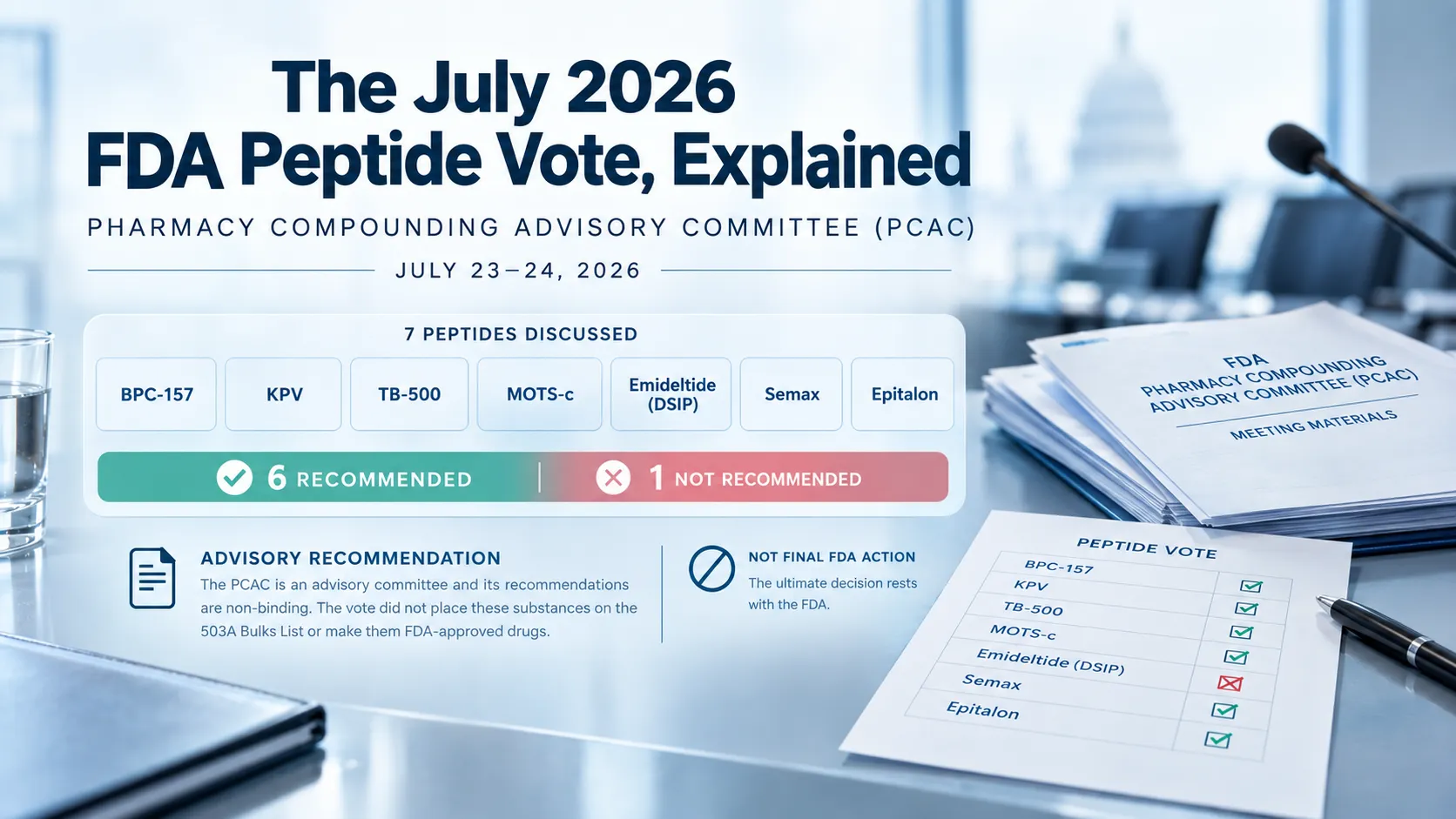
In July 2026, the FDA's advisory committee recommended 6 peptides for the 503A bulk list. None are on it yet. What the vote changed and what it didn't.