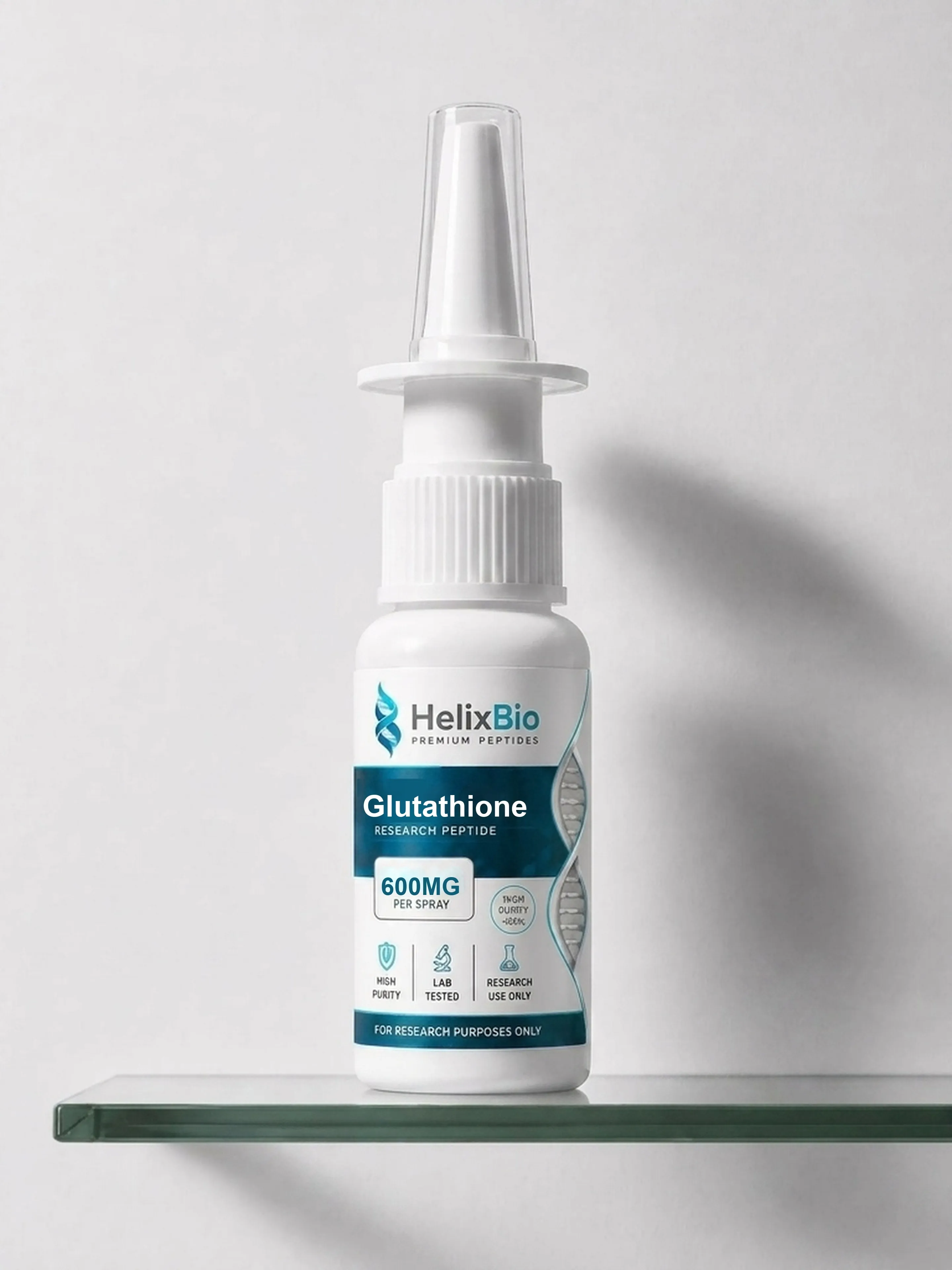
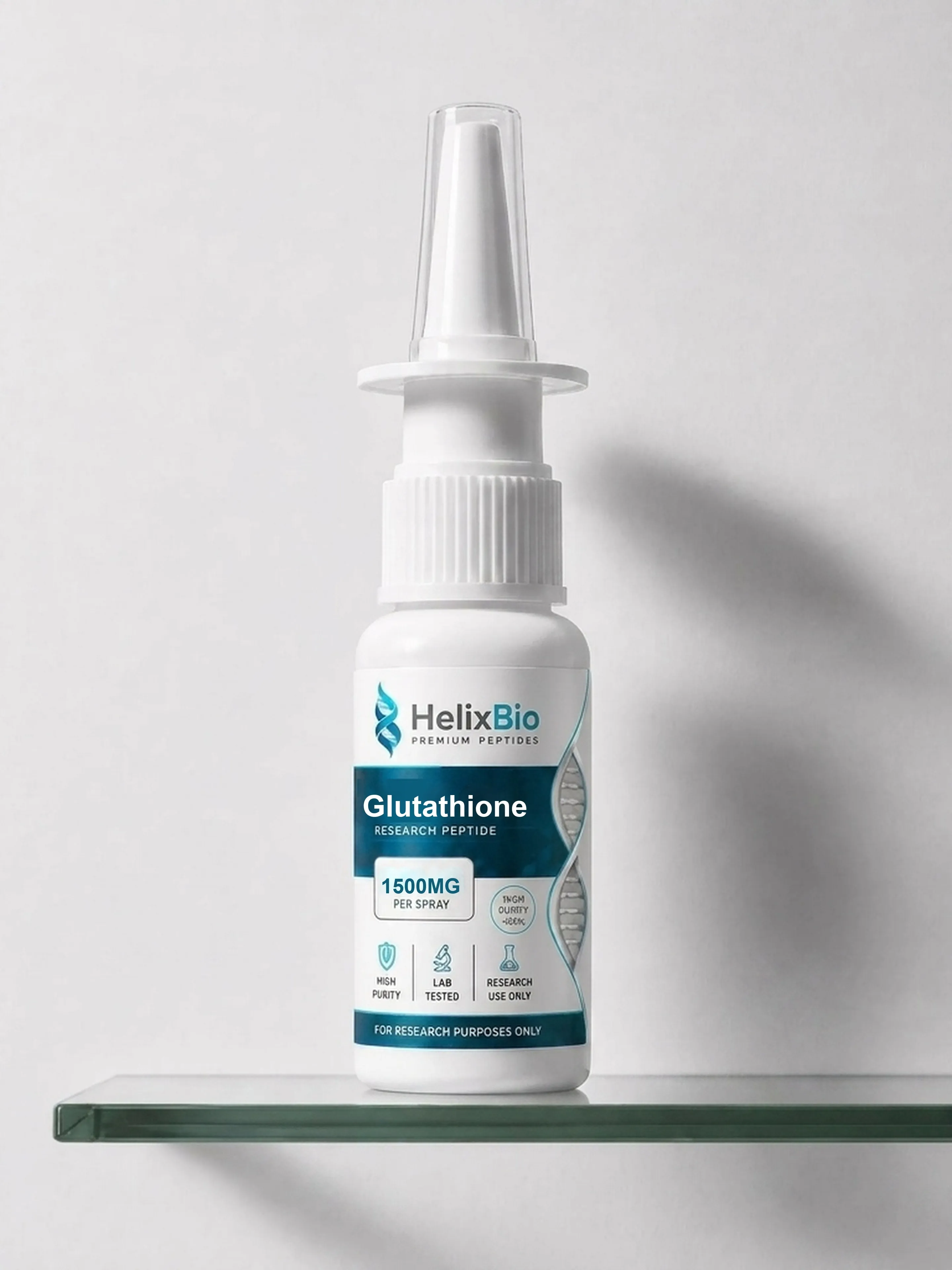
Glutathione is a γ-glutamyl tripeptide — L-glutamate bonded to L-cysteine through its gamma-carboxyl group, then to glycine — and its single free cysteine thiol is what makes it the dominant low-molecular-weight redox molecule inside mammalian cells. Helix Bio supplies it here as a prepared spray-format solution for controlled laboratory work, distinct from the lyophilised Glutathione vial listed separately in this catalog. Supplied for research and laboratory purposes only; not intended for human or veterinary use. Because glutathione’s chemistry is defined by a reactive sulfhydryl group, the questions that matter for a solution are not the same as those that matter for a dry solid. Researchers should review current product documentation and lot-specific analytical information — particularly anything establishing redox form and the analytical method used — before incorporating this material into an experimental workflow.
HPLC certified
Independent analysis
Highest standard
Full traceability
Glutathione is a tripeptide assembled from L-glutamate, L-cysteine and glycine, with the systematic name γ-L-glutamyl-L-cysteinylglycine and the molecular formula C₁₀H₁₇N₃O₆S at 307.32 g/mol. It is catalogued under CAS 70-18-8 and PubChem CID 124886.
One structural detail separates it from an ordinary tripeptide and explains most of its biology. Glutamate is joined to cysteine through its gamma-carboxyl group rather than the alpha-carboxyl used in conventional peptide bonds. Only the cysteine–glycine junction is a standard peptide bond. Because ordinary peptidases do not cleave a γ-glutamyl linkage, glutathione is unusually resistant to intracellular proteolysis, which is a large part of why cells can hold it at millimolar concentrations. Its breakdown instead requires a dedicated enzyme, γ-glutamyl transpeptidase, operating at the cell surface.
The reactive centre is the cysteine sulfhydryl. Through it, glutathione serves as the reducing substrate for glutathione peroxidases, as the conjugating nucleophile for glutathione S-transferases in phase II metabolism, and as one half of the GSH/GSSG redox couple that glutathione reductase maintains using NADPH. Synthesis runs in two ATP-dependent steps: glutamate-cysteine ligase forms the γ-linkage in the rate-limiting step, and glutathione synthetase adds the glycine.
This distinction is routinely blurred in commercial material and it should not be. Reduced glutathione (GSH) is the free-thiol species described above: C₁₀H₁₇N₃O₆S, 307.32 g/mol, CAS 70-18-8. Oxidized glutathione (GSSG), also called glutathione disulfide, is two GSH units joined through a disulfide bond: C₂₀H₃₂N₆O₁₂S₂, 612.63 g/mol, CAS 27025-41-8, PubChem CID 65359. They are separate registry entries and separate chemical entities.
The relationship is straightforward arithmetic. Two glutathione molecules weigh 614.64; forming the disulfide releases two hydrogens, leaving 612.63. In positive-ion mass spectrometry that is a protonated species near m/z 308 for GSH against roughly 613 for GSSG — around 305 daltons apart, and trivially resolvable. A single mass spectrometry run answers the identity question completely.
A third term, total glutathione, is an assay output rather than a description of contents. It is conventionally reported as GSH plus twice GSSG, and it therefore says nothing on its own about the proportion of material present as free thiol. In cell biology the GSH/GSSG ratio is itself used as an index of oxidative state, which is exactly why a research material’s redox composition is worth establishing rather than assuming.
The word “spray” here describes the physical presentation of the material. It is a prepared solution supplied in a spray-format container. It does not designate nasal, oral, sublingual, topical, inhaled or any other administration route, and Helix Bio does not supply this material for administration by any route.
What a solution format genuinely changes is chemistry, not delivery. A free thiol in an aerated aqueous environment is thermodynamically disposed to oxidise, and the reaction is accelerated by dissolved oxygen, by trace transition metal ions, and by rising pH as the thiol deprotonates to the more reactive thiolate. The oxidation product is GSSG — the same compound catalogued above. In other words, the principal stability question for a glutathione solution is not degradation into unrecognisable fragments but conversion into a well-characterised, easily measured second species.
That has two practical consequences for anyone evaluating this material. First, the vehicle composition, pH, and the presence or absence of a chelating agent or antioxidant are more consequential here than for a lyophilised peptide, and those are formulation facts rather than facts about glutathione. Second, an analytical figure obtained at manufacture describes the material at that moment; for a thiol in solution, the interval and conditions between that measurement and use are part of the experimental variable set. Both points argue for reading the current product documentation rather than reasoning from the compound’s general reputation.
Glutathione appears across a wide span of experimental biology and analytical chemistry, including:
The volume of literature on glutathione biology is very large, and almost all of it concerns the molecule’s endogenous role rather than the properties of any supplied preparation. Published research establishes what glutathione is and does inside cells. It does not establish the concentration, formulation, stability or analytical profile of a specific commercial material, and findings from one preparation should not be read across to another.
Glutathione is sold in more forms, by more kinds of vendor, than almost any other compound a laboratory is likely to source. Most of that market is nutritional or cosmetic, and the documentation attached to it answers questions a researcher does not have while leaving the ones they do have untouched.
The question that matters for a glutathione preparation is narrower than “how pure is it”. A chromatographic purity figure expressed as area percent is only meaningful if the method resolves oxidized glutathione, because GSSG is the expected oxidation product and it is a glutathione species itself. A method that does not separate the two, or a figure reported without stating what it separates, leaves the most important property of the material undetermined. The same applies to identity: mass spectrometry distinguishes GSH from GSSG by roughly 305 daltons, so identity confirmation is straightforward when it is actually performed and reported.
For this reason, researchers evaluating Glutathione Spray should look for documentation that states the analytical method, the redox form confirmed, and the date of testing, rather than relying on a general catalog description or a product name. Helix Bio states that its research materials are supported by batch-specific Certificates of Analysis. The applicable lot documentation, not this page, is the authoritative record of what a given container contains.
Glutathione Spray is intended for qualified users working in legitimate laboratory or scientific research environments, including:
The product is not intended for personal experimentation, self-administration, human consumption, veterinary use, cosmetic application or medical treatment.
| Specification | Details |
|---|---|
| Product Name | Glutathione Spray |
| Research Category | Longevity & Anti-Aging / Research Compound |
| Compound | Glutathione |
| Systematic Name | γ-L-glutamyl-L-cysteinylglycine |
| Compound Class | Tripeptide; low-molecular-weight non-protein thiol |
| Amino Acid Composition | L-glutamate, L-cysteine, glycine |
| Structural Note | γ-glutamyl linkage between glutamate and cysteine |
| Molecular Formula | C₁₀H₁₇N₃O₆S |
| Molecular Weight | 307.32 g/mol |
| CAS Number | 70-18-8 |
| PubChem CID | 124886 |
| ChEBI | CHEBI:16856 |
| Format | Prepared solution, spray-format container |
| Redox Form | Confirm against current lot-specific analytical documentation |
| Concentration | Refer to current product listing and lot documentation |
| Fill Volume | Refer to current product listing |
| Formulation and Vehicle | Refer to current product documentation |
| Purity | Refer to current lot-specific Certificate of Analysis |
| Identity Testing | Refer to applicable Certificate of Analysis |
| Storage | Follow current product-specific documentation |
| Packaging | Refer to current product listing |
| Intended Use | Research and laboratory investigation only |
| Human Use | Not intended for human consumption or administration |
| Veterinary Use | Not intended for veterinary use |
| Manufacturer | Helix Bio |
| Country of Origin | Verify current product documentation |
Glutathione is among the most studied small molecules in cell biology. The areas below reflect established experimental use of the compound; they are descriptions of research activity, not statements about outcomes attributable to this or any other supplied preparation.
Redox Homeostasis Research. Glutathione is the principal low-molecular-weight thiol buffer of the cell, and the ratio of its reduced to oxidized forms is widely used as an index of cellular oxidative state. Work in this area typically concerns the maintenance of that ratio, the conditions that shift it, and the methods used to measure it accurately without perturbing it during sample handling.
Enzymatic Systems Research. Glutathione is a required substrate or cofactor for several enzyme families. Glutathione peroxidases consume it in reducing hydroperoxides; glutathione reductase regenerates it from the disulfide using NADPH; glutathione S-transferases use it as a conjugating nucleophile. Oxidized glutathione is itself used as the standard substrate in glutathione reductase activity assays, which is one of several reasons the two forms are not interchangeable in a laboratory setting.
Metabolism and Conjugation Research. Glutathione conjugation is the founding reaction of phase II xenobiotic metabolism, and glutathione depletion is a recognised endpoint in toxicological models. Research in this area examines conjugate formation, the enzymes catalysing it, and downstream processing through the γ-glutamyl cycle.
Analytical Method Development. Because glutathione oxidises readily during sample preparation, quantifying it accurately is a methodological problem in its own right. A substantial literature addresses derivatisation, sample stabilisation, and chromatographic separation of GSH from GSSG by HPLC and LC-MS/MS. Reference material with a documented redox composition is directly relevant to this work.
Researchers should evaluate each publication according to its model system, the exact glutathione species studied, the concentration and preparation used, and the endpoints measured, rather than assuming that findings from one experimental system transfer to another.
Analytical quality matters for any research material, but for glutathione the specific risk is unusually well defined. The compound’s expected degradation product is oxidized glutathione, and GSSG is not an unknown impurity — it is a characterised molecule with its own registry number, its own molecular weight and its own established chromatographic behaviour. That makes the quality question answerable with precision, provided the right question is asked.
Two properties should be separated when reading documentation for this material:
Chemical purity — the proportion of the analysed sample that is glutathione-derived material rather than unrelated substances. This is what a conventional HPLC area-percent figure is usually intended to convey.
Redox composition — how much of that glutathione-derived material is present as reduced glutathione rather than as the disulfide. This is a separate determination, and a purity figure produced by a method that does not resolve GSSG does not report it.
A method that separates the two species answers both questions at once. A method that does not, or a figure quoted without the method attached, answers only the first. Mass spectrometry settles identity independently, since the two species differ by roughly 305 daltons.
Researchers should assess, where applicable:
No certification, regulatory approval or quality claim should be inferred unless it is explicitly documented by the manufacturer or a relevant regulatory authority. A general catalog statement is not a substitute for lot-specific documentation.
Storage and handling requirements should be taken from the current Glutathione Spray product documentation and lot-specific instructions. The considerations below explain why this material’s requirements differ from those of a dry solid, and should not be treated as a substitute for that documentation.
A prepared glutathione solution has no reconstitution step, so guidance written for lyophilised material — protection from moisture, reconstitution technique, post-reconstitution windows — does not apply to it. The relevant chemistry is different. A free thiol in an aerated aqueous environment tends toward oxidation, and three factors accelerate it: dissolved oxygen, trace transition metal ions, and increasing pH, since the deprotonated thiolate is the more reactive species. The result is GSSG rather than an unidentifiable breakdown product, which makes the change measurable but does not make it desirable.
General laboratory considerations:
Storage guidance should not be carried over from lyophilised glutathione, from another supplier’s solution, or from any other Helix Bio product, because vehicle composition, pH and packaging all affect the stability of a thiol in solution.
Helix Bio’s website describes research materials as being supplied to laboratories and institutions in the United States, and describes tracked shipping and cold-chain handling within its fulfilment process.
Because shipping conditions, packaging specifications, availability and delivery requirements may change, researchers should review the current Helix Bio shipping information and product listing before ordering. Containers should be inspected on receipt and transferred to appropriate storage promptly.
Product packaging should remain appropriately labelled and handled as research material after delivery. Researchers are responsible for following applicable institutional, federal, state and local requirements governing research materials.
Glutathione Spray is sold by Helix Bio for research and laboratory purposes only. It is not intended for human or veterinary consumption, self-administration, cosmetic application, diagnosis, treatment, cure, mitigation or prevention of any disease or medical condition.
Glutathione is not an FDA-approved drug in the United States. Its regulatory position is sometimes misread, and one point is worth stating plainly: in June 2022, FDA’s Pharmacy Compounding Advisory Committee voted to recommend adding glutathione to the final 503A Bulks List, against the recommendation of FDA staff, who had concluded that the available effectiveness and safety data were insufficient. That vote is advisory, is not binding on FDA, and is not an approval. It also concerns the activities of compounding pharmacies; Helix Bio is not a compounding pharmacy and does not operate as a compounding facility under Section 503A of the Federal Food, Drug, and Cosmetic Act.
Published research describes the biology of endogenous glutathione and the behaviour of specific glutathione preparations studied under defined conditions. It does not establish that this product is safe or effective for any use in humans, and evidence generated with oral, intravenous, nebulised or other formulations does not transfer to this material.
This product is not a dietary supplement, cosmetic, consumer wellness product or medical treatment. Researchers are responsible for determining whether a material is appropriate for their intended experimental application and for complying with applicable institutional and regulatory requirements.
Knowledge Base
Knowledge Base
Knowledge Base
Knowledge Base
Knowledge Base
Knowledge Base
Knowledge Base
Knowledge Base
Knowledge Base
Knowledge Base
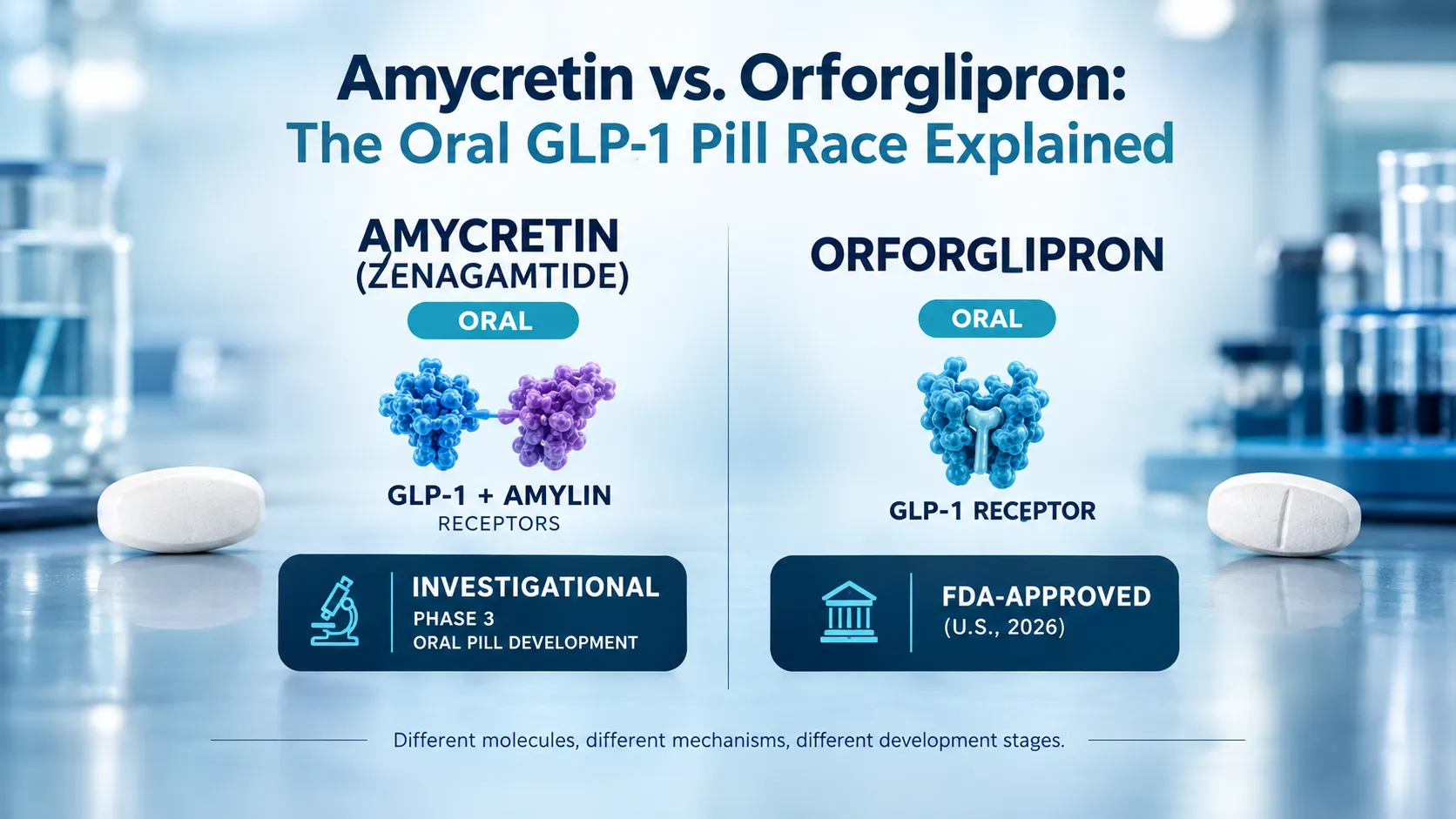
Amycretin is a peptide and orforglipron is not. How that chemistry explains the formulations, trial results, and approval status of both GLP-1 pills.
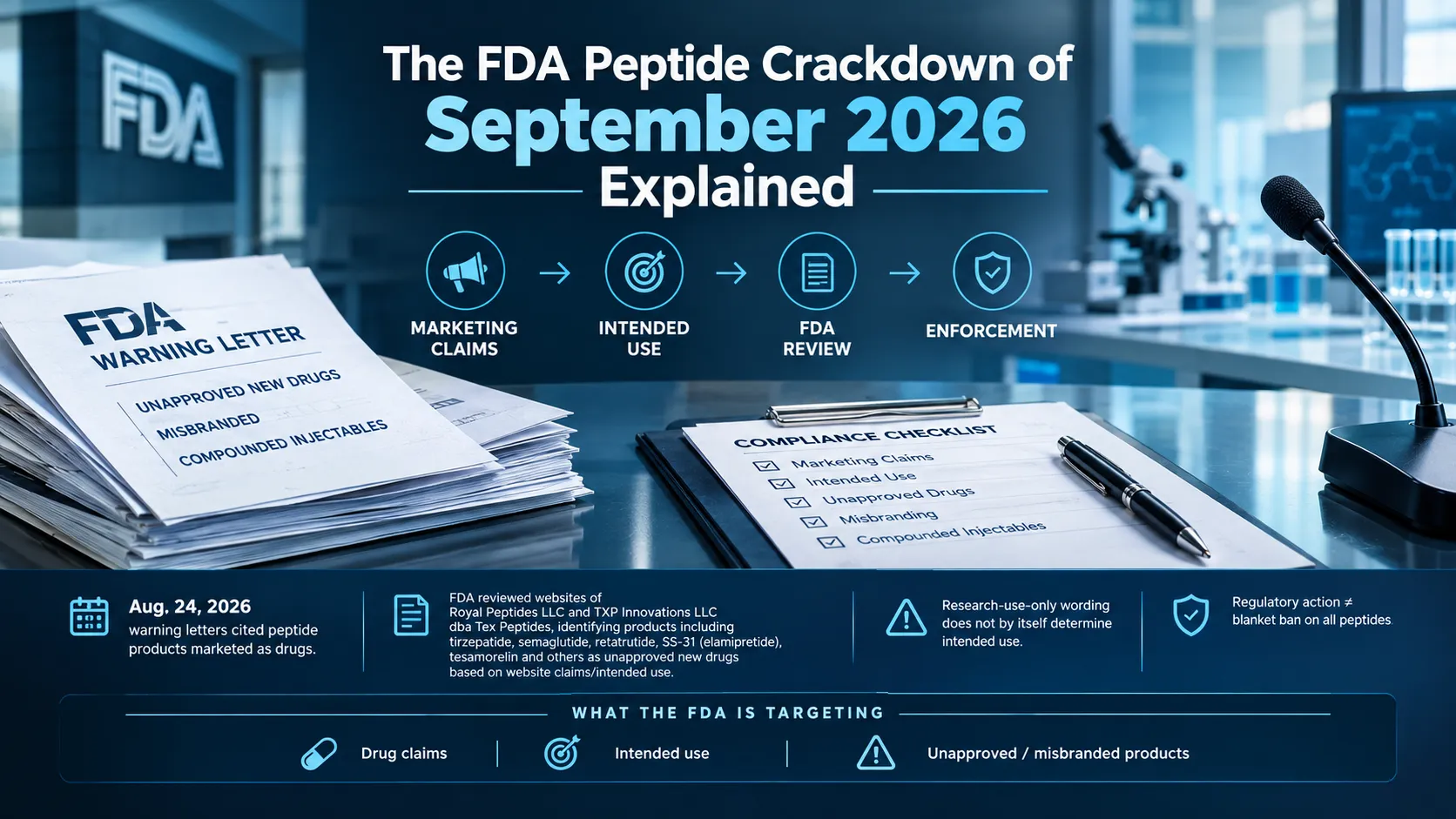
Five peptide sellers got FDA warning letters in September 2026. See who was named, why the research label failed, and the full 2026 enforcement timeline.
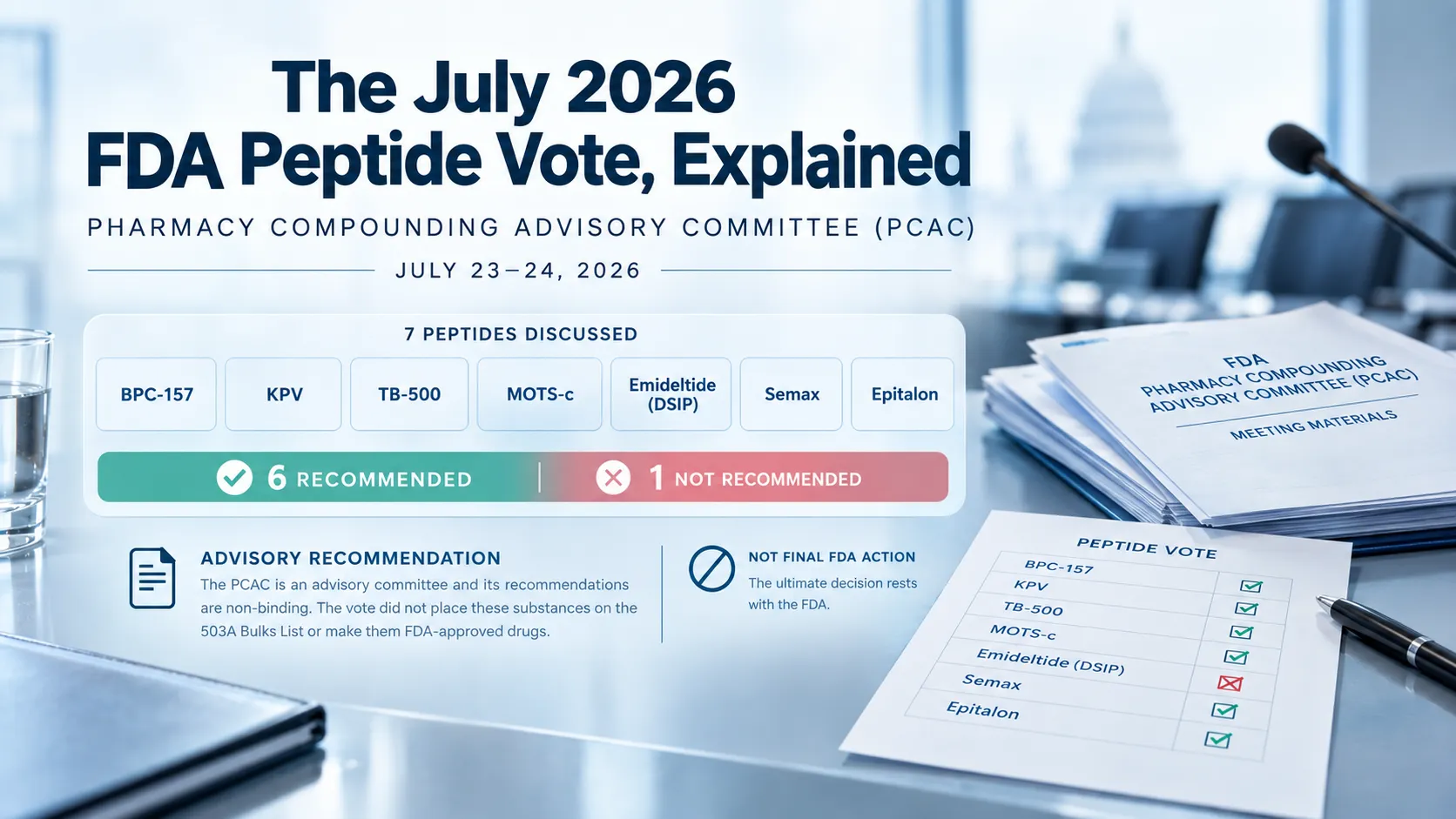
In July 2026, the FDA's advisory committee recommended 6 peptides for the 503A bulk list. None are on it yet. What the vote changed and what it didn't.