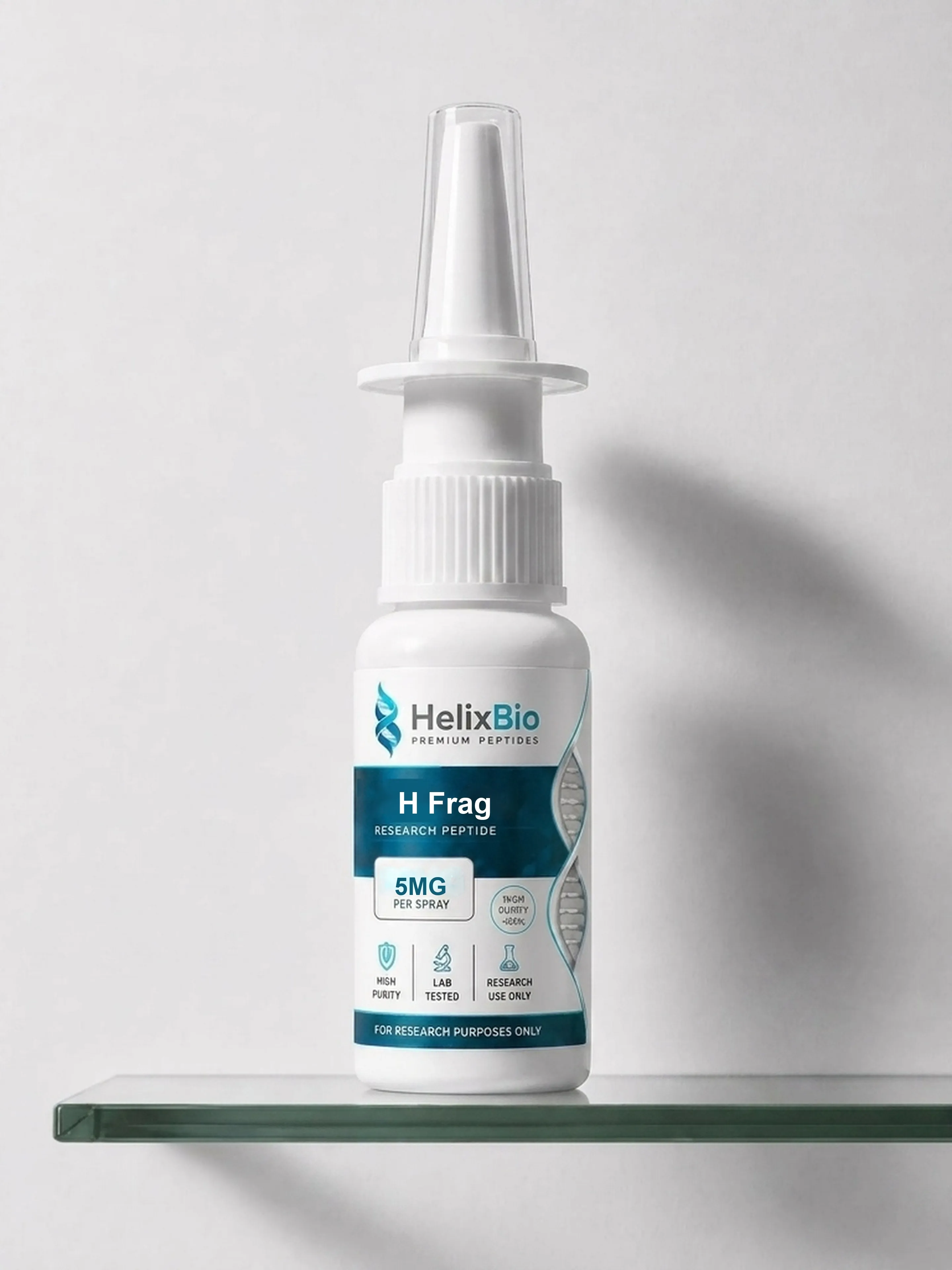
H Frag Spray is a research-use preparation of hGH Fragment 176-191, the sixteen-residue peptide corresponding to the C-terminal end of the 191-amino-acid human growth hormone sequence. The fragment begins at phenylalanine and carries an internal disulfide bridge between its two cysteine residues. It is a distinct molecule from AOD9604, which substitutes tyrosine at the first position and has a separate analytical profile and a separate evidence base.Helix Bio supplies this material for qualified laboratory and scientific applications. H Frag Spray is offered strictly for research use and is not intended for human or veterinary consumption, or for the diagnosis, treatment, cure or prevention of any disease.
HPLC certified
Independent analysis
Highest standard
Full traceability
Human growth hormone is a 191-residue polypeptide secreted by somatotroph cells of the anterior pituitary. During the 1970s and 1980s, structure-function work on the hormone set out to determine whether its metabolic activity could be separated from its growth-promoting activity by dissecting the molecule into defined regions. The C-terminal segment spanning residues 176 to 191 emerged from that work as the region of interest, and hGH Fragment 176-191 is the synthetic peptide corresponding to it.
The fragment does not reproduce the parent hormone in miniature. Full-length hGH signals through the growth hormone receptor, drives hepatic IGF-1 output, and affects carbohydrate handling. A sixteen-residue peptide lacks the four-helix bundle architecture required for that receptor engagement. What the fragment retains, and what makes it a subject of laboratory interest, is a defined sequence from a functionally interesting region of a well-characterised hormone.
Researchers approaching this compound should be aware that most of the mechanistic narrative circulating around it in commercial material is imported from a different molecule. That distinction is set out in the section below and in the specifications table.
hGH Fragment 176-191 is a hexadecapeptide with the sequence Phe-Leu-Arg-Ile-Val-Gln-Cys-Arg-Ser-Val-Glu-Gly-Ser-Cys-Gly-Phe, written in single-letter notation as FLRIVQCRSVEGSCGF. The two cysteine residues sit at positions 7 and 14 of the fragment, corresponding to Cys182 and Cys189 in full growth hormone numbering, and form a cyclic disulfide bond that closes a loop across the second half of the peptide. As a free peptide the molecule has the formula C78H123N23O22S2 and an average mass near 1799 g/mol, under CAS registry number 66004-57-7.
Analytical values for this compound are reported inconsistently across the supply market, and the reason is salt form rather than error in every case. Synthetic peptides purified by reversed-phase chromatography are commonly isolated as acetate or trifluoroacetate salts, and a certificate reporting the salt-form mass will not match the free-peptide figure. PubChem's record for the acetate form lists the formula C80H127N23O24S2 under CID 172966176; free-peptide entries list C78H123N23O22S2. Figures in the region of 1817 g/mol also appear in circulation and correspond to a different counter-ion or hydration assumption again.
The practical consequence is that a mass-spectrometry result cannot be judged against a remembered number. It has to be judged against the mass basis stated on the certificate for that lot.
H Frag Spray is supplied as a research material for in-vitro and laboratory investigation by qualified users. It is not a drug, dietary supplement, cosmetic or consumer product, and Helix Bio provides no dosing, administration or experimental protocol guidance for it.
Appropriate applications include analytical method development, peptide characterisation work, reference and comparator use in chromatographic or mass-spectrometric assays, and controlled cell-based or preclinical research designed and approved by the receiving institution. Researchers are responsible for determining whether the material suits their experimental design and for complying with institutional, federal, state and local requirements governing research chemicals.
Three characteristics distinguish this material from how it is generally presented elsewhere in the research supply market.
The sequence is the native one. hGH Fragment 176-191 begins at phenylalanine, exactly as the parent hormone does at residue 176. Product listings that show a tyrosine-initiated sequence are describing AOD9604, not this fragment. The distinction is a single residue and it changes the molecular mass by roughly 16 daltons at the amino acid level and the identity of the compound entirely.
The evidence base is narrower than the market implies. The lipolytic characterisation routinely attached to this fragment derives from studies on AOD9604, the modified analogue. The bare fragment has no comparable dedicated human study programme of its own. Helix Bio states this rather than borrowing the claim.
The analytical basis is stated, not assumed. Because salt form materially changes the expected mass, the specification table and the lot certificate identify which basis applies rather than presenting a single unqualified figure.
For a compound this widely mislabelled, the useful question is not what the product page claims but what the paperwork shows. A certificate for hGH Fragment 176-191 and a certificate for AOD9604 are not interchangeable: the expected masses differ by roughly 163 daltons, and a chromatographic method optimised for one will not necessarily resolve the impurity profile of the other.
Before a lot enters an experimental workflow, the identity result should be checked against the correct reference mass on the correct salt basis, the chromatographic purity figure should be read alongside the method that produced it, and the lot number on the certificate should match the lot on the container. Helix Bio makes lot-specific documentation available so those checks can actually be performed. A general catalogue statement is not a substitute for the certificate covering the material in hand.
H Frag Spray is intended for qualified users in legitimate laboratory and scientific research environments: academic and institutional research groups, biotechnology and pharmaceutical laboratories, contract research organisations, analytical laboratories developing or validating peptide methods, and educational research institutions.
It is not intended for personal experimentation, self-administration, human consumption, veterinary use, athletic use, or any medical purpose.
| Specification | Details |
|---|---|
| Product Name | H Frag Spray |
| Compound | hGH Fragment 176-191 |
| Common Synonyms | HGH Frag 176-191; hGH (176-191); growth hormone fragment 176-191; somatotropin (176-191) |
| Compound Class | Synthetic peptide fragment of human growth hormone |
| Peptide Length | 16 amino acids |
| Sequence | Phe-Leu-Arg-Ile-Val-Gln-Cys-Arg-Ser-Val-Glu-Gly-Ser-Cys-Gly-Phe (FLRIVQCRSVEGSCGF) |
| Structural Feature | Cyclic disulfide, Cys7–Cys14 (Cys182–Cys189 in hGH numbering) |
| Parent Molecule | Human growth hormone, residues 176–191 of 191 |
| Molecular Formula (free peptide) | C78H123N23O22S2 |
| Average Mass (free peptide) | ≈1799 g/mol |
| CAS Number | 66004-57-7 |
| PubChem CID | 172966176 (acetate form record) |
| Related but Distinct Compound | AOD9604 — N-terminal tyrosine variant, ≈1978 g/mol |
| Format | Spray preparation |
| Concentration | Refer to current product listing and lot documentation |
| Fill Volume | Refer to current product listing |
| Salt Form | Refer to the applicable Certificate of Analysis |
| Purity | Refer to lot-specific Certificate of Analysis |
| Identity Testing | Refer to the applicable Certificate of Analysis |
| Storage | Follow the storage conditions supplied with the product |
| Regulatory Status | Not an FDA-approved drug |
| Intended Use | Research and laboratory investigation only |
| Human Use | Not intended for human consumption |
| Veterinary Use | Not intended for veterinary use |
| Supplier | Helix Bio |
The research history here belongs largely to AOD9604, and reading it accurately means keeping track of which compound each finding was generated with.
AOD9604 was developed from this C-terminal region at Monash University and taken forward by Metabolic Pharmaceuticals. In obese and β3-adrenergic-receptor knockout mice, Heffernan and colleagues reported that the lipid-metabolism effects of both growth hormone and AOD9604 were substantially reduced when the β3-adrenergic receptor was absent, while IGF-1 did not rise significantly in the AOD9604 groups. That work is the origin of the β3-adrenergic mechanism and the "lipolysis without IGF-1" description. It was carried out with AOD9604, in mice.
AOD9604 subsequently went through a clinical programme of roughly six sponsor-run trials involving on the order of 900 participants. The pivotal efficacy trial did not separate from placebo and the programme was discontinued. Human safety and tolerability reports from that programme exist in the literature; efficacy findings supporting a weight-reduction claim do not.
hGH Fragment 176-191 itself has no comparable dedicated human study programme. Where the fragment appears in the literature it is generally as a synthetic reference material, a comparator in analytical work, or a subject of in-vitro adipocyte and peptide-chemistry investigation. Findings generated with AOD9604 should not be transferred to it without evidence establishing that the substitution at position one does not alter the result.
Full-length hGH is a four-helix-bundle protein whose receptor engagement depends on a binding surface distributed across the folded molecule. A sixteen-residue linear fragment with a single internal disulfide cannot reconstruct that surface, which is the structural reason a fragment of a hormone is not a low-dose version of the hormone. This is a useful point for structure-function research and a necessary caution against reading growth hormone literature as if it applied to the fragment.
The existence of published research does not establish that this material is safe or effective for any use in humans.
Two orthogonal checks matter for this compound. Chromatographic purity by reversed-phase HPLC reports how much of the material is the intended species relative to related impurities, and is meaningful only alongside the method and gradient that produced it. Mass-spectrometric identity confirms which species that is, and for a compound one residue away from a widely traded analogue it is the check that actually distinguishes the two. A result consistent with roughly 1978 Da is AOD9604, not hGH Fragment 176-191.
Before use, researchers should confirm: the compound name and sequence on the certificate; the observed mass and the salt basis it is reported against; the chromatographic purity figure and the method; the lot number and its match to the container; and the test date.
Storage requirements for this material should be taken from the documentation supplied with the specific lot. Storage conditions published for lyophilised hGH Fragment 176-191 do not transfer to a spray preparation: a peptide already in solution has a different stability profile from a dry powder, and the vehicle and container both affect it.
General laboratory practice applies. Keep the container closed when not in use, avoid unnecessary temperature cycling and unnecessary light exposure, maintain laboratory labelling and inventory records, and follow institutional procedures for handling research peptides. Material should not be used beyond a stated storage period or retest date without appropriate laboratory qualification.
H Frag Spray is supplied by Helix Bio for research and laboratory purposes only. It is not intended for human or veterinary consumption, self-administration, or the diagnosis, treatment, cure, mitigation or prevention of any disease or medical condition.
hGH Fragment 176-191 is not an FDA-approved drug. Approval status should not be inferred from published research, commercial availability, laboratory use, or from the clinical history of the related compound AOD9604. Unapproved drugs have not undergone the agency's review for safety, effectiveness and quality.
This product is not a dietary supplement, cosmetic, wellness product or medical treatment. Researchers are responsible for determining whether the material is appropriate for their intended application and for complying with applicable institutional and regulatory requirements.
Knowledge Base
Knowledge Base
Knowledge Base
Knowledge Base
Knowledge Base
Knowledge Base
Knowledge Base
Knowledge Base
Knowledge Base
Knowledge Base
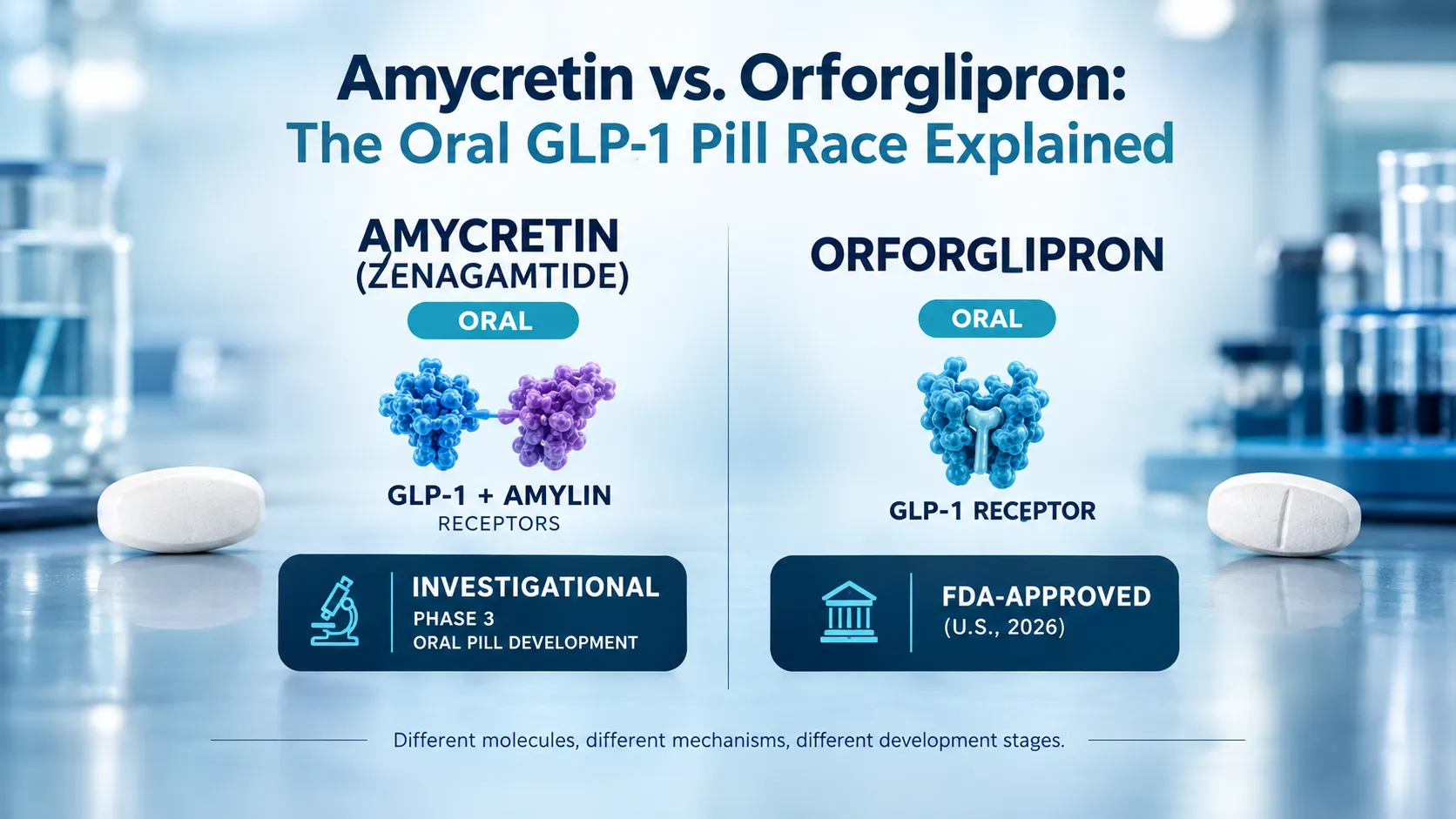
Amycretin is a peptide and orforglipron is not. How that chemistry explains the formulations, trial results, and approval status of both GLP-1 pills.
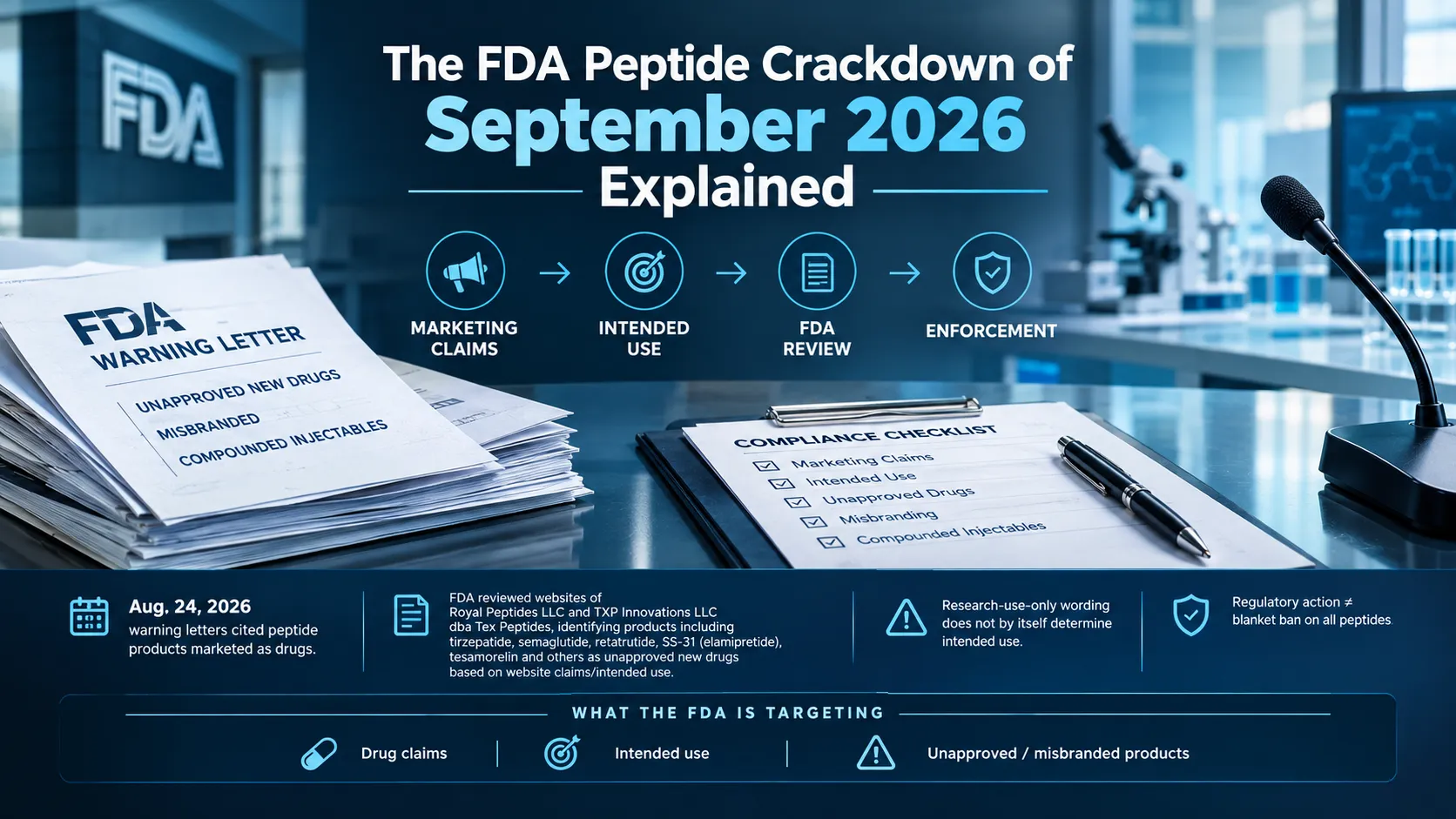
Five peptide sellers got FDA warning letters in September 2026. See who was named, why the research label failed, and the full 2026 enforcement timeline.

In July 2026, the FDA's advisory committee recommended 6 peptides for the 503A bulk list. None are on it yet. What the vote changed and what it didn't.