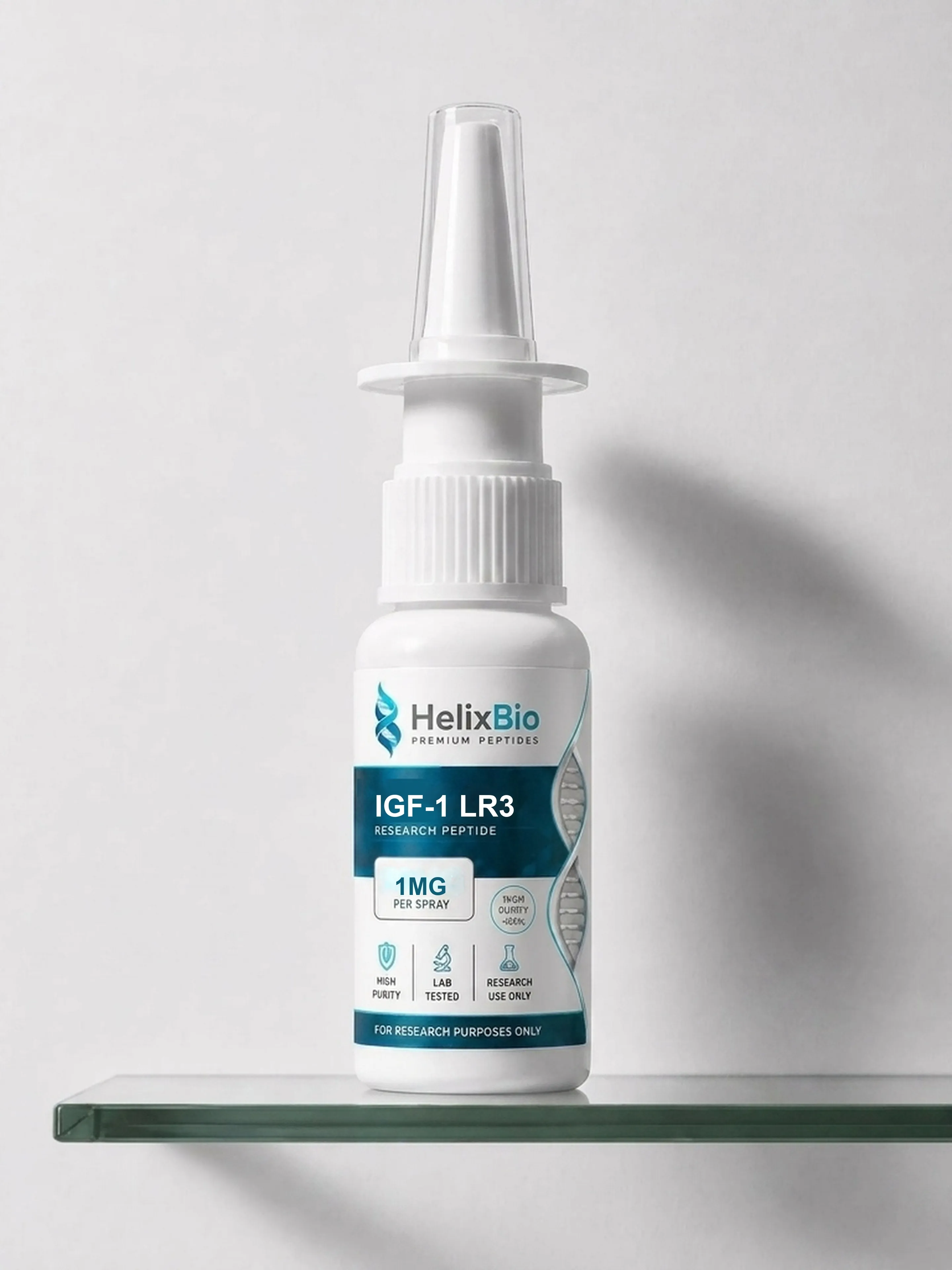
Long R3 IGF-1 — written IGF-1 LR3 across most research catalogues — is an 83-residue recombinant analogue of human insulin-like growth factor 1, built by two deliberate changes to the 70-residue native sequence: a thirteen-amino-acid extension on the N-terminus and an arginine substituted for glutamate at position three. Together those modifications substantially reduce the molecule’s affinity for IGF binding proteins, which is why it became a standard supplement in serum-free mammalian cell culture. IGF-1 LR3 Spray is Helix Bio’s spray-format preparation of that analogue, supplied as a research material. Helix Bio provides laboratory materials for qualified scientific work only. This product is not intended for human or veterinary consumption, self-administration, diagnosis, treatment, or the prevention of any disease. Researchers should review the current lot documentation before incorporating the material into any experimental workflow.
HPLC certified
Independent analysis
Highest standard
Full traceability
IGF-1 LR3 is an engineered protein, not a naturally occurring one. It takes the mature human IGF-1 sequence and applies exactly two modifications: an arginine replaces the glutamate at position 3, and a thirteen-residue extension — MFPAMPLSSLFVN — is added to the N-terminus. The result is a single-chain polypeptide of 83 amino acids with a calculated molecular weight of approximately 9,118 daltons, against native IGF-1’s 70 residues and 7,649 daltons.
Both modifications matter, and describing only one describes a different molecule. Material carrying the Arg³ substitution alone, without the extension, is sold separately as R3 IGF-I and is 70 residues long. The two are routinely conflated in conversation and occasionally in catalogues. They differ by roughly 1,400 daltons, which means a single mass-spectrometry run separates them unambiguously.
The extension itself has a specific and slightly unglamorous origin: it derives from methionyl porcine growth hormone and was included to improve recombinant expression yield. It is not a biologically active element. The functional consequence of the pair of changes is a marked reduction in binding to the IGF binding proteins — the family of carrier proteins that ordinarily sequester IGF-1 and limit how much of it is available to receptors. Published characterisation of this analogue records that IGFBP-3 does not inhibit its activity, and that it retains the capacity to bind both the type 1 IGF receptor and the insulin receptor.
Because IGF-1 LR3 is produced recombinantly in E. coli rather than assembled by solid-phase synthesis, it carries the three intramolecular disulfide bonds of the IGF-1 scaffold and must be refolded from inclusion bodies under oxidizing conditions during manufacture. That production route has direct consequences for how the material should be specified and verified, covered under Purity & Quality Standards below.
A spray describes how a material is presented, not how it is used. For IGF-1 LR3 the format raises two questions that are worth putting plainly rather than leaving implied.
The first concerns the literature. Intranasal delivery of native IGF-1 has been studied in rodent models — Liu and colleagues reported reduced infarct volume following intranasal IGF-1 in a rat focal ischemia model, and related work examined distribution to brain regions. Those studies used native IGF-1. No published research examining mucosal or intranasal administration of IGF-1 LR3 specifically was identified in preparing this page. The analogue is approximately 1,469 daltons larger than the molecule those studies used, and its defining modifications alter binding-protein interaction — a circulating-compartment property that has no obvious bearing on mucosal transport. Native IGF-1 delivery findings should not be read as findings about this analogue.
The second concerns the material itself. A protein held in aqueous solution behaves differently from a lyophilized powder. Proteins with multiple disulfide bonds are susceptible to disulfide exchange and aggregation in solution, and dilute protein solutions lose measurable material to adsorption on container surfaces. These are formulation-dependent effects, which means the vehicle composition, buffer, pH and any stabilising excipient are not incidental details — they are the variables that determine whether the material in the container matches the material described on the certificate. Researchers should obtain those details from the current product documentation rather than assuming them.
Helix Bio supplies this material for laboratory investigation. It is not intended for administration by any route.
IGF-1 LR3’s documented use sits in two areas.
The larger by far is cell culture. The analogue was developed as a growth-factor supplement for serum-free and reduced-serum mammalian culture, where cells secrete IGF binding proteins that neutralise native IGF-1 added to the medium. Reduced IGFBP affinity is what makes the analogue useful in that setting, and published work documents its use in CHO cell systems and in bioprocess development, where supplementation has been compared against insulin.
The smaller area is receptor and signalling research, where the analogue serves as a tool for sustained IGF1R engagement. The type 1 IGF receptor is a receptor tyrosine kinase whose downstream signalling proceeds through the PI3K/AKT and MAPK/ERK pathways. That receptor biology is well characterised in its own right; IGF-1 LR3’s role in it is as a ligand, and studies using the analogue should be read as studies of what the receptor does when engaged, not as evidence of any outcome in an organism.
What does not exist is human clinical research on this molecule. No clinical trial evaluating IGF-1 LR3 was identified. A recombinant human IGF-1 product is approved in the United States — mecasermin, whose amino acid sequence is identical to endogenous human IGF-1 — but that is the native 70-residue molecule, not this analogue, and its regulatory status does not extend here.
Most research materials in this catalogue are synthetic peptides, and the questions a researcher asks about a synthetic peptide are reasonably standard: was the right sequence assembled, and how much of the sample is that sequence. HPLC and mass spectrometry answer both.
IGF-1 LR3 is a different kind of material and it needs a different set of questions. It is a recombinant protein, folded rather than assembled, and its biological correctness depends on three disulfide bonds pairing the right way. A misfolded molecule has the same formula and the same mass as a correctly folded one, so mass spectrometry confirms composition without confirming structure, and chromatographic purity records how much of a sample is a given species without confirming that species is folded correctly. Neither test is wrong. Neither is sufficient on its own.
For this material, the documentation worth asking for extends to the expression system and residual host-cell protein, endotoxin, aggregate content, and — most usefully — a functional potency measurement. Reference-grade preparations of this analogue are released against a proliferation bioassay with a stated ED50, which is the one measurement that speaks to folding. Researchers evaluating IGF-1 LR3 Spray should request the current lot documentation and confirm which of these attributes it actually reports, rather than relying on a general catalogue statement written for a different class of compound.
IGF-1 LR3 Spray is intended for qualified users working in legitimate laboratory or scientific research environments, including:
The product is not intended for personal experimentation, self-administration, human consumption, veterinary use, or medical treatment of any kind.
| Specification | Details |
|---|---|
| Product Name | IGF-1 LR3 Spray |
| Active Research Compound | IGF-1 LR3 |
| Scientific Name | Long [Arg³] insulin-like growth factor 1 |
| Synonyms | Long R3 IGF-1, LR3-IGF-1, IGF1-LR3, LArg3 IGF-1 |
| Compound Type | Recombinant protein (engineered IGF-1 analogue) |
| Compound Class | Insulin-like growth factor family |
| Peptide Sequence | MFPAMPLSSLFVNGPRTLCGAELVDALQFVCGDRGFYFNKPTGYGSSSRRAPQTGIVDECCFRSCDLRRLEMYCAPLKPAKSA |
| Peptide Length | 83 amino acids |
| Structural Modification | Arg³ substitution + 13-residue N-terminal extension |
| Molecular Formula | C₄₀₀H₆₂₅N₁₁₁O₁₁₅S₉ |
| Molecular Weight | ~9,117.60 g/mol (calculated) |
| Disulfide Bonds | 3 intramolecular |
| Expression System | E. coli (recombinant) |
| CAS Number | 143045-27-6 |
| UNII | M9L22Y19H9 |
| Receptor Relationship | Type 1 IGF receptor (IGF1R) |
| Product Format | Spray-format solution |
| Concentration | Refer to current product documentation |
| Fill Volume | Refer to current product documentation |
| Total Content | Refer to current product documentation |
| Vehicle / Formulation | Refer to current product documentation |
| Purity | Refer to current lot-specific documentation |
| Testing Method | Refer to applicable Certificate of Analysis |
| Appearance | Refer to current product documentation |
| Storage | Follow current product-specific documentation |
| Packaging | Refer to current product listing |
| Lot Testing | Refer to applicable Certificate of Analysis |
| Manufacturer / Supplier | Helix Bio |
| Country of Origin | Verify current product documentation |
| Intended Use | Research and laboratory investigation only |
| Human Use | Not intended for human consumption |
| Veterinary Use | Not intended for veterinary use |
IGF1R signalling research. The type 1 IGF receptor is a receptor tyrosine kinase that signals through the PI3K/AKT and MAPK/ERK cascades. IGF-1 LR3 is used as a ligand in studies of that receptor, where its reduced binding-protein affinity makes receptor engagement less dependent on the binding-protein content of the experimental system. Findings from this work describe receptor and pathway behaviour. They are not evidence of physiological or therapeutic outcomes.
IGF binding protein interaction. The two structural modifications were made to reduce IGFBP affinity, and characterisation of the analogue records that IGFBP-3 does not inhibit its activity. This makes IGF-1 LR3 a useful comparator in work examining how binding proteins regulate growth-factor availability. The accurate description is reduced affinity and documented non-inhibition by a specific binding protein — not the abolition of all binding-protein interaction.
Serum-free cell culture supplementation. This is the analogue’s largest documented application. Cultured mammalian cells secrete IGF binding proteins that neutralise native IGF-1 added to the medium, and the LR3 analogue was developed specifically to remain available in that environment. Published work documents its use in CHO cell systems and bioprocess development, including comparisons against insulin supplementation and the development of dedicated ELISA methods for monitoring its concentration during production.
Evidence boundaries. Researchers should read every source on this molecule for which entity it actually studied. The IGF-1 literature is large, and most of it concerns native IGF-1 — including the intranasal delivery studies conducted in rodent models, the clinical evidence supporting mecasermin, and the epidemiology of circulating IGF-1. None of it is IGF-1 LR3 evidence. Within the analogue’s own literature, the distinction between cell-culture characterisation, preclinical animal work and human study should be maintained, and for IGF-1 LR3 the third category is empty.
Analytical documentation matters for any research material, but the specific documentation that matters depends on how the material was made. IGF-1 LR3 is produced recombinantly: expressed in E. coli, recovered from inclusion bodies, refolded under oxidizing conditions, then purified chromatographically. Each of those steps introduces a failure mode that a synthetic peptide does not have.
The central issue is folding. IGF-1 LR3 carries three intramolecular disulfide bonds, and biological activity depends on them pairing correctly. An incorrectly paired isomer contains exactly the same atoms in exactly the same number as a correctly paired one. Its mass is identical, so mass spectrometry cannot separate them; it may co-elute chromatographically, so an area-percent purity figure may not separate them either. A material can therefore report high chromatographic purity and correct mass while being functionally wrong.
The measurement that addresses this is a functional one. Reference preparations of this analogue are released against a cell proliferation bioassay with a stated half-maximal effective concentration — a potency figure, not a purity figure, and the only routine test that reports on structure rather than composition. Published reference specifications for this molecule also use SDS-PAGE rather than HPLC as the primary purity method, at a stated threshold above 95%. A higher purity number obtained by a method that does not address the relevant failure mode is not a stronger specification.
Researchers evaluating a specific IGF-1 LR3 Spray lot should establish which of the following the documentation actually reports:
No certification, regulatory approval, or quality attribute should be inferred unless it is explicitly documented for the specific lot. A general catalogue statement is not a substitute for lot documentation, and a specification framework designed for synthetic peptides should not be assumed to cover a recombinant protein.
Storage and handling requirements for IGF-1 LR3 Spray should be taken from the current product documentation and lot-specific instructions rather than inferred from general peptide guidance.
That distinction is more consequential here than for most products in the catalogue. General peptide storage guidance — including guidance published elsewhere on this site — assumes a lyophilized powder that will be reconstituted. IGF-1 LR3 Spray is supplied as a prepared solution, and a recombinant protein already in aqueous solution is subject to a different set of considerations.
General laboratory considerations include:
Storage conditions established for lyophilized IGF-1 LR3, for native IGF-1, for other IGF analogues, or for other products in this catalogue should not be applied to this preparation. Formulation, vehicle and packaging all affect protein stability, and a solution-format material has a different stability profile from a solid one.
Helix Bio’s website describes research materials as being supplied to laboratories and institutions in the United States, with tracked shipping and cold-chain handling within its fulfilment process.
Because shipping conditions, packaging specifications, availability and delivery requirements can change, researchers should review the current Helix Bio shipping information and the product listing before ordering. For a solution-format protein, transit temperature control is directly relevant to the condition of the material on arrival, and researchers should transfer the product to appropriate storage promptly on receipt.
Product packaging should remain appropriately labelled and handled as research material after delivery. Researchers are responsible for compliance with applicable institutional, federal, state and local requirements governing research materials.
IGF-1 LR3 Spray is supplied by Helix Bio for research and laboratory purposes only. It is not intended for human or veterinary consumption, self-administration, injection, ingestion, diagnosis, treatment, cure, mitigation or prevention of any disease or medical condition.
IGF-1 LR3 is not an FDA-approved drug. A recombinant human IGF-1 product is approved in the United States — mecasermin — but that product’s active ingredient is native human IGF-1, a 70-residue protein whose sequence is identical to the endogenous hormone. It is a different molecule from IGF-1 LR3, and its approval, labelling and clinical evidence do not extend to this analogue or to this product.
IGF-1 LR3 does not appear in any category of FDA’s Section 503A bulk drug substances list. Regulatory status should not be inferred from published research, from commercial availability, from laboratory use, or from the status of related molecules within the insulin-like growth factor family.
This product is not a dietary supplement, consumer wellness product, cosmetic or medical treatment. Researchers are responsible for determining whether a material is appropriate for their intended experimental application and for complying with applicable institutional and regulatory requirements.
Knowledge Base
Knowledge Base
Knowledge Base
Knowledge Base
Knowledge Base
Knowledge Base
Knowledge Base
Knowledge Base
Knowledge Base
Knowledge Base
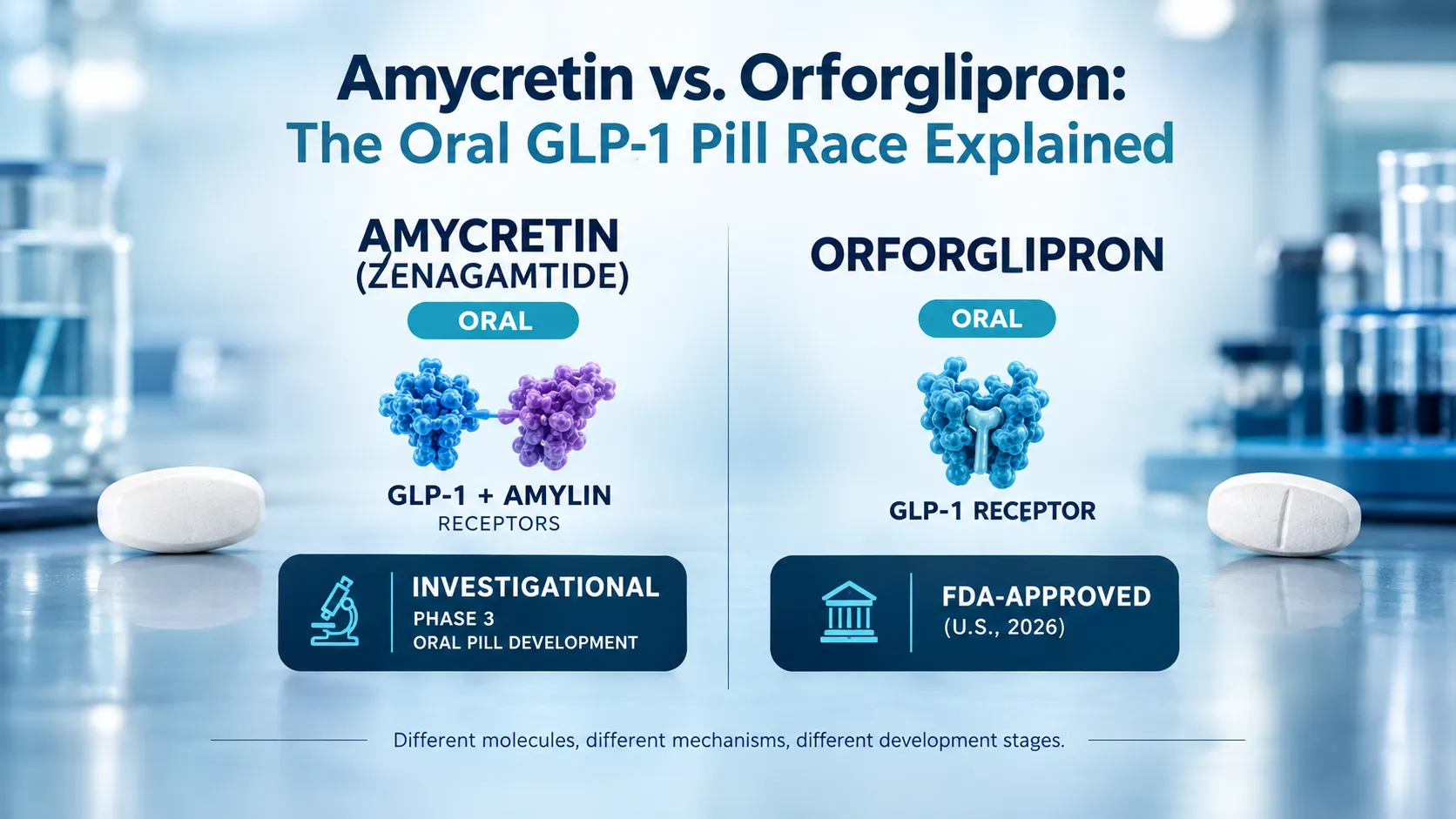
Amycretin is a peptide and orforglipron is not. How that chemistry explains the formulations, trial results, and approval status of both GLP-1 pills.
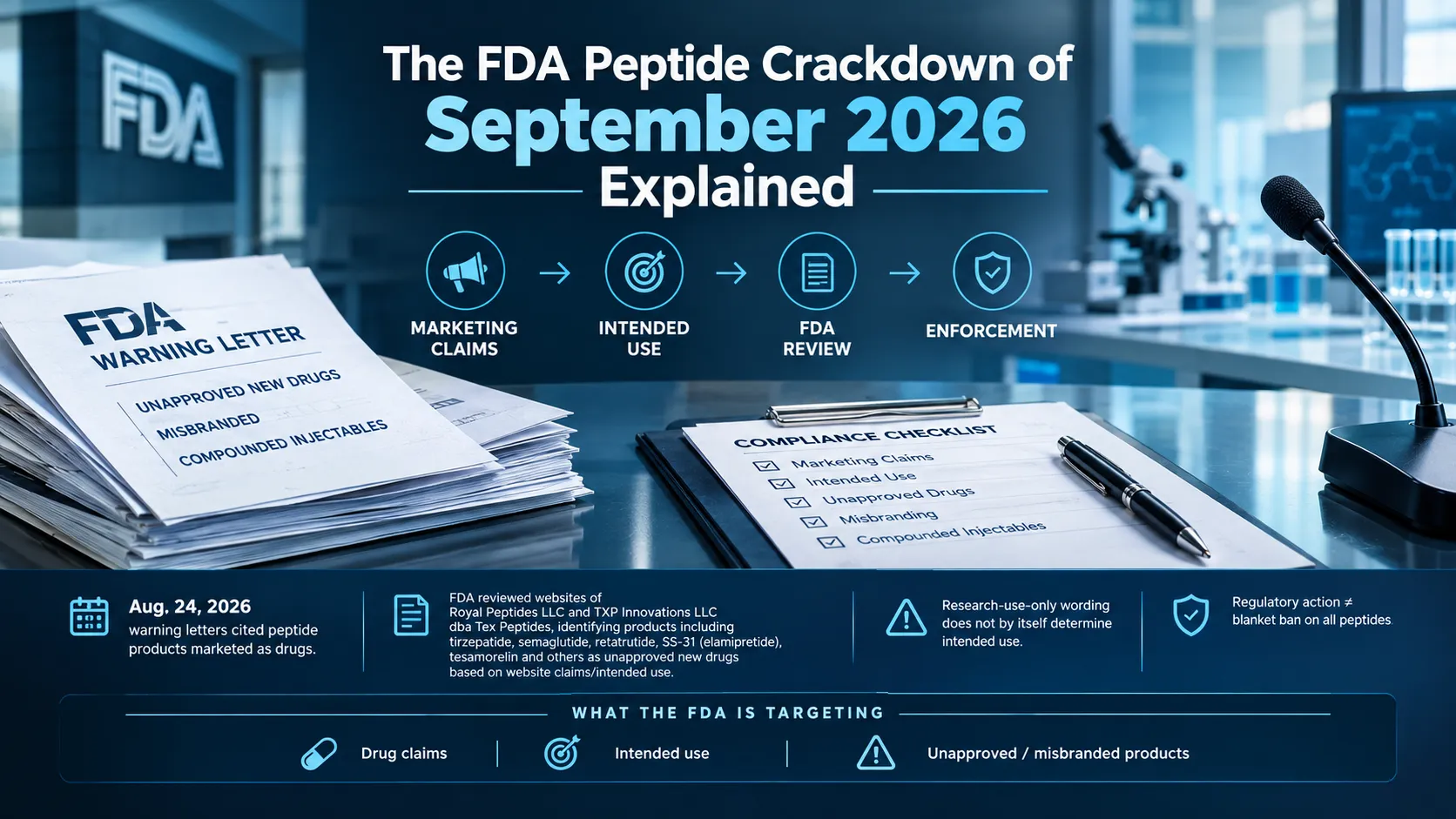
Five peptide sellers got FDA warning letters in September 2026. See who was named, why the research label failed, and the full 2026 enforcement timeline.
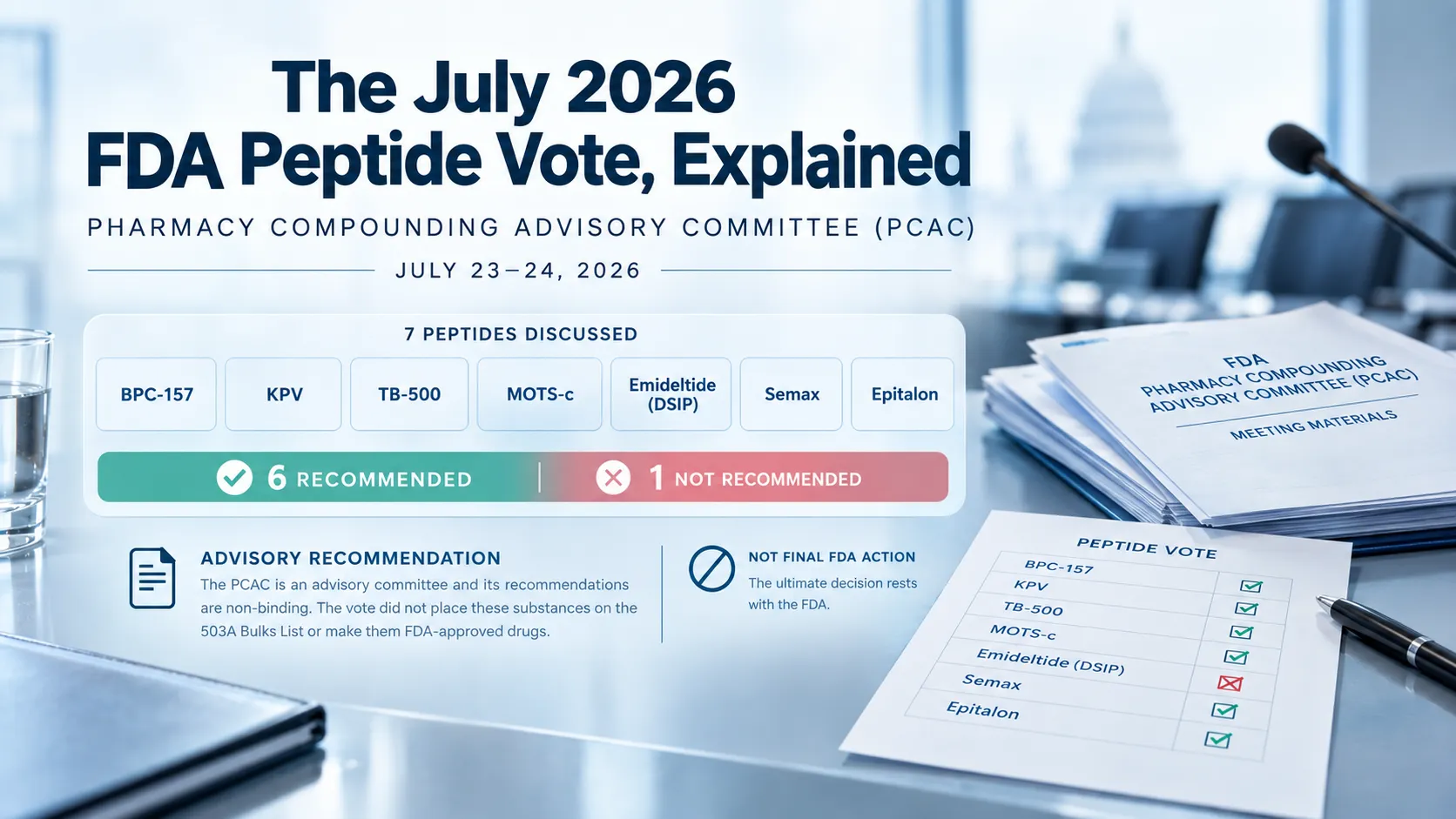
In July 2026, the FDA's advisory committee recommended 6 peptides for the 503A bulk list. None are on it yet. What the vote changed and what it didn't.