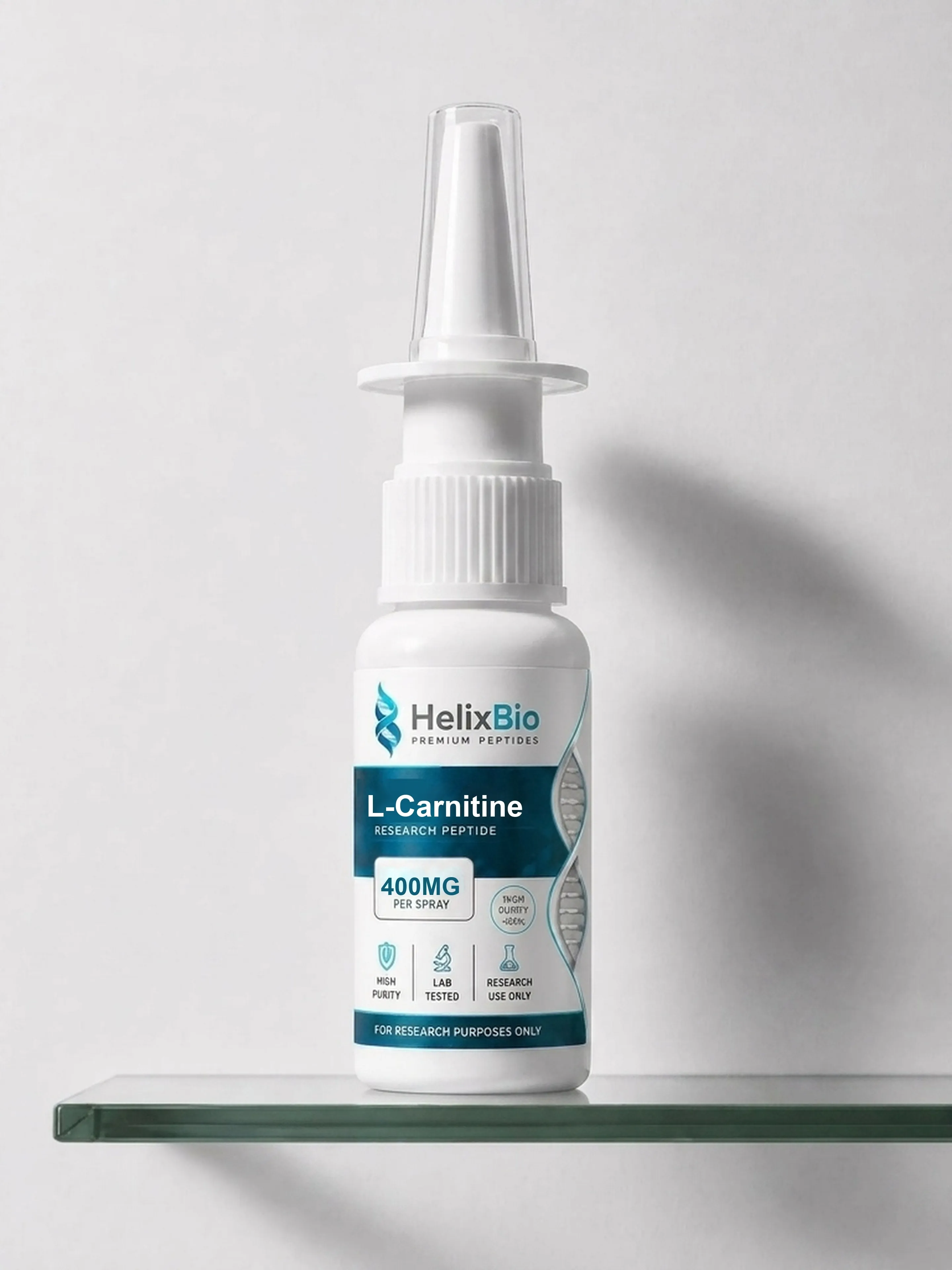
L-Carnitine Spray is a research-use solution containing L-carnitine, the biologically active enantiomer of carnitine and the form that occurs naturally in human tissue. L-carnitine is not a peptide; it is a small quaternary ammonium betaine (C7H15NO3, 161.20 g/mol, CAS 541-15-1) that carries long-chain fatty acids across the inner mitochondrial membrane through the carnitine shuttle.Helix Bio supplies this material to qualified laboratories for research use only. It is not a dietary supplement, not the prescription drug levocarnitine, and not intended for human or veterinary consumption.
HPLC certified
Independent analysis
Highest standard
Full traceability
L-carnitine — the pharmacopoeial name is levocarnitine — is the (R)-enantiomer of 3-hydroxy-4-(trimethylazaniumyl)butanoate. Only this enantiomer is biologically active; the D-form is not, which is why the "L-" prefix is part of the identity rather than a marketing convention. At physiological pH the molecule is a zwitterion: the quaternary ammonium nitrogen carries a permanent positive charge and the carboxylate a negative one. That permanent charge is the reason carnitine cannot diffuse freely across membranes and instead depends on the OCTN2 transporter (gene SLC22A5) to enter cells.
Humans obtain carnitine two ways. Most of it comes from the diet — red meat and dairy are the dense sources — and the remainder is synthesised in the liver, kidney and brain from lysine and methionine through a four-enzyme route running via trimethyllysine and γ-butyrobetaine. Because both supply routes exist, carnitine is described as conditionally essential rather than essential.
The supplied material is an aqueous solution presented in a spray bottle. Compositional details — the exact supplied form, concentration, mass basis and fill volume — are lot-specific and are stated on the current product listing and Certificate of Analysis rather than in this description.
One point deserves attention when comparing carnitine materials from any source. L-carnitine free base is hygroscopic and awkward to handle, so it is frequently supplied as a salt: L-carnitine tartrate, fumarate or hydrochloride. Salts differ in molecular weight, which means a stated milligram figure can refer either to the salt or to the carnitine it contains. The two numbers are not interchangeable, and the difference is large enough to matter in any quantitative work. Confirm which basis a stated concentration uses before calculating.
This material is supplied for laboratory investigation by qualified researchers and institutions. Typical contexts include mitochondrial fatty-acid oxidation assays, acylcarnitine profiling, transporter studies, and analytical method development where a defined carnitine solution is required.
It is not supplied for human or veterinary use, for self-administration, or for the diagnosis, treatment or prevention of any condition.
Long-chain fatty acids cannot cross the inner mitochondrial membrane as acyl-CoA. Carnitine solves this. On the outer mitochondrial membrane, carnitine palmitoyltransferase I transfers the acyl group from coenzyme A onto carnitine, producing an acylcarnitine. Carnitine-acylcarnitine translocase moves that acylcarnitine into the matrix in exchange for a free carnitine moving out. Once inside, carnitine palmitoyltransferase II reverses the transfer, regenerating acyl-CoA for β-oxidation and releasing carnitine to be recycled.
Two things follow from this cycle, and they explain most of what carnitine is used for in a laboratory. First, carnitine is a shuttle rather than a substrate — it is regenerated, not consumed. Second, the acylcarnitines produced at each step are stable, measurable, and specific to the chain length of the fatty acid involved, which is why acylcarnitine profiling by tandem mass spectrometry is the standard readout for fatty-acid oxidation disorders in newborn screening.
It is not intended for personal experimentation, self-administration, or any consumer application.
| Specification | Detail |
|---|---|
| Product name | L-Carnitine Spray |
| Compound | L-Carnitine |
| Scientific name | Levocarnitine |
| IUPAC name | (3R)-3-hydroxy-4-(trimethylazaniumyl)butanoate |
| Synonyms | Levocarnitine; (R)-carnitine; L-(−)-carnitine; vitamin BT |
| Compound class | Quaternary ammonium betaine (zwitterion) |
| Compound type | Non-peptide small molecule |
| Molecular formula | C7H15NO3 |
| Molecular weight | 161.20 g/mol |
| CAS Registry Number | 541-15-1 |
| PubChem CID | 10917 |
| ChEBI | CHEBI:16347 |
| InChIKey | PHIQHXFUZVPYII-ZCFIWIBFSA-N |
| Format | Aqueous solution, spray presentation |
| Purity and identity testing | Refer to the Certificate of Analysis for the current lot |
| Storage | Follow the storage conditions supplied with the product |
| Intended use | Research and laboratory investigation only |
| Human use | Not intended for human consumption |
| Veterinary use | Not intended for veterinary use |
Carnitine's transport role makes it a standard reagent in β-oxidation work. Because the shuttle is the rate-limiting step for long-chain fatty acid entry, experimental systems that manipulate carnitine availability, CPT1 activity or translocase function change oxidation flux in measurable ways.
Each intermediate in the shuttle leaves a chain-length-specific acylcarnitine signature. Tandem mass spectrometry of these species underpins both newborn screening for fatty-acid oxidation defects and metabolomic profiling in research settings. The free-carnitine to acylcarnitine ratio is itself an established analytical marker.
Loss-of-function mutations in SLC22A5, which encodes the OCTN2 transporter, cause primary carnitine deficiency — an autosomal recessive condition in which cells fail to accumulate carnitine and urinary losses rise. OCTN2 is consequently a well-defined target in transporter and membrane-biology research, and carnitine is the reference substrate for it.
Carnitine's trimethylamine moiety gives it a second, less obvious research life. Koeth and colleagues showed in 2013 that intestinal microbiota metabolise dietary L-carnitine to trimethylamine, which the liver oxidises to trimethylamine-N-oxide; in mice this pathway accelerated atherosclerosis, and it did not occur when the microbiota was suppressed. The finding made carnitine a fixture of host-microbiome metabolism research and remains actively debated.
Three carnitine forms appear frequently in the literature and are routinely conflated. They are not interchangeable.
| L-Carnitine | Acetyl-L-carnitine | Propionyl-L-carnitine | |
|---|---|---|---|
| Structure | Free carnitine | Acetyl ester of carnitine | Propionyl ester of carnitine |
| Formula | C7H15NO3 | C9H17NO4 | C10H19NO4 |
| Occurs endogenously | Yes — the free pool | Yes — a short-chain acylcarnitine | Yes — a short-chain acylcarnitine |
| Typical research framing | Transport, fatty-acid oxidation, transporter substrate | Acetyl-group donation; central nervous system literature | Propionyl-group metabolism; vascular literature |
All three are described together in the NIH Office of Dietary Supplements carnitine fact sheet, which is a useful entry point for the distinction. Findings reported for one ester should not be attributed to another, and none of them should be attributed to free L-carnitine without checking which compound the study actually used.
Carnitine sits across four categories that carry different weight, and conflating them is the most common error in carnitine literature. It is an endogenous metabolite; it is a lawful dietary ingredient; it is an approved prescription drug (levocarnitine, marketed as Carnitor) indicated for primary systemic carnitine deficiency and for secondary deficiency arising from inborn errors of metabolism; and it is a research material. Evidence generated in one category does not transfer to another. Clinical data supporting levocarnitine in carnitine-deficiency states says nothing about this research material, and nothing on this page should be read as a claim about it.
Carnitine has an unusual advantage over most research materials: it is a pharmacopoeial substance. Reference standards exist under both USP and European Pharmacopoeia monographs, and the identity is fully pinned by CAS, InChIKey and optical rotation. That means an analytical result can be checked against a public standard rather than against a supplier's own claim.
Three checks are worth making on any carnitine lot, and they are specific to this compound rather than generic advice:
Review the Certificate of Analysis and current product documentation for the specific lot before the material enters a workflow. A general catalogue statement is not a substitute for lot-specific analytical data.
Follow the storage conditions supplied with this product and on its current documentation. Storage guidance developed for carnitine powders does not transfer to a solution — an aqueous formulation raises different questions about container closure, microbial ingress and freeze-thaw behaviour than a dry solid does. Equally, conditions established for a different carnitine ester or a different vehicle should not be assumed to apply here.
Keep the container closed when not in use, avoid unnecessary temperature cycling, maintain laboratory labelling and inventory records, and follow institutional procedures for handling research materials.
L-Carnitine Spray is supplied by Helix Bio for research and laboratory use only. It is not intended for human or veterinary consumption, self-administration, or the diagnosis, treatment, cure, mitigation or prevention of any disease or condition.
This product is not a dietary supplement and is not the prescription drug levocarnitine. Levocarnitine is approved by the FDA for defined carnitine-deficiency indications; that approval applies to specific pharmaceutical products and does not extend to research materials containing the same compound. Researchers are responsible for determining whether this material is appropriate for their intended application and for complying with applicable institutional, federal, state and local requirements.
Knowledge Base
Knowledge Base
Knowledge Base
Knowledge Base
Knowledge Base
Knowledge Base
Knowledge Base
Knowledge Base
Knowledge Base
Knowledge Base
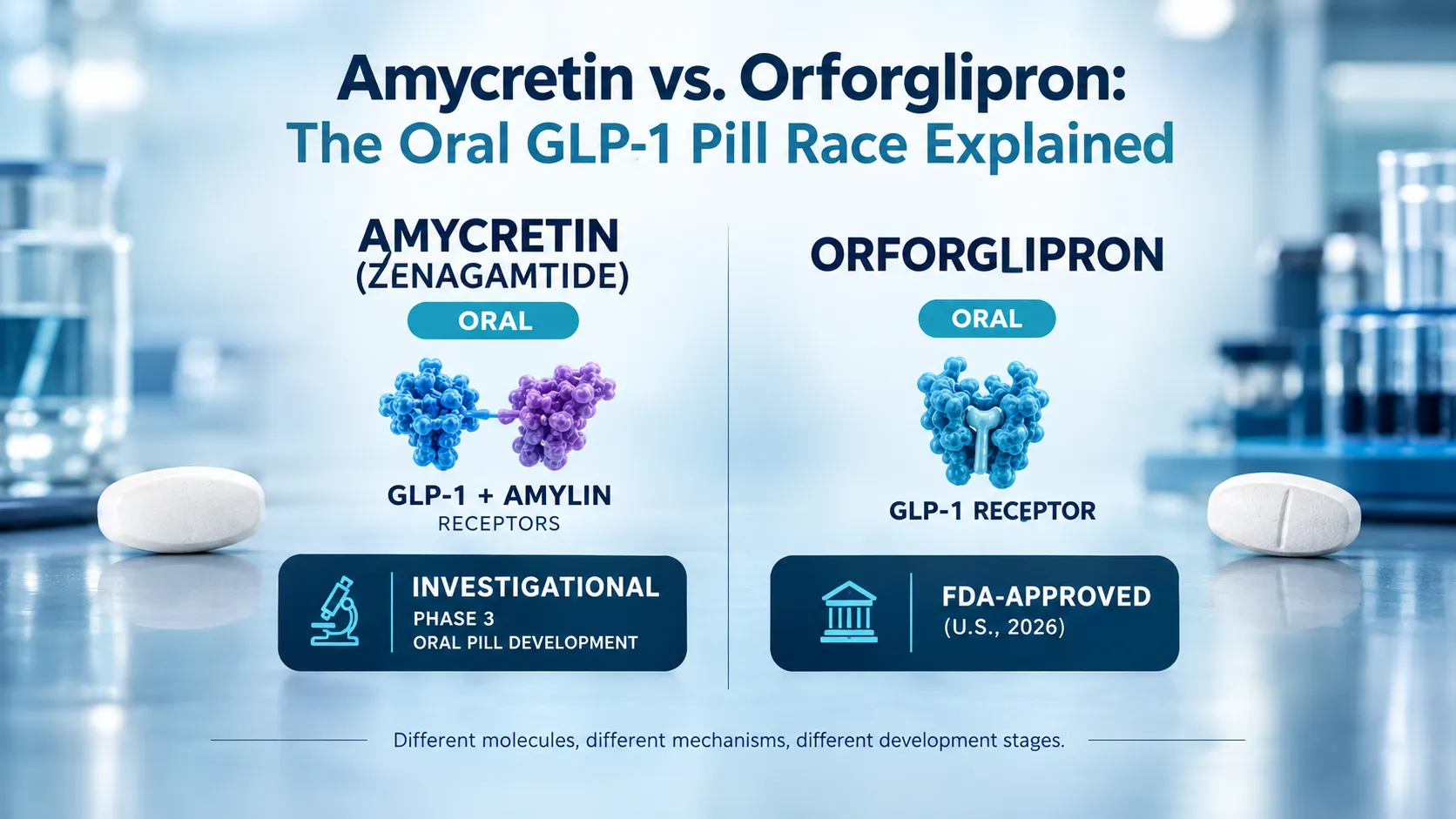
Amycretin is a peptide and orforglipron is not. How that chemistry explains the formulations, trial results, and approval status of both GLP-1 pills.
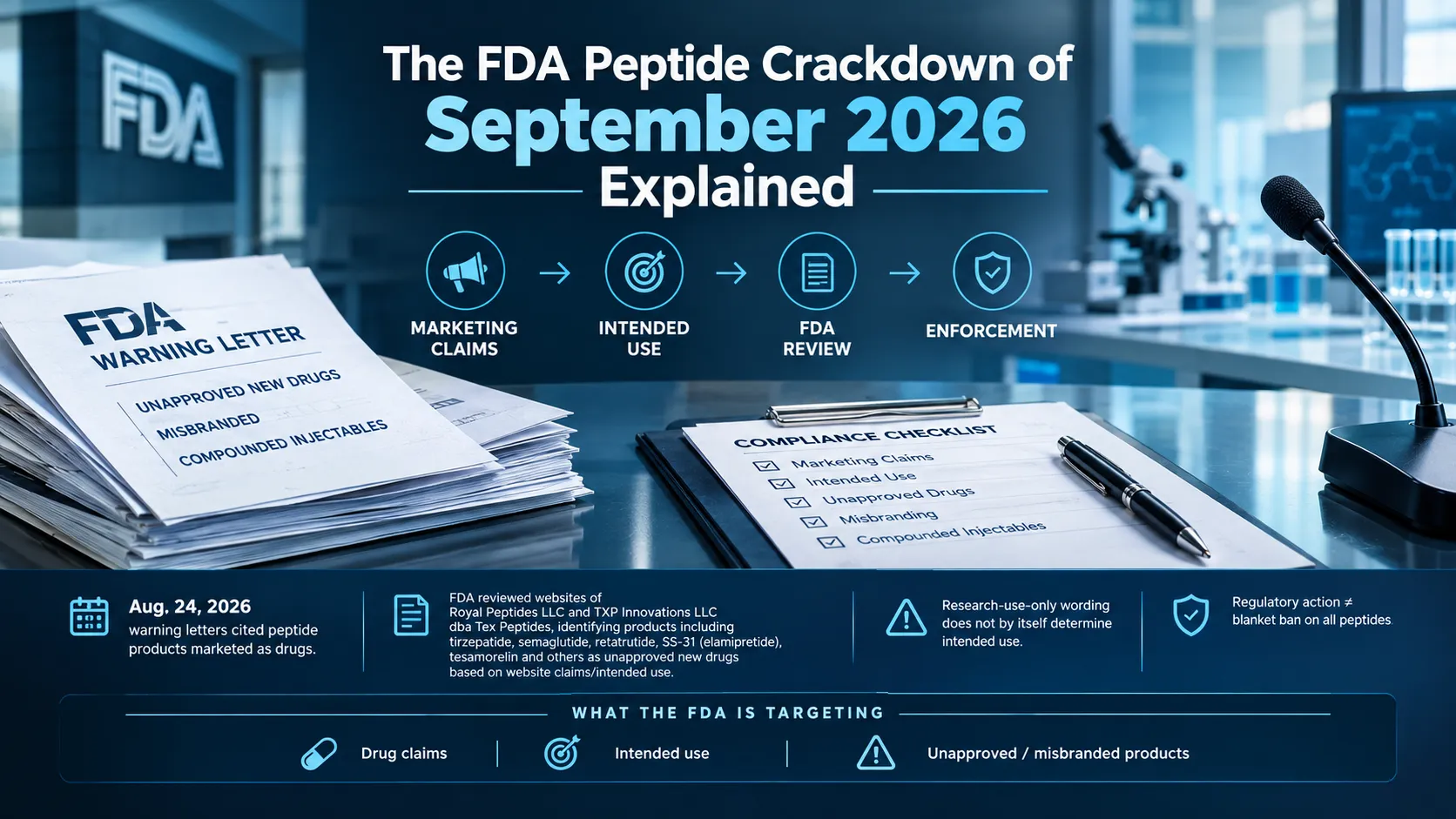
Five peptide sellers got FDA warning letters in September 2026. See who was named, why the research label failed, and the full 2026 enforcement timeline.

In July 2026, the FDA's advisory committee recommended 6 peptides for the 503A bulk list. None are on it yet. What the vote changed and what it didn't.