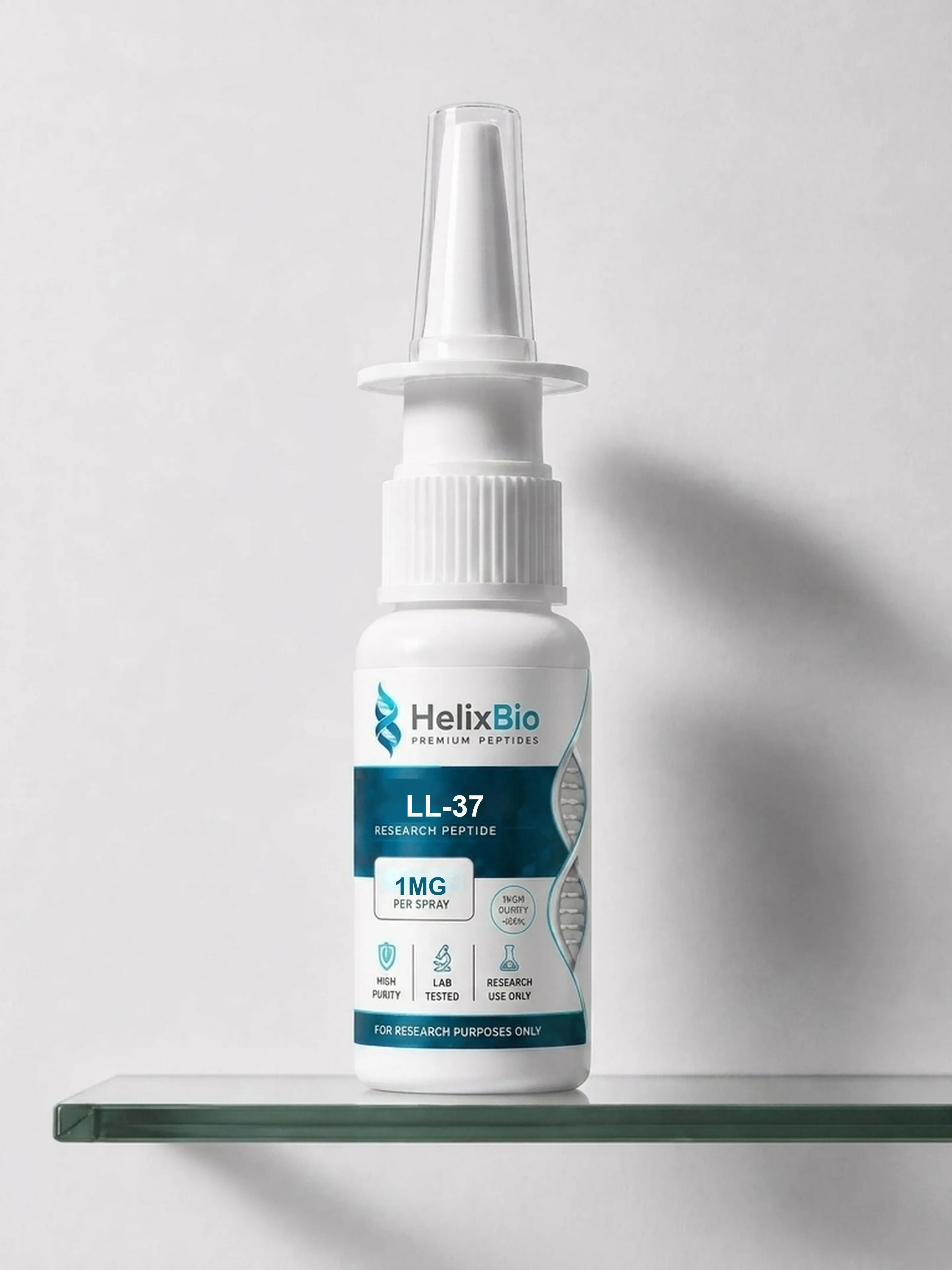
The name states the specification: two leucines at the N-terminus, thirty-seven residues in total. LL-37 is the mature antimicrobial peptide released from hCAP18, the precursor protein encoded by CAMP — the only cathelicidin gene humans have. Cationic, amphipathic and helical under the right solution conditions, it has been studied across membrane biology, innate immune signalling, epithelial research and host-defence models, and has been examined in controlled human trials as a topical agent. Helix Bio supplies this material as a Spray-format research preparation for qualified laboratory and scientific applications. It is not intended for human or veterinary use, ingestion, injection, nasal administration, or any other form of administration.
HPLC certified
Independent analysis
Highest standard
Full traceability
LL-37 is a 37-residue peptide with the sequence LLGDFFRKSKEKIGKEFKRIVQRIKDFLRNLVPRTES, terminating in a free acid. Its molecular weight is approximately 4493.3 g/mol, its formula is C₂₀₅H₃₄₀N₆₀O₅₃, and its side chains carry a net charge of +6 — six lysines and five arginines against two aspartates and three glutamates. It contains no cysteine and no methionine.
Three entities sit behind that name and they are not interchangeable. CAMP is the gene. hCAP18 — human cationic antimicrobial protein, roughly 18 kDa — is the precursor protein it encodes, built from a signal peptide, a conserved cathelin domain, and a C-terminal antimicrobial peptide. LL-37 is that C-terminal peptide once proteolytic cleavage has released it, corresponding to residues 134–170 of the precursor; in neutrophils, proteinase 3 is the characterised protease. A study that measures hCAP18 has not necessarily measured mature LL-37, and a study of CAMP transcription has measured neither.
The cathelicidin family is defined by the cathelin domain in the precursor, not by the mature peptide, which varies widely between species. Humans have one cathelicidin gene and one mature peptide. There is no second human cathelicidin to compare LL-37 against, and the mouse, porcine and bovine cathelicidins — CRAMP, protegrins, indolicidin — share an architecture with LL-37 and little else. Their evidence does not transfer.
For most peptides the vehicle is packaging. For this one it is a variable, and that is the substantive difference between a prepared solution and a powder.
Circular dichroism work published in 1998 established that LL-37 is largely disordered in salt-free water and folds into an α-helix in the presence of anions, with helical content tracking measured antibacterial activity against both Gram-positive and Gram-negative organisms. A separate study the same year reported only around 10% helix in phosphate buffer with or without 100 mM sodium chloride, rising to roughly 48% in 30% trifluoroethanol, 87% in SDS micelles and 95% in anionic POPG liposomes. Helical content also falls below pH 5, and the peptide is entirely disordered at pH 2.
The consequence for laboratory work is straightforward. A lyophilised powder leaves the choice of buffer to the researcher; a prepared solution arrives with that choice already made by the manufacturer. For LL-37, ionic composition and pH are therefore not incidental formulation details — they are among the first specifications a researcher should establish, because they define the conformational state the material starts in. Where an experimental design depends on a defined starting conformation, that information should come from the applicable product documentation rather than being assumed.
Researchers should also keep the LL-37 literature separate from the specifications of any commercial preparation. Published findings describe defined experimental systems and do not validate any particular concentration, vehicle or format.
LL-37 has been examined in the following areas:
The existence of published research does not establish that LL-37 Spray is safe or effective for use in humans, and laboratory antimicrobial activity is not evidence of clinical anti-infective efficacy. LL-37 is not an FDA-approved drug in the United States. LL-37-related bulk drug substances were removed from 503A Category 2 in April 2026 as a procedural step for further evaluation, and LL-37 is one of five substances scheduled for a Pharmacy Compounding Advisory Committee meeting before the end of February 2027. Removal from a category, a scheduled review and an advisory recommendation are each distinct from approval.
Two verification questions matter more for this material than for most peptides, and neither is answered by a product name.
The first is identity at the right level. Because CAMP, hCAP18 and LL-37 are routinely used interchangeably in commercial descriptions, and because N-terminally truncated analogues such as FF-33 and SK-29 exist and behave differently, the observed mass is what confirms what a material actually is. Approximately 4493 g/mol corresponds to the full 37-residue peptide.
The second is the vehicle. Helix Bio states that its research peptide catalog uses independent HPLC testing for purity assessment and mass spectrometry for molecular identity confirmation, and that batch-specific Certificates of Analysis are available. Those establish what the peptide is. For a prepared solution of a conformationally sensitive peptide, the formulation record — what it is dissolved in, at what pH — establishes what state it is in, and that is a separate question worth asking.
For LL-37 Spray specifically, researchers should verify the applicable product documentation and current lot information rather than relying on a general product description. A sitewide statement describes the catalog’s testing approach; it is not a lot-level analytical result.
LL-37 Spray is intended for qualified users working in legitimate laboratory or scientific research environments, including:
The product is not intended for personal experimentation, self-administration, human consumption, veterinary use or medical treatment.
| Specification | Details |
|---|---|
| Product Name | LL-37 Spray |
| Research Category | Healing & Recovery / Research Peptide |
| Compound | LL-37 |
| Scientific Name | Human cathelicidin antimicrobial peptide LL-37 |
| Synonyms | LL37, LL 37, cathelicidin LL-37, hCAP18(134–170) |
| Chemical Class | Cationic amphipathic antimicrobial peptide, 37 residues |
| Precursor Protein | hCAP18 (human cationic antimicrobial protein, ~18 kDa) |
| Gene | CAMP |
| Sequence | LLGDFFRKSKEKIGKEFKRIVQRIKDFLRNLVPRTES |
| Amino-Acid Residues | 37 |
| C-Terminus | Free acid |
| Molecular Formula | C₂₀₅H₃₄₀N₆₀O₅₃ |
| Molecular Weight | ≈4493.3 g/mol |
| Net Side-Chain Charge | +6 |
| Cysteine / Methionine | None present |
| UniProt Reference | P49913, residues 134–170 |
| Format | Prepared Spray solution |
| Intended Use | Research and laboratory investigation only |
| Human Use | Not intended for human consumption |
| Veterinary Use | Not intended for veterinary use |
| Purity | Refer to current lot-specific product documentation |
| Identity Testing | Refer to applicable Certificate of Analysis |
| Concentration | Refer to current product listing |
| Vehicle and pH | Refer to current product documentation |
| Fill Volume | Refer to current product listing |
| Packaging | Refer to current product listing |
| Storage | Follow current product-specific documentation |
| Manufacturer | Helix Bio |
| Country of Origin | Not specified; verify current product documentation |
LL-37 has one of the largest published literatures of any single human peptide, which makes evidence-level discipline more important here than usual rather than less.
Antimicrobial and Membrane Research The best-characterised activity is membrane interaction: the amphipathic helix associates with anionic phospholipid surfaces and permeabilises bacterial membranes. Published in vitro work reports a minimum inhibitory concentration of 5 µM against E. coli. Two findings from the same body of work bound that result and belong alongside it. LL-37 is cytotoxic toward several eukaryotic cell types at 13–25 µM — a window of roughly three- to five-fold above the bacterial MIC — and its antibacterial and cytotoxic activities are both inhibited in the presence of human serum. In vitro antimicrobial activity under defined assay conditions is not evidence of anti-infective efficacy in any organism.
Conformation and Solution Behaviour Circular dichroism studies established that LL-37 is largely disordered in salt-free water, adopts helical structure in the presence of anions, and shows helical content correlating with antibacterial activity. Reported figures span roughly 10% helix in phosphate buffer with or without 100 mM NaCl, about 48% in 30% trifluoroethanol, 87% in SDS micelles and 95% in POPG liposomes; helicity declines below pH 5 and is absent at pH 2. This makes LL-37 a standard subject in structure–activity work on cationic amphipathic peptides, and it is the reason vehicle composition is treated as a specification on this page rather than a formulation detail.
Innate Immune and Epithelial Research Beyond membrane activity, LL-37 has documented immunomodulatory effects studied in keratinocytes, neutrophils and other cell types, including receptor-mediated signalling — FPR2 is the most consistently reported receptor — and the formation of complexes with nucleic acids that alter innate immune recognition. These are distinct mechanisms with distinct evidence bases and should not be collapsed into a single “immune” claim.
Human Interventional Research LL-37 has been examined in controlled human trials as a topical agent in hard-to-heal venous leg ulcers, and the results run in two directions. A first-in-man study of 34 participants reported healing rate constants approximately six- and three-fold higher than placebo at two concentrations over a four-week randomised phase. A subsequent Phase IIb trial in 148 patients did not detect significant differences in healing across the entire study cohort. Both belong in an honest account of the evidence, and the larger study was the later one.
Researchers should evaluate each publication according to its model, species, concentration, assay conditions and endpoints. For this compound, assay buffer composition is one of the variables most likely to explain differences between reported results.
Analytical quality matters for any research peptide because impurities, degradation products, incorrect identity or inconsistent concentration introduce uncontrolled variables. LL-37 adds two considerations that a short synthetic peptide with a unique name would not.
The first is length. Truncated analogues of LL-37 are real research compounds with their own literature and their own behaviour — FF-33 and SK-29 are N-terminally shortened forms that require higher anion concentrations to fold and are less active in published comparisons. A mass result near 4493 g/mol confirms the full 37-residue peptide; a lower mass indicates something else, however pure it is. Purity and identity are separate questions.
The second is the vehicle record. For a peptide whose conformation is determined by its solution environment, the formulation is part of the material’s description, not an afterthought. Helix Bio states that its peptide materials undergo independent HPLC testing for purity and mass spectrometry for molecular identity, and that batch-specific Certificates of Analysis are available. For a specific LL-37 Spray lot, researchers should consult the applicable COA and product documentation for the actual analytical and formulation details.
Researchers should assess, where applicable:
No certification, regulatory approval or quality claim should be inferred unless explicitly documented by the manufacturer or a relevant regulatory authority. Sitewide catalog statements are not a substitute for lot-specific documentation.
Storage and handling requirements should be determined from the current LL-37 Spray product documentation and lot-specific instructions. Prepared solutions and lyophilised powders have different stability profiles, and for a highly cationic peptide the solution case carries considerations that powder does not.
General laboratory considerations include:
Storage guidance should not be inferred from research protocols for lyophilised LL-37, from another cathelicidin, or from another Spray-format product, because vehicle composition, pH and packaging all affect the relevant behaviour.
Helix Bio’s website describes research materials as being supplied to laboratories and institutions in the United States and describes tracked shipping and cold-chain handling within its fulfillment process.
Because shipping conditions, packaging specifications, availability and delivery requirements may change, researchers should review the current Helix Bio shipping information and product listing before ordering. For a prepared solution, transit temperature history is a more consequential variable than it is for lyophilised material.
Product packaging should remain appropriately labelled and handled as research material after delivery. Researchers are responsible for following applicable institutional, federal, state and local requirements governing research materials.
LL-37 Spray is sold by Helix Bio for research and laboratory purposes only. It is not intended for human or veterinary consumption, self-administration, ingestion, injection, nasal administration, any other form of administration, or the diagnosis, treatment, cure, mitigation or prevention of any disease or medical condition.
LL-37 is not an FDA-approved drug in the United States. Antimicrobial activity observed in laboratory assays is not evidence that a material treats, prevents or controls infection in any organism, and no such use is offered or implied.
LL-37-related bulk drug substances were removed from 503A Category 2 in April 2026 as a procedural step for further evaluation, and LL-37 is one of five substances scheduled for a Pharmacy Compounding Advisory Committee meeting before the end of February 2027. Removal from a category is not authorisation to compound, a scheduled review is not an approval, and advisory committee recommendations are not binding on FDA.
This product is not a dietary supplement, consumer wellness product or medical treatment. Researchers are responsible for determining whether a material is appropriate for their intended experimental application and for complying with applicable institutional and regulatory requirements.
Knowledge Base
Knowledge Base
Knowledge Base
Knowledge Base
Knowledge Base
Knowledge Base
Knowledge Base
Knowledge Base
Knowledge Base
Knowledge Base
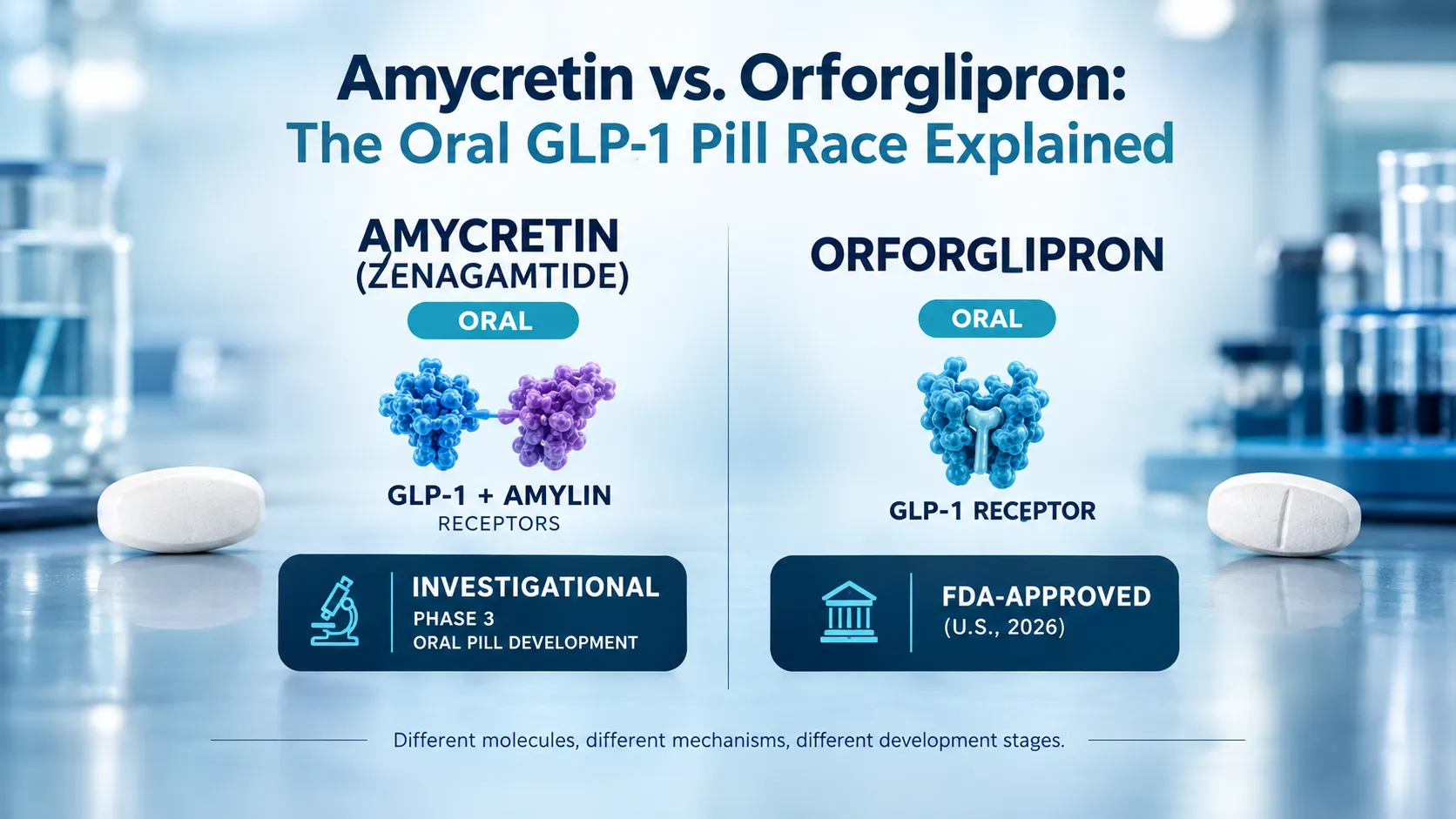
Amycretin is a peptide and orforglipron is not. How that chemistry explains the formulations, trial results, and approval status of both GLP-1 pills.
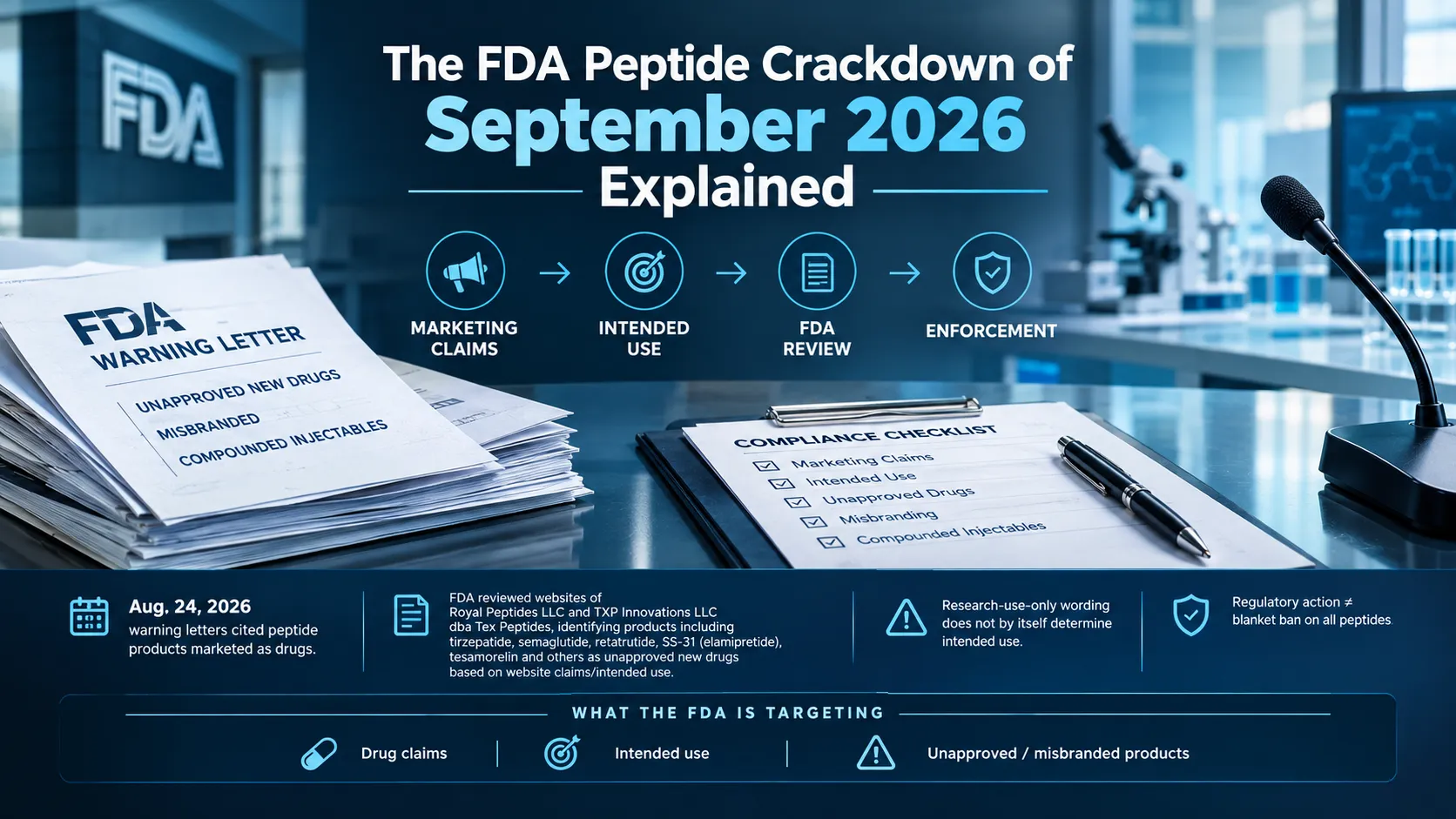
Five peptide sellers got FDA warning letters in September 2026. See who was named, why the research label failed, and the full 2026 enforcement timeline.
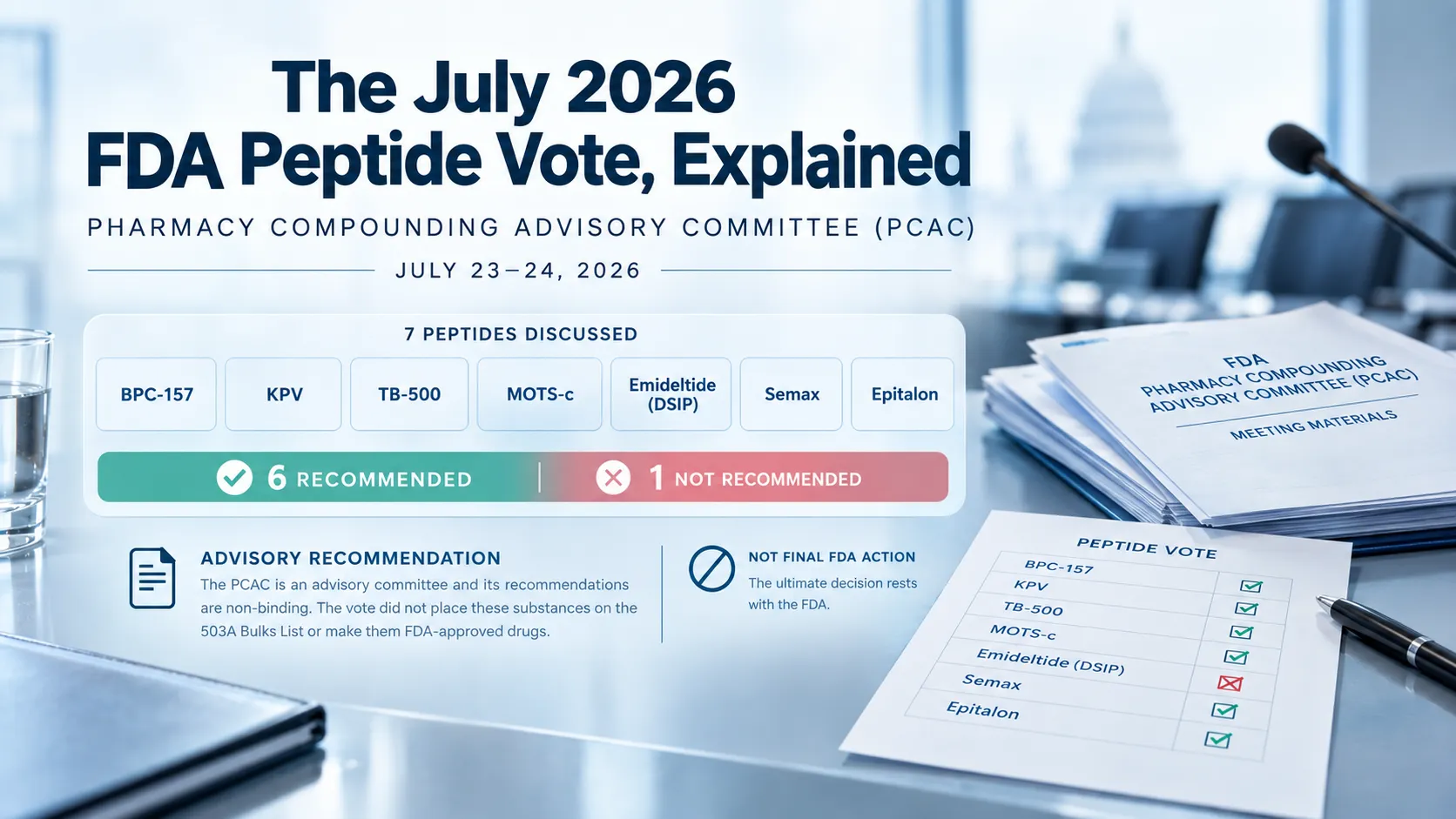
In July 2026, the FDA's advisory committee recommended 6 peptides for the 503A bulk list. None are on it yet. What the vote changed and what it didn't.