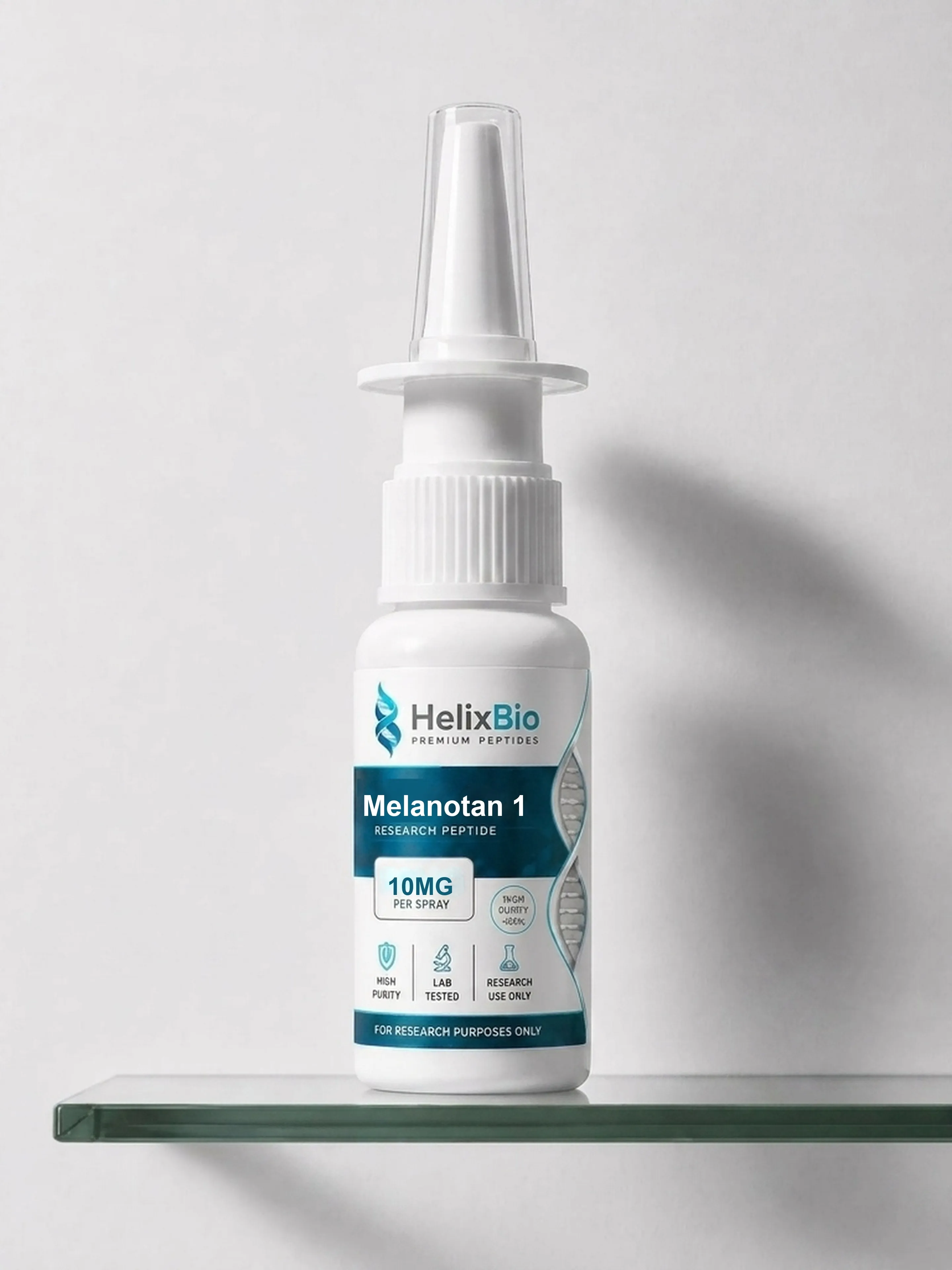
Melanotan 1 is the 13-residue α-MSH analogue known in the literature as NDP-MSH, or [Nle⁴,D-Phe⁷]-α-MSH: the native melanocortin sequence with norleucine replacing methionine at position 4 and the phenylalanine at position 7 inverted to its D-enantiomer. Helix Bio supplies it here as a prepared spray-format solution for controlled laboratory work, alongside the lyophilised Melanotan-1 vial listed separately in this catalog. Supplied for research and laboratory purposes only; not intended for human or veterinary use, and not a cosmetic or tanning product. Those two substitutions are what a researcher evaluating this material actually has to verify, and one of them cannot be seen by mass spectrometry. Current product documentation and lot-specific analytical information should be reviewed — with attention to the method used to establish identity — before the material enters an experimental workflow.
HPLC certified
Independent analysis
Highest standard
Full traceability
Melanotan 1 is a synthetic, linear analogue of alpha-melanocyte-stimulating hormone (α-MSH), defined by the sequence Ac-Ser-Tyr-Ser-Nle-Glu-His-D-Phe-Arg-Trp-Gly-Lys-Pro-Val-NH₂. It carries an acetylated N-terminus and a C-terminal primary amide, has the molecular formula C₇₈H₁₁₁N₂₁O₁₉ and a molecular weight of 1646.85 g/mol, and is catalogued under CAS 75921-69-6. In scientific literature it appears most often as NDP-MSH or [Nle⁴,D-Phe⁷]-α-MSH; it is also written as Melanotan I and MT-I. It emerged from structure–activity work on α-MSH analogues carried out at the University of Arizona.
Against the native hormone, the molecule differs at two positions and nowhere else. Norleucine at position 4 is the straight-chain, sulfur-free counterpart of methionine, and its substitution removes the only sulfur atom from the sequence. D-phenylalanine at position 7 is a stereochemical inversion — the same atoms in a different spatial arrangement. Both modifications sit within the His-Phe-Arg-Trp core that melanocortin structure–activity studies have repeatedly identified as central to receptor recognition, which is why this particular analogue became a standard reference ligand in melanocortin pharmacology rather than one of many.
Reported activity spans several melanocortin receptor subtypes, including MC1R, MC3R, MC4R and MC5R. MC1R is the subtype most closely associated with melanocyte biology and melanogenesis, and it is the receptor around which most of the compound’s research literature is organised.
Two comparisons are routinely confused, and they have opposite answers.
Melanotan 1 and afamelanotide are the same molecule. Afamelanotide is the international nonproprietary name for [Nle⁴,D-Phe⁷]-α-MSH. Same sequence, same formula, same CAS registry number. What differs is the product built around the molecule: afamelanotide reaches patients as an approved 16 mg bioresorbable implant, inserted subcutaneously by a trained clinician, manufactured and released under pharmaceutical controls. A shared CAS number does not transfer approval status, formulation, manufacturing history or clinical evidence from that product to a research material. The molecule is common; the product is not.
Melanotan 1 and Melanotan II are different compounds. Melanotan II is a cyclic heptapeptide, Ac-Nle-cyclo[Asp-His-D-Phe-Arg-Trp-Lys]-NH₂, formula C₅₀H₆₉N₁₅O₉ at 1024.18 g/mol, CAS 121062-08-6 — a truncated construct built on the α-MSH 4–10 core and closed by a lactam bridge. It is not a version of Melanotan 1. The two differ in length, architecture and mass, the gap being roughly 623 daltons, and their research literatures diverge accordingly. Findings involving Melanotan II are not evidence about Melanotan 1.
The word “spray” describes the physical presentation of this material. It is a prepared solution supplied in a spray-format container. It does not designate nasal, oral, sublingual, topical, dermal or any other route or application, and Helix Bio does not supply this material for administration to humans or animals by any means.
What the solution format changes is handling chemistry rather than delivery. Two features of this particular sequence matter once the peptide is in aqueous solution. It contains tryptophan at position 9 and tyrosine at position 2, both of which are among the residues most susceptible to photo-oxidation, so light exposure is a more meaningful variable than it would be for a sequence without aromatic residues. Conversely, the Nle⁴ substitution has removed the only methionine, and with it the classic methionine-oxidation liability that affects native α-MSH in solution. A peptide at low concentration in a container also loses material to surface adsorption, which affects a solution and not a dry solid.
None of that is a claim about this formulation. Vehicle composition, concentration, container material and any excipients determine how those general tendencies actually behave, and those are product facts that belong in the product documentation rather than inferences from the sequence.
Melanotan 1 appears across melanocortin pharmacology and peptide chemistry, including:
The existence of this literature does not establish that Melanotan 1 Spray is safe or effective for any use in humans, and results obtained with one preparation do not describe another. Each publication should be read for the exact molecular entity studied, the formulation and route used, the model system, and the endpoint measured.
Most peptide materials can be characterised adequately by two measurements: a chromatographic purity figure and a confirmed molecular mass. Melanotan 1 is an exception, and the reason is worth stating precisely because it changes what a researcher should ask for.
The difference between Melanotan 1 and the corresponding all-L peptide is the configuration of a single stereocentre at position 7. Stereoisomers share a molecular formula and share a mass. A mass spectrum reading 1646.8 is equally consistent with the correct D-Phe⁷ compound and with an incorrect L-Phe⁷ analogue, and no amount of instrument resolution changes that — the information simply is not present in the measurement. A reversed-phase purity figure is more informative, since diastereomeric peptides often separate chromatographically, but only if the method was developed to resolve that pair and only if the report says so.
The practical consequence: for this compound, identity confirmation should specify a method capable of establishing stereochemistry. Chiral chromatography, amino-acid analysis with chiral derivatisation after hydrolysis, or a validated RP-HPLC method demonstrated to separate the compound from its all-L counterpart all address it. “Mass confirmed” and “≥99% by HPLC” together do not, on their own, settle the question.
Helix Bio states that its research materials are supported by batch-specific Certificates of Analysis and by HPLC and mass spectrometry testing. For Melanotan 1 Spray specifically, researchers should read the applicable lot documentation for the methods actually used, rather than relying on a general catalog description or on the product name.
Melanotan 1 Spray is intended for qualified users working in legitimate laboratory or scientific research environments, including:
The product is not intended for personal experimentation, self-administration, human consumption, veterinary use, tanning, cosmetic application or medical treatment.
| Specification | Details |
|---|---|
| Product Name | Melanotan 1 Spray |
| Research Category | Melanocortin Research Compounds |
| Compound | Melanotan 1 |
| Common Names | Melanotan I, MT-I, NDP-MSH, NDP-α-MSH |
| Structural Description | [Nle⁴,D-Phe⁷]-α-MSH |
| International Nonproprietary Name | Afamelanotide |
| Compound Class | Synthetic linear tridecapeptide; α-MSH analogue |
| Sequence | Ac-Ser-Tyr-Ser-Nle-Glu-His-D-Phe-Arg-Trp-Gly-Lys-Pro-Val-NH₂ |
| Peptide Length | 13 residues |
| Terminal Modifications | N-terminal acetyl; C-terminal primary amide |
| Structural Modifications | Norleucine at position 4; D-phenylalanine at position 7 |
| Molecular Formula | C₇₈H₁₁₁N₂₁O₁₉ |
| Molecular Weight | 1646.85 g/mol |
| Monoisotopic Mass | 1645.84 Da |
| CAS Number | 75921-69-6 (free base) |
| Primary Research Target | Melanocortin receptors, including MC1R |
| Format | Prepared solution, spray-format container |
| Salt Form | Confirm against current lot-specific documentation |
| Concentration | Refer to current product listing and lot documentation |
| Fill Volume | Refer to current product listing |
| Formulation and Vehicle | Refer to current product documentation |
| Purity | Refer to current lot-specific Certificate of Analysis |
| Identity Testing | Refer to applicable Certificate of Analysis, including the method used to establish stereochemistry |
| Storage | Follow current product-specific documentation |
| Packaging | Refer to current product listing |
| Intended Use | Research and laboratory investigation only |
| Human Use | Not intended for human consumption or administration |
| Veterinary Use | Not intended for veterinary use |
| Cosmetic Use | Not a cosmetic product; not for cosmetic or tanning use |
| Manufacturer | Helix Bio |
| Country of Origin | Verify current product documentation |
The areas below describe established experimental use of this compound. They are descriptions of research activity, not statements of outcomes attributable to this or any other supplied preparation.
Melanocortin Receptor Pharmacology. Melanotan 1 has been used extensively as a reference agonist in melanocortin receptor work, across MC1R, MC3R, MC4R and MC5R. Its role in this literature is often as the comparator against which other ligands are assessed, which makes the identity of the reference material itself consequential for the interpretation of a binding or functional assay.
Structure–Activity Relationship Research. Two defined modifications against a well-characterised parent sequence make this molecule a standard case in analogue-design studies. Comparisons between the native hormone, this analogue and cyclised constructs such as Melanotan II are used to examine how backbone architecture and stereochemistry influence receptor recognition.
Melanocyte and Melanogenesis Models. MC1R signalling in melanocytes is associated with melanin synthesis, and melanocortin agonists are used as experimental stimuli in cellular pigmentation models. Findings in such models describe cellular responses under defined conditions and do not describe outcomes in intact organisms.
Comparative Melanocortin Peptide Research. Researchers compare this compound with native α-MSH and with other synthetic analogues to examine differences in receptor interaction, stability and experimental behaviour attributable to specific structural changes.
Analytical and Peptide-Chemistry Research. Because one of its two defining modifications is stereochemical, this peptide is a useful subject for method development in chiral separation, diastereomer resolution and peptide identity confirmation.
Each publication should be evaluated according to its model, the exact molecular entity used, concentration, preparation and endpoints, rather than assuming that findings from one experimental system apply to another.
For most research peptides, purity and identity are two questions answered by two methods. For Melanotan 1 they are three questions, and the third is the one most often left unanswered.
Chemical purity — the proportion of the sample that is the intended peptide rather than truncations, deletions, adducts or unrelated material. A reversed-phase HPLC area-percent figure is the usual measure.
Molecular identity — whether the observed mass matches the theoretical mass. For this compound that is an average molecular weight of 1646.85 and a monoisotopic mass of 1645.84. Mass spectrometry answers this well.
Stereochemical identity — whether position 7 carries D-phenylalanine. Mass spectrometry cannot answer this, because the D and L forms are isomers with identical masses. It requires a method that separates stereochemistry.
The third question is not academic. The D-Phe⁷ inversion is one of only two features distinguishing this molecule from native α-MSH, and it is the feature most implicated in the analogue’s receptor behaviour. A material that failed on stereochemistry while passing on mass and area-percent would look correct on a conventional Certificate of Analysis.
Researchers should assess, where applicable:
No certification, regulatory approval or quality claim should be inferred unless it is explicitly documented by the manufacturer or a relevant regulatory authority. A general catalog statement is not a substitute for lot-specific documentation.
Storage and handling requirements should be taken from the current Melanotan 1 Spray product documentation and lot-specific instructions. The considerations below explain why a prepared solution differs from a lyophilised solid and should not be treated as a substitute for that documentation.
A prepared solution has no reconstitution step, so guidance written for dry material — moisture protection, reconstitution technique, post-reconstitution windows — does not transfer. The relevant sensitivities are different. This sequence contains tryptophan and tyrosine, both readily photo-oxidised, which makes light exposure a more consequential variable for this peptide in solution than for sequences lacking aromatic residues. Peptides at low concentration also adsorb to container surfaces, which affects a solution and not a solid.
General laboratory considerations:
Storage guidance should not be carried over from lyophilised Melanotan 1, from an approved afamelanotide product, from Melanotan II, or from another Helix Bio spray, because vehicle, concentration and packaging all affect the stability of a peptide in solution.
Helix Bio’s website describes research materials as being supplied to laboratories and institutions in the United States, and describes tracked shipping and temperature-controlled handling within its fulfilment process.
Because shipping conditions, packaging specifications, availability and delivery requirements may change, researchers should review the current Helix Bio shipping information and product listing before ordering. Containers should be inspected on receipt and transferred to appropriate storage promptly.
Product packaging should remain appropriately labelled and handled as research material after delivery. Researchers are responsible for following applicable institutional, federal, state and local requirements governing research materials.
Melanotan 1 Spray is sold by Helix Bio for research and laboratory purposes only. It is not intended for human or veterinary consumption, self-administration, tanning, cosmetic application, diagnosis, treatment, cure, mitigation or prevention of any disease or condition.
The compound supplied here shares a molecular identity with afamelanotide, the active ingredient of an approved prescription product indicated to increase pain-free light exposure in adults with a history of phototoxic reactions from erythropoietic protoporphyria. That approval belongs to a specific 16 mg subcutaneous implant, administered by a trained healthcare professional, manufactured and released under pharmaceutical controls. It does not extend to research material, and this product is not that product, has not been evaluated by any regulatory authority for safety or efficacy, and must not be represented as an approved medicine.
Published research on melanocortin agonists, including studies reporting pigmentation changes in human participants, concerns specific molecules in specific formulations administered by specific routes. Nothing in that literature establishes any outcome for this material. Increases in pigmentation should not be equated with a quantified sun-protection factor, with protection against ultraviolet damage, or with a reduced need for conventional sun protection — the approved product’s own labelling directs patients to maintain sun protection measures during treatment.
This product is not a dietary supplement, cosmetic, consumer wellness product or medical treatment. Researchers are responsible for determining whether a material is appropriate for their intended experimental application and for complying with applicable institutional and regulatory requirements.
Knowledge Base
Knowledge Base
Knowledge Base
Knowledge Base
Knowledge Base
Knowledge Base
Knowledge Base
Knowledge Base
Knowledge Base
Knowledge Base
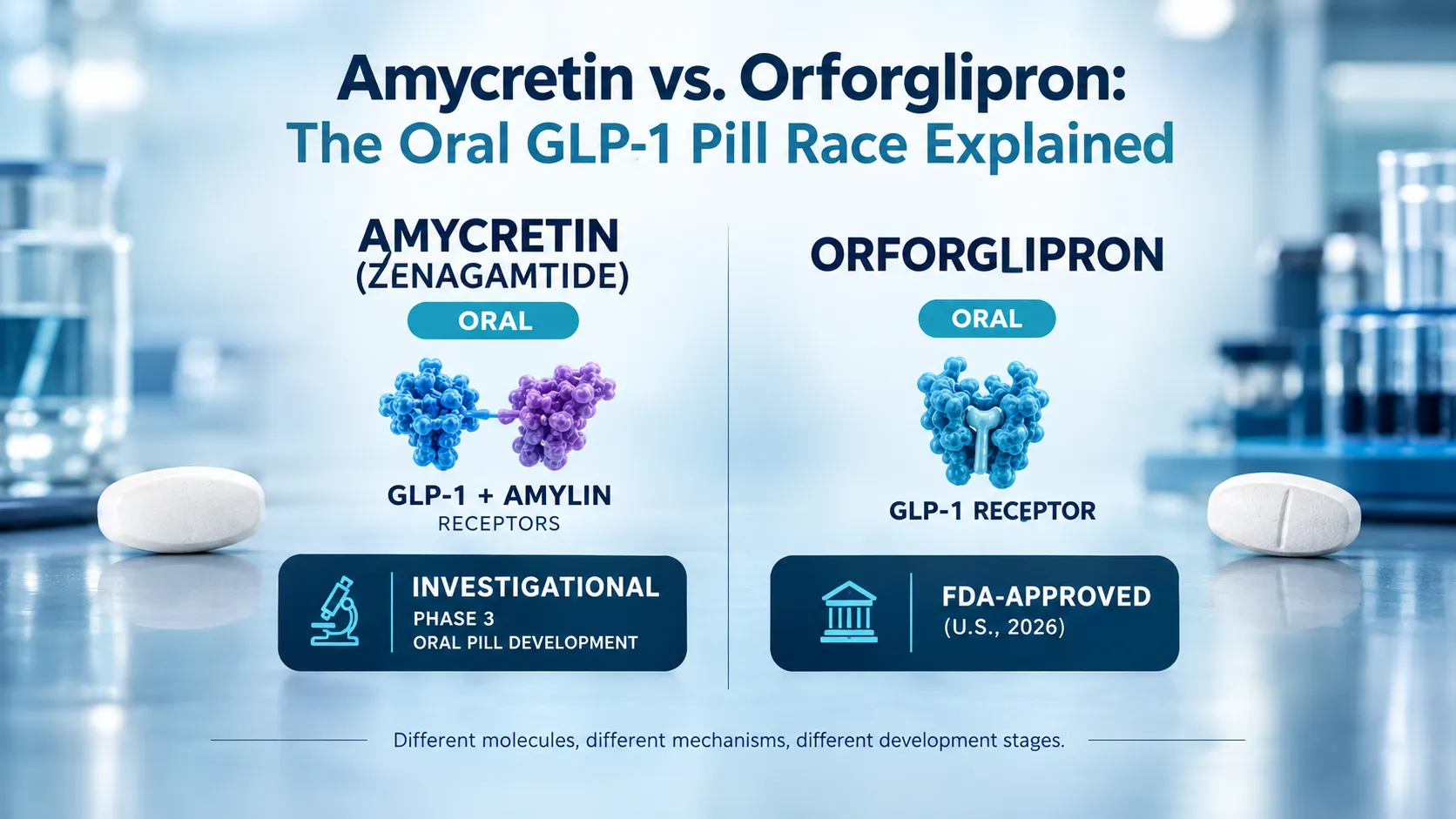
Amycretin is a peptide and orforglipron is not. How that chemistry explains the formulations, trial results, and approval status of both GLP-1 pills.
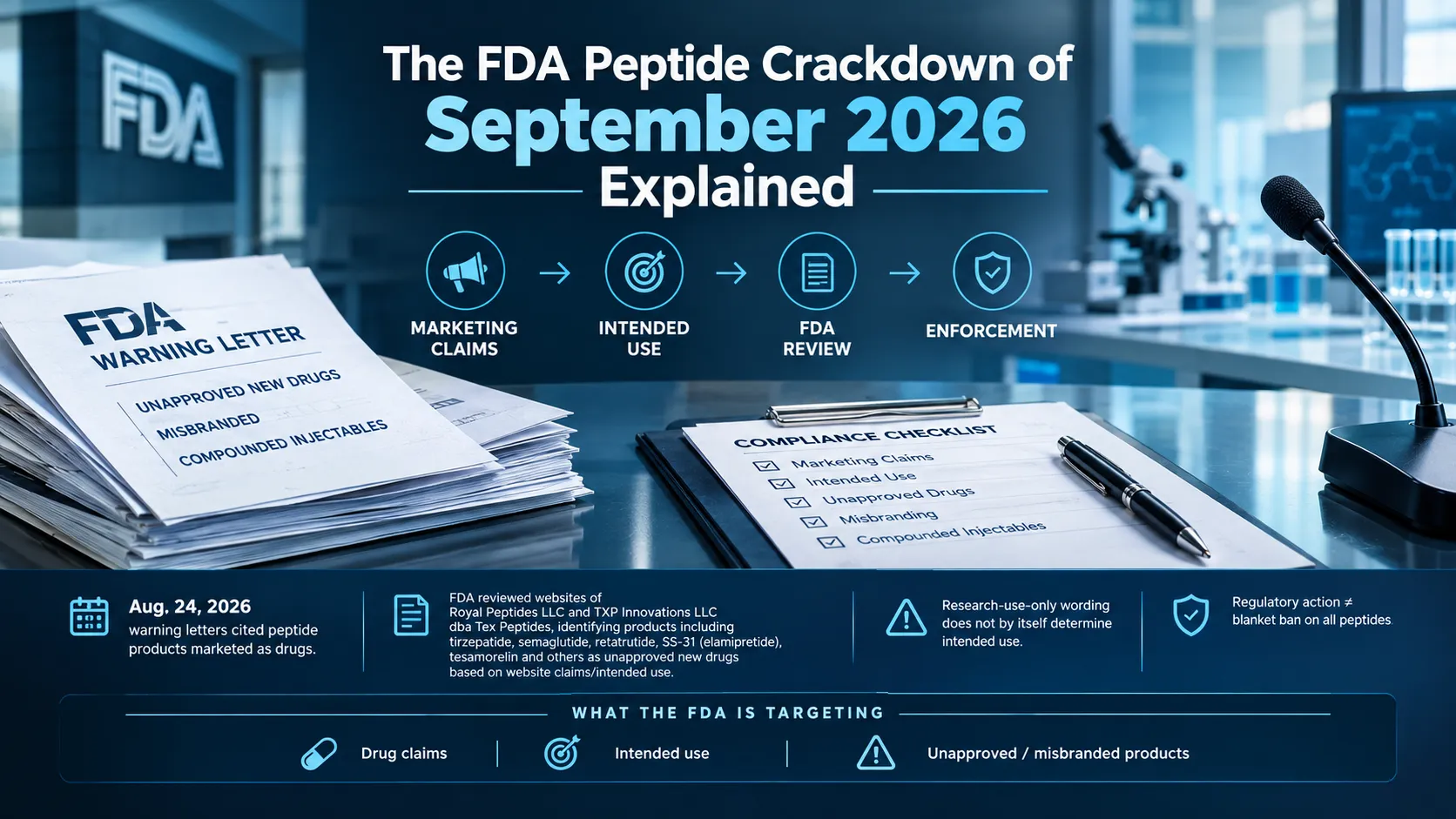
Five peptide sellers got FDA warning letters in September 2026. See who was named, why the research label failed, and the full 2026 enforcement timeline.

In July 2026, the FDA's advisory committee recommended 6 peptides for the 503A bulk list. None are on it yet. What the vote changed and what it didn't.