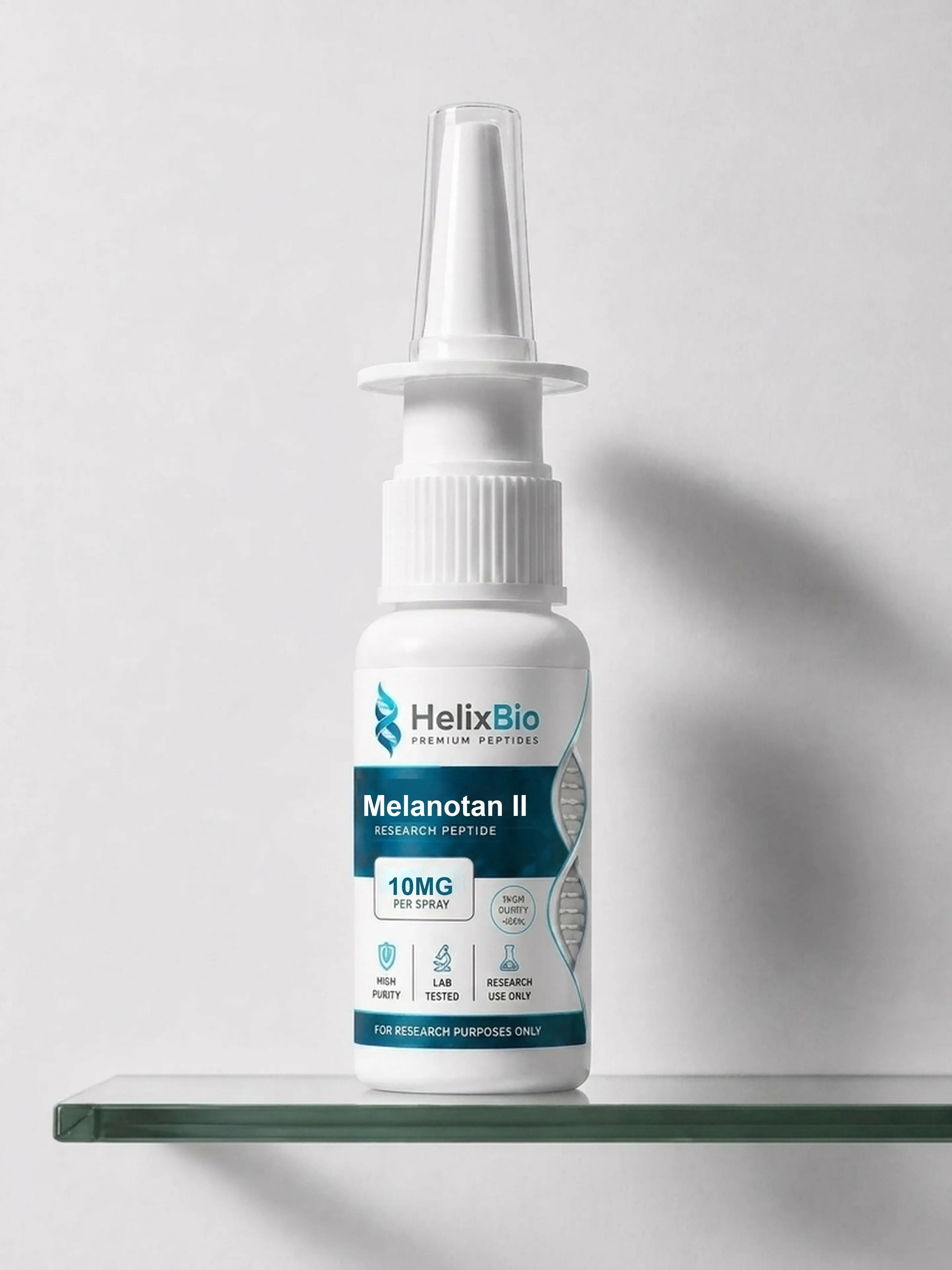
A 23-membered lactam ring is what separates Melanotan II from every linear melanocortin peptide it is related to. Bridging the Asp⁵ side chain to the ε-amino group of Lys¹⁰ locks a seven-residue fragment of α-MSH into a fixed conformation, and Helix Bio supplies that molecule — C₅₀H₆₉N₁₅O₉, 1024.18 g/mol, CAS 121062-08-6 — as a prepared spray solution for laboratory work. The material is intended for qualified scientific research only. It is not for human or veterinary consumption, administration by any route, tanning, cosmetic use, diagnosis, treatment, or prevention of disease.
HPLC certified
Independent analysis
Highest standard
Full traceability
Melanotan II is a synthetic cyclic heptapeptide analogue of alpha-melanocyte-stimulating hormone, developed at the University of Arizona and written in research notation as Ac-Nle⁴-cyclo[Asp⁵-His⁶-D-Phe⁷-Arg⁸-Trp⁹-Lys¹⁰]-NH₂. It is described in the literature as a non-selective melanocortin receptor agonist, with reported activity across MC1R, MC3R, MC4R and MC5R.
Three modifications separate it from the α-MSH region it derives from. Methionine is replaced by norleucine, removing the only oxidisable residue. Phenylalanine at position 7 is inverted to the D-enantiomer. And the lactam bridge closes the macrocycle. The receptor pharmacology and structure-activity consequences of those changes are covered in depth on the Melanotan-2 product page; this page concerns the molecule as a material, and specifically as a material in solution.
Melanotan II shares a shelf with a compound it is nearly indistinguishable from by mass.
Bremelanotide, sold in research contexts as PT-141, is documented as a likely metabolite of Melanotan II. The two differ in one respect: bremelanotide carries a free carboxy group where Melanotan II carries a C-terminal amide. Replacing –NH₂ with –OH changes the molecular weight by roughly 0.98 daltons — from about 1024.18 to about 1025.16.
That gap is smaller than it sounds. The ¹³C isotope peak of intact Melanotan II falls at approximately 1025.18, within about 0.02 daltons of bremelanotide’s monoisotopic ion. On an instrument working at unit resolution, a bremelanotide signal sits underneath Melanotan II’s own natural isotope envelope. Detecting or quantifying it requires high-resolution accurate mass, or chromatographic separation ahead of the detector.
Reversed-phase chromatography is usually the practical route, since an amide and a free acid differ in ionisation state and hydrophobicity in ways a gradient can exploit. The point for a researcher evaluating documentation is that on this compound, the purity method carries more of the identity burden than the mass-spectrometry method does.
Spray describes the container and the physical presentation. It does not describe a route, and none is implied, recommended or supported by this product.
What the format changes is chemistry. A lyophilised peptide sits dry and comparatively inert until a researcher prepares a solution to their own specification — solvent, concentration, pH, all chosen at the bench. A prepared solution commits those choices at manufacture and holds the molecule in water from that point onward.
For this molecule, two solution-phase considerations are worth naming, and both are specific rather than generic.
The first is the C-terminal amide. Hydrolysis of a C-terminal amide to the corresponding acid is a recognised degradation route for peptides in aqueous conditions, and for Melanotan II the product of that reaction is bremelanotide. A related substance that would be unremarkable on most peptides is, here, a distinct commercial compound with its own pharmacology. That makes the related-substance profile on a solution lot more consequential than it would be for a peptide whose degradants have no independent identity.
The second is tryptophan. Trp⁹ is one of the pharmacophore residues held in place by the macrocycle, and tryptophan is among the residues most susceptible to photo-oxidation. Light protection is therefore a substantive handling requirement for a solution of this peptide, not a boilerplate instruction.
Neither observation describes any particular Helix lot. Both are reasons to read the lot documentation carefully and to ask the supplier about vehicle composition, pH and light protection before a solution-format material enters a workflow.
Melanotan II appears in published research across several distinct areas, which should not be collapsed into each other:
The existence of this literature does not establish that Melanotan II Spray is safe or effective for anything. Melanotan II has never been approved as a medicine in any jurisdiction, and its development as a pharmaceutical was discontinued in 2000. Findings reported for native α-MSH, for Melanotan I, or for afamelanotide are findings about different molecules and do not carry across.
Most peptide materials are evaluated against a single question: is this the molecule the label says it is, at the stated purity. For Melanotan II the question is sharper, because the most likely wrong answer is another compound that is commercially available in its own right and sits within one dalton of the target.
That changes what useful documentation looks like. A molecular-weight confirmation reported to the nearest whole number does not separate Melanotan II from bremelanotide. Neither does a purity figure produced by a method that has not been shown to resolve the two. What does the work is a chromatographic method with demonstrated separation of the amide and acid forms, and a mass measurement with enough resolution to distinguish a monoisotopic ion from a neighbouring isotope peak.
Helix Bio’s position is that a researcher should be told this before ordering rather than after. For Melanotan II Spray, the specific items to look for are named in the section below, and the applicable lot documentation is what settles them.
Melanotan II Spray is intended for qualified users working in legitimate laboratory or scientific research environments, including:
It is not intended for consumers seeking tanning, cosmetic, sexual-function, appetite or therapeutic effects, and it is not intended for personal experimentation, self-administration, human consumption, veterinary use or medical treatment.
| Specification | Details |
|---|---|
| Product Name | Melanotan II Spray |
| Common Names | Melanotan-2, Melanotan 2, MT-II, MT-2 |
| Scientific Classification | Synthetic cyclic lactam heptapeptide analogue of α-MSH |
| Peptide Type | Cyclic peptide, 23-membered lactam macrocycle |
| Sequence | Ac-Nle⁴-cyclo[Asp⁵-His⁶-D-Phe⁷-Arg⁸-Trp⁹-Lys¹⁰]-NH₂ |
| Residue Count | Seven |
| Molecular Formula | C₅₀H₆₉N₁₅O₉ |
| Molecular Weight | 1024.18 g/mol |
| CAS Number | 121062-08-6 |
| PubChem CID | 92432 |
| ChEMBL ID | CHEMBL430239 |
| Related Compound | Bremelanotide, the corresponding C-terminal acid, ~1025.16 g/mol |
| Research Category | Melanocortin / Research Peptide |
| Format | Prepared spray solution |
| Salt Form | Refer to current lot documentation |
| Concentration | Refer to current product listing and lot documentation |
| Fill Volume | Refer to current product listing |
| Vehicle / Excipients | Refer to current product documentation |
| Appearance | Refer to current lot documentation |
| Purity | Refer to the applicable Certificate of Analysis |
| Identity Testing | Refer to the applicable Certificate of Analysis |
| Storage | Follow current product-specific documentation |
| Packaging | Refer to current product listing |
| Intended Use | Research and laboratory investigation only |
| Human Use | Not intended for human consumption or administration |
| Veterinary Use | Not intended for veterinary use |
| Manufacturer | Helix Bio |
| Country of Origin | Verify current product documentation |
Molecular values above describe the compound as characterised in public chemical databases and primary literature. They do not describe a lot. Lot-specific values come from the Certificate of Analysis.
Melanocortin receptor research. Melanotan II is reported as a non-selective agonist across MC1R, MC3R, MC4R and MC5R, which is precisely why it appears so often as a comparator ligand. Its value in a receptor experiment is usually as a reference point against which a more selective analogue is measured. Subtype-level pharmacology is developed on the Melanotan-2 product page.
Conformational constraint and peptide design. The lactam macrocycle holds His⁶, D-Phe⁷ and Trp⁹ in a fixed spatial relationship that a linear peptide of identical composition cannot maintain. That makes the compound a working example in studies of how ring size and rigidity affect receptor interaction, and a template that later melanocortin ligands were built against.
Melanogenesis at the cellular level. MC1R signalling in melanocytes is the pathway most associated with melanin synthesis, and Melanotan II’s melanogenic activity is the property it was originally designed for. Cellular melanogenesis, whole-organism pigmentation and any human outcome are three separate evidence levels and should be read as such.
Energy-balance research in rodents. Centrally administered Melanotan II has been examined in rodent feeding studies, with receptor attribution probed using melanocortin antagonists. This is rodent, central-administration evidence about signalling, not evidence about body weight in any other species or by any other route.
Human research. The human record on this molecule is small and specific: a pilot Phase I evaluation published in 1996, and a double-blind placebo-controlled crossover study of erectile response in men with psychogenic erectile dysfunction published in 1998. These are named here because they exist and because a researcher should know what the human evidence base actually consists of. They are not a product claim, and no dosing, route or protocol is provided.
Analytical method development. A compound whose principal related substance is a separate commercial peptide one dalton away is a genuinely useful test case for developing and validating separation methods.
Each publication should be evaluated on its exact molecular entity, model, route and endpoints. Work on native α-MSH, Melanotan I or afamelanotide is work on different molecules.
Analytical documentation matters on every research peptide. On this one it carries an unusual amount of weight, for a reason specific to the molecule.
The mass measurement alone does not settle identity. Melanotan II and bremelanotide differ by roughly 0.98 daltons. Melanotan II’s own ¹³C isotope peak lands within about 0.02 daltons of bremelanotide’s monoisotopic ion, which means a unit-resolution instrument cannot separate a bremelanotide impurity from Melanotan II’s natural isotope distribution. A reported molecular weight consistent with 1024 is necessary and not sufficient.
The salt form affects the mass basis. Melanotan II is commonly supplied as an acetate salt. Peptide content and gross weight are different quantities, and a stated milligram figure means different things depending on which is being reported. Where the documentation does not specify, it is a reasonable question to ask.
Researchers evaluating a Melanotan II Spray lot should look for:
No certification, regulatory approval or quality claim should be inferred unless it is explicitly documented by the manufacturer or the relevant regulatory authority. Third-party testing in particular should not be assumed for a given lot unless the lot documentation states it. Where a general catalogue statement and a lot document disagree, the lot document governs.
Storage and handling requirements should be taken from the current Melanotan II Spray product documentation and lot-specific instructions.
General laboratory considerations:
Because degradation behaviour depends on vehicle, pH, concentration, container and light exposure, storage guidance published for another Melanotan II preparation should not be assumed to describe this one.
Helix Bio describes its research materials as supplied to laboratories and institutions in the United States, with tracked shipping and controlled packaging practices within its fulfilment process.
Because shipping conditions, packaging specifications, availability and delivery requirements change, researchers should review the current Helix Bio shipping information and the product listing before ordering.
Product packaging should remain appropriately labelled and handled as research material after delivery, with the lot number retained so it can be matched to the applicable Certificate of Analysis. Researchers are responsible for following applicable institutional, federal, state and local requirements governing research materials.
Melanotan II Spray is supplied by Helix Bio for research and laboratory purposes only. It is not intended for human or veterinary consumption, self-administration, administration by any route, tanning, cosmetic use, diagnosis, treatment, cure, mitigation or prevention of any disease or condition. It is not a cosmetic, a dietary supplement, a consumer wellness product or a medical treatment.
Melanotan II is not an FDA-approved drug in the United States and has not been approved as a medicine in any jurisdiction. Its development as a pharmaceutical was discontinued in 2000.
Approval status held by a different molecule does not transfer. Afamelanotide — the same entity as Melanotan I, a linear thirteen-residue analogue — was approved by FDA in October 2019 under the trade name SCENESSE for a narrow indication in erythropoietic protoporphyria. Melanotan II is a cyclic seven-residue analogue and holds no such approval.
As of September 2026, Melanotan II was among twelve substances removed from Category 2 of FDA’s interim 503A bulk drug substances list on 15 April 2026. It was not considered at the Pharmacy Compounding Advisory Committee meeting of 23–24 July 2026; FDA has indicated a review of the remaining substances at a meeting before the end of February 2027. Removal from Category 2 did not place any substance on the authorised 503A list, an advisory-committee recommendation is not approval, and Helix Bio is not a compounding pharmacy or a facility under Section 503A of the Federal Food, Drug, and Cosmetic Act. Regulatory status changes; confirm current position directly with FDA.
Published research describing pigmentation responses does not establish photoprotection. Increased pigmentation is not a quantified sun protection factor, and nothing on this page should be read as a claim that Melanotan II protects against ultraviolet exposure or prevents skin cancer. Dermatology case reports have described changes in melanocytic naevi and melanoma diagnoses in individuals who used unlicensed melanotan preparations.
Researchers are responsible for determining whether a material is appropriate for their intended experimental application and for complying with applicable institutional and regulatory requirements.
Knowledge Base
Knowledge Base
Knowledge Base
Knowledge Base
Knowledge Base
Knowledge Base
Knowledge Base
Knowledge Base
Knowledge Base
Knowledge Base
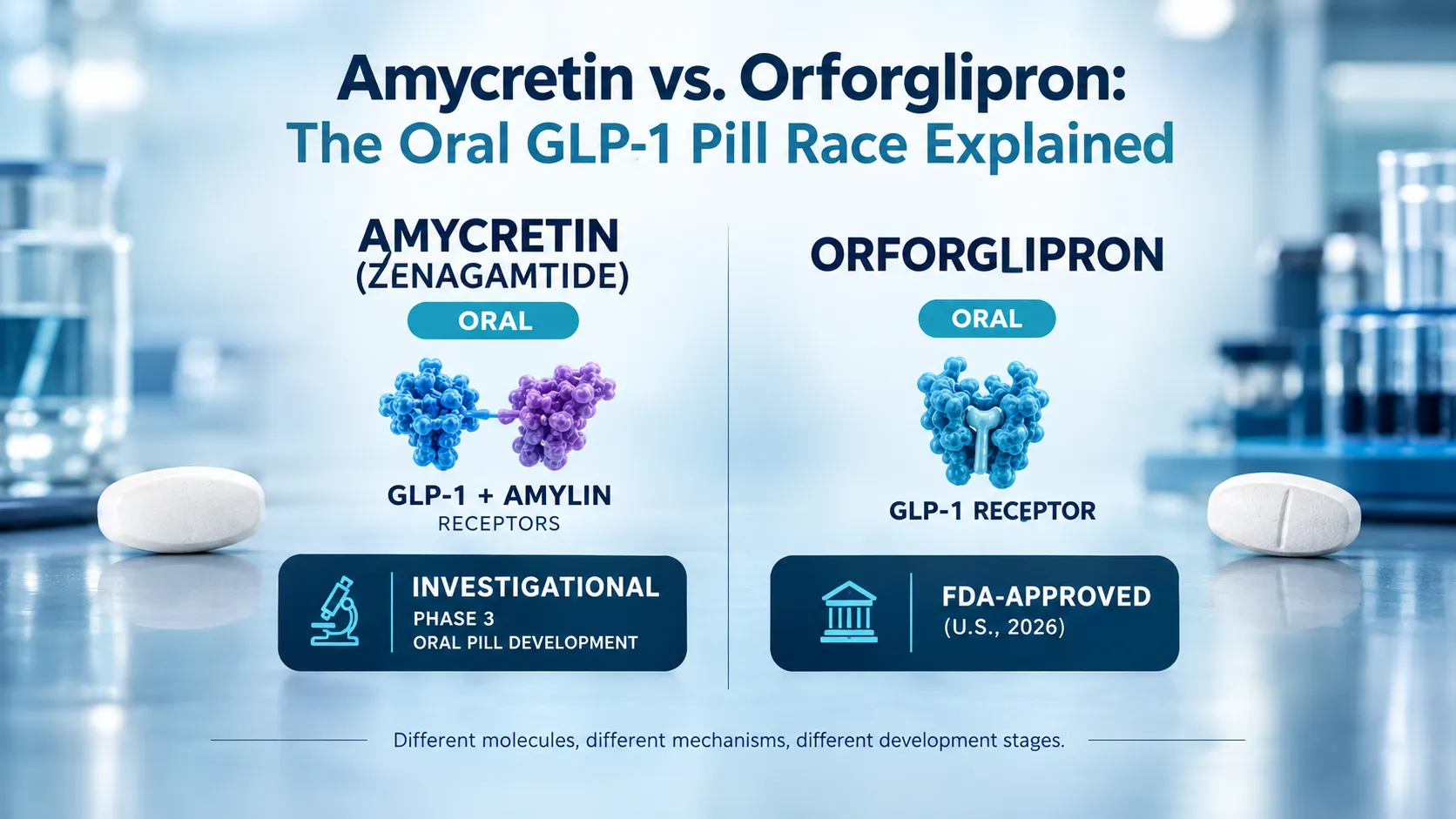
Amycretin is a peptide and orforglipron is not. How that chemistry explains the formulations, trial results, and approval status of both GLP-1 pills.
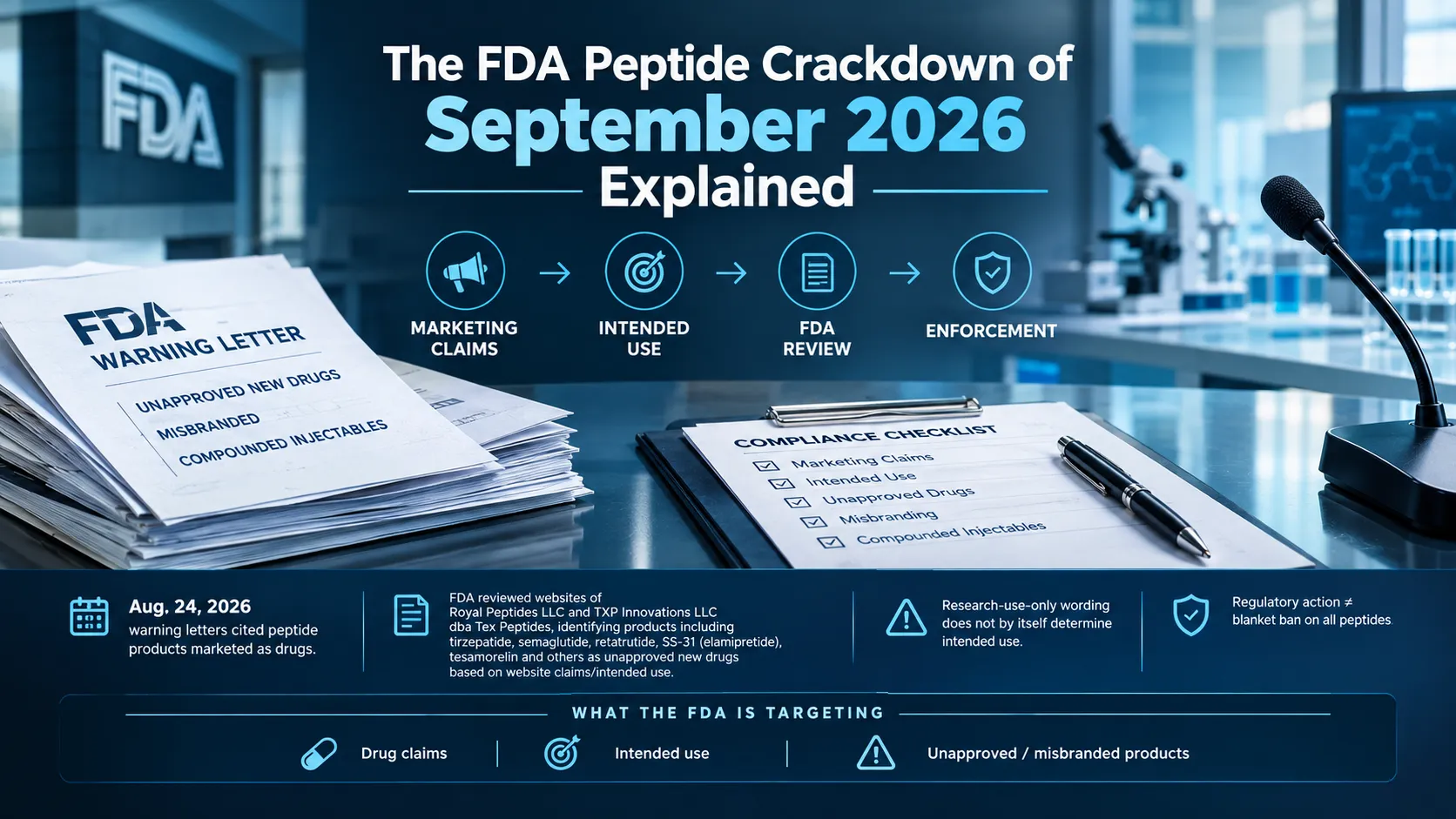
Five peptide sellers got FDA warning letters in September 2026. See who was named, why the research label failed, and the full 2026 enforcement timeline.

In July 2026, the FDA's advisory committee recommended 6 peptides for the 503A bulk list. None are on it yet. What the vote changed and what it didn't.