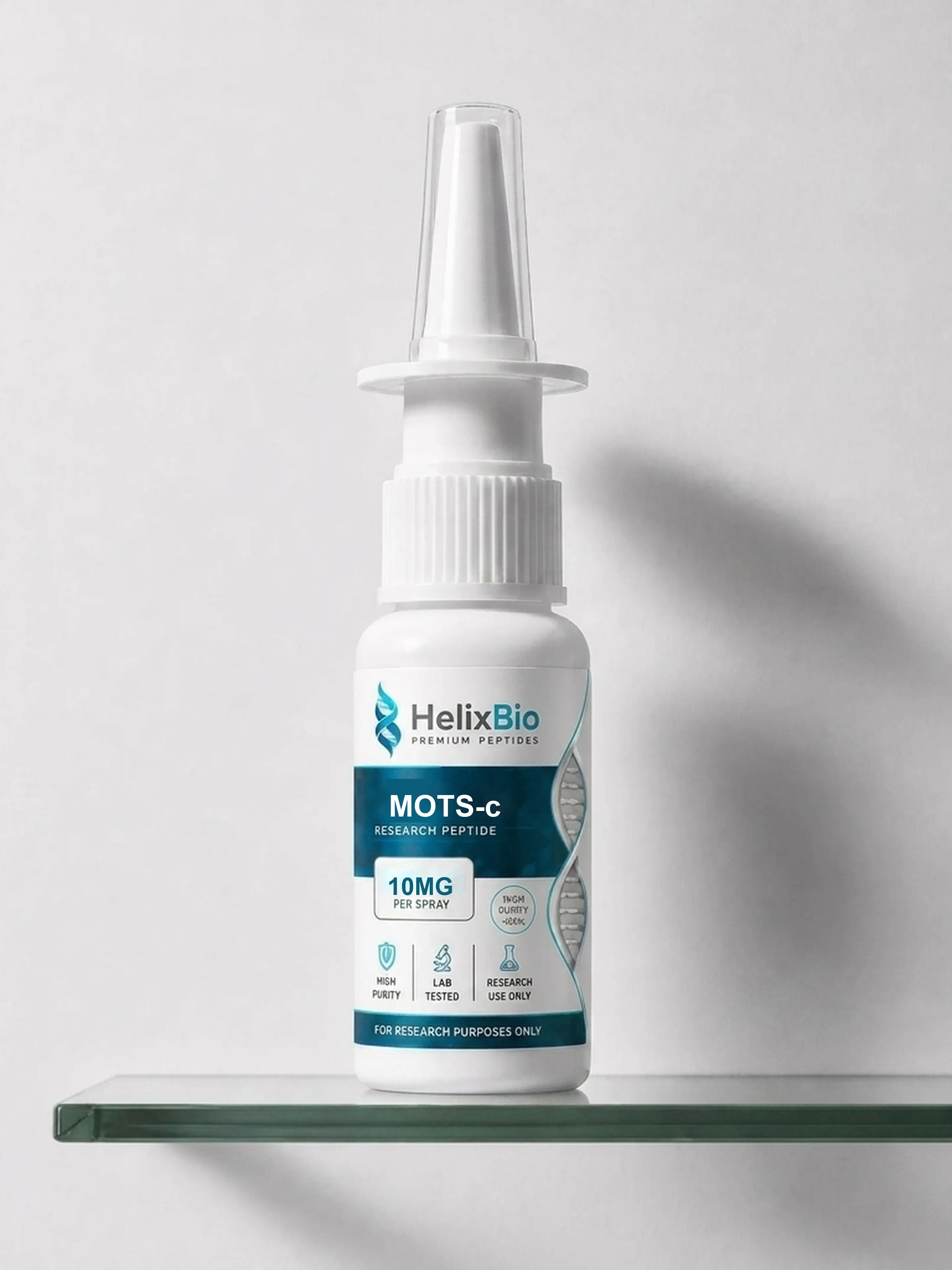
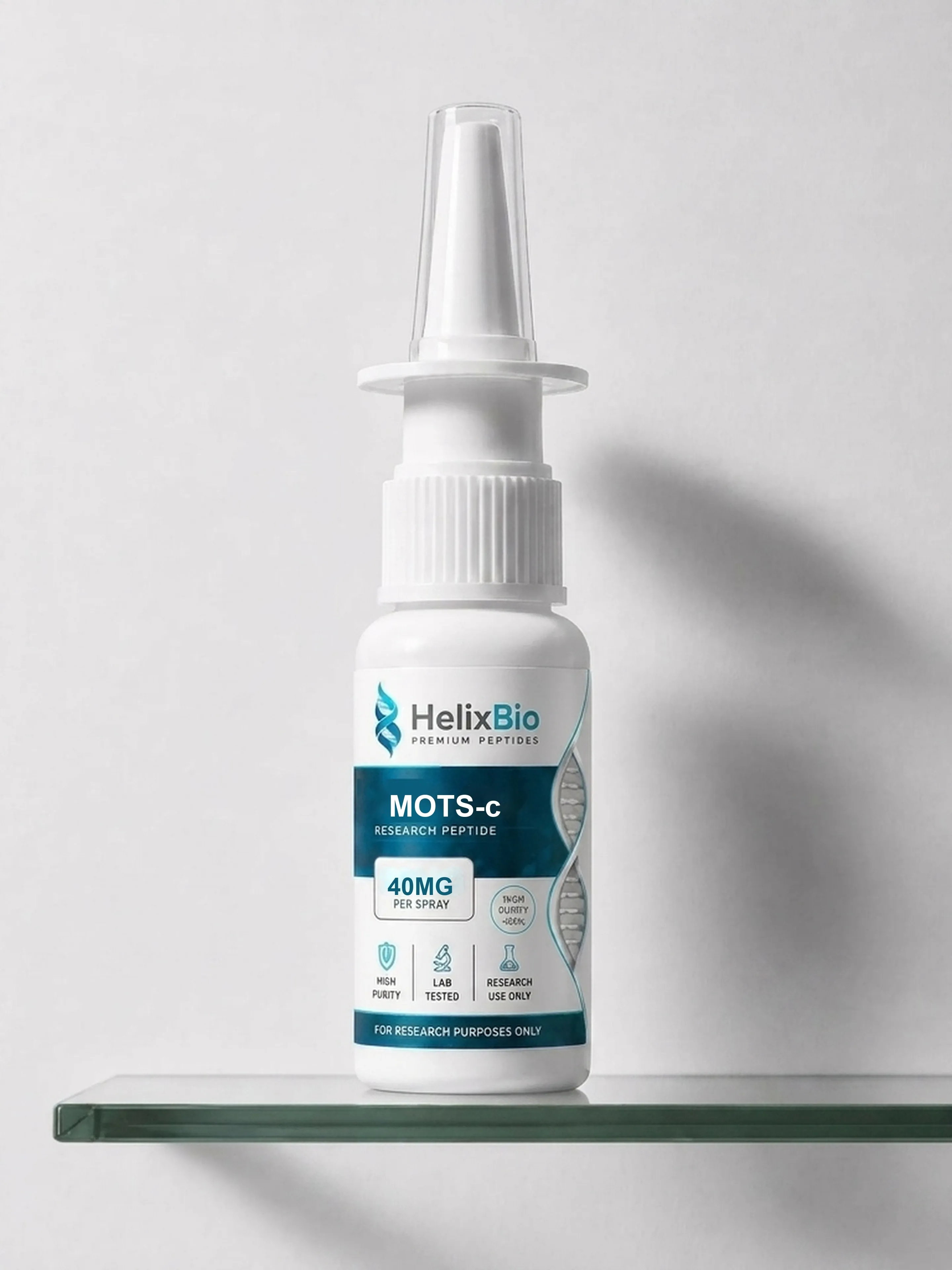
MOTS-c Spray is a research-use preparation of MOTS-c, a 16-amino-acid peptide encoded by a short open reading frame inside the mitochondrial 12S rRNA gene (MT-RNR1). Unlike almost every peptide in a research catalogue, MOTS-c is not a nuclear gene product — it is one of a small group of mitochondrial-derived peptides, and it is translated in the cytoplasm using the standard genetic code rather than the mitochondrial one.Published work on MOTS-c is concentrated in skeletal muscle metabolism, glucose handling, insulin signalling and exercise physiology, almost entirely in cell and rodent models. Human data to date is observational: exercise raises endogenous MOTS-c, but no controlled trial of administered MOTS-c has been published.Helix Bio supplies MOTS-c Spray strictly as a research material for qualified laboratory use. It is not intended for human or veterinary consumption, or for the diagnosis, treatment, cure or prevention of any disease.
HPLC certified
Independent analysis
Highest standard
Full traceability
MOTS-c stands for mitochondrial open reading frame of the 12S rRNA type-c. It is a 16-residue peptide with the sequence Met-Arg-Trp-Gln-Glu-Met-Gly-Tyr-Ile-Phe-Tyr-Pro-Arg-Lys-Leu-Arg, identified in 2015 by Lee, Cohen and colleagues at the University of Southern California through a computational search for short open reading frames in mitochondrial ribosomal RNA genes.
The coding sequence is a 51-base-pair stretch of the mitochondrial 12S rRNA gene. That location is the reason MOTS-c is classified as a mitochondrial-derived peptide (MDP) rather than an ordinary signalling peptide: the mitochondrial genome is only about 16.5 kb and was long assumed to encode nothing but thirteen respiratory-chain subunits, two rRNAs and twenty-two tRNAs. MOTS-c, humanin and the six small humanin-like peptides are the exceptions.
One structural detail follows from the location and is worth carrying into any experimental design. MOTS-c cannot be translated inside the mitochondrion, because the sORF contains tandem codons that read as stop signals under the mitochondrial genetic code. Translation occurs in the cytoplasm using the universal code, which means the polyadenylated transcript must be exported first. The first eleven residues are conserved across at least fourteen mammalian species, and avian MOTS-c diverges downstream because of a nucleotide deletion — so species is not a detail to gloss over when reading the literature.
MOTS-c is described in the review literature as a mitokine and as a retrograde signal: a molecule that carries information from the mitochondrion outward to the cytoplasm, the nucleus and, in circulation, to other tissues.
MOTS-c is a linear, unmodified, non-glycosylated 16-mer. It carries two methionine residues (positions 1 and 6) and no cysteines, so there is no disulfide bridge and no cyclisation to characterise — identity confirmation rests on intact mass and sequence rather than on folding.
The free-base molecular formula is C101H152N28O22S2, with an average mass of 2174.62 g/mol. It is catalogued as PubChem CID 146675088 and CAS 1627580-64-6.
Synthetic MOTS-c is usually supplied as a salt rather than as the free base. Acetate and trifluoroacetate forms both appear in the literature and in commercial material, and PubChem lists a separate entry for the trifluoroacetate salt. The distinction is not cosmetic: a salt form carries counter-ions that add mass, so a stated peptide quantity means one thing on a free-base basis and another on a gross-weight basis. When the FDA reviewed MOTS-c in 2026, it did so for the free base and the acetate as separate bulk drug substances. Researchers calculating molar concentrations should confirm which basis the Certificate of Analysis reports.
MOTS-c Spray is supplied for laboratory and scientific investigation only. It is appropriate for in vitro work, analytical method development, reference-material comparison, and controlled preclinical protocols conducted under institutional oversight.
It is not a drug, a dietary supplement, a cosmetic or a consumer wellness product. It is not supplied for human or veterinary administration, and Helix Bio provides no dosing, protocol or administration guidance for it. Researchers are responsible for determining whether the material suits their experimental design and for meeting the institutional, federal, state and local requirements that apply to it.
A spray is a solution, not a lyophilised powder, and for MOTS-c that has three practical consequences.
One point specific to MOTS-c: unlike some peptides that have an established intranasal research literature, published MOTS-c administration studies have used injection in rodent models. The spray format should therefore be treated as a solution presentation of the compound, not as a validated delivery route for it.
MOTS-c presents an identity problem that most catalogue peptides do not. Because it is short, unmodified and widely sold, material labelled MOTS-c can differ from the reference sequence by a single residue without any visible sign. Published sources are not immune to this either — at least one peer-reviewed review of MOTS-c prints the sequence with the isoleucine at position 9 missing, a fifteen-residue string that is not MOTS-c. Anyone verifying a Certificate of Analysis against a literature sequence should check the residue count first.
The FDA made a related observation in its 2026 briefing materials: for a 16-amino-acid peptide, it lacked the information needed to assess immunogenicity risk. That is a regulatory statement about a therapeutic pathway rather than a laboratory one, but it points at the same underlying issue — small peptides are only as characterised as their analytical record.
For MOTS-c Spray specifically, review the current lot documentation for identity confirmation, reported purity, the analytical methods used, the mass basis of the stated quantity, and the storage conditions applicable to a solution rather than a powder.
MOTS-c Spray is supplied to qualified users in legitimate research settings, including academic and institutional laboratories, biotechnology and pharmaceutical research groups, contract research organisations, and laboratories working in mitochondrial biology, metabolic signalling or peptide analytical chemistry.
It is not supplied for personal experimentation, self-administration, human or veterinary consumption, athletic use, or any medical purpose.
| Specification | Details |
|---|---|
| Product name | MOTS-c Spray |
| Compound | MOTS-c |
| Full name | Mitochondrial open reading frame of the 12S rRNA type-c |
| Compound class | Mitochondrial-derived peptide (MDP) |
| Genomic origin | 51-bp short open reading frame within MT-RNR1 (mitochondrial 12S rRNA gene) |
| Sequence | Met-Arg-Trp-Gln-Glu-Met-Gly-Tyr-Ile-Phe-Tyr-Pro-Arg-Lys-Leu-Arg (MRWQEMGYIFYPRKLR) |
| Amino-acid count | 16 |
| Molecular formula | C101H152N28O22S2 (free base) |
| Molecular weight | 2174.62 g/mol (free base) |
| CAS number | 1627580-64-6 |
| PubChem CID | 146675088 |
| UNII | A5CV6JFB78 |
| Format | Spray solution |
| Concentration and fill volume | Refer to current product listing |
| Salt form and mass basis | Refer to the applicable Certificate of Analysis |
| Purity | Refer to current lot-specific documentation |
| Identity testing | Refer to the applicable Certificate of Analysis |
| Storage | Follow the storage conditions supplied with the product |
| Intended use | Research and laboratory investigation only |
| Human use | Not intended for human consumption |
| Veterinary use | Not intended for veterinary use |
The research record on MOTS-c is a decade old and unusually concentrated. It divides cleanly by model system, and the divisions matter.
The route described in the 2015 discovery paper runs through one-carbon metabolism rather than through a receptor. MOTS-c was reported to interfere with the folate–methionine cycle, causing AICAR to accumulate; AICAR in turn activates AMP-activated protein kinase (AMPK). Later work reported that under metabolic stress MOTS-c translocates from the cytoplasm to the nucleus, where it associates with stress-responsive transcription factors and influences nuclear gene expression — the observation that led to MOTS-c being described as a retrograde mitochondrial signal.
No cell-surface receptor for MOTS-c has been established. Descriptions of MOTS-c as a peptide hormone rest on its systemic distribution and its behaviour in circulation, not on a characterised receptor interaction.
Cultured cell work has examined glucose flux, AMPK phosphorylation, GLUT4-related expression and responses to oxidative stress. Findings in isolated cells describe what the peptide does to a pathway under defined conditions; they do not describe what happens in an organism.
Mouse work is the bulk of the efficacy literature. Administered MOTS-c has been reported to affect insulin sensitivity and body-weight trajectory in diet-induced obesity models, and a 2021 study in Nature Communications reported that intermittent MOTS-c treatment begun late in life (at 23.5 months) improved physical capacity measures in aged mice. These are rodent results with rodent dosing, and they are the origin of most of the claims made about MOTS-c online.
Human data on MOTS-c is observational and concerns the peptide the body makes, not peptide that was given. The same 2021 study measured an approximately twelve-fold rise in skeletal-muscle MOTS-c and roughly a 1.6-fold rise in circulating MOTS-c after a bout of exercise. A separate 16-week supervised aerobic and resistance intervention in breast cancer survivors (ClinicalTrials.gov NCT01140282) reported increased MOTS-c in non-Hispanic White participants but not in Hispanic participants — a difference that has not been explained.
No published controlled trial has administered MOTS-c to humans. FDA stated in its 2026 review materials that there were no clinical studies in humans to draw on.
A mitochondrial polymorphism, m.1382A>C, changes residue 14 of MOTS-c from lysine to glutamine and is essentially restricted to Northeast Asian populations. It has been examined in the context of exceptional longevity in Japanese cohorts. This is association work in specific populations; it is not evidence that administered MOTS-c extends lifespan in anyone.
| MOTS-c | Humanin | SHLP1–6 | |
|---|---|---|---|
| mtDNA gene | MT-RNR1 (12S rRNA) | MT-RNR2 (16S rRNA) | MT-RNR2 (16S rRNA) |
| Length | 16 aa | 24 aa | 20–38 aa |
| Identified | 2015 | 2001 | 2016 |
| Main research focus | Metabolism, skeletal muscle, exercise | Cytoprotection, neuroprotection, apoptosis | Varies by peptide — cell survival, proliferation, apoptosis |
The three are frequently discussed together as a class, and evidence about one is regularly attributed to another in secondary sources. They share a genomic neighbourhood and a general role in mitochondrial-to-nuclear communication; they do not share findings.
Helix Bio states that its research peptides undergo independent HPLC purity testing and mass spectrometry identity confirmation, and that batch-specific Certificates of Analysis are available. A general catalogue statement is not a substitute for the record covering the material in hand.
For a MOTS-c spray lot, the documentation worth reading closely covers:
Follow the storage conditions supplied with the product. Do not carry over storage guidance from lyophilised MOTS-c, from another supplier's spray, or from another mitochondrial-derived peptide — formulation, vehicle and packaging all affect stability, and a solution behaves differently from a powder.
General laboratory practice applies: avoid unnecessary temperature cycling, keep the container closed when not in use, protect from light and inappropriate temperature, maintain labelling and inventory records, and follow institutional procedures for handling research materials.
MOTS-c Spray is supplied by Helix Bio for research and laboratory purposes only. It is not intended for human or veterinary consumption, self-administration, diagnosis, treatment, cure, mitigation or prevention of any disease or condition.
MOTS-c is not an FDA-approved drug. On 23 July 2026, FDA's Pharmacy Compounding Advisory Committee voted 7–5 with two abstentions to recommend that MOTS-c-related bulk drug substances be added to the Section 503A Bulks List, against the recommendation of FDA's own reviewers. That vote is advisory. It did not approve MOTS-c, did not add it to the 503A list, and did not authorise pharmacy compounding; FDA retains the decision and must complete rulemaking before anything changes. Nothing about the vote alters the status of research-use material sold online.
MOTS-c is prohibited at all times under the World Anti-Doping Agency Prohibited List, in the metabolic modulator category covering AMPK activators, and is named there explicitly. USADA has published an athlete advisory on it. Anyone subject to anti-doping testing should treat this material accordingly.
Researchers are responsible for determining whether this material is appropriate for their intended application and for complying with applicable institutional and regulatory requirements.
Knowledge Base
Knowledge Base
Knowledge Base
Knowledge Base
Knowledge Base
Knowledge Base
Knowledge Base
Knowledge Base
Knowledge Base
Knowledge Base
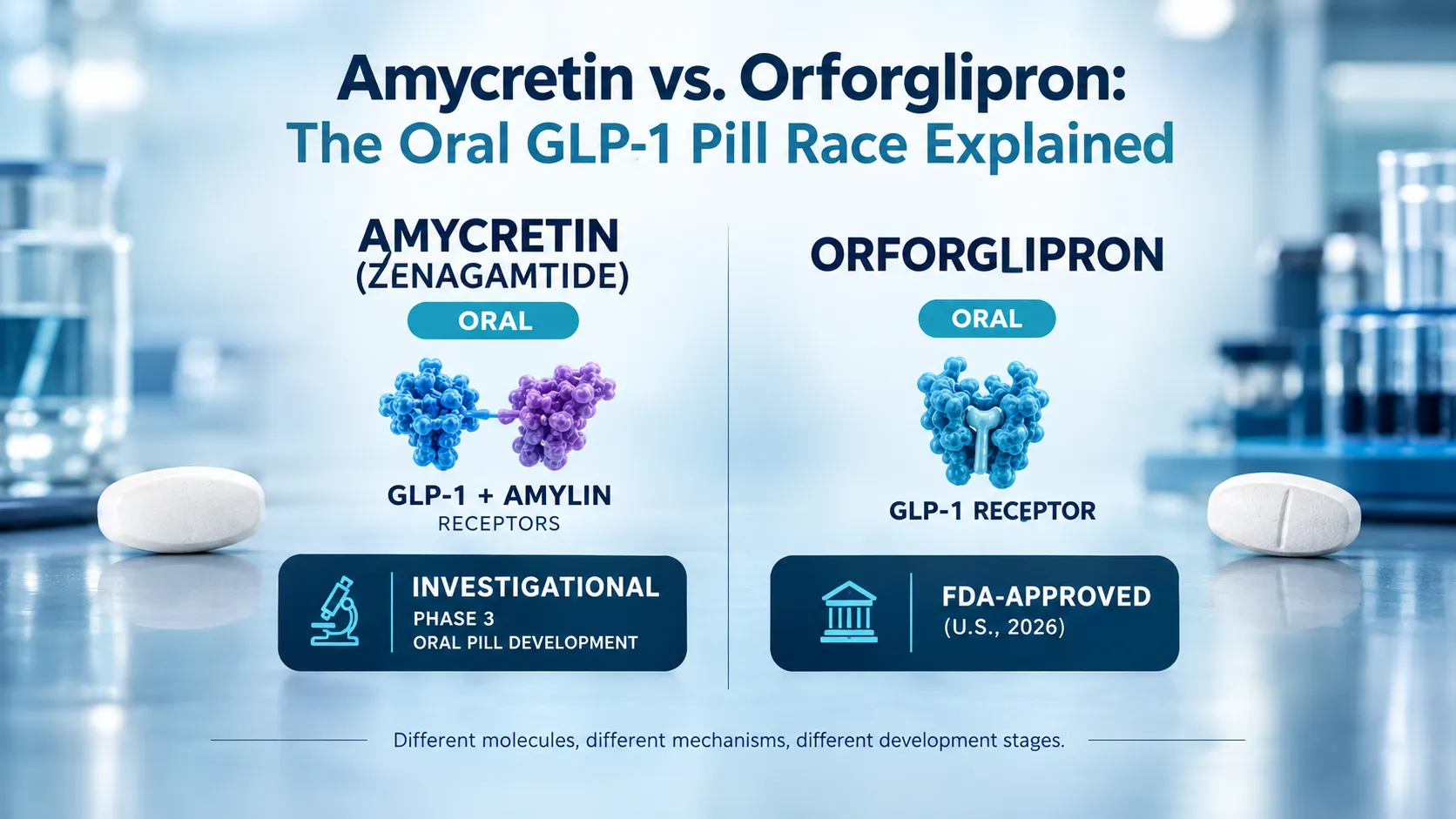
Amycretin is a peptide and orforglipron is not. How that chemistry explains the formulations, trial results, and approval status of both GLP-1 pills.
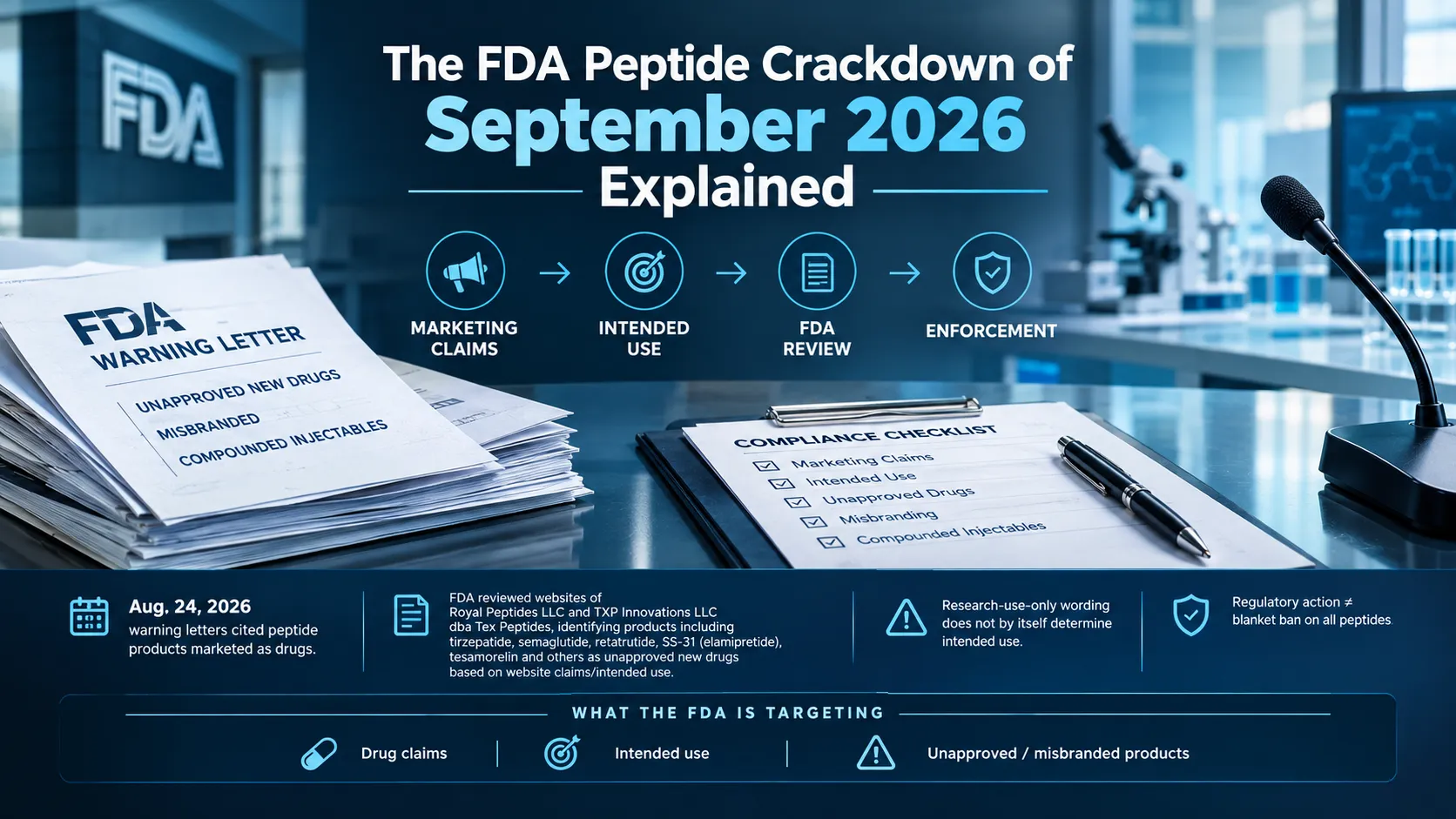
Five peptide sellers got FDA warning letters in September 2026. See who was named, why the research label failed, and the full 2026 enforcement timeline.

In July 2026, the FDA's advisory committee recommended 6 peptides for the 503A bulk list. None are on it yet. What the vote changed and what it didn't.