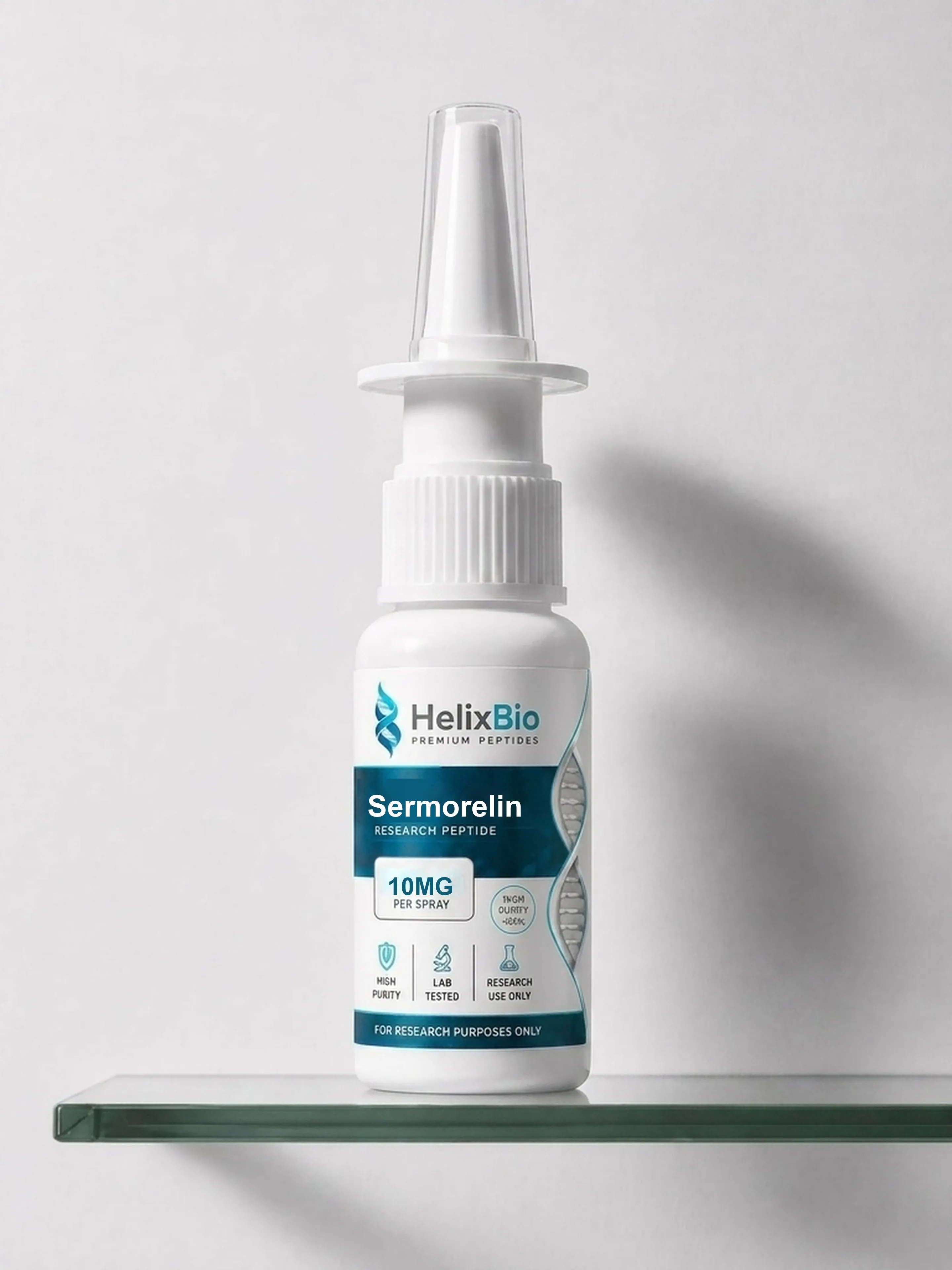
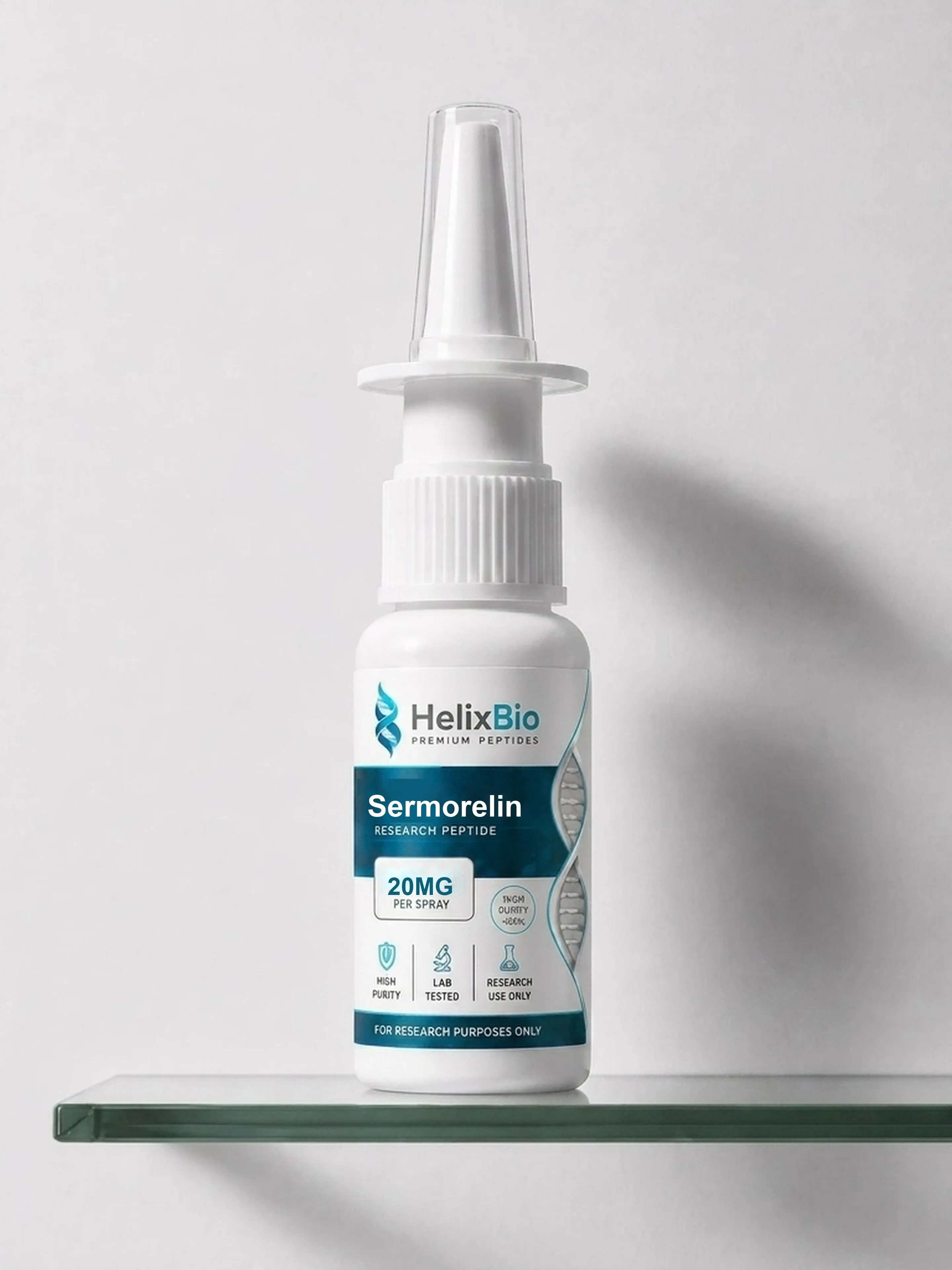
Sermorelin Spray is a research-use peptide preparation containing sermorelin, a synthetic 29-amino-acid peptide corresponding to the N-terminal fragment of human growth hormone-releasing hormone and identified in scientific literature as GHRH(1-29)-NH₂. Sermorelin acts at the growth hormone-releasing hormone receptor (GHRHR) and has a long published record in endocrine, receptor-pharmacology and peptide-chemistry research. Helix Bio supplies research materials for qualified laboratory and scientific applications. Sermorelin Spray is offered strictly for research use and is not intended for human or veterinary consumption, diagnosis, treatment, or prevention of disease.
HPLC certified
Independent analysis
Highest standard
Full traceability
Sermorelin is the amidated 29-residue N-terminal fragment of human growth hormone-releasing hormone, written in the literature as GHRH(1-29)-NH₂ or GRF(1-29)-NH₂. Its sequence is Tyr-Ala-Asp-Ala-Ile-Phe-Thr-Asn-Ser-Tyr-Arg-Lys-Val-Leu-Gly-Gln-Leu-Ser-Ala-Arg-Lys-Leu-Leu-Gln-Asp-Ile-Met-Ser-Arg-NH₂, and the free base has the formula C₁₄₉H₂₄₆N₄₄O₄₂S with a molecular weight of approximately 3,358 daltons.
The C-terminal amide is part of the molecule’s identity rather than an optional feature; the corresponding free-acid peptide is a different entity. Sermorelin is normally supplied as the acetate salt, which matters when a strength figure is interpreted, because acetate and residual water contribute to weighed mass.
Native human GHRH circulates as GHRH(1-44)-NH₂ and GHRH(1-40)-OH. Comparative work established that the first 29 residues carry the full intrinsic growth hormone-releasing activity of the parent hormone, which is why this fragment became a reference molecule in GHRH research. Equivalent intrinsic potency does not make sermorelin the same molecule as native GHRH — it is a defined fragment of it, and the distinction should be preserved in experimental records.
Sermorelin binds the growth hormone-releasing hormone receptor, a class B1 G-protein-coupled receptor on anterior pituitary somatotrophs. Receptor activation couples through Gs to adenylyl cyclase and raises intracellular cAMP, driving PKA-dependent signalling associated with growth hormone synthesis and release. Because the effect depends on a responsive somatotroph population, sermorelin behaves differently in experimental systems from administered growth hormone itself.
One further structural feature shapes how sermorelin behaves in practice. The N-terminal Tyr¹-Ala² bond is a substrate for dipeptidyl peptidase-4, and cleavage yields GHRH(3-29), which does not activate the receptor. This is the dominant route of inactivation and the reason sermorelin’s circulating half-life is short — historical human pharmacokinetic data placed it in the region of eleven to twelve minutes after intravenous administration.
A prepared solution and a lyophilized powder are not the same research material, and for sermorelin specifically the difference is not incidental.
Sermorelin retains two residues that later GHRH analogues were deliberately engineered to remove. Met²⁷ is the molecule’s only sulfur-containing residue and is susceptible to oxidation; the CJC-1295 family replaced it with leucine. Asn⁸ is an asparagine in a position where deamidation is a recognised degradation route for peptides in aqueous conditions; the same analogues replaced it with glutamine. A sermorelin preparation held in solution therefore carries chemical liabilities that a Modified GRF(1-29) preparation does not, and this is a genuine experimental variable rather than a marketing distinction.
The practical consequence is that formulation, vehicle and storage conditions belong to the specific material in hand. Concentration expressed per millilitre, the mass delivered per actuation, the vehicle composition and the storage regime are product facts. They must be read from the current Helix Bio product listing and the lot-specific Certificate of Analysis, not inferred from published protocols for other sermorelin preparations, from lyophilized presentations, or from other spray-format products.
Sermorelin Spray is supplied by Helix Bio as a spray-format research material. Helix Bio does not represent any route of administration for this product, and the format designation describes the physical presentation only.
Sermorelin appears across several distinct research areas:
The existence of published research does not establish that Sermorelin Spray is safe or effective for use in humans. Sermorelin has no current FDA approval in the United States. It previously held two approved new drug applications that were withdrawn after the manufacturer discontinued the products, and FDA published a determination in 2013 that those products were not withdrawn from sale for reasons of safety or effectiveness. Prior approval, withdrawal, and current status are three separate facts and should not be collapsed into one.
Researchers working with GHRH-family peptides face a specific identification problem. Sermorelin, Modified GRF(1-29) and the CJC-1295 forms share most of their sequence and are frequently sold under overlapping names. Confirming which molecule is actually in a container is not a formality — it determines whether the material carries the DPP-4-labile N-terminus and the oxidisable methionine that define sermorelin’s behaviour.
Helix Bio states that its research peptide catalog uses independent HPLC testing for purity assessment and mass spectrometry for molecular identity confirmation, and that batch-specific Certificates of Analysis are available for its products.
For Sermorelin Spray, the measured mass reported on the applicable Certificate of Analysis is the check that matters, because the closely related no-DAC analogue differs from sermorelin by a small but resolvable mass. Researchers should verify the current lot documentation rather than relying on a general product description or on the product name alone.
Sermorelin Spray is intended for qualified users working in legitimate laboratory or scientific research environments, including:
The product is not intended for personal experimentation, self-administration, human consumption, veterinary use, or medical treatment.
| Specification | Details |
|---|---|
| Product Name | Sermorelin Spray |
| Research Category | Growth Hormone Secretagogue / Research Peptide |
| Compound | Sermorelin |
| Scientific Nomenclature | GHRH(1-29)-NH₂ / GRF(1-29)-NH₂ |
| Chemical Class | Synthetic amidated peptide; GHRH fragment |
| Related Peptide | N-terminal fragment of human GHRH(1-44)-NH₂ |
| Sequence | Tyr-Ala-Asp-Ala-Ile-Phe-Thr-Asn-Ser-Tyr-Arg-Lys-Val-Leu-Gly-Gln-Leu-Ser-Ala-Arg-Lys-Leu-Leu-Gln-Asp-Ile-Met-Ser-Arg-NH₂ |
| Amino Acid Count | 29, C-terminally amidated |
| Molecular Formula (free base) | C₁₄₉H₂₄₆N₄₄O₄₂S |
| Molecular Weight (free base) | ≈ 3,358 Da |
| CAS Number | 86168-78-7 (free base); acetate salt carries a separate registry number — confirm against the applicable COA |
| Molecular Target | Growth hormone-releasing hormone receptor (GHRHR) |
| Format | Spray-format solution |
| Intended Use | Research and laboratory investigation only |
| Human Use | Not intended for human consumption |
| Veterinary Use | Not intended for veterinary use |
| Salt Form / Mass Basis | Refer to current lot-specific product documentation |
| Concentration | Refer to current product listing |
| Purity | Refer to current lot-specific product documentation |
| Identity Testing | Refer to applicable Certificate of Analysis |
| Packaging | Refer to current product listing |
| Storage | Follow current product-specific documentation |
| Manufacturer | Helix Bio |
| Country of Origin | Not specified; verify current product documentation |
Sermorelin has one of the longest published records of any peptide in the growth hormone-releasing hormone family, spanning receptor pharmacology, structure-activity work, analytical chemistry and human pharmacokinetics.
Sermorelin is used as a reference GHRHR ligand. Receptor activation couples through Gs to adenylyl cyclase, elevating cAMP and engaging PKA-dependent signalling associated with growth hormone synthesis and release, with downstream effects on hepatic IGF-1 production in intact systems. Because sermorelin acts on the pituitary rather than substituting for growth hormone, experimental design must account for whether the model retains a responsive somatotroph population.
The finding that GHRH(1-29)-NH₂ carries the full intrinsic potency of the longer native forms made this fragment the anchor for structure-activity work across the GHRH family. Sermorelin is the unmodified reference point against which each later substitution is measured — D-alanine at position 2 for protease resistance, glutamine at position 8 against deamidation, leucine at position 27 against oxidation. Researchers investigating GHRH analogue design generally need the unmodified molecule alongside the modified ones.
Dipeptidyl peptidase-4 cleaves the Tyr¹-Ala² bond to give GHRH(3-29), which does not activate the receptor. This single cleavage governs sermorelin’s short circulating half-life, reported in historical human pharmacokinetic work at roughly eleven to twelve minutes after intravenous administration. Half-life values published for albumin-conjugated GHRH analogues describe a different molecule and a different mechanism and should not be applied to sermorelin.
Sermorelin is one of relatively few peptides in this class with published human data on nasal absorption. A 1993 study administered GHRH(1-29)-NH₂ intravenously and intranasally to thirty healthy men and found nasal bioavailability of only 3–5%, with roughly 50 µg/kg intranasally required to approximate the growth hormone response of 1 µg/kg intravenously. A companion six-month study in children with growth hormone deficiency found peak responses declining by six weeks and further by six months, anti-GHRH antibodies developing in three patients, and local mucosal reactions; the authors concluded the intranasal preparation as then formulated was not suitable for that use.
These findings describe the molecule’s behaviour in specific pharmaceutical preparations under specific conditions. They are informative background for researchers designing route-comparison work, and they establish nothing about the performance, stability or suitability of this or any commercial research material. Related dose-response literature involving [Nle²⁷]GHRH(1-29)NH₂ concerns a norleucine-substituted analogue rather than sermorelin and should be cited as such.
Sermorelin is regularly compared against two different classes of compound, and the two comparisons are not equivalent.
Against modified GHRH analogues — Modified GRF(1-29) and the CJC-1295 forms — the difference is a small number of substitutions on a shared backbone, all acting at the same receptor. Against ghrelin-receptor secretagogues such as ipamorelin, GHRP-2 and GHRP-6, the difference is categorical: those compounds are short synthetic peptides acting at GHSR1a, a different receptor entirely, and they are not derived from the GHRH sequence. Tesamorelin sits in a third position again, built on the full-length GHRH(1-44) backbone with an N-terminal acyl modification and roughly 5,136 daltons in mass.
Researchers should evaluate each publication according to the exact compound studied, the model, the analytical method and the endpoints, rather than assuming that findings transfer across the growth hormone axis.
Analytical quality matters with research peptides because impurities, degradation products, incorrect identity or inconsistent concentration all become uncontrolled variables in an experiment. For sermorelin there is an additional consideration: several closely related GHRH analogues differ from it by only a few residues, so an identity check is doing real work rather than confirming the obvious.
Helix Bio states that its peptide materials are subjected to independent HPLC testing for purity and mass spectrometry for molecular identity, and that batch-specific Certificates of Analysis are available for its products.
For a specific Sermorelin Spray lot, researchers should consult the applicable COA and product documentation for the actual analytical results. A general catalog statement is not a substitute for lot-specific documentation, and a purity figure quoted at catalog level is not a measured value for the material received.
Researchers should assess, where applicable:
No certification, regulatory approval, or quality claim should be inferred unless it is explicitly documented by the manufacturer or the relevant regulatory authority.
Storage and handling requirements should be determined from the current Sermorelin Spray product documentation and lot-specific instructions.
General laboratory considerations include:
Storage conditions published for lyophilized sermorelin, for reconstituted injectable preparations, or for other spray-format products do not transfer to this material. A peptide held in solution is subject to different degradation pathways from the same peptide held as a dry powder, and for sermorelin those pathways include oxidation at Met²⁷ and deamidation at Asn⁸. Only documentation supplied with this specific formulation and lot describes its actual requirements.
Helix Bio’s website describes research materials as being supplied to laboratories and institutions in the United States and describes tracked shipping and cold-chain handling within its fulfillment process.
Because shipping conditions, packaging specifications, availability, and delivery requirements may change, researchers should review the current Helix Bio shipping information and product listing before ordering.
Product packaging should remain appropriately labeled and handled as research material after delivery. Researchers are responsible for following applicable institutional, federal, state, and local requirements governing research materials.
Sermorelin Spray is sold by Helix Bio for research and laboratory purposes only. It is not intended for human or veterinary consumption, self-administration, diagnosis, treatment, cure, mitigation, or prevention of any disease or medical condition.
Sermorelin has no current FDA approval in the United States. Two new drug applications for sermorelin acetate were approved historically and were later withdrawn after the manufacturer discontinued the products. FDA published a determination in 2013 that those products were not withdrawn from sale for reasons of safety or effectiveness. Prior approval of a pharmaceutical product does not extend to research materials, and none of that regulatory history applies to this product.
Helix Bio is not a compounding pharmacy and does not operate as a compounding facility under Section 503A of the Federal Food, Drug, and Cosmetic Act. Nothing on this page should be read as a statement about the eligibility of any substance for pharmacy compounding.
This product is not a dietary supplement, consumer wellness product, or medical treatment. Researchers are responsible for determining whether a material is appropriate for their intended experimental application and for complying with applicable institutional and regulatory requirements.
Knowledge Base
Knowledge Base
Knowledge Base
Knowledge Base
Knowledge Base
Knowledge Base
Knowledge Base
Knowledge Base
Knowledge Base
Knowledge Base
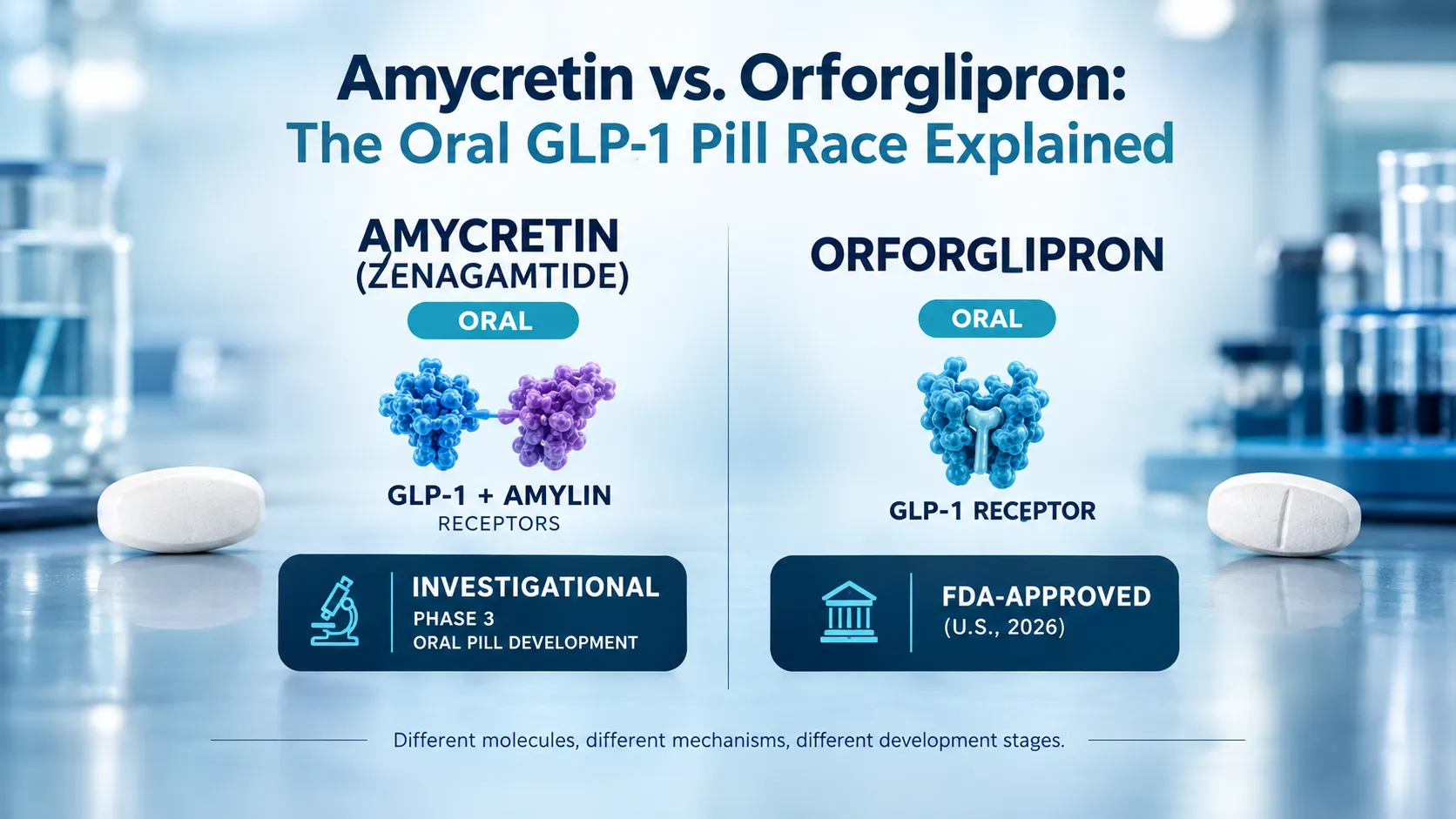
Amycretin is a peptide and orforglipron is not. How that chemistry explains the formulations, trial results, and approval status of both GLP-1 pills.
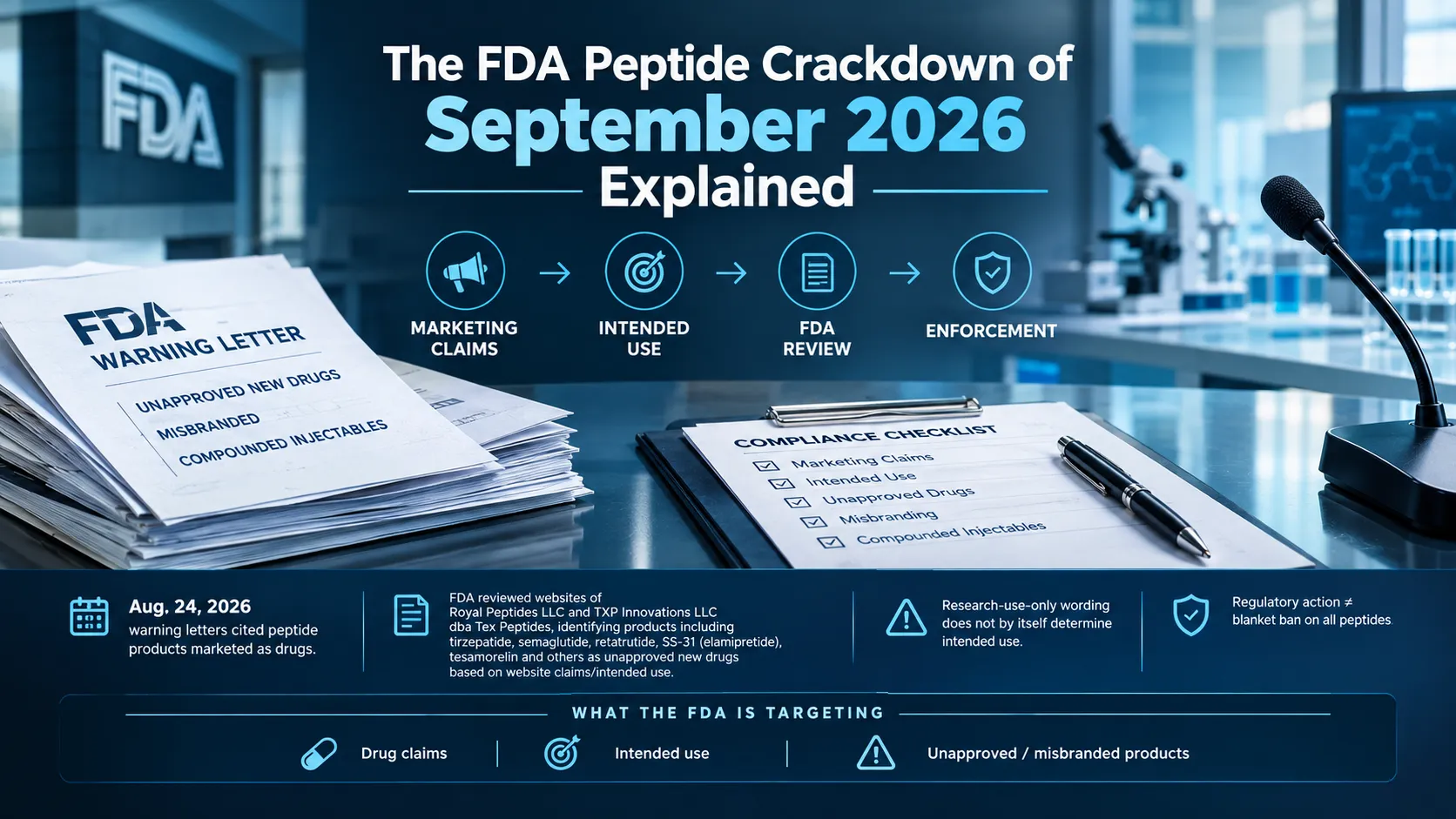
Five peptide sellers got FDA warning letters in September 2026. See who was named, why the research label failed, and the full 2026 enforcement timeline.
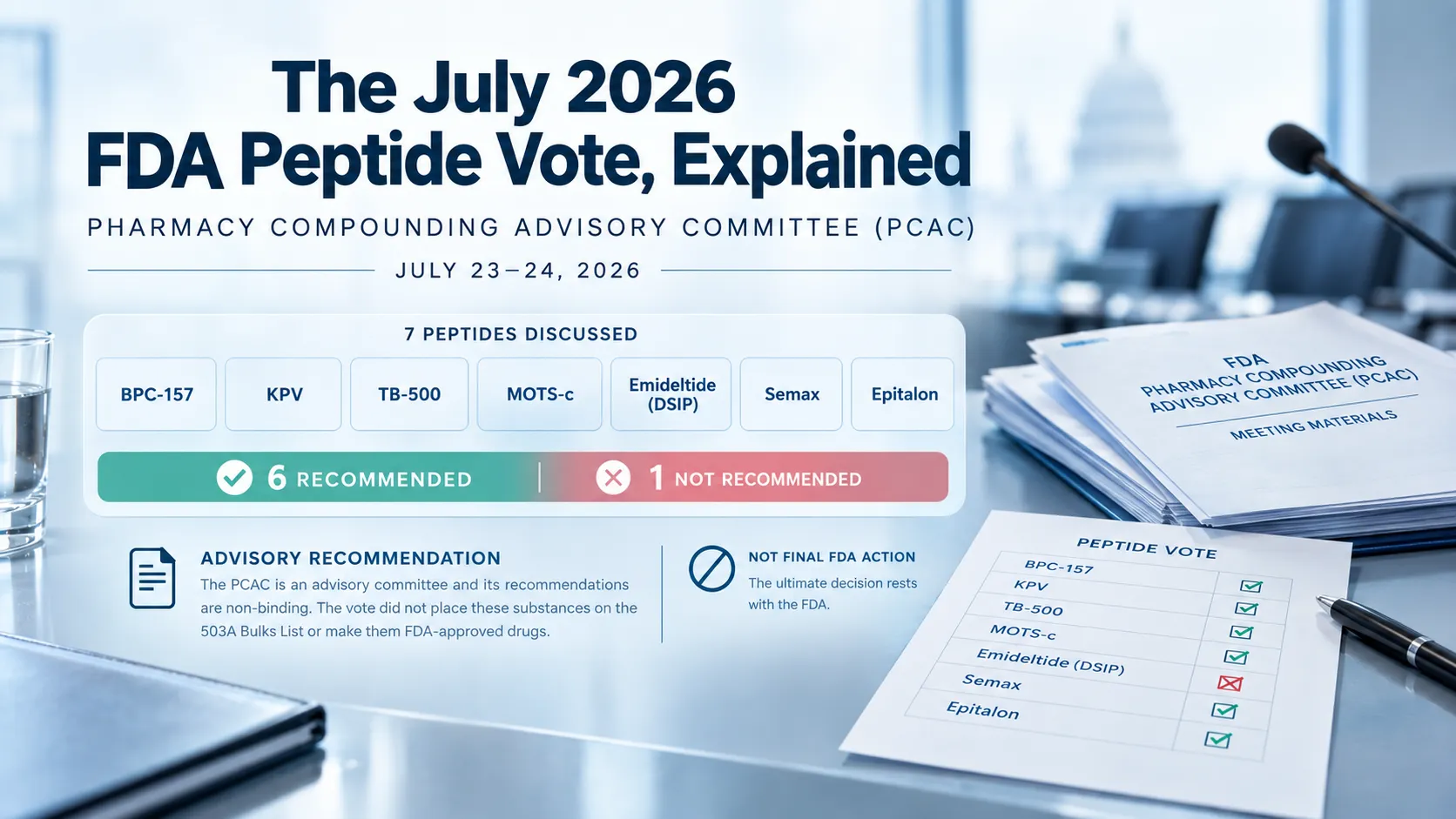
In July 2026, the FDA's advisory committee recommended 6 peptides for the 503A bulk list. None are on it yet. What the vote changed and what it didn't.