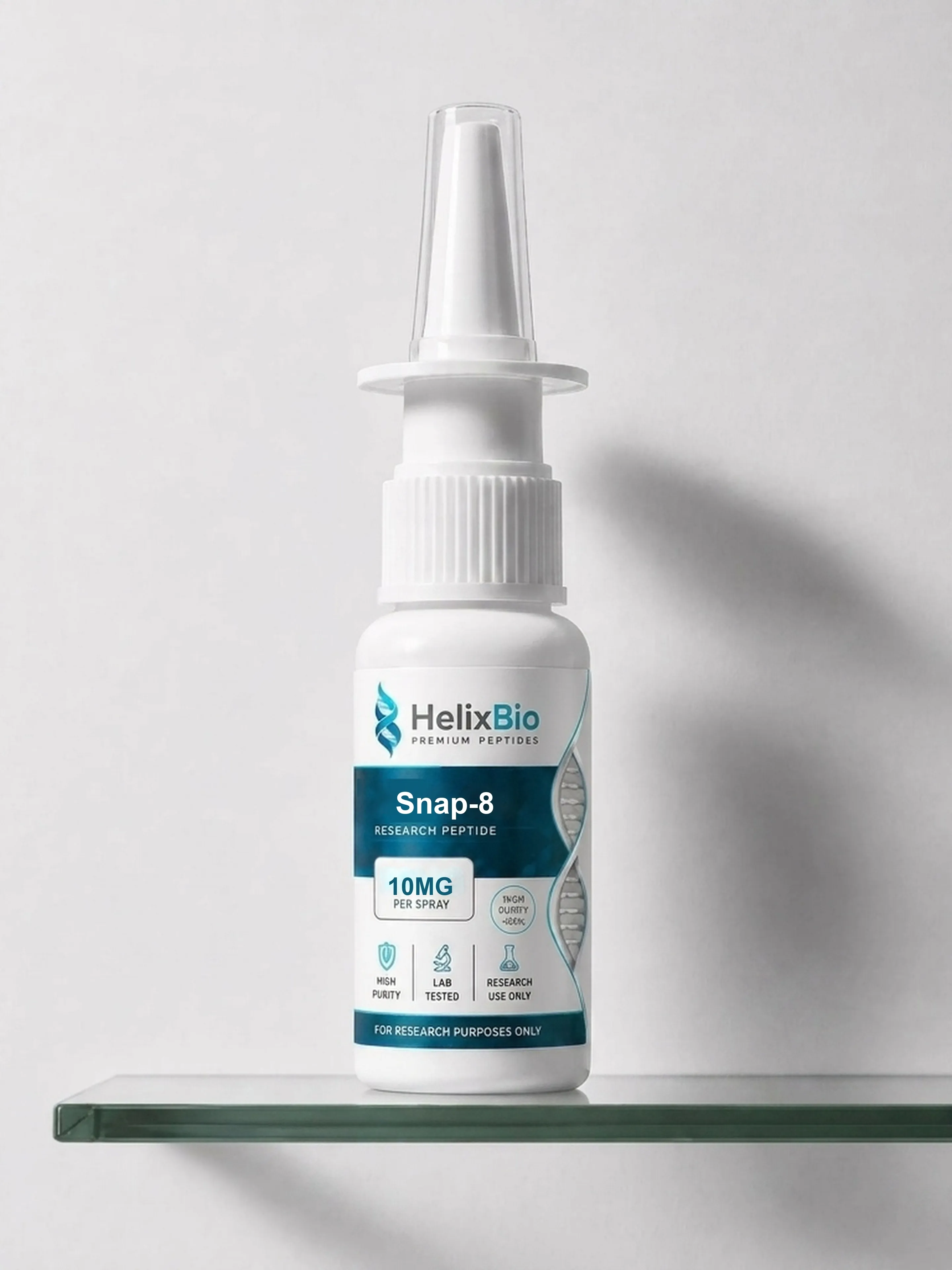
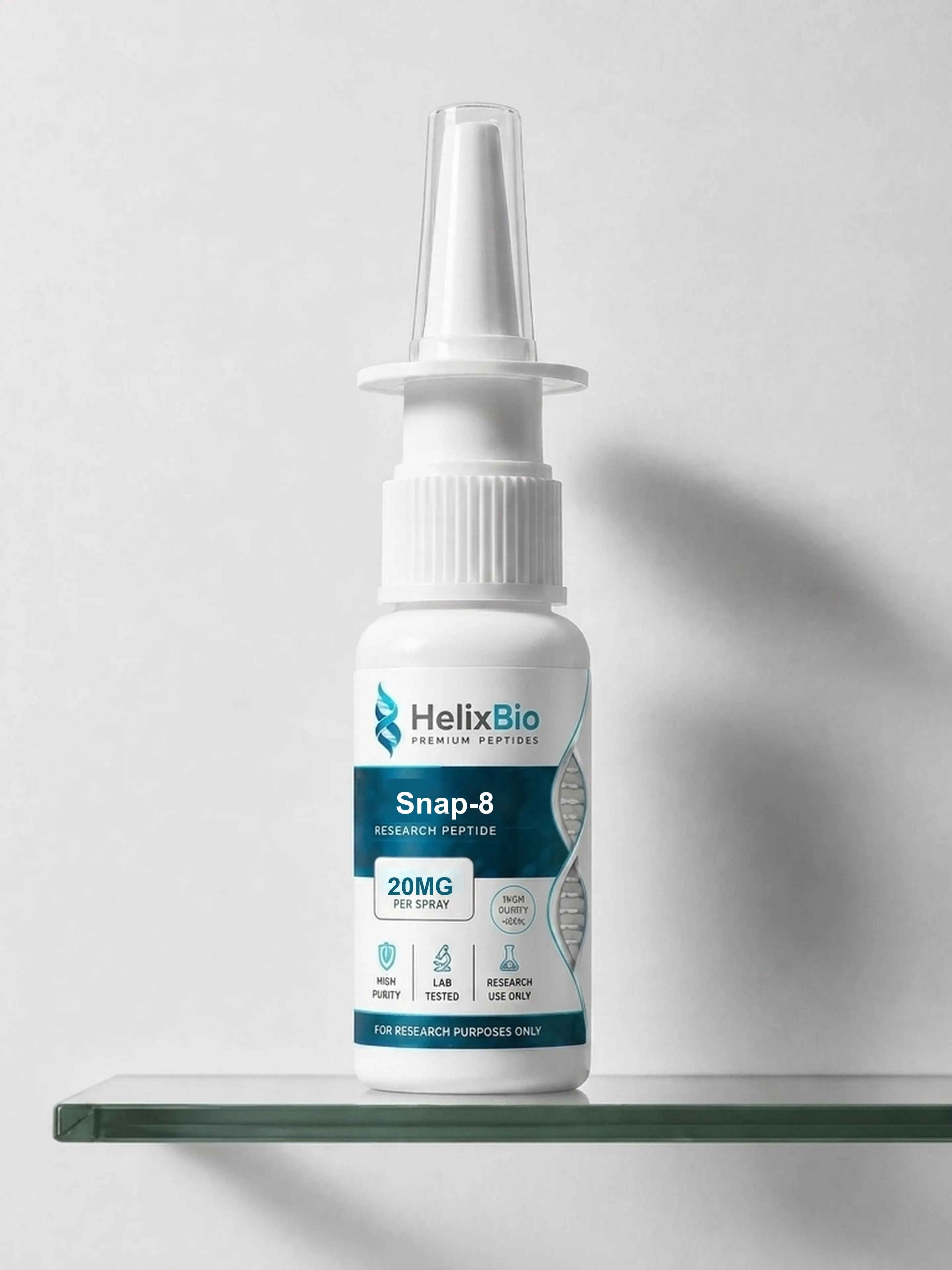
Acetyl Octapeptide-3, known commercially as SNAP-8, is a synthetic eight-residue peptide with the sequence Ac-Glu-Glu-Met-Gln-Arg-Arg-Ala-Asp-NH₂, reproducing residues 12 to 19 of the N-terminal region of the SNAP-25 protein. It has been examined in peptide chemistry, SNARE-complex research, analytical method development and cosmetic formulation science. This Helix Bio material supplies that peptide as a prepared spray-format solution rather than a lyophilised solid. Helix Bio supplies research materials to qualified laboratory and scientific users. SNAP-8 Spray is offered for research use only. It is not intended for human or veterinary consumption, cosmetic application, self-administration, or the diagnosis, treatment, cure or prevention of any disease.
HPLC certified
Independent analysis
Highest standard
Full traceability
SNAP-8 is a trade name associated with Lipotec S.A.U., now part of Lubrizol Life Science, for the peptide whose INCI designation is Acetyl Octapeptide-3. It is an octapeptide — eight amino-acid residues — carrying an acetyl group at the N-terminus and an amide at the C-terminus. Registry identifiers include CAS 868844-74-0 and PubChem CID 76283482, corresponding to the molecular formula C₄₁H₇₀N₁₆O₁₆S and an average molecular weight of approximately 1075.2 g/mol.
The sequence is not arbitrary. It copies a defined stretch of a much larger protein. SNAP-25, catalogued as UniProt P60880, is a 206-residue protein that participates in the SNARE complex, the assembly responsible for docking and fusing vesicles with the presynaptic membrane. SNAP-8 reproduces residues 12 through 19 of that protein's N-terminal region: Glu-Glu-Met-Gln-Arg-Arg-Ala-Asp.
That relationship is the whole reason the peptide exists, and it is also where most descriptions of SNAP-8 go wrong. An eight-residue fragment mimic is not the protein it is patterned on. SNAP-8 has none of SNAP-25's palmitoylation sites, no membrane association, and no C-terminal SNARE motif. It is a short synthetic peptide that happens to match a small window of a much longer sequence.
The proposed mechanism for peptides of this class is competition: a fragment matching the SNAP-25 N-terminus is thought to occupy a position in the ternary SNARE complex, producing an assembly less able to drive calcium-dependent vesicle fusion. That model comes from work published by Blanes-Mira and colleagues in 2002 and from the associated Lipotec patent family. It is worth reading that literature carefully, because the in vitro measurements behind it were made on the six-residue peptide Argireline and on a thirteen-residue peptide, not on the octapeptide. The mechanism is a class hypothesis. The direct experimental support for the octapeptide itself is thinner than most descriptions suggest.
Supplying a peptide as a prepared solution rather than as a lyophilised powder changes what a researcher has to think about, and for this particular sequence the changes are specific rather than generic.
Ac-EEMQRRAD-NH₂ contains a single methionine at position three. Methionine is the most oxidation-susceptible residue in the standard set, and the sulfoxide it forms is sixteen daltons heavier than the parent peptide — a shift a mass spectrometer resolves easily and a well-developed HPLC method usually does too. In a solution held over time, dissolved oxygen, trace metal contamination and light exposure all push that reaction forward. It is the first degradation product a stability-indicating method for this peptide should be designed to detect.
The C-terminal aspartyl residue raises a different and less convenient issue. Aspartyl residues can cyclise to a succinimide intermediate and rearrange to an iso-aspartyl form. The rearranged peptide has the same molecular mass as the original, so mass spectrometry alone will not distinguish them. It appears instead as a chromatographic shoulder or a second peak at the same mass. A purity figure generated by mass confirmation without adequate chromatographic resolution can miss it entirely.
Glutamine at position four adds a slower deamidation pathway with a one-dalton shift.
None of this makes a solution format unsuitable. It makes the analytical question different. For a solid, the relevant questions are purity by area normalisation and identity by mass. For a prepared solution, they extend to concentration on a defined basis, the vehicle, the time and conditions since preparation, and whether the analytical method separates isobaric species. Researchers should take those answers from the documentation supplied with the specific lot, not from published work on a cosmetic trade solution or on a lyophilised preparation.
One further distinction matters for anyone reading across from cosmetic literature. SNAP-8 is normally supplied to formulators as a dilute aqueous trade solution, so a use level quoted as a percentage in that context refers to the percentage of that solution, not of peptide. Concentration figures drawn from cosmetic sources sit on a different basis from a research material's peptide content, and the two should not be compared without converting.
Peer-reviewed work naming Acetyl Octapeptide-3 specifically is dominated by analytical chemistry rather than efficacy studies. A method development paper published in the Journal of Analytical Science and Technology in 2020 established an LC-MS/MS approach for the peptide using multiple reaction monitoring on a triple quadrupole instrument, reporting linearity of r ≥ 0.9971 and a limit of quantification of 0.0125 ng/mL, and applied it to a biodegradable microneedle patch loaded with the peptide. That paper is the clearest published demonstration that the compound can be identified and quantified to a defined standard.
Beyond analytical work, SNAP-8 appears in research contexts including:
The scientific literature concerning peptides of this family is not evidence that SNAP-8 Spray is safe or effective for use in humans. Acetyl Octapeptide-3 is used as a cosmetic ingredient and is not an FDA-approved drug; no approved drug product containing it exists. Efficacy percentages widely quoted for SNAP-8 originate in supplier technical documentation rather than in independent peer-reviewed trials, and no independent human study has established cosmetic efficacy for the peptide. Review work on the closely related Acetyl Hexapeptide-8 concludes that limited stratum corneum permeation remains the central unresolved question for the class.
Peptide names are unreliable. SNAP-8 circulates under at least five designations — Acetyl Octapeptide-3, Acetyl Octapeptide-8, Acetyl Glutamyl Heptapeptide-3, SNAP-9, and assorted misspellings — and public database records for the compound are not fully consistent. PubChem carries two entries under the Acetyl Octapeptide-3 name with different molecular formulas and masses roughly two daltons apart, both citing the same CAS number. Only one of them, CID 76283482 at C₄₁H₇₀N₁₆O₁₆S, corresponds to the formula the published sequence actually produces. A researcher checking a certificate of analysis against a database record can arrive at either number depending on which record they land on.
Helix Bio's catalogue is described as supported by independent HPLC purity testing and mass spectrometry identity confirmation, with batch-specific Certificates of Analysis available. For a prepared solution, both measurements carry conditions worth understanding: mass spectrometry confirms molecular mass, which will not separate an iso-aspartyl rearrangement from the parent peptide, and chromatographic purity depends on whether the method resolves closely eluting related species. The documentation supplied with a specific lot, rather than a general catalogue statement, is what answers those questions.
For SNAP-8 Spray in particular, researchers should establish the peptide concentration and the basis on which it is stated before the material enters a workflow, since a solution product's usable information is concentration rather than mass of solid.
SNAP-8 Spray is intended for qualified users working in legitimate laboratory or scientific research environments, including:
The product is not intended for personal experimentation, self-administration, cosmetic application, human consumption, veterinary use or medical treatment.
| Specification | Details |
|---|---|
| Product Name | SNAP-8 Spray |
| Scientific Name | Acetyl Octapeptide-3 |
| Common Synonyms | SNAP-8, Acetyl Octapeptide-8, Acetyl Glutamyl Heptapeptide-3 |
| Compound Type | Synthetic peptide |
| Peptide Class | Octapeptide |
| Sequence | Ac-Glu-Glu-Met-Gln-Arg-Arg-Ala-Asp-NH₂ |
| Peptide Length | 8 residues |
| Structural Modification | N-terminal acetylation; C-terminal amidation |
| Molecular Formula | C₄₁H₇₀N₁₆O₁₆S |
| Molecular Weight | ≈1075.2 g/mol (average) |
| CAS Number | 868844-74-0 |
| PubChem CID | 76283482 |
| Related Protein Region | SNAP-25 residues 12–19 (UniProt P60880) |
| Research Category | Cosmetic & Skin Research Compounds |
| Product Format | Prepared spray-format solution |
| Concentration | Refer to current product listing and lot documentation |
| Fill Volume | Refer to current product listing |
| Total Peptide Content | Refer to current product listing and lot documentation |
| Vehicle / Formulation | Refer to current product documentation |
| Appearance | Refer to current product documentation |
| Purity | Refer to current lot-specific Certificate of Analysis |
| Identity Testing | Mass spectrometry, where documented |
| Purity Testing | HPLC, where documented |
| Lot / Batch | Refer to applicable Certificate of Analysis |
| Storage | Follow current product-specific documentation |
| Packaging | Refer to current product listing |
| Intended Use | Research and laboratory investigation only |
| Human Use | Not intended for human consumption or application |
| Veterinary Use | Not intended for veterinary use |
| Manufacturer / Supplier | Helix Bio |
| Country of Origin | Refer to current product documentation |
Molecular values above describe the peptide entity. Product-level values including concentration, fill volume, vehicle, purity and storage must be taken from the current listing and the applicable Certificate of Analysis for the lot supplied.
SNAP-8 corresponds to a defined eight-residue window of the SNAP-25 N-terminal region. That gives researchers a synthetic, sequence-defined reagent for work on fragment-protein interaction and on SNARE assembly, distinct from work using the full-length protein. Findings obtained with a fragment describe the fragment; they do not establish the behaviour of SNAP-25 in a cell.
SNAP-8 and the shorter SNAP-25-derived hexapeptide differ by exactly two residues, Ala and Asp, appended C-terminally. That makes the pair a clean system for examining how a short sequence extension alters chromatographic behaviour, solubility, charge distribution and mass. The approximately 186-dalton separation between them is large enough for straightforward analytical discrimination.
A published LC-MS/MS method for Acetyl Octapeptide-3 using multiple reaction monitoring reported a limit of quantification of 0.0125 ng/mL and was applied to a peptide-loaded microneedle patch. The peptide is therefore an established analyte with a documented method available as a starting point for laboratories developing quantification or stability-indicating assays.
The sequence carries three characterised liability sites — a methionine subject to oxidation, an aspartyl residue subject to isomerisation, and a glutamine subject to slow deamidation. In solution these give a defined set of degradation products for stability studies, forced-degradation work and method validation.
Acetyl Octapeptide-3 is used as a cosmetic ingredient, and formulation research examines vehicle composition, stability and delivery for peptides of this class. Results from a cosmetic formulation do not transfer to a different preparation. Vehicle, pH, concentration basis, preservative system and study design all affect what is observed, and none of them is held constant between a cosmetic serum and a research solution.
Analytical documentation matters more for a prepared solution than for a solid, because a solution has already been through a step the researcher did not perform. Concentration, vehicle composition and elapsed time since preparation all sit outside the laboratory's control and all affect what arrives in the vial.
Helix Bio states that its research peptide batches undergo independent HPLC purity testing and mass spectrometry identity confirmation, and that batch-specific Certificates of Analysis are available.
For SNAP-8 Spray, the documentation should be read for:
Two analytical points are specific to this sequence. Mass confirmation near 1075 supports the intended structure, but a methionine sulfoxide impurity sits sixteen daltons above it and an iso-aspartyl rearrangement sits at the same mass as the parent — so mass data alone bounds identity, not purity. Chromatographic separation is what resolves the second case. Where a supplier reports both, the two measurements answer different questions and are stronger read together than either alone.
A general catalogue statement is not a substitute for lot documentation. No certification, regulatory approval or quality claim should be inferred unless it is explicitly documented by the manufacturer or by a relevant regulatory authority.
Storage requirements for SNAP-8 Spray should be taken from the current product documentation and lot-specific instructions for this preparation.
General laboratory considerations:
Storage guidance should not be carried across from a lyophilised SNAP-8 preparation, from a cosmetic trade solution, or from another peptide. A solid and a prepared solution do not share a degradation profile, and the oxidation and isomerisation pathways described above are relevant in solution in a way they are not for a dry material.
Helix Bio's website describes research materials as supplied to laboratories and institutions in the United States, with tracked shipping and cold-chain handling as part of its fulfilment process.
Shipping conditions, packaging specifications, availability and delivery requirements can change. Researchers should review the current Helix Bio shipping information and the product listing before ordering.
On delivery, the package should be inspected and the product name and lot information checked against the accompanying documentation. Packaging should remain appropriately labelled and handled as research material. Researchers are responsible for complying with applicable institutional, federal, state and local requirements governing research materials.
SNAP-8 Spray is supplied by Helix Bio for research and laboratory purposes only. It is not intended for human or veterinary consumption, ingestion, injection, inhalation, nasal or topical application, self-administration, cosmetic use, or the diagnosis, treatment, cure, mitigation or prevention of any disease or medical condition.
The word "Spray" on this page describes the physical presentation of the material. It does not indicate or imply any route of administration or application.
Acetyl Octapeptide-3 is not an FDA-approved drug in the United States, and no approved drug product containing it exists. Its use as a cosmetic ingredient does not constitute FDA approval, and regulatory status should not be inferred from published research, commercial availability or laboratory use.
Scientific literature concerning SNAP-25, the SNARE complex, botulinum neurotoxin, Acetyl Hexapeptide-8 or cosmetic peptide formulations is not evidence about this material. SNAP-8 is not botulinum toxin and is not Botox; those are approximately 150 kDa bacterial protein toxins that enzymatically cleave SNAP-25 near its C-terminus, and they have no molecular, pharmacological or regulatory equivalence to a synthetic eight-residue peptide.
Nothing on this page constitutes medical advice, dosage guidance, application instructions, cosmetic recommendations or a recommendation for personal use. Researchers are responsible for determining whether this material is appropriate for their experimental system and for complying with applicable institutional, safety and regulatory requirements.
Knowledge Base
Knowledge Base
Knowledge Base
Knowledge Base
Knowledge Base
Knowledge Base
Knowledge Base
Knowledge Base
Knowledge Base
Knowledge Base
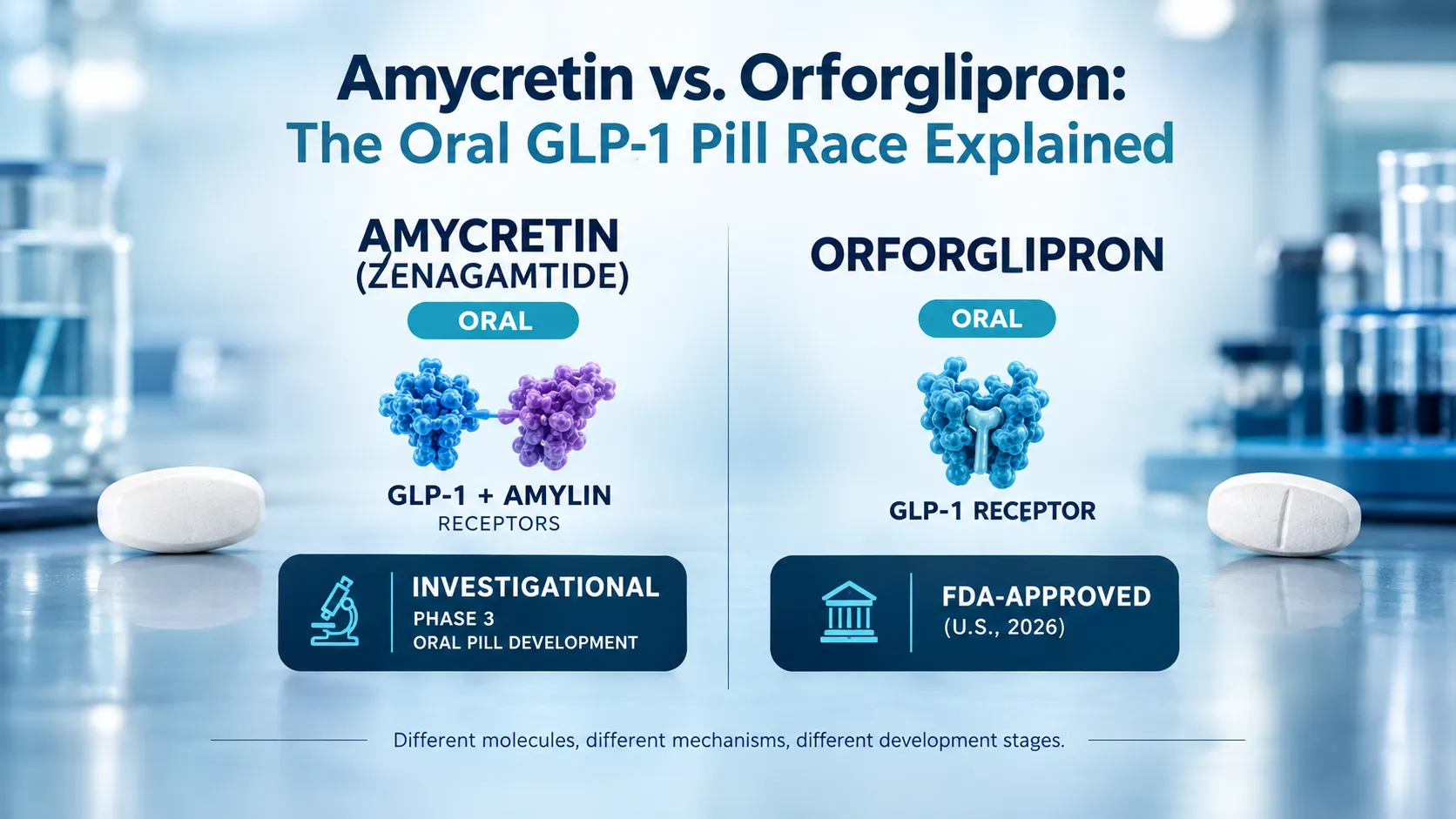
Amycretin is a peptide and orforglipron is not. How that chemistry explains the formulations, trial results, and approval status of both GLP-1 pills.
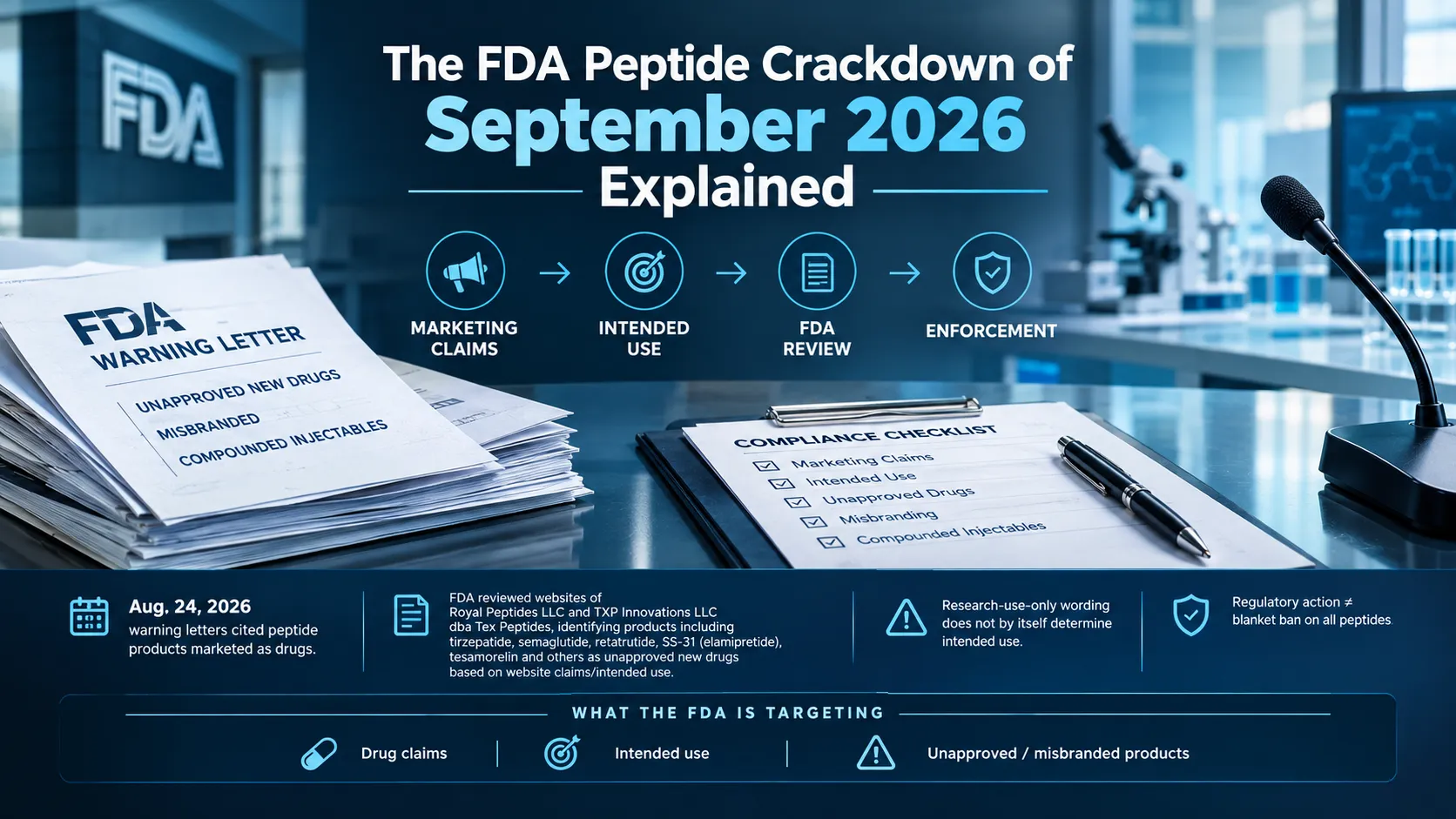
Five peptide sellers got FDA warning letters in September 2026. See who was named, why the research label failed, and the full 2026 enforcement timeline.

In July 2026, the FDA's advisory committee recommended 6 peptides for the 503A bulk list. None are on it yet. What the vote changed and what it didn't.