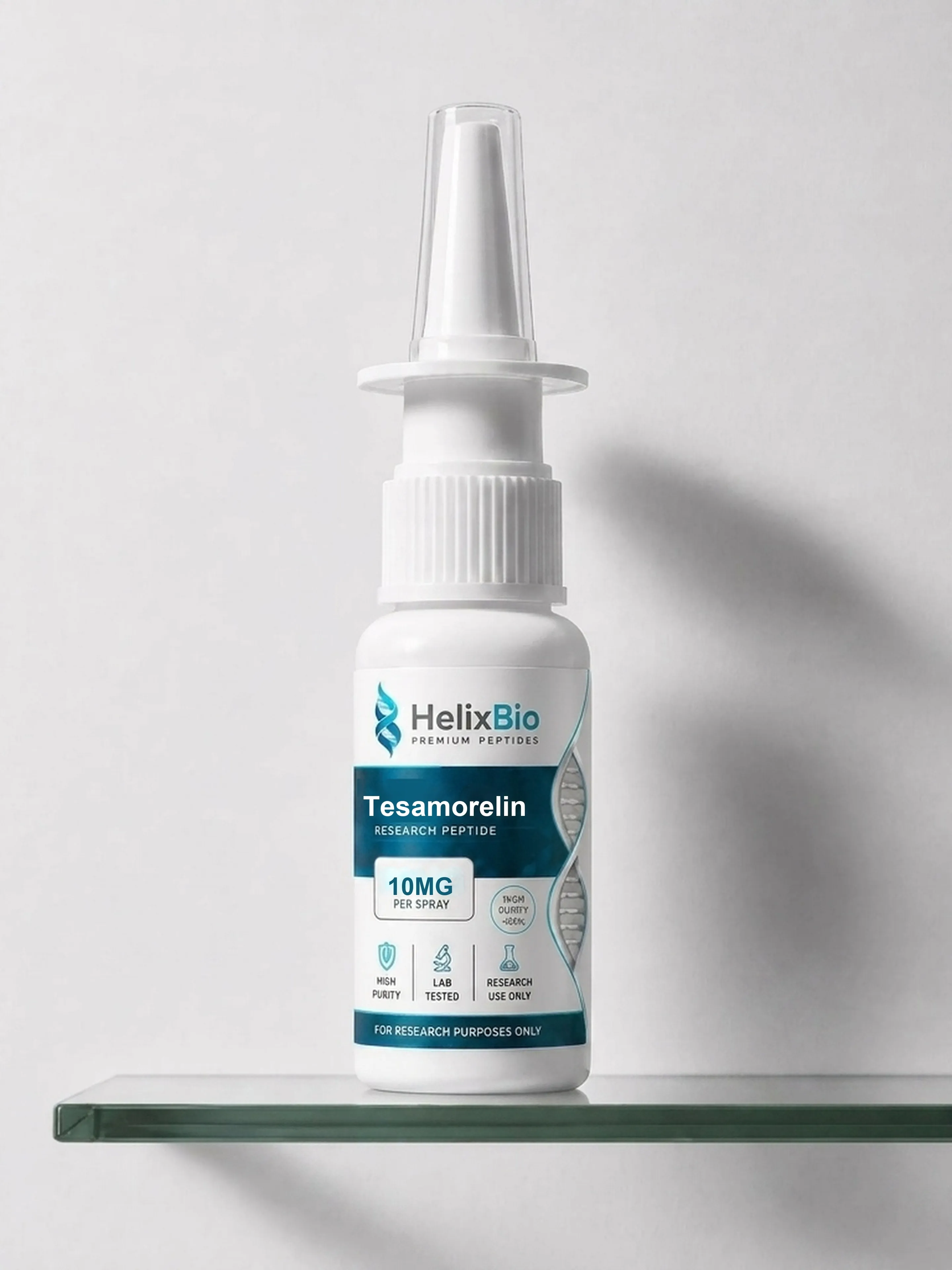
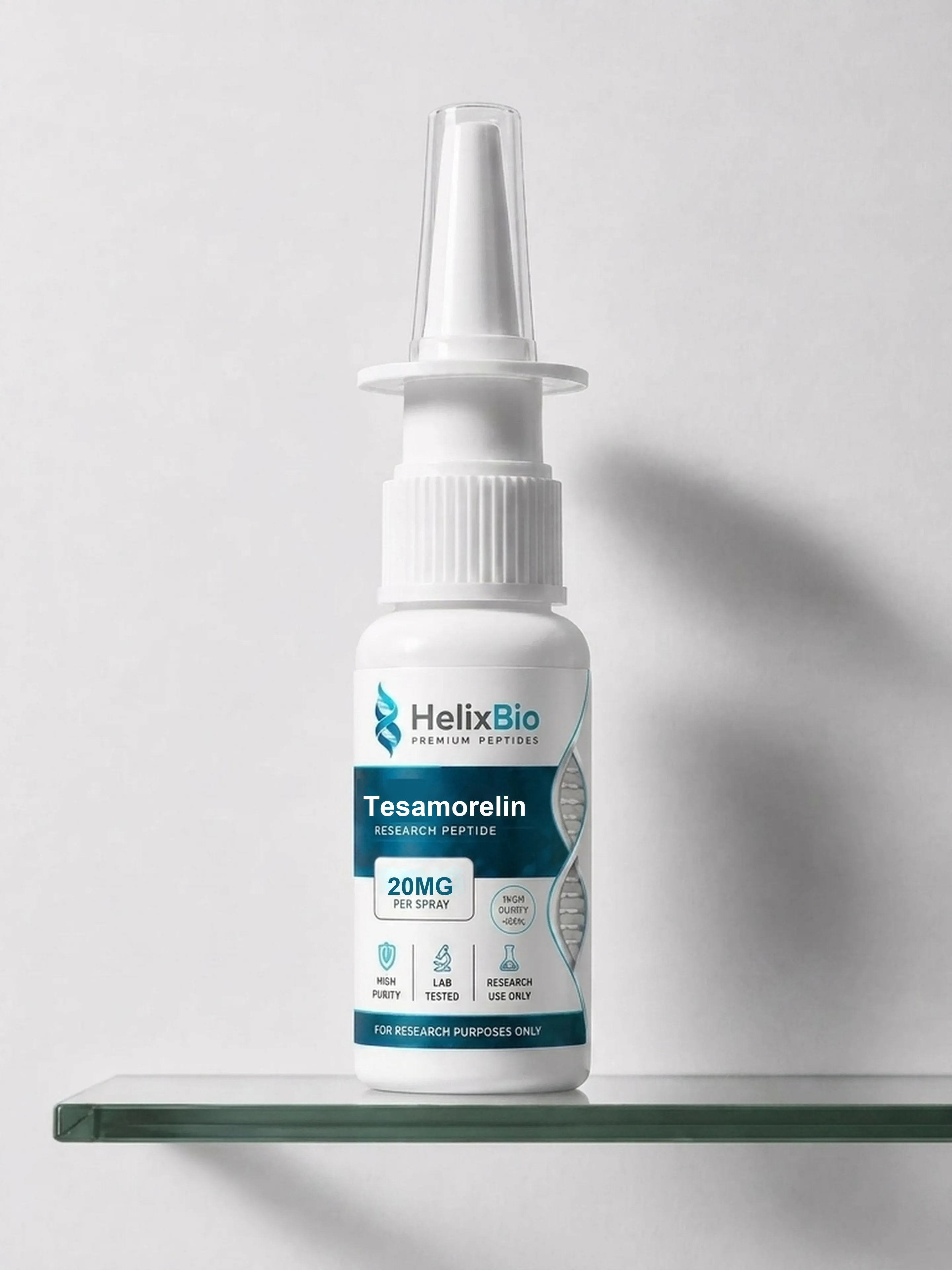
Among the growth hormone-releasing hormone analogues in research circulation, tesamorelin is the one that keeps the whole molecule. Where sermorelin and the CJC-1295 compounds are built on a 29-residue fragment, tesamorelin retains all 44 amino acids of human GHRH and adds a single trans-3-hexenoyl group at the N-terminus — a cap that resists enzymatic cleavage without altering the sequence underneath. Helix Bio supplies Tesamorelin Spray as a research material for qualified laboratory and scientific applications. Tesamorelin is also the active ingredient of a licensed prescription biological product, and that product’s approval carries no implication for this one. This material is offered strictly for research use and is not intended for human or veterinary consumption, diagnosis, treatment, or prevention of disease.
HPLC certified
Independent analysis
Highest standard
Full traceability
Tesamorelin is a 44-residue synthetic peptide corresponding to the complete sequence of human growth hormone-releasing hormone, carrying a trans-3-hexenoyl group acylated onto its N-terminus. Its molecular formula is C₂₂₁H₃₆₆N₇₂O₆₇S and its average molecular weight is 5135.86 g/mol as the free base. It appears in the literature under the development code TH9507.
The modification is worth understanding precisely, because it is frequently described incorrectly. Tesamorelin carries no substituted residues. Native GHRH is cleaved rapidly by dipeptidyl peptidase at the Tyr1-Ala2 bond, and tesamorelin’s answer to that is to cap the N-terminus rather than to swap an amino acid — which is what distinguishes it structurally from the CJC-1295 compounds, whose stability comes from four engineered substitutions on a shorter backbone.
That design produces a clean arithmetic identity check. Native human GHRH(1-44) has an average mass near 5039.73 g/mol. The trans-3-hexenoyl group contributes C₆H₈O, or 96.13 g/mol. The sum is 5135.86 — the published mass of tesamorelin. A spectrum consistent with roughly 5136 rather than roughly 5040 is direct evidence that the acylation is present and intact.
At the receptor, tesamorelin binds the growth hormone-releasing hormone receptor on pituitary somatotrophs, a class B G-protein-coupled receptor, with growth hormone release and hepatic IGF-1 production downstream. Its reported half-life is 26 to 38 minutes. That figure is worth carrying, because half-life values quoted for CJC-1295 with DAC — a molecule engineered for covalent albumin conjugation and multi-day persistence — are sometimes transferred to tesamorelin. They do not apply. A single acyl cap is not albumin binding.
A spray-format material arrives as a prepared solution rather than a dry powder. There is no reconstitution step, the concentration is set by the manufacturer rather than chosen at the bench, and the solvent system, any excipients and the stability profile of a peptide already in solution are properties of that specific preparation rather than of tesamorelin as a compound.
For this molecule there is a documented reason to take that distinction seriously. The licensed pharmaceutical formulations of tesamorelin are supplied as lyophilised material with defined reconstitution schedules — the earlier F4 formulation reconstituted daily, the F8 formulation approved in 2025 requiring weekly reconstitution and less than half the administration volume. Those schedules were set by the manufacturer of a product made under a biologics licence. They say something about how tesamorelin is handled in solution in a pharmaceutical setting, and they are a reasonable prompt for asking a supplier what the equivalent basis is for any prepared-solution research material.
No published study of intranasal or other mucosal tesamorelin administration was identified in preparing this page. Route-comparison literature does exist for smaller peptides in this area — sermorelin and GHRP-6 both have published non-injected human data — but tesamorelin at 5136 g/mol is a substantially larger molecule, and that literature does not extend to it. Researchers should not assume otherwise from the presence of a spray format.
Product documentation and lot-specific analytical information should be reviewed before a material enters an experimental workflow.
Tesamorelin appears in research contexts including:
Published clinical findings concerning tesamorelin were generated with a licensed pharmaceutical product administered subcutaneously in defined patient populations under trial protocols. They do not establish that this research material is safe or effective for any use, and they are not transferable to a different formulation or route.
The useful thing a supplier can offer on a compound like this is a way to check what the material actually is.
Tesamorelin is well separated by mass from everything it is likely to be confused with. At 5135.86 g/mol it sits roughly 1,778 Da above sermorelin, roughly 1,489 Da above CJC-1295 with DAC, and roughly 96 Da above unmodified GHRH(1-44). The last of those is the one that matters most, because it is the smallest gap and the one that confirms the defining modification is present rather than absent. A certificate of analysis reporting a molecular ion consistent with 5136 is doing real identity work; one reporting only a purity percentage is not, since a highly pure sample of the wrong peptide still reports as pure.
Two things to check rather than assume. Tesamorelin has two CAS registry numbers in circulation — 218949-48-5 for the free base and 901758-09-6 for the salt — and vendor listings cite them interchangeably even though they refer to different substances. And research material is normally supplied as the acetate while 5135.86 is the free-base mass, so net peptide content needs its basis stated to be interpretable. For a solution product, concentration carries the same ambiguity.
Helix Bio states that its research peptide catalogue uses independent HPLC testing for purity assessment and mass spectrometry for molecular identity confirmation, and that batch-specific Certificates of Analysis are available. For Tesamorelin Spray specifically, the applicable lot documentation is what establishes the analytical result.
Tesamorelin Spray is intended for qualified users working in legitimate laboratory or scientific research environments, including:
The product is not intended for personal experimentation, self-administration, human consumption, veterinary use, or medical treatment.
| Specification | Details |
|---|---|
| Product Name | Tesamorelin Spray |
| Research Category | Growth Hormone Secretagogue / Research Peptide |
| Compound | Tesamorelin |
| Scientific Name | Growth hormone-releasing hormone (1-44), N-terminal trans-3-hexenoyl |
| Synonyms | TH9507 |
| Chemical Class | Synthetic peptide, 44 residues |
| Compound Class | Growth hormone-releasing hormone analogue |
| Backbone | Complete human GHRH(1-44) sequence |
| Modification | trans-3-hexenoyl group at N-terminus |
| Amino Acid Count | 44 |
| Molecular Formula | C₂₂₁H₃₆₆N₇₂O₆₇S (free base) |
| Molecular Weight | 5135.86 g/mol (free base) |
| CAS Number (free base) | 218949-48-5 |
| CAS Number (salt) | 901758-09-6 |
| PubChem CID | 16137828 |
| ChEBI | CHEBI:63626 |
| Receptor / Target | Growth hormone-releasing hormone receptor (GHRHR) |
| Format | Spray solution |
| Salt Form | Refer to current lot-specific product documentation |
| Concentration | Refer to current product listing |
| Fill Volume | Refer to current product listing |
| Intended Use | Research and laboratory investigation only |
| Human Use | Not intended for human consumption |
| Veterinary Use | Not intended for veterinary use |
| Purity | Refer to current lot-specific product documentation |
| Identity Testing | Refer to applicable Certificate of Analysis |
| Packaging | Refer to current product listing |
| Storage | Follow current product-specific documentation |
| Manufacturer | Helix Bio |
| Country of Origin | Not specified; verify current product documentation |
GHRH Receptor Research. Tesamorelin is a full-length GHRH analogue, which makes it useful in receptor work where the complete native sequence is wanted rather than a truncated one. GHRHR is a class B G-protein-coupled receptor, and questions about how backbone length affects receptor engagement are answerable by comparing full-length and fragment-based analogues directly.
Tesamorelin Compared With Sermorelin. Both act at GHRHR and both derive from human GHRH, and there the similarity ends. Sermorelin is the unmodified 29-residue N-terminal fragment with a C-terminal amide, at 3357.93 g/mol. Tesamorelin is the complete 44-residue hormone with an N-terminal acyl cap, at 5135.86. Roughly 1,778 Da separates them. Neither is established as superior; they are different molecules with different evidence bases and, as set out in the compliance section, materially different regulatory positions.
Tesamorelin Compared With the CJC-1295 Compounds. Both are described as GHRH analogues and both are built on different principles. The CJC-1295 compounds use the 29-residue fragment with four engineered amino acid substitutions; the DAC form adds a linker for covalent albumin conjugation. Tesamorelin substitutes nothing and conjugates to nothing — its entire modification is one acyl group on an otherwise native sequence. The pharmacokinetic consequence is the point worth carrying: tesamorelin’s 26 to 38 minute half-life belongs to a short-acting molecule, and persistence figures reported for albumin-conjugated compounds are properties of that conjugation rather than of GHRH analogues generally.
Receptor-Class Separation. Ipamorelin, GHRP-2 and GHRP-6 act at the growth hormone secretagogue receptor, the ghrelin receptor, not at GHRHR. Convergence on a shared endpoint is not shared mechanism, and the two classes are not experimental substitutes for one another.
Analytical and Formulation Research. At 5136 g/mol tesamorelin sits well above the size range where most research peptides fall, which makes it relevant to method development for identity confirmation, purity determination and stability assessment of larger synthetic peptides. The sequence contains residues with recognised chemical liabilities in peptide chemistry generally, including methionine and asparagine, which is one reason formulation and analytical characterisation are treated seriously for this molecule.
Clinical Research — and its boundary. Tesamorelin has an unusually substantial clinical literature for a compound sold as a research material: randomised trials reported in the New England Journal of Medicine (2007), the Journal of Clinical Endocrinology & Metabolism (2010), JAMA (2014) and The Lancet HIV (2019), plus a study of cognition in older adults published in Archives of Neurology (2012).
Every one of those studies used a licensed pharmaceutical product, administered subcutaneously, in a defined patient population, under a trial protocol. They establish what that product did under those conditions. They establish nothing about a research-grade material, a different formulation, a different route of administration, or any use outside the studied populations, and they should not be cited as though they did.
For a 44-residue peptide the analytical questions differ from those for a short one. Longer sequences give synthesis more opportunities to go wrong, and the characteristic impurities — deletion sequences missing one residue, truncated chains, incompletely deprotected material — sit closer in mass to the target than the impurities of a hexapeptide do. Chromatographic purity and mass confirmation answer different questions here, and both are needed.
The identity check that carries most information is the acyl cap. Unmodified GHRH(1-44) sits near 5039.73 g/mol and tesamorelin near 5135.86 — a 96.13 Da separation. A mass consistent with the lower figure would indicate material lacking the modification that defines the compound.
Helix Bio states that its peptide materials are subjected to independent HPLC testing for purity and mass spectrometry for molecular identity, and that batch-specific Certificates of Analysis are available. For a specific Tesamorelin Spray lot, the applicable COA and product documentation carry the actual analytical results.
Researchers should assess, where applicable:
No certification, regulatory approval, or quality claim should be inferred unless explicitly documented by the manufacturer or the relevant regulatory authority.
Storage and handling requirements should be determined from the current Tesamorelin Spray product documentation and lot-specific instructions.
General laboratory considerations include:
Two transfers to avoid. Storage conditions published for lyophilised tesamorelin do not apply to a prepared solution — a peptide already in solution has a different stability profile, and container, closure and solvent all contribute. And handling conditions for the licensed pharmaceutical product do not apply either; that product is manufactured, formulated and labelled under a biologics licence, and its conditions describe it rather than this material.
Helix Bio’s website describes research materials as being supplied to laboratories and institutions in the United States and describes tracked shipping and cold-chain handling within its fulfilment process.
Because shipping conditions, packaging specifications, availability and delivery requirements may change, researchers should review the current Helix Bio shipping information and product listing before ordering.
Product packaging should remain appropriately labelled and handled as research material after delivery. Researchers are responsible for following applicable institutional, federal, state and local requirements governing research materials.
Tesamorelin Spray is sold by Helix Bio for research and laboratory purposes only. It is not intended for human or veterinary consumption, self-administration, diagnosis, treatment, cure, mitigation, or prevention of any disease or medical condition.
Tesamorelin’s regulatory position requires a precise statement rather than a simple one, because both a flat “approved” and a flat “not approved” would mislead.
Tesamorelin is the active ingredient of a licensed prescription biological product in the United States, approved in 2010 and supplied for subcutaneous injection. On 23 March 2020, under the transition provision of the Biologics Price Competition and Innovation Act, approved applications for biological products were deemed to be licences under section 351 of the Public Health Service Act, and tesamorelin’s application transitioned accordingly.
That licence attaches to a specific product, manufactured under a biologics licence to defined standards, in a defined formulation, for a defined route and population. It attaches to nothing else. A research-grade material sharing the same active ingredient is not covered by it, has not been evaluated by FDA, and carries no approval of any kind.
One consequence follows directly and is worth stating because it distinguishes tesamorelin from every neighbouring compound. FDA’s guidance to compounders states that biological products transitioning under that provision are not eligible for the compounding exemptions in sections 503A and 503B of the FD&C Act. Tesamorelin therefore falls outside the bulk drug substances framework entirely, rather than occupying a category within it. This reflects its regulatory classification, not a safety determination.
This product is not a dietary supplement, consumer wellness product, or medical treatment. Researchers are responsible for determining whether a material is appropriate for their intended experimental application and for complying with applicable institutional and regulatory requirements.
Knowledge Base
Knowledge Base
Knowledge Base
Knowledge Base
Knowledge Base
Knowledge Base
Knowledge Base
Knowledge Base
Knowledge Base
Knowledge Base
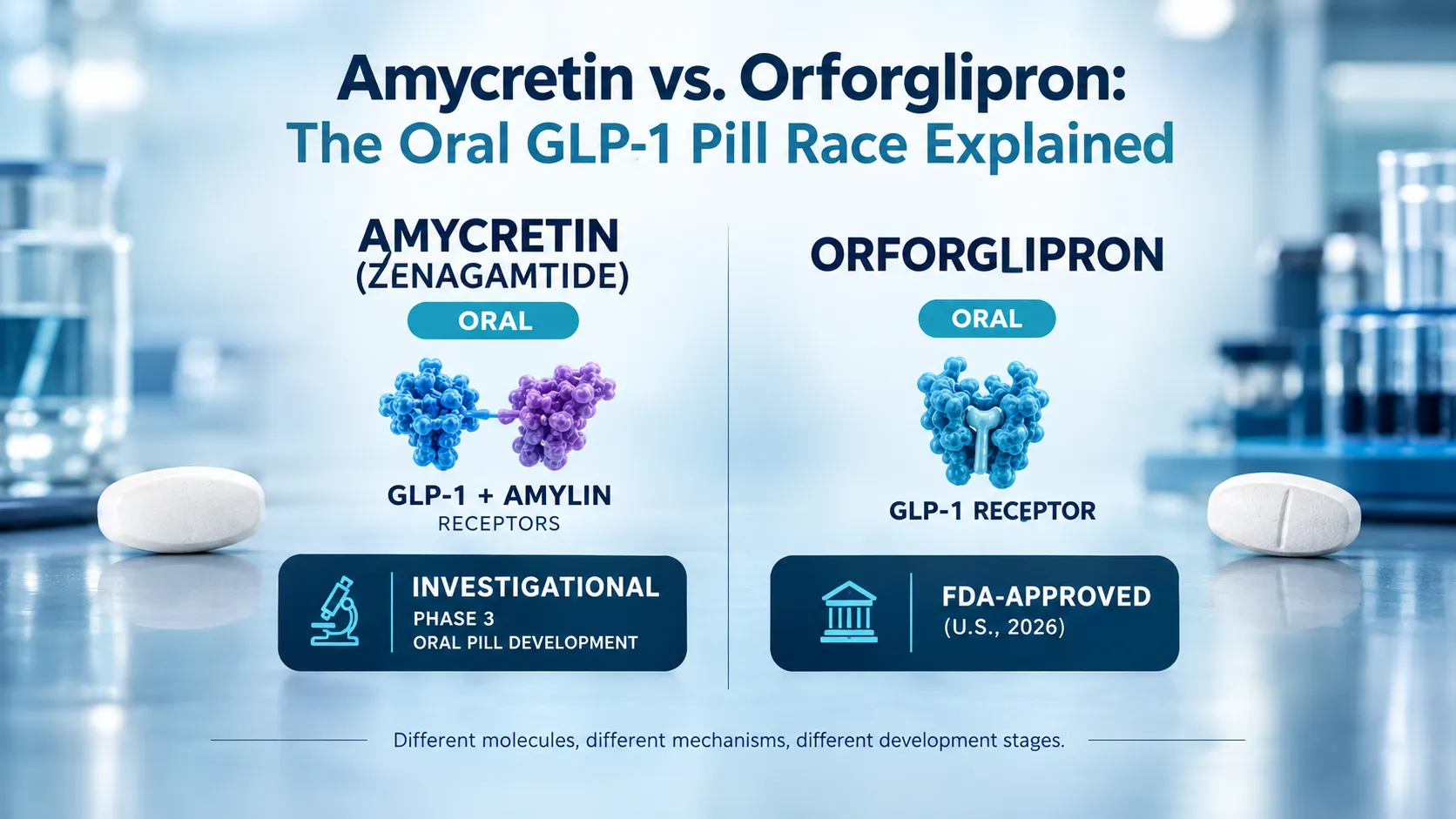
Amycretin is a peptide and orforglipron is not. How that chemistry explains the formulations, trial results, and approval status of both GLP-1 pills.
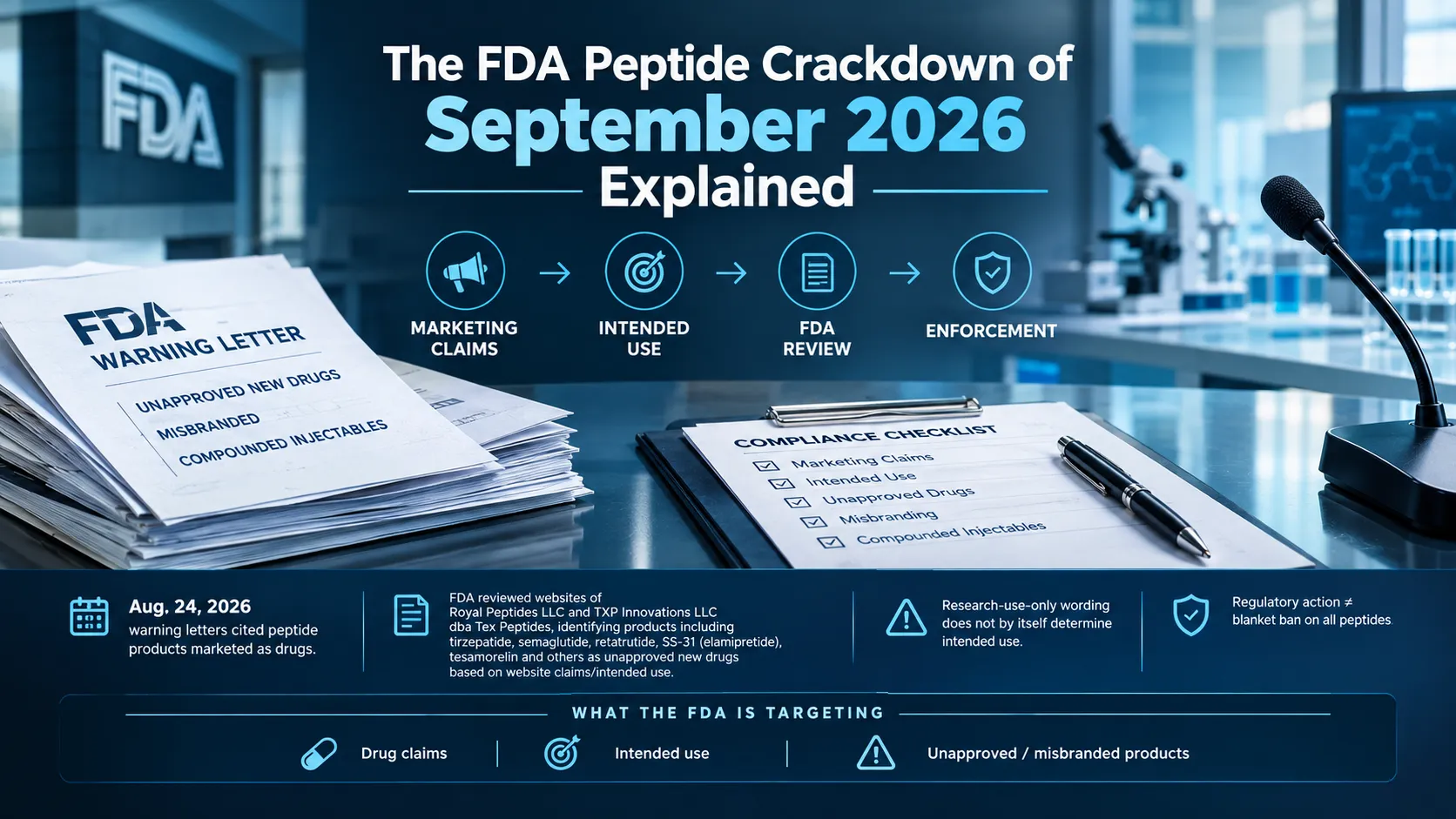
Five peptide sellers got FDA warning letters in September 2026. See who was named, why the research label failed, and the full 2026 enforcement timeline.
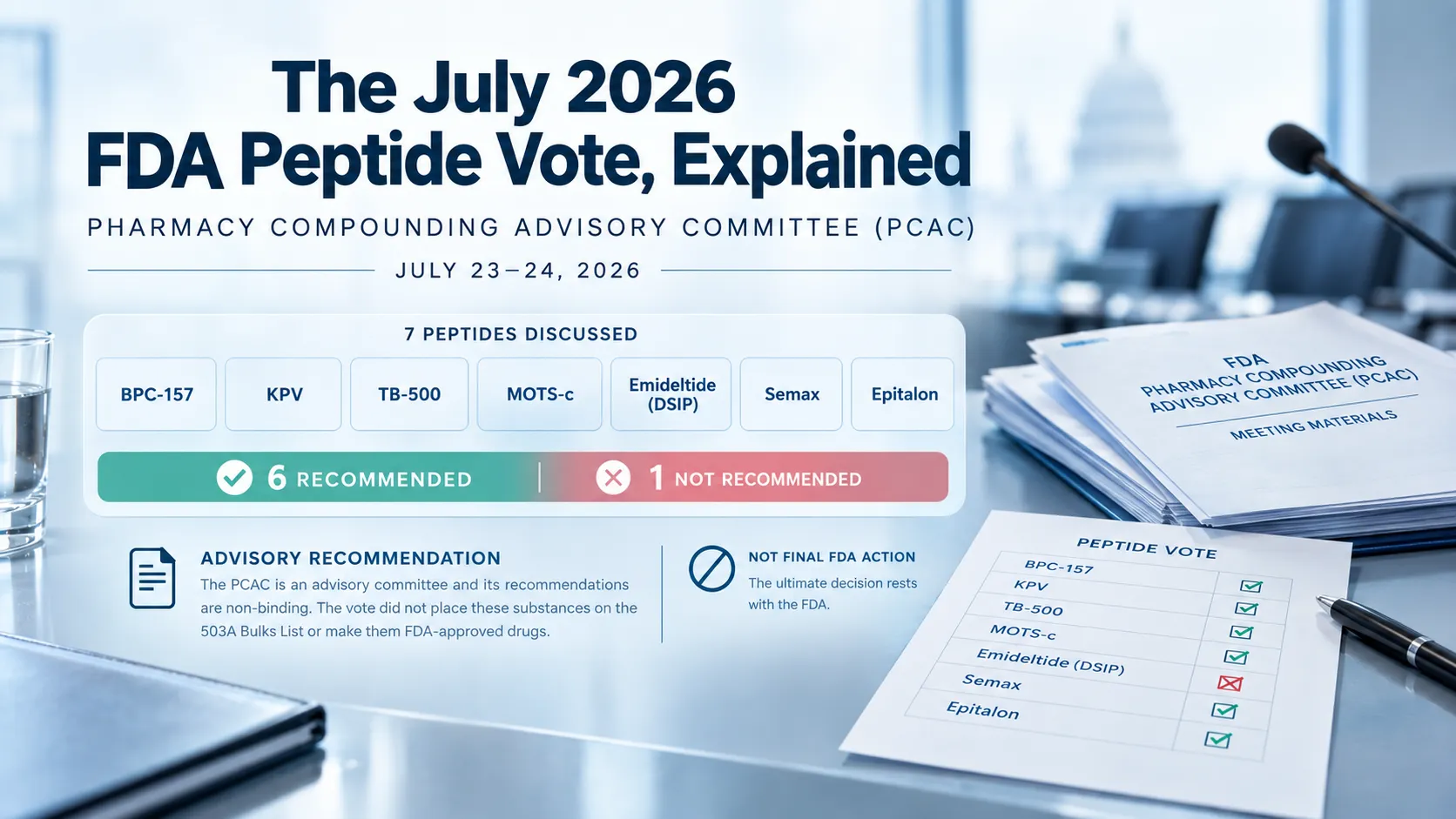
In July 2026, the FDA's advisory committee recommended 6 peptides for the 503A bulk list. None are on it yet. What the vote changed and what it didn't.