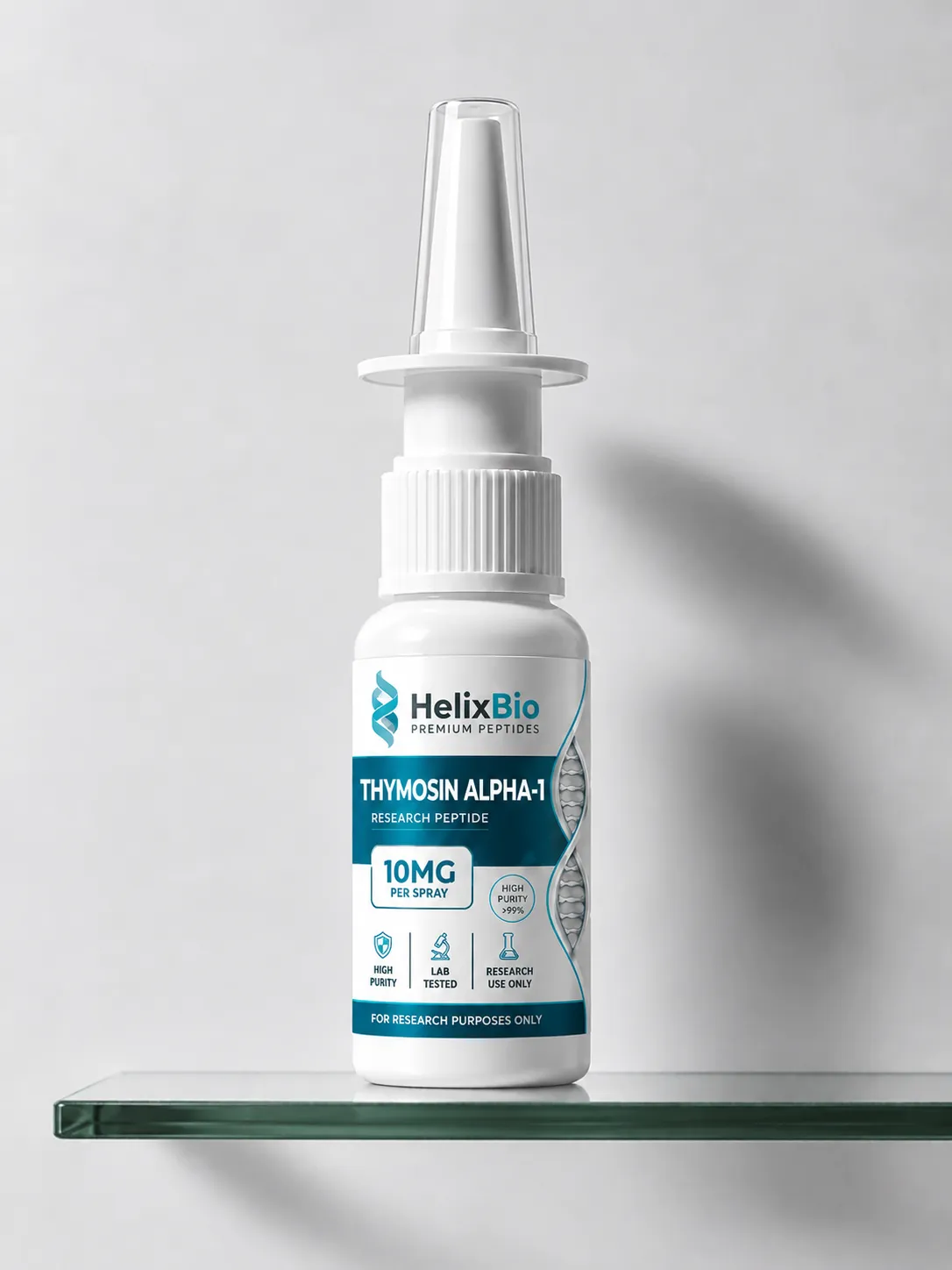
Thymosin alpha-1 begins life as the first twenty-eight residues of a much larger nuclear protein. Prothymosin alpha is cleaved by the enzyme legumain, and the fragment released — acetylated at its N-terminal serine, strongly acidic, 3108.32 g/mol — is the peptide that carries the name. It was the first peptide isolated from thymic tissue, and its synthetic form is known internationally by the name thymalfasin. Helix Bio supplies Thymosin Alpha-1 Spray as a prepared-solution research material for qualified laboratory and scientific applications. It is offered strictly for research use and is not intended for human or veterinary consumption, diagnosis, treatment, or prevention of disease.
HPLC certified
Independent analysis
Highest standard
Full traceability
Thymosin alpha-1 is a 28-residue peptide with the sequence Ac-SDAAVDTSSEITTKDLKEKKEVVEEAEN, molecular formula C₁₂₉H₂₁₅N₃₃O₅₅ and an average molecular weight of 3108.32 g/mol. Mass spectrometry typically reports it near 3107.4. Its CAS registry number is 62304-98-7.
The N-terminal serine is acetylated, and that acetylation is not incidental. It is part of what defines the mature peptide, and it is analytically consequential: recombinant expression in E. coli does not acetylate the peptide natively, and producing the Nα-acetylated form recombinantly has required purpose-built intein-fusion strategies. A non-acetylated 28-mer of the same sequence would be roughly 42 daltons lighter — a difference straightforward by mass spectrometry and invisible to a purity percentage.
The peptide is the N-terminal segment of prothymosin alpha, a chromatin-associated nuclear protein, released by the lysosomal asparaginyl endopeptidase legumain. Sources report the precursor’s length variously as 107, 109, 111 or 113 residues depending on species and on whether the initiator methionine is counted; what is consistent is that thymosin alpha-1 corresponds to its first twenty-eight residues. The precursor is a separate entity with its own biology and is roughly four times the length, so its properties should not be described as though they belonged to the mature peptide.
Thymalfasin is the international non-proprietary name for the synthetic peptide. That relationship is a naming one, and what follows from it about regulatory status is set out in the compliance section below rather than assumed here.
A spray-format material arrives as a prepared solution rather than a dry powder, with the concentration set by the manufacturer rather than chosen at the bench.
For this peptide, one property makes that concentration harder to verify than usual. The sequence contains no tryptophan, no tyrosine and no phenylalanine — no aromatic residues at all. Absorbance at 280 nm, the default method for peptide and protein quantitation, is therefore essentially blind to it. Concentration has to be established by peptide-bond absorbance in the far ultraviolet, by amino acid analysis, or by another quantitative method. For a lyophilised vial sold by mass this matters less. For a solution sold at a stated concentration, it determines how that figure can be checked at all, and it is a reasonable thing to ask a supplier which method produced it.
The composition raises a second question specific to solution formats. The peptide terminates in asparagine and contains several aspartate residues, and asparagine deamidation is a well-recognised solution-phase liability for peptides generally, producing a mass shift near one dalton that is not trivial to resolve. Whether and how quickly it occurs in any particular preparation depends on that preparation’s pH, buffer and storage conditions — which makes it a question for the manufacturer’s stability data rather than something inferable from the sequence.
No published study of intranasal, mucosal or other non-injected thymosin alpha-1 administration was identified in preparing this page. Product documentation and lot-specific analytical information should be reviewed before a material enters an experimental workflow.
Thymosin alpha-1 has been investigated across immunological research contexts including:
The level of evidence varies considerably across these areas, and the human clinical record concerns a pharmaceutical preparation rather than a research material. That distinction is set out in the research section below and is not a formality.
Two things are worth a supplier saying about this compound, and neither is about purity in the usual sense.
The first is that identity here has two components. Mass spectrometry consistent with roughly 3107 to 3108 confirms the 28-residue peptide; a result roughly 42 daltons lighter would indicate material lacking the N-terminal acetylation that defines the mature form. Both are easy measurements. Neither is implied by a purity percentage, and a highly pure non-acetylated peptide reports as highly pure.
The second is the quantitation problem. With no tryptophan, tyrosine or phenylalanine in the sequence, this peptide is effectively invisible to 280 nm absorbance. Any stated concentration for a solution product therefore rests on a method other than the default one, and knowing which method was used is more informative than the number alone.
Helix Bio states that its research peptide catalogue uses independent HPLC testing for purity assessment and mass spectrometry for molecular identity confirmation, and that batch-specific Certificates of Analysis are available. For Thymosin Alpha-1 Spray specifically, the applicable lot documentation is what establishes the analytical result — and for this peptide, which detection wavelength and which quantitation method were used are part of what that documentation should convey.
Thymosin Alpha-1 Spray is intended for qualified users working in legitimate laboratory or scientific research environments, including:
The product is not intended for personal experimentation, self-administration, human consumption, veterinary use, or medical treatment.
| Specification | Details |
|---|---|
| Product Name | Thymosin Alpha-1 Spray |
| Compound | Thymosin alpha-1 |
| Scientific Name | Thymosin alpha-1 |
| Synonyms | Tα1; TA1; thymalfasin (INN of the synthetic peptide) |
| Sequence (one letter) | Ac-SDAAVDTSSEITTKDLKEKKEVVEEAEN |
| Amino Acid Count | 28 |
| Modification | Nα-acetylation at the N-terminal serine |
| Compound Type | Acetylated acidic peptide |
| Molecular Formula | C₁₂₉H₂₁₅N₃₃O₅₅ |
| Molecular Weight | 3108.32 g/mol |
| CAS Number | 62304-98-7 |
| Precursor | Prothymosin alpha, residues 1–28 |
| Precursor Processing | Cleavage by legumain (asparaginyl endopeptidase) |
| Aromatic Residues | None present |
| Format | Spray solution |
| Acetylation Confirmation | Refer to applicable Certificate of Analysis |
| Salt Form | Refer to current lot-specific product documentation |
| Concentration | Refer to current product listing |
| Quantitation Method | Refer to current lot-specific product documentation |
| Fill Volume | Refer to current product listing |
| Intended Use | Research and laboratory investigation only |
| Human Use | Not intended for human consumption |
| Veterinary Use | Not intended for veterinary use |
| Purity | Refer to current lot-specific product documentation |
| Identity Testing | Refer to applicable Certificate of Analysis |
| Packaging | Refer to current product listing |
| Storage | Follow current product-specific documentation |
| Manufacturer | Helix Bio |
| Country of Origin | Not specified; verify current product documentation |
Immune-Cell Research. Thymosin alpha-1 has been examined in relation to T-cell differentiation from precursors and immature thymocytes, interleukin-2 production and high-affinity IL-2 receptor expression, interferon-gamma production by peripheral blood mononuclear cells, and MHC class I upregulation. Toll-like receptor engagement on dendritic cells, particularly TLR2 and TLR9, is the mechanism most frequently described in the modern literature. These are described activities drawn from cell and animal systems, and the strength of support varies between them.
Peptide Processing Research. The precursor relationship is itself a research subject. Prothymosin alpha is a nuclear, chromatin-associated protein, and the release of its N-terminal 28 residues by legumain is a defined proteolytic event. That makes thymosin alpha-1 relevant to work on precursor processing and on how a nuclear protein yields a circulating peptide with a different functional profile.
Analytical Characterisation. The absence of aromatic residues, the Nα-acetylation, and the strongly acidic random-coil character make this peptide a legitimate subject for method development — quantitation without 280 nm absorbance, confirming acetylation by a 42 dalton mass difference, and chromatography of highly acidic sequences all present specific challenges.
Thymosin Alpha-1 Compared With Thymosin Beta-4. The shared name is historical rather than structural. Both were isolated from the same preparation — thymosin fraction 5 of calf thymus — in the 1970s, and the naming reflects that common source. They belong to different protein families. Thymosin alpha-1 is a 28-residue acetylated acidic peptide derived from prothymosin alpha, described in immune-cell contexts. Thymosin beta-4 is a 43-residue peptide of roughly 4963 g/mol whose principal described activity is G-actin sequestration. Roughly 1855 daltons separate them, and evidence does not transfer between them in either direction. TB-500, a seven-residue fragment of thymosin beta-4, is a third entity again and unrelated to this one.
The Clinical Evidence Boundary. Thymosin alpha-1 has an unusually large human clinical literature for a compound sold as a research material, spanning decades of randomised trials in hepatitis, sepsis, oncology adjunct and vaccine-response settings.
Every part of it concerns a pharmaceutical preparation — synthetic thymalfasin, manufactured to defined standards, supplied as a sterile lyophilised powder for reconstitution and subcutaneous administration, studied in defined patient populations under trial protocols. It establishes what that product did under those conditions. It establishes nothing about a research-grade material, a different formulation, a different route, or any use outside the studied populations, and it should not be cited as though it did.
Two features of this peptide make its documentation worth reading more carefully than most.
The first is acetylation. Mass spectrometry consistent with roughly 3107 to 3108 confirms the acetylated 28-residue peptide. A result approximately 42 daltons lighter would indicate the non-acetylated sequence — a different entity from the mature peptide, and one that a purity figure would not distinguish.
The second is detection. With no tryptophan, tyrosine or phenylalanine in the sequence, absorbance at 280 nm does not usefully detect this peptide. Chromatographic purity assessment must rely on far-UV peptide-bond absorbance, and quantitation must come from amino acid analysis or an equivalent method. A purity percentage is only interpretable alongside the wavelength and method that produced it, which is true generally and unusually consequential here.
Helix Bio states that its peptide materials are subjected to independent HPLC testing for purity and mass spectrometry for molecular identity, and that batch-specific Certificates of Analysis are available. For a specific Thymosin Alpha-1 Spray lot, the applicable COA carries the actual results.
Researchers should assess, where applicable:
No certification, regulatory approval, or quality claim should be inferred unless explicitly documented by the manufacturer or the relevant regulatory authority.
Storage and handling requirements should be determined from the current Thymosin Alpha-1 Spray product documentation and lot-specific instructions.
General laboratory considerations include:
Three transfers to avoid. Storage conditions published for lyophilised thymosin alpha-1 do not apply to a prepared solution — a peptide already in solution has a different stability profile, and pH, buffer, container and closure all contribute. Conditions specified for the approved pharmaceutical preparation describe that product, which is manufactured, formulated and labelled under a marketing authorisation in the territories where it holds one. And conditions for thymosin beta-4 or any other thymosin describe a different molecule. Guidance for this material should come from this material’s documentation.
Helix Bio’s website describes research materials as being supplied to laboratories and institutions in the United States and describes tracked shipping and cold-chain handling within its fulfilment process.
Because shipping conditions, packaging specifications, availability and delivery requirements may change, researchers should review the current Helix Bio shipping information and product listing before ordering.
Product packaging should remain appropriately labelled and handled as research material after delivery. Researchers are responsible for following applicable institutional, federal, state and local requirements governing research materials.
Thymosin Alpha-1 Spray is sold by Helix Bio for research and laboratory purposes only. It is not intended for human or veterinary consumption, self-administration, diagnosis, treatment, cure, mitigation, or prevention of any disease or medical condition.
Thymosin alpha-1’s regulatory position needs three separate statements, because merging them produces a misleading picture in either direction.
Internationally, the synthetic peptide thymalfasin is marketed as an approved pharmaceutical in more than 35 countries, principally for chronic hepatitis B and in some territories for chronic hepatitis C or as an adjunct in cancer care. Those approvals attach to a specific product, manufactured under a marketing authorisation, in those jurisdictions.
In the United States, thymosin alpha-1 has never been FDA-approved for any indication. Development advanced through phase 3 hepatitis trials without securing approval. FDA has granted orphan drug designations covering malignant melanoma, chronic active hepatitis B, DiGeorge anomaly and hepatocellular carcinoma; an orphan designation is a development incentive and is not an approval.
On the compounding framework, FDA’s list of bulk drug substances nominated for use in compounding under section 503A, updated 14 May 2026, does not list thymosin alpha-1 in Category 1, Category 2 or Category 3. Category 2 on that document comprises cesium chloride, domperidone, germanium sesquioxide, ibutamoren mesylate, kisspeptin-10, and quinacrine hydrochloride for intrauterine administration. A number of current secondary sources state that thymosin alpha-1 holds Category 2 status; the primary document does not show it in any category. Absence from a nomination list is neither a safety finding nor an endorsement.
None of the above confers any status on this product. Approval of a pharmaceutical preparation elsewhere, orphan designation in the United States, and position within a compounding framework are three separate things, and none of them applies to a research-grade material.
This product is not a dietary supplement, consumer wellness product, or medical treatment. Researchers are responsible for determining whether a material is appropriate for their intended experimental application and for complying with applicable institutional and regulatory requirements.
Knowledge Base
Knowledge Base
Knowledge Base
Knowledge Base
Knowledge Base
Knowledge Base
Knowledge Base
Knowledge Base
Knowledge Base
Knowledge Base
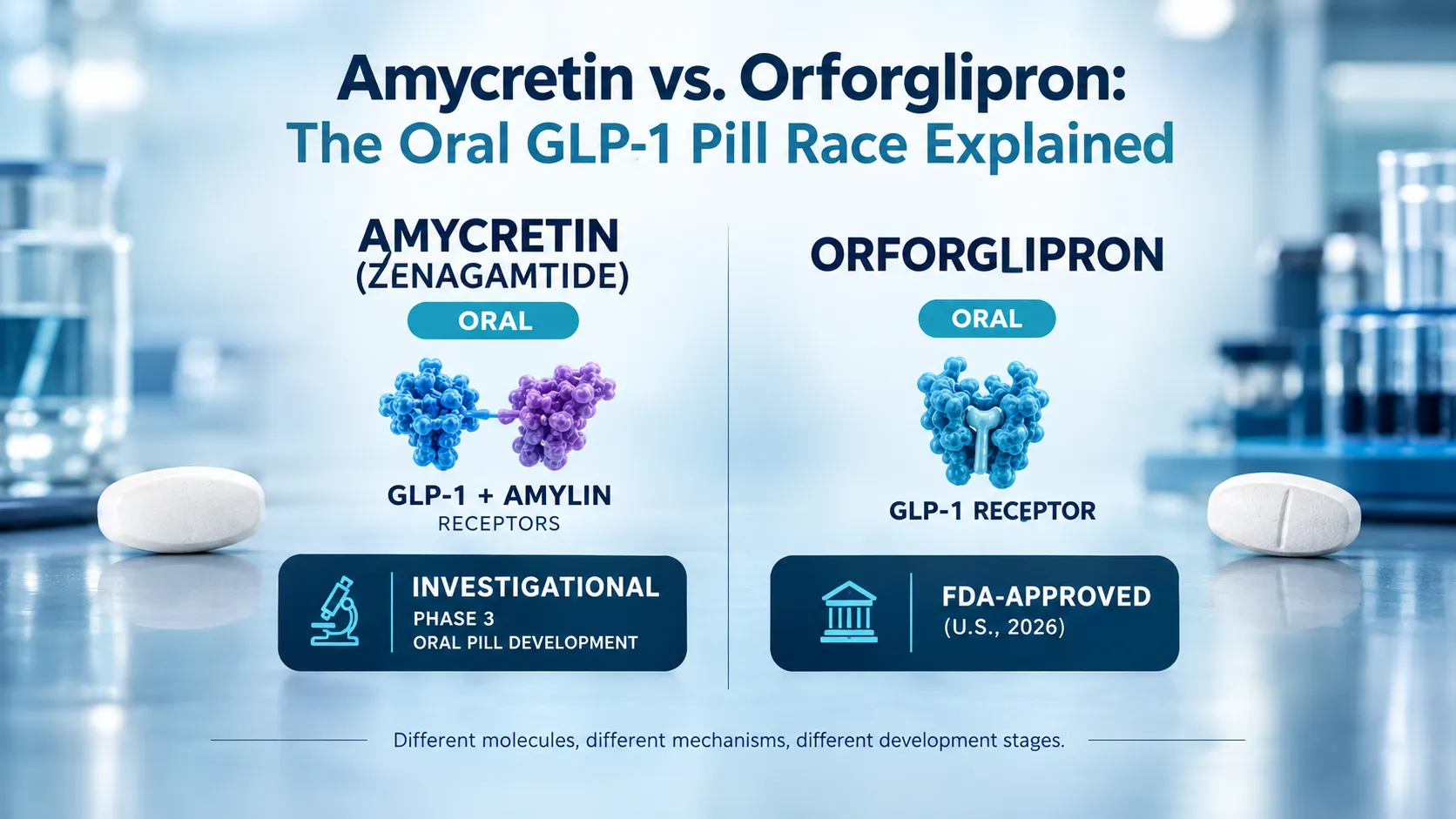
Amycretin is a peptide and orforglipron is not. How that chemistry explains the formulations, trial results, and approval status of both GLP-1 pills.
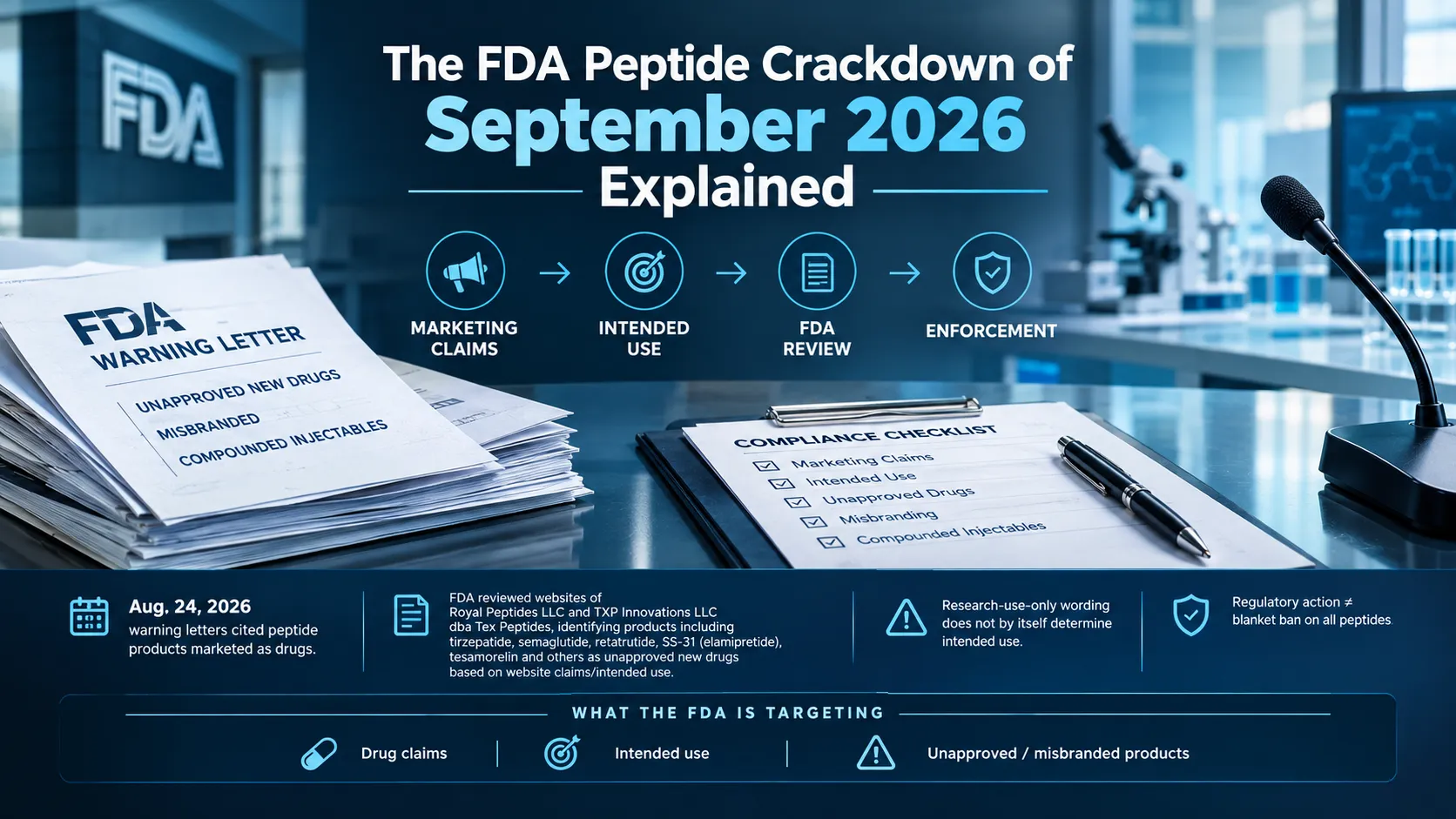
Five peptide sellers got FDA warning letters in September 2026. See who was named, why the research label failed, and the full 2026 enforcement timeline.
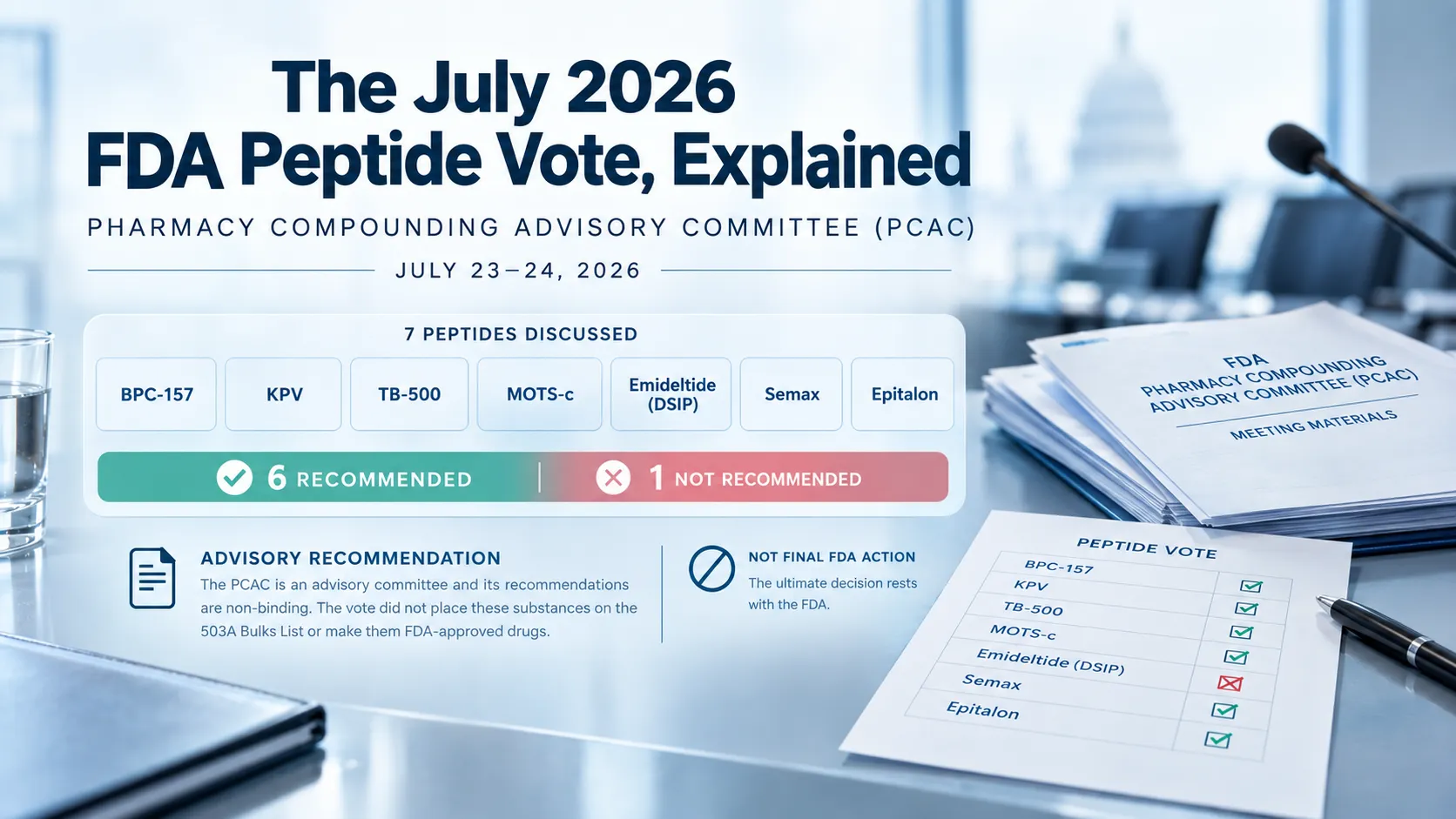
In July 2026, the FDA's advisory committee recommended 6 peptides for the 503A bulk list. None are on it yet. What the vote changed and what it didn't.